



Fiber memristors for smart textiles: materials, devices, and applications
 0
0 Abstract
Fiber memristors represent a transformative platform for next-generation wearable electronics, enabling the seamless integration of non-volatile memory and neuromorphic computing directly onto or within textile fibers. This intrinsic functionalization at the fiber level effectively overcomes the “sense-transmit-process” separation inherent in conventional wearable systems, paving the way for truly intelligent, energy-efficient, and autonomous textiles. This review provides a comprehensive overview of the development and state-of-the-art research in this emerging field. We first elucidate the fundamental device architectures and underlying resistive-switching mechanisms. Subsequently, we systematically summarize the material systems and advanced fabrication strategies employed to construct robust and weavable memristive fibers, followed by a critical analysis of their electrical, mechanical, and functional performance metrics. A dedicated section highlights the cutting-edge applications of fiber memristors, particularly in integrated sensing-memory-computing systems, neuromorphic signal processing, and adaptive human-machine interfaces. Key challenges are thoroughly discussed, along with promising future research directions. By offering a holistic perspective spanning materials, devices, and integrated systems, this review aims to provide comprehensive theoretical insights and technical guidance for the development of next-generation intelligent textiles, thereby accelerating the deep fusion of electronic functionality and textile substrates.
Keywords
INTRODUCTION
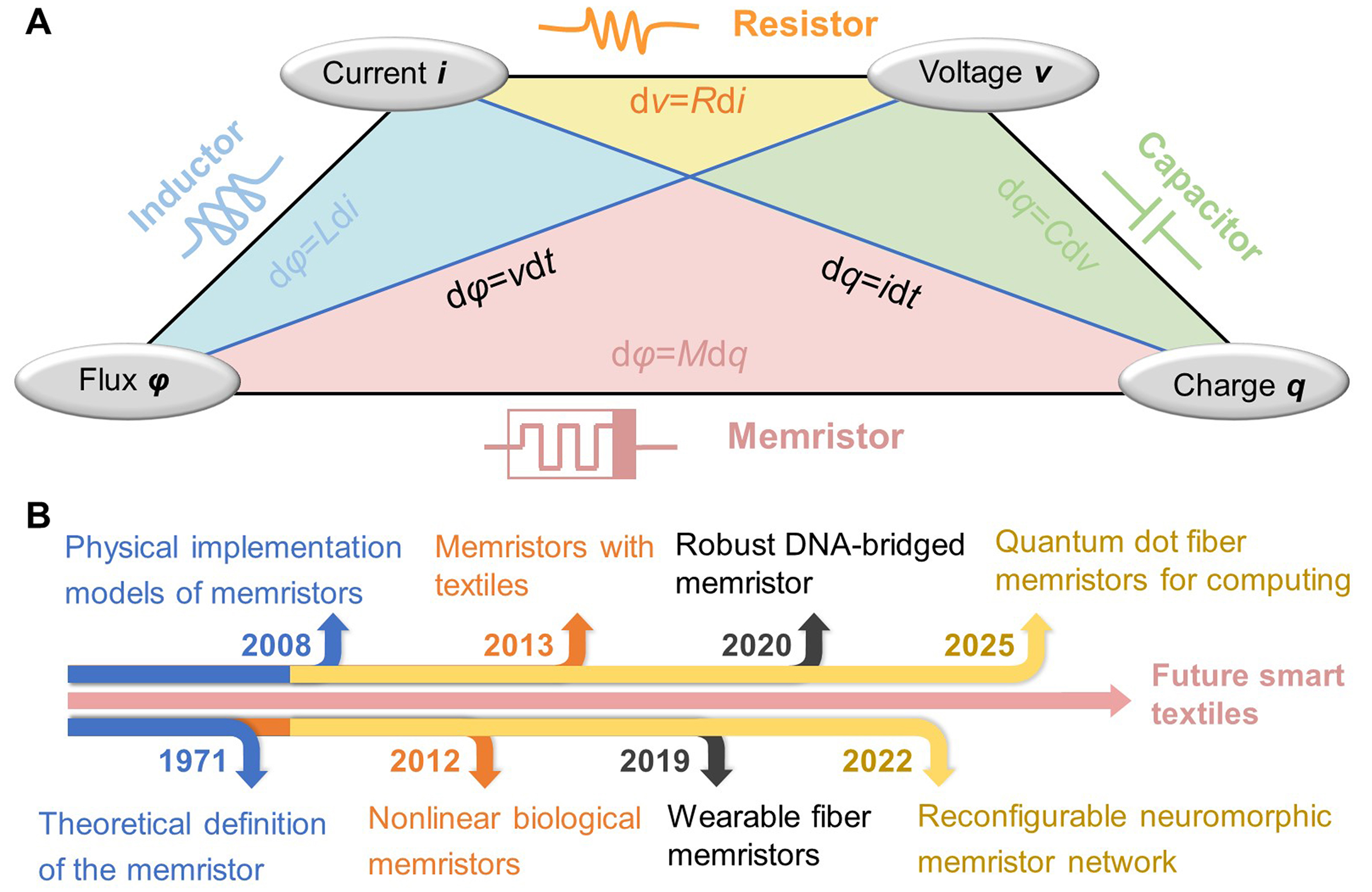
Memristors, recognized as the fourth fundamental circuit element alongside resistors, capacitors, and inductors, modulate their resistance based on the history of charge flow, granting them non-volatile memory and a synaptic-like capacity to “remember” past electrical states[1]. This unique property makes them promising not only for next-generation memory but also as artificial synapses in neuromorphic systems. They inherently align with the core requirement of “memory-computing fusion” in computing-in-memory architectures, effectively minimizing data transfer distances and significantly enhancing system energy efficiency[2]. Furthermore, their tunable conductance can directly emulate synaptic weights for efficient computation and pattern recognition[3]. Memristors, with their in-memory computing capability, provide a key solution to the bottlenecks of high power consumption and limited data processing in the traditional von Neumann architecture[4]. The memristor was first theorized in 1971 by Leon O. Chua[1]. Derived from the relationships between the four fundamental circuit variables [current (i), voltage (v), charge (q), and magnetic flux (φ)], memristor defines a functional relationship between flux and charge. The correlations among these four circuit elements and the development of fiber-based memristors are summarized in Figure 1[5-11]. The field advanced markedly with the first experimental realization of a memristor by Hewlett-Packard Laboratories in 2008, which used a Pt/TiO2/Pt stack in a crossbar configuration[5]. This spurred exploration of diverse resistive-switching materials, from inorganic oxides and chalcogenides to organic and hybrid systems. Among them, inorganic chalcogenides have emerged as a core candidate material in the field of memristors, due to their superior ionic conductivity, topological insulating properties, and tunable electronic structure[12-14]. Organic materials, in particular, have gained attention due to their chemical tunability, solution processability, and intrinsic flexibility[15].
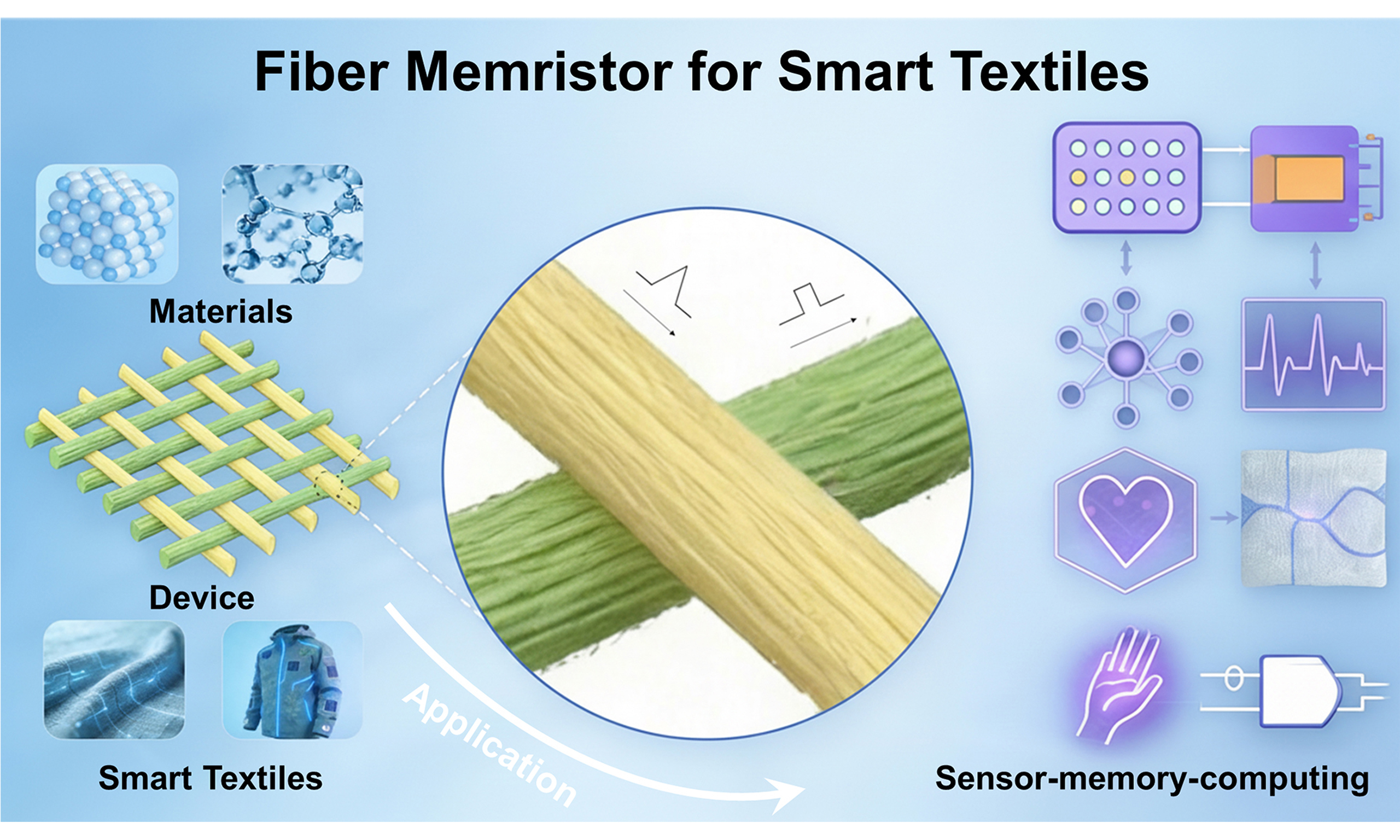
A key structural insight is that the woven, intersecting architecture of textiles naturally mirrors the crossbar arrays used in memristive circuits. A key structural insight is that the woven, intersecting architecture of textiles naturally mirrors the crossbar arrays used in memristive circuits[16,17]. This congruence has propelled the development of fiber memristors, which merge the information-processing functions of memristors with the inherent advantages of textile fibers - flexibility, lightweight, breathability, wearability, and seamless integration[18,19]. Fiber memristors are thus emerging as foundational components for truly intelligent textiles. Their development aligns with the broader shift in electronics toward flexible, integrated, and intelligent systems, meeting the core requirements of memristor-based neuromorphic chips for low power consumption and high parallelism[20]. Compared with rigid planar memristors, fiber-based devices offer superior mechanical compliance, enduring bending, stretching, and weaving while being imperceptibly embedded into fabrics[21-24]. More importantly, they enable the co-localization of sensing, memory, and computing within fibers, paving the way for distributed, adaptive, and low-power edge-intelligent systems. These capabilities open promising applications in real-time health monitoring[25], smart diagnostics[26], natural human-machine interfaces[27], and flexible neuromorphic computing[28,29].
Despite rapid progress, a systematic review covering material design, device physics, and system-level applications of fiber memristors remains lacking. This Review aims to provide a comprehensive overview. We begin with fundamental structures and switching mechanisms, then discuss material systems, fabrication strategies, and performance metrics. We highlight cutting-edge applications in neuromorphic computing and wearable technology, and finally outline key challenges and future directions to guide the transition from laboratory prototypes to practical, scalable intelligent textiles.
STRUCTURE AND OPERATION PRINCIPLES OF FIBER MEMRISTORS
Device architecture and resistive switching characteristics
The basic architecture of a fiber memristor is depicted in Figure 2A, typically consisting of a metal–insulator–metal (MIM) sandwich structure with a top electrode (TE), a resistive switching (RS) layer, and a bottom electrode (BE). Upon electrical stimulation, the device can reversibly switch between at least two distinct resistance levels. A set operation, achieved by applying a programming voltage pulse, transitions the device from a high-resistance state (HRS, OFF) to a low-resistance state (LRS, ON). Conversely, a reset operation restores the HRS, usually triggered by a voltage of opposite polarity or higher magnitude.
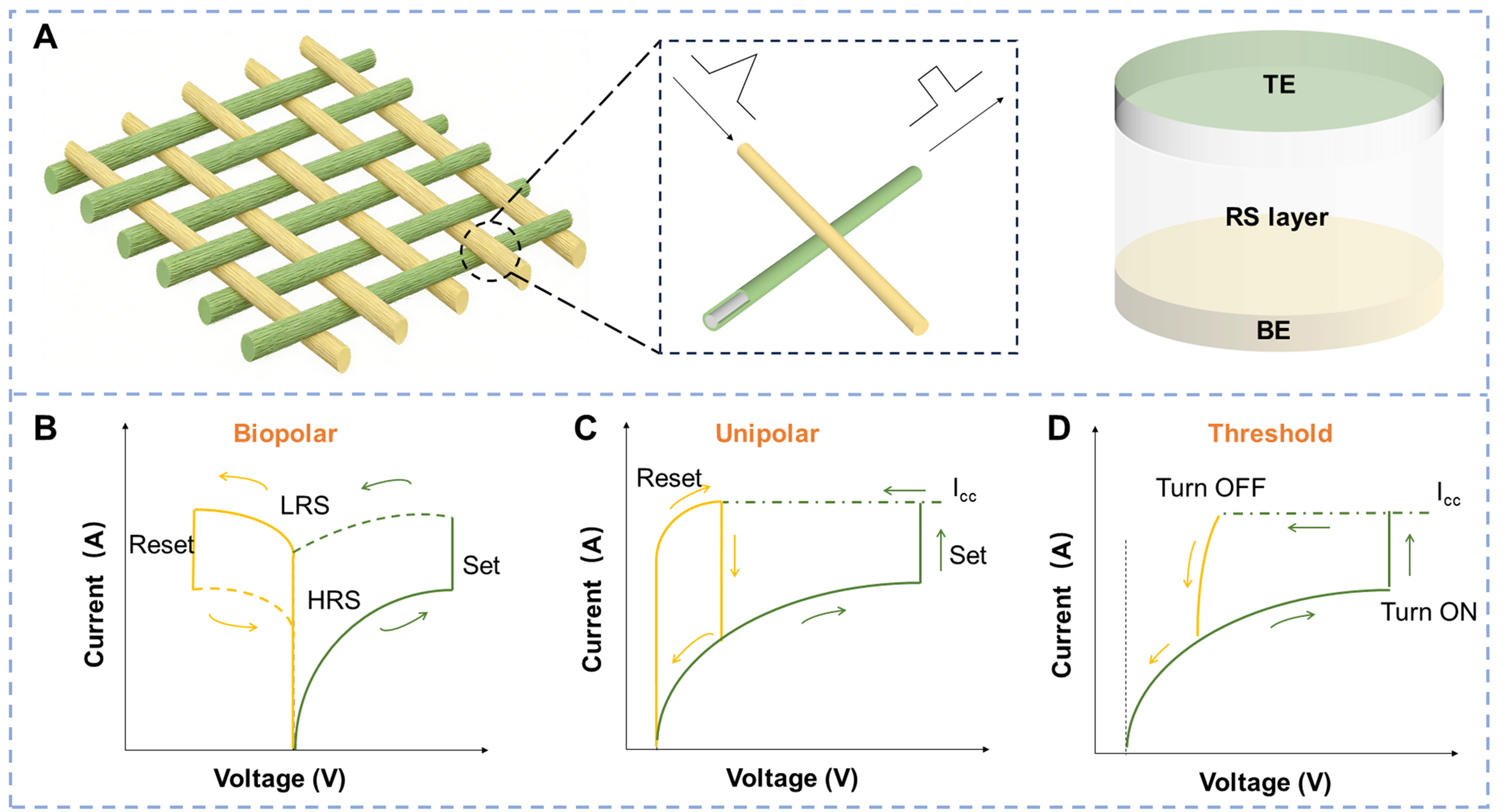
Figure 2. Memristor structure and RS behavior. (A) Structural schematic of a fiber memristor; (B) Non-volatile bipolar RS[30]; (C) Non-volatile unipolar RS[30]; (D) Volatile TS[30]. Reproduced with permission[30]. Copyright 2017, WILEY-VCH. RS: Resistive switching; TS: threshold switching; TE: top electrode; BE: bottom electrode; LRS: low-resistance state; HRS: high-resistance state.
RS characteristics are broadly classified into bipolar, unipolar, and threshold switching (TS)[30,31], as illustrated in Figure 2. In bipolar switching, set and reset require voltages of opposite polarity [Figure 2B], with underlying mechanisms such as electrochemical metallization (ECM) and valence-change mechanism (VCM)[32]. Unipolar switching uses the same voltage polarity for both operations [Figure 2C] and is often governed by thermochemical mechanisms (TCM) driven by local Joule heating. Notably, the distinction between bipolar and unipolar behavior is not rigid; under different bias conditions, a single device may exhibit both modes, often described as nonpolar switching[33-35].
TS refers to volatile behavior in which the LRS spontaneously reverts to the HRS when the applied voltage drops below a critical value [Figure 2D]. This characteristic is exploited in crossbar arrays as a selector device to suppress sneak-path currents. During electrical characterization, a compliance current (Icc) is commonly imposed to prevent excessive current and avoid permanent dielectric breakdown.
RS mechanisms of memristors
The operating mechanisms of memristors can be broadly categorized into ECM, VCM, TCM, and interface barrier modulation/charge trapping–detrapping mechanisms. Among these, ECM and VCM represent the most extensively studied and widely accepted physical origins for memristive behavior.
ECM
The ECM, illustrated in Figure 3A and B, relies on the cooperative action of an electrochemically active electrode (e.g., Ag, Cu) and an inert electrode (e.g., Pt, Au). Under a positive bias, the active electrode oxidizes, releasing mobile metal cations (Ag+, Cu2+) that migrate through the switching layer toward the inert electrode[36-38]. There, they are reduced and accumulate, forming a metallic conductive filament that bridges the electrodes and switches the device from HRS to LRS - the set process. Applying a reverse bias dissolves the filament via re-oxidation, causing the ions to migrate back and restoring the HRS in the reset process[39-41].
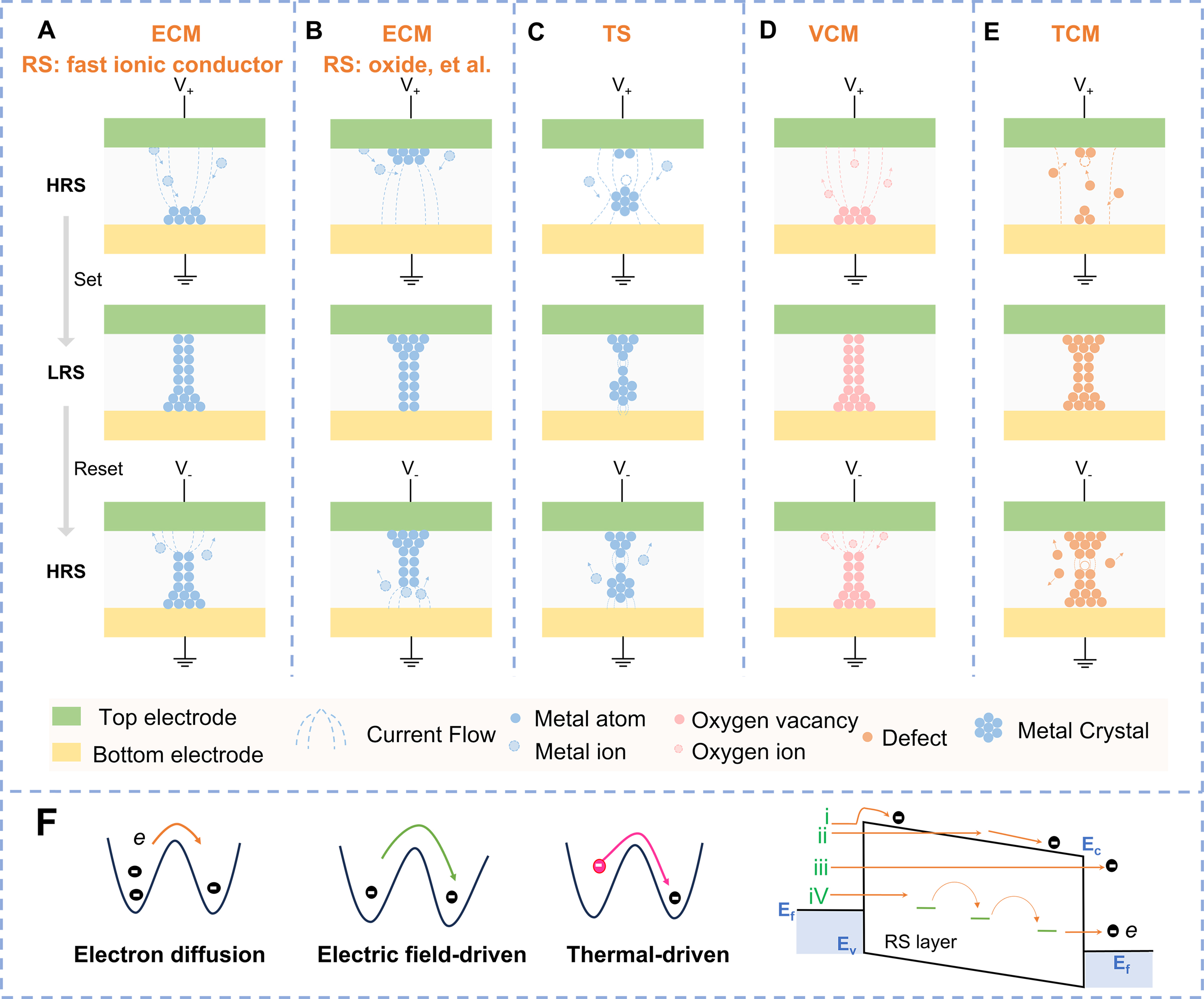
Figure 3. RS mechanisms. (A) ECM with a fast-ion conductor as the switching layer[30]; (B) ECM with a metal oxide as the switching layer[30]; (C) TS[30]; (D) VCM[30]; (E) TCM[30]; (F) Electronic transport mechanism. Reproduced with permission[30]. Copyright 2017, WILEY-VCH. RS: Resistive switching; ECM: electrochemical metallization; TS: threshold switching; VCM: valence-change mechanism; TCM: thermochemical mechanism; HRS: high-resistance state; LRS: low-resistance state.
Filament morphology and growth dynamics depend critically on the switching layer’s properties [Figure 3A and B]. In fast-ion conductors, cations move freely, leading to rapid filament formation near the cathode. In oxides, where ion mobility is lower, filaments tend to nucleate and grow from the anode side. For instance, in CuZnS-based nanoconduits with amorphous/crystalline heterostructures, Ag+ migration can be guided along defined pathways, forming dense Ag filaments near the Pt electrode and enhancing switching uniformity[42].
Beyond metals, similar field-driven formation/rupture of conductive paths occurs in some organic and carbon-based materials. In polymer-based devices, localized Joule heating can pyrolyze the material to form carbon filaments. Their rupture often requires additional thermal energy, typically resulting in a higher reset than set voltage[43]. Although the materials differ, the underlying physics remains the field-controlled creation and destruction of conductive channels. Unstable filaments that cannot be sustained below a certain current lead to volatile TS behavior [Figure 3C][44].
VCM
The VCM occurs predominantly in anion-migrating materials, especially transition metal oxides (e.g., TiO2, HfOx) and perovskites (e.g., SrTiO3)[37,45,46]. Here, applied fields drive the migration of oxygen ions, creating and redistributing oxygen vacancies within the switching layer. These positively charged oxygen vacancies can cluster to form localized conductive channels, switching the device to LRS during set process[47] [Figure 3D]. A reverse reset voltage drives oxygen ions back to recombine with vacancies, dissolving the channel and restoring HRS. This mechanism does not require metal ion injection from electrodes; the generally higher mobility of oxygen vacancies compared to metal cations enables faster switching[31,48-50].
Analogous ion-migration behavior is observed in halide perovskites, where bromide/iodide ions migrate under bias to modulate interfacial barriers and conduction, enabling stable memristive responses[47]. Furthermore, oxygen vacancies accumulation at the electrode interface can alter the local Schottky barrier height, inducing RS - an effect related to the interfacial modulation mechanisms discussed below.
TCM
In TCM, RS is driven primarily by Joule heating and is largely independent of voltage polarity, leading to unipolar/nonpolar behavior [Figure 3E]. Initially in HRS, current injection causes localized Joule heating that triggers a thermochemical reaction (e.g., thermal reduction or decomposition) in the switching layer, forming a conductive filament and setting the device to LRS. Subsequently, a voltage of the same polarity (without current compliance) generates intense heat within the filament, promoting atomic diffusion away from its narrowest region and leading to filament rupture via a self-accelerating thermal process[51].
Interface barrier modulation and charge trapping–detrapping
In interface barrier modulation, switching arises from changes in the Schottky barrier height at the electrode/switching-layer interface. Under bias, the trapping or release of charges (e.g., oxygen vacancies) modulates the depletion width and barrier height, switching between HRS and LRS[52]. Alternatively, charge trapping and detrapping at defect states within the switching layer can govern conduction. As illustrated in Figure 3F, multiple transport processes may coexist[53], including: (i) Schottky emission over the interfacial barrier; (ii) Fowler–Nordheim tunneling under high fields; (iii) direct tunneling through thin layers; and (iv) various trap-assisted processes such as Poole–Frenkel emission and trap-to-trap hopping. Electron-dominated switching is often described by models such as space-charge-limited current (SCLC, where I∝V at low bias and I∝V2 at higher bias)[54], Poole–Frenkel emission (field-assisted thermal ionization from traps), and the Simmons–Verderber model (originally proposed for negative differential resistance in Au/SiO2/Al structures)[55].
The four primary RS mechanisms are summarized in Table 1 and their current implementations in fiber-based memristors are also listed.
Comparison of primary RS mechanisms in memristors
| Mechanism | Mobile species | Working principle | Key features | Advantages | Limitations | Fiber-based device |
| ECM | Metal cations (e.g., Ag+, Cu2+) | Field-driven oxidation of active electrode, migration and reduction of metal ions to form/dissolve metallic filaments | • Bipolar switching • Abrupt set/reset, strong filamentary behavior | • Low operating voltage • High ON/OFF ratio • Good scalability | • Filament instability • Electrode material constraints • Sensitivity to humidity and temperature | • Ag/CuZnS/Pt[42] • Ag/TCPP@PMMA/Pt1[56] • Al/MAPbl3/Al[57] • Al/PDA/Al[58] • Cu/BiOI/TiO2/Carbon[59] |
| VCM | Anion-related defects (e.g., oxygen vacancies) | Electric-field-induced migration and redistribution of oxygen vacancies forming/dissolving conductive paths | • Bipolar switching • Filamentary or interfacial-assisted conduction | • Fast switching speed • High endurance • Good CMOS compatibility | • High forming voltage often required • Variability due to stochastic vacancy dynamics | Carbon/Al2O3/Al[60] |
| TCM | Atoms in filament core (thermally activated) | Joule heating induces local chemical reduction or decomposition to form filaments; excessive heating ruptures filaments | • Unipolar/non-polar switching • Switching polarity-independent • Reset typically occurs at higher current/voltage than set due to thermal dissolution | • Simple device structure • Forming-free in some cases | • Higher reset power/current required • Limited endurance due to thermal stress | Al/pEGDMA/Al[43] |
| Interface barrier modulation/charge trapping-detrapping | Electrons, trapped charges, interfacial defects | Bias-induced trapping/detrapping or defect accumulation modulates Schottky barrier height and carrier transport | • Bipolar or unipolar switching • Often involves multiple conduction modes (e.g., SCLC, tunneling, Poole-Frenkel) • No permanent CF formation | • Multilevel capability • Can mimic synaptic functions (e.g., conductance modulation) | • Usually lower ON/OFF ratio • Interface sensitivity | - |
MATERIAL SYSTEMS FOR FIBER-BASED MEMRISTORS
Early smart electronic textiles typically involved attaching or stacking discrete electronic modules onto fabric surfaces. This approach not only compromises essential textile properties (such as softness, conformity, and wearing comfort) but also limits system-level processing due to poor interconnectivity and synergy among modules. Moreover, conventional rigid planar devices with complex wiring degrade mechanically and lose breathability on deformable textiles, restricting their wearable utility[61].
To achieve deeper electronic-textile integration, research has shifted toward intrinsic fiber-level strategies, primarily[19]: (i) embedding miniaturized components within fabrics; and (ii) directly weaving electronically functional fibers into textiles. The latter method, fabricating sensing, memory, or computing units directly on fibers and integrating them via textile techniques, offers a promising route to flexible, breathable, and large-area electronic systems. In this context, fiber-based memristors have emerged as key components for memory and neuromorphic functions. Their performance relies critically on two material elements: the RS layer for reversible resistance modulation, and the electrode materials for charge injection/collection. Correspondingly, the material systems fall into three broad categories: flexible and processable organic functional materials, conductive and robust carbon-based materials, and metallic nanowires suited for high-density integration.
RS layer in fiber memristors
The performance of a memristor is fundamentally governed by the physicochemical properties of its RS layer, including ion migration kinetics, interfacial barriers, and local electric field distribution, which collectively determine the formation, stability, and rupture of conductive filaments. Research in this area focuses on three primary material categories: inorganic materials, organic polymers, and their composites.
Inorganic materials, such as metal oxides[62], perovskites[63,64], and two-dimensional (2D) materials[65-67], typically deliver more stable, faster, and more robust RS. However, their inherent rigidity often limits flexibility, a key requirement for wearable integration[68]. Organic polymers, particularly those derived from natural sources, offer compelling advantages for wearable applications, including biodegradability, skin compatibility, and excellent flexibility. Natural fibers composed of cellulose or proteins[69,70] serve as promising substrates. For instance, electrospun cellulose fibers have been widely used to construct flexible memristive systems[71,72]. Bae et al. developed a memristor using cotton yarn coated with polydopamine (PDA) as the RS layer[58]. PDA’s strong interfacial adhesion and electrochemical activity enable direct control over filament dynamics [Figure 4A]. In another design[43], the same group used a solvent-free polymer, poly(ethylene glycol) dimethacrylate (pEGDMA), as the RS layer. Its stable, inert structure forms a tight core–shell coating on Al-coated cotton. Under an applied voltage, localized Joule heating triggers thermal decomposition of pEGDMA, leading to conductive filament formation [Figure 4B]. Overall, organic polymers are valued for their flexibility, simple processing, and low cost[73,74], allowing operation at ultra-low voltages under mechanical deformation. A remaining challenge, however, is improving the long-term stability and reproducibility of their switching characteristics[75].
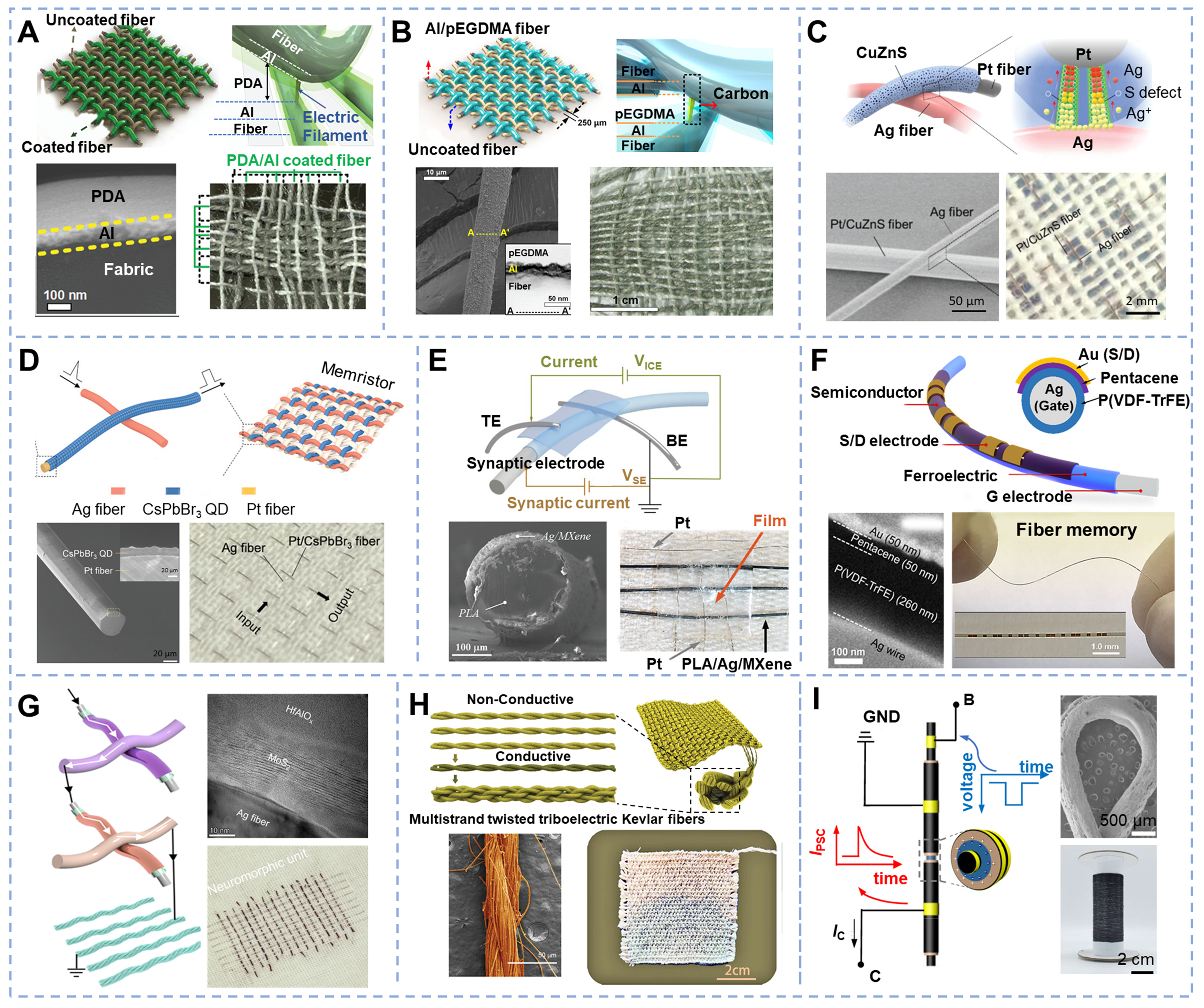
Figure 4. Material platforms for fiber memristors. (A) PDA/Al/cotton[58]; (B) pEGDMA/Al/cotton[43]; (C) Pt/CuZnS/Ag[42]; (D) Pt/CsPbBr3/Ag[61]; (E) PLA/Ag/MXene/Pt[77]; (F) Au/P(VDF-TrFE)/Ag[79]; (G) Ag/MoS2/HfAlOx/CNT[10]; (H) Non-conductive Kevlar/Conductive Kevlar fibers[81]; (i) CNT/SEBS-IM/SEBS-SN/CNT ionic fiber[83]. Reproduced with permission from Ref.[58]. Copyright 2019, WILEY-VCH. Reproduced with permission from Ref.[43]. Copyright 2017, American Chemical Society. Reproduced with permission from Ref.[42]. Copyright 2023, WILEY-VCH. Reproduced with permission from Ref.[61]. Copyright 2022, WILEY-VCH. Reproduced with permission from Ref.[77]. Copyright 2024, WILEY-VCH. Reproduced with permission from Ref.[79]. Copyright 2019, American Chemical Society. Reproduced from Ref.[10] under the CC BY license. Reproduced from Ref.[81] under the CC BY license. Reproduced from Ref.[83] under the CC BY license. PDA: Polydopamine; pEGDMA: poly(ethylene glycol) dimethacrylate; PLA: polylactic acid; P(VDF-TrFE): poly(vinylidene fluoride-trifluoroethylene); CNT: carbon nanotube; SEBS-IM: poly(styrene-b-(ethylene-co-butylene)-b-styrene grafting 3-hexylimidazolium groups; SEBS-SN: poly(styrene-b-(ethylene-co-butylene)-b-styrene grafting sodium sulfonate groups; QD: quantum dot; TE: top electrode; BE: bottom electrode; GND: ground.
Electrode materials for fiber memristors
The interwoven, crossbar-like structure of fiber memristors readily accommodates metallic fibers as electrodes. Commonly used metals include Al, Ag, Pt, Au, and Cu fibers. Al fibers are particularly valued for their low density (~2.7 g·cm-3), good ductility, and sufficient conductivity, making them a promising lightweight electrode material that enhances wearing comfort without compromising signal reliability under dynamic conditions[76]. Noble metal fibers such as Ag and Pt offer exceptional conductivity and chemical stability for high-performance applications. For instance, Liu et al. demonstrated a Pt/CuZnS/Ag fiber memristor with high ion mobility and excellent stability [Figure 4C][42]. In another study, Liu et al. used electric-field-assisted assembly to deposit CsPbBr3 quantum dots on a Pt fiber, constructing a device with an Ag fiber that achieved an ultralow set voltage (0.16 V), a high ON/OFF ratio (> 105), and multi-level storage [Figure 4D][61].
To improve wearability, metal coatings can be applied to polymeric fibers. Ren et al. deposited Ag onto biocompatible polylactic acid (PLA) fibers[77], while the semicrystalline structure of PLA provides a balance of strength and flexibility[78]. In this design, the Ag layer conducts charge while an electrophoretically deposited MXene (Ti3C2Tx) nanosheet layer enables RS, yielding a device with 17 nW power consumption and a 23 ms response time [Figure 4E]. Kang et al. used a 100 µm-diameter Ag fiber as the BE and an Au-coated TE with a ferroelectric poly(vinylidene fluoride-trifluoroethylene) [P(VDF-TrFE)] switching layer[79]. This device operates below 5 V with a minimum power of 3 × 10⁴ pW, offers a tunable memory window, and exhibits piezoelectrically modulated switching under strain [Figure 4F].
Carbon-based fibers, such as carbon nanotube (CNT) fibers, constitute another major electrode class, combining high conductivity, mechanical strength, and intrinsic flexibility[80]. Wang et al. fabricated an Ag/MoS2/HfAlOx/CNT fiber memristor where the CNT fiber serves as a weavable BE[10]. The device can be switched between non-volatile synaptic and volatile neuronal modes, supporting multi-level conductance states with long retention [Figure 4G]. The fiber double-twist structure can serve as a typical structure for fiber memristors [Figure 4H][81]. Chen et al. developed a CNT-fiber-based artificial optoelectronic synapse featuring a double-twisted structure of TiO2-x nanowires and MoS2 nanosheets, which responds to both electrical and optical (365 nm) stimuli via oxygen-vacancy migration and photogenerated carrier separation[82]. This artificial optoelectronic synaptic fiber exhibits helical deformation, which densifies the contact points of CNTs while altering the contact configuration between TiO2-x and MoS2 as well as the distribution of oxygen vacancies. Moderate twisting optimizes the uniformity of the interface barrier. Differences in the elastic modulus between the fibers generate shear forces, driving relative interfacial slippage, and minor slippage under small-angle bending further improves contact uniformity. Xing et al. constructed an ionic fiber memristor by coating a CNT fiber core with polycations [SEBS-IM, poly(styrene-b-(ethylene-co-butylene)-b-styrene (SEBS) grafting 3-hexylimidazolium groups] and polyanions (SEBS-SN, SEBS grafting sodium sulfonate groups) layers[83]. This device performs Boolean logic operations and exhibits synaptic behaviors such as paired-pulse facilitation (PPF) and short-term potentiation (STP) [Figure 4I].
The material systems for above fiber-based memristors are summarized in Table 2. A notable distinction between organic and inorganic switching layers lies in the occurrence of nonlinear conductance drift, which is frequently observed in polymeric systems. This phenomenon is primarily attributed to the structural relaxation of polymer chains, thermal instability of conductive filaments, and ill-defined charge trapping/de-trapping dynamics at organic–inorganic interfaces. In contrast, inorganic materials typically exhibit more stable and linear conductance modulation. Correspondingly, the failure mechanisms also differ substantially between the two material classes. In inorganic ECM/VCM systems, device failure often results from filament dissolution or interfacial delamination under mechanical stress. In contrast, organic/polymer-based devices tend to degrade progressively under sustained electrical bias, mainly due to gradual compositional changes or slow dielectric breakdown. Progress toward scalable fabrication of fiber-based memristors has centered on mitigating the stochastic nature of filament formation during RS and reducing device-to-device variability. Effective strategies include the use of hybrid structures or heterogeneous interfaces to integrate multiple switching mechanisms, as well as array-level compensation through write-verify algorithms or hardware-software co-design. These approaches, already validated in textile-integrated prototypes, represent viable pathways to enhanced uniformity and manufacturability.
Material systems for fiber-based memristors
| Component | Materials category | Representative examples | Advantages | Limitations | Suitability for fiber/textile integration |
| RS layer | Inorganic materials[61-67] | • Metal oxides (TiO2, HfAlOx, CuSnO, HfOx) • Perovskites (CsPbBr3) • 2D materials (MoS2, MXenes) | Fast switching, high endurance, good retention, stable electrical characteristic | Intrinsic rigidity, higher processing temperature, limited stretchability | ++ Often require thin-film coatings or hybrid structures |
| Natural polymers[58,69-72] | Cellulose, protein fibers, PDA | Renewable, biodegradable, skin-friendly, intrinsically fibrous | Moisture sensitivity, limited electrical stability | ++++ Directly compatible with textile processing | |
| Organic polymers[43,79] | pEGDMA, P(VDF-TrFE) | Excellent flexibility, low-cost processing, biocompatibility, low-voltage operation | Variability, limited endurance, retention instability under long-term cycling | +++ Ideal for wearable, breathable, and deformable textiles | |
| Composites[59] | • Organic/inorganic hybrids • Multilayer heterostructures (BiOI/TiO2, HfO2/Ta2O5) | Improved uniformity, reduced variability, enhanced endurance | Increased fabrication complexity | +++ Balance between performance and flexibility | |
| Electrode layer | Metal fibers[42,61,76] | Active metals (Ag, Cu)/inert metals (Pt, Au, Al) | High conductivity, well-defined interfaces, mature processing | Weight, potential fatigue, reduced breathability | +++ Easily woven but comfort depends on density |
| Metal-coated polymer[77-79] | Ag on PLA, Au coating | Lightweight, flexible, good conductivity | Coating adhesion and durability issues | ++++ Optimized for wearable comfort | |
| Carbon-based fibers[10,82] | • CNT fibers • Graphene fibers | High conductivity, mechanical robustness, chemical stability | Contact resistance variability, fabrication cost | ++++ Intrinsically flexible and weavable | |
| Ionic/hybrid electrodes[83] | Polyelectrolyte coatings (SEBS-IM, SEBS-SN) | Low power, analog switching, bio-inspired operation | Lower speed, limited current density | +++ Soft and mechanically matched to textiles |
FABRICATION APPROACHES FOR FIBER MEMRISTORS
Fiber memristors are pivotal for enabling in-fabric information storage and in-situ neuromorphic computing. A central fabrication challenge is the deposition of thin, uniform, and mechanically compliant functional layers onto curved fiber substrates. Techniques have evolved from basic dip-coating and sputtering toward more precise and controllable methods, such as electric-field-assisted deposition, electroless plating, hydrothermal synthesis, and molecular self-assembly, providing a robust foundation for high-performance devices.
Solution-based processing offers advantages of low cost, simplicity, and compatibility with conventional textile dyeing and finishing lines, making it attractive for scalable production. For example, Bae et al. developed a vacuum-free, room-temperature two-step dip-coating process to sequentially deposit an Al shell and a PDA switching layer onto cotton yarn, producing a textile-compatible memristor [Figure 5A][58]. This polydimethylsiloxane (PDMS) encapsulation strategy exhibits excellent tensile and bending toughness, closely matching the mechanical deformation characteristics of the cotton fabric substrate. Moreover, it effectively blocks the ingress of moisture and oxygen from the air, preventing oxidation or moisture-induced degradation of the PDA resistive-switching layer and the Al electrode. Liu et al. used chemical bath deposition to grow CuZnS with abundant sulfur vacancies on Pt-coated fibers, creating vertically aligned nanochannels that guide Ag+ migration and suppress random filament growth [Figure 5B][42].The seed-assisted hydrothermal method can promote the coating and growth of nanoparticles on target substrates[82], and is also applicable to the fabrication of fiber-based memristors [Figure 5C][84].
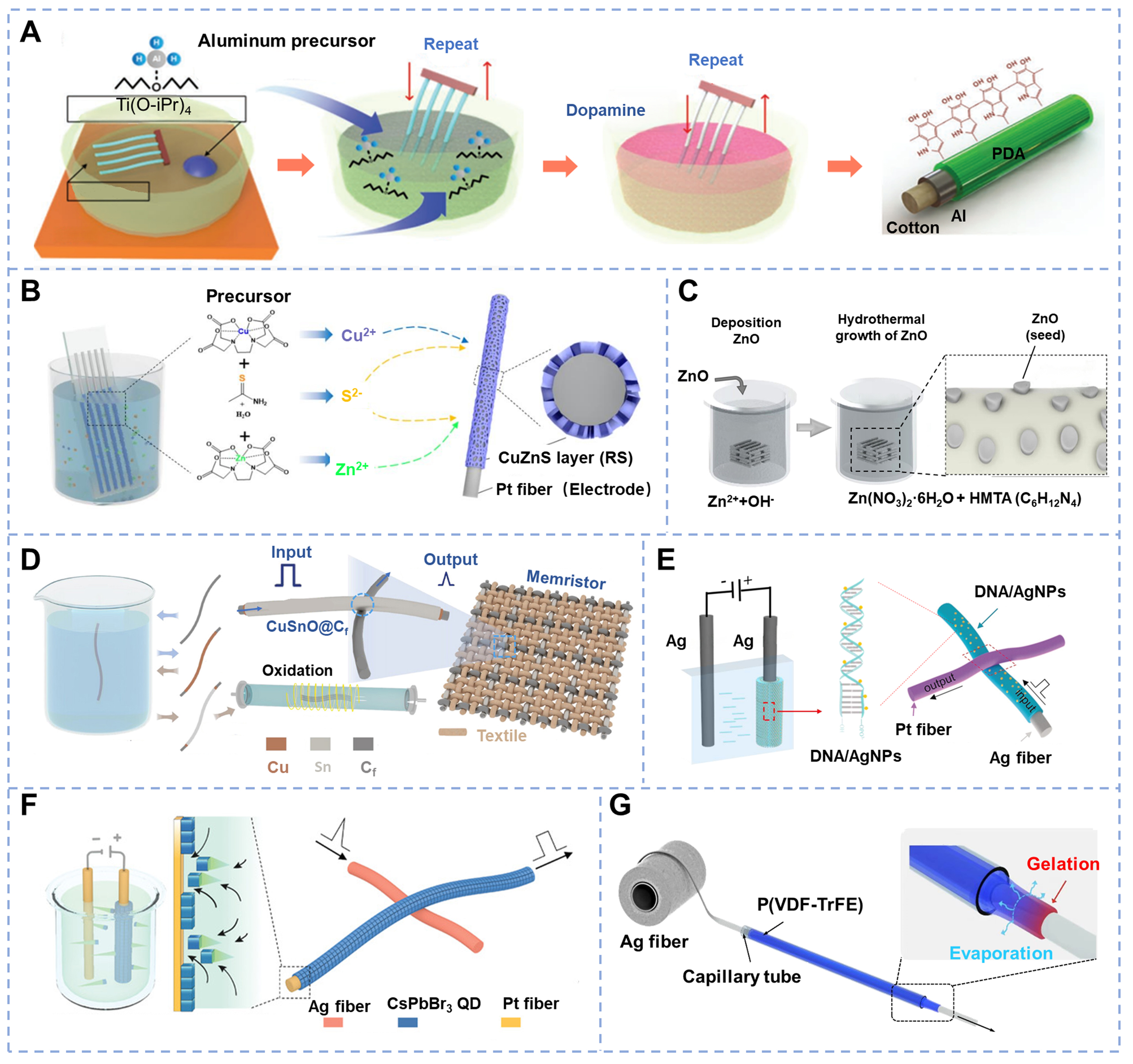
Figure 5. Fabrication strategies for fiber-based memristors. (A) Two-step solution dip-coating[58]; (B) Chemical bath deposition[42]; (C) Seed-assisted hydrothermal growth[84]; (D) Two-stage selective electroless plating[85]; (E) Electrophoretic deposition[9]; (F) Electric-field-assisted assembly[61]; (G) Capillary tube-assisted coating[79]. Reproduced with permission from Ref.[58]. Copyright 2019, WILEY-VCH. Reproduced with permission from Ref.[42]. Copyright 2023, WILEY-VCH. Reproduced with permission from Ref.[84]. Copyright 2024, American Chemical Society. Reproduced with permission from Ref.[85]. Copyright 2025, WILEY-VCH. Reproduced with permission from Ref.[9]. Copyright 2020, WILEY-VCH. Reproduced with permission from Ref.[61]. Copyright 2022, WILEY-VCH. Reproduced with permission from Ref.[79]. Copyright 2019, American Chemical Society. PDA: Polydopamine; RS: resistive switching; HMTA: hexamethylenetetramine; QD: quantum dot; P(VDF-TrFE): poly(vinylidene fluoride-trifluoroethylene).
Electric-field-assisted and self-assembly techniques allow precise customization and functionalization, accelerating the transition from lab prototypes to wearable systems. Huang et al. developed a two-step selective electroless plating and thermal oxidation process to fabricate a bifacial amorphous CuSnO layer on carbon fibers - a vacuum-free, low-cost route compatible with complex curved surfaces[85]. The two-stage selective electroless plating offers a viable strategy for improving array uniformity to some extent [Figure 5D]. Xu et al. used electrophoretic deposition to co-assemble DNA molecules and Ag nanoparticles into a continuous nanomembrane on flexible fiber electrodes, where DNA helices serve as ion channels to bridge Ag and form conductive filaments [Figure 5E][9]. Liu et al. reported a high-performance textile memristor based on Pt/CsPbBr3 fibers, in which a uniform CsPbBr3 perovskite layer was deposited via electric-field-assisted assembly [Figure 5F][61]. However, challenges such as nanoscale channel-size variations or inhomogeneous electric-field distribution during scaling remain. Kang et al. fabricated low-voltage organic ferroelectric transistor memories by capillary-assisted continuous coating of P(VDF-TrFE) nanocrystalline films onto metal microwires[79]. This method achieves a high single-fiber yield with minimal material waste, making it suitable for scalable industrial production [Figure 5G].
Solution-based fabrication methods for fiber memristors, such as inkjet printing and dip-coating, offer low cost and high prototype yields. However, they suffer from limited throughput and poor uniformity, primarily due to inconsistent solvent evaporation across large batches. In contrast, vapor-phase techniques (CVD and ALD) deliver excellent thickness control and high array yields, but come at higher cost and exhibit limited compatibility with flexible fiber substrates. Roll-to-roll processing shows strong potential for scalable production of wearable textiles. It has enabled low-temperature deposition of halide perovskite fibers on polyethylene terephthalate (PET) or cotton substrates with promising yields, although challenges in adhesion and defect control still increase mitigation costs. Overall, fiber memristors substantially reduce material costs compared with rigid silicon-based devices, yet achieving scalable, uniform mass production will likely require hybrid printing approaches that combine the advantages of multiple techniques.
PERFORMANCE EVALUATION OF FIBER MEMRISTORS
The performance of fiber-based memristors is assessed through a set of interconnected electrical and mechanical metrics, each critical for their operation in practical wearable systems. Key electrical parameters include the set and reset voltages [Figure 6A], which directly dictate the energy consumption per switching event - lower operating voltages generally lead to reduced power dissipation[86]. Equally important is the HRS/LRS ratio [Figure 6B]. A large ON/OFF ratio enhances read/write reliability, improves state distinguishability, lowers error rates, and is fundamental for stable signal recognition and accurate data storage. Furthermore, the ability to achieve and sustain multiple, discrete resistance levels [Figure 6C] enables high-density data storage, supports sophisticated neuromorphic computing paradigms such as weight tuning in synapses, and facilitates reconfigurable logic circuits, underscoring its significance for both research and applications.
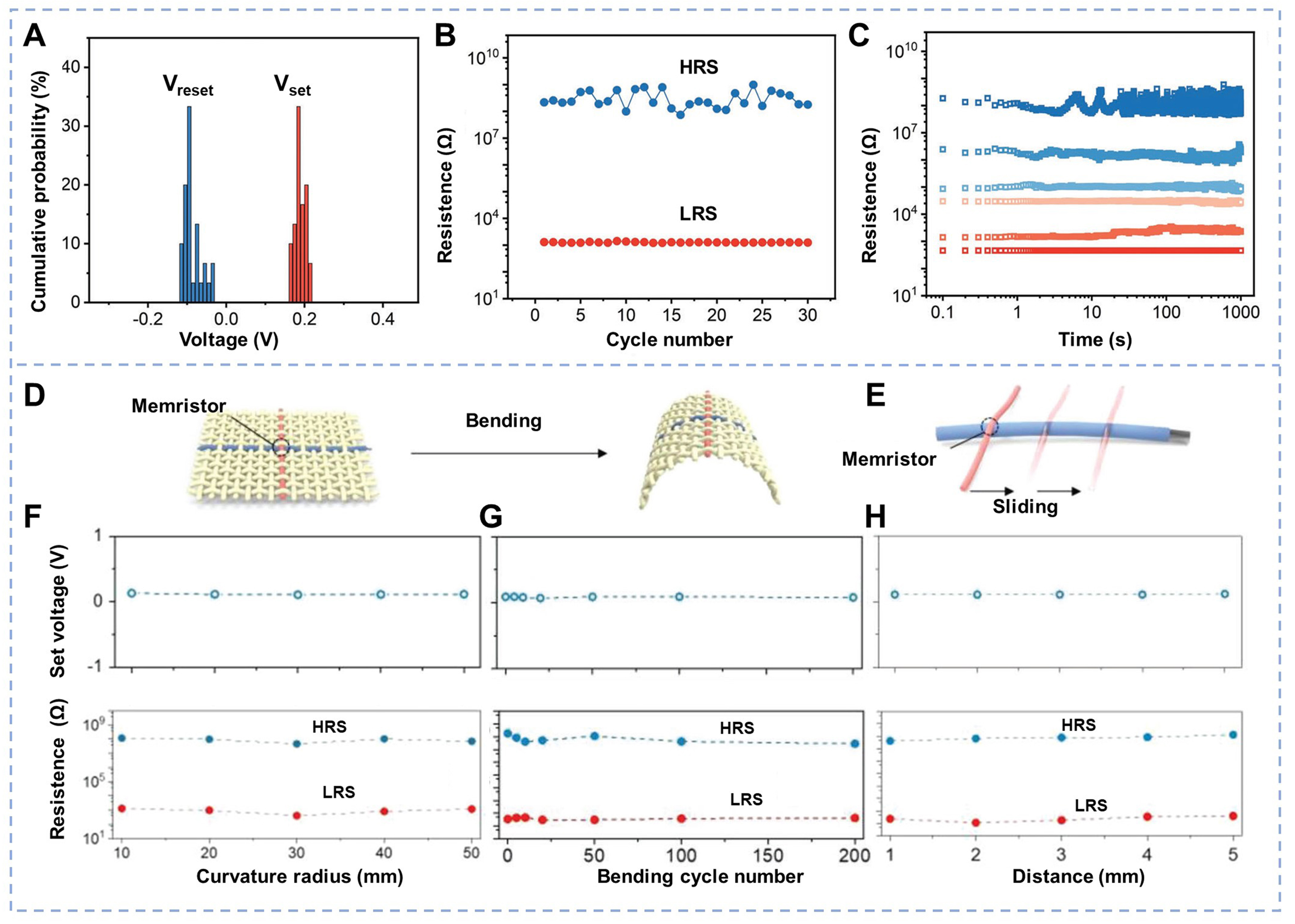
Figure 6. Performance parameters of fiber memristors. (A) Distribution of set and reset voltages for an Ag/SiO2/Pt fiber memristor[86]; (B) HRS and LRS resistance values over multiple switching cycles[86]; (C) Retention times at different resistance states for the nanofiber memristor[86]; (D) Schematic of a bendable and (E) slidable Ag/CuZnS/Pt fiber memristor unit[42]; (F-H) Variations in set voltage and resistance state with bending curvature radius, bending cycles and sliding distance of the fiber electrode[42]. Reproduced with permission from Ref.[86]. Copyright 2025, WILEY-VCH. Reproduced with permission from Ref.[42]. Copyright 2023, WILEY-VCH. HRS: High-resistance state; LRS: low-resistance state.
As intrinsically flexible devices, the mechanical reliability of fiber memristors is paramount. Parameters like the minimum bending radius and cyclic bending endurance [Figure 6D] directly determine their stability and functional longevity when integrated into textiles that undergo routine deformation[42]. Systematic characterization under bending stress is therefore essential to qualify them for wearable use. A distinct challenge arising from their textile morphology is interfacial slippage between fibers under stress or strain [Figure 6E]. Unlike rigid planar memristors, this micro-scale movement can alter contact geometry and pressure, leading to unwanted resistance fluctuations and degradation of switching performance over time. Investigating the influence of slippage on resistance states and switching ratios is thus crucial for ensuring operational reliability in dynamic real-world environments. A typical performance evaluation of the fiber memristor includes the dependence of set voltage and resistance state on bending curvature radius, bending cycles, and sliding distance of the fiber electrode, as shown in Figure 6F-H.
A comprehensive summary of the reported performance for various fiber-based memristors is provided in Table 3, facilitating a comparative overview of current achievements and remaining challenges.
Reported performance for fiber-based memristors
| TE/BE | RS | VSet/VReset | Power consumption | ON/OFF ratio | Retention | Bending | Fiber radii | Washability | Ref. | ||
| Cycles | Time | Cycles | Min. radii | ||||||||
| Pt/Ag | DNA/AgNPs | -0.5 V/0.7 V | 100 pW | ~106 | > 500 | 105 s | > 2,000 | - | 50 μm | - | [79] |
| Pt/Ag | CuZnS | 0.089 V/- | 0.1 nW | ~106 | > 100 | 4 × 10⁴ s | > 200 | 0.1 mm | 10-25 μm | - | [42] |
| Ag/Pt | PEDOT:PSS | 0.02 V/- | - | ~106 | > 200 | 500 μs | > 200 | - | - | - | [87] |
| Ag/Pt | TCPP@PMMA | 80 mV/- | 0.39 nW | 4 × 10³ | 1,000 | - | > 1,000 | 5 mm | - | - | [56] |
| Ag/Pt | SiO2 | 0.18 V/-0.08 V | - | ~105 | 1,000 | 104 s | - | - | 150 nm | - | [86] |
| Al/Al | MAPbl3 | -0.47 V/1.66 V | - | ~106 | > 500 | 104 s | - | - | 100 μm | - | [57] |
| Al/Al | PDA | 1.3 V/-1.3 V | - | - | 800 | 7 × 10⁶ s | - | - | - | √ | [58] |
| Al/Al | pEGDMA | -1.5 V/1.5 V | - | ~102 | 4,000 | 1.5 × 10⁷ s | - | 3 mm | - | √ | [43] |
| Carbon/Al | Al2O3 | -2 V/2 V | 2 mW | ~102 | 1,000 | 104 s | - | 5 mm | - | √ | [60] |
| Cu/Carbon | BiOI/TiO2 | 0.78 V/- | - | ~105 | - | 104 s | - | - | - | - | [59] |
| Cu/Carbon | Ba0.6Sr0.4TiO3 | -1.5 V/1.5 V | - | ~106 | 1,000 | 787 s | > 3,000 | - | 3.5 μm | - | [88] |
| Cu/Carbon | CuSnOx | -0.070 V/0.342 V | 34.5 pW | ~5 × 10⁴ | 100 | 104 s | > 1,000 | 10 mm | - | √ | [85] |
| Carbon/Carbon | TiO2 nanorods | 1.45 V/- | - | ~105 | 1,500 | - | - | - | - | - | [8] |
| Carbon/Carbon | CH3NH3PbI3/Au nanoparticles | 0.025 V/- | - | ~107 | 200 | - | - | - | - | - | [89] |
Studies at micro/nano scales have demonstrated that under various mechanical stresses, particularly at small bending radii (for example, 0.1 mm), fiber memristors often show no significant cracking, peeling, or delamination[42,66]. The interfacial barriers remain intact during bending, and the electrical performance remains stable afterward. Finite-element simulations further suggest that curvature-induced electric-field inhomogeneity can enhance the local field at nanoconstrictions. Moreover, interfacial slippage may lead to the re-formation of stable connections at new contact points, preserving resistive-switching characteristics[60]. Physical fixation using non-conductive yarns at crossover points has also been shown to help suppress yarn slippage during wear[60]. Nevertheless, a deeper mechanistic understanding of how specific deformations such as twisting or tensile strain physically alter conductive filaments and interfacial barriers is still lacking. Future work should focus on quantifying the critical conditions for microcrack initiation vs. delamination, clarifying failure modes, and systematically exploring the effects of fiber-curvature-induced field inhomogeneity and interfacial slippage on electrical performance.
Textile-type memristor arrays have demonstrated good mechanical durability, withstanding hundreds of bending and sliding cycles, while also offering flexibility, breathability, and moisture permeability comparable to commercial garments[42]. Inert oxides or hydrophobic polymers can serve as alternative encapsulation layers to prevent infiltration by sweat or rain during wear. After immersion in detergent for
APPLICATION OF FIBER MEMRISTORS
Fiber memristors for integrated sensing, memory, and computing
The advancement of artificial intelligence has propelled significant progress in smart optical fibers and electronic textiles. Nonetheless, a predominant reliance on cloud servers or physically detached computing modules persists in most systems, necessitating the high-energy transmission of distributed sensor data to remote units for analysis. This conventional “sense–transmit–process” paradigm introduces substantial latency and severely limits real-time responsiveness, underscoring the need for localized intelligent textile systems capable of on-site data preprocessing, feature extraction, and basic machine-learning operations[90]. Memristors, with their electrically tunable non-volatile resistance, offer a compelling hardware solution by intrinsically merging memory and logic within a single device. They are thus ideal building blocks for edge-side, low-power computing architectures[91], directly addressing the energy and bandwidth inefficiencies inherent in von Neumann’s separated memory-and-processing design[92].
As foundational units for in-memory computing, memristor-based logic circuits store inputs and outputs directly as resistance states and execute Boolean operations without frequent data shuttling. Digital-type memristors with abrupt switching are preferred, requiring high ON/OFF ratios, long retention, fast speed, and low operating voltage for efficient computation[22]. Here, logic “1” and “0” are represented by distinct resistance states, enabling the construction of non-volatile logic gates (AND, OR, NOT). For instance, the memristor-aided logic (MAGIC) architecture performs operations with a single voltage pulse, minimizing peripheral circuitry[93]. Translating this to textiles, NOT and NOR gates have been realized directly at the cross-points of woven functional fibers [Figure 7A][43]. Each junction acts as a programmable logic node, supporting in-situ flexible logic and reconfigurable fabric-embedded circuits. Further demonstrating this capability, Xu et al. implemented implication (IMP) and Not AND (NAND) operations on a DNA-bridged memristor textile chip, validating logic-in-memory on a woven platform [Figure 7B][9].

Figure 7. Integrated sensing-memory-computing applications. (A) In-memory NOR/NOT gates in a crossbar via MAGIC[43]; (B) IMP and NAND logic-in-memory[9]; (C) Memristor current responses elicited by voltage-pulse stimuli mimic the learning-forgetting-relearning behavior[85]; (D) Spatiotemporal integration and dynamic logic in an NbOx neuron[95]; (E) Flexible memristor-based analog computing architecture[96]; (F) Artificial somatosensory system (MFSN array + SNN classifier) for tactile simulation, with multimodal (pressure/temperature) firing-rate modulation and temperature-dependent pulse-amplitude modulation[97]. Reproduced with permission from Ref.[43]. Copyright 2017, American Chemical Society. Reproduced with permission from Ref.[9]. Copyright 2020, WILEY-VCH. Reproduced with permission from Ref.[85]. Copyright 2025, WILEY-VCH. Reproduced from Ref.[95] under the CC BY license. Reproduced with permission from Ref.[96]. Copyright 2022, WILEY-VCH. Reproduced with permission from Ref.[97]. Copyright 2022, WILEY-VCH. NOR: Not OR; MAGIC: memristor-aided logic; IMP: implication; NAND: Not AND; MFSN: multimodal fusion spiking neurons; SNN: spiking neural network; TE: top electrode; BE: bottom electrode; PDMS: polydimethylsiloxane; PET: polyethylene terephthalate.
Beyond Boolean logic, memristor systems can emulate advanced neuromorphic paradigms for spatiotemporal processing. Mao et al. constructed a reservoir computing system using five diffusive Cs3Sb2Br9 perovskite memristors to recognize the letter “M”[94]. Temporal pulse streams derived from the image pixel rows were fed into the memristors, whose dynamic current responses formed the reservoir states for a trainable readout layer [Figure 7C][85]. Duan et al. designed an artificial neuron based on NbOx memristors, demonstrating spatiotemporal integration - where output frequency scales with summed input strength and is sensitive to inter-pulse timing - and dynamic execution of AND logic [Figure 7D][95].
Furthermore, fiber memristors can emulate multimodal biological perception. Wang et al. reported an artificial-skin system where a 3 × 3 pressure sensor array was directly connected to a 9 × 1 HfO2 memristor array[96]. Analog pressure signals were processed in parallel via vector-matrix multiplication within the memristor network, bypassing analog-to-digital conversion [Figure 7E]. Advancing this concept, Zhu et al. developed a system of multimodal fusion spiking neurons (MFSN), each integrating a pressure sensor and an NbOx memristor[97]. The MFSN output frequency was co-modulated by pressure and temperature, enabling direct fusion of sensory information in the pulse domain for subsequent processing by a spiking neural network classifier [Figure 7F]. These works collectively highlight the potential of fiber memristors to underpin truly integrated, brain-inspired sensing–memory–computing systems for wearable intelligence.
Fiber memristors for neuromorphic networks and synaptic emulation
Memristors, characterized by their reconfigurable resistance states, high integration density, and non-volatile memory, have become pivotal components for hardware emulation of synapses in neuromorphic computing. Their simple two-terminal structure readily forms high-density crossbar arrays that inherently merge memory and computation, offering a route to bypass the energy and latency bottlenecks of the von Neumann architecture[98]. In neuromorphic systems, a memristor’s conductance serves as an analog to synaptic strength. Its continuous tunability enables the direct emulation of biological learning rules, including long-term potentiation (LTP), long-term depression (LTD), PPF, and various forms of STP/short-term depression (STD)[91,99].
Engineering such synaptic behavior involves concerted efforts at multiple levels. At the material level, chemical strategies (such as doping, vacancy control, and interface engineering) tailor ion migration and electronic properties to optimize conductance modulation[100]. At the device level, structural designs (e.g., dual-gate, van der Waals heterostructures) introduce programmability and complex dynamics. Furthermore, coupling with external physical stimuli (light, strain, temperature) enables multimodal synaptic responses, mirroring the rich sensory integration in biological systems. Integrating these devices into large-scale arrays is the foundational step toward building efficient, brain-inspired hardware that performs in-memory computing[29].
Significant progress has been made using fiber-based memristors as building blocks for such systems. Jiang
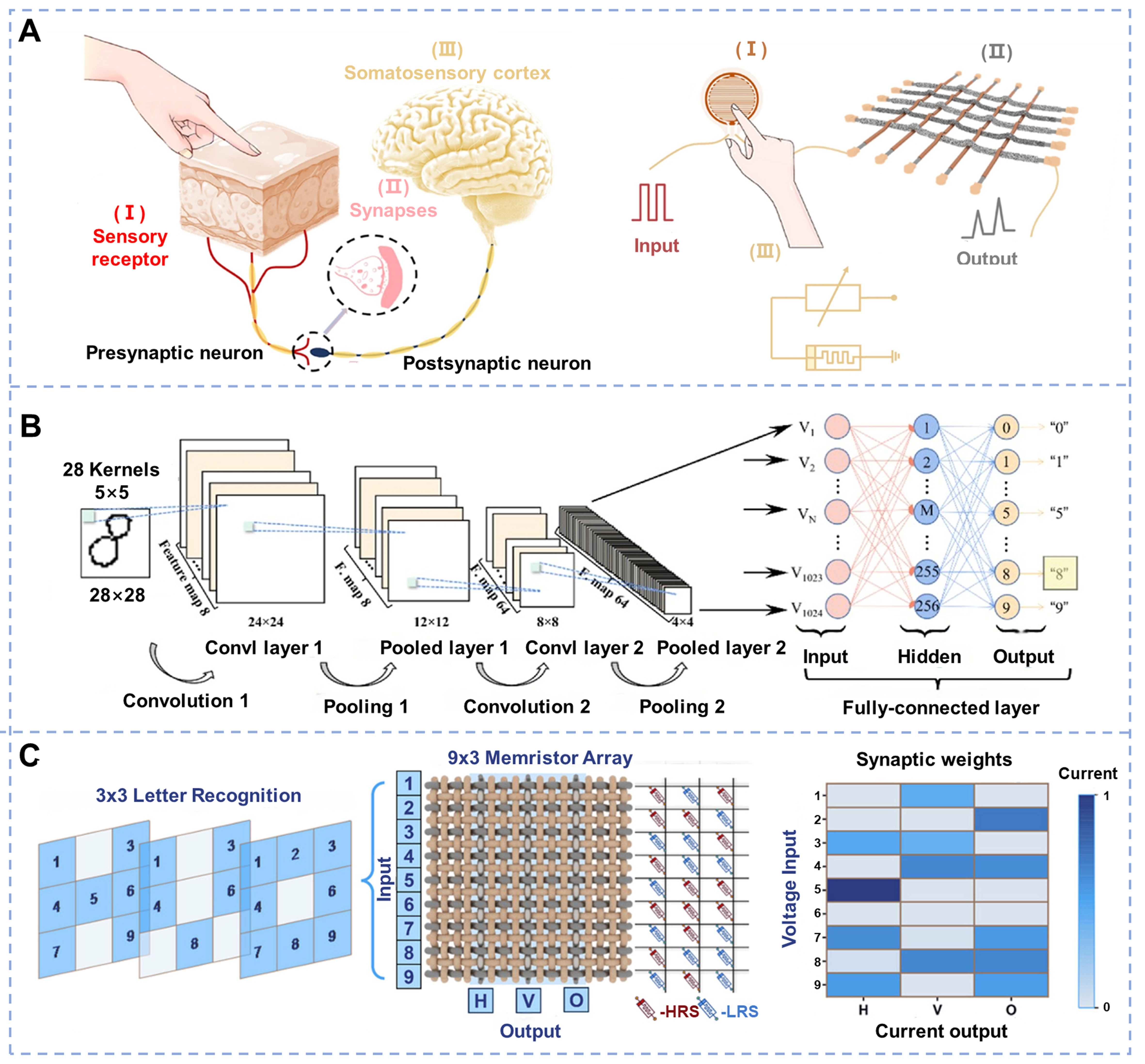
Figure 8. Neuromorphic and synaptic simulation application. (A) Schematic diagram illustrating the integration of an intelligent textile system with a brain-inspired neural network[59]; (B) Simulation performance of a CNN based on an Au/CsPbBr3/ITO memristive device[101]; (C) Capability of a Pt/CuSnO@Cf fiber memristor for weight storage and information processing[85]. Reproduced from Ref.[59] under the CC BY license. Reproduced from Ref.[101] under the CC BY license. Reproduced with permission from Ref.[85]. Copyright 2025, WILEY-VCH. CNN: Convolutional neural network; ITO: indium tin oxide.
These results underscore the potential of fiber memristors for efficient, localized pattern recognition and data processing. However, translating single-device performance into reliable large-scale systems requires addressing practical challenges such as device-to-device variability, nonlinear conductance drift, and cycle-to-cycle instability. Acknowledging and mitigating these non-ideal effects is crucial for realistic performance assessment and system-level design[58].
Fiber memristors for dynamic signal detection
The exceptional mechanical flexibility of fiber memristors allows them to conform to complex curvatures and withstand dynamic deformation, enabling stable integration onto surfaces or within environments that undergo constant movement. This characteristic establishes them as a unique platform for adaptive wearable sensing and edge computing[16]. By co-integrating with flexible sensors, energy sources, and displays, such systems can perform in situ signal acquisition and processing on the skin, paving the way for responsive human-machine interaction and continuous health monitoring.
A key application is in dynamic gesture recognition, where fiber memristors transduce physical motion directly into processable electrical codes. For instance, Yuan et al. developed an artificial curvature-sensing neuron based on VO2[102]. Attached to a finger, its resistance varies with the bending angle, modulating the output pulse frequency of the neuron and thereby encoding continuous motion into a discrete frequency signal [Figure 9A]. Advancing this concept, Wang et al. implemented a hybrid convolutional and backpropagation neural network framework to classify finger-bending waveforms, achieving accurate recognition of specific gestures like “OK” [Figure 9B][56].
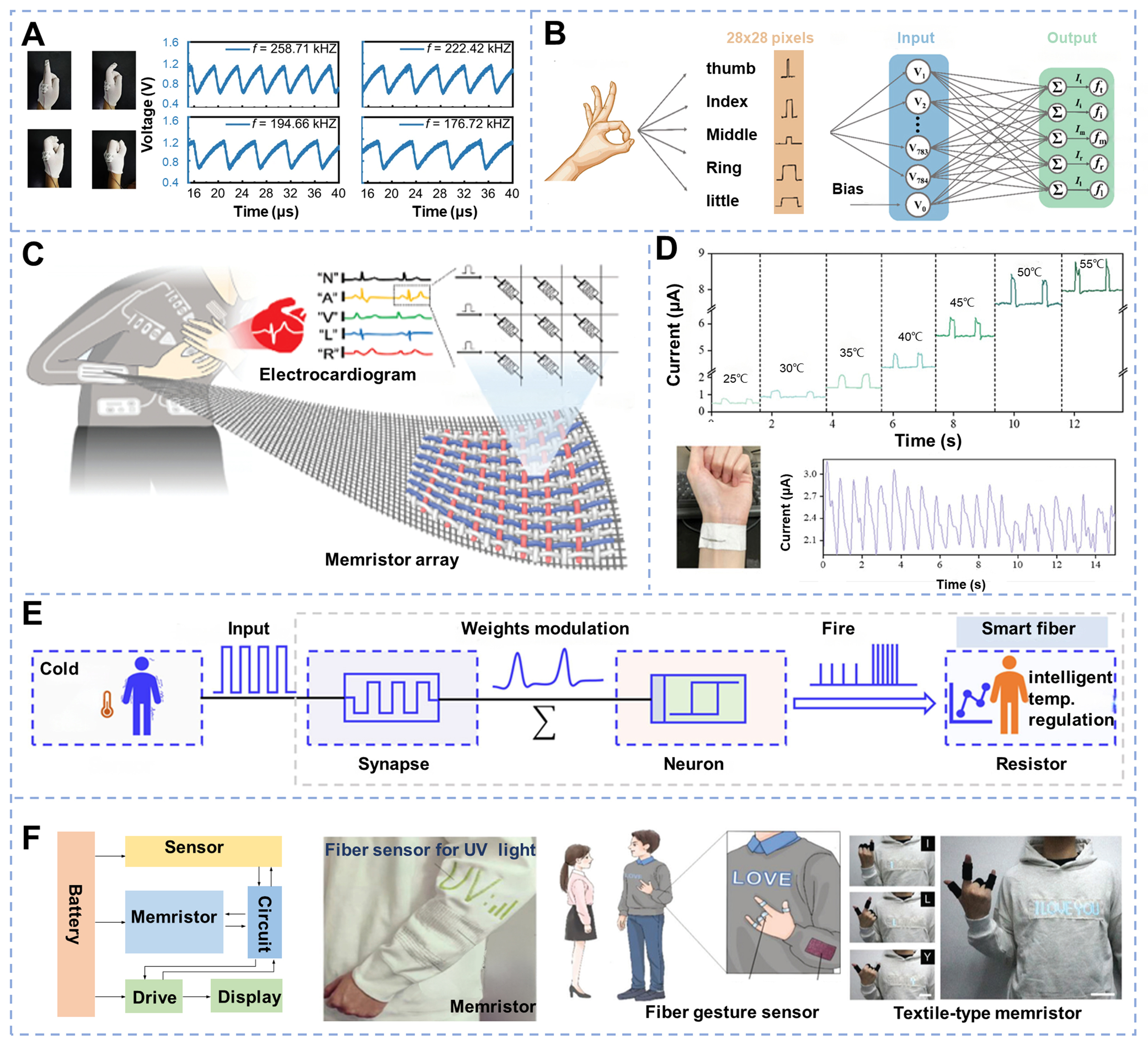
Figure 9. Dynamic signal detection and gesture recognition. (A) Response of a VO2-based artificial sensory neuron at different curvatures[102]; (B) Back-propagation neural network for gesture recognition[56]; (C) Physiological data storage and feedback via ECG pattern recognition[61]; (D) Synaptic current responses of a bio-inspired tactile system for arterial pulse monitoring and temperature-variant tests[77]; (E) Intelligent fiber-based heating system[10]; (F) Integrated fabrics for UV monitoring (memristor/UV sensor/display) and gesture recognition (memristor/triboelectric sensor)[42]. Reproduced from Ref.[102] under the CC BY license. Reproduced with permission from Ref.[56]. Copyright 2024, WILEY-VCH. Reproduced with permission from Ref.[61]. Copyright 2022, WILEY-VCH. Reproduced with permission from Ref.[77]. Copyright 2024, WILEY-VCH. Reproduced from Ref.[10] under the CC BY license. Reproduced with permission from Ref.[42]. Copyright 2023, WILEY-VCH. ECG: Electrocardiogram; UV: ultraviolet.
Beyond sensing, fiber memristor-based wearables can emulate neural network functions for integrated perception and computation. When coupled with multimodal sensors, stimuli such as pressure, physiological signals, and electrocardiograms (ECG) are converted into receptor potentials and processed directly by the memristor network[103]. This “sense-and-process” fusion is particularly promising for medical diagnostics. Liu et al. integrated a fiber memristor array into a garment for real-time ECG analysis, successfully classifying five cardiac states with 83% accuracy after only 15 training cycles [Figure 9C][61]. Furthermore, fiber memristors can be engineered for multimodal sensing. Ren et al. developed a PLA/Ag/MXene/Pt/ME-ICE memristor whose synaptic current increases systematically with temperature (from 25 to 55 °C) due to enhanced ion dissociation in the ionic layer[77]. This thermal sensitivity allowed the device, when sewn into a textile, to capture and encode arterial pulse signals [Figure 9D].
To achieve higher-order system functionality, fiber memristors are increasingly integrated with other functional fibers into complete smart textile systems. Wang et al. created an intelligent thermal management fabric by connecting memristive synaptic and neuronal fibers with resistive heating fibers, enabling neural-inspired control of a heating profile across a 3,000 s cycle [Figure 9E][10]. In another example, Liu et al. wove fiber memristors with a ultraviolet (UV)-sensitive fiber sensor and a textile display to produce a fabric that monitors and alerts the wearer to ultraviolet exposure[42]. Similarly, integrating memristors with triboelectric fiber sensors can translate gesture language into visual feedback, offering novel assistive interfaces [Figure 9F].
Reliable physical interconnections and impedance matching remain major challenges in system integration. For example, integrating fiber-based memristors with sensors, energy storage units, and readout circuits requires the development of matched flexible peripheral electronics, rather than relying solely on rigid components, to achieve robust and textile-compatible systems. In addition, most reported neuromorphic demonstrations still depend on offline training and external computational resources. Realizing true edge intelligence will require the co-design of adaptive learning algorithms, ultralow-power circuits, and reliable intra-textile interconnects, enabling autonomous and real-time adaptation directly within textile platforms.
CONCLUSION AND OUTLOOK
Fiber memristors represent a transformative platform in wearable electronics, seamlessly integrating sensing, memory, and neuromorphic computing within textile substrates. The transition of fiber-based memristors from laboratory prototypes to large-scale, reliable integrated systems still faces multiple challenges. These primarily include: maintaining uniform and consistent device performance over large-area textiles, ensuring long-term reliability under repeated mechanical deformation, suppressing conductance drift and parameter fluctuations, and achieving seamless system-level integration with power, sensing, and communication modules.
To address these issues, future research should focus on developing novel composite fibers and core-shell structures to enhance switching uniformity and durability, advancing roll-to-roll manufacturing and digital textile technologies for scalable production, and exploring hybrid architectures that integrate volatile and non-volatile functions within a single fiber. Simultaneously, establishing standardized testing protocols and reliability evaluation frameworks that closely mimic real-world wearing conditions is crucial. At the circuit and system level, efforts should concentrate on the co-design of hybrid volatile/non-volatile memristor architectures to simultaneously enable dynamic signal processing and stable data storage, thereby providing a high-performance foundation for real-time health monitoring and edge intelligence integrated into textiles. The environmental robustness of devices must also be systematically improved through advanced encapsulation and materials engineering to ensure long-term stable operation under practical wearing conditions such as sweat, humidity, repeated washing, and friction. Furthermore, research must progress from qualitative observations of mechanical performance to quantitative analysis of failure mechanisms (e.g., by clarifying the critical conditions and processes of micro-crack initiation and interfacial delamination) to provide a theoretical basis for durability design.
Looking ahead, the continued convergence of textile engineering, materials science, and neuromorphic hardware design will enable fiber memristors to evolve into core components of adaptive, intelligent wearable systems. By bridging the gap between electronics and textiles, they are poised to redefine human-technology interaction - embedding computation not in separate devices, but directly into the fabric of everyday life, ultimately enabling pervasive, responsive, and truly integrated human-machine experiences.
DECLARATIONS
Authors’ contributions
Conceptualization of the review scope, conducting the literature survey, outlining the manuscript structure, and writing the original draft: Chen, T.; Zhang, S.; Zhang, C.; Chen, C.; Wu, Z.
Participated in critical discussion of the content, contributed to manuscript organization, and designed/created the figures and graphical elements: Chen, T.; Zhang, S.; Hu, Y.; Liu, Z.; Huang, B.; Zhao, M.; Wu, T.; Zhang, X.; Zhang, C.; Chen, C.; Wu, Z.
Initiated the reviewing concept, supervised the project, and were involved in substantive discussion, revision, and finalization of the manuscript: Chen, T.; Zhang, S.; Chen, C.; Wu, Z.
All authors reviewed the manuscript and approved the final version for submission.
Availability of data and materials
Not applicable.
AI and AI-assisted tools statement
During the preparation of this manuscript, the AI tool ChatGPT (version 5.2) was used solely for language editing. The tool did not influence the study design, data collection, analysis, interpretation, or the scientific content of the work. All authors take full responsibility for the accuracy, integrity, and final content of the manuscript.
Financial support and sponsorship
This work acknowledges the support by the Fundamental Research Funds for the Central Universities (No. 2232025G-02), National Natural Science Foundation of China (Grant Nos. 62201345, 52505624, 52402195, 52202179), Shanghai Sailing Program (Grant No. 24YF2708000), and China Postdoctoral Science Foundation (2023M742225).
Conflicts of interest
Hu, Y. is affiliated with Guangzhou Mechanical Engineering Research Institute Co. Ltd, while the other authors declare no conflicts of interest.
Ethical approval and consent to participate
Not applicable.
Consent for publication
Not applicable.
Copyright
© The Author(s) 2026.
REFERENCES
1. Chua, L. Memristor - The missing circuit element. IEEE. Trans. Circuit. Theory. 1971, 18, 507-19. https://www.cpmt.org/scv/meetings/chua.pdf. (accessed 9 Apr 2026).
2. Zhu, S. K.; Zhao, Y. Review and outlook on synaptic devices and chips for neuromorphic systems. J. Funct. Mater. Dev. 2024, 30, 287-99.
3. Peng, H.; Li, H.; Tao, G.; Xia, L.; Xu, W.; Zhai, T. Smart textile optoelectronics for human‐interfaced logic systems. Adv. Funct. Mater. 2024, 34, 2308136.
4. Wang, S.; Liu, A.; Wu, H.; et al. Advances in flexible perovskite memristors for neuromorphic electronics. Mater. Futures. 2026, 5, 012701.
5. Strukov, D. B.; Snider, G. S.; Stewart, D. R.; Williams, R. S. The missing memristor found. Nature 2009, 453, 80-3.
6. Hota, M. K.; Bera, M. K.; Kundu, B.; Kundu, S. C.; Maiti, C. K. A natural silk fibroin protein‐based transparent bio‐memristor. Adv. Funct. Mater. 2012, 22, 4493-9.
7. Serrano-Gotarredona, T.; Prodromakis, T.; Linares-Barranco, B. A proposal for hybrid memristor-CMOS spiking neuromorphic learning systems. IEEE. Circuits. Syst. Mag. 2013, 13, 74-88.
8. Hu, S.; Yue, J.; Jiang, C.; et al. Resistive switching behavior and mechanism in flexible TiO2@Cf memristor crossbars. Ceram. Int. 2019, 45, 10182-6.
9. Xu, X.; Zhou, X.; Wang, T.; et al. Robust DNA-bridged memristor for textile chips. Angew. Chem. Int. Ed. Engl. 2020, 59, 12762-8.
10. Wang, T.; Meng, J.; Zhou, X.; et al. Reconfigurable neuromorphic memristor network for ultralow-power smart textile electronics. Nat. Commun. 2022, 13, 7432.
11. Zhang, J.; Zhu, Z.; Meng, J.; Wang, T. Fiber memristor-based physical reservoir computing for multimodal sleep monitoring. Research 2025, 8, 0870.
12. Wu, Z.; Chen, X.; Zhang, Y.; Dun, C.; Carroll, D. L.; Hu, Z. In situ electrical properties’ investigation and nanofabrication of Ag/Sb2Te3 assembled multilayers’ film. Adv. Mater. Interfaces. 2018, 5, 1701210.
13. Wu, Z.; Feng, Y.; Liu, Y.; et al. Bipolar resistive switching in the Ag/Sb2Te3/Pt heterojunction. ACS. Appl. Electron. Mater. 2021, 3, 2766-73.
14. Yu, Z.; Wu, Z.; Xia, W.; et al. Plasmon-enhanced Sb2Te3/FTO heterojunction optoelectronic synapses for image compression encoding and high-accuracy recognition. Appl. Phys. Lett. 2025, 127, 223304.
15. Xia, Z.; Sun, X.; Wang, Z.; Meng, J.; Jin, B.; Wang, T. Low-power memristor for neuromorphic computing: from materials to applications. Nanomicro. Lett. 2025, 17, 217.
16. Yang, C.; Wang, H.; Cao, Z.; et al. Memristor-based bionic tactile devices: opening the door for next-generation artificial intelligence. Small 2024, 20, e2308918.
17. Hu, H.; Ma, Y.; Hassan, Y. A.; et al. Conductive PDA@HNT/rGO/PDMS aerogel composites with significantly enhanced durability and stretchability for wearable electronics. Microstructures 2025, 5, 2025020.
18. Wang, Z.; Xu, K.; Meng, J.; Feng, B.; Wang, T. Carbon-based memristors for neuromorphic computing. Appl. Phys. Rev. 2025, 12, 041307.
19. Zhang, H.; Wang, Z.; Wang, Z.; et al. Recent progress of fiber-based transistors: materials, structures and applications. Front. Optoelectron. 2022, 15, 2.
20. Duan, X.; Cao, Z.; Gao, K.; et al. Memristor-based neuromorphic chips. Adv. Mater. 2024, 36, e2310704.
21. Shen, J.; Guan, P.; Jiang, A.; et al. A polyanionic strategy to modify the perovskite grain boundary for a larger switching ratio in flexible woven resistive random-access memories. ACS. Appl. Mater. Interfaces. 2022, 14, 44652-64.
22. Xu, J.; Luo, Z.; Chen, L.; et al. Recent advances in flexible memristors for advanced computing and sensing. Mater. Horiz. 2024, 11, 4015-36.
23. Liu, Y.; Chen, L.; Li, W.; et al. Scalable production of functional fibers with nanoscale features for smart textiles. ACS. Nano. 2024, 18, 29394-420.
24. Lohr, W. H.; Bothra, S.; Kumar, N.; Singh, S.; Khanna, S. P.; Hadimani, R. L. Novel PET-metal fiber-based yarn memristor as a synaptic device. IEEE. Trans. Magn. 2024, 60, 1-5.
25. Rajan, K.; Garofalo, E.; Chiolerio, A. Wearable intrinsically soft, stretchable, flexible devices for memories and computing. Sensors 2018, 18, 367.
26. Lin, W.; Sun, B.; Mao, S.; et al. Flexible memristors for implantable applications. ACS. Appl. Nano. Mater. 2025, 8, 2073-105.
27. Lu, H.; Zhang, Y.; Zhu, M.; et al. Intelligent perceptual textiles based on ionic-conductive and strong silk fibers. Nat. Commun. 2024, 15, 3289.
28. Shi, C.; Heble, A. Y.; Zhang, S. Multiparametric AFM insights into electron transport mechanisms in biomemristors. Mater. Today. Phys. 2024, 44, 101429.
29. Sun, Y.; Wang, H.; Xie, D. Recent advance in synaptic plasticity modulation techniques for neuromorphic applications. Nanomicro. Lett. 2024, 16, 211.
30. Li, Y.; Long, S.; Liu, Q.; Lv, H.; Liu, M. Resistive switching performance improvement via modulating nanoscale conductive filament, involving the application of two-dimensional layered materials. Small 2017, 13, 1604306.
31. Waser, R.; Dittmann, R.; Staikov, G.; Szot, K. Redox-based resistive switching memories - nanoionic mechanisms, prospects, and challenges. Adv. Mater. 2009, 21, 2632-63.
32. Jeong, D. S.; Schroeder, H.; Breuer, U.; Waser, R. Characteristic electroforming behavior in Pt/TiO2/Pt resistive switching cells depending on atmosphere. J. Appl. Phys. 2008, 104, 123716.
33. Shen, W.; Dittmann, R.; Waser, R. Reversible alternation between bipolar and unipolar resistive switching in polycrystalline barium strontium titanate thin films. J. Appl. Phys. 2010, 107, 094506.
34. Akinaga, H.; Shima, H.; Takano, F.; Inoue, I. H.; Takagi, H. Resistive switching effect in metal/insulator/metal heterostructures and its application for non‐volatile memory. IEEJ. Trans. Electr. Electron. Eng. 2007, 2, 453-7.
35. Inoue, I. H.; Yasuda, S.; Akinaga, H.; Takagi, H. Nonpolar resistance switching of metal/binary-transition-metal oxides/metal sandwiches: homogeneous/inhomogeneous transition of current distribution. Phys. Rev. B. 2008, 77, 035105.
36. Zhao, Y.; Zhai, Q.; Dong, D.; et al. Highly stretchable and strain-insensitive fiber-based wearable electrochemical biosensor to monitor glucose in the sweat. Anal. Chem. 2019, 91, 6569-76.
37. Zhu, Y.; Liang, J. S.; Shi, X.; Zhang, Z. Full-inorganic flexible Ag2S memristor with interface resistance-switching for energy-efficient computing. ACS. Appl. Mater. Interfaces. 2022, 14, 43482-9.
38. Ren, J.; Liang, H.; Li, J.; et al. Polyelectrolyte bilayer-based transparent and flexible memristor for emulating synapses. ACS. Appl. Mater. Interfaces. 2022, 14, 14541-9.
39. Yu, T.; Li, J.; Lei, W.; et al. The resistance switching performance of the memristor improved effectively by inserting carbon quantum dots (CQDs) for digital information processing. Nano. Res. 2024, 17, 8438-46.
41. Meng, J.; Liu, Y.; Fang, Y.; et al. Fiber-shaped Cu-ion diffusive memristor for neuromorphic computing. IEEE. Electron. Device. Lett. 2023, 44, 1220-3.
42. Liu, Y.; Zhou, X.; Yan, H.; et al. Highly reliable textile-type memristor by designing aligned nanochannels. Adv. Mater. 2023, 35, e2301321.
43. Bae, H.; Jang, B. C.; Park, H.; et al. Functional circuitry on commercial fabric via textile-compatible nanoscale film coating process for fibertronics. Nano. Lett. 2017, 17, 6443-52.
44. Sun, W. J.; Zhao, Y. Y.; Cheng, X. F.; He, J. H.; Lu, J. M. Surface functionalization of single-layered Ti3C2Tx MXene and its application in multilevel resistive memory. ACS. Appl. Mater. Interfaces. 2020, 12, 9865-71.
45. Hu, Z.; Li, Q.; Li, M.; et al. Ferroelectric memristor based on Pt/BiFeO3/Nb-doped SrTiO3 heterostructure. Appl. Phys. Lett. 2013, 102, 102901.
46. Li, Z.; Gu, D.; Xie, X.; et al. Photoelectric reservoir computing based on TiOx memristor for analog signal processing. ACS. Appl. Nano. Mater. 2025, 8, 6591-603.
47. Kwon, D. H.; Kim, K. M.; Jang, J. H.; et al. Atomic structure of conducting nanofilaments in TiO2 resistive switching memory. Nat. Nanotechnol. 2010, 5, 148-53.
48. Strachan, J. P.; Pickett, M. D.; Yang, J. J.; et al. Direct identification of the conducting channels in a functioning memristive device. Adv. Mater. 2010, 22, 3573-7.
49. Long, S.; Perniola, L.; Cagli, C.; et al. Voltage and power-controlled regimes in the progressive unipolar RESET transition of HfO2-based RRAM. Sci. Rep. 2013, 3, 2929.
50. Mei, S.; Bosman, M.; Nagarajan, R.; Wu, X.; Pey, K. L. Compliance current dominates evolution of NiSi2 defect size in Ni/dielectric/Si RRAM devices. Microelectron. Reliab. 2016, 61, 71-7.
51. Russo, U.; Ielmini, D.; Cagli, C.; Lacaita, A. L. Self-accelerated thermal dissolution model for reset programming in unipolar resistive-switching memory (RRAM) devices. IEEE. Trans. Electron. Devices. 2009, 56, 193-200.
52. Asanuma, S.; Akoh, H.; Yamada, H.; Sawa, A. Relationship between resistive switching characteristics and band diagrams of Ti/Pr1-xCaxMnO3 junctions. Phys. Rev. B. 2009, 80, 235113.
53. Yang, J. J.; Strukov, D. B.; Stewart, D. R. Memristive devices for computing. Nat. Nanotechnol. 2013, 8, 13-24.
54. Faleev, S. V.; Léonard, F. Theory of enhancement of thermoelectric properties of materials with nanoinclusions. Phys. Rev. B. 2008, 77, 214304.
55. Simmons, J. G.; Verderber, R. R. New conduction and reversible memory phenomena in thin insulating films. Proc. R. Soc. Lond. A. 1967, 301, 77-102.
56. Wang, Y.; Su, J.; Ouyang, G.; et al. Flexible Zn‐TCPP nanosheet‐based memristor for ultralow‐power biomimetic sensing system and high‐precision gesture recognition. Adv. Funct. Mater. 2024, 34, 2316397.
57. Shu, P.; Cao, X.; Du, Y.; et al. Resistive switching performance of fibrous crosspoint memories based on an organic–inorganic halide perovskite. J. Mater. Chem. C. 2020, 8, 12865-75.
58. Bae, H.; Kim, D.; Seo, M.; et al. Bioinspired polydopamine‐based resistive‐switching memory on cotton fabric for wearable neuromorphic device applications. Adv. Mater. Technol. 2019, 4, 1900151.
59. Jiang, C.; Huang, S.; Yu, Y.; et al. A BiOI/TiO2 heterogeneous interface-based fiber memristor for intelligent textile system and high-precision hand gestures recognition. Nano. Res. 2025, 18, 94907367.
60. Jo, A.; Seo, Y.; Ko, M.; et al. Textile resistance switching memory for fabric electronics. Adv. Funct. Mater. 2017, 27, 1605593.
61. Liu, Y.; Zhou, X.; Yan, H.; et al. Robust memristive fiber for woven textile memristor. Adv. Funct. Mater. 2022, 32, 2201510.
62. Grishin, A. M.; Velichko, A. A.; Jalalian, A. Nb2O5 nanofiber memristor. Appl. Phys. Lett. 2013, 103, 053111.
63. Dai, S.; Zhao, Y.; Wang, Y.; et al. Recent advances in transistor‐based artificial synapses. Adv. Funct. Mater. 2019, 29, 1903700.
64. Zhang, B. W.; Lin, C.; Nirantar, S.; et al. Lead‐free perovskites and metal halides for resistive switching memory and artificial synapse. Small. Struct. 2024, 5, 2300524.
65. Huh, W.; Lee, D.; Lee, C. H. Memristors based on 2D materials as an artificial synapse for neuromorphic electronics. Adv. Mater. 2020, 32, e2002092.
66. Huang, J.; Yang, S.; Tang, X.; et al. Flexible, transparent, and wafer-scale artificial synapse array based on TiOx/Ti3C2Tx film for neuromorphic computing. Adv. Mater. 2023, 35, e2303737.
67. Saini, S.; Dwivedi, A.; Lodhi, A.; Khandelwal, A.; Tiwari, S. P. Multilevel resistive switching in flexible RRAM devices with a PVP:MoSe2 active layer. ACS. Appl. Electron. Mater. 2024, 6, 6718-25.
68. Zhang, Y.; Fan, S.; Zhang, Y. Bio-memristors based on silk fibroin. Mater. Horiz. 2021, 8, 3281-94.
69. Shi, C.; Wang, J.; Sushko, M. L.; Qiu, W.; Yan, X.; Liu, X. Y. Silk flexible electronics: from Bombyx mori silk Ag nanoclusters hybrid materials to mesoscopic memristors and synaptic emulators. Adv. Funct. Mater. 2019, 29, 1904777.
70. Sun, W.; Gregory, D. A.; Tomeh, M. A.; Zhao, X. Silk fibroin as a functional biomaterial for tissue engineering. Int. J. Mol. Sci. 2021, 22, 1499.
71. Rananavare, A. P.; Kadam, S. J.; Prabhu, S. V.; Chavan, S. S.; Anbhule, P. V.; Dongale, T. D. Organic non-volatile memory device based on cellulose fibers. Mater. Lett. 2018, 232, 99-102.
72. Xu, J.; Zhao, X.; Zhao, X.; et al. Memristors with biomaterials for biorealistic neuromorphic applications. Small. Sci. 2022, 2, 2200028.
73. Xiao, Y.; Jiang, B.; Zhang, Z.; et al. A review of memristor: material and structure design, device performance, applications and prospects. Sci. Technol. Adv. Mater. 2023, 24, 2162323.
74. Rao, Z.; Wang, X.; Mao, S.; et al. Flexible memristor-based nanoelectronic devices for wearable applications: a review. ACS. Appl. Nano. Mater. 2023, 6, 18645-69.
75. Yang, C.; Wang, H.; Wang, K.; et al. Silk fibroin-based biomemristors for bionic artificial intelligence robot applications. ACS. Nano. 2025, 19, 17173-98.
76. Kim, D. H.; Wu, C.; Park, D. H.; et al. Flexible memristive devices based on InP/ZnSe/ZnS core-multishell quantum dot nanocomposites. ACS. Appl. Mater. Interfaces. 2018, 10, 14843-9.
77. Ren, S.; Wang, K.; Jia, X.; et al. Fibrous MXene synapse-based biomimetic tactile nervous system for multimodal perception and memory. Small 2024, 20, e2400165.
78. Sultana, A.; Ghosh, S. K.; Sencadas, V.; et al. Human skin interactive self-powered wearable piezoelectric bio-e-skin by electrospun poly-L-lactic acid nanofibers for non-invasive physiological signal monitoring. J. Mater. Chem. B. 2017, 5, 7352-9.
79. Kang, M.; Lee, S. A.; Jang, S.; et al. Low-voltage organic transistor memory fiber with a nanograined organic ferroelectric film. ACS. Appl. Mater. Interfaces. 2019, 11, 22575-82.
80. Di, J.; Zhang, X.; Yong, Z.; et al. Carbon-nanotube fibers for wearable devices and smart textiles. Adv. Mater. 2016, 28, 10529-38.
81. Xing, F.; Gao, X.; Wen, J.; et al. Multistrand twisted triboelectric kevlar yarns for harvesting high impact energy, body injury location and levels evaluation. Adv. Sci. 2024, 11, e2401076.
82. Chen, L.; Li, R.; Yuan, S.; et al. Fiber-shaped artificial optoelectronic synapses for wearable visual-memory systems. Matter 2023, 6, 925-39.
83. Xing, Y.; Zhou, M.; Si, Y.; et al. Integrated opposite charge grafting induced ionic-junction fiber. Nat. Commun. 2023, 14, 2355.
84. Kim, D.; Kim, N. W.; Kim, T. G.; et al. Surface functionalization of 3D-printed scaffolds with seed-assisted hydrothermally grown ZnO nanoarrays for bone tissue engineering. ACS. Appl. Mater. Interfaces. 2024, 16, 45389-98.
85. Huang, S.; Ding, Z.; Cheng, Y.; Zhao, Z.; Zhang, D.; Jiang, C. Memristive fibers for intelligent textiles information storage and processing in multi-scenarios. Small 2025, 21, e2505191.
86. Liu, Y.; Zhang, Y.; Zhou, X.; et al. High-performing nanofiber memristor via field-induced ion migration concentration at highly-curved interwoven interface. Small 2025, 21, e2409951.
87. Meng, Y.; Zhu, J. Low energy consumption fiber-type memristor array with integrated sensing-memory. Nanoscale. Adv. 2022, 4, 1098-104.
88. Wang, Z.; Yue, J.; Jiang, C.; et al. Vacancy-induced resistive switching and synaptic behavior in flexible BST@Cf memristor crossbars. Ceram. Int. 2020, 46, 21569-77.
89. Meng, Y. Plasmon-enhanced responsiveness perovskite-based photo-memoristor. Opt. Mater. 2025, 162, 116839.
90. Kang, M.; Kim, T. Recent advances in fiber-shaped electronic devices for wearable applications. Appl. Sci. 2021, 11, 6131.
91. Wang, K.; Wang, M.; Sun, B.; et al. An innovative biomimetic technology: memristors mimic human sensation. Nano. Energy. 2025, 136, 110698.
92. Tang, Z.; Sun, B.; Zhou, G.; et al. Research progress of artificial neural systems based on memristors. Mater. Today. Nano. 2024, 25, 100439.
93. Dang, C.; Wang, Z.; Hughes-Riley, T.; et al. Fibres-threads of intelligence-enable a new generation of wearable systems. Chem. Soc. Rev. 2024, 53, 8790-846.
94. Mao, J.; Zheng, Z.; Xiong, Z.; et al. Lead-free monocrystalline perovskite resistive switching device for temporal information processing. Nano. Energy. 2020, 71, 104616.
95. Duan, Q.; Jing, Z.; Zou, X.; et al. Spiking neurons with spatiotemporal dynamics and gain modulation for monolithically integrated memristive neural networks. Nat. Commun. 2020, 11, 3399.
96. Wang, M.; Tu, J.; Huang, Z.; et al. Tactile near-sensor analogue computing for ultrafast responsive artificial skin. Adv. Mater. 2022, 34, e2201962.
97. Zhu, J.; Zhang, X.; Wang, R.; et al. A heterogeneously integrated spiking neuron array for multimode-fused perception and object classification. Adv. Mater. 2022, 34, e2200481.
98. Park, H.; Han, J. K.; Yim, S.; et al. An analysis of components and enhancement strategies for advancing memristive neural networks. Adv. Mater. 2025, 37, e2412549.
99. Jang, H.; Lee, J.; Beak, C. J.; Biswas, S.; Lee, S. H.; Kim, H. Flexible neuromorphic electronics for wearable near-sensor and in-sensor computing systems. Adv. Mater. 2025, 37, e2416073.
100. Park, T. J.; Deng, S.; Manna, S.; et al. Complex oxides for brain-inspired computing: a review. Adv. Mater. 2023, 35, e2203352.
101. Luo, F.; Zhong, W.; Tang, X.; Chen, J.; Jiang, Y.; Liu, Q. Application of artificial synapse based on all-inorganic perovskite memristor in neuromorphic computing. Nano. Mater. Sci. 2024, 6, 68-76.
102. Yuan, R.; Duan, Q.; Tiw, P. J.; et al. A calibratable sensory neuron based on epitaxial VO2 for spike-based neuromorphic multisensory system. Nat. Commun. 2022, 13, 3973.
Cite This Article
 Open Access
How to Cite
Download Citation
Export Citation File:
Type of Import
Tips on Downloading Citation
Citation Manager File Format
Type of Import
Direct Import: When the Direct Import option is selected (the default state), a dialogue box will give you the option to Save or Open the downloaded citation data. Choosing Open will either launch your citation manager or give you a choice of applications with which to use the metadata. The Save option saves the file locally for later use.
Indirect Import: When the Indirect Import option is selected, the metadata is displayed and may be copied and pasted as needed.
About This Article
Special Topic
Copyright

Data & Comments
Data
0








Comments
Comments must be written in English. Spam, offensive content, impersonation, and private information will not be permitted. If any comment is reported and identified as inappropriate content by OAE staff, the comment will be removed without notice. If you have any queries or need any help, please contact us at support@oaepublish.com.