




fig6
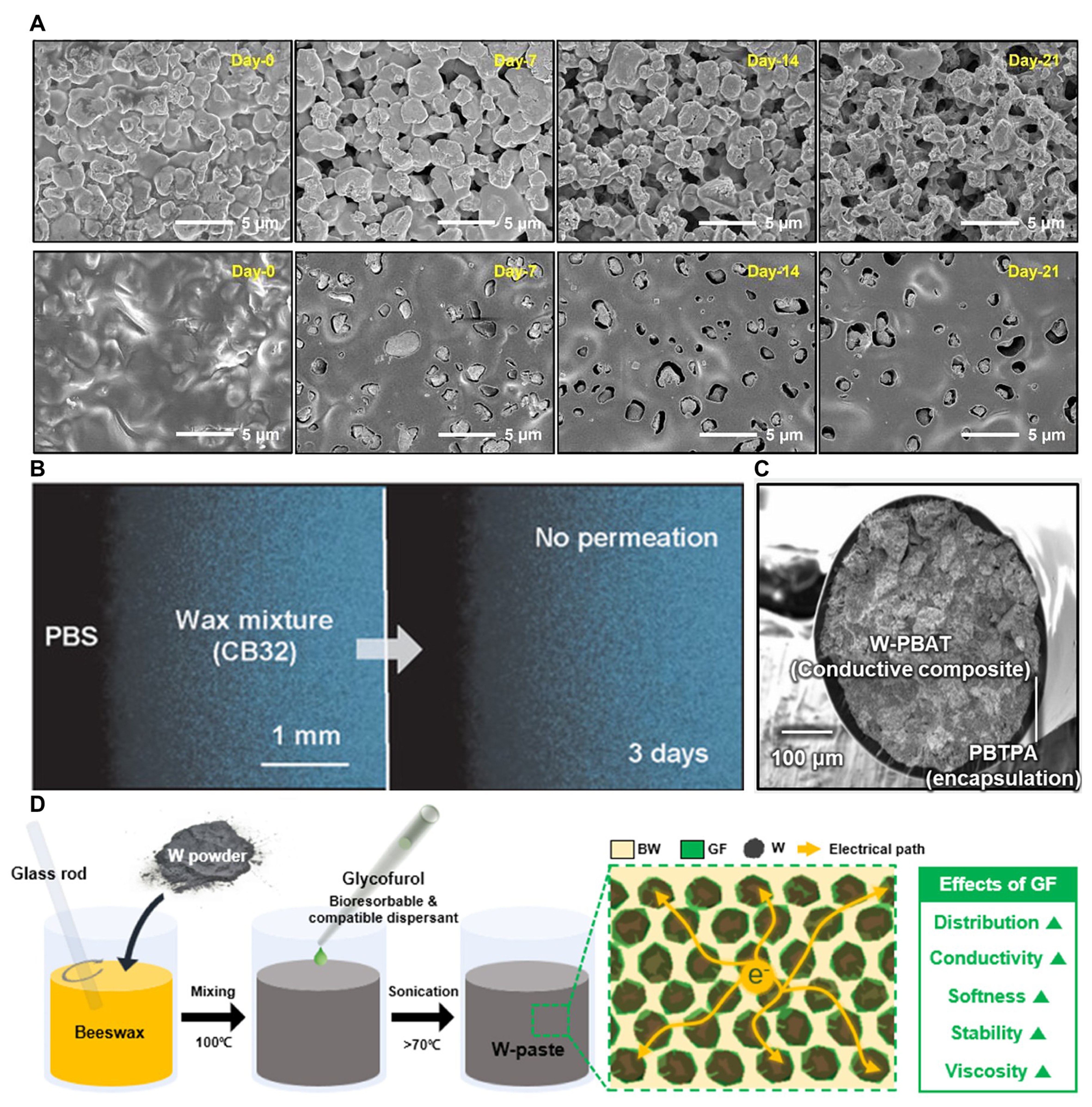
Figure 6. Strategies for maintaining the operational stability of biodegradable conductive composite pastes against degradation. (A) Comparative analysis of microstructural changes during immersion, presenting a series of SEM images of Mo/PBTPA paste (top) and Mo/PLGA paste (bottom) in PBS at 37 °C. The images contrast the degree of surface erosion and pore formation over time. Reprinted with permission from Ref.[111]. Copyright 2018, Elsevier; (B) Optical images demonstrating the waterproofing efficacy of the wax mixture layer, showing effective inhibition of internal penetration even after 3 days under physiological conditions (37 °C, pH 7.4). Reproduced with permission from Ref.[129]. Copyright 2020, John Wiley & Sons; (C) SEM image of a one-dimensional W/PBAT conductive composite fiber encapsulated with a PBTPA polymer coating to prevent premature environmental degradation. Reproduced with permission from Ref.[108] under the CC BY license; (D) Schematic illustration of the fabrication process for W/beeswax pastes with the addition of GF as a dispersant, detailing enhanced particle dispersion and the resulting overall stability of the composite. Reproduced with permission from Ref.[35] under the CC BY-NC-ND license. No modifications were made. SEM: Scanning electron microscopy; PBTPA: poly(1,4-butanedithiol-co-1,3,5-triallyl-1,3,5-triazine-2,4,6(1H,3H,5H)-trione-co-4-pentenoic anhydride); PLGA: poly(lactic-co-glycolic acid); PBS: phosphate-buffered saline; PBAT: poly(butylene adipate-co-terephthalate); GF: glycofurol; BW: beeswax.