



fig4
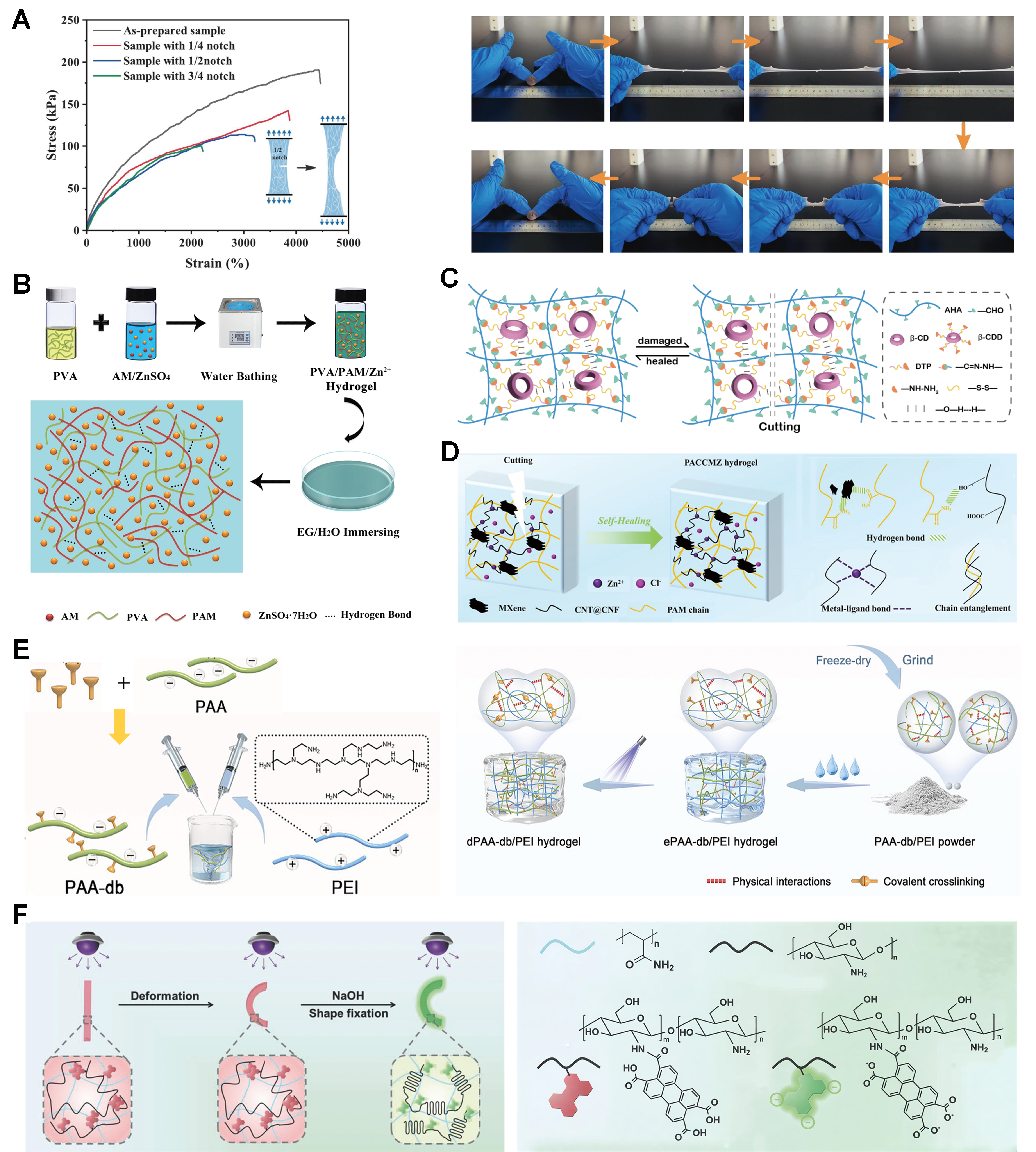
Figure 4. Fatigue performance and environmental stability of hydrogels. (A) Photos of the stretched hydrogel with a notch and tensile stress-strain curves[96]. Copyright 2025, Elsevier; (B) Schematic illustration on the synthesis and structure of PVA/PAM/Zn/EG (PPZE) hydrogel[98]. Copyright 2022, The American Association for the Advancement of Science; (C) Self-healing mechanism of β-cyclodextrin/hyaluronic acid (ACD) hydrogel[104]. Copyright 2025, Elsevier; (D) Self-healing mechanism diagram of PACCMZ hydrogel. Self-healing mechanism[103]. Copyright 2025, Elsevier; (E) Schematic diagram for the preparation of negatively-charged double bond-functionalized polyacrylic acid and positively-charged polyethyleneimine powder (PAA-db/PEI powder)[112]. Copyright 2025, Wiley-VCH; (F) The mechanisms of the shape memory hydrogels with simultaneously switchable fluorescence[113]; Copyright 2018, Wiley-VCH. PVA: Poly(vinyl alcohol); PAM: polyacrylamide; EG: ethylene glycol; PACCMZ: polyacrylamide/carbon nanotube@cellulose/MXene/Zn2+; AM: acrylamide; AHA: aldehyde-modified hyaluronic acid; DTP: 3,3′-dithiobis (propionyl hydrazide); CNT: carbon nanotube; CNF: cellulose nanofiber; PAA: polyacrylic acid; PEI: polyethyleneimine.