



fig5
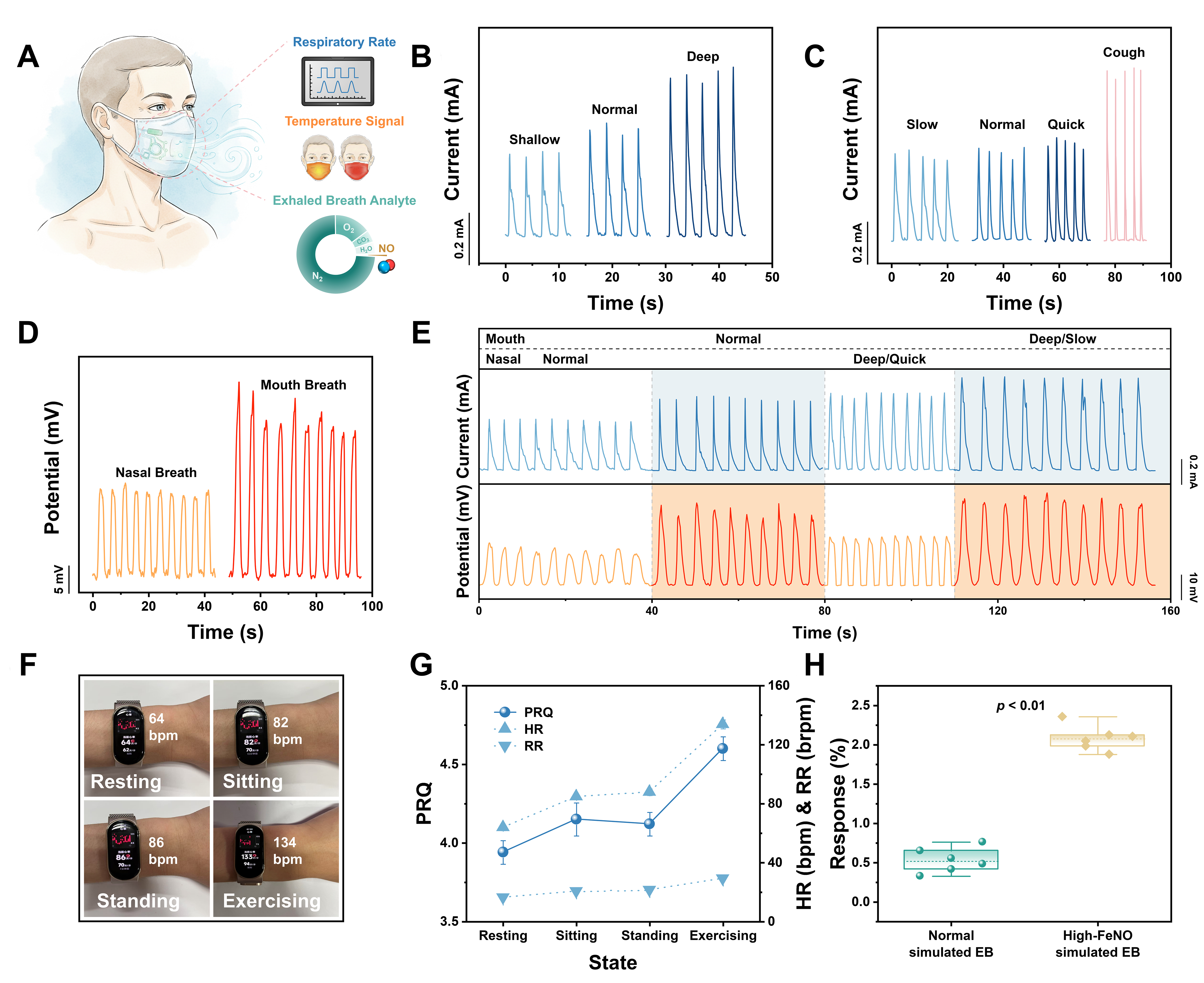
Figure 5. Wearable respiratory monitoring enabled by the integrated multimodal sensing mask. (A) Schematic illustration of the sensor integrated into a wearable mask for respiratory monitoring; (B) Pressure sensing signals corresponding to different breathing depths; (C) Pressure sensing signals corresponding to different breathing rates; (D) Temperature sensing responses distinguishing nasal and mouth breathing; (E) Multimodal identification of diverse breathing behaviors based on combined pressure and temperature signals; (F) HR monitoring under different activity states; (G) PRQ calculated from HR and RR under various physiological conditions. The error bars represent the standard deviation based on a sample size of three (n = 3); (H) Differentiation of exhaled NO levels between normal simulated EB and high-FeNO simulated EB. Box plots were generated from six repeated measurements for each condition (n = 6). The P-value was determined by paired t-test (two-tailed). Human-related mask tests were conducted by the first author as self-experiments, and no external volunteers or patients were recruited. HR: Heart rate; PRQ: pulse respiration quotient; RR: respiratory rate; NO: nitric oxide; EB: exhaled breath; FeNO: fractional exhaled nitric oxide.