




A superelastic and cushioning aerogel with dual sensing for intelligent safety protection
 0
0 Abstract
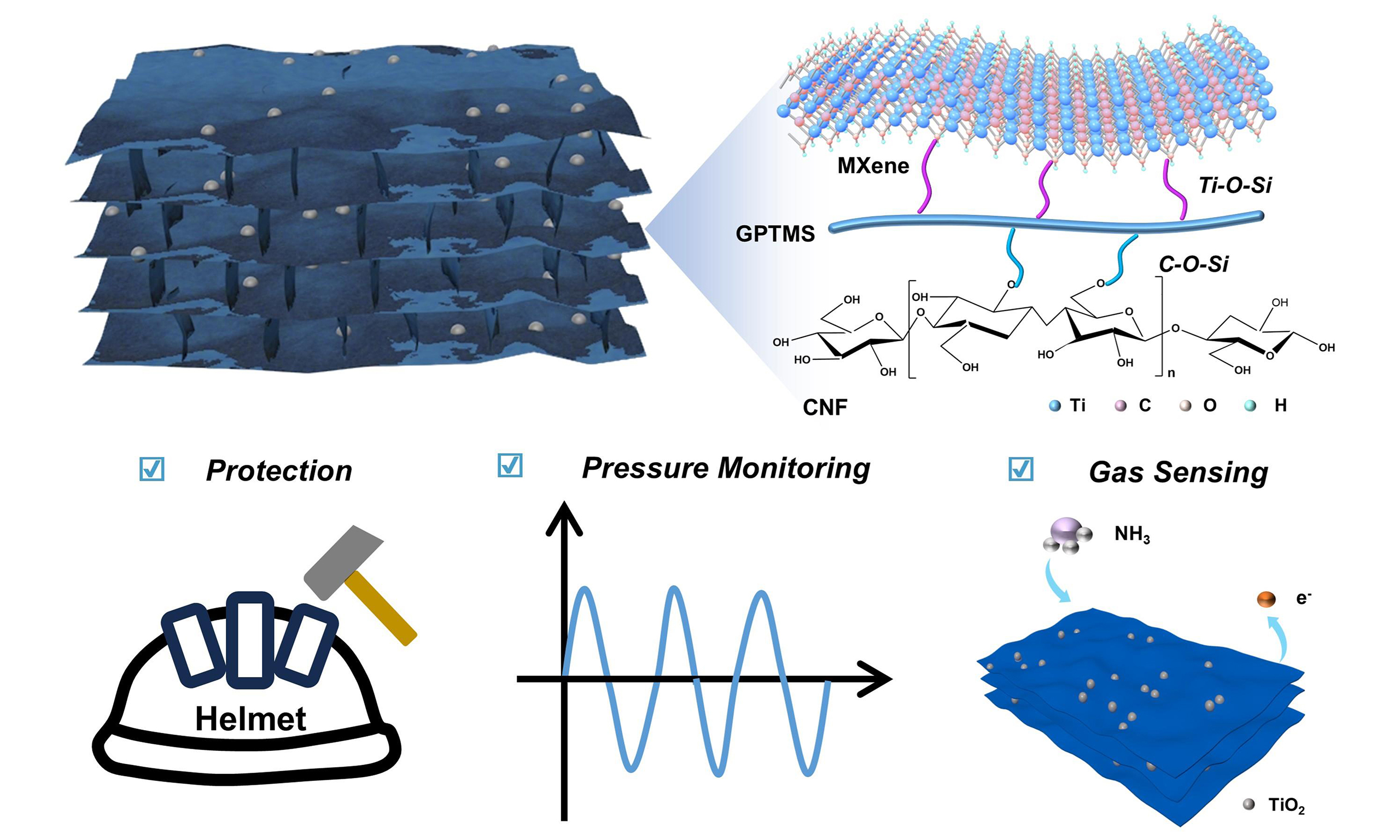
Safety protection equipment necessitates the use of aerogel materials with effective mechanical impact resistance. However, conventional materials often suffer from limited resilience and a lack of multi-sensing functionality, making them inadequate for safety monitoring in complex scenarios. To address this, we developed a composite aerogel (denoted as G-T@M/C) based on cellulose nanofibers and MXene, fabricated through oxidation, cross-linking, and freeze-drying. This aerogel demonstrates mechanical resilience, achieving a rebound rate of 95% even under 90% compressive strain. It showed a static cushioning coefficient of 3.32 in the stress range of 2.4-36.2 kPa, and demonstrated significantly better practical cushioning performance than expanded polyethylene and expanded polystyrene. Moreover, this aerogel exhibits piezoresistive sensitivity of 3.9 and high stability throughout 1,500 compression-release cycles at 80% strain. Simultaneously, this aerogel possesses sensitive gas sensing capabilities, exhibiting a response concentration to ammonia gas ranging from 0.001 to 10 ppm, with a response time to
Keywords
INTRODUCTION
With the development and progress of society, people’s fields of work have become increasingly specialized. Correspondingly, the personnel protection requirements for certain specialized work environments have diversified. For example, nitramine-based explosives find extensive application in blasting operations within the mining, civil engineering, and defense sectors. Despite their utility in military and demolition contexts, explosives carry significant risks. In particular, ammonium nitrate explosives have been involved in more than 50 major incidents worldwide over the past one hundred years, resulting in a total death toll above 2,700[1,2]. It not only generates substantial quantities of toxic gases (e.g., NH3) prior to explosion, but its detonation also releases intense shock waves and flying debris[3,4]. Traditional safety equipment mainly provides mechanical impact protection, yet it generally lacks real-time toxic gas monitoring and early warning functions, preventing it from delivering pre-accident alerts. This limitation makes it inadequate for the safety requirements of complex blasting conditions. In recent years, significant advances have been made in flexible gas sensing technologies for toxic gas detection, including self-healing nanocomposite sensors with enhanced mechanical robustness[5], wireless metal organic framework (MOF)-based sensor patches with interference suppression[6]. Additionally, quantum dot-sensitized MXene sensors have shown promise for breath analysis in hazardous environments[7].
Aerogels are lightweight solid materials characterized by a three-dimensional nanoporous network structure. This unique architecture imparts a range of exceptional properties, such as low density, high specific surface area, and tunable pore structures[8]. These attributes make aerogels well-suited to meet both the lightweight requirements and the multifunctional integration needs of modern protective equipment. In recent years, ongoing innovations in material design, composition, and preparation techniques have led to the development of lightweight and multifunctional aerogels and established a material foundation for technological advances in personal protective equipment. For example, Zhou et al. have developed a composite material that combines thermal management with intelligent protection capabilities. It absorbs 55.4% of the force during low-speed impacts and retains its electrothermal functionality even after deformation[9]. Nevertheless, its long-term cyclic stability still requires improvement. Wang et al. prepared an aerogel for firefighting protective clothing that triggers a fire alarm within 2.03 s and exhibits low thermal conductivity (0.06233 W/m·K)[10]. However, the complexity of its fabrication process and its relatively low mechanical strength limit broader application. Hu’s team also developed a multi-scale biomimetic composite aerogel[11]. This material demonstrates a high tensile strength of 3.70 MPa and a buckling strength of
Herein, a simple approach is proposed to prepare layered porous composite aerogels, designated as G-T@M/C [with G for “crosslinked by (3-glycidyloxypropyl) methyldiethoxysilane (GPTMS)”, T for TiO2, @ for TiO2 attached to the MXene surface, M for MXene, and C for cellulose nanofibers (CNFs)][12-14]. By combining material selection with structural design, the resulting aerogel achieves a combination of elasticity with 95% height retention after 90% compression. It demonstrates an optimal static cushioning coefficient (SCC) value of 3.32 at 8.3 kPa, while maintaining piezoresistive sensitivity of 3.9 and gas detection capability for ammonia at low concentrations down to 1 ppb. The integration of this multifunctional aerogel into safety helmets combines physical impact monitoring, effective personal protection, and early warning of hazardous gases.
EXPERIMENTAL
Materials
2,2,6,6-Tetramethylpiperidinyloxy (TEMPO) and lithium fluoride (LiF) were obtained from McLean Biochemical Technology Co., Ltd. (China). Sodium hypochlorite (NaClO) was sourced from Beijing Huaxia Yuanyang Technology Co., Ltd., while sodium hydroxide (NaOH), sodium bromide (NaBr), and hydrochloric acid (HCl) were provided by Jiangtian Chemical Technology Co., Ltd. (China). Ti3AlC2 powder was supplied by Laizhou Kaikai Ceramic Materials Co., Ltd. Additionally, GPTMS was acquired from Beijing Warwick Chemical Co., Ltd. (China). Ammonia solution at 25% concentration was purchased from Fengchuan Chemical Reagents Technology Co., Ltd.
Synthesis of CNF
CNFs were obtained through TEMPO-mediated oxidation followed by high-pressure homogenization[15]. First, 10 g of sulfate-bleached eucalyptus pulp was dispersed in deionized water to form a 1% fiber suspension. Then, 0.1 g of TEMPO and 1 g of NaBr were dissolved in deionized water at 40 °C and introduced into the suspension. A 10 wt% NaClO solution, pre-adjusted to pH 10.5 using 0.1 M HCl, was added dropwise via a peristaltic pump to initiate oxidation. Throughout this process, the pH was maintained at approximately 10.5 by supplementing with 0.5 mM NaOH as needed. After oxidation, the suspension was ultrasonicated, and the reaction was quenched by adding 20 mL of anhydrous ethanol. The obtained pulp was filtered and rinsed with deionized water to neutrality, followed by redispersion in 1 wt% solution. Finally, the suspension was passed through a high-pressure homogenizer to obtain a uniform CNF dispersion.
Bleached eucalyptus sulfate pulp (cellulose content 86%-90%, hemicellulose content 3%-4%, and lignin content 1%-3%) was used as the raw material, following the method described in a previous report[15]. We prepared CNFs with a mass fraction of 1 wt%, a diameter range of 20-60 nm, and an average length of 68 µm. After oxidizing the pulp with 8 mmol/g NaClO, the resulting CNFs exhibited a surface zeta potential of -56.87 mV and a carboxyl group content of 0.69 mmol/g.
Preparation of MXene sheets
MXene sheets were prepared by etching the Al layer of Ti3AlC2 with HCl and LiF. Slowly add 1.6 g of LiF to 12 M HCl while stirring at 800 rpm for 5 min at room temperature magnetically until the mixture disperses uniformly. Then slowly add 1.0 g of Ti3AlC2 to the mixture. Next, the water bath temperature was raised to 45 °C, and magnetic stirring at 1,200 rpm was continued for 24 h to etch the Al layer. The obtained reaction mixture was rinsed with deionized water and centrifuged several times until the pH of the supernatant was no less than 5.5. Impurities were then removed by centrifugation for 30 min, and the deep green supernatant was collected. The MXene sheets were obtained by freeze-drying the supernatant.
Synthesis of TiO2@MXene
MXene was added to deionized water and stirred at 500 rpm for 5 min at room temperature to achieve uniform dispersion. Subsequently, we determined the effect of MXene oxidation time on mechanical properties. Based on the measured stress–strain curves of the aerogel, the optimal oxidation time for MXene was ultimately set at 9 h [Supplementary Figure 1]. Transfer the solution to a vacuum drying oven and oxidize at 70 °C for 9 h. After cooling, dissolve the dried TiO2@MXene (denoted as T@M) in deionized water to prepare a T@M dispersion (10 mg·mL-1).
Preparation of G-T@M/C aerogel
We determined the influence of the T@M, CNF, and GPTMS ratio on mechanical properties. Based on the three sets of parallel stress–strain curves measured for the aerogel under each condition, the optimal composition was determined to be T@M:CNF:GPTMS = 1:2:1 [Supplementary Figures 2-5]. Unless otherwise specified in subsequent discussions, all G-T@M/C aerogels referred to in this paper were prepared using this mass ratio. The CNF dispersion (1 wt%) and T@M suspension (10 mg·mL-1) were first mixed at a mass ratio of 2:1 (CNF:T@M) and stirred at 600 rpm for 30 min at room temperature. GPTMS was then added dropwise to the mixture at a mass ratio of GPTMS:CNF = 1:2. The resulting dispersion was stirred at 600 rpm and 60 °C for 2 h to promote the hydrolysis and condensation of GPTMS with both CNF and T@M. After reaction, unreacted GPTMS, oligomers, and other small molecules were removed by centrifugation. The centrifuged solution was poured into a polydimethylsiloxane (PDMS) mold positioned on a copper bridge, with bothsides of the bridge immersed in liquid nitrogen (-196 °C) and ice water (0 °C), respectively, to create a temperature gradient. Following directional freezing, the sample was demolded and freeze-dried under vacuum at -60 °C for 36 h. Finally, the G-T@M/C aerogel sample was cured in a vacuum oven at
Characterization
The microstructure of the aerogel was examined by scanning electron microscopy (SEM, JEOL JSM-IT300LV, Japan). The chemical structure was analyzed using Fourier transform infrared spectroscopy (FTIR) (Nicolet iS5, USA), while the surface chemical composition was determined by X-ray photoelectron spectroscopy (XPS, Thermo Scientific K-Alpha, USA). Crystal structure characterization was carried out through X-ray diffraction (XRD, Bruker D2 Phaser, Germany). We then conducted detailed tests on the aerogel using a static contact angle measuring instrument (VCA Optima, AST, USA), a motor control platform (DM422s, Wuhan Hongxingyang Technology Co., Ltd.), and a digital source meter (Keithley 2400, Tektronix, USA).
Mechanical property test
The compression stress–strain curves of G-T@M/C aerogels were obtained using a universal testing machine (Lishi LD23.53, China). Strain energy (e) and static cushioning coefficient (C) were calculated using Equations (1)[16] and (2)[17]:
where ε is the compressive strain and σ is the compressive stress.
The acceleration G’s experienced by aerogels during descent are measured by a drop test machine.
Pressure sensing test
The G-T@M/C aerogel was bonded between the compression plates of the motor control platform (MD442s, China) using two Cu electrodes. Resistance changes during compression were recorded in real time via a source meter (Keithley 2000, China), and the aerogel’s sensitivity (S) was calculated according to Equations (3) and (4)[18].
where R0 denotes the resistance without strain, R represents the resistance under strain, and ΔStrain indicates the compression size change.
Gas sensing test
The G-T@M/C aerogel sensor was mounted on a printed glass substrate equipped with platinum finger electrodes (15 mm × 50 mm, 3 mm spacing) using liquid metal as a conductive adhesive. Gas detection experiments were conducted at room temperature. After being equilibrated with dry nitrogen, the calibrated gas was diluted to a typical concentration with dry air via a mass flow controller at a total flow rate of
The response time was defined as the time required for the sensor response to reach 90% of the maximum signal variation after exposure to ammonia. The recovery time was determined as the time for the signal to return to 10% of the maximum response after switching to pure dry air. All measurements were performed at room temperature with constant humidity and fixed gas flow rate, and the average value of three repeated tests was adopted.
RESULTS AND DISCUSSION
Preparation and characterization
Figure 1 depicts the structural design and fabrication procedure of the G-T@M/C aerogel. The preparation started from TEMPO-oxidized CNF [Figure 1A] and a uniform mixture of a pre-oxidized MXene dispersion [Figure 1B]. TiO2 grow on the MXene surface through hydrothermal oxidation. Then, GPTMS hydrolyzes and self-polymerizes in water to generate hydroxysilanes, which further condense with rich surface hydroxyl groups distributed on CNF and MXene surfaces, forming a crosslinked network[19,20]. Finally, the resulting solution was subjected to a two-step freeze-drying process followed by vacuum drying [Figure 1C].
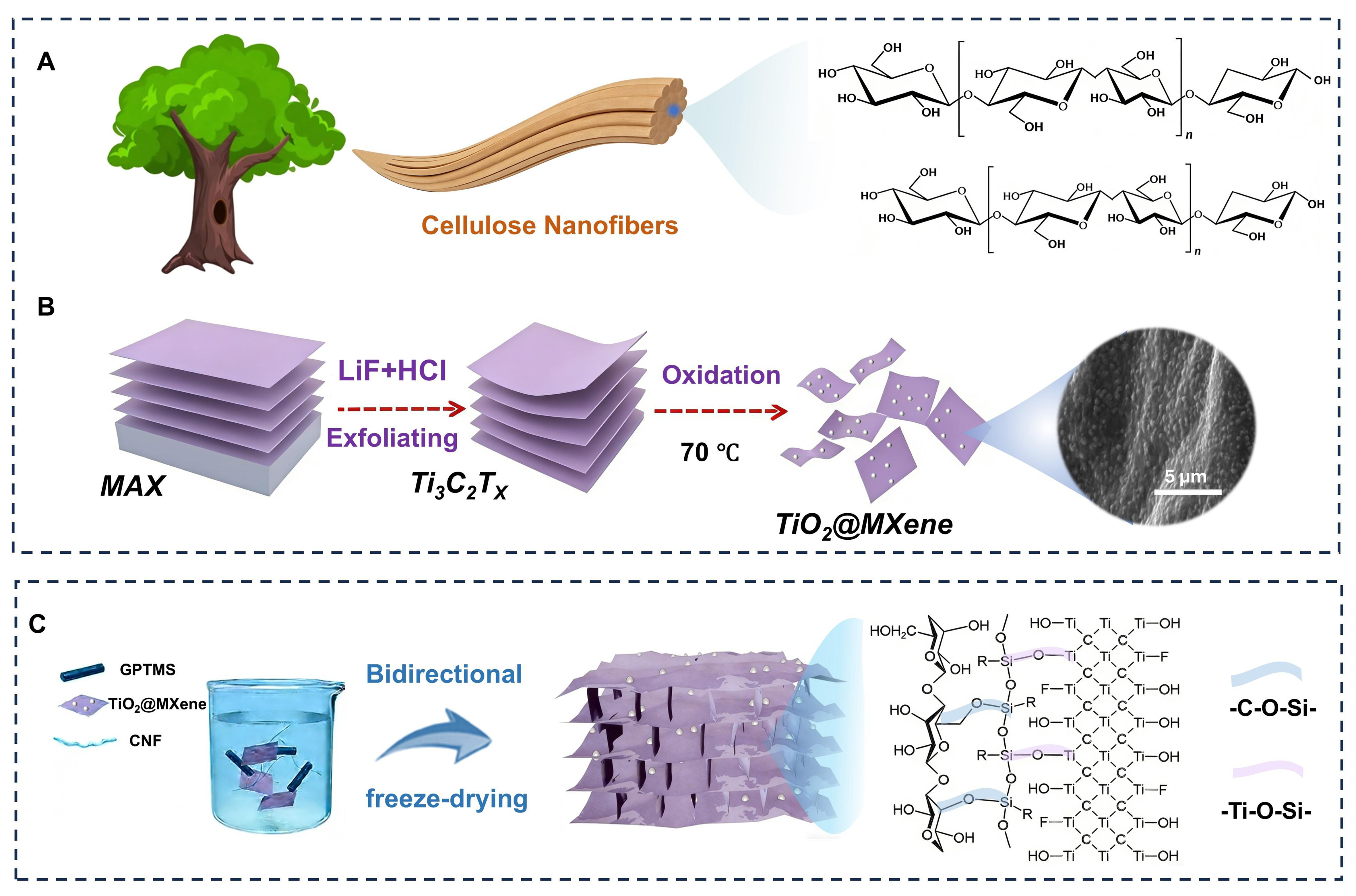
Figure 1. Preparation process of G-T@M/C aerogel. (A) Schematic illustration of preparing CNF; (B) Schematic illustration of the TiO2@MXene preparation process; (C) Schematic illustration of preparing G-T@M/C aerogel by crosslinking CNF and TiO2@MXene with GPTMS. CNF: Cellulose nanofiber; GPTMS: (3-glycidyloxypropyl) methyldiethoxysilane.
The surface structure and chemical crosslinking of the CNF and MXene components were investigated using a combination of characterization techniques. The obtained aerogel [Figure 2A] has dimensions of 20 mm × 20 mm × 20 mm, a mass of 0.089 g, and a calculated bulk density of 11.11 mg·cm-3. It demonstrated a typical anisotropic layered porous architecture [Figure 2B]. The pre-oxidation treatment resulted in the formation of a uniform distribution of TiO2 on the surface of MXene [Figure 2C]. Their corresponding energy-dispersive X-ray spectroscopy (EDS) elemental distribution maps revealed a uniform distribution of C, Ti, and Si across the surface [Figure 2D]. The appearance of characteristic anatase TiO2 peaks near 23.09° in the XRD analysis pattern of G-T@M/C [Figure 2E] confirms the presence of TiO2 on the MXene surface[21,22]. XRD patterns of the T@M, T@M/C, and G-T@M/C nanocomposites reveal a progressive shift of the characteristic MXene diffraction peak from 7.8° to 5.7°, and further to 3.5° [Figure 2F], suggesting the intercalation of CNF and GPTMS into the MXene interlayers[23]. XPS analysis of G-T@M/C aerogel revealed a characteristic Si–O–Ti bond at 531.2 eV in the O 1s spectrum [Figure 2G] and a C–O–Si bond at 102.2 eV in the Si 2p spectrum [Figure 2H], which also correlates with the successful crosslinking of GPTMS with CNF and MXene[19,24]. FTIR analysis of the G-T@M/C film displays absorption peaks at 926, 1,262 and 1,171 cm-1
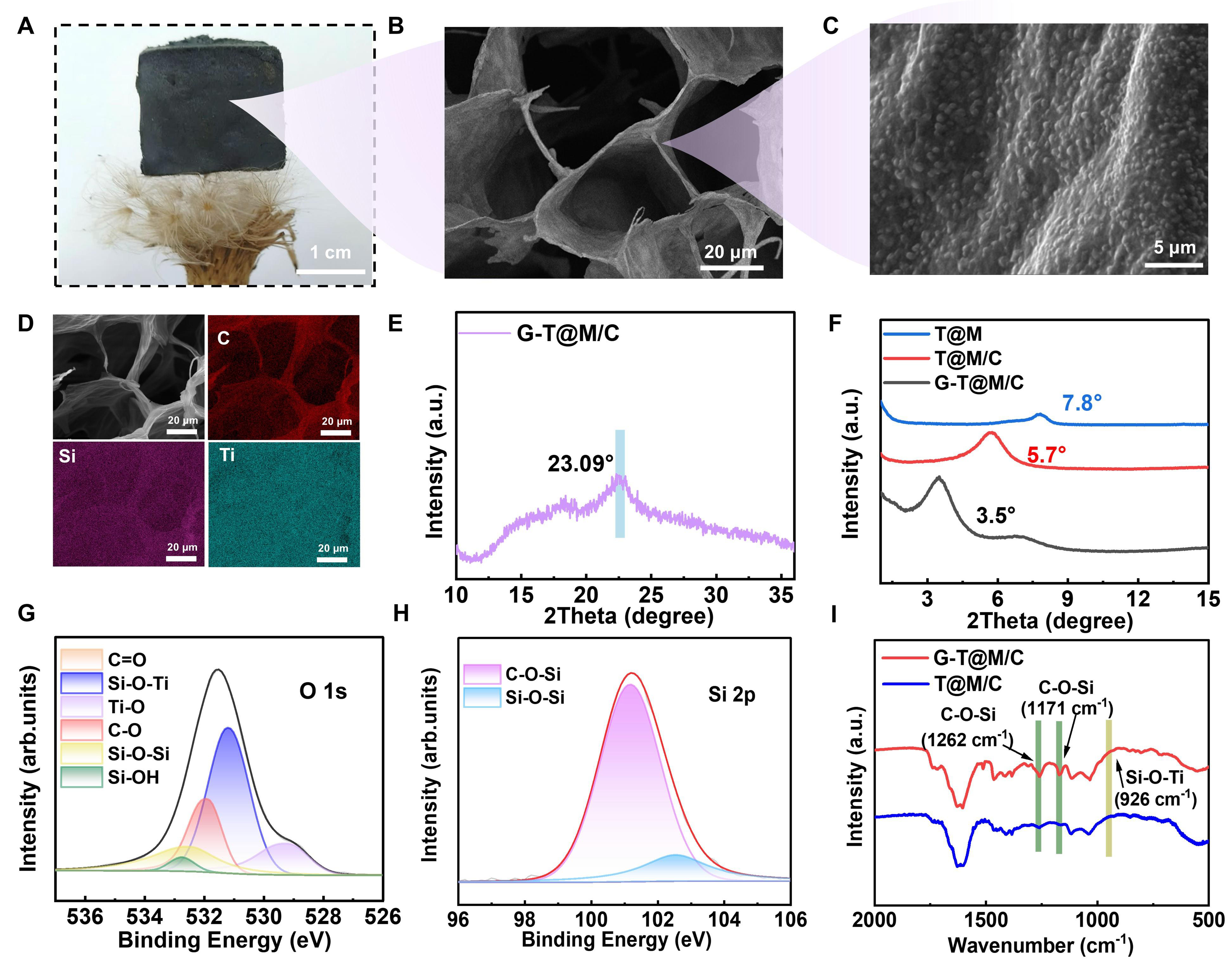
Figure 2. (A) Photo image of the lightweight G-T@M/C aerogel; (B) SEM image of G-T@M/C aerogel; (C) SEM image of oxidized MXene; (D) EDS elemental mapping of C, O, Ti, and Si for the G-T@M/C composite; (E) XRD patterns of G-T@M/C; (F) XRD patterns of T@M, T@M/C, and G-T@M/C; XPS spectra of G-T@M/C in the (G) O 1s and (H) Si 2p region; (I) FTIR curves of G-T@M/C and T@M/C. SEM: Scanning electron microscopy; EDS: energy-dispersive X-ray spectroscopy; XRD: X-ray diffraction; XPS: X-ray photoelectron spectroscopy; FTIR: Fourier transform infrared spectroscopy.
Mechanical protection performance
The elastic mechanical performance of aerogels is critical for their practical applicability. As shown in Figure 3A, the G-T@M/C aerogel demonstrates significant rebound recovery after being subjected to 90% compressive strain. Under the same strain, pure CNF aerogel reaches a maximum compressive stress of
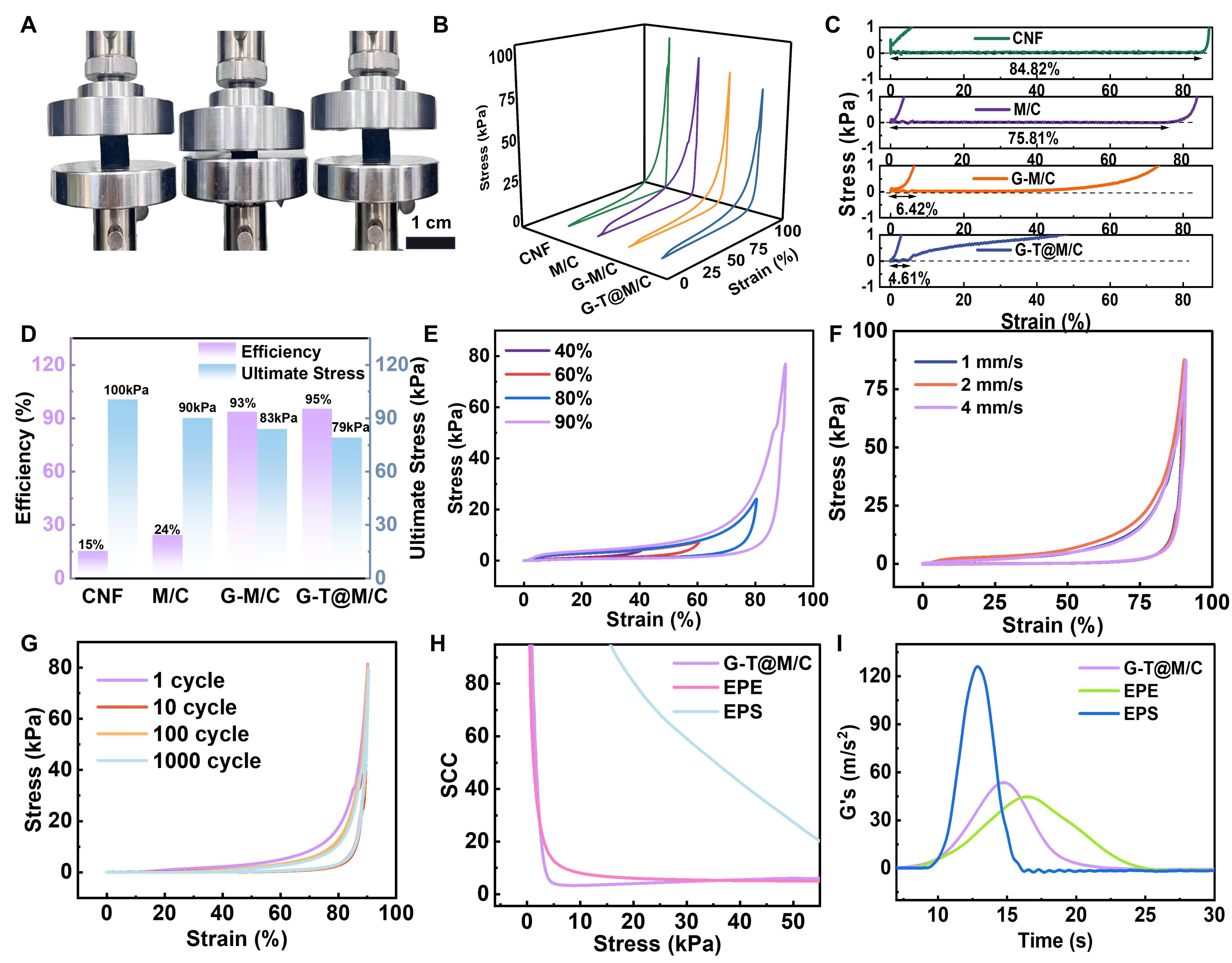
Figure 3. (A) Optical images of G-T@M/C in the initial state, at 90% compressive strain, and after full strain release; (B) Compressive stress–strain curves of CNF, M/C, G-M/C, and G-T@M/C; (C) Partial enlargement of (D); (D) Ultimate stress and height retention of CNF, M/C, G-M/C, and G-T@M/C at 90 % strain; (E) The stress–strain curves of G-T@M/C at different compressive strains; (F) Stress–strain curves of G-T@M/C compressed to 90% at different speeds; (G) Stress–strain profiles of G-T@M/C during the 1st, 10th, 100th, and 1,000th compression-release cycles at 90% strain; (H and I) The SCC and drop acceleration of EPE, EPS, and G-T@M/C foams. CNF: Cellulose nanofiber; SCC: static cushioning coefficient.
Beyond elasticity, the cushioning performance of aerogels is vital for their practical use. The G-T@M/C aerogel was evaluated alongside commercial EPE and EPS foams using the SCC and the acceleration response (G’s) in drop tests. The SCC represents the stress magnitude required to resist unit stress energy. As shown in Figure 3H, the G-T@M/C aerogel displays a lower SCC across the 2.4-36.2 kPa range compared to EPE and EPS, highlighting its superior performance in low-stress scenarios. G-T@M/C aerogel exhibits optimal SCC of 3.32 at 8.3 kPa, while EPE and EPS exhibited optimal SCC values of 4.84 and 2.92 at stresses of 68 and 168 kPa, respectively. These results suggest that under identical low-pressure energy input, the G-T@M/C aerogel absorbs more energy than EPE or EPS and provides enhanced protection. G’s represents the acceleration response during a vertical drop from a specific height. A smaller peak acceleration (G’s value) means the outer aerogel can effectively absorb impact energy, delivering superior cushioning and protective performance for internal components. In drop tests from 30 cm height, the G’s value serves as an indicator of energy absorption; a lower peak implies better cushioning and protection for the contents[41]. The width of the G’s peak reflects the cushioning duration after ground contact[42,43]. An overly short duration may lead to rapid material rebound and potential secondary impact on the packaged object. As illustrated in Figure 3I, the aerogel exhibits a peak G’s value markedly lower than EPS and slightly higher than EPE, confirming its improved capacity to dissipate impact energy. This indicates that G-T@M/C aerogel significantly outperforms EPS in impact energy absorption, while exhibiting performance comparable to EPE.
The internal mechanisms underlying the superelasticity, cushioning capacity, and durability of G-T@M/C aerogel were investigated via SEM analysis. As shown in Supplementary Figure 9, the aerogel possesses a regularly arranged quadrilateral layered architecture. Under 90% compressive strain, the pore walls deform through bending rather than fracture or collapse. Specifically, the walls undergo quadrilateral folding and S-shaped bending [Supplementary Figure 10], which helps to dissipate impact energy and offer sufficient space for cushioning[44,45]. After compression recovery, the pore walls recover their original morphology. This microstructure explains how the three-dimensional network formed by GPTMS-crosslinked T@M and CNF achieves superelastic recovery cycling through synergistic material mechanical interactions and covalent crosslinking. After 1,000 compression cycles, the aerogel shows signs of incomplete rebound, decreased structural regularity, and localized fracture of pore walls [Supplementary Figure 11]. These microstructural changes account for the slight degradation in mechanical strength observed after repeated loading. We also investigate the pore size distribution, porosity, and density data of pure CNF, M/C, G-M/C, and G-T@M/C aerogels, and analyze the correlation between these structural parameters and mechanical/sensing performance. As demonstrated in Supplementary Figure 6 and Supplementary Table 1, the G-T@M/C aerogel exhibits the largest pore size (29.00 μm) and the lowest density (11.11 mg/cm3). Its excellent mechanical and sensing properties can be reasonably explained by its unique structural features. The large pores provide ample space for deformation, enabling the aerogel to withstand significant compressive strain while maintaining excellent resilience[46]. Furthermore, the well-oriented MXene/CNF network, combined with the “molecular bridging” or “hinge-like” action of GPTMS (G), effectively suppresses crack propagation and enhances the overall toughness of the composite framework[47]. This structural design also endows the material with excellent fatigue resistance: under cyclic compression, the large-pore walls have sufficient bending space and do not collide with one another, thereby preventing permanent structural collapse[48].
Physical pressure monitoring properties
The high electrical conductivity of MXene and the porous architecture of the G-T@M/C aerogel enable its function as a piezoresistive sensor capable of responding to external pressure. Figure 4A shows the ΔI/I0–strain calibration curve, which can be divided into three distinct strain regions with progressively decreasing sensitivity: low strain (0%-25%), medium strain (25%-40%), and high strain (40%-80%), the corresponding sensitivities are 3.9, 1.6, and 0.96, respectively, with matching linear correlation coefficients of 0.99, 0.97, and 0.99. When retested at a high relative humidity of 75%, the ΔI/I0–strain calibration curve showed negligible change [Supplementary Figure 12]. The pressure sensing behavior of MXene aerogels arises from the synergistic coupling between the porous scaffold architecture and the MXene conductive network. The 3D interconnected porous structure serves as a mechanically compliant framework that undergoes progressive pore collapse under compressive loading, rather than abrupt densification[49]. This sequential deformation - initiated from larger macropores and extending to smaller mesopores - ensures a gradual increase in the contact area between adjacent MXene-coated pore walls, thereby extending the linear sensing range and preventing premature signal saturation. Simultaneously, the MXene nanosheets assembled on the pore walls form a continuous conductive network whose electrical resistance is highly sensitive to compressive strain. Upon pressure application, two distinct contributions govern the resistance decrease: (i) the formation of additional conductive pathways as neighboring pore walls come into contact; and (ii) the reduction of inter-sheet tunneling barriers as the distance between MXene nanosheets decreases. These coupled mechanisms enable MXene aerogel-based sensors to achieve both high sensitivity and a wide detection range[50]. Notably, the hierarchical nature of the porous structure allows for pressure discrimination across a broad spectrum: subtle pressures are detected through initial contacts at isolated pore wall junctions, while higher pressures involve extensive pore collapse and near-complete conductive network percolation[51]. The sensor also demonstrated rapid response and recovery times of 84 and 62 ms [Figure 4B]. Moreover, when the compression rate rose from 1 to 8 mm/s, the peak ΔI/I0 stayed nearly constant at approximately 1.6. Figure 4C indicates that the sensing performance of the G-T@M/C aerogel is stable and unaffected by speed. Under a constant strain rate of 2 mm/s, Figure 4D shows the ΔI/I0 values measured at 20%, 40%, 60%, and 80% strain were 0.83, 1.25, 1.47, and 1.63, respectively, consistent with the calibration curve in Figure 4A. Moreover, G-T@M/C aerogel can distinguish between different objects and different masses of the same object [Supplementary Figure 13]. The sensor’s long-term reliability was confirmed through 1,500 compression-release cycles (0%-80% strain), during which it exhibited consistently stable resistance. Steady performance across magnified views of cycles 98-106, 772-782, and 1,410-1,420 further attests to its high durability [Figure 4E].
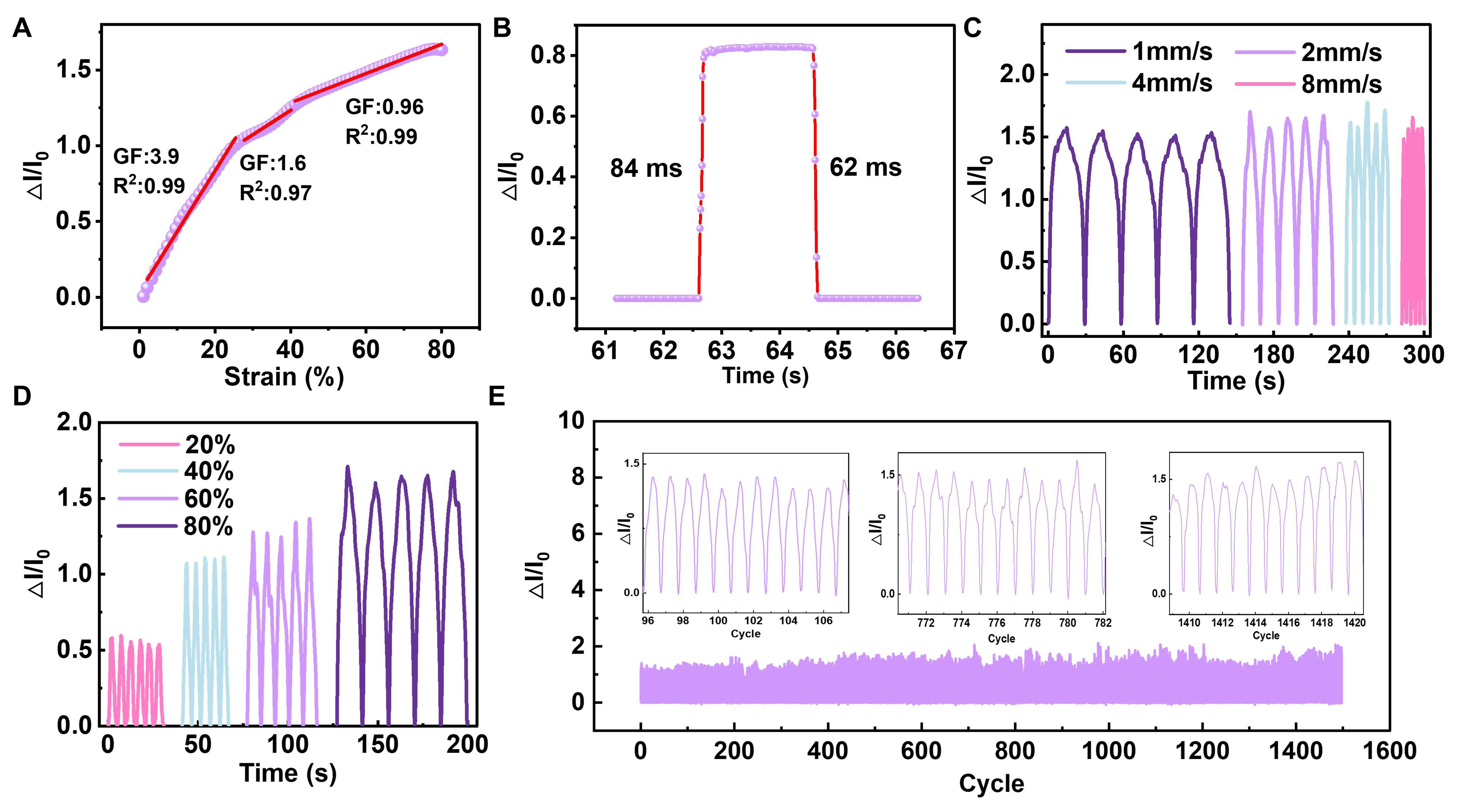
Figure 4. (A) Curve of relative current variation for G-T@M/C across a strain range of 0% to 80%; (B) Response and recovery time of G-T@M/C aerogel; ΔI/I0 value of G-T@M/C (C) at different compression rates at 80% strain and (D) under different compression strains; (E) Sensing performance stability of G-T@M/C at 80% strain for 1,500 cycles. GF: Gauge factor; R2: coefficient of determination.
Gas sensing performance
The sensing performance toward NH3 is essential for the practical application of the G-T@M/C sensor. The selectivity of the G-T@M/C sensor was evaluated against several common interfering gases. As shown in Figure 5A, the sensor displays a markedly stronger response to 1 ppm ammonia than to typical reducing gases (formaldehyde, carbon monoxide), or oxidizing gases (carbon dioxide). We also tested typical gases produced during the explosion, such as sulfur dioxide (SO2) and nitrogen dioxide (NO2). SO2 is an acidic, weakly oxidizing gas. On the TiO2 surface, adsorption is primarily physical, with minimal charge transfer and no significant change in electrical resistance [Supplementary Figure 14A], in line with previous literature. TiO2 grows in situ on the MXene surface, forming a metal–semiconductor heterojunction: the MXene provides high electrical conductivity and an electron reservoir, while TiO2 (n-type semiconductor) provides adsorption sites. NO2 (a strong oxidizing agent) captures electrons on the TiO2 surface, while interfacial charge transfer occurs from MXene to TiO2, significantly altering the material’s electrical conductivity (increased resistance) and generating a strong sensing signal [Supplementary Figure 14B]. Figure 5B presents the resistance and response curves of the sensor upon exposure to NH3 at concentrations ranging from 0.001 to 10 ppm at room temperature. A noise analysis was conducted on the response to 1 ppb of ammonia, confirming the accuracy of the 1 ppb reading [Supplementary Figure 15]. A linear relationship between the resistance response and NH3 concentration is observed from 0.001 to 30 ppm [Figure 5C], with a high correlation coefficient (R2 = 0.98), indicating a broad sensing range and excellent response linearity (The 0.001-10 ppm range consists of a set of arbitrarily selected concentration points intended to demonstrate the sensor’s step response characteristics at various typical concentration levels (as shown in Figure 5B). Because there are too few data points in the 0.001-10 ppm range, the 0.001-30 ppm range was specifically designed to evaluate the sensor’s linear response behavior). Subsequently, the transient response of G-T@M/C to 10 ppm NH3 gas was investigated under various humidities, ranging from dry air to 85% relative humidity [Supplementary Figure 16]. In all cases, the aerogel’s resistance increased as NH3 was adsorbed. NH3 is highly soluble in water; it is rapidly absorbed by the water film on the material surface and reacts with water to form ammonium ions (NH4+). The mobility of NH4+ is much lower than that of H+[52], resulting in a significant decrease in the efficiency of the ionic conduction pathway. Furthermore, the generated NH4+ ions react with pre-adsorbed O2- and OH- ions on the material surface, consuming a large number of conductive ions (H+/H3O+). The ionic conduction pathways are severely disrupted, causing a sharp drop in carrier concentration and a substantial increase in resistance. The presence of moisture effectively provides ammonia with an efficient “reaction platform”, resulting in a much greater increase in resistance compared to dry conditions[53]. Figure 5D compares the response–recovery profiles of G-M/C and G-T@M/C sensors to 1 ppm NH3. The G-T@M/C sensor exhibited a ΔR/R0 value of approximately 0.062, about 1.58 times higher than that of G-M/C (0.039), along with a more stable baseline resistance. Furthermore, the response/recovery times for the G-M/C and G-T@M/C gas sensors were approximately 130 s/200 s and 17 s/170 s, respectively. The response/recovery time of the G-T@M/C gas sensor was 0.12 times that of the G-M/C sensor for response and 0.85 times for recovery. According to the experimental findings, we propose a sensing mechanism to explain the enhanced sensitivity of the G-T@M/C sensor [Figure 5E]. To verify whether a Schottky barrier forms at the TiO2/MXene interface, ultraviolet photoelectron spectroscopy (UPS) measurements were conducted [Figure 5F]. The work function of pristine MXene was determined to be 4.69 eV, which decreased to 4.37 eV after oxidation. This reduction of approximately 0.32 eV indicates the formation of an interfacial Schottky barrier heterojunction, attributed to the intrinsically lower work function of TiO2 and the resulting band alignment. The built-in electric potential at this heterointerface introduces a depletion layer, thereby modulating carrier transport. Upon exposure to electron-donating NH3 molecules, the barrier height is dynamically reduced, enhancing interfacial conductivity and amplifying the resistive response of the sensor. When n-type TiO2 is deposited on the MXene surface, electrons transfer from the TiO2 conduction band to MXene, establishing an internal electric field at their interface[54]. Upon air contact, oxygen molecules capture electrons according to Equations (5) and (6)[55] to form oxygen anions, reducing the electron density on the TiO2 surface[56].
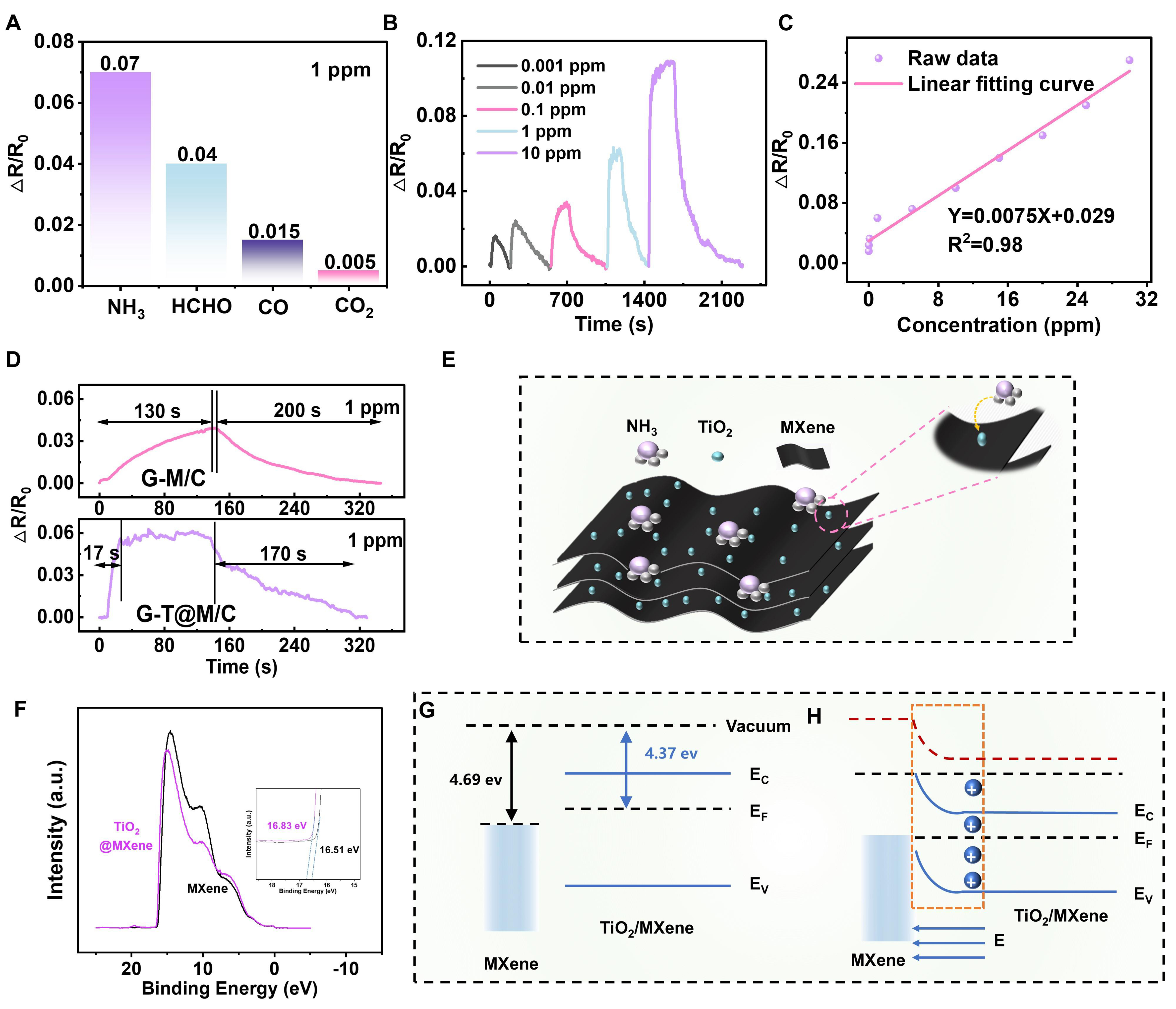
Figure 5. (A) Response values of the G-T@M/C sensor to different gases at the same concentration (1 ppm); (B) Response-recovery curve of the G-T@M/C sensor at different NH3 concentrations; (C) Resistance response curve of the G-T@M/C sensor at different NH3 concentrations; (D) Response-recovery curves of the G-M/C sensor (upper) and G-T@M/C (lower) sensor at 1 ppm NH3 concentration; (E) Schematic diagram of the gas response mechanism of the G-T@M/C sensor; (F) UPS spectra of MXene and TiO2@MXene; (G) The alignment of MXene energy levels before and after oxidation demonstrates the formation of a TiO2@MXene Schottky barrier; (H) Schematic illustration of charge transfer and band bending mechanisms when G-T@M/C aerogel comes into contact with ammonia gas. UPS: Ultraviolet photoelectron spectroscopy.
Conversely, in an NH3 environment, NH3 molecules interact with adsorbed O2- anions via Equation (7)[55], capturing electrons and enhancing the electric field, thereby increasing resistance. Relevant investigations reveal that the adsorption energy of small molecules on the TiO2 surface presents a positive linear relationship with their HOMO energy levels[3,57]. Figures 5G and H illustrate the proposed ammonia sensing mechanism. Partial oxidation of MXene leads to the in-situ formation of TiO2 nanoparticles on the MXene surface, thereby constructing a Schottky barrier heterojunction. As shown in Figure 5G, the Fermi level of MXene lies below the conduction band of TiO2, which drives electron transfer and induces upward band bending of TiO2 at equilibrium. In this heterostructure, the TiO2-rich regions serve as the main NH3 adsorption sites[3], while the remaining MXene network provides a conductive pathway. Accordingly, electron donation from adsorbed NH3 on TiO2 effectively modulates the TiO2/MXene barrier and amplifies the resistance change across the junction network. Under exposure to NH3, the adsorbed electron-donating molecules neutralize the holes in MXene and reduce the hole concentration. Consequently, the built-in electric field is enhanced, the Schottky barrier is strengthened, electron transport becomes more difficult, and the overall resistance increases. Therefore, introducing TiO2 onto the MXene surface to create a heterointerface promotes effective charge separation, which amplifies the electrical signal change upon NH3 adsorption. This mechanism enhances the material’s responsiveness to NH3, thereby improving the sensitivity of ammonia gas detection. Evaluated by the key performance metrics of rebound rate, Compression ratio, piezoresistive sensitivity, gas detection limit, and response time, this work shows distinct advantages over state-of-the-art CNF/MXene dual-mode aerogels [Supplementary Table 2 and Supplementary Figure 17][23,46,58,59].
Application
Owing to its mechanical properties and multifunctional sensing capabilities, the G-T@M/C aerogel can be integrated into the inner structure of safety helmets to provide both impact protection and gas leakage warning [Figure 6A]. Designed for blasting personnel, these helmets not only shield wearers from physical hazards such as falling rocks but also continuously detect ambient ammonia levels. The cushioning performance of the G-T@M/C aerogel was evaluated against common materials (EPE and EPS) using a drop test with eggs. When dropped from a height of 30 cm, eggs impacting the EPE and EPS surfaces rebounded and sustained secondary damage. In contrast, eggs dropped onto the G-T@M/C aerogel exhibited no rebound and remained intact, demonstrating its superior energy absorption [Figure 6B]. To visually evaluate the cushioning protection performance of G-T@M/C, raw eggs were dropped from a height of 100 cm onto surfaces of G-T@M/C aerogel. As shown in the two sequential images in Figure 6C, eggs dropped onto G-T@M/C exhibited no rebound and remained intact, clearly demonstrating the aerogel’s superior energy absorption in practical scenarios [Supplementary Video 1]. Additionally, a flexible 3 × 3 G-T@M/C aerogel array was assembled, with a 2 × 2 cm2 active pixel region and an overall device dimension of 8 × 8 cm2 [Figure 6D]. When a 100 g weight was placed within the pressure testing zone (with a schematic at top left), the output resistance signals from the sensing pixels accurately reconstructed the pressure distribution at the contact area. Furthermore, this aerogel was uniformly distributed inside the safety helmet, with each aerogel unit connected in series to a light-emitting diode (LED) to provide a visual indication of external mechanical pressure and ammonia concentration. External impacts are simulated through hammer strikes: when either side of the helmet is struck, the corresponding warning LED on that side immediately turns on. For gas detection, a leak is simulated by evaporating a 10 ppm ammonia solution, triggering the corresponding indicator light to illuminate and thereby providing an effective early warning [Figure 6E and Supplementary Video 2].
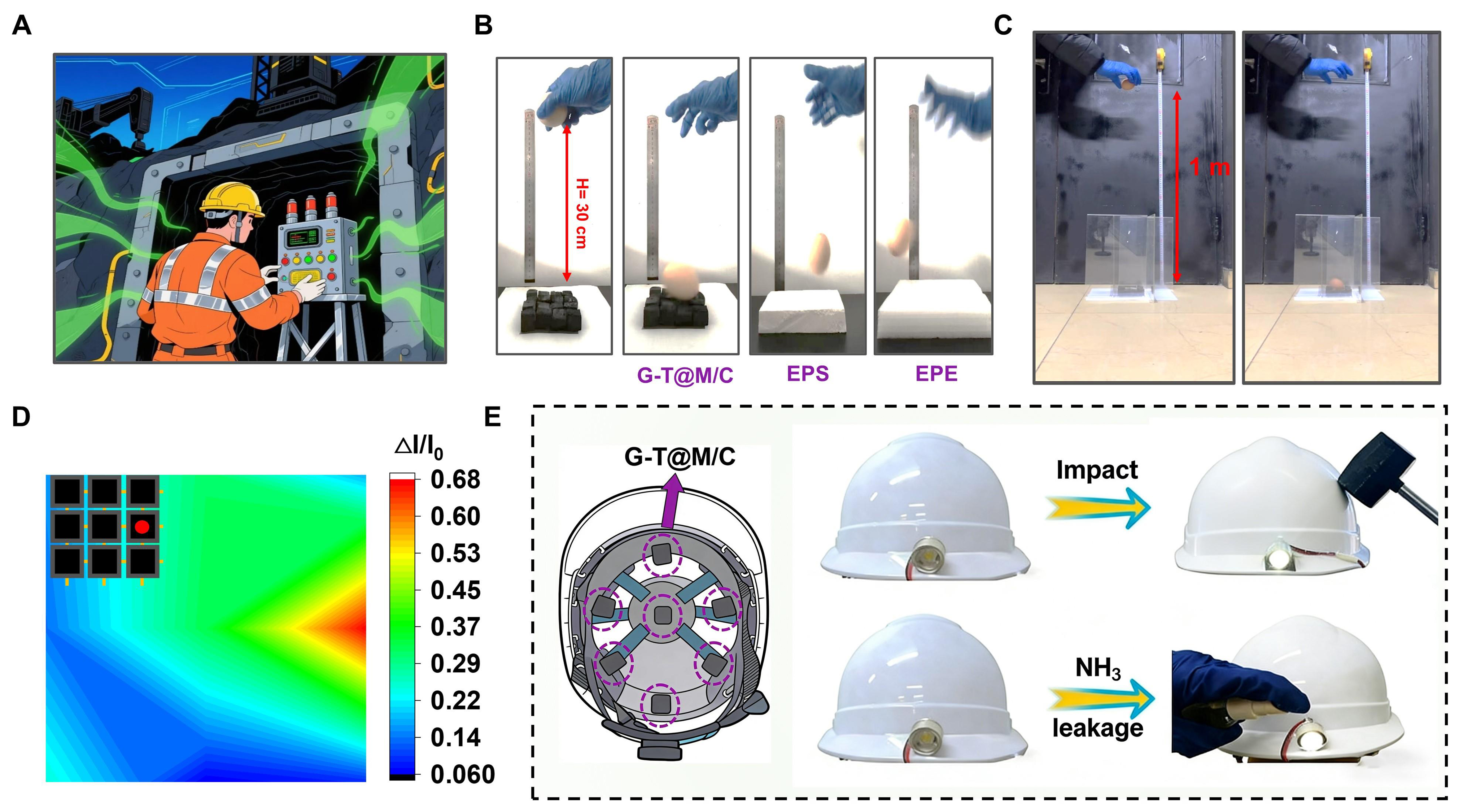
Figure 6. (A) Schematic diagram of the intelligent protective safety helmet structure based on G-T@M/C aerogel; (B) Photographs of eggs after drop tests using G-T@M/C aerogel, EPE and EPS as cushioning liners; (C) An egg drop test from a height of 1 meter was conducted using G-T@M/C aerogel as a cushioning pad; (D) Photograph of a sensor array detecting a 100 g weight and the corresponding pressure distribution relative to the change in electric current; (E) Integrated circuit display system for monitoring pressure and ammonia gas. Variation in LED bulb brightness within integrated circuits under pressure. Variation in LED bulb brightness within integrated circuits in ammonia gas conditions. LED: Light-emitting diode.
CONCLUSIONS
In summary, this study successfully developed a multifunctional composite aerogel for intelligent safety protection in hazardous environments. This aerogel exhibits high mechanical resilience, retaining 95% rebound capacity at 90% strain along with superior cushioning performance. It also realizes dual pressure and gas sensing, with a detection limit of 1 ppb for ammonia. These properties allow seamless integration into safety helmets to provide impact protection, pressure sensing, and real-time toxic gas warning. This work offers a promising strategy for designing next-generation intelligent protective equipment that combines physical safeguarding with environmental monitoring.
DECLARATIONS
Authors’ contributions
Conceptualization, methodology, formal analysis, investigation, writing - original draft, writing - review and editing, visualization: Mao, N.
Conceptualization, methodology, validation, formal analysis, investigation, data curation, writing - original draft, visualization: Yuan, J.
Conceptualization, methodology: Li, X.
Validation, investigation, resources, data curation, writing - review and editing, visualization: Ren, G.
Visualization: Jia, C.
Data curation: Huang, J.; Song, Y.
Supervision: Liu, H.; Yang, S.
Conceptualization, investigation, writing - review and editing, supervision, project administration, funding acquisition: Liu, Y.
Supervision, funding acquisition: Cheng, B.
Availability of data and materials
The data that support the findings of this study are available from the corresponding author upon reasonable request.
AI and AI-assisted tools statement
During the preparation of this work, the authors used AI tool ChatGPT (version 5.4, released 2026-03-05) due to language polishing and the generation of schematic illustrations (Figure 6A and the plant elements in Figure 1A). The authors reviewed and edited all AI-generated content and accept full responsibility for the published material.
Financial support and sponsorship
This work was supported by the State Key Laboratory of Bio-based Fiber Materials (No. SKLBFM202523), National Natural Science Foundation of China (No. 52503322), Tianjin Science and Technology Project (No. 25ZXZSSS00730, No. 25ZXZSSS00800).
Conflicts of interest
Huang, J. and Song, Y. are affiliated with the Electric Power Research Institute of Yunnan Power Grid Co., Ltd. The other authors declare no conflicts of interest.
Ethical approval and consent to participate
Not applicable.
Consent for publication
Not applicable.
Copyright
© The Author(s) 2026.
Supplementary Materials
REFERENCES
1. Lakzian, K. Comprehensive analysis of a major ammonium nitrate accident: causes, consequences, safety recommendations, and emergency response for ammonium nitrate incidents. Next. Res. 2025, 2, 100270.
2. Liu, T.; Li, X.; He, H.; et al. Bioinspired triboelectric droplet sensor for ammonia monitoring. Nat. Commun. 2026, 17, 2153.
3. Zhang, D.; Yu, S.; Wang, X.; et al. UV illumination-enhanced ultrasensitive ammonia gas sensor based on (001)TiO2/MXene heterostructure for food spoilage detection. J. Hazard. Mater. 2022, 423, 127160.
4. Kim, Y.; Lee, S.; Song, J.; et al. 2D transition metal dichalcogenide heterostructures for p- and n-type photovoltaic self-powered gas sensor. Adv. Funct. Mater. 2020, 30, 2003360.
5. Du, L.; Wang, X.; Sun, M.; et al. Polyurethane nonwovens integrated with nanocomposite as twist-assisted healing flexible sensor for ultrasensitive room-temperature NO2 detection. Adv. Mater. 2026, 38, e09512.
6. Jiang, Y.; Wang, Y.; Wang, T.; et al. Wireless wearable MOF-based NH3 gas sensor patch with a zeolite overlayer for suppressing NO2 interference. ACS. Sens. 2026, 11, 2656-67.
7. Zhou, M.; Xu, B.; Wang, D.; Wu, Z.; Zhang, L.; Cai, S. A wearable acetone gas sensor enabled by quantum dot-sensitized flower-like Ti3C2Tx for metabolic monitoring. ACS. Sens. 2026, 11, 157-67.
9. Zhou, J.; Zhang, J.; Sang, M.; et al. Advanced functional Kevlar composite with excellent mechanical properties for thermal management and intelligent safeguarding. Chem. Eng. J. 2022, 428, 131878.
10. Wang, Y.; Liu, J.; Zhao, Y.; et al. Temperature-triggered fire warning PEG@wood powder/carbon nanotube/calcium alginate composite aerogel and the application for firefighting clothing. Compos. Part. B. Eng. 2022, 247, 110348.
11. Hu, Z.; Wang, S.; Wu, J.; et al. Robust multi-scale bionic ANF/PMSQ aerogel featuring impact protection, thermal insulation and anti-icing functions. Compos. Part. B. Eng. 2025, 297, 112304.
12. Du, H.; Liu, K.; Xu, T.; et al. Lignocellulosic films: preparation, properties, and applications. Chem. Rev. 2025, 125, 11666-814.
13. Saleh, A. K.; El-Sayed, M. H.; El-Sakhawy, M. A.; et al. Cellulose-based conductive materials for bioelectronics. ChemSusChem 2025, 18, e202401762.
14. Gao, M.; Shang, Y.; Li, B.; Du, H. Sustainable preparation of cellulose nanocrystals: state of the art and perspectives. Green. Chem. 2022, 24, 9346-72.
15. Isogai, A.; Zhou, Y. Diverse nanocelluloses prepared from TEMPO-oxidized wood cellulose fibers: nanonetworks, nanofibers, and nanocrystals. Curr. Opin. Solid. State. Mater. Sci. 2019, 23, 101-6.
16. Xu, K.; Lv, Q.; Liu, L.; et al. Silicified wood-inspired, high-strength fire-resistant chitin-based aerogels for sustainable high-temperature thermal insulation. Adv. Funct. Mater. 2026, 36, e75626.
17. Zhao, Y.; Peng, C.; Yang, Z.; et al. Mechanically strong and flame-retardant cellulose-based aerogel prepared via phosphorylation-coupled Ca2+ coordination. Gels 2025, 11, 408.
18. Pan, X.; Wang, Y.; Xu, Z.; et al. Improving electronics stability via covalent-linked interfaces for ultra-robust pressure sensing array. Chem. Eng. J. 2024, 489, 151354.
19. Shi, X.; Fan, X.; Zhu, Y.; et al. Pushing detectability and sensitivity for subtle force to new limits with shrinkable nanochannel structured aerogel. Nat. Commun. 2022, 13, 1119.
20. Cheng, H.; Li, Y.; Wang, B.; et al. Chemical crosslinking reinforced flexible cellulose nanofiber-supported cryogel. Cellulose 2018, 25, 573-82.
21. Kuang, D.; Wang, L.; Guo, X., et al. Facile hydrothermal synthesis of Ti3C2Tx-TiO2 nanocomposites for gaseous volatile organic compounds detection at room temperature. J. Hazard. Mater. 2021, 416, 126171.
22. Tai, H.; Duan, Z.; He, Z., et al. Enhanced ammonia response of Ti3C2Tx nanosheets supported by TiO2 nanoparticles at room temperature. Sens. Actuators. B. Chem. 2019, 298, 126874.
23. Xu, T.; Song, Q.; Liu, K.; et al. Nanocellulose-assisted construction of multifunctional MXene-based aerogels with engineering biomimetic texture for pressure sensor and compressible electrode. Nanomicro. Lett. 2023, 15, 98.
24. Zhao, J.; Yang, Y.; Yang, C.; et al. A hydrophobic surface enabled salt-blocking 2D Ti3C2 MXene membrane for efficient and stable solar desalination. J. Mater. Chem. A. 2018, 6, 16196-204.
25. Kim, W. B.; Choi, S. H.; Lee, J. S. Quantitative analysis of Ti−O−Si and Ti−O−Ti bonds in Ti−Si binary oxides by the linear combination of XANES. J. Phys. Chem. B. 2000, 104, 8670-8.
26. Liu, R.; Pan, X.; Mao, Z.; et al. Well-cushioned and highly-elastic aerogel for multifunctional intelligent transportation packaging. Chem. Eng. J. 2024, 493, 152660.
27. Ren, J.; Li, Z.; Liu, S.; Xing, Y.; Xie, K. Silica–titania mixed oxides: Si–O–Ti connectivity, coordination of titanium, and surface acidic properties. Catal. Lett. 2008, 124, 185-94.
28. Niu, M.; Wang, H.; Chen, J.; Su, L.; Wu, D.; Navrotsky, A. Structure and energetics of SiOC and SiOC - modified carbon-bonded carbon fiber composites. J. Am. Ceram. Soc. 2017, 100, 3693-702.
29. Lin, W.; Hu, X.; You, X.; et al. Hydrophobic modification of nanocellulose via a two-step silanation method. Polymers 2018, 10, 1035.
30. Wetzelaer, G. A. H.; Blom, P. W. M. Comment on “Enhanced charge selectivity via anodic-C60 layer reduces nonradiative losses in organic solar cells”. ACS. Appl. Mater. Interfaces. 2022, 14, 7523-6.
31. Chen, Y.; Zhang, L.; Yang, Y.; et al. Recent progress on nanocellulose aerogels: preparation, modification, composite fabrication, applications. Adv. Mater. 2021, 33, e2005569.
32. Lipatov, A.; Lu, H.; Alhabeb, M.; et al. , Elastic properties of 2D Ti3C2Tx MXene monolayers and bilayers. Sci. Adv. 2018, 4, eaat0491.
33. Firestein, K. L.; von Treifeldt, J. E.; Kvashnin, D. G.; et al. Young’s modulus and tensile strength of Ti3C2 MXene nanosheets as revealed by in situ TEM probing, AFM nanomechanical mapping, and theoretical calculations. Nano. Lett. 2020, 20, 5900-8.
34. Gavezzotti, A. Comparing the strength of covalent bonds, intermolecular hydrogen bonds and other intermolecular interactions for organic molecules: X-ray diffraction data and quantum chemical calculations. New. J. Chem. 2016, 40, 6848-53.
35. Dereka, B.; Yu, Q.; Lewis, N. H. C.; Carpenter, W. B.; Bowman, J. M.; Tokmakoff, A. Crossover from hydrogen to chemical bonding. Science 2021, 371, 160-4.
36. Yu, H.; Xu, K.; Zhang, Z.; Cao, X.; Weng, J.; Wu, J. Oxygen functionalization-induced crossover in the tensile properties of the thinnest 2D Ti2C MXene. J. Mater. Chem. C. 2021, 9, 2416-25.
37. Dai, J.; Wei, C.; Wu, C. Fracture of Ti3C2-TiO2 atomically thin films. Extreme. Mech. Lett. 2024, 71, 102211.
38. McIntosh, B. J.; Márkus, B. G.; Nyáry, A.; Simon, F.; Forró, L.; Beke, D. Surface chemistry-driven oxidation mechanisms in Ti3C2Tx MXenes. Small. Sci. 2025, 5, 2500209.
39. Xie, K.; Wang, J.; Xu, K.; Wei, Z.; Zhang, M.; Zhang, J. In-situ synthesis of fluorine-free MXene/TiO2 composite for high-performance supercapacitor. Arab. J. Chem. 2024, 17, 105551.
40. Zhang, X.; Wang, J.; Jiang, Y.; et al. A 3D crinkled MXene/TiO2 heterostructure with interfacial coupling for ultra-fast and reversible potassium storage. J. Mater. Chem. A. 2024, 12, 7598-604.
41. Lu, X.; Wang, X.; Song, W.; et al. Sustainable lignocellulose bio-based foam with good cushioning performance and thermal insulation for transportation packaging. Ind. Crops. Prod. 2024, 216, 118758.
42. Song, W.; Pan, X.; Wang, X.; et al. Load-bearing structure inspired cellulose-based aerogel with high resilience and water tolerance. Adv. Funct. Mater. 2025, 35, 2415937.
43. Hakozaki, K.; Taniuchi, H.; Takahashi, S. Study on the drop impact acceleration of the radioactive package by new approximation method based on velocity obtained by integrating acceleration. J. Nucl. Sci. Technol. 2023, 60, 401-14.
44. Xia, Y.; Qin, H.; Tong, W.; et al. Ultra-stiff yet super-elastic graphene aerogels by topological cellular hierarchy. Adv. Mater. 2025, 37, e2417462.
45. Qin, B.; Yu, Z. L.; Huang, J.; et al. A petrochemical-free route to superelastic hierarchical cellulose aerogel. Angew. Chem. Int. Ed. Engl. 2023, 62, e202214809.
46. Wang, A.; Gao, Z.; Wu, S.; et al. Superelastic and ultra-soft MXene/CNF aerogel@PDMS-based dual-modal pressure sensor for complex stimuli monitoring. Adv. Sci. 2025, 12, e2502797.
47. Wang, Y.; Deng, Z.; Ou, H.; Feng, S.; Xiang, X. Polydopamine-bridged MXene/graphene composite aerogel for bifunctional applications in supercapacitors and piezoresistive sensors. Chem. Eng. J. 2025, 522, 167528.
48. Marszewski, M.; Dashti, A.; Mcneil, P. E.; et al. Elastic and plastic mechanical properties of nanoparticle-based silica aerogels and xerogels. Microporous. Mesoporous. Mater. 2022, 330, 111569.
49. Niu, Y.; Wang, C.; Huang, B.; et al. Bovine rumen inspired multiple-nested porous aerogel pressure sensor with high sensitivity and wide detection range. Sens. Actuators. B. Chem. 2026, 450, 139291.
50. Cheng, Y.; Li, L.; Liu, Z.; et al. 3D porous MXene aerogel through gas foaming for multifunctional pressure sensor. Research 2022, 2022, 9843268.
51. Chen, T.; Wang, J.; Wu, X.; Li, Z.; Yang, S. Ethanediamine induced self-assembly of long-range ordered GO/MXene composite aerogel and its piezoresistive sensing performances. Appl. Surf. Sci. 2021, 566, 150719.
52. Zhou, Y.; Wang, Y.; Wang, Y.; et al. MXene Ti3C2Tx-derived nitrogen-functionalized heterophase TiO2 homojunctions for room-temperature trace ammonia gas sensing. ACS. Appl. Mater. Interfaces. 2021, 13, 56485-97.
53. Wang, Y.; Zhou, Y.; Wang, Y. Humidity activated ionic-conduction formaldehyde sensing of reduced graphene oxide decorated nitrogen-doped MXene/titanium dioxide composite film. Sens. Actuators. B. Chem. 2020, 323, 128695.
54. Li, Y.; Deng, X.; Tian, J.; Liang, Z.; Cui, H. Ti3C2 MXene-derived Ti3C2/TiO2 nanoflowers for noble-metal-free photocatalytic overall water splitting. Appl. Mater. Today. 2018, 13, 217-27.
55. Dogra, N.; Gasso, S.; Sharma, A.; Sharma, K.; Sharma, S. TiO2 decorated MXene nanosheets for high-performance ammonia gas sensing at room-temperature. Surf. Interfaces. 2024, 48, 104290.
56. Zhang, D.; Jiang, C.; Li, P.; Sun, Y. Layer-by-layer self-assembly of Co3O4 nanorod-decorated MoS2 nanosheet-based nanocomposite toward high-performance ammonia detection. ACS. Appl. Mater. Interfaces. 2017, 9, 6462-71.
57. Kamachi, T.; Tatsumi, T.; Toyao, T.; et al. Linear correlations between adsorption energies and HOMO levels for the adsorption of small molecules on TiO2 surfaces. J. Phys. Chem. C. 2019, 123, 20988-97.
58. Lu, Z.; Kou, Y.; Hua, L.; et al. Porous and flexible aramid nanofiber/MXene nanosheet composite aerogel for rapid ammonia sensing at room temperature. ACS. Appl. Nano. Mater. 2025, 8, 7407-17.
Cite This Article
 Open Access
How to Cite
Download Citation
Export Citation File:
Type of Import
Tips on Downloading Citation
Citation Manager File Format
Type of Import
Direct Import: When the Direct Import option is selected (the default state), a dialogue box will give you the option to Save or Open the downloaded citation data. Choosing Open will either launch your citation manager or give you a choice of applications with which to use the metadata. The Save option saves the file locally for later use.
Indirect Import: When the Indirect Import option is selected, the metadata is displayed and may be copied and pasted as needed.
About This Article
Special Topic
Copyright

Data & Comments
Data
0








Comments
Comments must be written in English. Spam, offensive content, impersonation, and private information will not be permitted. If any comment is reported and identified as inappropriate content by OAE staff, the comment will be removed without notice. If you have any queries or need any help, please contact us at support@oaepublish.com.