



fig1
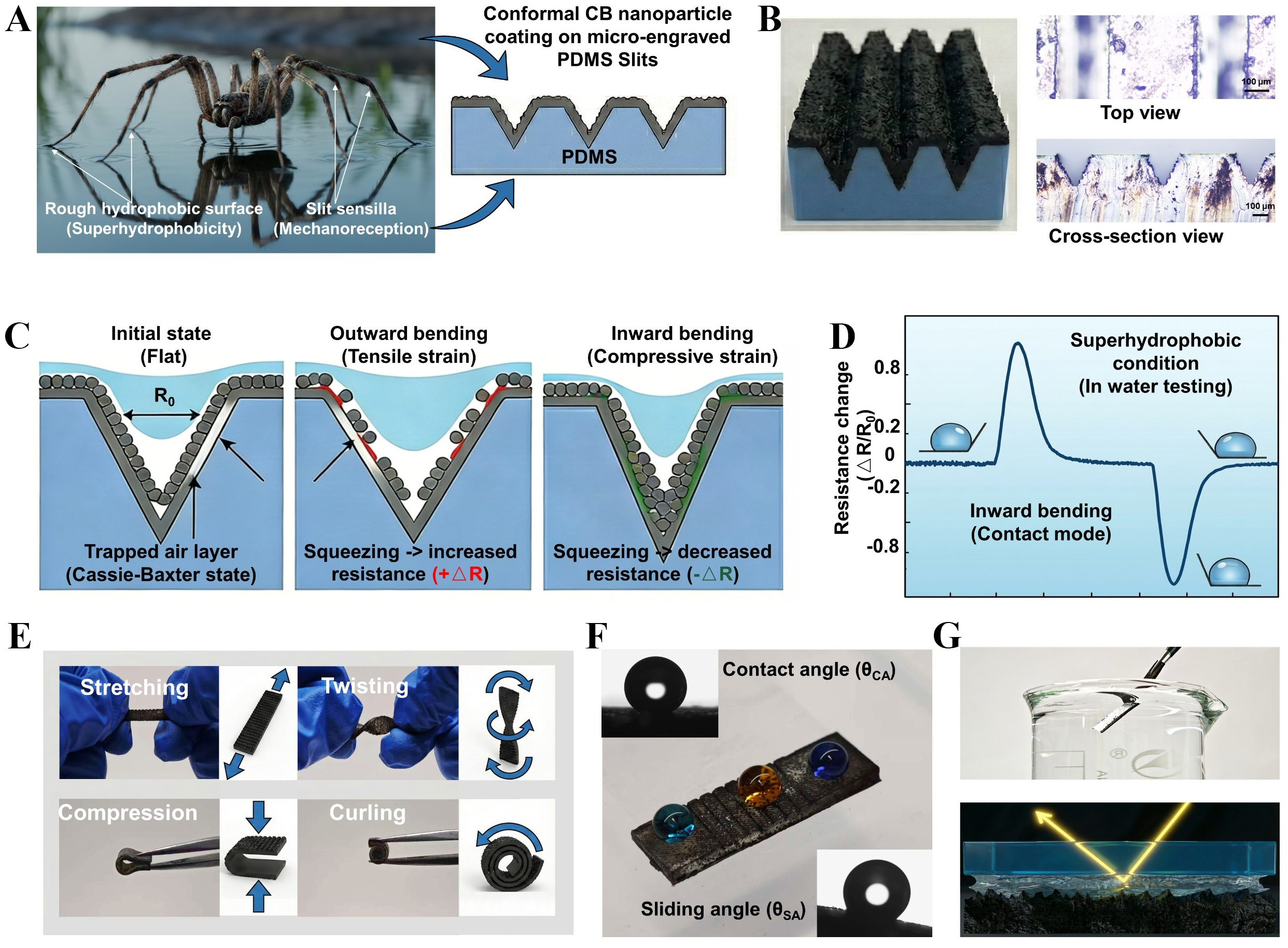
Figure 1. Bioinspired design strategy and electromechanical working principle of the monolithic superhydrophobic sensor. (A) Schematic of the biomimetic mapping of the fishing spider, translating its biological slit sensilla (mechanoreception) and hierarchical microsetae (superhydrophobicity) into a microengraved PDMS/CB architecture; (B) Schematic and optical microscopy images showing the macroscopic slit array, microscopic surface roughness (top view), and deep-groove profile (cross-sectional view); (C) Illustration of the bidirectional sensing mechanism under outward and inward bending, featuring a stable air-plastron interface; (D) Representative real-time resistance response curves corresponding to the bidirectional deformation modes; (E) Photographs demonstrating the mechanical flexibility of the sensor under stretching, twisting, compression, and curling; (F) Surface wettability characterization showing a high static water contact angle and low sliding angle with multicolored liquid droplets; (G) Underwater optical photograph of the air plastron, showing the characteristic “silver mirror” reflection. CB: Carbon black; PDMS: polydimethylsiloxane.