




fig1
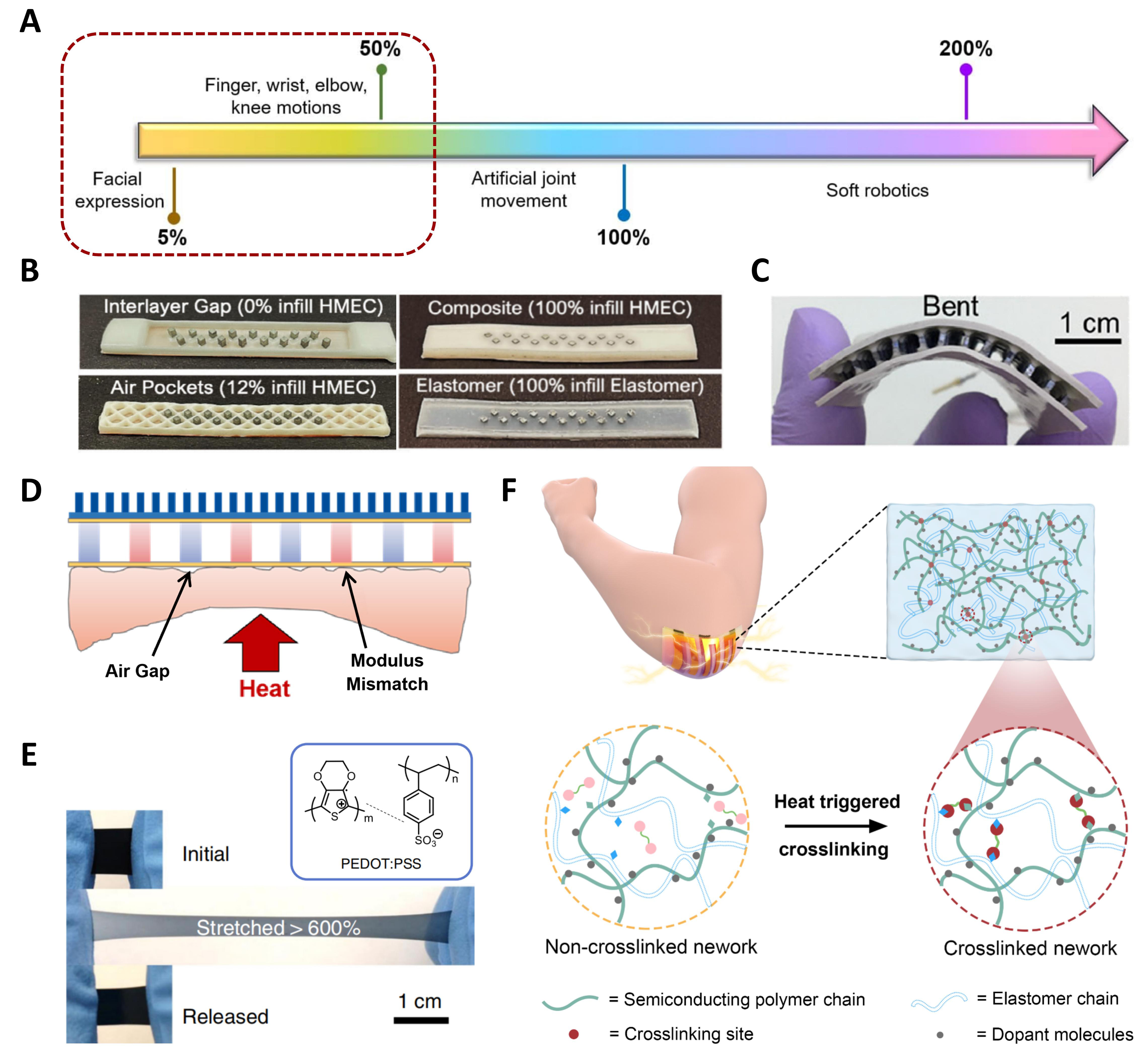
Figure 1. (A) Representative deformation strains experienced by different regions of the human body during daily activities. Reprinted with permission from[7]. Copyright 2018, The Authors, the CC-BY license; (B) Photographs of the representative inorganic TE devices based on an “island-bridge” architecture. Reprinted with permission from[22]. Copyright 2024, WILEY-VCH; (C) Photographs showing inorganic TE devices with good bending flexibility but limited stretchability and elastic recovery due to the inherently high modulus of the active materials. Reprinted with permission from[6]. Copyright 2019, The Authors, the CC-BY license; (D) Schematic illustration of an air gap and modulus mismatch between inorganic flexible TEG and human skin. Reprinted with permission from[24]. Copyright 2021, WILEY-VCH; (E) A free-standing organic TE material exhibiting over 600% tensile strain with minimal mechanical hysteresis. Reprinted with permission from[27]. Copyright 2020, The Authors, the CC-BY license; (F) Schematic diagram of intrinsically elastic TE elastomers through nanoscale phase separation, thermally activated cross-linking, and targeted doping. TE: Thermoelectric; TEG: thermoelectric generator; HMEC: hollow microsphere elastomer composite; PEDOT:PSS: poly(3,4-ethylenedioxythiophene):poly(styrenesulfonate).