




fig4
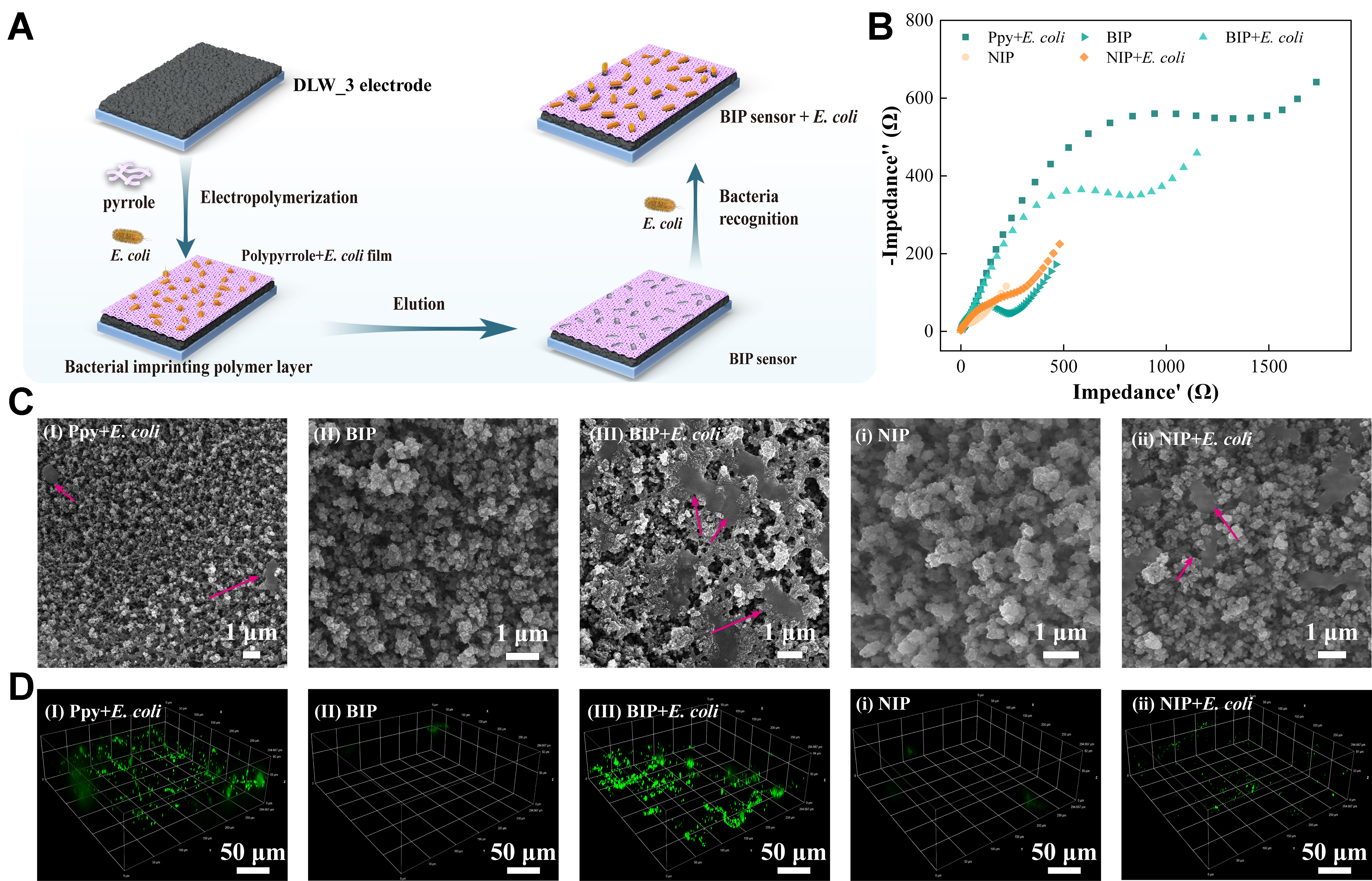
Figure 4. Fabrication and characterization of a BIP sensor on a DLW-PDMS electrode. The DLW_3 condition was used as the base electrode material. (A) Schematic illustrating the fabrication of the BIP sensor via electropolymerization of pyrrole around E. coli templates, followed by template removal and specific rebinding; (B) Nyquist plots from EIS analysis tracking the impedance changes at each stage of sensor fabrication and operation; (C) SEM micrographs and (D) corresponding in-situ confocal fluorescence maps (60× lens) of the electrode surface after: (I) initial polymerization of the polypyrrole layer with entrapped E. coli (Ppy + E. coli); (II) template elution to form the BIP; and (III) rebinding of target bacteria (BIP + E. coli). Control experiments with a (i) NIP for (ii) recognition of E. coli are shown for comparison. The scale bars for SEM and confocal are 1 and 50 μm, respectively. BIP: Bacterial-imprinted polymer; DLW: direct laser writing; PDMS: polydimethylsiloxane; E. coli: Escherichia coli; EIS: electrochemical impedance spectroscopy; SEM: scanning electron microscopy; NIP: non-imprinted polymer.