




fig1
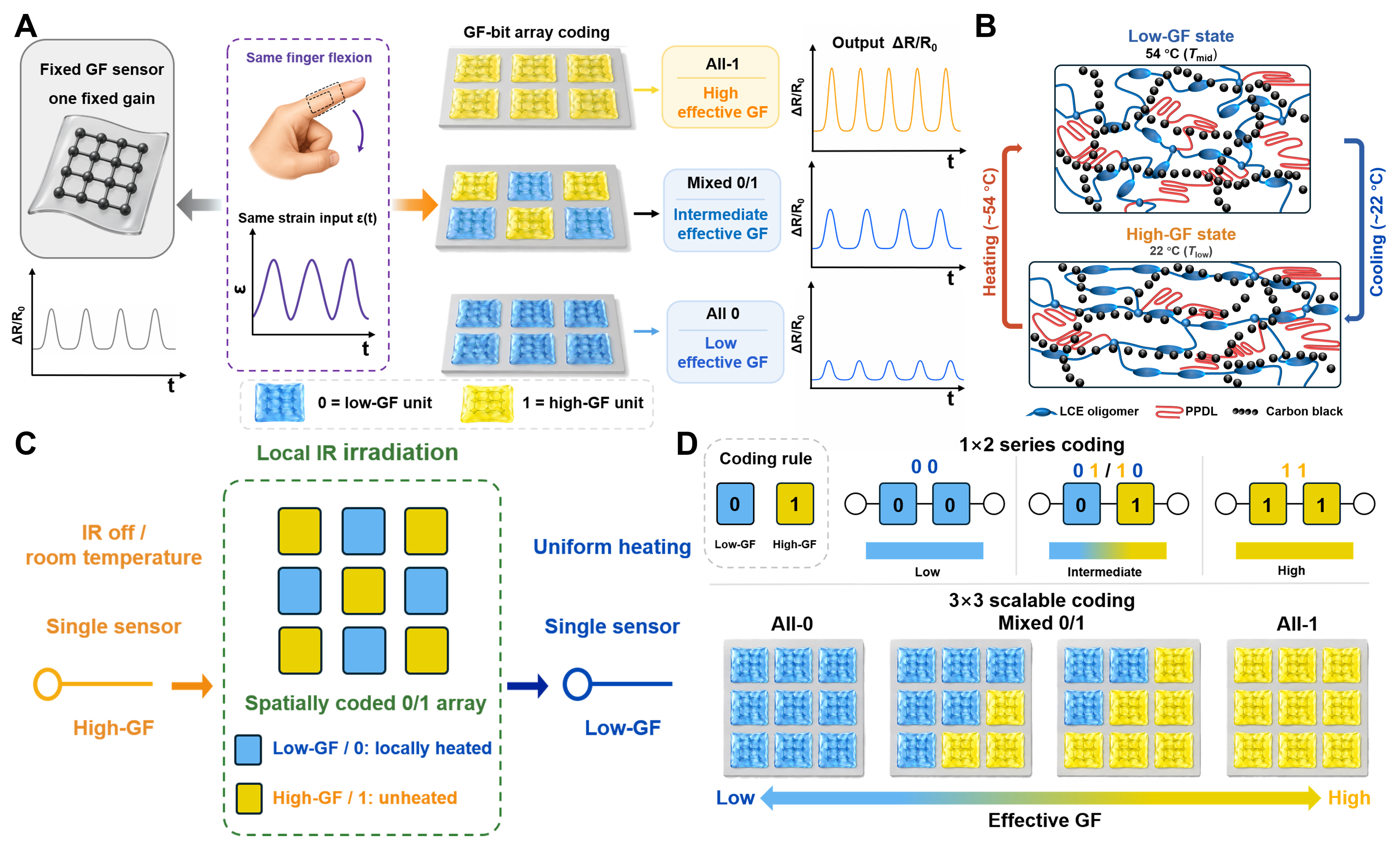
Figure 1. Concept of thermally switchable GF bits for array-level multilevel gain coding. (A) Comparison between a conventional fixed-GF strain sensor and the proposed GF-bit array. Under the same mechanical input, all-1, mixed 0/1, and all-0 arrays generate high, intermediate, and low effective GF outputs, respectively; (B) Schematic mechanism of thermally switchable GF states in the programmed dual-phase rSMP/CB network. Heating across the lower-temperature liquid-crystalline transition drives the contracted low-GF state while the PPDL crystalline framework is retained, whereas cooling restores liquid-crystalline ordering and the elongated high-GF state; (C) Thermal-state coding of single sensors and array pixels. A room-temperature sensor corresponds to the high-GF state, uniform heating switches the sensor to the low-GF state, and local IR irradiation provides a conceptual route to spatially mixed 0/1 thermal-state patterns; (D) Electrical coding from a two-pixel unit to scalable 3 × 3 arrays, showing that increasing the fraction of high-GF pixels increases the array-level effective GF. GF: Gauge factor; rSMP: reversible shape-memory polymer; CB: carbon black; PPDL: poly(pentadecanolide); IR: infrared; LCE: liquid-crystalline elastomer.