



fig4
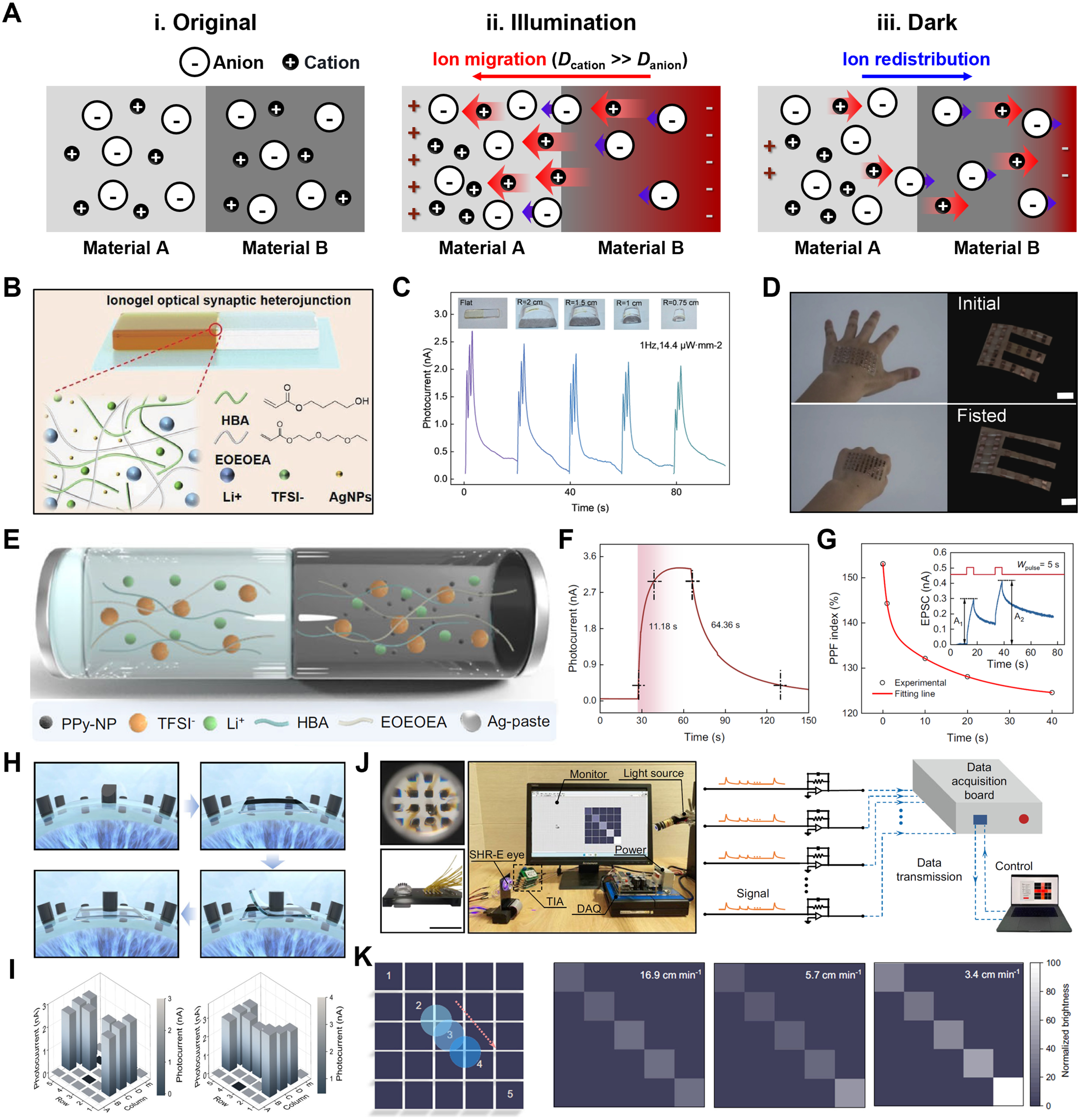
Figure 4. PTE-based zero-power optoelectronic synapses. (A) Schematic illustrations of the working mechanism in PTE-based zero-power optoelectronic synapse correspond to the (i) original, (ii) illumination, and (iii) dark state, respectively. Danion and Dcation represent the anion and cation diffusion coefficient, respectively; (B) Schematic illustration of artificial neuromorphic vision skin based on a silver nanoparticle-doped ionogel heterostructure; (C) Optical synaptic characteristics of the devices in the planar state and under different curvatures; (D) Optical images of the flexible neuromorphic vision skin device attached to human skin. Subfigures (B-D) Reproduced with permission[43]. Copyright 2025, IOP Publishing; (E) Schematic illustration of the zero-power ionogel photoreceptor; (F) Photoresponse of the device under 365 nm illumination without an external power; (G) PPF index as a function of light stimulus interval; (H) Optical images of photoreceptor transplantation by replacing a damaged pixel with a healthy one in the host retina; (I) Visual restoration in the “I” mapping after photoreceptor transplantation; (J) Optical images and schematic illustration of the real-time motion tracking testing measurement setup; (K) Schematic of the laser spot motion path and real-time trajectory tracking at different speeds, demonstrating motion direction and perception capability. Subfigures (E-K) Reproduced with permission[44]. Copyright 2024, Springer Nature. PTE: Photothermoelectric; HBA: 4-hydroxybutyl acrylate; EOEOEA: 2-(2-ethoxyethoxy)ethyl acrylate; TFSI-: bis(trifluoromethanesulfonyl)imide anion; AgNPs: silver nanoparticles; PPy-NP: polypyrrole nanoparticle; PPF: paired-pulse facilitation; EPSC: excitatory postsynaptic current; SHR-E: self-powered hemispherical retinomorphic eye; TIA: trans-impedance amplifier; DAQ: data acquisition.