



fig2
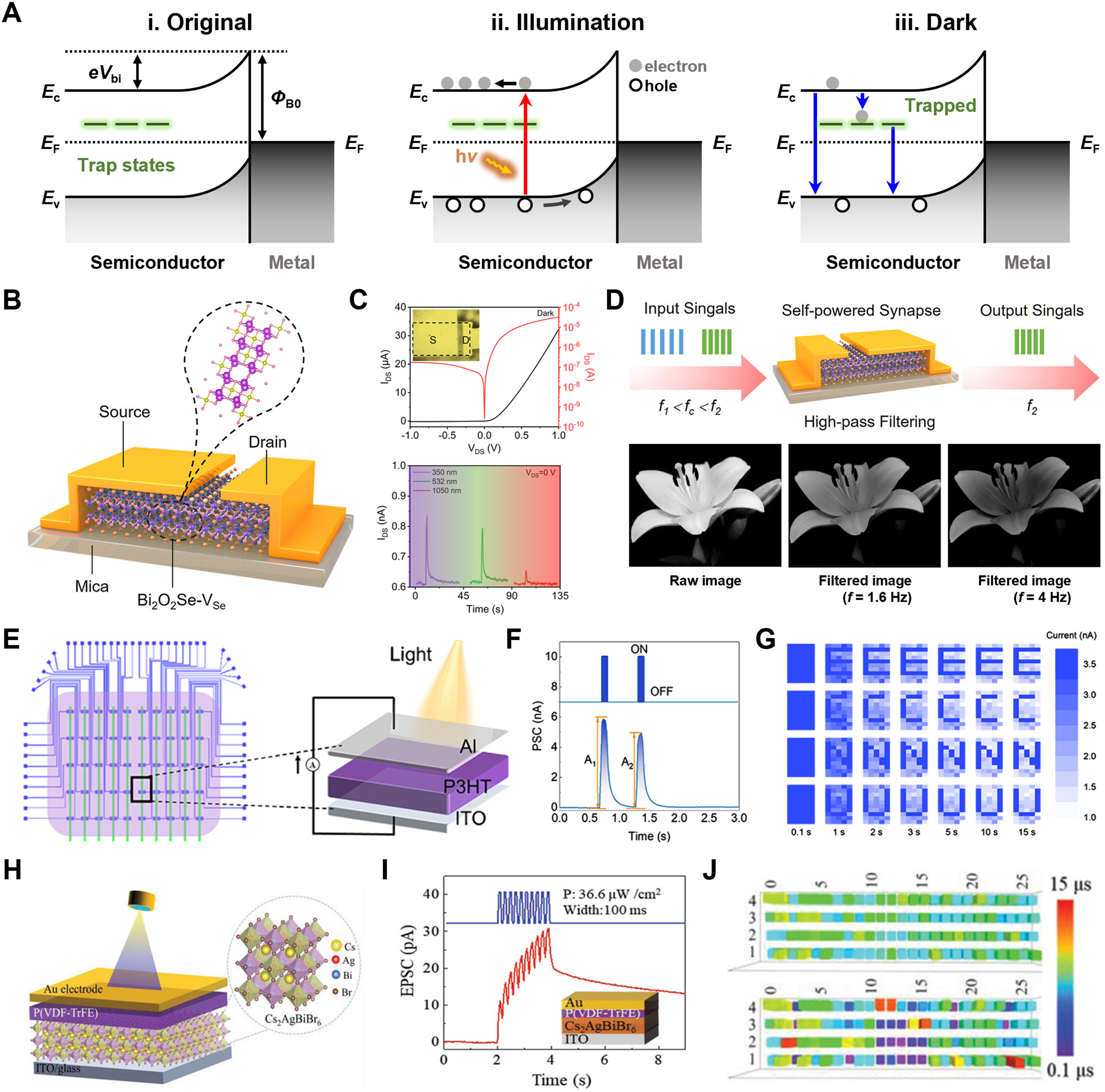
Figure 2. Schottky junction-based zero-power optoelectronic synapses. (A) Schematic illustrations of the working mechanism in a Schottky junction-based zero-power optoelectronic synapse correspond to the (i) original, (ii) illumination, and (iii) dark state, respectively. Ec, Ev and EF represent the bottom of conduction band, top of valence band, and Fermi level of the semiconductor, respectively. ΦB0, Vbi and e denote the work function of metal, built-in potential and elementary charge, respectively; (B) Schematic of the Bi2O2Se-VSe nanosheet-based zero-power optoelectronic synapse, with the inset highlighting the vacancy-rich atomic structure; (C) IDS depending on VDS characteristics of the device measured in dark conditions (top) and IDS without bias under illumination at wavelengths of 350, 532, and 1,050 nm (P = 66 μW·cm-2), demonstrating broadband photoreception (bottom); (D) Demonstration of high-pass filtering of the device. Subfigures (B-D) Reproduced with permission[32]. Copyright 2024, American Chemical Society; (E) Schematic illustration of a 10 × 5 array of ITO/P3HT/Al zero-power optoelectronic synapse; (F) Representative PSCs induced by two consecutive light pulses (λ = 520 nm, P = 215 mW·cm-2, duration = 100 ms, interval = 500 ms); (G) Photopic adaptation of the zero-power vision sensor array for pattern recognition. Subfigures (E-G) Reproduced with permission[33]. Copyright 2025, American Chemical Society; (H) Schematic illustration of the Cs2AgBiBr6-based zero-power photonic synapse; (I) Representative EPSC triggered by 10 light pulses (λ = 445 nm, P = 36.6 μW·cm-2) exhibiting in-sensor reservoir; (J) The weight modulation in the 25 × 4 array before and after the 50 training epochs for vehicle-flow classification. Subfigures (H-J) Reproduced with permission[34]. Copyright 2022, John Wiley & Sons. Bi2O2Se-VSe: Bi2O2Se nanosheet with selenium vacancies; ITO: indium tin oxide; P3HT: poly(3-hexylthiophene-2,5-diyl); PSCs: postsynaptic currents; EPSC: excitatory postsynaptic current; P(VDF-TrFE): poly(vinylidene fluoride-trifluoroethylene).