




Role of Mn in partitioning behavior and precipitation evolution in multicomponent Fe-Cu-based steels
 0
Abstract
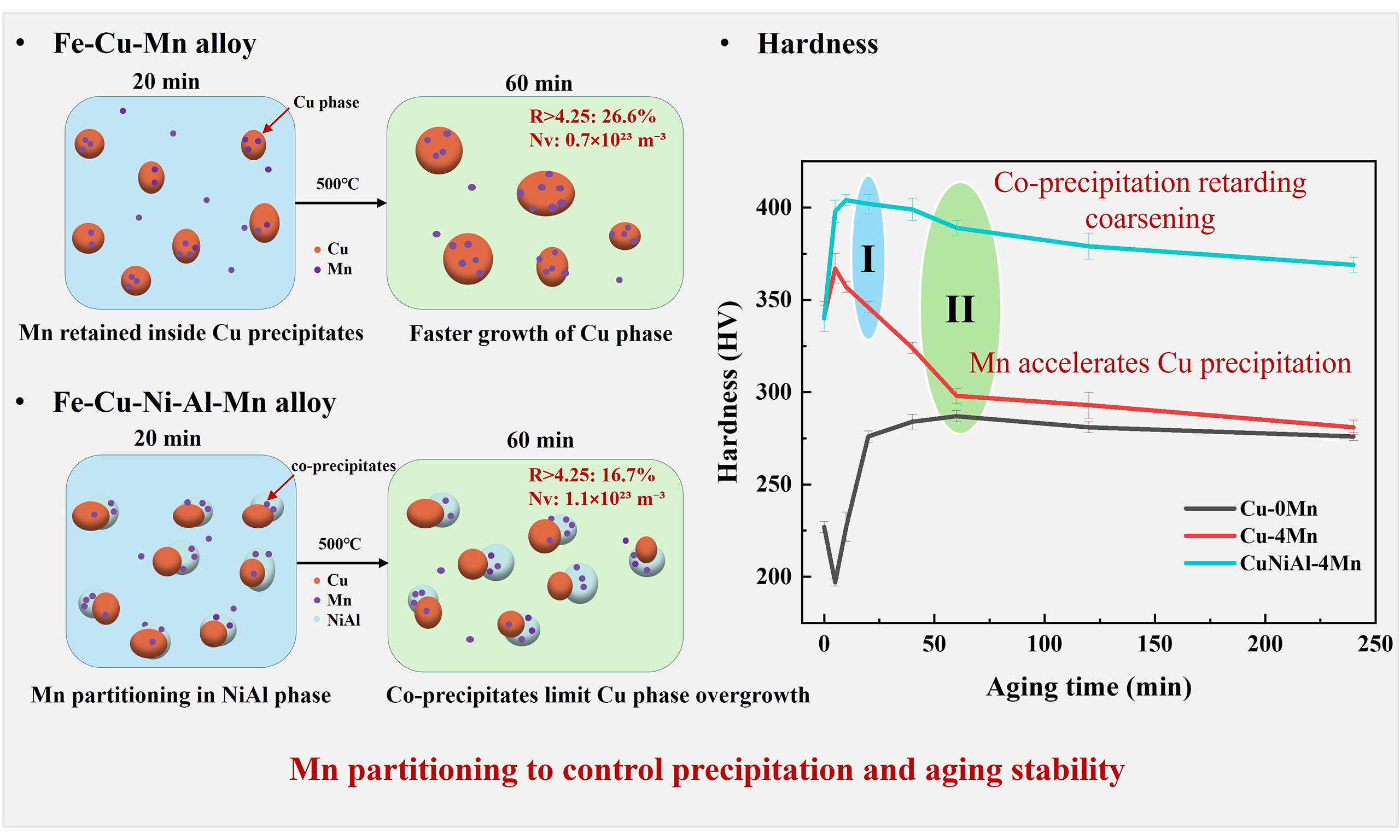
This study investigates the role of Mn partitioning in the precipitation behavior and mechanical properties of Fe-Cu and Fe-Cu-Ni-Al steels. In Fe-Cu steel, fine Cu precipitates form at a high number density within a ferritic matrix upon aging. Mn addition enhances hardenability and induces martensite formation, doubling the geometrically necessary dislocation density. Mn enriches within the Cu-rich precipitates and accelerates Cu precipitation kinetics, producing an early peak hardness of 367 HV after 5 min followed by softening to 298 HV after 60 min. Further addition of Ni and Al redirects Mn toward NiAlMn precipitates, promoting Cu and NiAlMn co-precipitation and compositional partitioning. This redistribution modifies the co-precipitation pathway, retains a higher number density of fine Cu-rich precipitates, and reduces the preferential enlargement of coarse particles. The Fe-Cu-Ni-Al-Mn steel achieves high hardness (404 HV after aging for 10 min) and strength (ultimate tensile strength of 1,200 MPa after aging for 20 min) through the combined effects of a martensitic matrix and Cu and NiAlMn precipitation strengthening. These findings identify Mn as a regulator of solute partitioning and precipitation stability, and provide guidance for the compositional design of multicomponent nanoprecipitation-strengthened steels.
Keywords
INTRODUCTION
Fe-Cu-Ni-Al nanoprecipitation-strengthened steels combine high strength with good ductility and are widely used in shipbuilding and offshore structures[1-5]. Their mechanical properties are primarily governed by the nucleation, growth and coarsening of Cu and B2-structured NiAl-type nanoprecipitates[6-9]. Controlling the precipitation kinetics of these nanoscale phases is therefore central to the design of high-performance multicomponent Fe-Cu-based steels[10-14]. Recent efforts have focused on tailoring precipitate characteristics through alloying, with Mn attracting growing interest for its dual role in controlling phase transformation and segregation and in regulating precipitation behavior in Fe-Cu-based systems[5,15,16].
Mn has been reported to alter the nucleation thermodynamics of Cu-rich clusters, to increase defect and vacancy concentrations, and to accelerate Cu precipitation[17-19]. Atom probe tomography (APT) and small-angle neutron scattering studies on neutron-irradiated Fe-Cu and Fe-Cu-Mn alloys report that Mn may remain within early Cu-rich clusters, whereas irradiation-generated defects or the subsequent structural evolution of the Cu-rich phase can promote a broader Mn distribution at the interface[20]. In multicomponent Fe-Cu-based steels, Mn can partition with Ni and Al into segregations associated with the Cu-rich precipitates, producing a Cu and NiAlMn compositional partitioning. Such partitioning may reduce the interfacial energy and modify cross-interface solute transport, thereby affecting the growth and coarsening of the co-precipitates[21,22]. First-principles calculations suggest that Mn atoms preferentially occupy Al sublattice sites in the B2-NiAl structure[23], and experimental studies have shown that the Cu and NiAlMn co-precipitates become more distinct with increasing aging time[24,25]. These observations indicate that Mn may follow different partitioning pathways depending on the surrounding element distribution. However, these partitioning behaviors have been established in different alloy systems and under different thermal or irradiation conditions, and a direct comparison of their effects on the evolution of Cu-rich precipitates, number density retention, and the resulting mechanical stability is still lacking.
This work investigates the precipitation behavior and Mn partitioning in Fe-2.5Cu and Fe-2.5Cu-2.5Ni-0.5Al systems. The Al content was kept relatively low to limit extensive independent NiAl precipitation and thereby make the effect of Mn on B2-NiAl precipitation more apparent[26]. Using APT, high-resolution transmission electron microscopy, and mechanical property measurements, the study focuses on the effect of the local chemical environment on Mn partitioning, and on how the resulting redistribution relates to precipitate evolution and mechanical stability during aging.
MATERIALS AND METHODS
Four steels were studied, with the nominal compositions (wt.%) Fe-2.5Cu (Cu-0Mn), Fe-2.5Cu-4Mn (Cu-4Mn), Fe-2.5Cu-2.5Ni-0.5Al (CuNiAl) and Fe-2.5Cu-2.5Ni-0.5Al-4Mn (CuNiAl-4Mn). The two reference alloys, Cu-0Mn and CuNiAl, were presented in a previous study on the effect of Mo[27]. All steels were melted in a vacuum electric arc furnace and cast into 500 g ingots (50 × 50 × 17 mm3). The ingots were homogenized at 1,200 °C for 2 h, hot-rolled to 3 mm plates, and air-cooled to room temperature (RT). Cold rolling was then applied in multiple passes to a total thickness reduction of 50%. Sectioned samples were solution-treated at 900 °C for 60 min under an argon (Ar) atmosphere, water-quenched, and subsequently aged at 500 °C for 5-240 min under Ar before final water-quenching. The heat-treated samples were ground and mechanically polished. Vickers hardness was measured on the polished samples under a 2 kgf load with a 15 s dwell time, each value being averaged over ten indentations. Tensile testing was conducted on an Instron 5969 universal testing machine at a crosshead speed of 1 mm/min, with three samples tested per condition. Nanoindentation was carried out using a KLA iMicro nanoindenter equipped with a Berkovich diamond indenter at a maximum load of 1,000 mN, with nine uniformly distributed indentations per sample.
Light optical microscopy (LOM), electron backscatter diffraction (EBSD), APT and scanning transmission electron microscopy (STEM) were used to characterize the microstructure, precipitation behavior, elemental segregation and partitioning. LOM samples were etched with 4% nital at RT. Samples for EBSD were electropolished in a 10% perchloric acid-ethanol solution using a Struers LectroPol-5 system and analyzed on a JEOL JSM-7800F scanning electron microscope equipped with a Bruker Quantax EBSD system at 15 kV and a 0.15 μm step size. Thin foils for STEM were prepared by twin-jet electropolishing in an electrolyte of 8% perchloric acid in ethanol at -30 °C and 35 V, followed by Ar ion milling at 3 keV with a 4° incidence angle in a Gatan 697 Ilion II system, and examined on an FEI Talos F200s.
APT sample blanks of 0.5 × 0.5 × 15 mm3 were cut from the aged samples and electropolished in two steps: first in a 25 vol% perchloric/acetic acid solution at 12-16 V, then in a 2 vol% perchloric acid in 2-butoxyethanol solution at 4-6 V. APT analyses were performed on a CAMECA EIKOS-UV instrument in voltage mode at 50 K, with a pulse frequency of 100 kHz, a pulse fraction of 20% and a detection rate of 0.3%-0.5%. For each condition, 2-3 successful tips were analyzed and the selected dataset contained more than 10 million detected ions. The data were reconstructed and analyzed using APSuite (version 6.3.1.110). To quantify the composition, mean radius and number density of the precipitates while minimizing analytical bias, 10 at.% Cu and 15 at.% NiAlMn isoconcentration surfaces (isosurfaces) were used to delineate the precipitate-matrix interfaces. Mean radii (Rp) were calculated by assuming a spherical shape and averaging over all fully enclosed precipitates. The uncertainty in Rp represents one standard deviation of the particle size distribution. To avoid the influence of atomic-scale solute clusters, only Cu clusters with a radius larger than 0.5 nm were counted as precipitates; excluding the smaller clusters did not change the precipitation trends observed among the alloys. Number density (Nv) was estimated by averaging the values obtained with and without partially enclosed precipitates. The uncertainty in Nv was defined as half the difference between the two estimates. Further details of the reconstruction and quantification procedure follow the methodology described in Ref.[28].
RESULTS
Mechanical properties
Figure 1A shows the hardness evolution of the four steels during aging at 500 °C. In the as-quenched state, Cu-0Mn steel exhibits the lowest hardness (227 HV) and CuNiAl steel 247 HV, whereas Cu-4Mn and CuNiAl-4Mn steels show similar values (340 HV). Despite this similarity, their different chemical compositions lead to distinct matrix and precipitation characteristics during aging. During aging, the hardness of Cu-0Mn steel first decreases to approximately 196 HV and then increases, reaching a maximum of approximately 287 HV after 60 min. Cu-4Mn steel hardens much more rapidly, reaching a peak of 367 HV after only 5 min; its hardness then falls rapidly to about 298 HV after 60 min and declines gradually to approximately 280 HV after 240 min. CuNiAl steel reaches 340 HV after 20 min, followed by only a slight decrease to approximately 328 HV after 120 min. CuNiAl-4Mn steel achieves the highest peak hardness of 404 HV after 10 min and, although its hardness subsequently decreases, it remains at 389 HV after 60 min and 370 HV after 240 min. CuNiAl-4Mn steel therefore combines the highest peak hardness with rapid aging and the best hardness retention among the four steels.
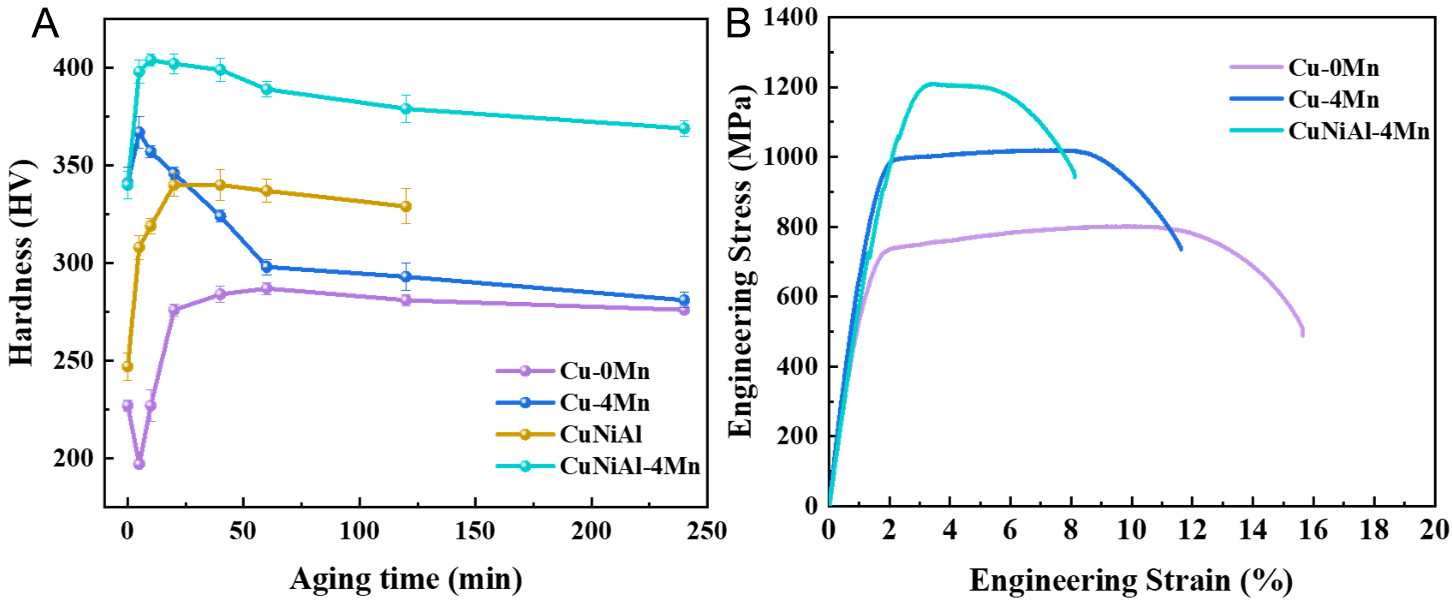
Figure 1. (A) Hardness evolution of the Cu-0Mn, Cu-4Mn, CuNiAl and CuNiAl-4Mn steels as a function of aging time at 500 °C; error bars represent standard deviations from ten independent Vickers hardness measurements; (B) Representative engineering stress-strain curves of the steels aged for 20 min at 500 °C; three tensile specimens were tested for each alloy.
Room-temperature tensile tests were performed on Cu-0Mn, Cu-4Mn and CuNiAl-4Mn samples aged for
Matrix microstructure
LOM and EBSD analysis reveal distinct phases and grain size variations among the three steels [Figure 2]. Cu-0Mn steel exhibits a predominantly ferritic matrix with a uniform grain size, Cu-4Mn steel contains a ferrite-martensite duplex microstructure, and CuNiAl-4Mn steel is fully martensitic [Figure 2A-C]. Previous work on CuNiAl steel reported a matrix consisting mainly of a ferrite-martensite dual microstructure[27]. Since martensite is rich in low-angle grain boundaries[29], the Mn-containing steels are expected to exhibit significantly higher dislocation densities. The geometrically necessary dislocation (GND) density was calculated from kernel average misorientation (KAM) maps using[30]:
where ρ is the GND density, θKAM is the KAM angle, b is the Burgers vector
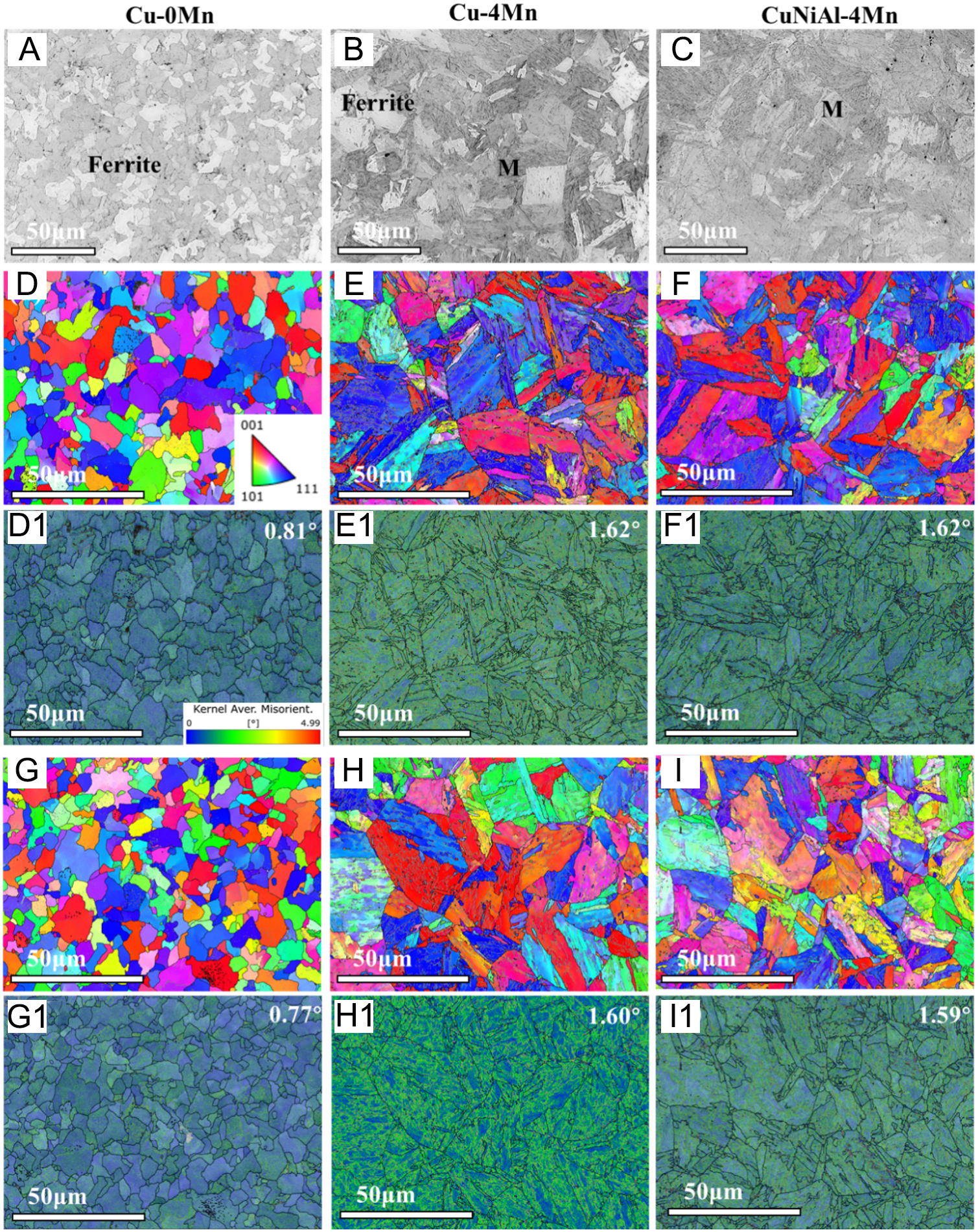
Figure 2. LOM images of the steels in the as-quenched state: (A) Cu-0Mn, (B) Cu-4Mn, and (C) CuNiAl-4Mn; EBSD inverse pole figure maps are shown for the as-quenched state in (D-F) and the 60 min aged state in (G-I); the corresponding KAM maps (including the average misorientation value) and average misorientation values are shown in (D1-F1) and (G1-I1).
In the as-quenched state, the GND density in Cu-4Mn steel (~1.3 × 10¹⁵ m-2) is approximately twice that of Cu-0Mn steel (~6.5 × 10¹⁴ m-2), and that of CuNiAl-4Mn steel (~1.3 × 10¹⁵ m-2) is approximately twice that of CuNiAl steel (~7.0 × 10¹⁴ m-2[27]) [Figure 2D-F]. These differences show that Mn effectively improves hardenability, with a strengthening effect comparable to that of molybdenum[27]. After 60 min of aging, a slight decrease is observed in all steels, with Cu-0Mn steel reaching ~6.2 × 10¹⁴ m-2 and Cu-4Mn and CuNiAl-4Mn steels retaining ~1.28 × 10¹⁵ m-2 [Figure 2G-I].
Precipitation behavior
Figure 3 shows the distribution of Cu precipitates in the three steels after 60 min of aging. In Cu-0Mn steel [Figure 3A and B], fine Cu precipitates are observed throughout the matrix, with relatively coarse precipitates forming preferentially at grain boundaries. In Cu-4Mn steel [Figure 3C], the precipitates are more homogeneously distributed; grain boundary precipitates are only slightly larger than intragranular ones, but the intragranular precipitates are significantly larger than those in Cu-0Mn steel, indicating that Mn substantially accelerates Cu precipitate growth. Trace Mn-rich secondary phases are also detected along the grain boundaries. These Mn-rich carbide particles may influence local precipitation by providing heterogeneous nucleation sites for Cu precipitates and by restricting grain boundary migration. Although Mn-C particles can contribute to reverted austenite formation during intercritical annealing, their direct influence is expected to be limited under the present aging treatment[31]. Strengthening is therefore governed primarily by the matrix transformation and nanoprecipitation. In CuNiAl-4Mn steel [Figure 3D], the grain boundary Cu precipitates are comparable in size to those in the other steels, while the intragranular Cu precipitates fall between the sizes observed in Cu-0Mn and Cu-4Mn steels (see Supplementary Figure 2 for details).
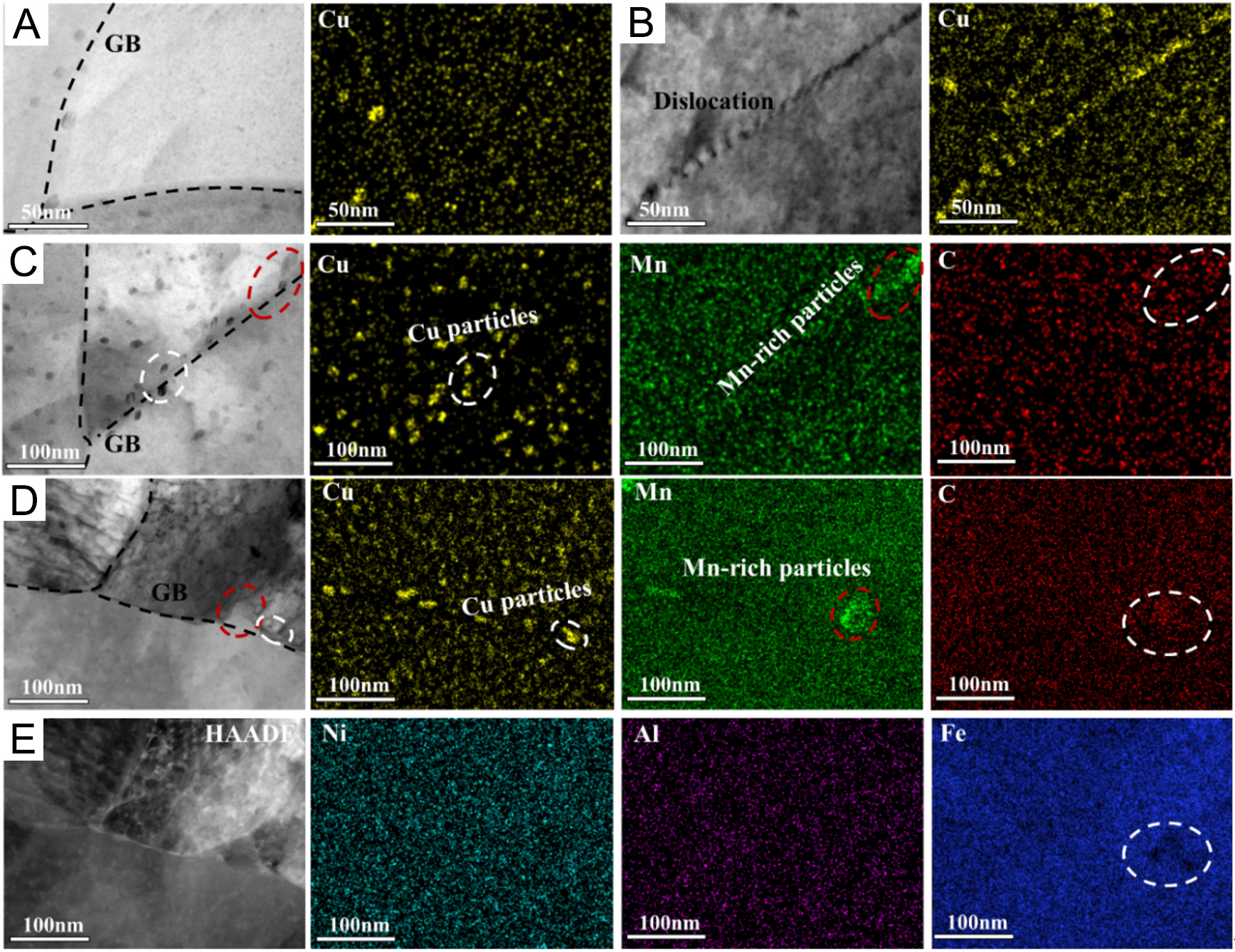
Figure 3. STEM bright-field images and energy-dispersive X-ray spectroscopy maps of Cu, Mn, C, Ni, Al and Fe in samples aged for 60 min: (A and B) Cu-0Mn steel, (C) Cu-4Mn steel, (D) CuNiAl-4Mn steel, and (E) the corresponding high-angle annular dark-field (HAADF) image of (D).
Figure 4 presents the isoconcentration surfaces, radius distributions and proxigrams of the Cu precipitates in the three steels aged for 20 and 60 min, with the quantitative data summarized in Table 1. For Cu-0Mn steel aged for 20 min [Figure 4A], it contains the smallest Cu precipitates (~1.6 nm) but the highest number density, (14.9 ± 0.2) × 1023 m-3. Cu-4Mn and CuNiAl-4Mn steels [Figure 4D and G] show similar mean radii (~2.0 nm), but the number density in CuNiAl-4Mn steel, (4.4 ± 0.8) × 1023 m-3, is approximately 1.5 times that in Cu-4Mn steel, (2.9 ± 0.1) × 1023 m-3.
Mean radius (Rp) and number density (Nv) of precipitates from APT
| Aging time | Phase | Parameter | Cu-0Mn | Cu-4Mn | CuNiAl-4Mn |
| 20min | Cu phase | Rp, nm | 1.6 ± 0.6 | 2.0 ± 1.0 | 2.0 ± 0.8 |
| Nv, × 1023 m-3 | 14.9 ± 0.2 | 2.9 ± 0.1 | 4.4 ± 0.8 | ||
| NiAlMn phase | Rp, nm | 1.9 ± 0.8 | |||
| Nv, × 1023 m-3 | 5.0 ± 0.8 | ||||
| 60 min | Cu phase | Rp, nm | 2.0 ± 0.8 | 2.8 ± 1.7 | 2.7 ± 1.3 |
| Nv, × 1023 m-3 | 4.6 ± 0.9 | 0.7 ± 0.1 | 1.1 ± 0.1 | ||
| NiAlMn phase | Rp, nm | 2.8 ± 1.3 | |||
| Nv, × 1023 m-3 | 1.8 ± 0.3 |
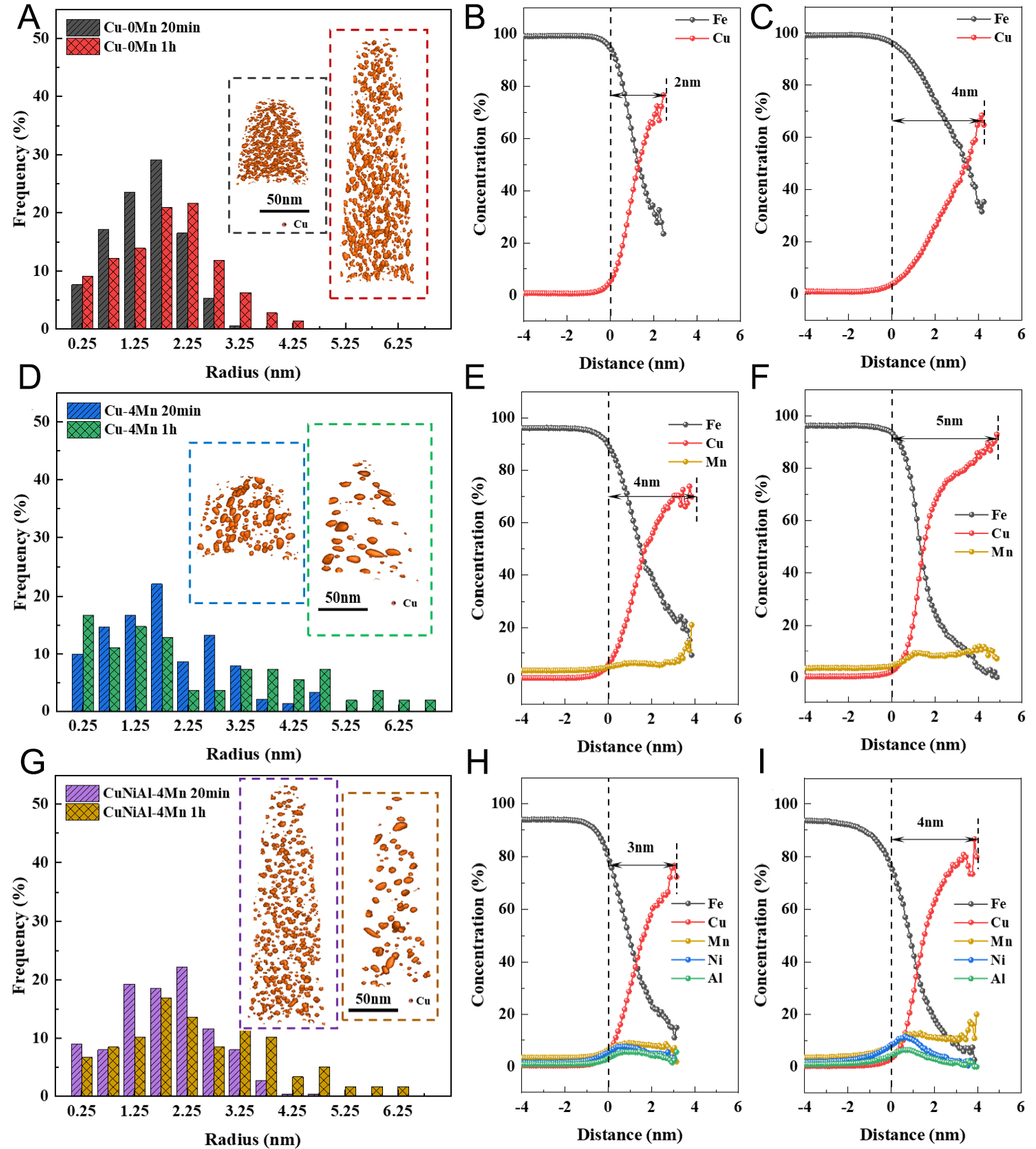
Figure 4. Radius distributions of Cu precipitates in the three alloys after aging for 20 and 60 min, with insets showing the 10 at.% Cu isosurfaces, together with the proxigram analysis of the Cu precipitates in (A-C) Cu-0Mn steel, (D-F) Cu-4Mn steel, and (G-I) CuNiAl-4Mn steel.
After 60 min of aging, the mean radii in Cu-4Mn and CuNiAl-4Mn steels grow to ~2.8 and ~2.7 nm respectively, both substantially larger than in Cu-0Mn steel (~2.0 nm). Despite the similar mean sizes, the two Mn-containing steels differ in their size distributions [Figure 4D and G]. Cu-4Mn steel displays a bimodal distribution, with 26.6% of the precipitates exceeding 4.25 nm, compared with only 16.7% in CuNiAl-4Mn steel. This difference demonstrates that Cu-4Mn contains a higher fraction of coarse Cu-rich precipitates, consistent with the STEM observations. The Cu core enrichment within precipitates shows distinct differences among the investigated alloys. The Cu-0Mn proxigrams show no significant increase in the Cu concentration between 20 and 60 min [Figure 4B and C], whereas the core Cu concentration in Cu-4Mn increases markedly from approximately ~70 to 90 at.% [Figure 4E and F]. The Mn concentration within the Cu-rich precipitates remains higher than in the surrounding matrix, indicating preferential Mn partitioning into the Cu-rich phase. A similar redistribution is observed in CuNiAl-4Mn steel
To further analyze the distribution of the NiAlMn phase, Figure 5 presents the NiAlMn phases identified using a 15 at.% isosurface together with their radius distributions; the quantitative results are summarized in Table 1. After 20 min, the NiAlMn phase has a mean radius of ~1.9 nm and a number density of (5.0 ± 0.8) × 1023 m-3, comparable in size and slightly higher in number density than the Cu-rich phase. After 60 min, the mean radius increases to ~2.8 nm while the number density decreases to (1.8 ± 0.3) × 1023 m-3, indicating pronounced growth accompanied by a reduction in number density. The proxigrams in Figure 5B and C reveal a substantial compositional evolution of the NiAlMn phase. After 20 min, the precipitates remain dominated by Cu, with a maximum Cu concentration of approximately 50 at.%, whereas Ni, Al and Mn are each present at approximately 10-15 at.%. After 60 min, Ni, Al and Mn increase to approximately 20-30 at.% while Cu decreases to approximately 30 at.%. These results indicate that the early NiAlMn enrichments are strongly associated with the Cu-rich precipitates, whereas prolonged aging promotes solute redistribution and the formation of distinct Cu-rich and NiAlMn enrichments, consistent with our previous findings on the nucleation sequence of the two phases in a similar alloy system[32].
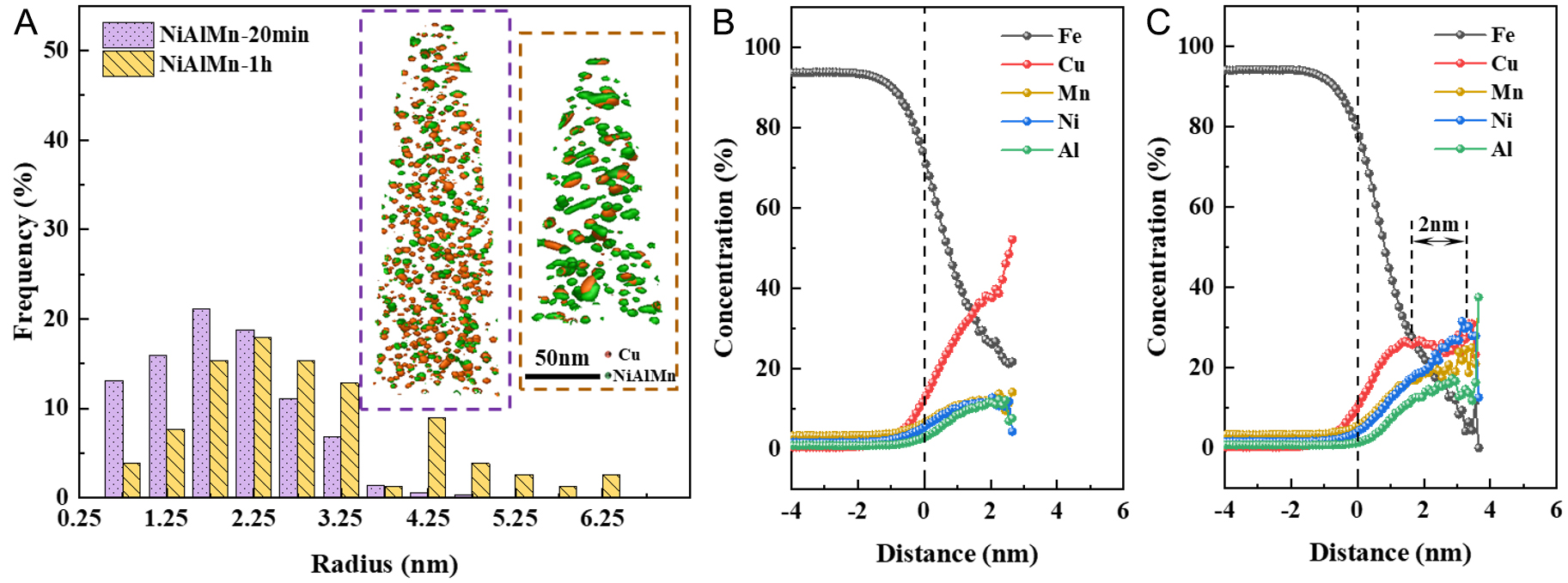
Figure 5. (A) 10 at.% Cu and 15 at.% NiAlMn isosurfaces and radius distributions of the NiAlMn precipitates, and proxigrams of the NiAlMn precipitates in samples aged for (B) 20 min and (C) 60 min.
To compare the precipitate size evolution between 20 and 60 min quantitatively, an apparent coarsening coefficient was calculated from the mean radius according to Lifshitz-Slyozov-Wagner (LSW) theory[33]. The coarsening coefficient K is defined by
2D atom maps and 1D concentration profiles were obtained from selected precipitates in Cu-4Mn and CuNiAl-4Mn steels aged for 20 and 60 min [Figures 6 and 7] to examine the spatial distribution of Mn, Ni, and Al. In Cu-4Mn steel [Figure 6], Cu and Mn are co-enriched within the precipitate core, with the Mn enrichments closely matching the spatial extent of the Cu enrichments. As the aging time increases from 20 to 60 min, the Cu enrichment rises from 18 to 39 at.%. The 1D concentration profiles show that the local Mn concentration increases from approximately 4 at.% in the surrounding matrix to ~6 at.% within the Cu-rich region after 20 min. After 60 min, the Mn concentration within the Cu-rich phase increases further to
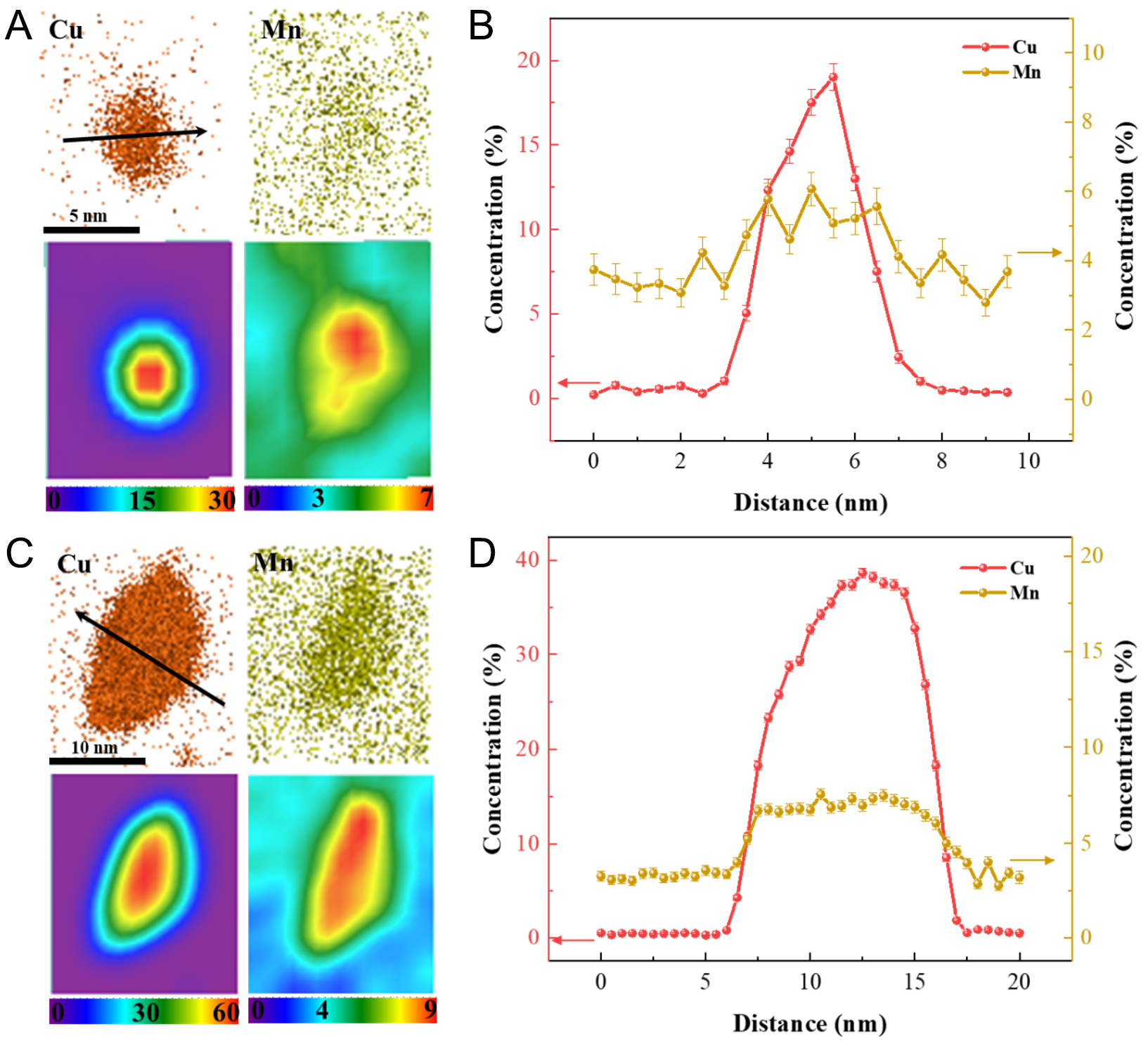
Figure 6. APT atom maps, 2D concentration maps and 1D concentration profiles of representative Cu precipitates in Cu-4Mn steel aged for (A and B) 20 min and (C and D) 60 min. Error bars represent the counting-statistics standard deviation
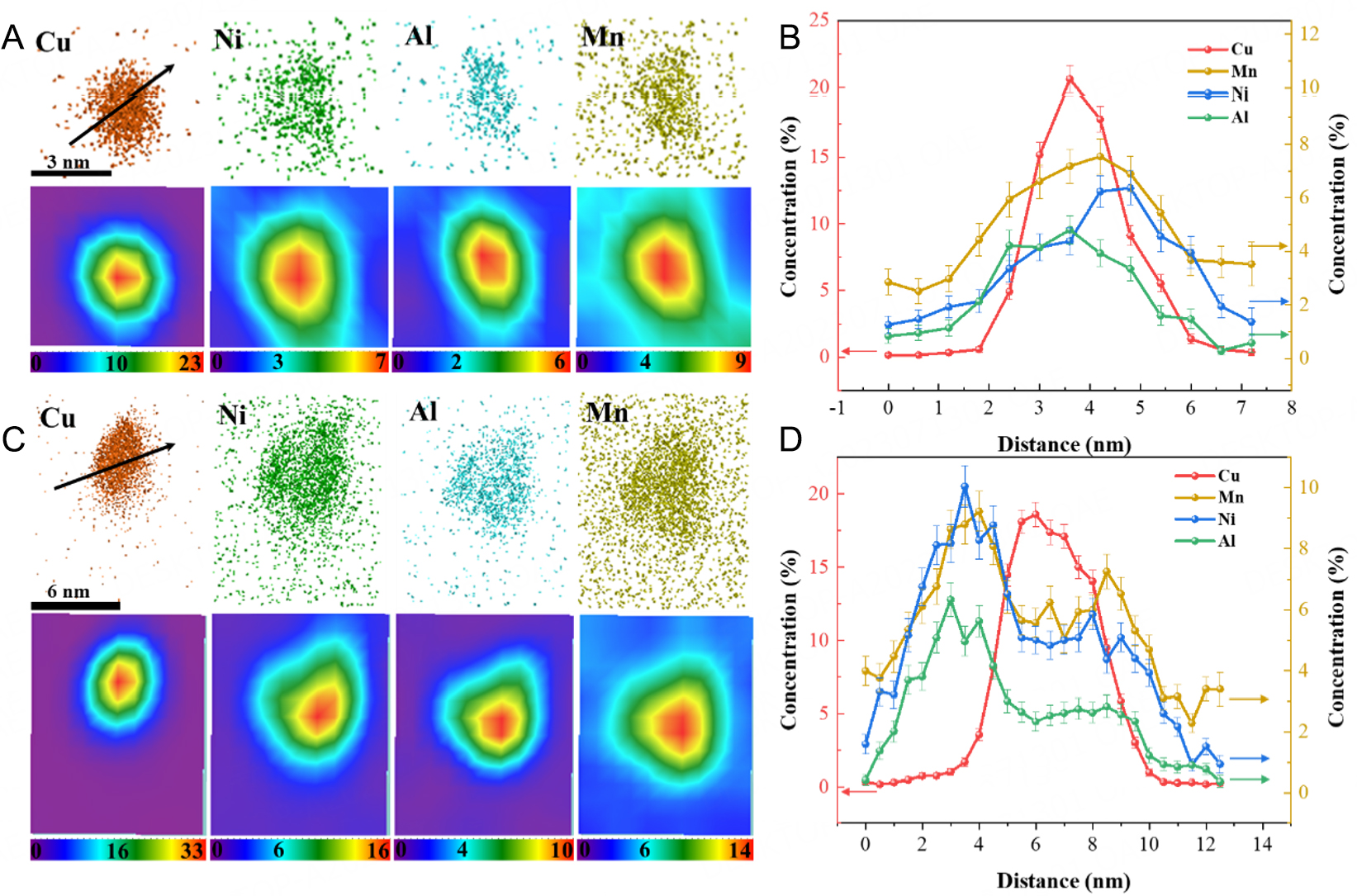
Figure 7. APT atom maps, 2D concentration maps, and 1D concentration profiles of representative Cu precipitates in CuNiAl-4Mn steel aged for (A and B) 20 min and (C and D) 60 min. Error bars represent the counting-statistics standard deviation
In CuNiAl-4Mn steel [Figure 7], the atom maps show Ni, Al, and Mn enriched together with Cu in the co-precipitates. After 20 min, the 1D concentration profiles show that the Ni, Al, and Mn enrichments extend beyond the Cu enrichments [Figure 7A and B]. The precipitate center is dominated by Cu, at 21 at.%, surrounded by 6 at.% Ni, 5 at.% Al, and 7.5 at.% Mn. After 60 min [Figure 7C and D], the NiAlMn phase has become progressively enriched around the Cu phase. The Cu content in the precipitate changes little relative to the 20 min condition, but Ni increases to 10 at.%, Al to 6 at.%, and Mn to 9 at.%, indicating that the majority of the Mn atoms have partitioned into the NiAlMn enrichments. The distribution of Mn is therefore closely related to the alloying elements present in the system.
DISCUSSION
Effect of Mn on Cu precipitation
The APT and transmission electron microscopy results show that after 20 min of aging, the Cu precipitates in Cu-0Mn steel are smaller and present at a higher number density than those in Cu-4Mn steel. This is partly because Cu-0Mn steel is under-aged whereas Cu-4Mn steel is already over-aged at this stage
Notably, Mn is enriched within the Cu-rich precipitates in Cu-4Mn steel without showing a distinct concentration maximum at the precipitate and matrix interface [Figure 6], differing from the interfacial Mn segregation widely reported in multicomponent Fe-Cu-Ni-Al systems[21,22]. At 20 min, the local Mn concentration increases from approximately 4 at.% in the surrounding matrix to 6 at.% within the Cu-rich precipitates. At 60 min, it reaches 7.5 at.% while the matrix concentration remains at 4 at.%, again without a distinct interfacial maximum. The difference from Ref.[20] may partly arise from the different experimental conditions: that study investigated neutron-irradiated Fe-Cu-Mn alloys, in which irradiation-generated defects and vacancies can alter solute diffusion and segregation.
Phase-field simulations of Fe-Cu-Mn alloys have predicted that Cu and Mn initially form co-clusters, followed by redistribution of Mn toward the cluster and matrix interface as precipitation proceeds[16,36]. However, the reported Cu threshold of approximately 85 at.% represents a model-specific condition for Mn redistribution[16]. In the present APT analysis, the proxigram in Figure 4F shows that the Cu concentration reaches approximately 90 at.% inside the Cu-rich phase, whereas the 1D profile in Figure 6D was obtained from one selected precipitate and gives a lower local concentration. Because these profiles have different sampling volumes and statistical bases, their absolute concentrations should not be directly compared. Importantly, both analyses show that Mn remains enriched within the Cu-rich precipitates without developing a distinct interfacial maximum under the present aging conditions. In addition, the absence of Ni and Al eliminates the attractive chemical interaction between Mn and other solutes at the interface[21], further reducing the driving force for interfacial segregation. Unlike the multicomponent Fe-Cu-Ni-Al system, where the negative mixing enthalpies between Ni, Al and Mn drive Mn to partition to the interface and form NiAlMn precipitates, the Fe-Cu-Mn system lacks such a chemical driving force. The Mn enrichment within the Cu-rich phase observed in Cu-4Mn steel can therefore be regarded as an earlier partitioning state rather than as intrinsically inconsistent with the interfacial segregation predicted at later stages.
Effect of Mn on Cu and NiAlMn co-precipitation
After 20 min of aging, the mean radius of the Cu precipitates in CuNiAl-4Mn steel is comparable to that in Cu-4Mn steel (~2.0 nm), whereas the number density is 1.5 times higher [Table 1]. Since the two steels have the same Mn content, this difference is primarily associated with the addition of Ni and Al to the Mn-containing chemical environment. Previous studies have shown that Ni associates with Cu-rich clusters during early precipitation, promoting the co-precipitation of Cu-rich and NiAl precipitates[21]. The positive Cu-Ni mixing enthalpy (+4 kJ/mol) disfavors Cu-Ni mixing, whereas the negative Ni-Mn and Al-Mn mixing enthalpies favor the enrichment of Mn together with Ni and Al[37]. Mn can also partially substitute for Al on the Al sublattice of the B2-NiAl precipitates, reducing the lattice misfit with the body-centered cubic (BCC)-Fe matrix and facilitating the formation of Mn-containing NiAl precipitates[23,38]. These interactions are consistent with Mn partitioning being progressively redirected toward the NiAlMn precipitates in the presence of Ni and Al[6].
After 60 min of aging, the mean radius of the Cu-rich precipitates is similar in CuNiAl-4Mn and Cu-4Mn steels (~2.7 and ~2.8 nm respectively), but only 16.7% of the Cu-rich precipitates in CuNiAl-4Mn steel exceed 4.25 nm, compared with 26.6% in Cu-4Mn steel. The Cu-rich precipitate number density in CuNiAl-4Mn steel (1.1 ± 0.1) × 1023 m-3 also remains higher than that of (0.7 ± 0.1) × 1023 m-3 in Cu-4Mn steel [Table 1]. Thus, the formation of the associated NiAlMn precipitates does not produce a substantial difference in the mean radius of Cu-rich precipitates, but is associated with a lower coarse-particle fraction and the retention of a larger number of fine Cu-rich precipitates. The NiAlMn phase itself reaches a mean radius of ~2.8 nm and retains a number density of (1.8 ± 0.3) × 1023 m-3. The similar mean radii of the Cu-rich and NiAlMn phases indicate growth on comparable length scales, as expected for co-precipitation, while the higher number density of the NiAlMn phase shows that the two kinds of precipitates are not in strict one-to-one correspondence. The calculated K values provide a kinetic comparison of the precipitate evolution. Since K is derived from only two aging times, over which continued growth, co-precipitation, and solute redistribution all occur[33,39], it is used here only as a comparative descriptor of the mean radius evolution. The lower K value of the Cu phase in CuNiAl-4Mn steel (4.87 × 10⁻³⁰ m3/s) than in Cu-4Mn steel
A similar evolution of Cu-rich and NiAl precipitates has been reported previously. Jiao et al.[25] found that the mean radius of Cu-rich precipitates changed only slightly during prolonged aging whereas the associated NiAl-based precipitates continued to grow, which they attributed partly to the transfer of Ni, Al, and Mn rejected from the Cu-enriched clusters into the neighboring NiAl precipitates. The APT maps and concentration profiles provide direct evidence for this redistribution [Figure 7]. After 20 min, the Ni, Al, and Mn enrichments already extend beyond the Cu enrichments, although the two enrichments remain strongly overlapped [Figure 7A and B]. After 60 min, the enrichment of Ni, Al and Mn around the Cu-rich precipitates becomes more pronounced, giving a clearer compositional segregation between the Cu and NiAlMn precipitates [Figure 7C and D]. This indicates a transition from initial co-enrichment of Cu, Ni, Al, and Mn within overlapping clusters toward interfacial segregation of Ni, Al, and Mn during co-precipitate growth. The observed distribution is therefore more appropriately described as compositional partitioning within co-precipitates than as the formation of NiAlMn-rich precipitates around Cu-rich precipitates. Atomistic MD-MC simulations similarly predict that Cu-rich clusters form and are subsequently surrounded by Ni and Al enrichments, while CALculation of PHAse Diagrams-based phase-field simulations of Fe-Cu-Mn-Ni-Al alloys reproduce the redistribution of Ni, Al, and Mn from early Cu-containing clusters into co-precipitates[40,41]. These studies support a solute-transfer co-precipitation mechanism.
Mn plays a distinct and more complex role in regulating precipitation evolution in the Fe-Cu-Ni-Al system. First, Mn actively promotes the formation of B2-NiAlMn precipitates at relatively low Al contents, as shown by comparison with Mo-containing alloys of identical Al content, in which no distinct NiAl precipitates were detected by small-angle X-ray scattering or APT[27]. Mn substitution into the NiAl lattice reduces the lattice misfit with the BCC-Fe matrix and lowers the nucleation barrier of the B2 phase[38], enabling NiAlMn precipitation even at 0.5 wt.% Al. Second, Mn initially participates in multicomponent Cu-rich clusters and subsequently partitions together with Ni and Al into the associated NiAlMn precipitates at the Cu-rich precipitate interface. This redistribution promotes the compositional development of the NiAlMn phase and modifies the growth and coarsening pathway of the co-precipitates, thereby reducing the preferential formation of coarse Cu-rich particles while retaining a higher precipitate number density. The role of Mn in Fe-Cu-based precipitation systems is thus composition-dependent. In Cu-4Mn steel, it remains enriched within the Cu-rich precipitates and accelerates their early nucleation and growth, whereas in CuNiAl-4Mn steel its redistribution into the associated NiAlMn precipitates modifies the co-precipitation pathway and reduces the preferential enlargement of coarse Cu-rich precipitates.
Influence of Mn alloying on hardening
The hardness evolution of the steels reflects the composition-dependent effects of Mn on the initial matrix, the GND density, and the precipitation behavior [Figure 1A]. In the as-quenched condition, Cu-0Mn steel has a ferritic matrix with the corresponding GND density of ~6.5 × 10¹⁴ m-2 and exhibits the lowest hardness of 227 HV. The addition of Mn increases the hardness to approximately 340 HV in Cu-4Mn steel. It is associated with Mn-enhanced hardenability and the partial transformation of the matrix to martensite, resulting in the ferrite-martensite duplex microstructure with a higher GND density of ~1.3 × 10¹⁵ m-2 observed in Figure 2. The CuNiAl-4Mn steel is fully martensitic and also exhibits an as-quenched hardness of approximately 340 HV, substantially higher than the 247 HV of CuNiAl steel. Therefore, the higher initial hardness of the Mn-containing steels should be attributed to Mn solid-solution strengthening and the martensitic substructure[42].
With increasing aging time, the effect of Mn is further reflected in the precipitation strengthening. Cu-0Mn steel reaches a peak hardness of approximately 287 HV after 60 min, indicating that the strengthening contribution from Cu-rich precipitates develops slowly. Cu-4Mn steel reaches 367 HV after only 5 min, an earlier and higher peak consistent with the Mn-promoted nucleation and early growth of Cu-rich precipitates discussed in Section “Effect of Mn on Cu precipitation”. This rapid hardening is followed by pronounced softening, with the hardness decreasing to about 298 HV after 60 min and about 280 HV after 240 min. In this steel, Mn remains enriched within the Cu-rich precipitates without developing distinct interfacial segregation or associated Mn-containing precipitates. The softening is therefore consistent with the reduction in number density and the development of coarser particles: after 60 min, 26.6% of the Cu-rich precipitates exceed 4.25 nm in radius while the number density has fallen to (0.7 ± 0.1) × 1023 m-3, reducing their effectiveness as dislocation obstacles[43]. Recovery of the martensitic substructure during aging may also contribute to the hardness decrease, although this contribution cannot be quantified from the GND results.
CuNiAl-4Mn steel behaves differently, reaching a peak hardness of 404 HV after 10 min and retaining
The tensile properties measured after 20 min of aging are consistent with the combined effects of Mn on the matrix and on precipitation [Figure 1B]. The 20 min condition does not represent an identical precipitation stage in the three steels, but the comparison at a common aging time shows that the Mn-induced martensitic matrix and the accelerated Cu precipitation substantially increase strength, while the additional NiAlMn precipitates in CuNiAl-4Mn steel provide a further strengthening contribution. The accompanying reduction in elongation reflects the increased obstacle strength and the more limited capacity for strain hardening, particularly in CuNiAl-4Mn steel.
Overall, Mn plays a composition-dependent dual role. In Cu-4Mn steel it increases the initial hardness by promoting martensite formation and accelerates the formation and subsequent evolution of Cu-rich precipitates, producing an early hardness peak followed by pronounced softening. In CuNiAl-4Mn steel, Mn provides the same matrix-strengthening contribution but subsequently redistributes from early Cu-containing co-clusters into the associated NiAlMn precipitates. This redistribution modifies the co-precipitation pathway, reduces the preferential formation of coarse Cu-rich precipitates, and introduces an additional NiAlMn precipitate population, together giving the superior strength and hardness stability of CuNiAl-4Mn steel.
CONCLUSIONS
This work comparatively investigated the regulatory role of Mn on the matrix microstructure, Cu precipitation behavior, solute partitioning and nanostructure evolution in Fe-Cu and Fe-Cu-Ni-Al steels. The main conclusions are:
(1) Mn changes the as-quenched matrix microstructure and increases the GND density from ~6.5 × 10¹⁴ m-2 (Cu-0Mn steel) to ~1.3 × 10¹⁵ m-2 (Cu-4Mn steel). CuNiAl-4Mn steel is fully martensitic with a GND density similar to that of Cu-4Mn steel.
(2) Mn exhibits composition-dependent partitioning. In Cu-4Mn steel, the Mn concentration increases from approximately 4 at.% in the matrix to about 6 at.% within the Cu-rich precipitates after 20 min and 7.5 at.% after 60 min, without developing a distinct interfacial segregation. In CuNiAl-4Mn steel, Cu, Ni, Al, and Mn are co-enriched after 20 min, whereas Ni, Al, and Mn become more enriched adjacent to the Cu-rich precipitate after 60 min.
(3) After 60 min of aging, Cu-4Mn and CuNiAl-4Mn steels have similar mean Cu-rich precipitate radii (~2.8 and ~2.7 nm respectively), but CuNiAl-4Mn steel retains a higher number density (1.1 × 10²³ m-3) and a lower fraction of precipitates larger than 4.25 nm (16.7%). The lower coarsening coefficient K of the Cu-rich phase in CuNiAl-4Mn steel is consistent with slower mean radius evolution. The size distribution, retained number density, and K comparison indicate reduced preferential enlargement of coarse Cu-rich precipitates.
(4) In CuNiAl-4Mn steel, Mn promotes the formation of NiAlMn precipitates even at an Al content as low as 0.5 wt.%. After 60 min of aging, the NiAlMn precipitates reach a mean radius of ~2.8 nm and retain a number density of (1.8 ± 0.3) × 1023 m-3.
(5) The hardness of Cu-4Mn steel decreases rapidly from a peak of 367 to 298 HV after 60 min, whereas CuNiAl-4Mn steel reaches 404 HV after 10 min and retains 389 HV after 60 min and 370 HV after 240 min. CuNiAl-4Mn steel also achieves a YS of 1,182 MPa and a UTS of ~1,200 MPa after 20 min of aging. Its superior mechanical stability is attributed to the combined strengthening contributions of the martensitic matrix, the retained fine Cu-rich precipitates, and the associated NiAlMn phase.
DECLARATIONS
Acknowledgments
The atom probe tomography experiments were performed at the Hultgren Laboratory, KTH Royal Institute of Technology. The authors acknowledge the experimental and research-infrastructure support provided by the Hultgren Laboratory and the NEXT Competence Centre.
Authors' contributions
Writing - review & editing, writing - original draft, visualization, methodology, investigation, formal analysis, data curation, conceptualization: Qiu, N.
Writing - review & editing, methodology, data curation: Guehairia, S.; Zhao, L.
Writing - review & editing, supervision, resources: Hedström, P.
Writing - review & editing, methodology, investigation, data curation: Shen, Z.
Writing - review & editing, supervision, resources, project administration, funding acquisition: Zuo, X.
Writing - review & editing, methodology, investigation, data curation, resources, supervision: Zhou, T.
Availability of data and materials
The data supporting the findings of this study are available within the article and its Supplementary Materials. Additional data are available from the corresponding authors upon reasonable request.
AI and AI-assisted tools statement
At the final stage of the writing process, the authors used OpenAI ChatGPT (GPT-5.6 Sol model released on 9 July 2026) to improve the readability and language of the manuscript. The tool was not used to generate or analyze experimental data, figures, or scientific conclusions. The authors reviewed and edited the content as needed and take full responsibility for the content of the article.
Financial support and sponsorship
This work was supported by the China Postdoctoral Science Foundation (No. 2024M760417), the Open Research Fund of Songshan Lake Materials Laboratory (No. 2023SLABFN12), and the National Natural Science Foundation of China (No. U1860103). The atom probe work was carried out at the Hultgren Laboratory, KTH, with instrument funding from the Hugo Carlsson Research Foundation under Jernkontoret, KTH research infrastructure, and the KTH Department of Materials Science and Engineering. Nianshuang Qiu acknowledges financial support from the China Scholarship Council (No. 202306080035). The authors acknowledge the Competence Centre NEutron and X-ray science for industrial Technology transitions (NEXT) at KTH, financed by Vinnova (grant number 2023-00553).
Conflicts of interest
Zhao, L. is affiliated with HBIS Group, while the other authors have declared that they have no conflicts of interest.
Ethical approval and consent to participate
Not applicable.
Consent for publication
Not applicable.
Copyright
© The Author(s) 2026.
Supplementary Materials
REFERENCES
1. Xu, S. S.; Lu, X. H.; Liu, S. C.; et al. Precipitation strengthening of Cu/NiAl co-precipitates in a martensite-austenite dual-phase steel. Mater. Charact. 2021, 182, 111589.
2. Shen, Q.; Huang, D.; Liu, W.; Li, F.; Lu, Q. Effect of Cu content on the precipitation behavior of Cu-rich and NiAl phases in steel. Mater. Charact. 2022, 187, 111849.
3. Yang, X.; Di, X.; Wang, J.; et al. The co-precipitation evolution of NiAl and Cu nanoparticles and its influence on strengthening and toughening mechanisms in low-carbon ultra-high strength martensite seamless tube steel. Int. J. Plast. 2023, 166, 103654.
4. Zhang, R.; Zhang, Z.; Zhang, Y. Review of Cu-rich nanoprecipitate-strengthened steels: precipitation pathways, alloying control, and strength-toughness synergy. Rev. Mater. Res. 2026, 2, 100260.
5. Jiang, Y.; Lu, X. H.; Wu, X. X.; et al. Microstructure and mechanical properties of a Cu/NiAl nanoprecipitate-strengthened dual-phase steel. Mater. Charact. 2023, 196, 112594.
6. Jiao, Z. B.; Luan, J. H.; Miller, M. K.; Liu, C. T. Precipitation mechanism and mechanical properties of an ultra-high strength steel hardened by nanoscale NiAl and Cu particles. Acta Mater. 2015, 97, 58-67.
7. Li, Y.; Li, T.; Mohapatra, P. P.; Xu, X. Dynamic evolution of Cu-rich core-shell structures triggered by aluminum and its regulation on the stability and hardening effects of nanoparticles. J. Mater. Sci. Technol. 2026, 259, 197-208.
8. Shen, X.; Wang, Y.; Xu, Z.; et al. Atomic-scale study on core-shell Cu precipitation in steels: atom probe tomography and ab initio calculations. Steel Res. Int. 2025, 96, 2400817.
9. Wang, L.; Shen, Q.; Wang, X. Effect of Ni/Cu ratio on the precipitation sequence and microstructural evolution in Fe-Cu-Ni-Al-Mn steel. Model. Simul. Mater. Sci. Eng. 2026, 34, 055013.
10. Lin, W.; Wang, W.; Zhu, S.; Chen, Z.; Fan, C. Concurrent (Fe,Mo)2C carbides and Cu-rich clusters precipitation in ferritic steel containing copper during aging. Philos. Mag. 2022, 102, 1807-31.
11. Bambach, M. D.; Szczepański, Ł.; Żak, A. M. In situ and ex situ TEM analysis of the copper precipitation in martensitic steel. Metall. Mater. Trans. A 2022, 53, 1145-9.
12. Wei, M.; Zhai, T.; Wang, K. A study of grain boundary precipitation of nano-scale Cu-rich phase in polycrystalline Fe-Cu binary alloys using a phase-field method. J. Mater. Res. Technol. 2024, 33, 8983-91.
13. Liang, F.; Su, H.; Luo, X.; Wang, Z.; Chai, F.; Xu, Y. Atom-probe tomographic characterization of nanoscale precipitates in copper-bearing ultra-low-carbon high-strength steel tempered at different temperatures. Coatings 2025, 15, 208.
14. Shen, X.; Görzen, D.; Xu, Z.; et al. Nano-sized Cu precipitation and microstructural evolution in aged ultralow and medium carbon steels. Materialia 2022, 26, 101626.
15. Zhao, Y. Co-precipitated Ni/Mn shell-coated nano Cu-rich core structure: a phase-field study. J. Mater. Res. Technol. 2022, 21, 546-60.
16. Wei, M.; Zhai, T.; Xu, Y.; Tu, Y.; Han, H. A study of the effect of Mn on the precipitation and phase transition of nanoscale Cu-rich phase in Fe-Cu alloys by phase-field method. J. Mater. Res. Technol. 2025, 35, 1971-81.
17. Shabadi, R.; Taillard, R.; Radiguet, B.; De Baerdemaeker, J.; Leunis, E. Effect of Mn on the nanoprecipitation in binary Fe-Cu alloys. Solid State Phenom. 2011, 172-4, 297-302.
18. Li, B.; Zhang, L.; Li, C.; et al. The effect of Mn/Ni on thermodynamic properties of critical nucleus in Fe-Cu-Mn(Ni) ternary alloys. J. Nucl. Mater. 2018, 507, 59-67.
19. Li, T.; Xie, Y.; Wang, X.; et al. Mn promotes the rate of nucleation and growth of precipitates by increasing Frenkel pairs in Fe-Cu-based alloys. RSC Adv. 2019, 9, 19620-9.
20. Miller, M. K.; Wirth, B. D.; Odette, G. R. Precipitation in neutron-irradiated Fe-Cu and Fe-Cu-Mn model alloys: a comparison of APT and SANS data. Mater. Sci. Eng. A 2003, 353, 133-9.
21. Huang, D.; Yan, J.; Zuo, X. Co-precipitation kinetics, microstructural evolution and interfacial segregation in multicomponent nano-precipitated steels. Mater. Charact. 2019, 155, 109786.
22. Kolli, R. P.; Mao, Z.; Seidman, D. N.; Keane, D. T. Identification of a Ni0.5(Al0.5-xMnx) B2 phase at the heterophase interfaces of Cu-rich precipitates in an α-Fe matrix. Appl. Phys. Lett. 2007, 91, 241903.
23. Jiao, Z. B.; Luan, J. H.; Miller, M. K.; Yu, C. Y.; Liu, Y.; Liu, C. T. Precipitate transformation from NiAl-type to Ni2AlMn-type and its influence on the mechanical properties of high-strength steels. Acta Mater. 2016, 110, 31-43.
24. Shen, Q.; Wang, L.; Li, F.; Liu, W.; Wang, X. Effect of ageing temperature on the precipitation behaviors of Fe-CuNiAlMn steel. Mater. Sci. Technol. 2025, 42, 1447-59.
25. Jiao, Z. B.; Luan, J. H.; Miller, M. K.; Yu, C. Y.; Liu, C. T. Group precipitation and age hardening of nanostructured Fe-based alloys with ultra-high strengths. Sci. Rep. 2016, 6, 21364.
26. Zhang, X.; Wang, J.; Liu, S.; Yan, L.; Song, C.; Yu, H. Developing NiAl-strengthened HSLA steels by controlling nanoscale precipitation and high-angle boundaries. Mater. Sci. Eng. A 2022, 861, 144355.
27. Qiu, N.; Zhou, T.; Spartacus, G.; et al. Microstructure after quenching and precipitation behavior during tempering in Fe-Cu-Ni-Al steels. Mater. Charact. 2026, 232, 116012.
28. Sheng, Z.; Bonvalet Rolland, M.; Zhou, T.; Odqvist, J.; Hedström, P. Langer-Schwartz-Kampmann-Wagner precipitation simulations: assessment of models and materials design application for Cu precipitation in PH stainless steels. J. Mater. Sci. 2021, 56, 2650-71.
29. Ramazani, A.; Mukherjee, K.; Schwedt, A.; Goravanchi, P.; Prahl, U.; Bleck, W. Quantification of the effect of transformation-induced geometrically necessary dislocations on the flow-curve modelling of dual-phase steels. Int. J. Plast. 2013, 43, 128-52.
30. Calcagnotto, M.; Ponge, D.; Demir, E.; Raabe, D. Orientation gradients and geometrically necessary dislocations in ultrafine-grained dual-phase steels studied by 2D and 3D EBSD. Mater. Sci. Eng. A 2010, 527, 2738-46.
31. Hu, B.; Luo, H. A novel two-step intercritical annealing process to improve mechanical properties of medium-Mn steel. Acta Mater. 2019, 176, 250-63.
32. Qiu, N.; Shen, Z.; Zuo, X.; Zhou, G. Controlling the nucleation of multiple precipitates in precipitation-strengthened steel through Mo partitioning. Mater. Sci. Technol. 2022, 38, 876-81.
33. Lifshitz, I. M.; Slyozov, V. V. The kinetics of precipitation from supersaturated solid solutions. J. Phys. Chem. Solids 1961, 19, 35-50.
34. Wang, Y.; Liang, C.; Cui, H.; et al. Phase-field study of Cu-rich phase precipitation in Fe-Cu-based six-component alloys with varying Mn content. Intermetallics 2026, 197, 109381.
35. Xu, C.; Dai, W. J.; Chen, Y.; et al. Control of dislocation density maximizing precipitation strengthening effect. J. Mater. Sci. Technol. 2022, 127, 133-43.
36. Koyama, T.; Hashimoto, K.; Onodera, H. Phase-field simulation of phase transformation in Fe-Cu-Mn-Ni quaternary alloy. Mater. Trans. 2006, 47, 2765-72.
37. Takeuchi, A.; Inoue, A. Classification of bulk metallic glasses by atomic size difference, heat of mixing and period of constituent elements and its application to characterization of the main alloying element. Mater. Trans. 2005, 46, 2817-29.
38. Jiao, Z. B.; Luan, J. H.; Miller, M. K.; Yu, C. Y.; Liu, C. T. Effects of Mn partitioning on nanoscale precipitation and mechanical properties of ferritic steels strengthened by NiAl nanoparticles. Acta Mater. 2015, 84, 283-91.
39. Philippe, T.; Voorhees, P. W. Ostwald ripening in multicomponent alloys. Acta Mater. 2013, 61, 4237-44.
40. Sun, Y.; Zhao, Y.; Zhao, B.; et al. Multi-component phase-field simulation of microstructural evolution and elemental distribution in Fe-Cu-Mn-Ni-Al alloy. Calphad 2020, 69, 101759.
41. Kar’kin, I. N.; Kar’kina, L. E.; Gornostyrev, Y. N.; Korzhavyi, A. P. Kinetics of early decomposition stages in diluted bcc Fe-Cu-Ni-Al alloy: MC+MD simulation. Phys. Solid State 2019, 61, 601-8.
42. Wei, X.; Cao, X.; Luan, J. H.; Jiao, Z. B.; Liu, C. T.; Zhang, Z. W. Synergy of strengthening and toughening of a Cu-rich precipitate-strengthened steel. Mater. Sci. Eng. A 2022, 832, 142487.
43. Zhou, B. C.; Yu, C. Y.; Qiu, S.; et al. Atomistic study of Al partitioning and its influence on nanoscale precipitation of Cu-rich nanocluster-strengthened steels. Mater. Charact. 2022, 184, 111687.
Cite This Article
 Open Access
How to Cite
Qiu, N.; Guehairia, S.; Hedström, P.; Shen, Z.; Zhao, L.; Zuo, X.; Zhou, T. Role of Mn in partitioning behavior and precipitation evolution in multicomponent Fe-Cu-based steels. Microstructures 2026, 6, 20260140. https://dx.doi.org/10.20517/microstructures.2026.158
Download Citation
Export Citation File:
Type of Import
Tips on Downloading Citation
Citation Manager File Format
Type of Import
Direct Import: When the Direct Import option is selected (the default state), a dialogue box will give you the option to Save or Open the downloaded citation data. Choosing Open will either launch your citation manager or give you a choice of applications with which to use the metadata. The Save option saves the file locally for later use.
Indirect Import: When the Indirect Import option is selected, the metadata is displayed and may be copied and pasted as needed.
About This Article
Special Topic
Copyright

Data & Comments
Data
0







Comments
Comments must be written in English. Spam, offensive content, impersonation, and private information will not be permitted. If any comment is reported and identified as inappropriate content by OAE staff, the comment will be removed without notice. If you have any queries or need any help, please contact us at support@oaepublish.com.