



fig2
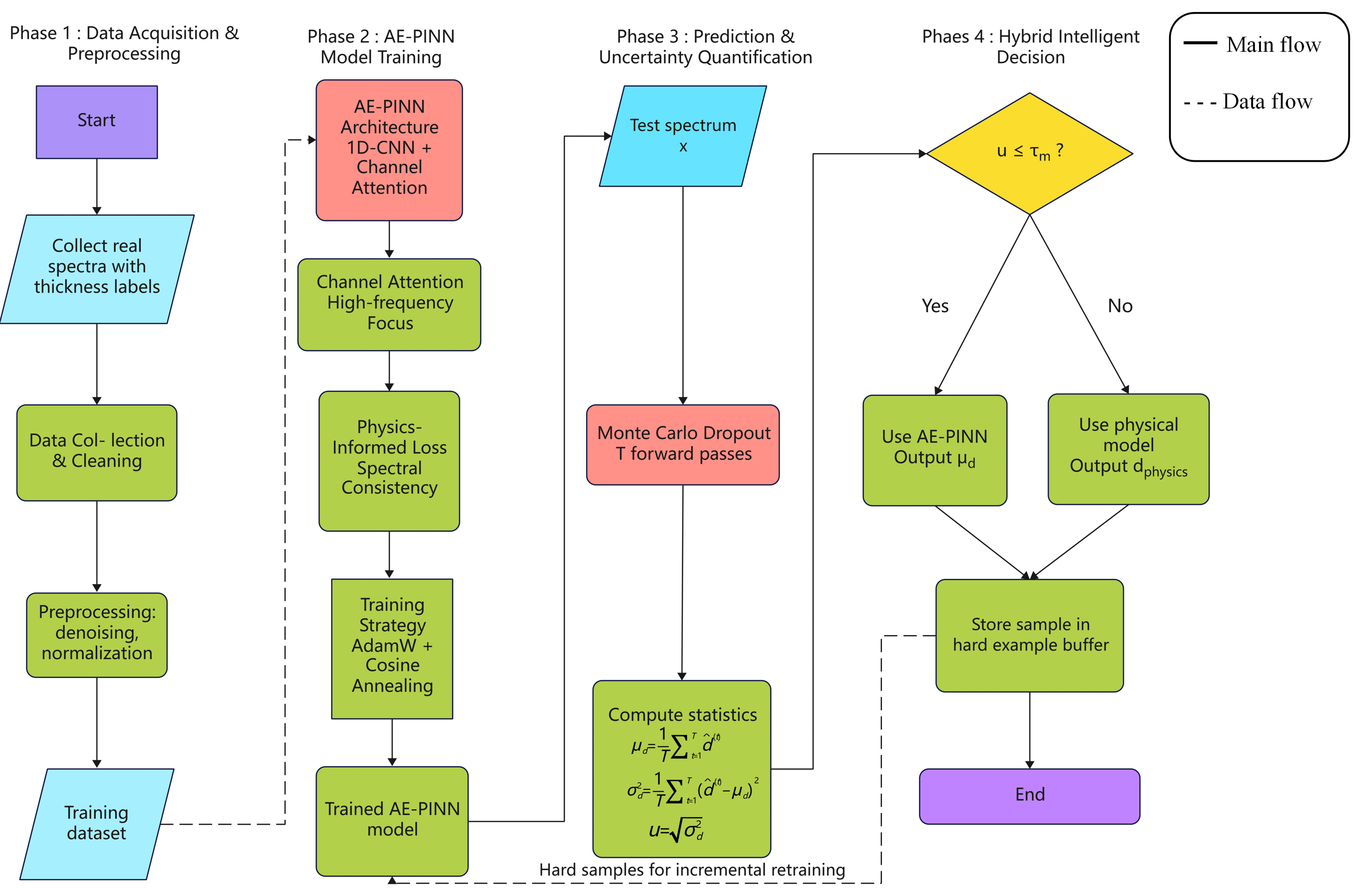
Figure 2. Flowchart of the AE-PINN algorithm. The algorithm consists of four core phases: (1) Real data acquisition and preprocessing: collect real interference spectra with thickness labels, and build the training set through denoising and normalization; (2) AE-PINN model training: includes 1D-CNN, channel attention module, and training with physical constraints; (3) Physical constraint mechanism: implement physical constraints through spectral consistency checking; (4) Uncertainty-Aware hybrid decision: intelligent mode switching based on uncertainty quantification via Monte Carlo Dropout. AE-PINN: Attention-enhanced physics-informed neural network; 1D-CNN: one-dimensional convolutional neural network.