



Multifunctional organic molecules as electron-buffering layers for stabilizing Zn anodes
 0
0 Abstract
Interfacial instability at the Zn anode represents a major obstacle to the advancement
Keywords
INTRODUCTION
Owing to their favorable safety profile, economic viability, and reduced environmental impact, aqueous zinc-ion batteries (AZIBs) are suited for large-scale energy storage and could complement existing lithium-ion battery technologies[1,2]. Studies have demonstrated that interfacial engineering plays a crucial role in enhancing the performance of Zn-based energy storage systems, including alkaline Zn-air batteries[3-5]. Nevertheless, the interfacial challenges in AZIBs differ substantially because they involve Zn deposition/stripping in ZnSO4-based electrolytes, which are accompanied by dendrite growth and parasitic side reactions[6,7]. To address interfacial issues, researchers have recently proposed various strategies to regulate metal-ion deposition behavior and interfacial reaction kinetics, including catalytic interfacial engineering[8-11], electrolyte optimization[12,13], interface engineering and electrode structure design[14-17]. Recent studies have demonstrated that catalytic interfacial engineering can accelerate Zn2+ desolvation, lower the nucleation barrier, and regulate Zn deposition kinetics[10,18]. Alongside catalytic interface design, electrolyte engineering has also emerged as an effective approach for tailoring the Zn anode/electrolyte interface and suppressing parasitic side reactions. For example, Na+[19], Mg2+[20], and Y3+[21] ions were introduced into the electrolytes. Due to their adsorption on the Zn anode surface, the craze growth of Zn dendrites was inhibited by the formation of shielding layers. However, owing to the irreversible depletion of the inorganic salt additive, the prolonged cycling performance of AZIBs needs to be further demonstrated.
Organic molecule additives, encompassing both small molecules and polymers (e.g., esters, nitriles, amines), have received considerable research attention[22-24]. This is primarily attributed to the ability of heteroatom-based functional groups (e.g., -S-, -N-, C=O, and C=N) to coordinate with Zn2+ ions via their lone electron pairs, thereby modulating the solvation of the Zn2+ ions[25]. Besides, introducing organic additives into the electrolyte can lower the activity of H2O molecules and hinder their redox reactions due to the strong binding to H2O molecules[26]. It has been reported that short-chain alcohols, such as ethanol and erythritol, can penetrate the Zn2+ solvation sheath via interactions with coordinated H2O, altering the primary solvation structure of Zn2+[27]. Ether additives have been shown to form a shielding layer at the Zn protrusion tip, thereby directing Zn2+ deposition into adjacent depressions and yielding a smoother zinc deposit morphology[28]. Moreover, extending the carbon chain length and increasing the number of functional groups within the additive molecules reinforce the hydrogen-bonding network with H2O, thereby suppressing undesirable side reactions. However, the incorporation of organic additives is not without drawbacks, as it may compromise the electrolyte’s ionic conductivity and potentially impair battery safety. Therefore, a judicious balance between the type and concentration of additives is essential to achieve optimal electrochemical performance.
As a result, trace-based organic molecular additives have received attention[29-32]. For instance, Yu et al. introduced trace amounts of hexamethylenetetramine (HMTA) as additives into the electrolyte of AZIBs. The HMTA additives can preferentially adsorb onto the Zn anode surface, creating a unique anode-molecule interface[29]. On the other hand, organic molecular additives based on bifunctional groups have been investigated[6,33]. For example, Li et al. reported the use of 4-amino-benzene-sulfonic acid (ABSA) additives in the ZnSO4 electrolyte to improve the performance of AZIBs[6]. They observed that ABSA forms an adsorption layer on the Zn anode surface, thereby facilitating the formation of a stable, sulfur-rich solid electrolyte interphase (SEI). In addition, organic molecules containing both sulfonic acid groups and hydroxyl or carbonyl groups have attracted considerable attention owing to their bifunctional characteristics[26,34]. Sun et al. proposed a chemical self-deoxygenation strategy involving the addition of sodium anthraquinone-2-sulfonate into the electrolyte, which effectively mitigates the performance degradation of AZIBs induced by dissolved oxygen[35]. However, the underlying mechanism by which the functional groups of organic additives regulate Zn deposition and stripping remains to be fully elucidated.
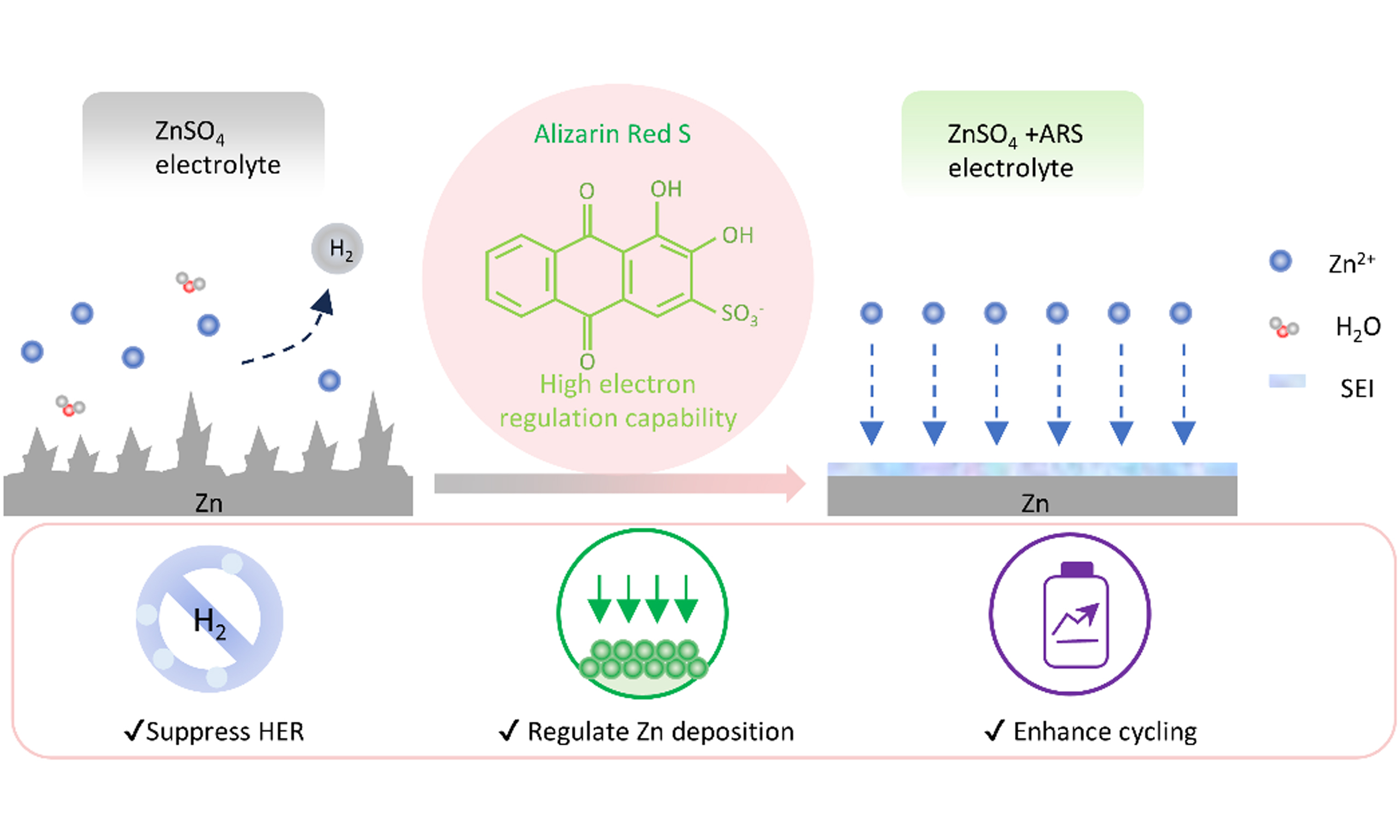
On this basis, alizarin red S (ARS) organic molecules bearing sulfonic acid, hydroxyl, and carbonyl groups were selected as electrolyte additives in this work. Their interactions with both the Zn anode interface and the electrolyte bulk were investigated. Comparative investigations were carried out on sodium p-hydroxybenzenesulfonate (PHS), which contains both hydroxyl and sulfonic groups, and sodium benzenesulfonate (SBS), which contains only a sulfonic group. Although similar multifunctional organic additives have been studied for Zn anode stabilization through Zn2+ coordination[36], preferential adsorption[6], and solvation regulation[34], relatively little attention has been paid to exploiting organic molecules with extended π-conjugated frameworks to regulate the interfacial electron distribution. Results show that, with the synergistic effect of the extended π-conjugated framework and multiple functional groups, ARS molecules can adsorb onto the Zn anode surface, homogenizing the local interfacial electron density and achieving uniform Zn deposition. Meanwhile, the C=O groups in ARS can accept protons, mitigating local pH fluctuations and effectively suppressing the accumulation of parasitic products. In addition, the electrochemical reduction of ARS generates a dense inorganic-rich SEI in situ at the Zn/electrolyte interface. Such an interfacial layer homogenizes Zn2+ flux and improves the reversibility of Zn deposition/dissolution. Benefiting from these effects, symmetric Zn//Zn cells containing ARS sustain prolonged operation beyond 2,700 h (1 mA cm-2, 0.5 mAh cm-2) and 2,000 h (2 mA cm-2, 1 mAh cm-2), exceeding those cells using ZnSO4, ZnSO4 + PHS, and ZnSO4 + SBS electrolytes. Zn//I2 batteries using the ZnSO4 + ARS electrolyte also deliver superior cycling stability and rate performance compared with those using the ZnSO4 electrolyte. This work provides new insights into the design of high-performance AZIBs through the use of multifunctional additive molecules.
EXPERIMENTAL AND COMPUTATIONAL METHODS
Materials
ARS (IND), PHS (98%), SBS (98%), and ZnSO4·7H2O (99%) were purchased from Shanghai Yuanye Bio-Technology Co., Ltd. Activated carbon (AC), I2, N-methyl-2-pyrrolidone (NMP, 99%), and polyvinylidene difluoride (PVDF) were provided by Shanghai Macklin Biochemical Co., Ltd. Zn foil (50 μm, 99.999%) and Ti foil (20 μm, 99.999%) were provided by Institute for High Purity Metallic Materials. The glass fiber separator (260 μm) was obtained from GE Whatman. Acetylene black was obtained from Shandong Xiya Chemical Co., Ltd.
Electrolytes and cells
The electrolytes used in this work are pure ZnSO4 (2 M) and ZnSO4 (2 M) with 0.02 mM additives, including ARS, PHS, and SBS, respectively. The optimal concentration of 0.02 mM was chosen to avoid the severe corrosion caused by a more acidic electrolyte at higher additive loadings [Supplementary Figure 1]. Ti//Zn cells and Zn//Zn cells were fabricated using commercial Ti foil and Zn foil without treatment and Whatman glass microfiber. Before assembling the Zn//I2 cells, the cathode material was prepared by diffusing iodine into the activated carbon and heating it at 90 °C for 4 h (I2:AC = 3:7). Then, a homogeneous cathode slurry was obtained by dispersing the cathode material, acetylene black, and PVDF (8:1:1 by weight) in NMP. Zn//I2 batteries were assembled using the as-prepared cathode and Zn foil as the cathode and anode, respectively, separated by glass fiber. The mass of iodine was nearly 1.0 mg cm-2. All cells were assembled into CR2032 coin cells.
Characterizations
A JEOL JEM-F200 (Japan) and a Hitachi SU8100 (Japan) were employed for Transmission Electron Microscopy (TEM) and Scanning Electron Microscopy (SEM) observations, respectively. X-ray Photoelectron Spectroscopy (XPS) measurements were obtained with a Thermo Scientific K-Alpha (USA). 1H Nuclear Magnetic Resonance (NMR) spectra were acquired on a Bruker Avance NEO 600 MHz spectrometer (Germany). Infrared spectra were collected using a Thermo Scientific Nicolet iN10 Fourier Transform Infrared Spectrometer (FTIR, USA). Raman spectroscopy tests were conducted using WITec alpha300 R (Germany). The crystalline structures were examined using Cu-Kα radiation on a Bruker D8 ADVANCE diffractometer (Bruker AXS GmbH, Germany), with an operating voltage of 40 kV and a scanning 2θ window of 5-80°. Ultravilet-visible (UV-Vis) Spectroscopy tests were analyzed using a Shimadzu UV1900i plus (Japan). In situ optical measurements were performed using Motic BA310Met microscopy (China).
The electrochemical cycling performance was tested on an Autolab M204 workstation (Metrohm, Switzerland). The cells and batteries’ charge/discharge and rate performance were tested on a Neware BTS-51 battery testing system (Neware, Shenzhen, China). A conventional three-electrode setup was employed for Tafel and cyclic voltammetry (CV) measurements, with Zn foil serving as the working electrode, Ti foil as the counter electrode, and Ag/AgCl as the reference electrode. The additive-induced variation in the electric double-layer (EDL) capacitance was investigated separately by CV in Zn//Zn symmetric cells. Hydrogen evolution behavior in the presence of the additive was examined through the linear scan voltammetry (LSV) measurements of symmetric Zn//Zn cells. For impedance analysis, electrochemical impedance spectroscopy (EIS) spectra were acquired under open-circuit potential (OCP) conditions by applying a 5 mV AC perturbation across the frequency range of 0.01 Hz ~100 kHz.
Theoretical calculation
Density functional theory (DFT) calculations were conducted with the DMol3 program package available in Materials Studio to quantify the intermolecular binding and adsorption energetics. The molecular structures were fully optimized using the generalized gradient approximation and Perdew-Burke-Ernzerhof exchange-correlation functional, followed by the corresponding energy calculations. The total orbital truncation parameter was set to 5.2 Å. The convergence criteria for orbital occupancy and energy were defined as 5 × 10⁻³ and 1 × 10⁻⁵ Ha, respectively, while the maximum force and atomic displacement were limited to 0.002 Ha Å-1 and 0.005 Å, respectively. The binding energy (Ebind) between the ARS, PHS, SBS, H2O, and Zn2+ was calculated according to[37]:
Where ETotal is the whole system’s energy. EA is the energy of ARS, PHS, and SBS, respectively. EB is the energy of the Zn2+ or H2O molecule.
The Zn (002) slab with lattice constants of 13.3245 Å × 13.3245 Å × 24.9468 Å was constructed to calculate the adsorption energy. A vacuum spacing of 20 Å was introduced along the direction normal to the slab to minimize interactions between periodic images. Brillouin-zone sampling was performed using a 1 × 1 × 1 k-point mesh. During structural optimization, the bottom-layer atoms were constrained at their initial positions, whereas the remaining upper atoms were allowed to relax. The adsorption strength of each species on the Zn (002) surface was quantified by the adsorption energy (Eads), defined as:
where Eslab+s denotes the total energy of the optimized adsorption system, and Eslab and Es represent the energies of the pristine Zn (002) slab and the isolated adsorbate, respectively.
RESULTS AND DISCUSSION
The three organic molecules differ in their functional groups: ARS contains -SO3-, -OH, and -C=O groups; PHS contains -SO3- and -OH groups; and SBS contains only -SO3- group [Figure 1A]. Among them, ARS possesses an extended π-conjugated framework, PHS features a combination of intra-ring π-conjugation and p-π conjugation, whereas SBS is limited to intra-ring π-conjugation. Therefore, the electron regulation capability of the three molecules follows the order: ARS > PHS > SBS, attributed to the dimensionality of their π-conjugation systems. As a result, these molecules exhibit distinct effects on the Zn2+ solvation sheath, Zn2+ coordination environment, and hydrogen-bonding network within the electrolyte. As shown in Supplementary Figures 2-4, UV-Vis spectra of ARS-, PHS-, and SBS-containing ZnSO4 electrolytes exhibit progressively intensified absorption bands with increasing additive concentration, indicating the increasing population of electronically active species in the electrolyte. Notably, the absorption band centered at ~525 nm is significantly enhanced in the ZnSO4 + ARS electrolyte [Figure 1B and Supplementary Figure 2]. This band is associated with the intramolecular charge transfer (ICT) transition within the anthraquinone π-conjugated framework of ARS[38,39]. The enhanced visible-light absorption suggests strengthened π-electron delocalization and electronic redistribution of ARS molecules induced by Zn2+ interaction. In Figure 1B, the absorption band at ~262 nm related to the π → π* transition of the anthraquinone conjugate exhibits an obvious red shift[40,41], which further indicates that the electron transition energy within the ARS framework is reduced and the π-electron delocalization is enhanced. Such electronically reconstructed ARS species possess an enhanced electron redistribution capability, enabling a more homogeneous interfacial electron distribution on the Zn surface, and thereby promoting uniform Zn deposition[42].
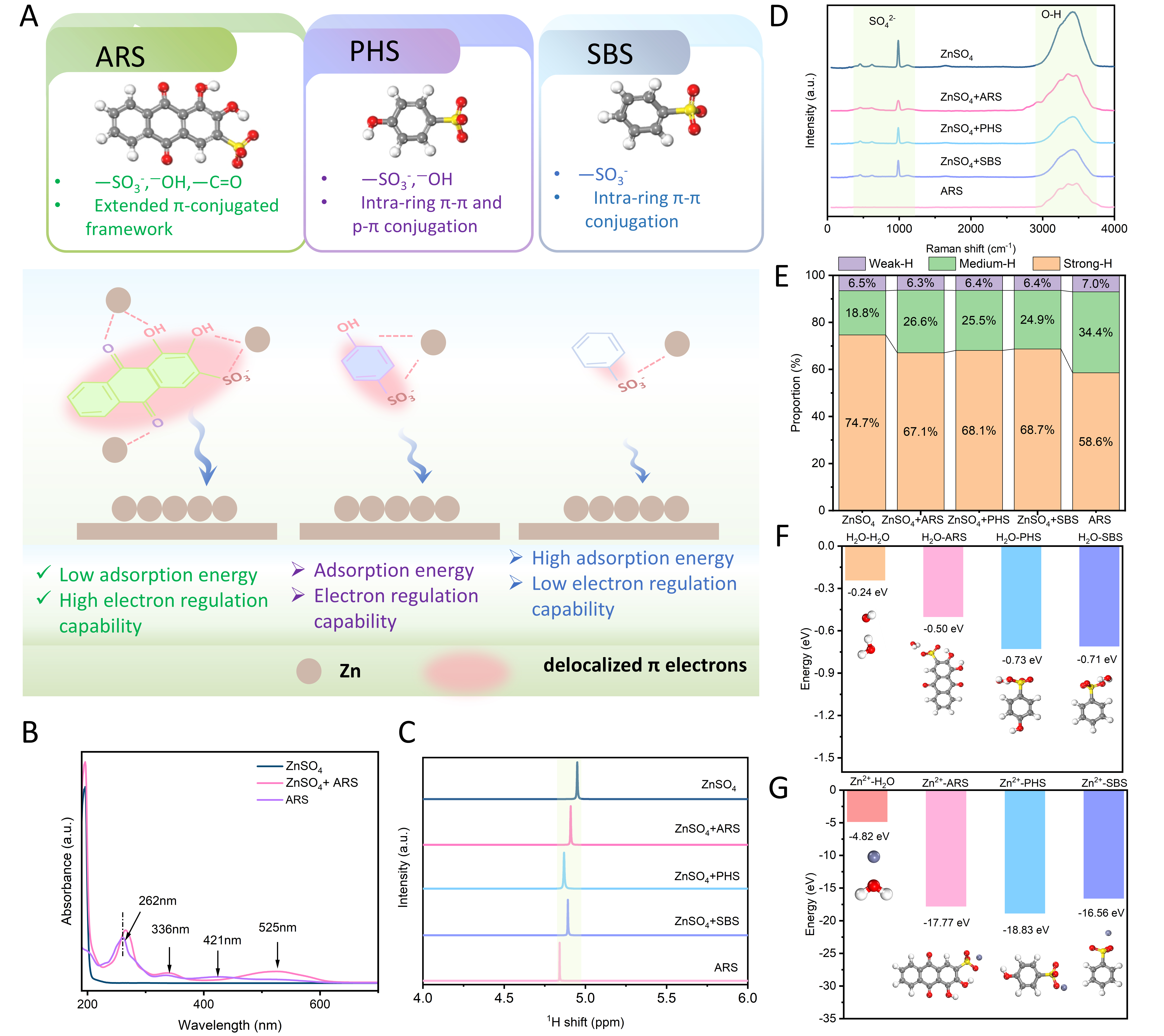
Figure 1. (A) The molecular structure characteristics of ARS, PHS, and SBS; (B) UV-Vis spectra of ZnSO4, ZnSO4 + ARS, and ARS, respectively; (C) NMR spectra, (D) Raman spectra, and (E) hydrogen-bonding ratio of ZnSO4, ZnSO4 with ARS/PHS/SBS, and ARS
NMR, FTIR, and Raman techniques were combined to investigate the Zn2+ solvation structure and hydrogen-bonding network of electrolytes. As shown in Figure 1C, a significant chemical shift of 1H appears after introducing ARS, PHS, and SBS into ZnSO4 solutions, indicating the formation of a new hydrogen-bonding network. Compared with the ZnSO4 solutions, the 1H NMR signals of water molecules in ZnSO4 + ARS and ARS solutions show a significant chemical shift toward a higher field, indicating an increased electron density around the proton nuclei and an enhanced shielding effect arising from the interaction between ARS molecules and H2O[43]. Figure 1D and Supplementary Figure 5 show Raman and FTIR spectra of ZnSO4 with different additives. In comparison with the pure ZnSO4 solution, the proportion of strong hydrogen bonding decreased, whereas that of the medium hydrogen bonding increased in the solution containing ARS, PHS, and SBS [Figure 1E and Supplementary Figure 6]. In contrast, the proportion of weak hydrogen bonding remained nearly unchanged, with values of approximately 6%~7%. Among the tested solutions, the ARS solution exhibited the lowest proportion of strong hydrogen bonding (58.6%) and the highest proportion of medium hydrogen bonding (34.4%). These results indicate that ARS, PHS, and SBS additives perturb the original hydrogen-bonding network[44]. This modification of the deposition environment may suppress both the Zn dendritic growth and the hydrogen evolution reaction (HER).
DFT calculations were performed to investigate the interactions of different molecules. The binding energies of ARS, PHS, SBS, and H2O molecules are all lower than the binding energy between H2O molecules [Figure 1F], suggesting that they can affect the hydrogen-bonding network and possibly also the solvation sheath. Moreover, the binding energies of ARS, PHS, and SBS with Zn2+ are lower than those of H2O, indicating that these molecules can enter the solvation sheath and partially replace the coordinated water molecules [Figure 1G]. However, these additives are used at trace concentrations. Consequently, their impact on the solvation sheath is rather limited in this work[45].
A combination of theoretical simulations and experimental tests was jointly applied to elucidate how these molecules interact with and regulate the electrode interface. The charge densities calculated by DFT show that the O in H2O, ARS, PHS, and SBS molecules exhibit significant electronegativity [Supplementary Figure 7], indicating a strong tendency for their adsorption onto the Zn surface[6]. The electronegative groups in the electrostatic potential diagram confirm the adsorption sites of these molecules on the Zn electrode surface [Supplementary Figure 8]. Figure 2A and Supplementary Figure 9 demonstrate their adsorption energies on the Zn (002) surface in horizontal and vertical configurations. As can be seen, ARS, PHS, and SBS molecules show stronger adsorption than H2O molecules in both horizontal and vertical orientations on the Zn (002) surface, owing to the rich lone-pair electrons on their O atoms. When adsorbed horizontally on the Zn (002) surface, the adsorption strength follows the order of ARS (-4.38 eV) > PHS (-3.46 eV) > SBS (-3.02 eV). In contrast, the adsorption strength order is reversed for the vertically adsorbed configurations. This difference can be attributed to the extended planar π-conjugated framework of ARS, which provides a larger contact area with the Zn (002) surface in the horizontal adsorption configuration, thereby strengthening van der Waals interactions and π-Zn interactions and resulting in stronger adsorption. In addition, the multiple polar functional groups of ARS enhance its interfacial interactions with the Zn surface through electrostatic interactions and charge redistribution, while the horizontal adsorption configuration further reduces steric hindrance. Conversely, for vertical adsorption, the interaction is mainly governed by localized coordination between sulfonic acid groups and the Zn surface. Therefore, SBS molecules with smaller steric hindrance exhibit relatively stronger adsorption in this configuration. The charge density difference in Supplementary Figures 10 and 11 verify the strong interactions between these molecules and the Zn (002) surface, showing more pronounced interfacial charge redistribution than that induced by H2O adsorption[46]. Meanwhile, owing to its multiple polar groups, ARS induces stronger interfacial charge redistribution with the Zn (002) surface than PHS and SBS. These results confirm that ARS, PHS, and SBS additive molecules can construct molecular adsorption layers with different adsorption strengths on the anode surface. Among them, ARS exhibits the strongest adsorption capability in the horizontal adsorption configuration due to the synergistic effect of its extended π-conjugated framework and multiple functional groups, which enables effective regulation of Zn2+ deposition behavior and HER kinetics at the Zn electrode interface.

Figure 2. (A) The adsorption energies of horizontally oriented H2O, ARS, PHS, and SBS on Zn (002); (B) OCP curves and (C) EDL capacitance measured in pristine and additive-containing ZnSO4 electrolytes; (D) LUMO - HOMO energy band gap and frontier molecular orbital distributions of H2O, ARS, PHS, and SBS molecules; (E) LSV and (F) Tafel polarization responses obtained under different electrolyte conditions; (G-K) HRTEM observations of cycled Zn from ARS-containing electrolyte and (L) corresponding EDX elemental maps. ARS: Alizarin red S; SBS: sodium benzenesulfonate; LUMO: lowest unoccupied molecular orbital; HOMO: highest occupied molecular orbital; OCP: open-circuit potential; EDL: electric double-layer; LSV: linear scan voltammetry; HRTEM: high-resolution transmission electron microscopy; EDX: energy-dispersive X-ray spectroscopy; HAADF: high-angle annular dark-field; PHS: sodium p-hydroxybenzenesulfonate.
In addition to the preliminary theoretical evaluation, the OCPs of Zn electrodes in different electrolytes were measured to provide experimental evidence for the adsorption of additive molecules on the Zn surface. As shown in Figure 2B, the OCP of the Zn electrode in the ZnSO4 electrolyte initially decreases due to Zn dissolution and then gradually recovers as the Zn2+ concentration at the Zn electrode interface reaches equilibrium[47]. However, the OCPs of the Zn electrodes in the ZnSO4-containing ARS, PHS, and SBS electrolytes show positive shifts, which are attributed to the special adsorption of these molecules on the Zn surface. The EDL capacitance of the Zn electrode in different electrolytes was measured to elucidate the effect of interfacial molecular adsorption on the EDL characteristics, as illustrated in Figure 2C and Supplementary Figure 12. The EDL capacitance of the Zn electrode in ZnSO4 solutions is about 245 μF cm-2. After introducing ARS, PHS, and SBS additives into the ZnSO4 solutions, this value decreases to 23 μF cm-2,
The lowest unoccupied molecular orbital (LUMO) and highest occupied molecular orbital (HOMO) characteristics were analyzed to gain insight into the electronic interactions between the molecules and the Zn surface. The tendency of a molecule to donate or accept electrons can be inferred from its HOMO and LUMO energy levels, respectively. The order of HOMO energy levels of ARS, PHS, SBS, and H2O molecules is H2O < ARS < SBS < PHS [Figure 2D]. This indicates that these molecular additives preferentially donate electrons to the Zn surface compared with adsorbed H2O molecules[48]. The energy levels are consistent with the adsorption energy results mentioned above. The ARS molecules have the lowest LUMO energy level, meaning that the ARS molecules are very susceptible to accepting electrons from the Zn anode. This facilitates the preferential reduction of ARS, thereby suppressing the HER[49,50]. Moreover, results show that the orbital energy gap (ΔE = ELUMO - EHOMO) of these molecules in descending order is: H2O (6.99 eV) > SBS (2.99 eV) > PHS (2.90 eV) > ARS (1.58 eV). The value of ΔE reflects the chemical reactivity of the molecule. ARS molecules exhibit the lowest ΔE, suggesting they are readily reduced on the Zn surface, thereby forming an SEI that regulates Zn2+ deposition and protects the Zn anode from corrosion[49,51]. Compared with PHS and SBS molecules, the ARS molecule contains multiple electronegative O atoms, which withdraw electron density from the aromatic rings, thus decreasing their π-electron density and making them susceptible to electrochemical reduction. The carbonyl (C=O) groups of ARS are proposed to undergo electrochemical reduction, likely forming hydroxylated aromatic species through the consumption of surface-adsorbed hydrogen intermediates, thereby suppressing HER and promoting the formation of a dense and uniform SEI[52]. In addition, the minimal pH variation in Supplementary Figure 14 indicates that the ARS additive effectively mitigates local pH fluctuations at the Zn/electrolyte interface. Figure 2E shows that the resistance of HER increased after the addition of ARS, PHS, and SBS, indicating suppressed HER[53]. This conclusion is further supported by the corrosion curves in Figure 2F. To be specific, the Zn electrode in the ZnSO4 electrolyte has a corrosion current of 1.78 mA cm-2 and a negative corrosion potential of -0.952 V. After adding ARS, PHS, and SBS, the corrosion potential shows a positive shift and the corrosion current density shows a decrease, implying the positive effect of additives on anti-corrosion performance[15]. Notably, upon the addition of ARS to the electrolyte, the corrosion current decreases to 0.708 mA cm-2, while the corrosion potential shifts positively to -0.947 V. These changes may be attributed to the electrochemical reduction of ARS molecules. CV curves in Supplementary Figure 15 show that there is a reduction peak at -0.7 V in the ARS electrolytes. The reduction species on the electrode were investigated by TEM [Figure 2G-K]. Results show that the lattice fringes of ZnCO3 (104), ZnS (111), ZnO (100), and ZnCO3 (116) are present on the Zn electrode cycled in ZnSO4 with ARS electrolytes[50,54], indicating the formation of an inorganic-rich SEI layer, which is composed of ZnCO3, ZnS, and ZnO. Energy-dispersive X-ray spectroscopy (EDX) elemental maps in Figure 2L show that the elemental distributions of C, S, O, and Zn on the Zn electrode surface are uniform. Sparse crystalline domains are discernible on the Zn surface after cycling in the pristine ZnSO4 electrolyte [Supplementary Figures 16 and 17], although its EDX elemental maps resemble those obtained in the presence of ARS. Upon introducing ARS, substantially more lattice fringes appear across the cycled Zn surface, indicative of enhanced interfacial product formation. These microscopic features support the formation of a compact and continuous inorganic-rich SEI induced by the ARS additive.
To identify the chemical composition of the species on the Zn anode cycled in ZnSO4 and ZnSO4 + ARS electrolytes, XPS coupled with Ar+ sputtering was applied. The variation of O, S, and C elements with sputtering time is depicted in Figure 3A and B. Deconvolution of the O 1s spectrum yields three components centered at 529.9, 531.6, and 533.6 eV, corresponding to Zn-O, C=O/S=O, and C-O/O-H species, respectively[16,55]. With increasing Ar+ sputtering time, the peak at 529.9 eV gradually increases, whereas the peak at 533.6 eV gradually disappears. The enhanced Zn-O signal indicates the presence of ZnO on the Zn electrode, which is attributed to the decomposition of Zn4SO4(OH)6·5H2O generated during the parasitic corrosion reactions between dissolved oxygen/water and Zn[56]. In the S 2p spectra, the peak at 169.1 eV is assigned to SO42-[57,58]. With increasing Ar+ sputtering time, the characteristic ZnS peak at 162.0 eV gradually emerges for the Zn electrode cycled in the ZnSO4 + ARS electrolyte, whereas no corresponding Zn-S signal is detected for the Zn electrode cycled in the ZnSO4 electrolyte. The findings suggest that the adsorbed ARS additives undergo electrochemical reduction at the anode interface, leading to the formation of ZnS species within the SEI. The C 1s spectrum comprises contributions from C-H/C-C (284.8 eV), C-O (286.4 eV), and ZnCO3 (288.9 eV), with the latter likely originating from reactions involving dissolved CO2 and decomposition products of organic molecules[29,55]. For the Zn electrode cycled in ZnSO4 electrolyte, prolonged Ar+ sputtering eliminates the C-O-C signal and progressively weakens the ZnCO3 component [Figure 3A]. In contrast, the signal intensity of ZnCO3 increases obviously, indicating rich ZnCO3 on the Zn electrode [Figure 3B]. The results show that the addition of ARS facilitates the formation of a uniform inorganic-rich SEI composed of ZnO, ZnS, ZnCO3 on the zinc electrode surface, in good agreement with the TEM observations. This robust interphase effectively inhibits Zn corrosion while promoting homogeneous Zn deposition[50].

Figure 3. In-depth XPS analysis of O 1s, S 2p, and C 1s on the Zn anode after 20 cycles in (A) pristine and (B) ARS-containing ZnSO4; (C) The current-time curves of Zn//Zn cells and (D) the potential-time curves of Ti//Zn cells in pristine and additive-containing ZnSO4 electrolytes; (E) The corresponding SEM results; The influences of (F) pristine and (G) ARS-containing ZnSO4 electrolytes on the Zn electrode surface. XPS: X-ray photoelectron spectroscopy; ARS: alizarin red S; SBS: sodium benzenesulfonate; SEI: solid electrolyte interphase; SEM: scanning electron microscopy; PHS: sodium p-hydroxybenzenesulfonate.
The chronoamperometry (CA) method was further applied to investigate the Zn nucleation and growth behavior. A lower steady-state current density indicates a more uniform and compact Zn deposition process, thereby suppressing dendrite formation[59]. Figure 3C demonstrates that the current density in the ZnSO4 electrolytes increases continuously for 200 s until 25 mA cm-2. The current density during Zn deposition in ZnSO4 electrolytes containing ARS, PHS, or SBS increases rapidly to about 17 mA cm-2 within 100 s and remains stable thereafter. The rapid increase in current means the 3D diffusion process, while the slow increase in current means the 2D diffusion process[46]. The former results in uniform and dense Zn deposition, while the latter results in irregular and sparse Zn deposition. Figure 3D shows an increased Zn nucleation overpotential after the introduction of ARS, PHS, and SBS additives, meaning that these additives promote the formation of smaller Zn nuclei and refined Zn deposition, which results in a more uniform Zn plating/stripping process and highly reversible Zn anodes[60].
In situ optical microscopy was used to track the dynamic Zn deposition process at the electrode interface. After 20 min of plating, pronounced uneven Zn accumulation can be observed on the electrode surface [Supplementary Figure 18], indicating highly nonuniform Zn growth. However, Zn electrodes cycled in ZnSO4 electrolytes containing ARS, PHS, or SBS exhibited smooth surfaces without obvious surface protrusions. The SEM results are consistent with this [Figure 3E]. Haphazard accumulation of large-sized flake deposits can be observed on the surface of Zn cycled in ZnSO4 electrolytes. Due to the presence of ARS additives, the deposits on the Zn electrode are dense and uniform. For the Zn electrode cycled in the PHS-containing electrolyte, relatively uniform deposits are observed, although their particle size is considerably larger. Cycling in the presence of SBS leads to the formation of a porous and noncompact deposit on the Zn surface. The X-ray diffraction (XRD) profile of Zn retrieved from the additive-free
Based on the above theoretical calculations and experimental results, the mechanism of ARS additives for Zn anodic protection is suggested. In the ZnSO4 electrolyte [Figure 3F], the Zn anode suffers from severe parasitic corrosion and hydrogen evolution, together with uncontrolled Zn dendritic growth, resulting in rapid deterioration of cycling performance. Upon introducing ARS into the electrolyte [Figure 3G], the preferential adsorption of ARS on the Zn anode surface displaces interfacial H2O molecules, creating a water-deficient interfacial environment. The C=O groups on the aromatic backbone of ARS preferentially react with surface-adsorbed hydrogen intermediates, thereby suppressing local alkalization caused by the HER. Subsequently, the adsorbed ARS molecules undergo electrochemical reduction to form a robust protective SEI. More importantly, due to the extended π-conjugated framework with highly delocalized π electrons, ARS acts as an electron-buffering layer that homogenizes the interfacial electron distribution on the Zn surface, thereby promoting uniform Zn deposition. Collectively, the introduction of ARS additives changes the Zn electrode interface by suppressing HER and Zn corrosion, facilitating reversible Zn deposition/stripping, and ultimately enhancing the cycling stability of the Zn anode.
To access the effect on the cycling performance of Zn anodes, Zn//Zn cells using ZnSO4 electrolytes with and without ARS, PHS, and SBS additives were tested at different current densities. Figure 4A shows that the Zn//Zn cell using the ZnSO4 electrolyte experiences a sudden short circuit after 260 h of cycling at 1 mA cm-2 and 0.5 mAh cm-2. With the introduction of additives, these cells can operate for more than 1,800 h. In particular, the Zn//Zn cell using the ZnSO4 + ARS electrolyte exhibits stable cycling for over 2,700 h. At

Figure 4. Cycling behavior of symmetric Zn//Zn cells in pristine and additive-containing ZnSO4 electrolytes at (A) 1, (B) 2, and (C)
Zn plating/stripping reversibility was examined using Ti//Zn cells. The incorporation of ARS leads to a pronounced enhancement in Coulombic efficiency (CE), with an average value of 99.5% retained over 500 cycles [Figure 4E]. Without ARS, however, the average CE decreases to approximately 95%, and the cell survives for only 70 cycles, highlighting the beneficial role of ARS in stabilizing reversible Zn deposition. The reproducibility of the CE measurements was verified using three independently assembled Ti//Zn cells. The corresponding CE profiles and statistical analysis (99.46 ± 0.08, n = 3) are presented in Supplementary Figure 21, confirming the excellent reproducibility of the electrochemical performance. The initial CE of the Ti//Zn cell using ZnSO4 + ARS electrolytes is 95.05%, higher than that of the cell using ZnSO4 electrolytes (90.02%) [Figure 4F], indicating that the irreversible loss of the former cell is smaller than that of the latter cell[61]. Conclusively, the excellent cycling stability of cells using ZnSO4 + ARS electrolytes is associated with the formation of a suitable adsorption layer in the EDL structure and the inorganic-rich SEI protective layer on the Zn anode surface, which can modify the operating environment of the Zn anode.
The significantly prolonged cycling lifespan of symmetric cells demonstrates the effectiveness of the electrolyte additives in suppressing Zn dendrite growth and the HER. To further verify the beneficial effect of the ARS additive in practical devices, Zn//I2 full batteries were assembled. As shown in Figure 5A, introducing ARS additives into the ZnSO4 electrolyte decreases the redox potential difference and increases the redox peak currents, indicating reduced electrochemical polarization and improved electrochemical reversibility. The EIS spectra in Figure 5B show that both the charge transfer resistance and interfacial resistance decrease upon the addition of ARS to the ZnSO4 electrolyte, indicating accelerated interfacial charge transfer kinetics due to interfacial regulation induced by ARS adsorption.
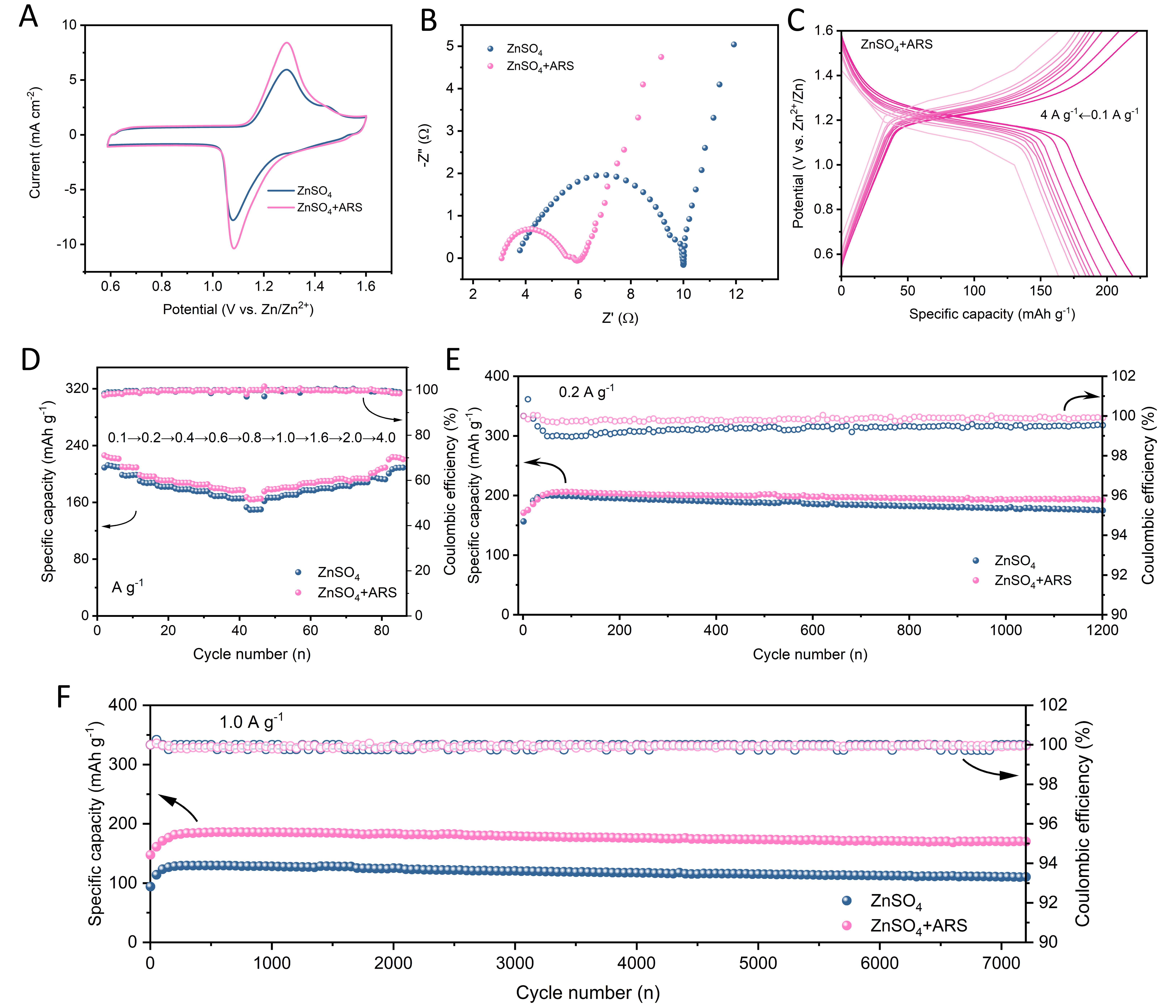
Figure 5. (A) CV profiles and (B) EIS spectra of the Zn//I2 batteries in pristine and ARS-containing ZnSO4 electrolytes; (C) Galvanostatic charge/discharge profiles of the ZnSO4 + ARS electrolyte and (D) rate performance of the ZnSO4 and ZnSO4 + ARS electrolyte over a current-density range of 0.1-4.0 A g-1. Extended cycling behavior of Zn//I2 batteries with and without ARS at (E) 0.2 A g-1 and (F) 1.0 A g-1. CV: Cyclic voltammetry; EIS: electrochemical impedance spectroscopy; ARS: alizarin red S.
The galvanostatic charge/discharge profiles of Zn//I2 batteries containing the ZnSO4 electrolyte [Supplementary Figure 22] and the ZnSO4 + ARS electrolyte [Figure 5C] were collected over a wide range of current densities from 0.1 to 4.0 A g-1. Their corresponding rate performance are presented in Figure 5D. Distinct voltage plateaus centered at approximately 1.3 V during charging and
CONCLUSION
In this work, ARS organic molecules, featuring an extended π-conjugated framework and multiple functional groups (sulfonic acid, hydroxyl, and carbonyl groups), were employed as an electrolyte additive to regulate the Zn anode/electrolyte interface in AZIBs. Comparative investigations using PHS and SBS as reference additives revealed that the synergistic effect of the extended π-conjugated framework and multiple functional groups is crucial for effective interfacial regulation and stable Zn deposition. Combined experimental and theoretical investigations demonstrate that ARS adsorption homogenizes the local interfacial electron distribution, regulates the Zn2+ flux, suppresses parasitic side reactions, and promotes the in situ formation of dense inorganic-rich SEI, thereby enabling uniform Zn deposition and highly reversible Zn plating/stripping. Consequently, Zn//Zn cells with the ZnSO4 + ARS electrolyte exhibit stable cycling for more than 2,700 h at
DECLARATIONS
Acknowledgments
The authors extend their gratitude to Ms. Mulan Chang (from Scientific Compass www.shiyanjia.com) for providing invaluable assistance with the XPS and NMR tests.
Authors’ contributions
Conceptualization, methodology, writing-original draft, formal analysis: Yue, Q.; He, J.
Investigation, data curation, DFT calculation: He, J.; Chen, Y.; Zhu, H.
Resources and supervision: Xiao, D.
Funding acquisition: Gao, T.; Li, X.
Project administration, supervision, writing-review: Qiu, L.; Li, X.
Availability of data and materials
The data supporting the findings of this study are available within the article and its Supplementary Materials. Additional data are available from the corresponding author upon reasonable request.
AI and AI-assisted tools statement
Not applicable.
Financial support and sponsorship
This work was funded by the Natural Science Foundation of Sichuan Province (No. 2025ZNSFSC0355) and the Key Laboratory of Fruit Waste Treatment and Resource Recycling of the Sichuan Provincial College (GZKF2405).
Conflicts of interest
All authors declared that there are no conflicts of interest.
Ethical approval and consent to participate
Not applicable.
Consent for publication
Not applicable.
Copyright
© The Author(s) 2026.
Supplementary Materials
REFERENCES
1. Zhao, Y.; Wang, Y.; Li, J.; et al. Thermodynamic and kinetic insights for manipulating aqueous Zn battery chemistry: towards future grid-scale renewable energy storage systems. eScience 2025, 5, 100331.
2. Lu, H.; Zhu, Y.; Du, Z.; Zhang, D.; Jin, Y. Aqueous zinc-iodine batteries for large-scale energy storage: challenges, strategies and perspectives. Adv. Funct. Mater. 2026, 36, e76322.
3. Poudel, M. B.; Anand, R.; Ojha, G. P.; et al. Nitrogen coordinated atomically dispersed manganese catalyzes oxygen reduction in practical zinc-air batteries and alkaline fuel cells. J. Power. Sources. 2026, 678, 239959.
4. Karim, O. L. A.; Poudel, M. B.; Bhandari, T.; Yoo, D. J. Integrating iron phthalocyanine and cobalt nanoparticles encapsulated N-doped CNTs as bifunction electrocatalyst for oxygen evolution reaction and oxygen reduction reaction in high-efficiency zinc-air battery. J. Alloys. Compd. 2026, 1071, 188725.
5. Poudel, M. B.; Balanay, M. P.; Lohani, P. C.; Sekar, K.; Yoo, D. J. Atomic engineering of 3D self-supported bifunctional oxygen electrodes for rechargeable zinc-air batteries and fuel cell applications. Adv. Energy. Mater. 2024, 14, 2400347.
6. Li, X.; Zhang, W.; Yu, J.; et al. Self-assembled protection layer induced by bifunctional additive for reversible aqueous zinc metal battery. Adv. Funct. Mater. 2024, 34, 2316474.
7. Yue, Q.; Zhu, H.; Chen, Y.; et al. Cation-anion cooperative additives in aqueous zinc-ion batteries: mechanistic insights and performance regulation. eScience. Energy. 2026, 2, 100038.
8. Wang, J.; Tang, B.; Wu, J.; et al. Revitalizing dendritic lithium with atomic modulator-decorated suspension electrolyte for durable lithium metal batteries. Sci. Adv. 2026, 12, eaef9111.
9. Zhang, J.; Liu, F.; He, R.; et al. Taming interfacial ion-dipole interactions with d-orbital delocalized electron catalysis expediates low-temperature Li metal batteries. Adv. Mater. 2026, 38, e10894.
10. Cheng, X.; Wang, W.; Tang, Z.; et al. Expediting desolvation-diffusion kinetics by self-cascade catalysis for durable low-temperature zinc metal batteries. Angew. Chem. Int. Ed. 2026, 65, e22417.
11. Wang, J.; Zhang, J.; Cheng, X.; et al. Electrode/electrolyte interface studies of rechargeable Li batteries with interface-specific sum frequency generation spectroscopy. J. Am. Chem. Soc. 2025, 147, 44633-51.
12. Hao, Z.; Yao, W.; Li, W.; et al. Insights on electrolyte engineering toward aqueous zinc-ion batteries. Energy. Mater. 2026, 6, 600036.
13. Wu, Z.; Huang, Z.; Zhang, R.; Hou, Y.; Zhi, C. Aqueous electrolyte additives for zinc-ion batteries. Int. J. Extrem. Manuf. 2024, 6, 062002.
14. Li, T.; Zhang, N.; Liu, B.; et al. Unlocking the critical role of cations doping in MnO2 cathode with enhanced reaction kinetics for aqueous zinc ion batteries. Adv. Funct. Mater. 2025, 35, 2423755.
15. Li, S.; Zhong, Y.; Huang, J.; et al. Regulating interfacial kinetics boosts the durable A h-level zinc-ion batteries. Energy. Environ. Sci. 2025, 18, 2599-609.
16. Wang, M.; Ma, J.; Meng, Y.; et al. In situ formation of solid electrolyte interphase facilitates anode-free aqueous zinc battery. eScience 2025, 5, 100397.
17. Zhao, M.; Lv, Y.; Xu, Y.; Yang, H.; Bo, Z.; Lu, J. Ordered zinc electrodeposition from single-crystal units to polycrystalline stacking within solid-electrolyte interphase in battery anodes. Nat. Commun. 2025, 16, 2843.
18. Dao, Y.; Li, M.; Zhang, M.; et al. Axial Coordination induced electron delocalization and p-p orbital hybridization in single-atom catalysts boosts Zn2+ desolvation for highly stable Zn anode. Adv. Sci. 2026, 13, e18148.
19. Xu, Y.; Zhu, J.; Feng, J.; et al. A rechargeable aqueous zinc/sodium manganese oxides battery with robust performance enabled by Na2SO4 electrolyte additive. Energy. Storage. Mater. 2021, 38, 299-308.
20. Wang, P.; Xie, X.; Xing, Z.; et al. Mechanistic insights of Mg2+ -electrolyte additive for high-energy and long-life zinc-ion hybrid capacitors. Adv. Energy. Mater. 2021, 11, 2101158.
21. Ding, Y.; Zhang, X.; Wang, T.; et al. A dynamic electrostatic shielding layer toward highly reversible Zn metal anode. Energy. Storage. Mater. 2023, 62, 102949.
22. He, Y.; Chen, Z.; Gao, Q.; Feng, J.; Hao, Z. Dynamic interface modulation of aqueous zinc-ion batteries by rational design of organic additives. Small 2025, 21, e06244.
23. Wang, C.; Zhang, D.; Yue, S.; et al. Organic electrolyte additives for aqueous zinc ion batteries: progress and outlook. Chem. Rec. 2024, 24, e202400142.
24. Tan, Y.; Xu, W.; Yang, F.; et al. Dynamic polyiodide-trapping and proton-capturing dual-network engineering for high-areal-capacity, long-cycling and high-temperature Zn-I2 batteries. Adv. Mater. 2026, 38, e22609.
25. Yang, X.; Li, W.; Chen, Z.; et al. Synchronous dual electrolyte additive sustains Zn Metal anode with 5600 h lifespan. Angew. Chem. Int. Ed. 2023, 62, e202218454.
26. Wang, K.; Li, Q.; Zhang, G.; et al. Interface regulation of the Zn anode by using a low concentration electrolyte additive for aqueous Zn batteries. Chem. Sci. 2023, 15, 230-7.
27. Tian, Z.; Liu, H.; Cheng, M.; et al. Ethanol as solvent additives with competitive effect for high-stable aqueous zinc batteries. ACS. Appl. Mater. Interfaces. 2024, 16, 21857-67.
28. Fan, L.; Hu, X.; Jiao, Y.; et al. Advances of designing effective and functional electrolyte system for high-stability aqueous Zn ion battery. Chem. Eng. J. 2024, 479, 147763.
29. Yu, H.; Chen, D.; Li, Q.; et al. In situ construction of anode-molecule interface via lone-pair electrons in trace organic molecules additives to achieve stable zinc metal anodes. Adv. Energy. Mater. 2023, 13, 2300550.
30. Cui, P.; Hu, J.; Luo, Y.; et al. Trace tea polyphenols enabling reversible dendrite-free zinc anode. J. Colloid. Interface. Sci. 2022, 624, 450-9.
31. Li, S.; Xu, Y.; Xu, X.; et al. Improved stability of zinc anodes by a trace amount of xylitol. J. Electron. Mater. 2024, 53, 408-17.
32. Chen, R.; Zhang, W.; Huang, Q.; et al. Trace amounts of triple-functional additives enable reversible aqueous zinc-ion batteries from a comprehensive perspective. NanoMicro. Lett. 2023, 15, 81.
33. Wang, F.; Liang, W.; Liu, X.; et al. A Bifunctional electrolyte additive features preferential coordination with iodine toward ultralong-life zinc-iodine batteries. Adv. Energy. Mater. 2024, 14, 2400110.
34. Zhou, C.; Zhang, H.; Duan, L.; et al. Bidirectional interfacial regulation for high performance zinc-iodine batteries. Energy. Storage. Mater. 2025, 83, 104711.
35. Sun, R.; Han, D.; Cui, C.; et al. A self-deoxidizing electrolyte additive enables highly stable aqueous zinc batteries. Angew. Chem. Int. Ed. 2023, 62, e202303557.
36. Cao, J.; Sun, Y.; Zhang, D.; et al. Interfacial double-coordination effect guiding uniform electrodeposition for reversible zinc metal anode. Adv. Energy. Mater. 2024, 14, 2302770.
37. Wang, Z.; Wang, J.; Kawashima, K.; Liu, Z.; Henkelman, G.; Mullins, C. B. Mass transfer limitation within molecular crowding electrolyte reorienting (100) and (101) texture for dendrite-free zinc metal batteries. Angew. Chem. Int. Ed. 2024, 63, e202407881.
38. Sharma, B. K.; Shaikh, A. M.; Chacko, S.; Kamble, R. M. Synthesis, spectral, electrochemical and theoretical investigation of indolo[2,3-b]quinoxaline dyes derived from anthraquinone for n-type materials. J. Chem. Sci. 2017, 129, 483-94.
39. Weng, H.; Zhang, Y.; Zhou, X.; et al. Building π-π-conjugated molecule adsorption layer on Zn anode for ultra-stable aqueous zinc-ion batteries. eScience 2026.
40. Liu, Y.; Li, J.; Zhu, J.; et al. The adsorption property and mechanism of phenyl/amine end-capped tetraaniline for alizarin red S. Colloid. Polym. Sci. 2018, 296, 1777-86.
41. Liao, X.; Zhu, L.; Chen, J.; et al. π-π stacking-directed crystallographic orientation of Zn elec-trodeposition for ultralong-life anodes. Adv. Mater. 2026, 38, e72888.
42. Li, Y.; Yang, Z.; Li, J.; et al. Molecular fence on the inner Helmholtz plane for highly reversible zinc metal anodes. eScience 2026, 6, 100556.
43. Wang, S.; Wang, S.; Wei, Z.; et al. A parts-per-million scale electrolyte additive for durable aqueous zinc batteries. Nat. Commun. 2025, 16, 1800.
44. Ma, Y.; Zhang, Q.; Liu, L.; et al. N,N-dimethylformamide tailors solvent effect to boost Zn anode reversibility in aqueous electrolyte. Natl. Sci. Rev. 2022, 9, nwac051.
45. Lu, Y.; Wang, Y.; Guo, C.; et al. Reconfiguring the Helmholtz plane with a trace polar additive for highly reversible zinc anodes. Inorg. Chem. Front. 2025, 12, 2719-30.
46. Yang, J.; Zhao, R.; Hu, Z.; et al. Blocking the passivation reaction via localized acidification and cation selective interface towards highly stable zinc anode. Energy. Storage. Mater. 2024, 70, 103449.
47. Li, Y.; Wu, P.; Zhong, W.; et al. A progressive nucleation mechanism enables stable zinc stripping-plating behavior. Energy. Environ. Sci. 2021, 14, 5563-71.
48. Wang, X.; Peng, H.; Sun, K.; et al. Melamine induced co-regulation of solvation structure and interface engineering to achieve dendrite-free Zn-ion hybrid capacitors. Energy. Storage. Mater. 2024, 66, 103208.
49. Bu, J.; Liu, P.; Ou, G.; et al. Interfacial adsorption layers based on amino acid analogues to enable dual stabilization toward long-life aqueous zinc iodine batteries. Adv. Mater. 2025, 37, e2420221.
50. Liu, K.; Sun, M.; Wu, Y.; et al. Binary electrolyte additive-reinforced interfacial molecule adsorption layer for ultra-stable zinc metal anodes. Adv. Mater. 2025, 37, e2420079.
51. Gan, X.; Zhang, C.; Ye, X.; Qie, L.; Shi, K. Unveiling the potential of redox electrolyte additives in enhancing interfacial stability for Zn-ion hybrid capacitors. Energy. Storage. Mater. 2024, 65, 103175.
52. Eisenberg, J. B.; Lee, K.; Yuan, X.; Schmidt, J. R.; Choi, K. S. The impact of electron donating and withdrawing groups on electrochemical hydrogenolysis and hydrogenation of carbonyl compounds. J. Am. Chem. Soc. 2024, 146, 15309-19.
53. Wu, Q.; Huang, J.; Zhang, J.; et al. Multifunctional cellulose nanocrystals electrolyte additive enable ultrahigh-rate and dendrite-free Zn anodes for rechargeable aqueous zinc batteries. Angew. Chem. Int. Ed. 2024, 63, e202319051.
54. Wei, X.; Mu, Y.; Chen, J.; et al. Optimizing Zn (100) deposition via crystal plane shielding effect towards ultra-high rate and stable zinc anode. Energy. Storage. Mater. 2025, 75, 104026.
55. Wang, K.; Qiu, T.; Lin, L.; Zhan, H.; Liu, X.; Sun, X. Solvation sheath regulation to induce sulfide solid–electrolyte interphase on Zn metal anode. ACS. Energy. Lett. 2024, 9, 1000-7.
56. Feng, K.; Chen, B.; Xi, B.; et al. Antioxidant interfaces enabled by self-deoxidizing and self-dehydrogenating redox couple for reversible zinc metal batteries. Adv. Energy. Mater. 2024, 14, 2401053.
57. Guo, G.; Ji, C.; Lin, J.; et al. Interfacial domino effect triggered by β-alanine cations realized highly reversible zinc-metal anodes. Angew. Chem. Int. Ed. 2024, 63, e202407417.
58. Lv, Y.; Huang, C.; Zhao, M.; et al. Synergistic anion-cation chemistry enables highly stable Zn metal anodes. J. Am. Chem. Soc. 2025, 147, 8523-33.
59. Yin, J.; Liu, H.; Li, P.; et al. Integrated electrolyte regulation strategy: trace trifunctional tranexamic acid additive for highly reversible Zn metal anode and stable aqueous zinc ion battery. Energy. Storage. Mater. 2023, 59, 102800.
60. Yue, Q.; Wan, Y.; Li, X.; et al. Restraining the shuttle effect of polyiodides and modulating the deposition of zinc ions to enhance the cycle lifespan of aqueous Zn-I2 batteries. Chem. Sci. 2024, 15, 5711-22.
Cite This Article
 Open Access
How to Cite
Yue, Q.; He, J.; Chen, Y.; Zhu, H.; Gao, T.; Xiao, D.; Qiu, L.; Li, X. Multifunctional organic molecules as electron-buffering layers for stabilizing Zn anodes. Energy Mater. 2026, 6, 600132. https://dx.doi.org/10.20517/energymater.2026.182
Download Citation
Export Citation File:
Type of Import
Tips on Downloading Citation
Citation Manager File Format
Type of Import
Direct Import: When the Direct Import option is selected (the default state), a dialogue box will give you the option to Save or Open the downloaded citation data. Choosing Open will either launch your citation manager or give you a choice of applications with which to use the metadata. The Save option saves the file locally for later use.
Indirect Import: When the Indirect Import option is selected, the metadata is displayed and may be copied and pasted as needed.
About This Article
Copyright

Data & Comments
Data
0








Comments
Comments must be written in English. Spam, offensive content, impersonation, and private information will not be permitted. If any comment is reported and identified as inappropriate content by OAE staff, the comment will be removed without notice. If you have any queries or need any help, please contact us at support@oaepublish.com.