

fig4
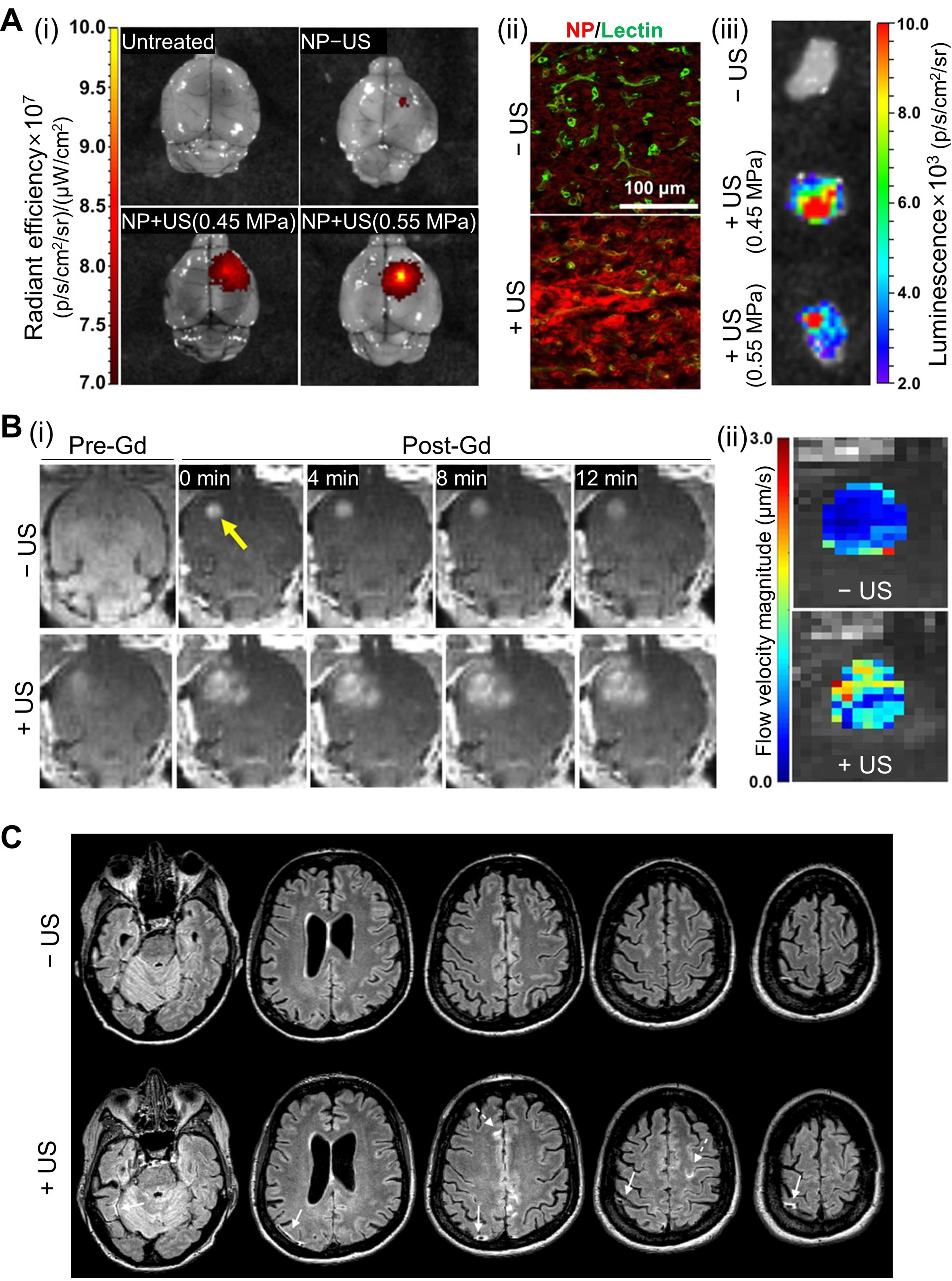
Figure 4. US-modulated glymphatic transport in disease models. (A) Enhanced influx and NP delivery in glioma-bearing mice. (i) Increased tumor uptake of fluorescent NPs following US with microbubble treatment. (ii) Confocal fluorescence imaging confirming deeper intratumoral penetration. (iii) Bioluminescence imaging showing elevated transgene expression after US-mediated BBB opening; (B) MRI-based assessment of BTB opening and interstitial flow changes. (i) Contrast-enhanced MRI with and without US-treatment demonstrating BTB permeability increase. (ii) Flow-velocity magnitude maps showing US-induced acceleration of interstitial transport; (C) Representative human FLAIR MRI showing sheath-like contrast enhancement around large cortical veins following MR-guided focused US-induced BBB opening in an AD patient. Subarachnoid contrast accumulation appears adjacent to the sonicated region, demonstrating a reversible BBB permeability response in human subjects. (A and B) Reproduced from Curley et al.[65], with permission from AAAS. (C) Reproduced from Meng et al.[66], with permission from John Wiley and Sons. Copyright © 2019 John Wiley and Sons. US: Ultrasound; NP: nanoparticle; BBB: blood-brain barrier; BTB: blood-tumor barrier; MRI: magnetic resonance imaging; FLAIR: fluid-attenuated inversion recovery; MR: magnetic resonance; AD: Alzheimer disease; Gd: gadolinium.