


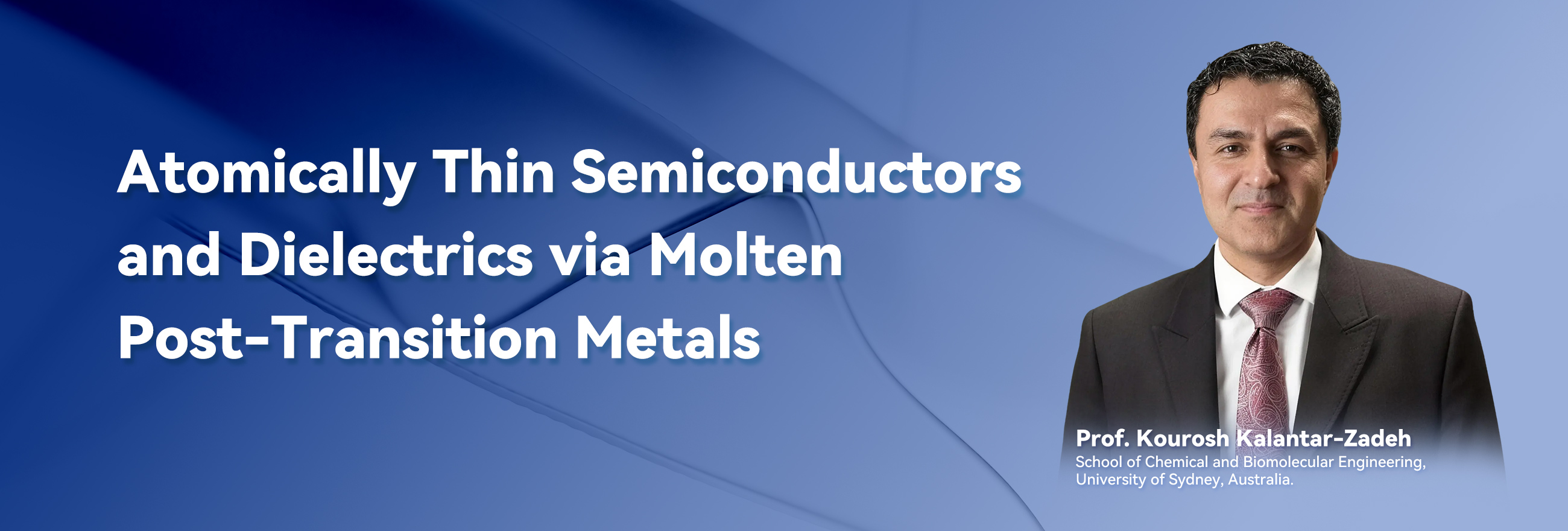
Atomically Thin Semiconductors and Dielectrics via Molten Post-Transition Metals
Time
August 25, 2026
11:00 (Sydney time, UTC+10)
9:00 (Beijing Time, UTC+8)
11:00 (Sydney time, UTC+10)
9:00 (Beijing Time, UTC+8)
Join the Webinar
Join Zoom:
https://us06web.zoom.us/j/81865949554?pwd=kqD9mxdUUyhFyGJQvcafPYM8HZiw8p.1
Meeting ID: 81865949554
Passcode: 815365
Share
Contents
Guest

Prof. Kourosh Kalantar-Zadeh
University of Sydney
Kourosh Kalantar-Zadeh is a Professor and Academic Lead at the University of Sydney who has the responsibility of Advising on High Impact Initiatives at the Faculty of Engineering. He is also one of the Australian Research Council (ARC) Laureate Fellows of 2018.
Prof Kalantar-Zadeh is an Adjunct Prof at the University of Newcastle and an Honorary Prof at RMIT.
Formerly Prof. Kalantar-Zadeh was a professor of Chemical Engineering at University of New South Wales (UNSW), Sydney, Australia and prior to that was a Distinguished Professor of Electronic Engineering at RMIT, Melbourne, Australia.
Prof. Kalantar-Zadeh is involved in research in the fields of chemical engineering, materials sciences, electronics, and medical devices. He has co-authored >500 scientific papers and books and is also a member of the editorial boards of journals including ACS Sensors, Advanced Materials Technologies, Nanoscale and ACS Nano. He is also an Associate Editor for ACS Applied Nano Materials journal.
Prof. Kalantar-Zadeh has received many international awards including the 2017 IEEE Sensor Council Achievement, 2018 ACS Advances in Measurement Science Lectureship awards and 2020 Robert Boyle Prize for Analytical Science, Royal Society of Chemistry (RSC), UK. His name has also appeared in the Clarivate Analytics most highly cited list since 2018.
Prof Kalantar-Zadeh is an Adjunct Prof at the University of Newcastle and an Honorary Prof at RMIT.
Formerly Prof. Kalantar-Zadeh was a professor of Chemical Engineering at University of New South Wales (UNSW), Sydney, Australia and prior to that was a Distinguished Professor of Electronic Engineering at RMIT, Melbourne, Australia.
Prof. Kalantar-Zadeh is involved in research in the fields of chemical engineering, materials sciences, electronics, and medical devices. He has co-authored >500 scientific papers and books and is also a member of the editorial boards of journals including ACS Sensors, Advanced Materials Technologies, Nanoscale and ACS Nano. He is also an Associate Editor for ACS Applied Nano Materials journal.
Prof. Kalantar-Zadeh has received many international awards including the 2017 IEEE Sensor Council Achievement, 2018 ACS Advances in Measurement Science Lectureship awards and 2020 Robert Boyle Prize for Analytical Science, Royal Society of Chemistry (RSC), UK. His name has also appeared in the Clarivate Analytics most highly cited list since 2018.
Abstract
Liquid metals and their low-melting-point alloys provide a unique reaction environment for the synthesis of atomically thin materials. Their intrinsically dynamic surfaces promote selective elemental segregation, enabling the controlled formation and extraction of ultrathin oxide layers with tailored compositions. This spontaneous interface enrichment acts as a natural filtering mechanism, where differences in the surface affinities of constituent metals govern the composition of the resulting two-dimensional (2D) materials. By exploiting this phenomenon, atomically thin semiconductors, dielectrics, and piezoelectric and ferroelectric materials with precisely controlled crystal symmetry and functionality can be synthesized.
As representative systems, molten alloys containing indium, tin, and bismuth with varying bulk compositions were employed to produce atomically thin semiconducting, transparent conducting, and dielectric oxide sheets. Despite large variations in bulk composition, certain elements exhibit a much stronger thermodynamic preference for surface enrichment, resulting in highly selective incorporation into the harvested 2D layers. This selective doping strategy enables precise tuning of the structural, electronic, and electromechanical properties of the materials. Furthermore, piezoelectric and ferroelectric functionalities were achieved through controlled dopant incorporation and by integrating ferroelectric oxides. The resulting atomically thin materials exhibit robust ferroelectric behaviour arising from spontaneous polarization in non-centrosymmetric crystal phases induced by composition engineering.
Selective interface enrichment in molten post-transition metal alloys provides a versatile and scalable route for synthesizing atomically thin semiconductors, dielectrics, piezoelectrics, and ferroelectrics. This liquid metal-based platform offers unprecedented control over composition and crystal symmetry, opening new opportunities for next-generation nanoelectronics, flexible electronics, sensing technologies, and low-power electronic devices.
As representative systems, molten alloys containing indium, tin, and bismuth with varying bulk compositions were employed to produce atomically thin semiconducting, transparent conducting, and dielectric oxide sheets. Despite large variations in bulk composition, certain elements exhibit a much stronger thermodynamic preference for surface enrichment, resulting in highly selective incorporation into the harvested 2D layers. This selective doping strategy enables precise tuning of the structural, electronic, and electromechanical properties of the materials. Furthermore, piezoelectric and ferroelectric functionalities were achieved through controlled dopant incorporation and by integrating ferroelectric oxides. The resulting atomically thin materials exhibit robust ferroelectric behaviour arising from spontaneous polarization in non-centrosymmetric crystal phases induced by composition engineering.
Selective interface enrichment in molten post-transition metal alloys provides a versatile and scalable route for synthesizing atomically thin semiconductors, dielectrics, piezoelectrics, and ferroelectrics. This liquid metal-based platform offers unprecedented control over composition and crystal symmetry, opening new opportunities for next-generation nanoelectronics, flexible electronics, sensing technologies, and low-power electronic devices.