



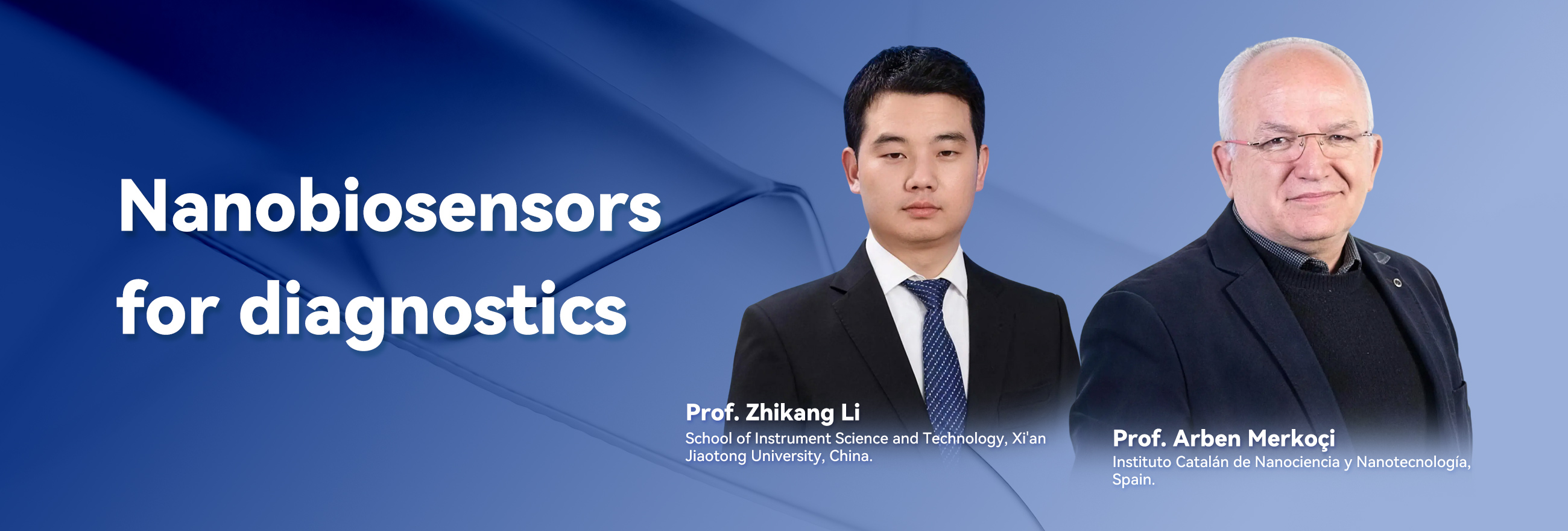
Nanobiosensors for diagnostics
Time
August 25, 2026
10:00 AM (Barcelona time, CEST)
4:00 PM (Beijing time)
10:00 AM (Barcelona time, CEST)
4:00 PM (Beijing time)
Join the Webinar

Zoom Meeting ID: 878 8083 3438
Passcode: 395383
Join Zoom Meeting:
https://us06web.zoom.us/j/87880833438?pwd=HNeHuJvcouWiX8C6BYkFsRSeQopQxQ.1
Share
Contents
Guest

Prof. Arben Merkoçi
Instituto Catalán de Nanociencia y Nanotecnología, Spain
Prof. Arben Merkoçi is an ICREA Research Professor and leader of the Nanobioelectronics & Biosensors Group at the Institut Català de Nanociència i Nanotecnologia (ICN2), Barcelona, Spain. He received his PhD from the University of Tirana and has held research positions in Hungary, Greece, Italy, Spain, and the United States. His research focuses on nanobiosensors, nanomaterials, printed diagnostics, paper-based analytical devices, and point-of-care technologies for healthcare and environmental monitoring. He has authored more than 370 scientific publications, supervised over 45 PhD students, and co-founded two spin-off companies in nanodiagnostics and printed electronics. Prof. Merkoçi is Co-Editor-in-Chief of Biosensors and Bioelectronics and was recently appointed to the Editorial Board of Soft Science. He is also a member of several European scientific academies and actively contributes to international science-policy initiatives. His recent work focuses on next-generation REASSURED nanobiosensors, sustainable diagnostics, and the integration of biosensors with digital health and artificial intelligence.
Moderator

Prof. Zhikang Li
School of Instrument Science and Technology, Xi'an Jiaotong University, China
Zhikang Li is a National Young Talent and a recipient of the Shaanxi Provincial Young Science and Technology Rising Star award. He is currently a Professor and Doctoral Supervisor at the School of Instrument Science and Engineering, Xi'an Jiaotong University, where he also serves as Deputy Director of the Institute of Intelligent Sensing and Deputy Director of the Shaanxi Provincial Engineering Research Center for Micro/Nano Acoustic Devices. His research focuses on MEMS ultrasonic transducers, flexible electronics, and wearable sensors, with significant contributions to multi-physics coupling theory, structural design, fabrication processes, performance characterization, and innovative applications. He has led 20 research projects, including those funded by the National Key Research and Development Program of China and the National Natural Science Foundation of China. As first or corresponding author, he has published 50 SCI-indexed papers in leading journals, including Science Advances, Advanced Materials, Advanced Functional Materials, Advanced Science, and Engineering, among which four are ESI Highly Cited Papers. He has also authored two English-language book chapters, contributed to one undergraduate textbook, and holds 40 Chinese invention patents. He has received seven scientific and technological awards, including the Second Prize of the China Machinery Industry Science and Technology Award, and currently serves as a Young Editorial Board Member of Information and Control and as a Committee Member of the Micro/Nano Manufacturing Technology Division of the Chinese Mechanical Engineering Society.
Abstract
Nanobiosensors are revolutionizing diagnostic technologies by combining advanced nanomaterials with biological recognition elements to achieve rapid, sensitive, affordable, and user-friendly detection of disease biomarkers. Their unique analytical performance, together with increasing portability and connectivity, is enabling a shift from centralized laboratory testing toward decentralized and personalized healthcare.
This lecture will present recent advances in nanobiosensor technologies for clinical diagnostics, highlighting how nanomaterials such as graphene, MXenes, metallic nanoparticles, and other functional nanostructures can significantly enhance sensing performance. Different transduction strategies, including electrochemical, optical, and paper-based platforms, will be discussed together with innovative fabrication approaches such as printing technologies that facilitate scalable and low-cost manufacturing.
Particular emphasis will be placed on the development of REASSURED diagnostic devices capable of providing rapid, accurate, connected, and environmentally sustainable solutions for point-of-care applications. Representative examples from healthcare, including infectious diseases, cancer biomarkers, and other clinically relevant targets, will illustrate the translation of nanobiosensors from laboratory research toward real-world implementation. The talk will also address current challenges related to clinical validation, manufacturability, regulatory approval, and large-scale deployment.
Finally, future perspectives on integrating nanobiosensors with wearable devices, smartphones, artificial intelligence, and digital health platforms will be presented, demonstrating how these technologies are paving the way toward ubiquitous diagnostics and more accessible, personalized healthcare worldwide.
This lecture will present recent advances in nanobiosensor technologies for clinical diagnostics, highlighting how nanomaterials such as graphene, MXenes, metallic nanoparticles, and other functional nanostructures can significantly enhance sensing performance. Different transduction strategies, including electrochemical, optical, and paper-based platforms, will be discussed together with innovative fabrication approaches such as printing technologies that facilitate scalable and low-cost manufacturing.
Particular emphasis will be placed on the development of REASSURED diagnostic devices capable of providing rapid, accurate, connected, and environmentally sustainable solutions for point-of-care applications. Representative examples from healthcare, including infectious diseases, cancer biomarkers, and other clinically relevant targets, will illustrate the translation of nanobiosensors from laboratory research toward real-world implementation. The talk will also address current challenges related to clinical validation, manufacturability, regulatory approval, and large-scale deployment.
Finally, future perspectives on integrating nanobiosensors with wearable devices, smartphones, artificial intelligence, and digital health platforms will be presented, demonstrating how these technologies are paving the way toward ubiquitous diagnostics and more accessible, personalized healthcare worldwide.