



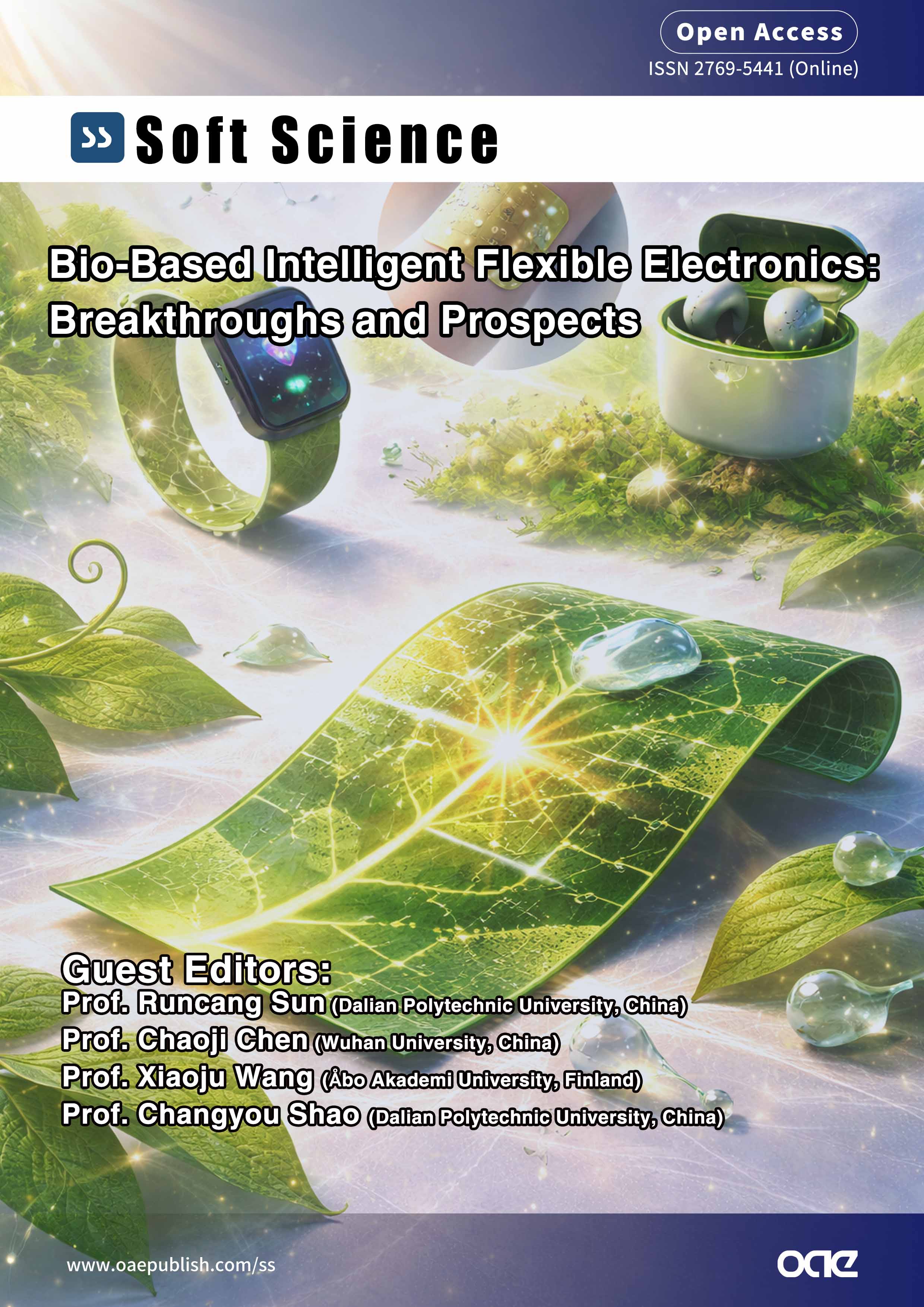
Topic: Bio-Based Intelligent Flexible Electronics: Breakthroughs and Prospects
Guest Editors
Special Topic Introduction
The rapid evolution of flexible electronics has created growing demand for materials that are not only high-performing but also sustainable, biocompatible, and capable of intelligent responsiveness. Bio-based materials—derived from renewable resources such as cellulose, wood, chitosan, and other biomass feedstocks—offer significant opportunities in this field. Their intrinsic hierarchical structures, tunable surface chemistry, and natural abundance make them ideal platforms for constructing flexible electronic systems with sensing, actuation, and energy conversion functionalities. Meanwhile, recent advances in bioinspired design and hydrogel engineering have further expanded their capabilities, enabling seamless integration with biological tissues, enhanced interfacial stability, and greater multifunctional performance.
This Special Issue focuses on the latest breakthroughs and future prospects in bio-based intelligent flexible electronics. It aims to bring together cutting-edge research on the rational design, fundamental mechanisms, and device-level integration of bio-derived soft materials. Contributions that explore innovative interfacial strategies, bioinspired architectures, and smart hydrogel systems are particularly welcome. Both experimental and theoretical studies that bridge materials science, mechanics, chemistry, and electronic engineering are encouraged.
Key areas of interest include, but are not limited to:
● Structural engineering of biomass-derivedmaterials (wood, cellulose, bamboo, ) for flexible electronics, including strategies to improve mechanical flexibility, ionic/electronic conductivity, and environmental stability.
● Bioinspired porous architectures and hierarchical designsfor enhanced sensing, actuation, and adaptive functionalities in flexible electronic devices.
● Biomass-based smart hydrogelsfor applications in flexible sensors, human-machine interfaces, and energy conversion devices (e.g., triboelectric nanogenerators, thermoelectric generators).
● Interfacial engineering in bio-based flexible systems, includingsoft-rigid coupling, adhesion mechanisms, and ion-electron transport at heterogeneous interfaces.
● Sustainable fabrication and scalable integrationof bio-based flexible electronics, with an emphasis on green synthesis, low-cost processing, and device reliability.
● Emerging applicationsin wearable health monitoring, soft robotics, environmental sensing, and sustainable energy harvesting.
Keywords
Bio-based materials; Intelligent flexible electronics; Biomass structural engineering; Smart hydrogels; Bioinspired design; Flexible sensors; Sustainable electronics
Submission Deadline
Submission Information
For Author Instructions, please refer to https://www.oaepublish.com/ss/author_instructions
For Online Submission, please login at https://www.oaecenter.com/login?JournalId=ss&IssueId=ss26041610432
Submission Deadline: 31 Aug 2026
Contacts: Mirra Du, Assistant Editor, Editor@softscijournal.net