




Coupling active polymer networks with solubility-driven gradients for augmented hydrogel thermocells
 0
0 
Abstract
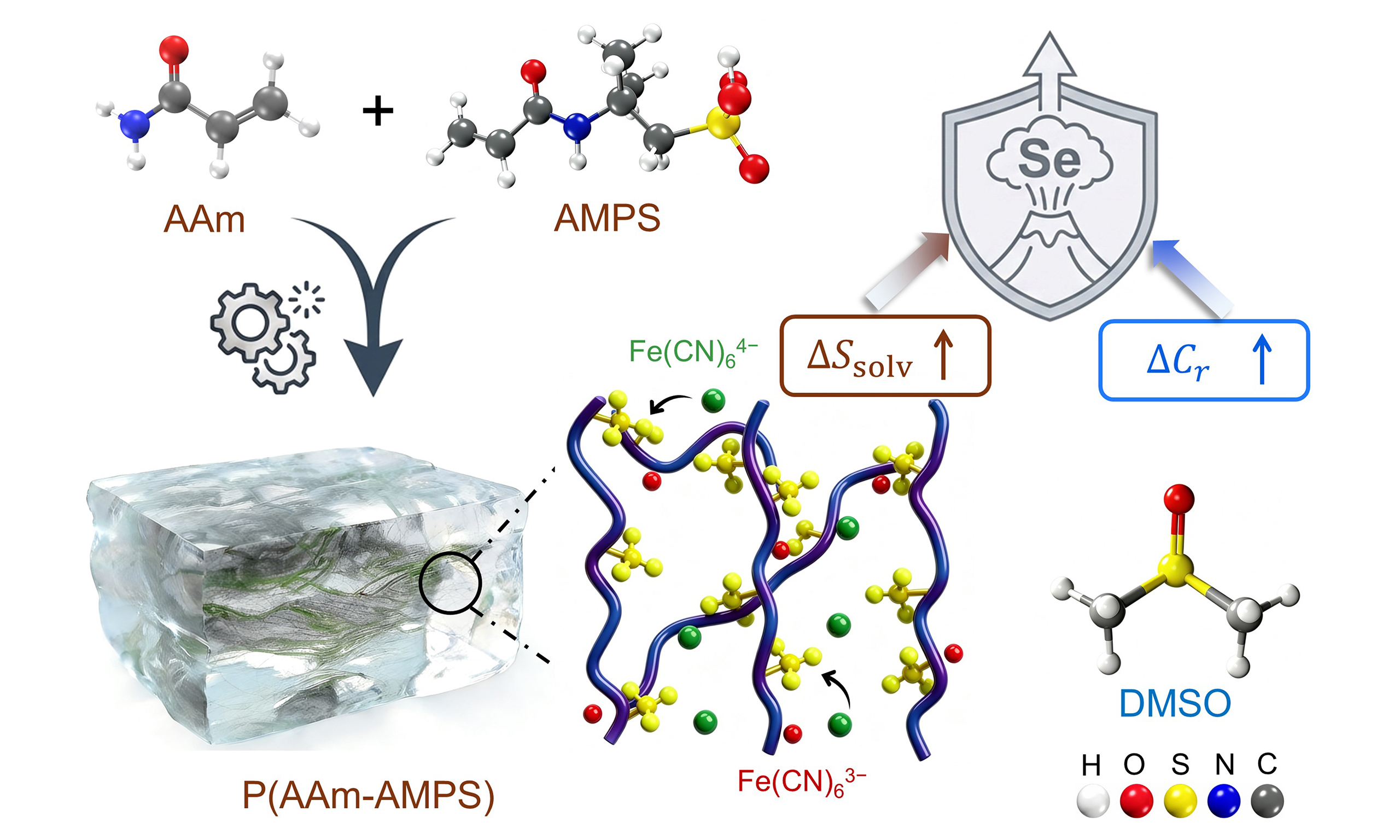
Quasi-solid-state thermocells (QTECs) convert low-grade heat into electricity via temperature-dependent redox reactions, but their rational design is hindered by an incomplete understanding of ion-solvent and ion-polymer interactions. Herein, precise control over these interactions is exploited in a binary strategy that simultaneously engineers the local solvation environment and a solubility gradient. Copolymerization of 2-acrylamido-2-methylpropanesulfonic acid (AMPS) with acrylamide (AAm) creates a stretchable network. The charged network selectively interacts with Fe(CN)64- ions, while the introduction of dimethyl sulfoxide (DMSO) breaks the solubility symmetry of the redox couple to establish a concentration gradient. This interplay between the active hydrogel and the solvent-induced gradient raises the Seebeck coefficient from 1.31 to 2.30 mV·K-1 while maintaining favorable thermal and ionic conductivities. Moreover, various spectroscopic and in-situ characterizations elucidate the contrasting roles of active and inert polymer networks in cooperating with this gradient. Together, these results demonstrate that coupling an active polymer network with a solvent-induced concentration gradient is an effective strategy for boosting thermoelectrochemical performance, which offers an unexplored design path for improved QTECs.
Keywords
INTRODUCTION
As the demand for sustainable recovery of low-grade waste heat (< 100 °C) intensifies, quasi-solid-state thermocells (QTECs) have attracted growing attention[1-5]. Comprising an elastic hydrogel electrolyte swollen with ionic solutions and inert electrodes, QTECs exploit continuous thermally driven redox reactions to directly convert heat into electricity[6-9]. Their inherent stretchability and leakage-free operation make them particularly suitable for self-powered wearable electronics and sensors[10,11]. The energy conversion capability of a QTEC is measured by its thermopower (Seebeck coefficient, Se), which reflects the voltage generated per unit temperature difference. The magnitude of Se is governed by two principal thermodynamic contributions: the concentration-driven entropy difference (ΔCr), arising from a non-equimolar distribution of oxidized and reduced ions across the temperature gradient, and the solvation-driven entropy difference (ΔSsolv), originating from the reorganization of ion solvation shells upon electron transfer[12-14]. Although enhancing either parameter alone can increase Se, simultaneously establishing both ΔCr and ΔSsolv within a single hydrogel network, and making them act synergistically, remains an unresolved challenge.
A widely adopted strategy for boosting Se is to amplify ΔCr[15-17]. This concentration-dependent contribution is captured by[18]:
where TH and Tc denote the temperatures at the hot and cold electrodes, A and B denote the two distinct redox ions, n is the number of electrons transferred, F is the Faraday constant, R is the ideal gas constant, and γ and C represent the activity coefficients and molar concentrations, respectively. Subscripts ox and red denote the oxidized and reduced species, while H and c refer to the hot and cold sides. Early work exploited host-guest hydrophobic encapsulation between α-cyclodextrin and I3- to induce a ΔCr between I-/I3- redox ions, which raised Se to 2.0 mV·K-1[19]. This concept was later extended by adding guanidinium salts to Fe(CN)64-/3- electrolyte. The thermosensitive crystallization of guanidinium-Fe(CN)64- complex generates a robust ΔCr and markedly improves the power output[20-24]. More recently, specific ion-solvent interactions have been employed to tune solubility of redox species and modulate ΔSsolv, leading to further gains in the thermoelectrochemical performance[15,25-27]. Despite these advances, existing strategies rely almost exclusively on regulating the liquid phase. As a result, the polymer network in hydrogel electrolytes is treated merely as a passive scaffold, with its potential to actively enhance thermopower left largely unexplored.
Efforts to activate the polymer network in QTECs have centered on backbone functionalization. Polyacrylamide (PAAm) hydrogels serve as the most commonly used matrix owing to their excellent mechanical properties, high water retention, and ease of processing[26,28-30]. However, the chemically inert PAAm backbone imposes a fundamental limitation. Without strong coordinating groups, it cannot engage in electrostatic or ion-dipole interactions with the redox ions, which severely restricts its ability to modulate ΔSsolv. To overcome this, recent studies have introduced tailored functional groups, such as zwitterionic sulfobetaine methacrylate, into the chains to establish selective ion-polymer interactions and to reshape the solvation environment of redox ions[31-33]. These active networks increase the entropy difference of redox ions and improve the thermoelectrochemical performance of QTEC. Nevertheless, these advances have only addressed part of the challenge. The rational integration of active polymer sites and a favorable ΔCr into a hydrogel electrolyte to amplify Se has not been realized. Moreover, it remains unknown whether active and inert networks cooperate with ΔCr in fundamentally different ways, a knowledge gap that directly hinders the design of truly optimized electrolytes. Bridging this gap demands a strategy that simultaneously engineers both the polymer network and the ionic environment.
Herein, we report an electrolyte design that couples polymer-network modification with a solvent-induced concentration gradient to address both limitations identified above. Copolymerizing a PAAm backbone with 2-acrylamido-2-methylpropanesulfonic acid (AMPS) converts the inert hydrogel matrix into an electrostatically active scaffold, while introducing dimethyl sulfoxide (DMSO) as a co-solvent to generate a pronounced solubility asymmetry between redox ions. The resulting copolymer network and DMSO-induced ΔCr synergistically raise Se from 1.31 mV·K-1 (in pristine PAAm) to 2.30 mV·K-1, with a high normalized power density of 0.32 mW·m-2·K-2. Importantly, the synergy between the active polymer network and ΔCr enhances Se through a nonlinear, volcano-shaped relationship. This work demonstrates that the rational coupling of polymer-network functionality with solvent-mediated concentration effects constitutes a viable strategy for high-performance QTECs.
EXPERIMENTAL
Materials and preparation of thermogalvanic hydrogel electrolytes
Potassium ferricyanide [K3Fe(CN)6, ≥ 99.5%], potassium hexacyanoferrate [K4Fe(CN)6·3H2O, > 99.0%], DMSO (≥ 99.9%), and AMPS (98%) were purchased from Shanghai Macklin Biochemical Technology Co., Ltd. (Shanghai, China). Acrylamide (AAm, ≥ 99.9%), ammonium persulphate (APS, ≥ 96%), and N,N'-methylenebisacrylamide (MBAA, ≥ 99%) were obtained from Shanghai Aladdin Biochemical Technology Co., Ltd. (Shanghai, China). Graphite plates were sourced from Qingdao Baofeng Graphite Produce Co., Ltd. All chemicals were used as received. Deionized water was employed throughout.
In a typical synthesis, AAm and AMPS (total mass of 2.0 g) were dissolved in 5.0 mL of deionized (DI) water at predetermined mass ratios to yield the desired copolymer compositions. Subsequently, 0.02 g of APS (initiator) and 0.02 g of MBAA (crosslinker) were added. After stirring at room temperature for 1 h at 300 rpm, the precursor was transferred into a polytetrafluoroethylene mold and polymerized at 60 °C for 1 h to produce a hydrogel matrix. By varying the AAm/AMPS ratio, pAAm, p(AAm-AMPS), and pAMPS hydrogels were obtained.
The as-prepared hydrogel matrices were then immersed in a 0.4 M Fe(CN)64-/3- aqueous solution at 60 °C for 3 h to yield the thermogalvanic hydrogel electrolytes. Samples prepared without co-solvents were denoted as PAAm and P(AAm-AMPS). To establish a concentration gradient of the redox ions, DMSO was introduced into the immersion solution. The resulting DMSO-containing electrolytes were labeled as PAD-X and PSD-X for the PAAm and P(AAm-AMPS) systems, respectively, where X indicates the volume percentage (vol%) of DMSO.
Density functional theory calculation
Density functional theory (DFT) simulations were performed to evaluate electrostatic potentials (ESPs) and binding energy. For ESP analysis, geometry optimizations were carried out at the B3LYP/6-311G(d) level[34,35], with an implicit solvent model using the Gaussian 16 package[36]. Single-point energy calculations were then performed on the optimized structures to map ESP surfaces, followed by critical extrema analysis via the Multiwfn program. For binding energy calculations, simulations were conducted using the DMol3 module in Materials Studio 2023. The generalized gradient approximation with the Perdew–Burke–Ernzerhof functional and double numerical plus polarization basis sets were employed. The convergence tolerances for energy, force, and displacement were set to 1 × 10⁻⁵, 0.002 Ha·Å-1, and 0.005 Å, respectively. Individual ions and interacting pairs were fully relaxed before single-point energy calculations to determine the binding energy.
Material characterization
Fourier transform infrared (FTIR) spectra were collected using a Bruker Vertex 70V + Hyperion II spectrometer (Bruker, Germany) under vacuum in the range of 400-4,000 cm-1. X-ray photoelectron spectroscopy (XPS) was performed on a PHI VersaProbe 4 system (ULVAC-PHI, Japan). Ultraviolet-visible (UV-vis) absorption spectra were recorded from 200 to 500 nm with a PerkinElmer LAMBDA 1050+ spectrophotometer (PerkinElmer, USA). Thermal conductivity was measured using a Hot Disk TPS 2500S analyzer (Hot Disk AB, Sweden). X-ray diffraction (XRD) patterns were collected on a Malvern PANalytical diffractometer (Malvern PANalytical, UK) with Cu Kα radiation (λ = 1.5406 Å) over the 2θ range 10°-60°. The morphology of the electrolyte was examined by scanning electron microscopy (SEM, Hitachi Regulus8100, Hitachi, Japan) at an acceleration voltage of 15 kV and an optical microscope (YM710TR, YUESCOPE, China). A universal testing machine (Instron 68TM, Instron, USA) equipped with a 50 N load cell was used to evaluate the mechanical properties at a deformation rate of 50 mm·min-1. Viscosity measurements were conducted using a Brookfield DV3T LV rheometer (AMETEK Brookfield, USA).
Thermoelectrochemical performance measurements
The QTEC was assembled in a sandwich configuration of platinum (Pt)|hydrogel electrolyte (3 × 1 ×
RESULTS AND DISCUSSION
Properties of P(AAm-AMPS) electrolyte
Figure 1A schematically compares the network structures of the pristine PAAm and P(AAm-AMPS) hydrogel electrolytes. The PAAm backbone is non-electroactive and provides minimal electrostatic interaction with redox ions. In contrast, copolymerization with AMPS monomers introduces abundant sulfonate groups (−SO3-) that act as fixed anionic centers. ESP maps confirm that the AMPS monomer carries a strongly negative charge distribution localized on the sulfonate moiety, whereas the AAm unit remains essentially neutral [Figure 1B]. This concentrated negative charge creates a strong local electric field, which offers a driving force for valence-selective interactions with the redox ions.
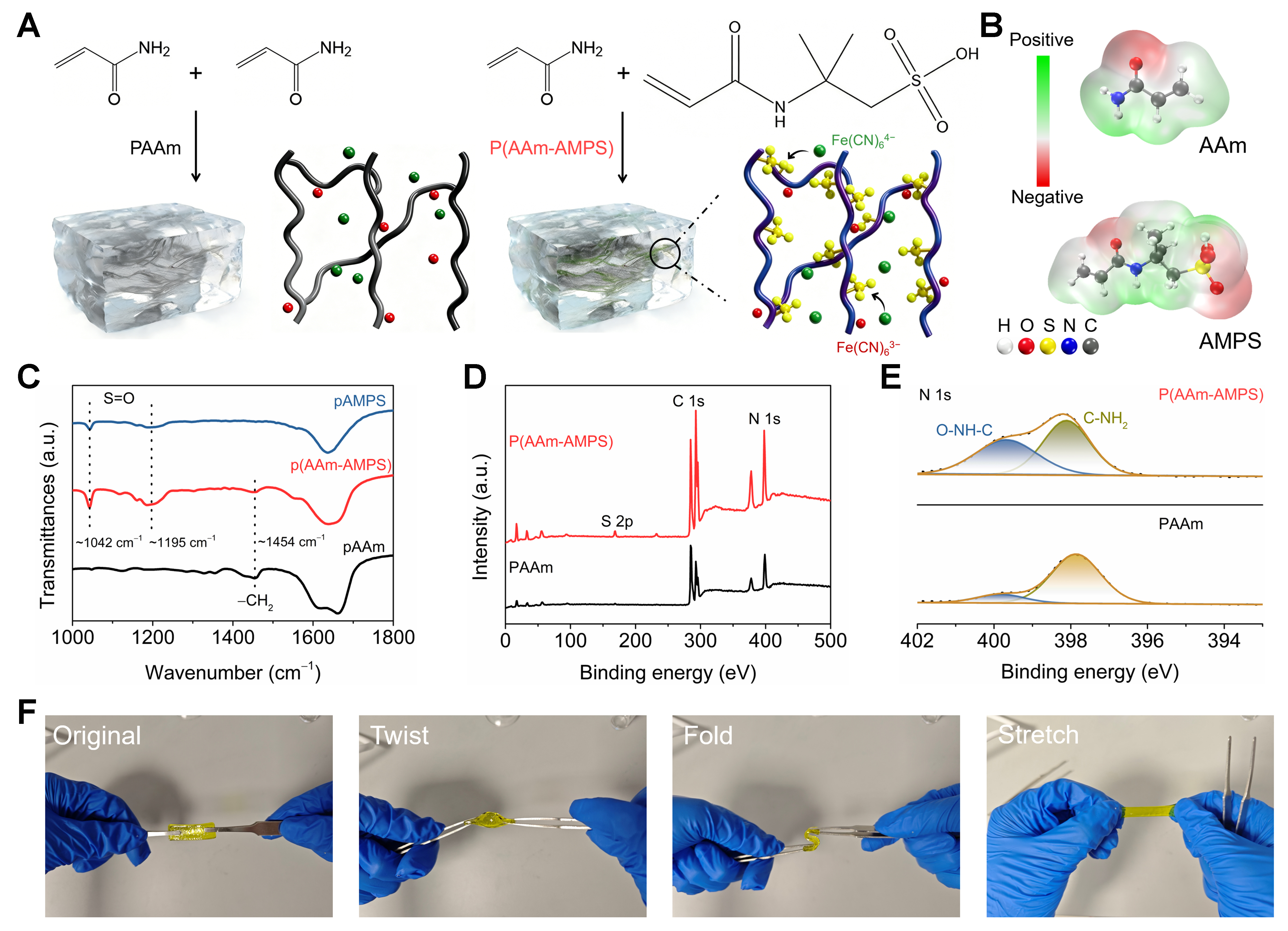
Figure 1. Design and chemical characterization of the thermogalvanic hydrogel electrolytes. (A) Schematic of the synthesis and network structure of PAAm and P(AAm-AMPS) electrolytes; (B) ESP maps of AAm and AMPS chain segments; (C) FTIR spectra of different hydrogel matrices; (D) XPS full spectra and (E) high-resolution N 1s spectra of PAAm and P(AAm-AMPS) electrolytes; (F) Digital photographs of the as-prepared P(AAm-AMPS) electrolyte. PAAm: Polyacrylamide; AAm: acrylamide; AMPS: 2-acrylamido-2-methylpropanesulfonic acid; ESP: electrostatic potential; FTIR: Fourier transform infrared; XPS: X-ray photoelectron spectroscopy.
FTIR spectra verify the integration of both polymer components [Figure 1C]. The peak at ~1,450 cm-1 corresponds to the −CH2 bending vibration of the PAAm segments[37,38], while the bands at 1,042 and
Activating the polymer network
The heat-to-electricity conversion in the QTEC relies on temperature-dependent redox reactions of the Fe(CN)64-/3- couple [Figure 2A]. At the hot electrode, Fe(CN)64- oxidizes to Fe(CN)63- and releases an electron; this electron travels through the external circuit to the cold electrode, where it reduces Fe(CN)63- back to Fe(CN)64-. To evaluate the effect of network composition, Figure 2B and Supplementary Figure 2 examine the Se of the P(AAm-AMPS) electrolytes as a function of the AAm/AMPS mass ratio. The pristine PAAm electrolyte (1:0 ratio) exhibits an Se of 1.31 mV·K-1, consistent with previous reports[26,30]. Incorporation of AMPS markedly influences Se, an effect attributable to emerging ion-polymer interactions. Se reaches a maximum of 1.61 mV·K-1 at a 1:1 mass ratio, approximately a 23% improvement over PAAm. Further increasing AMPS content to a 1:3 ratio, however, reduces Se to 1.42 mV·K-1. Excess AMPS chains saturate the local coordination environment and consequently provide little additional solvation contrast between the redox ions. The overcrowded sulfonate groups also introduce steric hindrance and induce electrostatic chain aggregation, which further reduces ΔSsolv. This non-monotonic dependence highlights the need for a balanced copolymer composition.
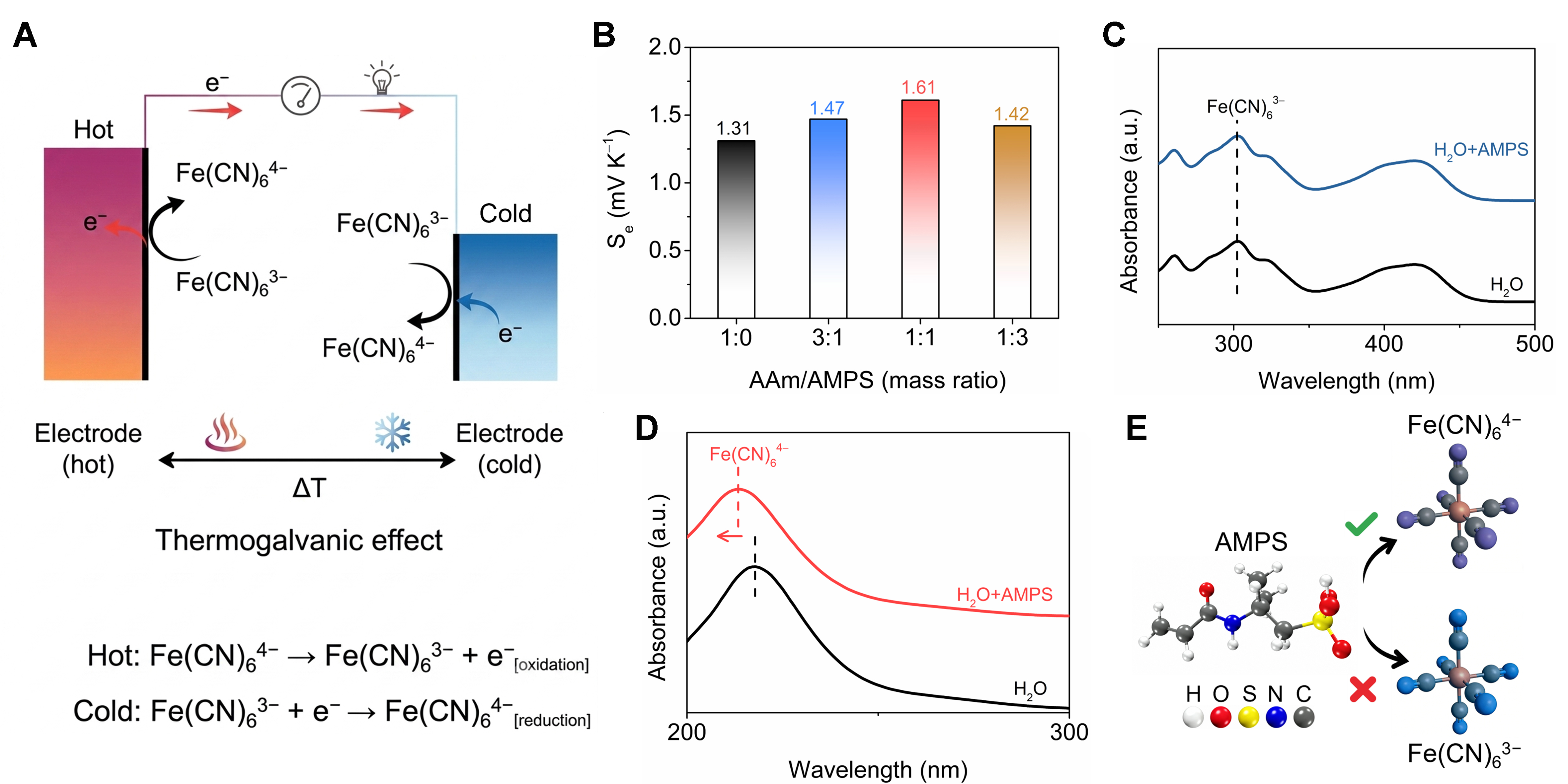
Figure 2. Thermogalvanic mechanism and microscopic interactions in the P(AAm-AMPS) electrolyte. (A) Schematic illustration of the thermogalvanic mechanism in a Fe(CN)64-/3--based thermocell; (B) Thermopower of P(AAm-AMPS) electrolytes as a function of the AAm/AMPS mass ratios; UV-vis spectra of (C) K3Fe(CN)6 and (D) K4Fe(CN)6 solutions with and without AMPS; (E) Schematic illustration of the microscopic interactions between AMPS segments and redox ions. AAm: Acrylamide; AMPS: 2-acrylamido-2-methylpropanesulfonic acid; UV-vis: ultraviolet-visible.
To elucidate the origin of thermopower enhancement in P(AAm-AMPS) electrolytes, we performed UV-vis spectroscopy to probe the specific interactions between AMPS-containing polymer and two redox ions. As shown in Figure 2C, the characteristic absorption peak of Fe(CN)63- remains unchanged upon the addition of AMPS. In contrast, the Fe(CN)64- signal exhibits a noticeable shift from 218 to 214 nm [Figure 2D], indicating a stronger interaction with the AMPS chains[43-45]. DFT calculations further support this interpretation. The AMPS−Fe(CN)64- complex exhibits a substantially more negative ESP minimum than AMPS−Fe(CN)63- [Supplementary Figure 3], along with a more favorable binding energy [Supplementary Figure 4]. The pronounced UV-vis divergence, together with DFT calculations, demonstrates that the copolymer network preferentially interacts with Fe(CN)64- over Fe(CN)63- [Figure 2E]. Such valence-selective ion-polymer interactions effectively alter ΔSsolv to boost Se.
Polar solvent-boosted concentration gradient
Introducing a ΔCr of the redox ions provides an effective route to boost Se [as captured by Equation (1)]. Since this strategy hinges on the solubility contrast between the two redox species, we incorporated DMSO as an organic co-solvent to tune their dissolution thresholds [Supplementary Figures 5 and 6]. The Se of PAAm and P(AAm-AMPS) electrolytes were then systematically examined with varying DMSO contents. Figure 3A and Supplementary Figure 7 depict Se as a function of the DMSO volume fraction for the two hydrogel matrices. For the PAAm-based electrolyte containing DMSO (denoted PAD-X), Se rises almost linearly with increasing DMSO concentration. In contrast, the P(AAm-AMPS)-based counterparts (denoted PSD-X) shows a non-monotonic, volcano-shaped dependence. The Se reaches a maximum of 2.30 mV·K-1 at 10 vol% DMSO, clearly surpassing that of PAD-10 (2.02 mV·K-1), while maintaining excellent mechanical properties [Supplementary Figure 8]. In addition to the in-plane performance, the cross-plane Se was also measured [Supplementary Figure 9].
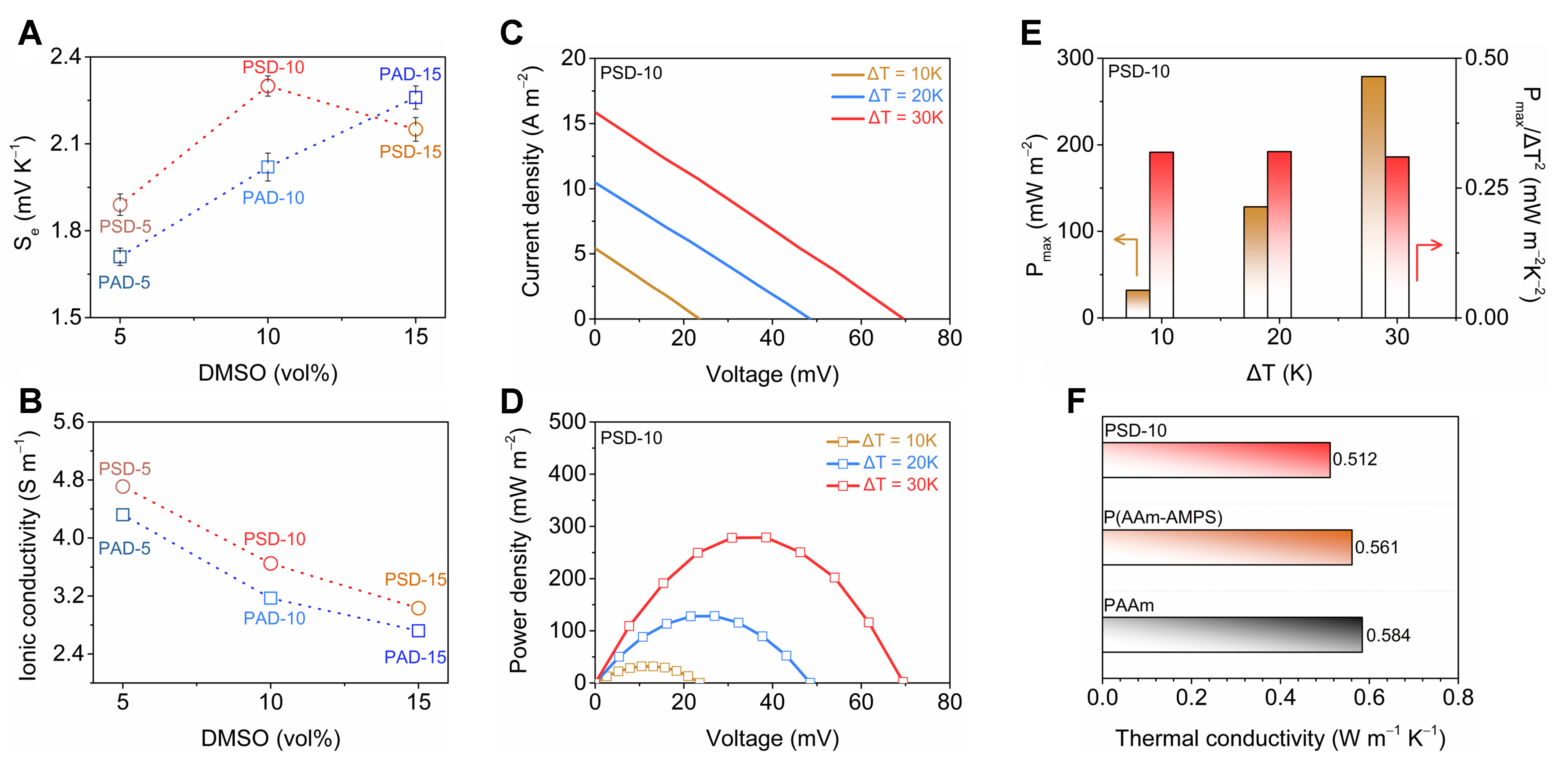
Figure 3. Thermoelectrochemical performance optimization and power output characterization. (A) Thermopower and (B) ionic conductivity of PAAm and P(AAm-AMPS) electrolytes as a function of DMSO volume fractions; (C) Current density-voltage and (D) power density curves of the optimized PSD-10 electrolyte measured under different ΔT; (E) Maximum power density (Pmax) and the normalized power density (Pmax/ΔT2) under the corresponding ΔT; (F) Thermal conductivity of different hydrogel electrolytes. PAAm: Polyacrylamide; AAm: acrylamide; AMPS: 2-acrylamido-2-methylpropanesulfonic acid; DMSO: dimethyl sulfoxide.
This enhancement arises from the interplay between the selective ion-polymer interaction in the P(AAm-AMPS) network and the DMSO-induced ΔCr. Minor DMSO addition mainly enhances ΔCr through differential solubility between redox ions, with minimal impact on ΔSsolv. At higher content, DMSO increasingly enters the solvation shell of redox ions and competes with sulfonate groups for ion coordination, potentially diminishing their ΔSsolv contribution. Excess DMSO (> 10 vol%) also induces shrinkage of the hydrogel matrix [Supplementary Figure 10], which further restricts the local coordination space. The resulting loss in ΔSsolv outweighs the gain in ΔCr, thereby dictating the non-monotonic trend in Se. The PAD-X electrolytes, by contrast, lack active functional groups, so Se follows the monotonic increase in ΔCr.
Beyond Se, the ionic conductivity (σ) of the hydrogel electrolytes also depends strongly on composition. At each DMSO concentration, the PSD electrolytes consistently outperform their PAD counterparts in σ [Figure 3B]. This improvement originates from anionic sulfonate groups in the P(AAm-AMPS) network, which promotes dissociation of redox ions and elevates effective charge carrier density[46]. With increasing DMSO content, σ declines for all electrolytes, a trend attributable to combined effects of reduced ion concentration and increased viscosity [Supplementary Figure 11]. Despite this modest reduction in conductivity, the PSD-10 electrolyte delivers superior power output under various ΔT. The voltage-current and voltage-output power density curves of the PSD-10 based-QTEC exhibit characteristic linear V-I and parabolic V-P relationships [Figure 3C and D]. At a ΔT of 10 K, the device yields a short-circuit current density of
Beyond these gains in thermoelectrochemical performance, the design also effectively suppresses thermal conductivity (κ). A low κ is essential to sustain a stable ΔT across the QTEC. Specifically, the value drops from 0.584 W·m-1·K-1 for pristine PAAm electrolyte to 0.561 W·m-1·K-1 for P(AAm-AMPS) electrolyte, and reaches a minimum of 0.512 W·m-1·K-1 for PSD-10 [Figure 3F]. Swelling measurements [Supplementary Figure 10] reveal the expansion of the polymer matrix after moderate DMSO (≤ 10 vol%) incorporation. This looser network architecture reduces continuous heat conduction pathways and adds polymer-solvent interfaces that enhance phonon scattering. This effect, together with the elevated viscosity induced by DMSO, contributes to the more pronounced decrease in thermal conductivity after DMSO addition compared with copolymerization[47,48].
Mechanism of solubility-driven concentration gradient
XPS analysis confirms the successful integration of the Fe(CN)64-/3- in PSD-10. The high-resolution Fe 2p spectrum shows coexisting Fe2+ and Fe3+ states, a prerequisite for the thermogalvanic effect [Figure 4A]. During the operation of PSD-10-based-QTEC, the dynamic migration of redox ions under a ΔT was monitored by in situ Raman spectroscopy [Figure 4B]. The characteristic peaks at 2,058 and 2,093 cm-1 correspond to Fe(CN)64-, whereas the 2,132 cm-1 signal belongs to Fe(CN)63-[49]. At the cold side, the Fe(CN)63- stretching vibration gradually loses intensity, consistent with its reduction to Fe(CN)64-. The spectral features of two redox ions evolve in distinctly anti-correlated trends, a direct reflection of ΔT-driven ion migration and the accompanying redox reactions at the electrodes.
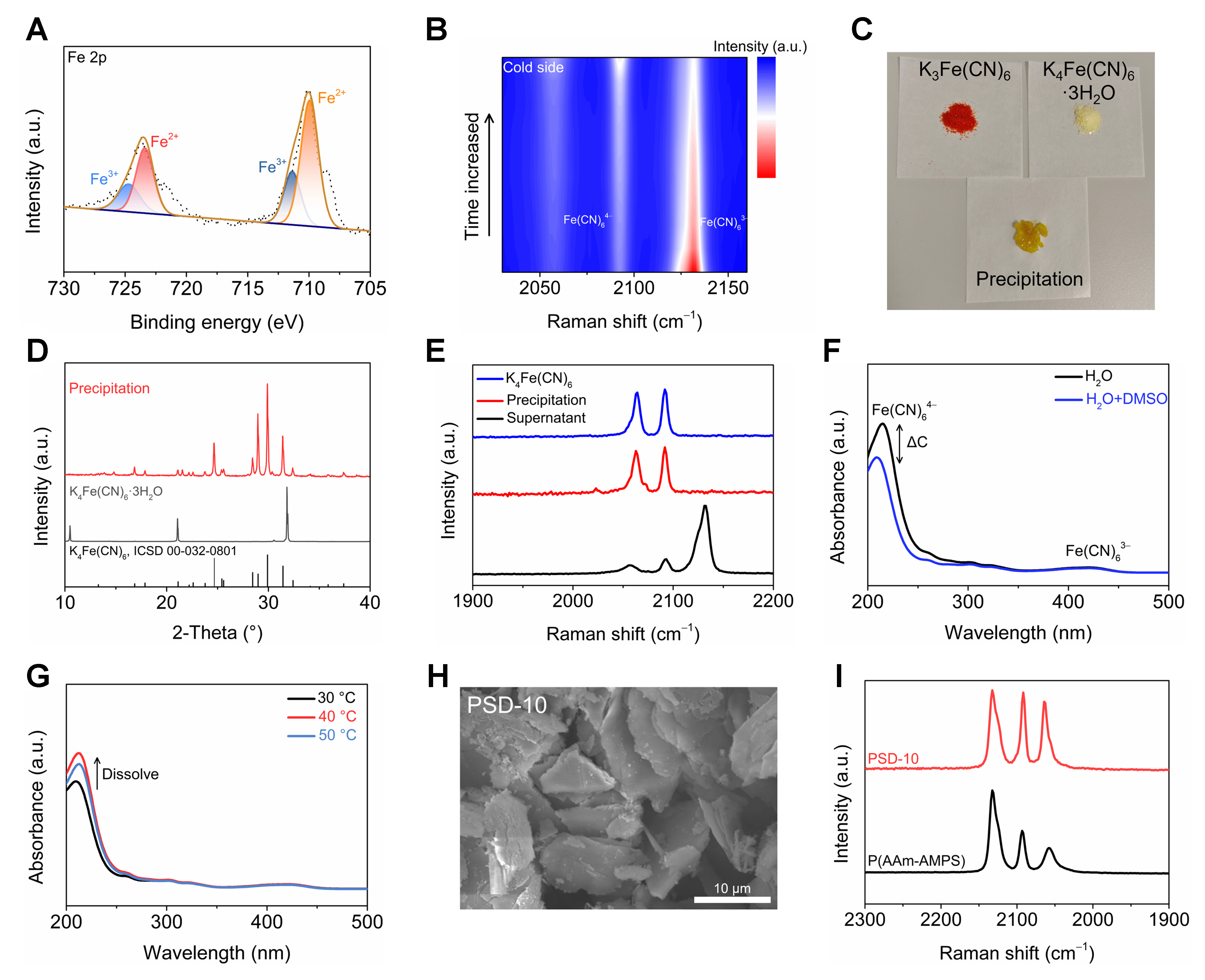
Figure 4. Investigation of the solubility-induced concentration gradients. (A) High-resolution XPS Fe 2p spectrum of the PSD-10 electrolyte; (B) Time-resolved in situ Raman spectra at the cold side of the PSD-10 electrolyte under a ΔT; (C) Optical images of precipitation in DMSO/H2O/K3Fe(CN)6/K4Fe(CN)6 solution and solids of K3Fe(CN)6, and K4Fe(CN)6·3H2O (photographed by the authors); (D) XRD patterns and (E) Raman spectra of the precipitate and supernatant in the DMSO/H2O/K3Fe(CN)6/K4Fe(CN)6 solution; (F) UV-vis absorption spectra of redox species with varying DMSO volume fractions and (G) temperature-dependent UV-vis spectra of redox species in DMSO/H2O solutions; (H) Morphological characterization of the PSD-10 electrolyte (SEM image); (I) Raman spectra of P(AAm-AMPS) and PSD-10 electrolytes. XPS: X-ray photoelectron spectroscopy; DMSO: dimethyl sulfoxide; XRD: X-ray diffraction; UV-vis: ultraviolet-visible; SEM: scanning electron microscopy; AAm: acrylamide; AMPS: 2-acrylamido-2-methylpropanesulfonic acid.
To establish the link between Se enhancement and ΔCr, we examined the precipitate formed in the DMSO-containing electrolytes. All characterizations consistently identify that the precipitate contains Fe(CN)64- as the anionic component. It exhibits a yellow appearance identical to that of K4Fe(CN)6·3H2O rather than the red hue characteristic of K3Fe(CN)6 [Figure 4C]; the XRD pattern matches the standard reference of K4Fe(CN)6 [Figure 4D]; Raman peaks are identical to those of pristine K4Fe(CN)6 [Figure 4E]. Together, these observations demonstrate that only Fe(CN)64- selectively crystallizes.
UV-vis spectroscopy of the supernatant quantitatively corroborates the above selective crystallization. The Fe(CN)64- concentration drops substantially after DMSO incorporation, whereas Fe(CN)63- content remains nearly unchanged [Figure 4F]. This solubility disparity arises from differential ion-solvent interactions between the two redox ions[15,50], and the resulting thermodynamic equilibrium is highly temperature-sensitive. Temperature-dependent UV-vis profiles [Figure 4G] capture a prominent recovery of Fe(CN)64- absorbance upon heating, indicating that the precipitated K4Fe(CN)6 crystals redissolve as temperature rises. Direct visual confirmation is provided by optical microscopy images [Supplementary Figure 13]. This reversible crystallization–dissolution transition establishes ΔCr under a ΔT, which directly contributes to the observed Se enhancement.
The DMSO-induced crystallization of Fe(CN)64- ions is physically confined within the PSD-10 hydrogel matrix. SEM images reveal micrometer-sized crystals embedded throughout the polymer network [Figure 4H]. The corresponding Raman spectra also display markedly stronger Fe(CN)64- signals compared to the P(AAm-AMPS) electrolyte [Figure 4I]. This signal enhancement is attributable to physical scattering from the DMSO-induced solid Fe(CN)64- precipitates. The localization of such precipitates within the hydrogel framework, consequently, facilitates a stable ΔCr across the electrolyte.
Operational durability and device integration
The long-term stability of the PSD-10-based QTEC was evaluated under a quasi-continuous discharge mode [Figure 5A and B]. Upon applying a ΔT = 10 K, the open-circuit voltage rises to approximately 23.1 mV within a thermal accumulation period of about 10 min. The subsequent repeated discharge-recovery cycles show only a gradual, minimal voltage decay, attributed primarily to polarization effect[51]. After 200 consecutive cycles, the voltage stabilizes at ~21.2 mV, corresponding to a retention rate of 91.8%. The power output remains highly stable over 200 cycles as well [Supplementary Figure 14]. Although the device remains stable over this timescale, gradual ion redistribution is inevitable over extended use, and intermittent operation with resting periods could potentially further improve the cycling performance. Figure 5C demonstrates that the output voltage remains stable during a continuous 10-hour operation under a constant ΔT. After encapsulation with polyimide tape, the assembled QTEC also maintained good performance retention when tested daily over 7 days [Supplementary Figure 15]. These results highlight the excellent operational durability of the PSD-10-based QTECs for sustained low-grade heat harvesting.
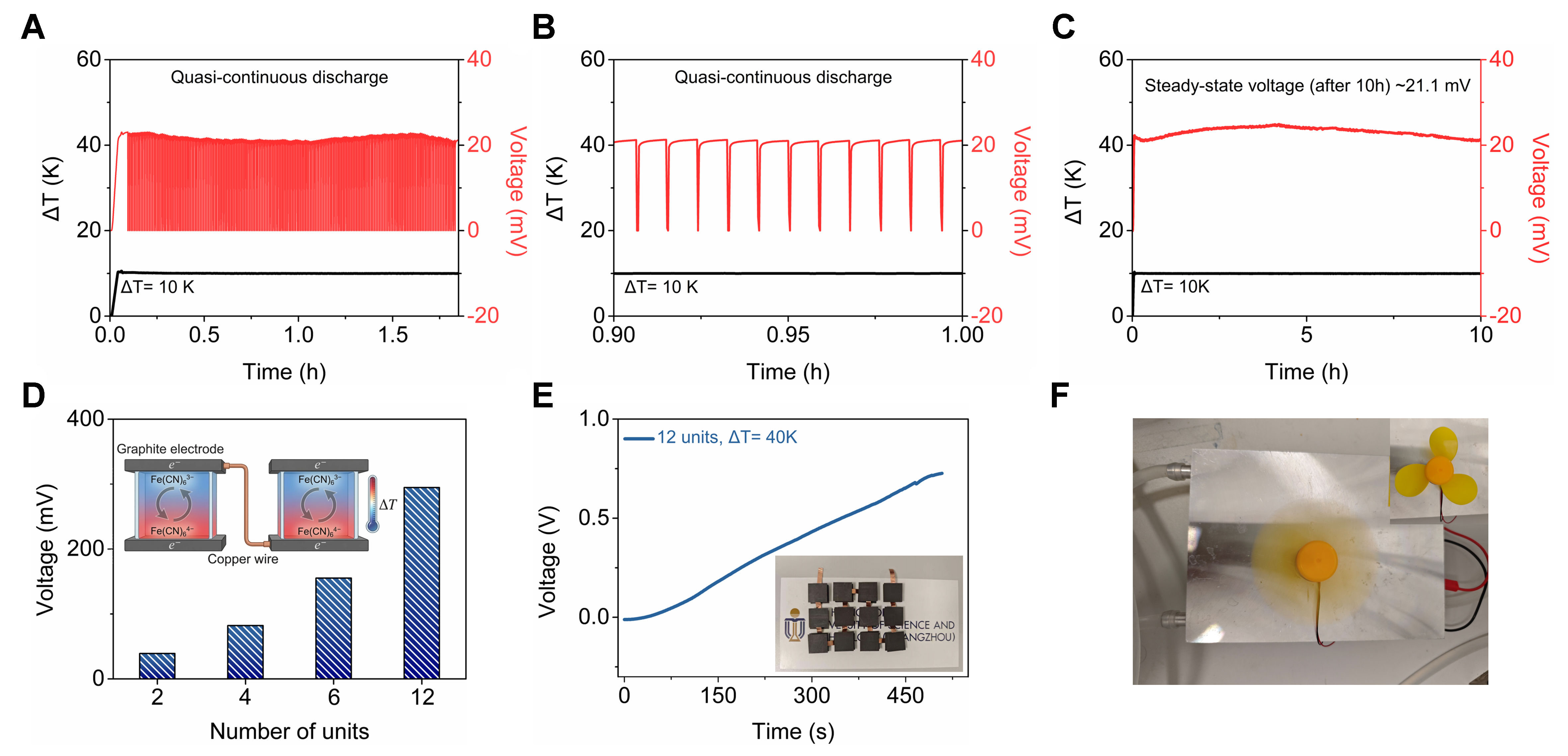
Figure 5. Long-term stability and device integration. (A) Quasi-continuous discharge profiles of the PSD-10-based thermocell at a ΔT = 10 K; (B) Magnified view of the discharge cycles from 0.9 to 1.0 h in (A); (C) Voltage evolution of PSD-10-based thermocell during prolonged operation at a ΔT = 10 K; (D) Output voltage as a function of the number of series-connected units under a constant ΔT; (E) Voltage-time curve of an integrated module consisting of 12 series-connected units at ΔT = 40 K; and (F) Optical image of the module powering a small fan (photographed by the authors).
To meet practical voltage requirements under small temperature gradients, multiple QTEC units were connected in series using segmented PSD-10 hydrogel electrolytes, adjacent graphite electrodes, and copper ribbons interconnects [Figure 5D]. Increasing the number of series-connected units from 2 to 12 raises the thermovoltage from 39.1 to 294.7 mV at ΔT = 10 K, which confirms the scalability of the device. Elevated temperature gradients enhance the power generation capability, as demonstrated by the ~0.73 V output of the 12-unit module at ΔT = 40 K within a short time [Figure 5E]. Combined with a voltage amplifier, this module can power a small electronic device [Figure 5F], which demonstrates the practical applicability of the PSD-10 electrolyte. The hydrogel electrolyte is easy to prepare and can be fabricated at scale, which makes it compatible with advanced packaging technologies. These features highlight its potential for large-scale ionic thermoelectric energy harvesting.
CONCLUSION
In summary, this work presents a QTEC with enhanced thermoelectrochemical performance via the integrated design of an electrostatically active polymer network and a polar co-solvent. At an optimal AAm/AMPS mass ratio of 1:1, the copolymer network selectively interacts with Fe(CN)64- over Fe(CN)63- ions to effectively modulate the solvation entropy difference (ΔSsolv). The subsequent introduction of DMSO breaks the solubility symmetry of the redox couple, which establishes a concentration gradient (ΔCr) that further boosts the thermopower. A non-monotonic dependence of Se on DMSO content reveals a competition between the two mechanisms. A maximum of 2.30 mV·K-1 is reached at 10 vol% DMSO, while favorable thermal and ionic conductivities are retained. The DMSO-introduced concentration gradient originates from the selective crystallization of Fe(CN)64- and the resulting precipitates are physically confined within the hydrogel network to sustain a stable ΔCr under the temperature gradient. Under quasi-continuous discharge, the optimized PSD-10-based QTEC retains 91.8% of its initial voltage after 200 cycles and maintains stable output over 10 h of continuous operation.
This work highlights that the polymer network, when functionalized with charged groups, actively enhances thermopower through selective ion coordination. The active network alone delivers a modest yet meaningful gain through polymer-based solvation entropy modulation, a design strategy that has remained largely unexplored in thermogalvanic electrolytes. More importantly, the active contribution can be effectively coupled with a solvent-induced concentration gradient. This strategy, which establishes the polymer network as an active and tunable component, expands the design landscape of QTECs beyond common single-mechanism approaches. Further exploration of alternative polymer architectures, for instance from block copolymers to phase-separated morphologies, may broaden this optimization space and raise the efficiency limits of next-generation QTECs.
DECLARATIONS
Acknowledgments
We acknowledge the support on material characterization from Wilson Tang Brilliant Energy Science and Technology Lab (BEST Lab) at HKUST(GZ), with additional measurements conducted at MCPF.
Authors’ contributions
Conceptualization, visualization, investigation, methodology, data curation, writing - original draft: Lin, W.
Software, visualization, investigation, methodology, data curation: Zheng, D.
Validation: Wu, S.; He, P.
Conceptualization, writing - review and editing, supervision, resources, project administration: Fang, C.
Availability of data and materials
The original contributions presented in this study are included in the article/Supplementary Materials. Further inquiries can be directed to the corresponding author(s).
AI and AI-assisted tools statement
During the preparation of this manuscript, the AI tool Gemini (Google) (version 3.1 Pro, released 2026-02-10) was used solely for language editing. The tool did not influence the study design, data collection, analysis, interpretation, or the scientific content of the work. All authors take full responsibility for the accuracy, integrity, and final content of the manuscript.
Financial support and sponsorship
This work is supported by the Guangzhou-HKUST(GZ) Joint Funding Scheme (No. 2025A03J3872).
Conflicts of interest
All authors declared that there are no conflicts of interest.
Ethical approval and consent to participate
Not applicable.
Consent for publication
Not applicable.
Copyright
© The Author(s) 2026.
Supplementary Materials
REFERENCES
1. Garofalo, E.; Bevione, M.; Cecchini, L.; Mattiussi, F.; Chiolerio, A. Waste heat to power: technologies, current applications, and future potential. Energy. Technol. 2020, 8, 2000413.
2. Han, C. G.; Qian, X.; Li, Q.; et al. Giant thermopower of ionic gelatin near room temperature. Science 2020, 368, 1091-8.
3. Duan, J.; Yu, B.; Huang, L.; et al. Liquid-state thermocells: opportunities and challenges for low-grade heat harvesting. Joule 2021, 5, 768-79.
4. Li, Z.; Xu, Y.; Zhang, X. Progresses and insights of thermoelectrochemical devices for low-grade heat harvesting: from mechanisms, materials to devices. EnergyChem 2024, 6, 100136.
5. Shi, X. L.; Li, N. H.; Li, M.; Chen, Z. G. Toward efficient thermoelectric materials and devices: advances, challenges, and opportunities. Chem. Rev. 2025, 125, 7525-724.
6. Liu, W.; Fang, Y.; Lyu, X.; Peng, X.; Luo, Z.; Zou, Z. Construction and application of thermogalvanic hydrogels. Soft. Sci. 2024, 4, 44.
7. Lin, W.; Wu, S.; Niu, S.; et al. Critical design strategy of thermogalvanic hydrogels for low-grade heat harvesting. Adv. Sci. 2025, 12, e06038.
8. Xiao, M.; Meng, J.; Zhang, H.; Wu, Z.; Li, Z. Ionic gels for low-grade heat energy harvesting and thermal sensing. Adv. Mater. 2025, 37, e06436.
9. Zhang, H.; Yang, X.; Cui, X.; et al. Thermoelectric gel electronics for self‐powered wearable physiological monitoring. Adv. Funct. Mater. 2026, 36, e00015.
10. Cai, X.; Zeng, Y.; Liu, P.; et al. Bioinspired ionic thermoreceptors with anisotropic architecture for thermotactile perception in robots. Sci. Adv. 2026, 12, eaed5473.
11. Huang, M.; Liu, S.; Chi, Y.; et al. Multimodal sensing conductive organohydrogel electronics based on chitosan-encapsulated MXene nanocomposites for deep learning-enhanced ball sports recognition. Soft. Sci. 2025, 5, 24.
12. Chen, Y.; Huang, Q.; Liu, T.; Qian, X.; Yang, R. Effect of solvation shell structure on thermopower of liquid redox pairs. EcoMat 2023, 5, e12385.
13. Xu, Y.; Li, Z.; Li, S.; Zhang, S.; Zhang, X. Reversibly tuning thermopower enabled by phase-change electrolytes for low-grade heat harvesting. Energy. Environ. Sci. 2025, 18, 750-61.
14. Zeng, Y.; Yu, B.; Chen, M.; et al. Solvation entropy engineering of thermogalvanic electrolytes for efficient electrochemical refrigeration. Joule 2025, 9, 101822.
15. Li, S.; Li, Z.; Xu, D.; Hu, R. Strong concentration gradient effect and weak solvation effect in thermopower enhancement in K3Fe(CN)6/K4Fe(CN)6 aqueous electrolyte with ethanol addition. Chem. Eng. J. 2024, 493, 152806.
16. Fang, W.; Ou, Z.; Wang, Y.; et al. High-performance Cu-based liquid thermocells enabled by thermosensitive crystallization and etched carbon cloth electrode. Nanomicro. Lett. 2026, 18, 131.
17. Yu, H.; Liu, X.; Li, M.; et al. Constructing high‐power N‐type thermocells via fluoride‐mediated imidazole–iodine coordination. Angew. Chem. Int. Ed. Engl. 2026, 138, e25056.
18. Yu, B.; Duan, J.; Cong, H.; et al. Thermosensitive crystallization-boosted liquid thermocells for low-grade heat harvesting. Science 2020, 370, 342-6.
19. Zhou, H.; Yamada, T.; Kimizuka, N. Supramolecular thermo-electrochemical cells: enhanced thermoelectric performance by host-guest complexation and salt-induced crystallization. J. Am. Chem. Soc. 2016, 138, 10502-7.
20. Duan, J.; Feng, G.; Yu, B.; et al. Aqueous thermogalvanic cells with a high Seebeck coefficient for low-grade heat harvest. Nat. Commun. 2018, 9, 5146.
21. Gui, J. X.; Cheng, Y.; Ren, K.; et al. Development of ternary hydrogel electrolytes for superior gel thermocells: exceptional anti-drying, anti-freezing, and mechanical robustness. Adv. Mater. 2025, 37, e2420214.
22. Lin, Z.; Hong, J.; Huang, C.; et al. A strong, tough, and high-efficiency hydrogel thermocell for thermal energy harvesting. Nano. Energy. 2025, 138, 110878.
23. Liu, L.; Bo, Y.; Zhang, D.; et al. 3D printable shape-customized hydrogel thermocells. Natl. Sci. Rev. 2026, 13, nwaf518.
24. Liu, L.; Zhang, D.; Bai, P.; et al. Fatigue-resistant and super-tough thermocells. Nat. Commun. 2025, 16, 1963.
25. Li, J.; Chen, S.; Han, Z.; et al. High performance bacterial cellulose organogel‐based thermoelectrochemical cells by organic solvent‐driven crystallization for body heat harvest and self‐powered wearable strain sensors. Adv. Funct. Mater. 2023, 33, 2306509.
26. Liu, Z.; Hu, Y.; Lu, X.; Mo, Z.; Chen, G.; Liu, Z. Electrolyte engineering of quasi‐solid‐state thermocells for low‐grade heat harvest at sub‐zero temperatures. Adv. Energy. Mater. 2024, 14, 2402226.
27. Xie, B.; Chen, Z.; Li, H.; et al. Stratified triphasic thermocells with boosted thermopower enabled by entropy‐concentration dual regulation strategy. Adv. Funct. Mater. 2026, 36, e19934.
28. Li, Y.; Wang, W.; Cui, X.; et al. Self-powered machine-learning-assisted material identification enabled by a thermogalvanic dual-network hydrogel with a high thermopower. Small 2025, 21, e2405911.
29. Lu, X.; Xie, D.; Zhu, K.; et al. Swift assembly of adaptive thermocell arrays for device-level healable and energy-autonomous motion sensors. Nanomicro. Lett. 2023, 15, 196.
30. Xu, C.; Sun, Y.; Zhang, J.; Xu, W.; Tian, H. Adaptable and wearable thermocell based on stretchable hydrogel for body heat harvesting. Adv. Energy. Mater. 2022, 12, 2201542.
31. Lei, Z.; Gao, W.; Wu, P. Double-network thermocells with extraordinary toughness and boosted power density for continuous heat harvesting. Joule 2021, 5, 2211-22.
32. Liu, Y.; Yin, L.; Chen, S.; et al. A hydrogel thermoelectrochemical cell with high self-healability and enhanced thermopower both induced by zwitterions. J. Mater. Chem. A. 2024, 12, 18582-92.
33. Shin, G.; Baek, J. Y.; Kim, J. H.; et al. Mechanically adaptable high‐performance p(SBMA‐MMA) copolymer hydrogel with iron (II/III) perchlorate for wearable thermocell applications. Adv. Funct. Mater. 2025, 35, 2412524.
34. Liu, X.; Shen, X.; Li, H.; et al. Ethylene carbonate‐free propylene carbonate‐based electrolytes with excellent electrochemical compatibility for Li‐ion batteries through engineering electrolyte solvation structure. Adv. Energy. Mater. 2021, 11, 2003905.
35. Wu, Y.; Hu, Q.; Liang, H.; et al. Electrostatic potential as solvent descriptor to enable rational electrolyte design for lithium batteries. Adv. Energy. Mater. 2023, 13, 2300259.
36. Gaussian, Inc. Gaussian 16. https://gaussian.com/gaussian16. (accessed 2026-10-09).
37. Ma, N.; Chen, Y.; Wang, L.; et al. Ag/AgCl@agar/P(AM-co-HEAA) hydrogel with ultra-stretchability, fatigue resistance, and freezing tolerance for human motion and electrophysiological signal monitoring. Int. J. Biol. Macromol. 2025, 331, 148239.
38. Wu, T.; Chen, Y.; Ji, C.; Guo, G.; Li, M.; Sun, C. Bionic zwitterionic osmolyte-based hydrogel electrolyte for achieving highly reversible zinc–metal anodes. ACS. Appl. Energy. Mater. 2025, 8, 64-75.
39. Rosa, F.; Bordado, J.; Casquilho, M. Hydrosoluble copolymers of acrylamide‐(2‐acrylamido‐2‐methylpropanesulfonic acid). Synthesis and characterization by spectroscopy and viscometry. J. Appl. Polym. Sci. 2003, 87, 192-8.
40. Zhuang, W.; Wang, Z.; Li, C.; et al. Acidic hydrogel enables full-period Mn2+/MnO2 conversion in high-energy quasi-solid-state Zn-MnO2 batteries. Adv. Mater. 2026, 38, e22827.
41. Wang, H.; Wei, W.; Liu, X.; Xu, S.; Dong, Y.; He, R. Ultrahigh-capacity epitaxial deposition of planar Zn flakes enabled by amino-rich adhesive hydrogel electrolytes for durable low-temperature zinc batteries. Energy. Storage. Mater. 2023, 55, 597-605.
42. Wei, W.; Zhang, M.; Yan, H.; et al. Simultaneous regulation of solvation shell and ion migration in morpholine-crosslinked polyacrylamide hydrogel electrolytes for durable zinc metal batteries. J. Energy. Chem. 2025, 102, 703-11.
43. Li, J.; Chen, S.; Wu, Z.; et al. Bacterial cellulose hydrogel-based wearable thermo-electrochemical cells for continuous body heat harvest. Nano. Energy. 2023, 112, 108482.
44. Inoue, H.; Zhou, H.; Ando, H.; Nakagawa, S.; Yamada, T. Exploring the local solvation structure of redox molecules in a mixed solvent for increasing the Seebeck coefficient of thermocells. Chem. Sci. 2023, 15, 146-53.
45. Lin, W.; Niu, S.; Wu, S.; Fang, C. Engineering asymmetric solvation structures for synergistically boosted quasi-solid thermocells. Chem. Sci. 2026, 17, 15087-97.
46. Liu, Y.; Li, F.; Hao, J.; et al. A polyanionic hydrogel electrolyte with ion selective permeability for building ultra‐stable Zn/I2 batteries with 100 °C wide temperature range. Adv. Funct. Mater. 2024, 34, 2400517.
47. Hu, X.; Liu, L.; Wang, J. Hydrogels for robust thermal management: mechanism and applications. Chem. Soc. Rev. 2026, 55, 3432-68.
48. Zhang, C.; Shi, X. L.; Chao, X.; et al. Ionic coordination and hierarchical architecture enable record n-type thermoelectric efficiency in soft hydrogels. Angew. Chem. Int. Ed. Engl. 2026, 65, e4172130.
49. Lu, X.; Mo, Z.; Liu, Z.; et al. Robust, efficient, and recoverable thermocells with zwitterion-boosted hydrogel electrolytes for energy-autonomous and wearable sensing. Angew. Chem. Int. Ed. Engl. 2024, 63, e202405357.
50. Liu, Z.; Qu, M.; Xu, F.; et al. Antisolvent engineering enhanced high-entropy liquid flow thermocells with giant power densities for low-grade heat harvesting. Energy. Environ. Sci. 2026, 19, 1054-68.
Cite This Article
 Open Access
How to Cite
Lin, W.; Zheng, D.; Wu, S.; He, P.; Fang, C. Coupling active polymer networks with solubility-driven gradients for augmented hydrogel thermocells. Soft Sci. 2026, 6, 93. https://dx.doi.org/10.20517/ss.2026.163
Download Citation
Export Citation File:
Type of Import
Tips on Downloading Citation
Citation Manager File Format
Type of Import
Direct Import: When the Direct Import option is selected (the default state), a dialogue box will give you the option to Save or Open the downloaded citation data. Choosing Open will either launch your citation manager or give you a choice of applications with which to use the metadata. The Save option saves the file locally for later use.
Indirect Import: When the Indirect Import option is selected, the metadata is displayed and may be copied and pasted as needed.
About This Article
Special Topic
Copyright

Data & Comments
Data
0








Comments
Comments must be written in English. Spam, offensive content, impersonation, and private information will not be permitted. If any comment is reported and identified as inappropriate content by OAE staff, the comment will be removed without notice. If you have any queries or need any help, please contact us at support@oaepublish.com.