

fig8

Structural design strategies of polymer binders for Silicon-based anodes in lithium-ion batteries

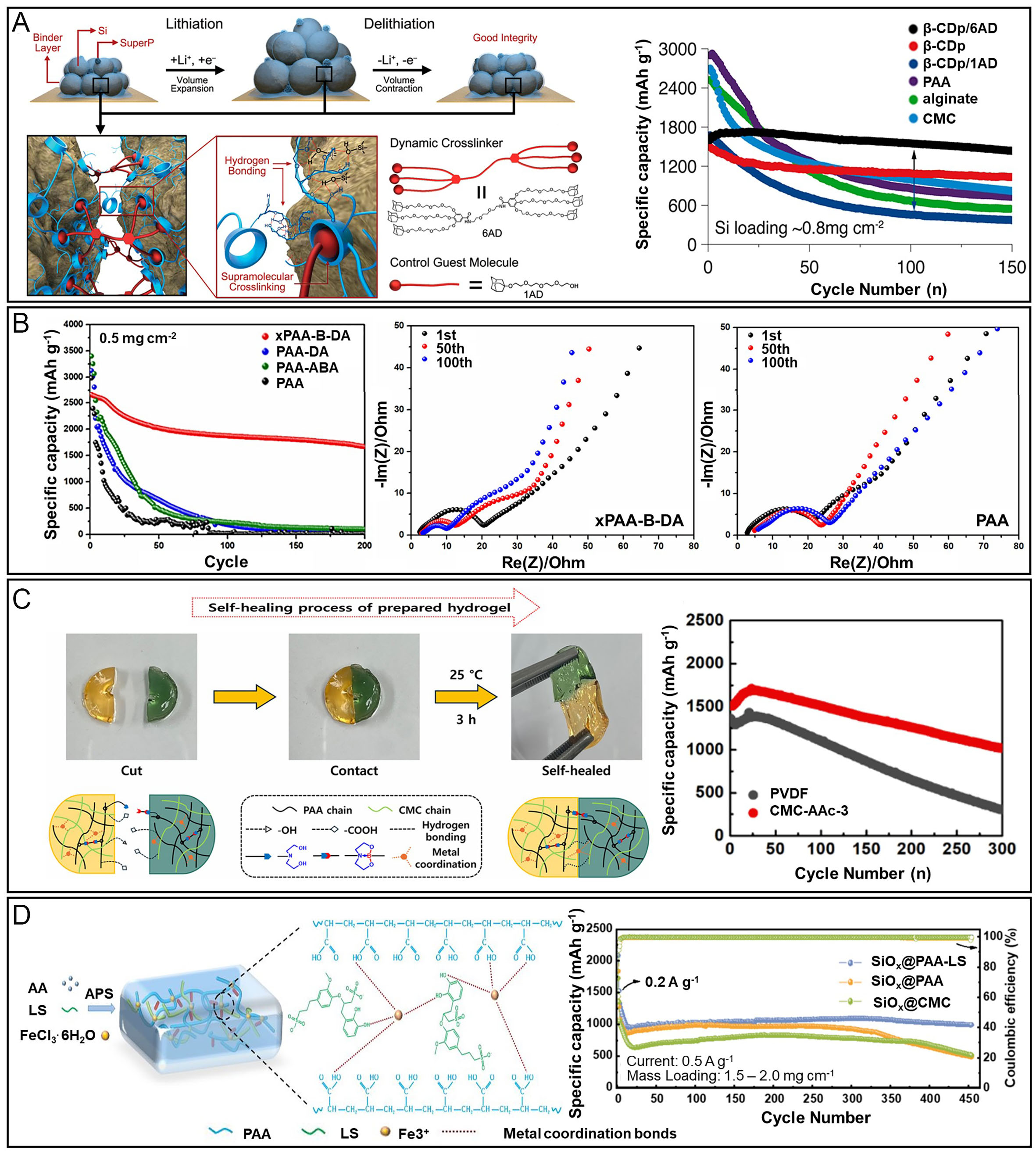
Figure 8. Electrochemical performance and structural stability of Si anodes incorporating polymeric dynamically cross-linked binders. (A) Schematic illustration of the self-healing mechanism in a polymer binder and the cycling performance of Si electrodes using dynamically cross-linked polymer binders based on CD and AD host-guest interactions. Adapted with permission from ref.[97]; (B) Schematic illustration of the self-healing 3D polymeric binder (xPAA-B-DA), constructed via boronic ester and dopamine-based cross-linking chemistry, demonstrating its integration within Si anodes during lithiation/delithiation. Also shown are the electrochemical impedance spectra of Si@xPAA-B-DA and Si@PAA electrodes measured at the 1st, 50th, and 100th cycles under a current density of 1 C. Adapted with permission from ref.[28]; (C) Schematic illustration of the self-healing mechanism in the CMC-AAc3 binder, along with extended cycling performance data. The CMC-AAc3 binder retained 67.2% of its initial capacity after 300 cycles at a rate of 0.2 C, demonstrating its enhanced durability under long-term operation. Adapted with permission from ref.[99]; (D) Schematic representation of the PAA-LS binder architecture, followed by long-term cycling performance of SiOx anodes using PAA-LS, PAA, and CMC binders at a current density of 0.5 A g-1, demonstrating the improved capacity retention and enhanced electrode stability provided by the lignosulfonate-modified binder. Adapted with permission from ref.[29].

Microstructures
ISSN 2770-2995 (Online)

Portico

All published articles are preserved here permanently:

https://www.portico.org/publishers/oae/

Portico

All published articles are preserved here permanently:

https://www.portico.org/publishers/oae/