


A powerful tool to bridge knowledge chasm in IIoT: industrial foundation model
 0
1. INTRODUCTION
The Industrial Internet of Things (IIoT) integrates next-generation information technology and artificial intelligence (AI), creating manufacturing and service ecosystems across the value chain. Through ubiquitous connectivity among humans, machines, systems, and environments, it provides a foundation for breaking down knowledge silos and interconnecting multi-source data[1,2]. However, industrial knowledge assets remain fragmented, decentralized, and heterogeneous, lacking platform-level standardized resource aggregation, and are insufficient for cross-level decision-making[3-5].
Overcoming this bottleneck requires deep integration of humans, the physical world, and the cyberworld, condensing multi-source knowledge into accessible and executable digital representations. Generative AI, represented by pretrained large language models, has shown strong capabilities in knowledge representation and reasoning[6,7]. Extending this paradigm to industrial systems through domain fine-tuning and alignment offers a pathway to build an industrial brain and bridge persistent knowledge gaps[8,9].
This perspective argues that the central IIoT bottleneck is not connectivity alone, but a coupled knowledge chasm spanning data, knowledge, architecture, and trust. We propose industrial foundation models (IFMs) as a bridging tool. Built on pretrained generative architectures, IFMs integrate domain mechanisms, empirical data, and operational rules, connect multi-level industrial knowledge, and enable autonomous reasoning, cross-layer semantic association, and adaptive decision-making.
Compared with related reviews and perspectives, it makes four contributions: (i) It decomposes the IIoT knowledge chasm into four coupled but diagnosable gaps: data, knowledge, architecture, and trust; (ii) It proposes an IFM as a cognitive bridge that fuses physical mechanisms, operational data, and rules in a shared latent space, augmented by knowledge graphs and configurable semantic schema; (iii) It separates the IFM into three layers - the model layer, the training methodology layer, and the industrial system layer - so that model-level novelty is not conflated with deployment mechanisms such as safety shields or secure execution environments; (iv) It outlines a flattened IIoT architecture, an intelligent–digital–physical closed loop, a cross-process transfer protocol, and a research agenda. See Supplementary Table 1 for a comparison between the proposed IFM and related frameworks. The IFM is presented as a conceptual bridge and enabling architecture, not a fully validated system.
2. DEVELOPMENT TRENDS IN IIoT
IIoT architecture is evolving from hierarchical isolation toward flattened, software-defined integration. As shown in Figure 1A[10], the traditional ISA-95/IEC 62264 hierarchy organizes industrial operations into five levels: physical production processes (Level 0), sensing and manipulating the production process (Level 1), monitoring and supervising control (Level 2), manufacturing operations management (Level 3), and business planning and logistics (Level 4). Although this topology defines clear boundaries, it creates data silos, communication latency, and reconfiguration bottlenecks.
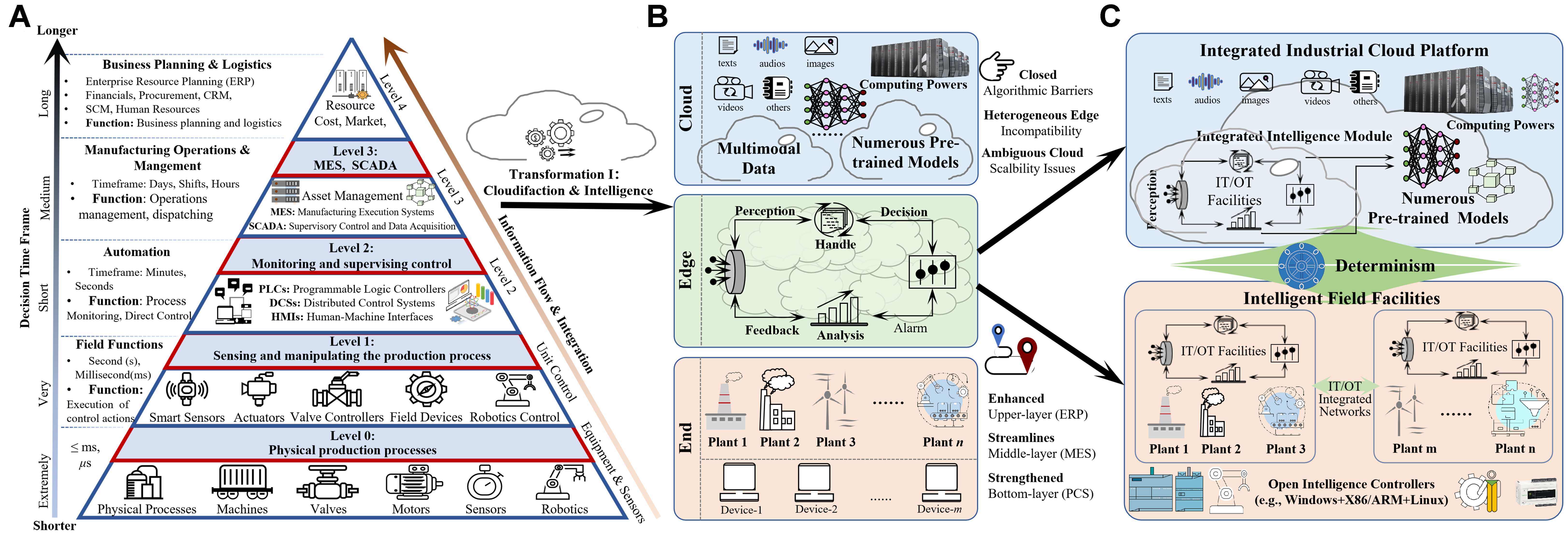
Figure 1. Evolutionary trajectory of IIoT architectures: (A) traditional ISA-95/IEC 62264 multi-layer pyramid model, in which the pre-training layer represents multiple pre-trained models, including but not limited to the IFM; (B) contemporary cloud-edge-end collaborative architecture with cloud-based IFM pre-training; (C) next-generation flattened intelligent architecture driven by the convergence of IT and OT, in which the core model is labeled as the IFM-based Industrial Cognitive Brain and the controller is labeled with real-time Linux, RTOS, and containerized runtime environments on x86/ARM platforms. All panels and the involved photographs were drawn or taken by the authors based on their own conceptual design and the publicly available online images only for general inspiration; no third-party copyrighted material and elements were involved in the final version. IIoT: Industrial Internet of Things; IFM: industrial foundation model; IT:Information Technology; OT:Operational Technology; CRM: customer relationship management; SCM: supply chain management; QMS: quality management systems; MES: manufacturing execution systems; ERP: enterprise resource planning; SCADA: Supervisory Control and Data Acquisition; DCS: Distributed Control System; HMI: human-machine interfaces.
Contemporary paradigms have shifted toward cloud-edge-end collaborative [Figure 1B][3,11]. Compute-intensive tasks, multimodal processing and large-scale foundation model (IFM) pre-training are performed in the cloud, whereas time-critical closed-loop operations run at the edge for direct field-device management. Nevertheless, this paradigm still faces three practical issues: (i) closed algorithmic barriers, where proprietary models, interfaces, and data formats limit interoperability and reuse; (ii) heterogeneous edge incompatibility, where diverse hardware, operating systems, and industrial protocols hinder unified deployment; and (iii) cloud scalability issues, where bandwidth, latency, privacy, cost, and elastic resource allocation constrain real-time industrial closed-loop applications.
For software-defined, highly autonomous factories, this paper proposes a flattened intelligent architecture [Figure 1C][2,12], which differs from Figure 1B in reorganizing the automation stack across cloud, edge, and field layers. The enterprise resource planning (ERP) is enhanced (enhanced ERP) by integrating enterprise planning and supply-chain decisions with the IFM-based Industrial Cognitive Brain, enabling dynamic constraint generation and cross-domain decision support. The manufacturing execution system (MES) layer is streamlined (Streamlined MES) by migrating scheduling, quality management, and part of production execution to cloud-edge collaborative services, reducing intermediate layers, incorporates time-sensitive networking (TSN)-enabled deterministic communication and safety shields, thereby improving real-time control, interoperability, and reconfiguration. Open intelligent controllers are built on general-purpose computing platforms (e.g., x86/ARM industrial PCs or edge AI devices) and open operating systems [e.g., real-time Linux, Real-Time Operating System (RTOS), or containerized runtimes]. They reduce reliance on proprietary field devices. High-level cognitive reasoning is centralized in the industrial cloud, while time-critical control remains at the edge. Synchronized by deterministic mechanisms such as TSN, this topology could enable Information Technology (IT)/Operational Technology (OT) convergence, ultra-low-latency closed-loop, and software-defined orchestration across heterogeneous assets. It remains conceptual; feasibility depends on advances in deterministic networking, open control platforms, and edge intelligence.
As shown in Supplementary Table 1, whether IIoT adopts the current three-layer or a future two-layer architecture, the fundamental challenge remains the end–edge–cloud coordination of heterogeneous data and knowledge, which calls for an IFM-enabled cognitive architecture to bridge the data, knowledge, architecture, and trust gaps while balancing computational accuracy, real-time efficiency, and industrial trustworthiness. Moreover, the flattened architecture [Figure 1C] differs from Figure 1B in three key aspects. First, MES and Supervisory Control and Data Acquisition (SCADA) functions are reorganized into cloud-edge collaborative services rather than remaining in separate hierarchical layers. Second, edge nodes host IFM inference, real-time control, and safety verification, enabling local autonomous loops. Third, TSN provides deterministic communication with bounded latency, time synchronization, and traffic scheduling, which are essential for closed-loop control across heterogeneous assets.
3. INDUSTRIAL KNOWLEDGE CHASMS: A TAXONOMY
Traditional manufacturing decision-making relies heavily on human expertise and empirical heuristics. With multi-source operational data, managers face cognitive overload. Dependence on fragmented knowledge silos impedes efficiency in resolving inter-process interdependencies, executing real-time maintenance, and diagnosing anomalies. Conventional methods - rigid rule bases, ad hoc expert consultation, and coarse-grained data mining - lack semantic flexibility and contextual awareness[13]. Consequently, explicit physics-based models and implicit human intuition remain disjointed. See Supplementary Figure 1 for an abstract conceptual illustration of the Industrial Knowledge Chasm. In addition, this study classifies the industrial knowledge chasm into four coupled but diagnosable types. The Gap diagnosis, bridging mechanisms, and evaluation indicators are summarized in Supplementary Table 2.
Data gap. It arises from missing modalities, distribution shift, sparse labels, and unsynchronized temporal data. Time series, text, images, control signals, and maintenance records differ in sampling rates, time scales, semantics, and quality. Missing labels, temporal lags, and semantic misalignment hinder aggregation and pretraining.
Knowledge gap. It arises from semantic misalignment, missing causal relations, incomplete constraints, and fragmented process knowledge. Tacit experience, fragmented rules, and unstructured process knowledge are difficult to codify. The lack of industry-wide semantic standards prevents linking process knowledge, control logic, and enterprise decisions. Physics-based and data-driven models are often developed separately, which further fragments model knowledge and limits cross-domain transferability.
Architecture gap. It arises from cloud-edge separation, model-system coupling, real-time constraints, and nondeterministic interfaces. Automation stacks remain isolated across ERP, MES, and Process Control System (PCS), creating data silos, latency, and reconfiguration barriers. A model may perform well offline but cannot be reliably integrated into real-time control and execution systems.
Trust gap. It arises from privacy, security, verifiability, responsibility tracing, and human-agent trust, which cannot be solved at one layer. They require system-level mechanisms such as secure execution, privacy-preserving inference, auditability, and graduated authorization.
These gaps are mutually reinforcing: data heterogeneity aggravates model transferability; knowledge fragmentation weakens knowledge codification; architecture isolation prevents deployment; and trust deficits hinder adoption in safety-critical settings. Bridging them requires a unified cognitive architecture, not isolated point solutions[14,15]. A diagnostic workflow maps symptoms to the dominant gap, the selected bridging mechanism, and the evaluation indicators used to assess whether the gap has been reduced.
4. INDUSTRIAL COGNITIVE BRAIN UNDER IIoT
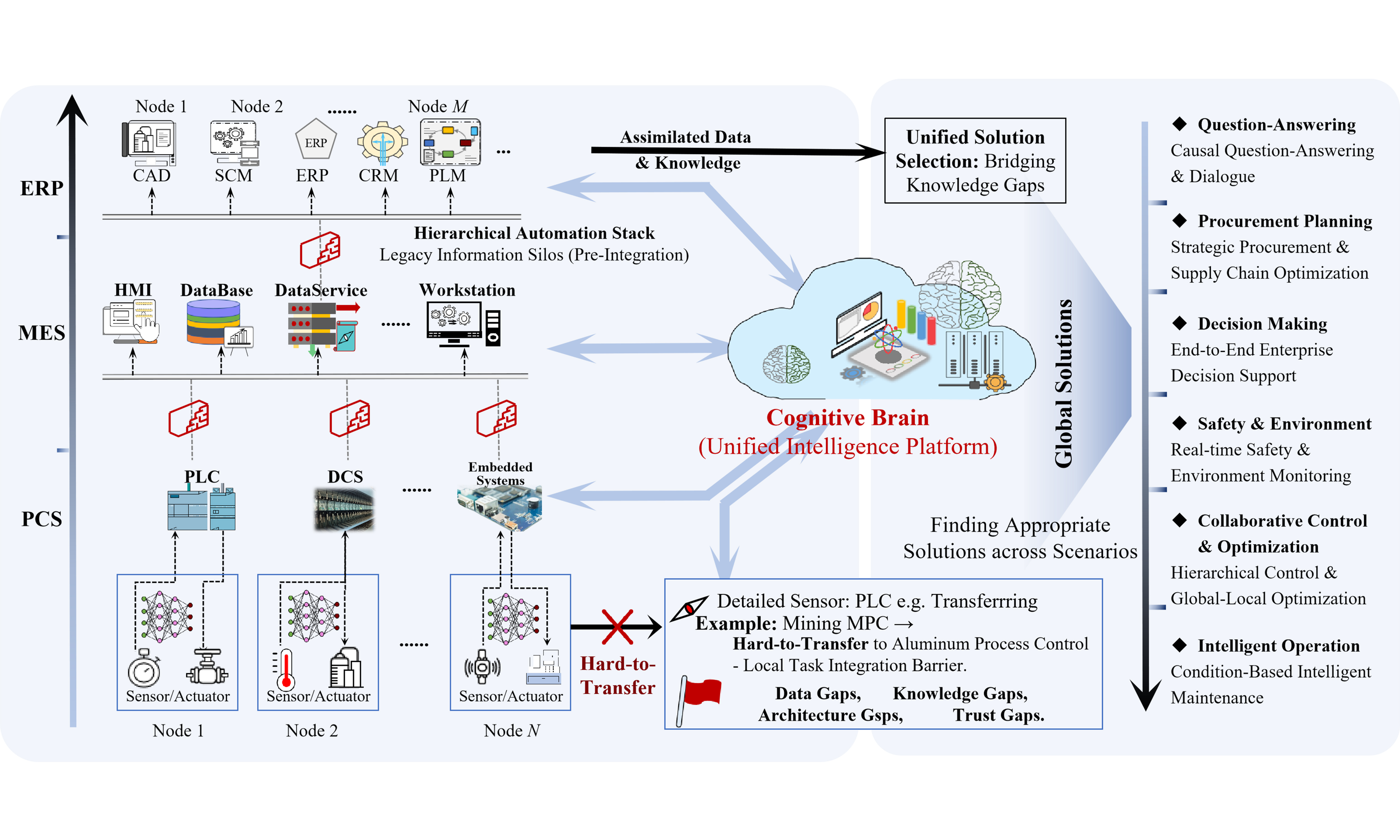
From isolated stacks to a unified platform. Traditional automation stacks are rigid and isolated across ERP, MES, PCS, and field devices. They suffer from information silos and cross-domain transferability bottlenecks. For example, model predictive control (MPC) tailored for mining operations[16] is difficult to transfer to aluminum electrolysis[17] because of differences in physical dynamics, delays, actuation limits, and task-specific barriers.
Industrial Cognitive Brain as a unified decision engine. To eliminate structural silos, the Industrial Cognitive Brain acts as a centralized intelligence core that assimilates multimodal operational data and domain knowledge from all tiers (ERP, MES, PCS). Leveraging the generalization and cross-domain reasoning of foundation models, it bridges systemic knowledge gaps and serves as a unified solution engine[18]. At operational and strategic levels, it supports causal question answering, supply-chain procurement planning, and enterprise decision support. At the physical level, it enables real-time safety monitoring, condition-based maintenance, and multi-tier collaborative control, supporting an end-to-end autonomous ecosystem. See Supplementary Figure 2 for the schematic of pre-trained IFM functioning as a unified cognitive bridge across the industrial knowledge chasm.
Mechanism-level elaboration: a worked example in aluminum electrolysis. Its fault diagnosis and parameter optimization are utilized as a conceptual worked example. This example illustrates the proposed mechanisms rather than reporting new experimental results, as illustrated in Supplementary Table 3.
Inputs. It includes cell voltage, line current, electrolyte temperature, alumina feed rate, electrolyte composition, anode effect records, operator logs, maintenance records, and a knowledge graph of cell dynamics and safety constraints.
Representation. The industrial multimodal encoder maps these inputs into a shared latent space. Process-specific dynamics are preserved through a process-specific adapter. Units are normalized through a unit-normalization layer. Temporal relationships are encoded through temporal convolution or transformer modules. Control semantics are aligned through a control-semantics alignment loss.
Causal question answering. A causal graph is constructed from process knowledge and data. Variables include current, temperature, alumina concentration, cell voltage, and anode effect. Interventions and counterfactual reasoning are used to distinguish causal relations from correlations. For example, the system asks whether a change in alumina feed would reduce the probability of anode effect under a given temperature and current condition.
Planning under constraints. The system combines the causal diagnosis with operational constraints, including temperature limits, current limits, material availability, and maintenance schedules. ERP and MES information is introduced as part of the constraint set. Feasible plans are generated through constraint satisfaction and scheduling algorithms.
Verification. The generated plan is verified against physical constraints, safety constraints, and operational constraints. Evaluation indicators include diagnostic accuracy, constraint-violation rate, plan feasibility, and negative-transfer indicators.
Conceptual illustration across mining, aluminum electrolysis, and zinc smelting. Mining MPC must handle large delays, geotechnical uncertainty, and fleet constraints; aluminum electrolysis MPC deals with high-temperature multiphase dynamics, slow variables, and tight energy constraints[16,17]. Their state variables, actuation limits, and objectives differ substantially. An IFM can encode both tasks in a shared representation, support few-shot adaptation, and use a MPC shield before execution. However, roasting and leaching involve different time constants, chemical reactions, and control objectives, so a controller for one stage cannot be directly reused[19]. An IFM can link these stages through shared semantic and dynamic representations, while physical models and operational rules provide verification constraints. These examples are conceptual, not validated deployments, but they clarify how an IFM could bridge model and knowledge gaps across heterogeneous processes.
5. IFMS FOR THE INDUSTRIAL COGNITIVE BRAIN
Why an IFM differs from a general multimodal foundation model. Existing industrial models are highly specialized, with limited interoperability, adaptability, and standardization. Heterogeneous telemetry, unstructured process knowledge, fault records, and plant contexts remain isolated, creating a knowledge chasm and preventing accuracy and generalization gains from large-scale industrial corpora[14,20]. An IFM is not merely a general-purpose or domain-adapted multimodal foundation model fine-tuned on industrial data. To make this distinction precise, we separate the IFM into three layers, as illustrated in Supplementary Table 4.
Model layer. It contains the industrial multimodal encoder, the shared latent space, process-semantic embedding, physics-constraint embedding, and knowledge-graph embedding. These components determine how industrial data and knowledge are represented and fused.
Training methodology layer. It includes self-supervised pretraining, physics-informed learning, knowledge-enhanced learning, hybrid learning, and cross-process adaptation. These methods determine how the model is trained and adapted.
Industrial system layer. It includes deterministic interfaces, safety shields, secure execution environments, privacy protection, cloud-edge-device orchestration, and integration with ERP, MES, and Distributed Control System (DCS). These components determine how the model is deployed and governed in industrial settings. Moreover, an external safety shield or secure execution environment belongs to the system layer. It does not, by itself, define a different foundation-model architecture.
Enabling mechanisms. As illustrated in Supplementary Tables 5 and 6, cross-layer semantic association uses a shared latent space and knowledge-graph grounding. Causal question answering uses causal reasoning, retrieval, and process knowledge. Procurement planning uses tool calling to ERP and supply-chain databases. Safety monitoring and condition-based maintenance use multimodal encoders and time-series pretraining. Multi-tier collaborative control generates policies followed by an external MPC shield. Adaptive decision-making combines few-shot adaptation, continual learning, and online verification. The Transformer architecture, based on self-attention, provides a scalable backbone for long-range dependency modeling; however, industrial time-series and data need causal, multimodal, and physics-constrained attention. Through self-supervised and multi-task learning, it maps high-dimensional signals into a shared latent space without labor-intensive manual labeling or rigid expert rules[21]. The IFM bridge can transform fragmented field data into actionable cognitive control, supporting more autonomous industrial workflows and shorter task adaptation cycles, and accelerating digitalization, connectivity, and intelligence[22,23].
Physical constraints: intrinsic and extrinsic. Physical constraints are enforced in two complementary ways. Intrinsically, they are embedded through physics-informed losses, structured priors, and knowledge-graph rules during pretraining and fine-tuning. Extrinsically, they are applied as a safety-shield verification layer before decisions are executed. Thus, the IFM does not replace physical verification; it is coupled with it.
6. LARGE MODELS FOR INTELLIGENT-DIGITAL-PHYSICAL SPACES
Intelligent manufacturing deeply integrates advanced information technologies - IIoT, big data, and AI - with traditional manufacturing. Its core driver is the new generation of AI, particularly general-purpose large models. These technologies can enable intelligent-digital-physical convergence spaces for multi-scenario ecosystems, covering digital-physical fusion perception, internal and external connectivity, collaborative cognition and computation, and optimized decision-making and execution.
Intelligent space for high-level engine. It anchors by a pretrained large foundation model with a multimodal encoder-decoder backbone enhanced by knowledge-graph integration, and coordinates five vectors: explicit knowledge representation and reasoning; adaptive learning and evolution; real-time decision-making; ethical alignment and safety guardrails; and intuitive user-AI collaboration[4].
Cyberspace for an intermediate digital-twin layer. It bridges cognitive reasoning and physical execution, integrating cyber-physical system (CPS) models, digital twin repositories, high-performance analytics, and cloud-to-edge infrastructure[24]. It enables vertical data aggregation, predictive simulation, and runtime optimization. The Physical space captures operational dynamics through sensor networks, IoT devices, robotics, smart environment controllers, and human-in-the-loop activities.
As illustrated in Supplementary Tables 5 and 6, the intelligent-digital-physical architecture forms a bidirectional closed-loop: an upward perception stream, where physical telemetry and anomaly logs enter the cyberspace, are abstracted, and feed the cognitive foundation model; and a downward control stream, where the model performs cross-domain reasoning to formulate optimization strategies and control policies. Policies pass to the cyberspace for verification, then become actuation commands for physical devices, achieving end-to-end cognitive automation. Supplementary Figure 3 details the triadic architectural framework interconnecting Intelligence, Digital, and Physical spaces in the IIoT era.
7. INDUSTRIAL PRIVACY PROTECTION AND EDGE TRUST IN THE ERA OF PRETRAINED LARGE MODELS
The deepening integration of academia and industry is creating a collaborative, open, and multi-scenario ecosystem in intelligent manufacturing. This entails large-scale industrial data flows and introduces cybersecurity and leakage risks. It outlines an end-to-end privacy-preserving and security-enforced architecture across the industrial edge, cloud, and enterprise control tiers. Supplementary Figure 4 illustrates the end-to-end privacy and security protection architecture for IIoT foundation model ecosystems, structured into three hierarchical layers.
Edge trust layer. Before data enters the privacy-preserving pipeline, an edge trust layer should identify devices and detect anomalies using heterogeneous network-level features[25]. This layer operates upstream; the IFM pipeline is downstream and consumes only authenticated, trusted data. Interactions and dependencies among heterogeneous components should be modeled because they shape security risks and anomalous behavior across the IIoT architecture[26]. Therefore, the proposed architecture does not subsume edge device identification; it depends on such a detection layer as a precondition.
Factory side layer. The system ingests raw data from IIoT sensors, Programmable Logic Controllers (PLCs)/DCSs, computer vision systems, and network gateways. To ensure data sovereignty, the edge node implements a four-stage pipeline: transforming raw data using k-anonymity and l-diversity; enforcing secure data ingestion protocols; maintaining encrypted local storage; and executing decentralized training via federated learning (FL)[27,28]. Raw data remains on-premise; only encrypted local model updates pass through secure aggregation.
Cloud side layer. Foundation models are deployed within hardware-isolated Secure Enclaves, such as trusted execution environment (TEE). A privacy-preserving engine uses homomorphic encryption (HE) to perform inferences on encrypted payloads without decryption. Against adversarial examples, model inversion, and backdoor injections, the cloud incorporates robust adversarial training, secure multi-party computation (SMPC), and differential privacy (DP)[29].
8. KEY CHALLENGES AND FUTURE DIRECTIONS
IFMs in IIoT can dismantle information silos and bridge cross-layer knowledge gaps. Their ability to extract value from heterogeneous data across scenarios and processes opens new pathways for industrial intelligence[30]. However, deep integration of large language models with industrial knowledge faces critical scientific challenges.
Data bias and quality. Industrial datasets suffer from incomplete streams, temporal lags in high-frequency sensor logs, and semantic misrepresentations across manufacturing domains.
Model Limitations. Current foundational architectures remain prone to hallucinations, lack systematic understanding of operational contexts, and show logical reasoning deficiencies in complex decision-making.
Ethical and societal risks. Unchecked deployment risks amplifying erroneous domain heuristics, introducing algorithmic bias into automated operations, and widening the digital divide between advanced and traditional enterprises.
We outline three future directions.
Representation enhancement. Advance multimodal learning to align heterogeneous time-series, textual, and visual data; incorporate few-shot/zero-shot transfer and continual learning to mitigate domain drift while avoiding catastrophic forgetting.
Knowledge discovery. Enable autonomous hypothesis generation, cross-domain operational insight extraction, and comprehensive processing of unstructured industrial knowledge.
Societal and industrial impact. Use foundation models to make specialized technical knowledge broadly accessible through personalized operator training, accessible knowledge retrieval, and accelerated scientific and engineering breakthroughs in smart manufacturing, promoting knowledge democratization.
Industrial production involves round-the-clock continuous operation, extremely high stability requirements, and severe consequences of abnormal conditions. Large-model-driven industrial technologies therefore cannot be directly deployed without thorough testing. This practical constraint hinders rapid promotion and deep proliferation in industry.
DECLARATIONS
Authors’ contributions
Writing - original draft, data curation, visualization, funding acquisition: Ren, H. (Hao Ren)
Validation, review and editing, formal analysis, funding acquisition: Ren, H. (Haojie Ren)
Investigation, visualization processing: Jia, R.
Supervision, project administration: Yang, C.; Gui, W.
Availability of data and materials
Not applicable.
AI and AI-assisted tools statement
Not applicable.
Financial support and sponsorship
This work was supported in part by Fundamental and Interdisciplinary Disciplines Breakthrough Plan of the Ministry of Education of China (No.JYB2025XDXM309), the Open Research Project of the State Key Laboratory of Industrial Control Technology, China (Grant No. ICT2026A26), the National Natural Science Foundation of China (Grant 52471291), the Key Technology R&D Plan “New Generation Information Technology” Program of the 2025 Science and Technology Commission of Shanghai Municipality (No. 25511105004), the Shanghai Municipal Education Commission (Grant 22CGA10), the Anhui Postdoctoral Scientific Research Program Foundation (No. 2025B1084), and in part by the Fundamental Research Funds for the Central Universities (Grant 222202517006).
Conflicts of interest
All authors declared that there are no conflicts of interest.
Ethical approval and consent to participate
Not applicable.
Consent for publication
Not applicable.
Copyright
© The Author(s) 2026.
Supplementary Materials
REFERENCES
1. Hu, Y.; Jia, Q.; Yao, Y.; et al. Industrial Internet of Things intelligence empowering smart manufacturing: a literature review. IEEE. Internet. Things. J. 2024, 11, 19143-67.
3. Qiu, T.; Chi, J.; Zhou, X.; Ning, Z.; Atiquzzaman, M.; Wu, D. O. Edge computing in Industrial Internet of Things: architecture, advances and challenges. IEEE. Commun. Surv. Tutor. 2020, 22, 2462-88.
4. Zheng, Q.; Liu, J.; Zeng, H.; Guo, Z.; Wu, B.; Wei, B. Knowledge forest: a novel model to organize knowledge fragments. Sci. China. Inform. Sci. 2021, 64, 179103.
5. Ding, W.; Yao, L.; Li, Y.; Long, W.; Yi, J. Incremental learning model based on an improved CKS-PFNN for aluminium electrolysis manufacturing. Neural. Comput. Appl. 2021, 34, 2083-102.
6. Emmanouilidis, C.; Waschull, S.; Zotelli, J. Integrating knowledge and data-driven artificial intelligence for decisional enterprise interoperability. In Innovative intelligent industrial production and logistics; Dassisti, M.; Madani, K.; Panetto, H.; Eds.; Cham: Springer Nature Switzerland; 2025. pp. 372-98.
7. Liu, C.; Tang, D.; Zhu, H.; Wang, L.; Cai, Q.; Nie, Q. LLM-enhanced embodied multi-agent manufacturing system: a novel self-organizing production paradigm for embodied perception, embodied analysis and embodied decision. J. Manuf. Syst. 2026, 84, 357-82.
8. Zhou, B.; Li, X.; Liu, T.; Xu, K.; Liu, W.; Bao, J. CausalKGPT: industrial structure causal knowledge-enhanced large language model for cause analysis of quality problems in aerospace product manufacturing. Adv. Eng. Inform. 2024, 59, 102333.
9. Sitapure, N.; Kwon, J. S. CrystalGPT: enhancing system-to-system transferability in crystallization prediction and control using time-series-transformers. Comput. Chem. Eng. 2023, 177, 108339.
10. International Society of Automation. ISA-95 Series of Standards: enterprise-control system integration. Parts 1-7. https://www.isa.org/standards-and-publications/isa-standards/isa-95-standard. (accessed 2026-10-22).
11. Wang, Y.; Fang, J.; Cheng, Y.; She, H.; Guo, Y.; Zheng, G. Cooperative end-edge-cloud computing and resource allocation for digital twin enabled 6G Industrial IoT. IEEE. J. Sel. Top. Signal. Process. 2024, 18, 124-37.
12. Kaur, K.; Garg, S.; Aujla, G. S.; Kumar, N.; Rodrigues, J. J. P. C.; Guizani, M. Edge computing in the Industrial Internet of Things environment: software-defined-networks-based edge-cloud interplay. IEEE. Commun. Mag. 2018, 56, 44-51.
13. Kourtis, G.; Kavakli, E.; Sakellariou, R. A rule-based approach founded on description logics for Industry 4.0 smart factories. IEEE. Trans. Ind. Inform. 2019, 15, 4888-99.
14. Yang, T.; Yi, X.; Lu, S.; Johansson, K. H.; Chai, T. Intelligent manufacturing for the process industry driven by industrial artificial intelligence. Engineering 2021, 7, 1224-30.
15. Ma, Y.; Zheng, S.; Yang, Z.; Zheng, P.; Leng, J.; Hong, J. Leveraging large language models in next generation intelligent manufacturing: retrospect and prospect. J. Manuf. Syst. 2025, 82, 809-40.
16. Botha, S.; Le Roux, J.; Craig, I. Hybrid non-linear model predictive control of a run-of-mine ore grinding mill circuit. Miner. Eng. 2018, 123, 49-62.
17. Yue, W.; Gui, W.; Chen, X.; Zeng, Z.; Xie, Y. A data and knowledge collaboration strategy for decision-making on the amount of aluminum fluoride addition based on augmented fuzzy cognitive maps. Engineering 2019, 5, 1060-76.
18. Zhu, H.; Tiwari, P.; Ghoneim, A.; Hossain, M. S. A collaborative AI-enabled pretrained language model for AIoT domain question answering. IEEE. Trans. Ind. Inform. 2022, 18, 3387-96.
19. Wang, H.; Wang, C.; Liu, Q.; et al. A data and knowledge driven autonomous intelligent manufacturing system for intelligent factories. J. Manuf. Syst. 2024, 74, 512-26.
20. Jardim-Goncalves, R.; Sarraipa, J.; Agostinho, C.; Panetto, H. Knowledge framework for intelligent manufacturing systems. J. Intell. Manuf. 2009, 22, 725-35.
21. Tian, Z.; Zhao, X.; Li, X.; Ma, X.; Li, Y.; Wang, Y. Multi-modal semantics fusion model for domain relation extraction via information bottleneck. Expert. Syst. Appl. 2024, 244, 122918.
22. Chen, Y.; Ren, T.; Li, Y.; et al. AI-empowered intelligence in industrial robotics: technologies, challenges, and emerging trends. Intell. Robot. 2026, 6, 1-18.
23. Lei, L.; Zhang, H.; Yang, S. X. ChatGPT in connected and autonomous vehicles: benefits and challenges. Intell. Robot. 2023, 3, 145-8.
24. Pourmirza, Z.; Couraud, B.; Bozdal, M.; et al. Cyber-physical multi-energy systems: towards an integrated energy system - a review. Renew. Sustain. Energy. Rev. 2026, 239, 117112.
25. Rabbani, M.; Gui, J.; Nejati, F.; et al. Device identification and anomaly detection in IoT environments. IEEE. Internet. Things. J. 2025, 12, 13625-43.
26. Cimino, G.; Deufemia, V. SIGFRID: unsupervised, platform-agnostic interference detection in IoT automation rules. ACM. Trans. Internet. Things. 2025, 6, 1-33.
27. Xiao, P.; Wang, C.; Lin, Z.; Hao, Y.; Chen, G.; Xie, L. Knowledge-based clustering federated learning for fault diagnosis in robotic assembly. Knowl. Based. Syst. 2024, 294, 111792.
28. Zhu, J.; Cao, J.; Saxena, D.; Jiang, S.; Ferradi, H. Blockchain-empowered federated learning: Challenges, solutions, and future directions. ACM. Comput. Surv. 2023, 55, 1-31.
29. Li, Y.; Jiang, Q.; Hao, Z.; Liu, W.; Chen, T.; Li, J. Challenges and opportunities of privacy-preserving computation techniques in IoV edge services: a systematic review and meta-analysis. IEEE. Trans. Intel. Transp. Syst. 2026, 27, 3843-61.
Cite This Article
 Open Access
How to Cite
Ren, H.; Ren, H.; Jia, R.; Yang, C.; Gui, W. A powerful tool to bridge knowledge chasm in IIoT: industrial foundation model. Intell. Robot. 2026, 6(4), 801-10. https://dx.doi.org/10.20517/ir.2026.35
Download Citation
Export Citation File:
Type of Import
Tips on Downloading Citation
Citation Manager File Format
Type of Import
Direct Import: When the Direct Import option is selected (the default state), a dialogue box will give you the option to Save or Open the downloaded citation data. Choosing Open will either launch your citation manager or give you a choice of applications with which to use the metadata. The Save option saves the file locally for later use.
Indirect Import: When the Indirect Import option is selected, the metadata is displayed and may be copied and pasted as needed.
About This Article
Copyright

Data & Comments
Data
0







Comments
Comments must be written in English. Spam, offensive content, impersonation, and private information will not be permitted. If any comment is reported and identified as inappropriate content by OAE staff, the comment will be removed without notice. If you have any queries or need any help, please contact us at support@oaepublish.com.