


fig1
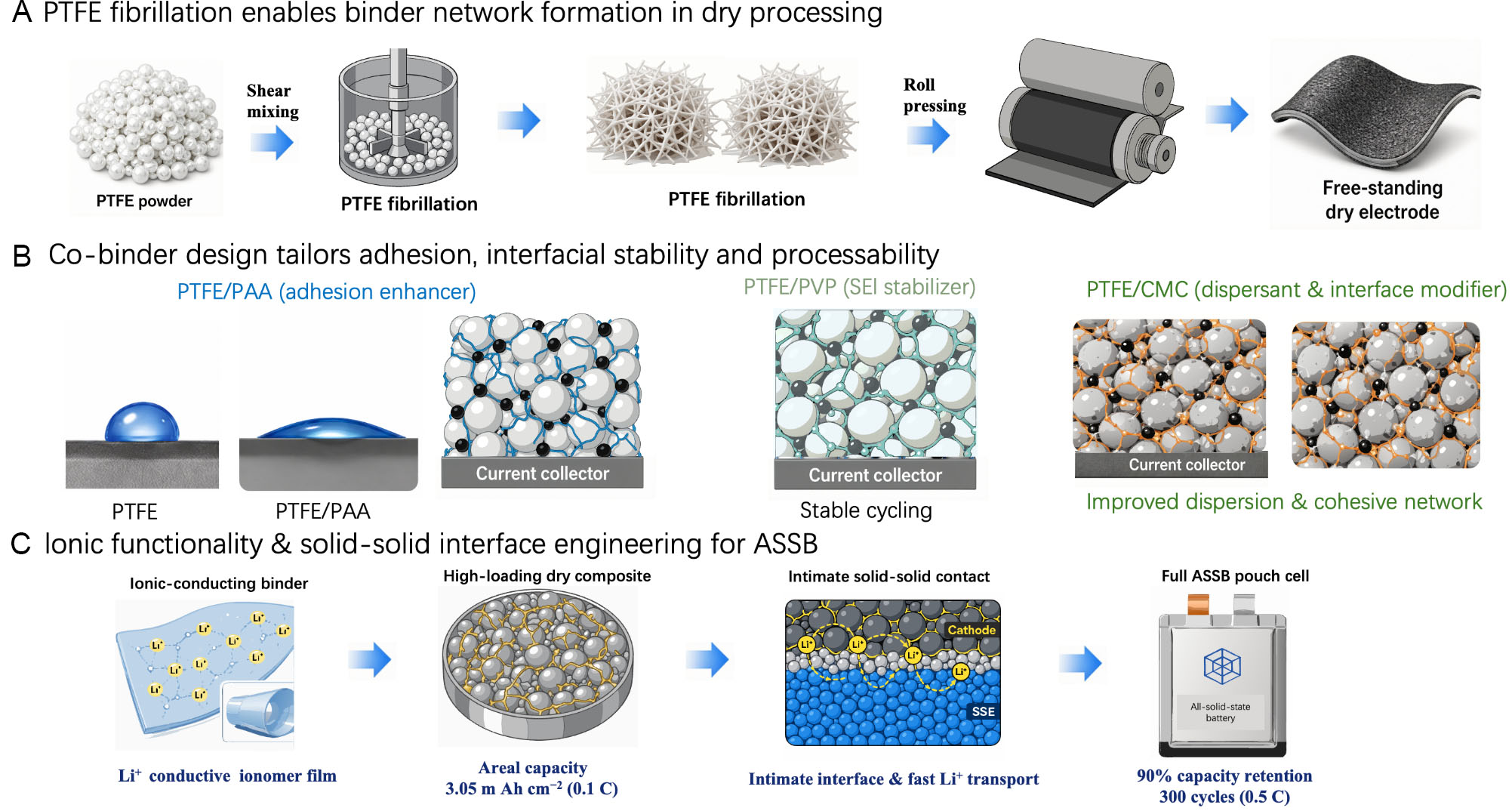
Figure 1. Schematic illustration of the evolution of dry-electrode binder design from PTFE fibrillation to multifunctional and solid-stateelectrolyte-compatible architectures. (A) PTFE powder undergoes shear mixing and fibrillation, followed by roll pressing to form a freestanding dry electrode; (B) PTFE/PAA, PTFE/PVP, and PTFE/CMC co-binder strategies introduce complementary functions associated with interfacial adhesion, SEI stabilization, particle dispersion, and cohesive network formation; (C) Li+-conducting binders enable ionic transport in high-loading composite electrodes and promote intimate cathode-solid-electrolyte contact, thereby reducing interfacial impedance and supporting stable all-solid-state battery operation. The wetting sketches in (B) are schematic; improved wettability with PAA/PTFE is reported in Ref.[18]. In (C), the ionomer cell results are 3.05 mAh cm-2 (0.1 C) and 90% retention after 300 cycles (0.5 C); the pouch cell is a separate demonstration[4]. PTFE: Polytetrafluoroethylene; PAA: polyacrylic acid; PVP: polyvinylpyrrolidone; CMC: sodium carboxymethyl cellulose; SEI: solid electrolyte interphase; ASSB: all-solid-state battery; SSE: solid-state electrolyte.