




Surgical disparities and the robot: an innovators’ perspective
 0
0  , ...
, ... INTRODUCTION
Minimally invasive surgery (MIS) has profoundly revolutionized the surgical care of patients. The impact of laparoscopic surgery and its attendant benefits has been largely ignored by social scientists and economists to date, yet those with particular insight have heralded its advent as on par with the introduction of general anesthesia[1]. When one considers the decrease in surgical trauma, quicker return to economic productivity and activities of daily living, drastically reduced hospital stays, and the transition to outpatient procedures, history may judge its impact as comparable to the introduction of surgical antisepsis [Figure 1A].
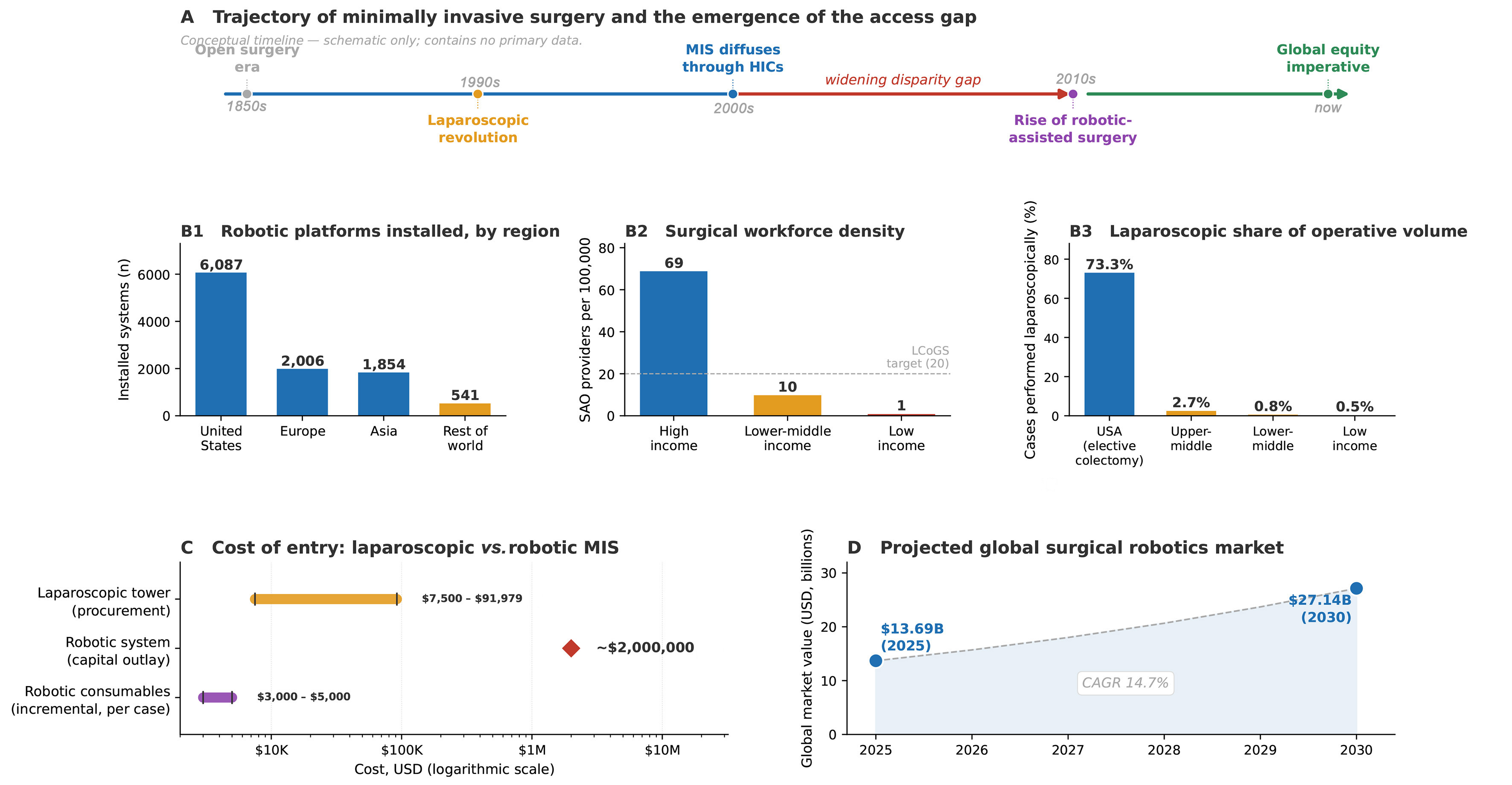
Figure 1. Surgical disparities and the robot: a multi-dimensional overview. Methods note: no primary data were collected for this figure. All values in (B1-3), (C) and (D) are taken directly from the published sources cited below, with the unit of measurement and denominator stated for each; no normalization, modeling, or rescaling has been applied, and interpolated points are identified as such. (A) A conceptual, non-quantitative timeline (schematic only) tracing surgery across four eras - the open-surgery era (from the 1850s), the laparoscopic revolution (1980s-2000s) during which MIS diffused through HICs, the rise of robotic-assisted surgery (2010s onward), and the present “global equity imperative” - in which the widening arrow between the high-income diffusion of MIS and the present day depicts the growing disparity gap that is the central theme of this perspective; (B1) Absolute number of installed robotic surgical systems (n) by region as of 30 June 2025 (United States 6,087; Europe 2,006; Asia 1,854; rest of world 541), illustrating the extreme geographic concentration of robotic infrastructure in high-income regions[2]; (B2) Density of SAO providers per 100,000 population by World Bank income group (high income 69; lower-middle income 10; low income 1), with the dashed line marking the LCoGS minimum target of 20 per 100,000; only high-income countries exceed the target, whereas low-income countries fall roughly 20-fold below it[3,4]; (B3) Percentage of cases performed laparoscopically, showing that even basic laparoscopy - not robotics - remains largely inaccessible outside high-income settings; the US bar (elective colectomy, 73.3%) reflects a national series, while the income-group bars (upper-middle 2.7%; lower-middle 0.8%; low 0.5%) derive from COSECSA trainee logs (68,659 cases), the two sets being drawn from different case types and denominators and juxtaposed for scale rather than as a matched comparison[5,6]; (C) Capital and per-case cost ranges on a logarithmic USD axis for three entry points - a laparoscopic tower (procurement, $7,500-91,979), a robotic system (capital outlay, ~$2,000,000), and robotic consumables (incremental, per case, $3,000-5,000) - highlighting the 22- to 267-fold difference in capital cost that separates a laparoscopic tower from a robotic system[2,7,8]; (D) Projected global surgical-robotics market value (USD billions) rising from $13.69B (2025) to $27.14B (2030) at a compound annual growth rate of 14.7%, in which the two filled circles are the reported values and the dashed line is interpolated from the reported CAGR and shown for trend only[9]. MIS: Minimally invasive surgery; HICs: high-income countries; SAO: surgical, anaesthetic and obstetric; LCoGS: Lancet Commission on Global Surgery; USD: United States dollar; CAGR: compound annual growth rate.
It is largely the patients of high-income countries (HIC) that have benefited from the MIS revolution [Figure 1B]. Great strides have been made in global surgery and access to surgical care in low- and middle-income countries (LMICs) over the past decade, due in part to the clarion call of the Lancet Commission. Unfortunately, the equipment, technology and training needed to become proficient in laparoscopic surgery are not yet widely accessible in LMICs. Today we find ourselves on the cusp of significant change: laparoscopic technology is becoming more cost-feasible through genericization, industry competition and regional manufacturing, while high-quality surgical training has been adapted for austere settings through more robust and accessible distance-learning technology (telesurgery, tele-mentoring, social networks).
A BRIEF HISTORY OF THE LAPAROSCOPIC REVOLUTION
Thirty-five to forty years into the MIS revolution in Western medicine, our LMIC colleagues are now beginning to embrace these techniques and offer their patients the advantages ours have long enjoyed: less traumatic surgery, lower anticipated wound and infectious complications, and, in colorectal cancer, better long-term physical functioning than after open surgery[10]. Reduced hospital stays would also let overburdened hospitals care for more patients with the same beds, while patients’ quicker recovery carries evident economic benefit for them and their employers.
Whereas MIS has for decades been synonymous with laparoscopic, arthroscopic or thoracoscopic surgery, it increasingly means robotic or robotic-assisted surgery (RAS). While this shift may appear minor, it carries important economic and social implications. The benefits that LMIC patients stand to gain are unlikely to be delivered at scale by current robotic platforms in the near term, given prevailing capital, consumable, infrastructure and training requirements; emerging platforms and falling component costs may eventually narrow this gap, but the timeline remains uncertain.
Beyond the priority of developing loco-regional RAS training and faculty champions, adopting robotic surgery in LMICs is constrained by three interconnected problems. Infrastructure: hospitals need reliable operating rooms, uninterrupted power, sterilization, high-speed Information Technology (IT) for software updates and tele-mentoring, and local technical support, resources most facilities lack. Cost is large and recurring: the capital outlay for a contemporary robotic system is of the order of United States dollar (USD) 2 million, with an additional USD 3,000-5,000 per procedure in proprietary consumables[8], whereas a complete laparoscopic tower can be procured for USD 7,500-91,979, a 22- to 267-fold difference shown to determine whether MIS is cost-effective in resource-constrained settings [Figure 1C][7]. Social and system-level obstacles include too few trained surgeons and biomedical engineers, regulatory and procurement hurdles, patient misconceptions, and the risk that high-cost technologies deepen inequity by concentrating advanced care in a few urban centers rather than expanding access[11].
Laparoscopic and robotic surgery must be considered separately for each income group and level of procedural complexity, because the two are at entirely different stages of global diffusion [Table 1]. Among 68,659 operative cases logged by trainees across the College of Surgeons of East, Central and Southern Africa (COSECSA) between 2015 and 2020, only 0.9% were performed laparoscopically, with a clear income gradient (2.7% upper-middle-income, 0.8% lower-middle-income, 0.5% low-income)[6]. The complexity gradient was equally stark, 29% of cholecystectomies, 3% of appendectomies, and 0.5% of hernia repairs were performed laparoscopically, and trainees reported far lower operative autonomy for laparoscopic (22.5%) than open (61.5%) cases[6]. Robotic surgery is effectively absent: a continent-wide review identified 1,328 published robotic cases across all of Africa, confined to three of fifty-four countries, of which 90.1% were urological and only 7.4% general-surgical[16].
Laparoscopic and robotic minimally invasive surgery, stratified by country income group and procedural complexity
| High-income countries | Upper-middle income | Lower-middle income | Low income | |
| Simple procedures (cholecystectomy, appendectomy, hernia) | Laparoscopy is standard of care. Robotic share of cholecystectomy rose from 0.1% (2017) to 26% (2024) in a US multi-hospital series, at ~2.5x the disposable cost and without demonstrated patient benefit[12] | Laparoscopy used in 2.7% of all general surgical cases. Cholecystectomy 29% laparoscopic; appendectomy 3%; hernia repair 0.5%[10] | Laparoscopy used in 0.8% of all general surgical cases; open approach predominates[10] | Laparoscopy used in 0.5% of all general surgical cases; open surgery is the default[10] |
| Complex procedures (rectal, HPB, bariatric, thoracic) | Laparoscopy dominant (73.3% of elective colectomy); robotic 11.1%[13]. RAS shows genuine advantage in selected pelvic and reconstructive work (e.g., lower conversion in rectal cancer)[6] | Confined to a small number of private and academic centres | Essentially absent | Essentially absent |
| Robotic activity | 6,087 installed systems in the United States alone; 2,006 in Europe; 1,854 in Asia (30 June 2025)[14] | 541 systems across the entire rest of the world[14]. Across Africa: 1,328 published robotic cases in total, in 3 of 54 countries; 90.1% urological[15] | Negligible | None reported[15] |
In HIC, the pattern is inverted, and in a way that should give us pause. Laparoscopy is the standard of care across the complexity spectrum, 73.3% of elective colectomies in a US cohort of 78,987 were laparoscopic, versus 11.1% robotic and 15.6% open[5]. Yet robotic uptake is growing fastest not in the complex pelvic and reconstructive work where its advantages are best established, but in the simplest operations: in a US multi-hospital series of 14,806 cholecystectomies, the robotic share rose from 0.1% (2017) to 26% (2024), at roughly 2.5 times the disposable cost and without demonstrated patient benefit[14]. The global surgical-robotics market is projected to grow from USD 13.69 billion (2025) to USD 27.14 billion by 2030 [compound annual growth rate (CAGR) 14.7%; Figure 1D], concentrated almost entirely where platforms and trained surgeons already exist[9]. The robot is thus adopted most rapidly where the evidence for it is weakest, while most of the world's surgical patients cannot yet be offered even a laparoscopic cholecystectomy.
The robot is a sophisticated and expensive resource increasingly populating operating rooms across HICs, where it plays an important clinical role. Its most indisputable advantages are technical and ergonomic rather than consistently superior outcomes[17]. Articulated, wristed instruments exceed the degrees of freedom of standard laparoscopy, and motion scaling and tremor filtration enhance precision in confined spaces, of genuine benefit in selected cancer and reconstructive work in the pelvis, mediastinum and abdominal wall. The evidence in specific indications requires careful statement: the ROLARR trial did not demonstrate a statistically significant reduction in conversion to open surgery (8.1% vs. 12.2%)[15], whereas the subsequent REAL trial (1,180 patients, middle and low rectal cancer) reported superior specimen quality with the robotic approach[18]. The ergonomic argument is better established; musculoskeletal disorders are highly prevalent in MIS[13], and a systematic review found consistently lower muscular activation and cognitive workload with robotic than laparoscopic operating[12]. Shorter learning curves have also been reported, albeit in an industry-supported trial[19]. These advantages should be acknowledged honestly. Yet, driven by commercial marketing, there has been a rapid and insufficiently scrutinized transition of established laparoscopic procedures toward a robotic approach.
The implications are substantial. The pace of adoption has sometimes outstripped the deliberation applied to other costly innovations, with insufficient attention to cost-effectiveness for patient, system and society. For most common general-surgical procedures, randomized trials and meta-analyses in colorectal, gynecologic and urologic surgery have shown no clear patient-centered advantage of the robotic approach over standard laparoscopy, major complications, oncologic outcomes, pain, length of stay and recovery are broadly similar, while robotic surgery is often associated with longer operative times and higher costs[17]. Indeed, the majority of procedures can be performed with equal effectiveness by laparoscopy, yielding excellent and well-documented results. Results do vary by procedure and indication, and in selected pelvic and complex reconstructive procedures the evidence is more favorable to RAS.
RAS has, we would argue, received less rigorous appraisal than comparably costly surgical resources. Individual surgeons often have limited skin in the game regarding its cost, and facility reimbursement is typically outstripped by robotic procedure costs, notably in the physician-owned ambulatory setting, where RAS has been slow to take root. RAS will retain a growing role in wealthier countries, but trainees must be taught to critically appraise its use, weighing long-term trade-offs. A broad migration to RAS risks eroding laparoscopic proficiency among surgeons and limiting trainee exposure; preserving these skills is essential, since laparoscopy remains the most scalable MIS platform globally. Reports of laparoscopy’s obsolescence, the phrase laparoscopy is dead is now heard at meetings, are premature. Laparoscopic and open skills must remain in every surgeon’s armamentarium, and given persistent inequities in access even within HICs, the implications for LMICs are greater still.
Returning to our LMIC colleagues: given the consuming focus of multinational industry and Western surgeons on the robot, and the attendant demise of standard laparoscopy, how are these vital, desperately needed MIS techniques to be taught and disseminated? Happily, examples abound of LMIC surgeons bringing MIS to their communities and leading training initiatives, often through exemplary global south-to-global-south collaborations[6,20]. But as they watch the developed world move away from laparoscopy, is it fair to imply that RAS delivers better care? A small but growing number of RAS programs are emerging in middle-income settings, often through international partnerships or newer, lower-cost platforms; these are encouraging and deserve careful evaluation, but they do not change the near-term reality that laparoscopy remains the only MIS modality realistically scalable to most LMIC settings[21].
The emergence of lower-cost robotic platforms deserves comment, as it is increasingly invoked as the answer to affordability. Several systems now compete on price and deployment flexibility. The SSi Mantra (SS Innovations, India) is offered at under one-third the capital cost of an established platform, with proportionally lower consumables and a US 510(k) submission filed[22]. The Versius system (CMR Surgical, UK) is modular and portable, deployed across more than 30 countries under cost-per-case and managed-service arrangements that reduce upfront capital[23]. The Toumai system (MicroPort MedBot, China) is engineered for telesurgery: in June 2025 it performed the first telesurgery under a US Investigational Device Exemption, a radical prostatectomy directed from Orlando on a patient in Luanda, Angola, 17,000 km away[24]. The Senhance platform (Asensus) has similarly been used in Tunisia[16].
These developments are encouraging, several of us have worked with these platforms, but three caveats temper the conclusion that they resolve affordability. First, lower cost is relative: even at one-third the price, capital outlay remains in the hundreds of thousands of dollars, an order of magnitude above the USD 7,500-91,979 needed to equip a laparoscopic theater [Figure 1C][7]. Second, the pricing claims are largely company-reported and unvalidated; to our knowledge, no peer-reviewed cost-effectiveness analysis of any lower-cost robotic platform in an LMIC setting has been published. Third, and most importantly, capital price is only one of three barriers: a cheaper robot does not by itself supply reliable electricity, sterilization, biomedical-engineering support, bandwidth, or trained teams[11]. The Angola telesurgery is a remarkable feat, but it was performed in a well-resourced facility and poses as sharply as it answers who, in a low-income setting, will receive such care. We therefore welcome these platforms and call for their prospective, independent evaluation in LMIC settings.
The focus should instead be on addressing the factors that have limited MIS adoption in LMICs to date; solving them will also ease a sensible adoption of RAS when it makes clinical and fiscal sense.
ETHICAL CONSIDERATIONS
The disparities we describe are not merely economic; they carry ethical weight. The central question raised by robotic surgery under resource constraint is one of distributive justice and opportunity cost. Health budgets are finite, and every dollar committed to a robotic platform, its consumables, and its service infrastructure is a dollar not committed to laparoscopic equipment, anesthesia, oxygen, sterilization, blood banking, or training. Where surgery is among the most cost-effective interventions in all of global health[25], and five billion people still lack access to safe, affordable surgical care[3], allocating scarce capital to a technology that confers no demonstrated patient-centered advantage for most procedures[17] demands a justification not yet supplied.
A second concern is intra-national. High-cost technology concentrates in a few urban, often private centers; robotic programs in LMICs risk widening domestic inequity even as they raise the technical ceiling, benefiting the few able to reach and pay for such centers while the district hospital still performs open cholecystectomy. A third bears on autonomy: where robotic is marketed as a synonym for advanced or safer, patients may consent to, and pay out of pocket for, a modality whose superiority is unproven for their operation. The duty to obtain genuinely informed consent, as to equipoise and as to cost, rests with the surgeon, not the manufacturer[26].
These arguments can be pushed too far, and we guard against a paternalistic conclusion. It would be untenable for HIC surgeons to enjoy robotic platforms while telling colleagues in LMICs the technology is not for them; the history of global health holds too many examples of externally imposed austerity dressed up as prudence. LMIC surgeons and their patients have precisely the same claim on technological progress as anyone else, and the programs emerging in Egypt, South Africa, Morocco and Angola are theirs to build and govern. Our argument concerns sequencing, not prohibition: foundational capacity, trained surgeons, functioning theaters, sterilization, maintenance, laparoscopic equipment, should be established first, because it benefits every surgical patient and is the precondition for safe robotic practice thereafter.
This carries a reciprocal obligation for high-income surgery. If HIC academic centers, training programs, and industry abandon laparoscopy, if laparoscopy is dead becomes self-fulfilling, the training pipelines, supply chains, instrument manufacturing, and expert proctors on which LMIC laparoscopic programs depend will atrophy with it, and the consequences would be borne not in Boston or Paris but in Kigali and Lagos. Nor is wholesale supersession prudent even in high-income practice: robots fail, are occupied, or are contraindicated, and patients present out of hours to hospitals without one. To rule out laparoscopy across the board would be unreasonable on clinical grounds in HIC, and indefensible on ethical grounds everywhere else.
ARTIFICIAL INTELLIGENCE: WILL IT NARROW THE GAP, OR WIDEN IT?
Given the venue of this perspective, one further question demands treatment: what will artificial intelligence (AI) do to the disparities we describe? Surgical AI is not one technology but a spectrum, from computer-vision anatomical recognition and intraoperative guidance, through decision support and automated skills assessment, to the progressive autonomy that may eventually be delegated to the platform[27-29]. Each rung carries a different distributional logic, and it would be a mistake to assume AI is uniformly equalizing or uniformly concentrating in its effects[30].
There are substantive reasons to believe AI could narrow the gap. Much of what makes MIS inaccessible in LMICs is not the hardware but the scarcity of expertise, and expertise is what AI is best placed to distribute. Computer-vision systems that identify structures, warn of unsafe dissection planes, or verify the critical view of safety could act as continuously available intraoperative supervision where no experienced mentor exists[28]. Automated skills assessment could substitute for the absent proctor, and AI-augmented tele-mentoring could multiply the reach of a few expert trainers[31]. Crucially, most of these capabilities are software, whose marginal cost of reproduction approaches zero: an algorithm trained once can be deployed to a district hospital in Malawi as cheaply as to a teaching hospital in Munich. AI applied to laparoscopy, not exclusively to robotics, may thus be the single most promising route to scaling MIS expertise globally, and should be pursued deliberately as such.
There are equally substantive reasons for concern. First, if AI is bundled exclusively into proprietary robotic platforms, it will not democratize expertise but add a further premium to a technology LMICs cannot afford, widening the gap it might have closed. Second, algorithms are trained on data, and surgical datasets are overwhelmingly generated in high-income, high-volume, robotically equipped centers; a model trained on pristine robotic footage of well-nourished, early-stage patients may perform poorly on a laparoscopic view of advanced pathology in a patient presenting late, the populations most in need of decision support are least represented in the training data. Third, the infrastructure AI presupposes, power, bandwidth, computation, data governance, is the same whose absence is already the binding constraint. Fourth, there remain unresolved questions of data sovereignty and equitable benefit-sharing when LMIC surgical data train models later sold back to them.
The determinative question is therefore not whether surgical AI is developed, but where it is deployed, on what data it is trained, and to which platform it is tethered. Built primarily as a value-added feature of high-cost robots, it will amplify the disparities described here; built as a platform-agnostic layer able to run on the laparoscopic tower a district hospital can actually afford, it may prove the most powerful equity instrument MIS has yet produced. That is a design choice, not an inevitability, and it is being made now. The surgical-AI community, this journal included, bears an obligation to make it consciously: to insist on platform-agnostic development, on training data that include LMIC practice, on the participation of LMIC surgeons and engineers in model development rather than mere data provision, and on evaluation where the need is greatest.
RECOMMENDATIONS
We propose the following priorities to preserve laparoscopy as the global equity platform of MIS and to lay the foundation for responsible, phased adoption of robotic surgery in LMICs when justified:
●Preserve advanced laparoscopic training in HIC residencies while funding broad access to comprehensive MIS training for LMIC surgeon champions and their teams.
●Overcome cost barriers to laparoscopic equipment through industry price-tiering, purpose-designed products and support for loco-regional manufacturing.
●Develop the local technology, IT infrastructure and product support whose absence leaves donated or purchased equipment idle for want of maintenance and repair.
●Expand tele-mentoring, tele-proctoring and telepresence support to LMIC training programs and surgeons to enable safe MIS adoption.
●Subject emerging lower-cost robotic platforms to prospective, independent evaluation of outcomes and cost-effectiveness in LMIC settings, accounting for full cost of ownership rather than capital price alone, before advocating scale-up.
●Sustain laparoscopic training, proctoring, manufacturing and supply within high-income surgery, recognizing that the global laparoscopic ecosystem cannot survive the abandonment of laparoscopy in the countries that sustain it.
●Ensure surgical AI is developed platform-agnostically, trained on data that include LMIC practice, and evaluated with the substantive participation of LMIC surgeons and engineers, so that it becomes an instrument of equity rather than a further premium on an unaffordable technology.
CONCLUSION
RAS offers real technical and ergonomic advantages and, in selected indications, demonstrable patient benefit; these should be recognized and built upon. But if the resource demands of RAS continue to draw disproportionate investment, focus and training capacity away from laparoscopy, access to surgical care in LMICs, and among disadvantaged populations within HICs, could be meaningfully compromised. Without deliberate stewardship, accelerating robotic adoption could itself become a driver of surgical-care disparity. The priorities proposed above are intended to balance continued innovation in RAS with the urgent, scalable dissemination of laparoscopic MIS where it stands to benefit the greatest number of patients worldwide.
DECLARATIONS
Authors’ contributions
Made substantial contributions to the conception and design of the work: Park A, Swanstrom L, Schwaitzberg S, Gumbs A
Drafted the manuscript: Park A, Gumbs A
Performed critical revision of the manuscript for important intellectual content: Park A, Swanstrom L, Schwaitzberg S, Gumbs A
All authors read and approved the final version of the manuscript.
Availability of data and materials
Not applicable.
AI and AI-assisted tools statement
During the preparation of this manuscript, the AI tool Claude (Anthropic; version Claude Opus 4.8, released 2026-05-28) was used for language editing and the generation of Figure 1. The tool did not influence the study design, data collection, analysis, interpretation, or the scientific content of the work. All authors take full responsibility for the accuracy, integrity, and final content of the manuscript.
Financial support and sponsorship
Professor Gumbs is supported by the COMPASS-AI (Community of Multidisciplinary Professionals Advancing Safe and Successful AI Implementation in Clinical Practice) project (grant number 101233553) under the EU4Health Programme 2021-2027, part of the European Union’s Apply AI Strategy to develop guidelines for the safe implementation of AI in Healthcare. Views and opinions expressed are, however, those of the author only and do not necessarily reflect those of the European Union or the HaDEA. Neither the European Union nor the granting authority can be held responsible for them.
Conflicts of interest
Gumbs A holds the following positions and roles that constitute potential conflicts of interest relevant to this work: President of the Artificial Intelligence Organization for the Next Generation of Surgeons (AIONS); Founder of Tao Surgical; and Chief Medical Officer of Accrea Medical Robotics, a company developing cobotic surgical platforms. To mitigate any editorial conflict where this manuscript is considered for publication in AIS, Gumbs A would be recused from all editorial decisions concerning the manuscript, and the submission would be handled end-to-end by an independent guest editor with no professional or commercial relationship with Gumbs A, AIONS, Tao Surgical, or Accrea Medical Robotics, with external peer review managed without the involvement of Gumbs A. No content of the manuscript was modified at the request of, or with input from, any commercial entity.
Gumbs A is an Editor-in-Chief of Artificial Intelligence Surgery. Park A and Swanstrom L are Editorial Board Members of Artificial Intelligence Surgery. Park A, Swanstrom L and Gumbs A were not involved in any steps of editorial processing, notably including reviewers’ selection, manuscript handling, and decision making.
Park A discloses the following relationships: Vice President of the Society of American Gastrointestinal and Endoscopic Surgeons (SAGES); member of the SAGES Ingenuity Board of Directors; and member of the Proximie Global Surgery Advisory Board.
Schwaitzberg S discloses the following relationships: consulting fees from Stryker; unpaid member of the SAGES Ingenuity Board; and stock options in Sovato Health and HIA Technologies.
Swanstrom L discloses the following relationships: royalties and consulting fees from Wolf; consulting relationships with Taurus, Phantom GI, Myka Labs, Qaelon, MediGlobe, and Scialytics; advisory board member of Aido and USGI Medical; leadership role at Endogenex; member of the Board of Governors of the American Foregut Society; and stock or stock options in Fractyl and Taurus.
Ethical approval and consent to participate
Not applicable.
Consent for publication
Not applicable.
Copyright
© The Author(s) 2026.
REFERENCES
2. Intuitive Surgical, Inc. Intuitive announces second quarter 2025 earnings: da Vinci surgical system installed base as of June 30, 2025. Sunnyvale, CA: Intuitive Surgical; 2025. Available from https://isrg.intuitive.com/news-releases/news-release-details/intuitive-announces-second-quarter-earnings-5 [accessed 6 August 2026].
3. Meara JG, Greenberg SL. The Lancet Commission on Global Surgery Global surgery 2030: evidence and solutions for achieving health, welfare and economic development. Surgery. 2015;157:834-5.
4. Holmer H, Lantz A, Kunjumen T, et al. Global distribution of surgeons, anaesthesiologists, and obstetricians. Lancet Glob Health. 2015;3:S9-11.
5. Abd El Aziz MA, Grass F, Behm KT, et al. Trends of complications and innovative techniques’ utilization for colectomies in the United States. Updates Surg. 2021;73:101-10.
6. Yankunze Y, Mwachiro MM, Lando JO, et al. Laparoscopy experience in East, Central, and Southern Africa: insights from operative case volume analysis. Surg Endosc. 2024;38:4415-21.
7. Silverstein A, Costas-Chavarri A, Gakwaya MR, et al. Laparoscopic versus open cholecystectomy: a cost-effectiveness analysis at rwanda military hospital. World J Surg. 2017;41:1225-33.
8. Ng AP, Sanaiha Y, Bakhtiyar SS, Ebrahimian S, Branche C, Benharash P. National analysis of cost disparities in robotic-assisted versus laparoscopic abdominal operations. Surgery. 2023;173:1340-5.
9. MarketsandMarkets. Surgical robots market report 2025-2030. Northbrook, IL: MarketsandMarkets Research Pvt. Ltd.; 2025. Available from https://www.marketsandmarkets.com/Market-Reports/surgical-robots-market-256618532.html [accessed 6 August 2026].
10. Cui M, Liu S. Meta-analysis of the effect of laparoscopic surgery and open surgery on long-term quality of life in patients with colorectal cancer. Medicine. 2023;102:e34922.
11. Mehta A, Cheng Ng JC, Awuah WA, et al. Embracing robotic surgery in low- and middle-income countries: potential benefits, challenges, and scope in the future. Ann Med Surg. 2022;84:104803.
12. Wee IJY, Kuo LJ, Ngu JCY. A systematic review of the true benefit of robotic surgery: ergonomics. Int J Med Robot. 2020;16:e2113.
13. Alleblas CCJ, de Man AM, van den Haak L, Vierhout ME, Jansen FW, Nieboer TE. Prevalence of musculoskeletal disorders among surgeons performing minimally invasive surgery: a systematic review. Ann Surg. 2017;266:905-20.
14. Dallal RM, Araya S, Sadeh JI, Marchuk TP, Yeo CJ. Impact of the robotic platform and surgeon variation on cholecystectomy disposable costs - more is not better. Surgery. 2025;183:109332.
15. Jayne D, Pigazzi A, Marshall H, et al. Effect of robotic-assisted vs conventional laparoscopic surgery on risk of conversion to open laparotomy among patients undergoing resection for rectal cancer: the ROLARR randomized clinical trial. JAMA. 2017;318:1569-80.
16. Falola AF, Dada OS, Adeyeye A, et al. Analyzing the emergence of surgical robotics in Africa: a scoping review of pioneering procedures, platforms utilized, and outcome meta-analysis. J Minim Invasive Surg. 2024;27:142-55.
17. Kawka M, Fong Y, Gall TMH. Laparoscopic versus robotic abdominal and pelvic surgery: a systematic review of randomised controlled trials. Surg Endosc. 2023;37:6672-81.
18. Feng Q, Yuan W, Li T, et al. Robotic versus laparoscopic surgery for middle and low rectal cancer (REAL): short-term outcomes of a multicentre randomised controlled trial. Lancet Gastroenterol Hepatol. 2022;7:991-1004.
19. Gall TMH, Alrawashdeh W, Soomro N, White S, Jiao LR. Shortening surgical training through robotics: randomized clinical trial of laparoscopic versus robotic surgical learning curves. BJS Open. 2020;4:1100-8.
20. Wilkinson E, Aruparayil N, Gnanaraj J, Brown J, Jayne D. Barriers to training in laparoscopic surgery in low- and middle-income countries: a systematic review. Trop Doct. 2021;51:408-14.
21. Burke J, Gnanaraj J, Dhanda J, et al. Robotic surgery in low- and middle-income countries. Bull R Coll Surg Engl. 2024;106:138-41.
22. SS Innovations International, Inc. SSi Mantra surgical robotic system: installed base, procedure volume and pricing. Fort Lauderdale, FL and Gurugram, India: SS Innovations; 2026. Available from https://ssinnovations.com [accessed 6 August 2026].
23. CMR Surgical. Versius Surgical System: 45,000 patients treated globally. Cambridge, UK: CMR Surgical; March 2026. Available from https://cmrsurgical.com [accessed 6 August 2026].
24. MicroPort MedBot. Toumai endoscopic surgical robot completes the first robotic telesurgery performed under a US FDA Investigational Device Exemption (Orlando, USA to Luanda, Angola). Shanghai: MicroPort MedBot; 2025. Available from https://microport.com [accessed 6 August 2026].
25. Chao TE, Sharma K, Mandigo M, et al. Cost-effectiveness of surgery and its policy implications for global health: a systematic review and analysis. Lancet Glob Health. 2014;2:e334-45.
26. Schwaitzberg SD. Financial modeling of current surgical robotic system in outpatient laparoscopic cholecystectomy: how should we think about the expense? Surg Endosc. 2016;30:2082-5.
27. Gumbs AA, Frigerio I, Spolverato G, et al. Artificial Intelligence Surgery: How Do We Get to Autonomous Actions in Surgery? Sensors. 2021;21:5526.
28. Gumbs AA, Grasso V, Bourdel N, et al. The advances in computer vision that are enabling more autonomous actions in surgery: a systematic review of the literature. Sensors. 2022;22:4918.
29. Yang GZ, Cambias J, Cleary K, et al. Medical robotics - regulatory, ethical, and legal considerations for increasing levels of autonomy. Sci Robot. 2017;2:eaam8638.
30. Gumbs AA, Alexander F, Karcz K, et al. White paper: definitions of artificial intelligence and autonomous actions in clinical surgery. Art Int Surg. 2022;2:93-100.
Cite This Article
 Open Access
How to Cite
Download Citation
Export Citation File:
Type of Import
Tips on Downloading Citation
Citation Manager File Format
Type of Import
Direct Import: When the Direct Import option is selected (the default state), a dialogue box will give you the option to Save or Open the downloaded citation data. Choosing Open will either launch your citation manager or give you a choice of applications with which to use the metadata. The Save option saves the file locally for later use.
Indirect Import: When the Indirect Import option is selected, the metadata is displayed and may be copied and pasted as needed.
About This Article
Copyright

Data & Comments
Data
0






Comments
Comments must be written in English. Spam, offensive content, impersonation, and private information will not be permitted. If any comment is reported and identified as inappropriate content by OAE staff, the comment will be removed without notice. If you have any queries or need any help, please contact us at support@oaepublish.com.