
1. Our Commitment to Open Access
At OAE Publishing Inc. (hereafter "OAE"), we are committed to advancing open science by ensuring that all research we publish is freely accessible, rigorously peer-reviewed, and produced in accordance with the highest standards of academic publishing.
As a fully open access publisher, OAE makes all scholarly content immediately available worldwide without subscription, paywall, or access restrictions, in accordance with internationally recognized publishing standards and ethical guidelines.

2. What is Open Access
Open Access refers to the practice of making scholarly research freely available online without subscription or access barriers.
Unlike traditional subscription-based publishing models, Open Access enables readers to access, read, and use research outputs without cost, while allowing authors to retain key rights over their work.
Open Access enhances the visibility, accessibility, and impact of research by removing barriers to knowledge dissemination and enabling broader participation in the scientific process.
In accordance with internationally recognized frameworks, including the Budapest Open Access Initiative (2002), the Berlin Declaration on Open Access (2003), and the Bethesda Statement on Open Access Publishing (2003), Open Access is defined by the following core principles:
- Peer-reviewed research is freely available without subscription or paywall barriers
- Articles are made available immediately upon publication, without embargo
- Content may be reused, distributed, and reproduced in any medium, provided appropriate attribution is given
These principles form the foundation of modern Open Access publishing and guide OAE's policies and practices.
3. Open Access Model
OAE operates under a Gold Open Access model, ensuring that all research articles are made immediately and permanently available online without any subscription, paywall, or access barriers.
Under this model, the final published version of each article is openly accessible upon publication, without embargo, and remains permanently available as part of the scholarly record.
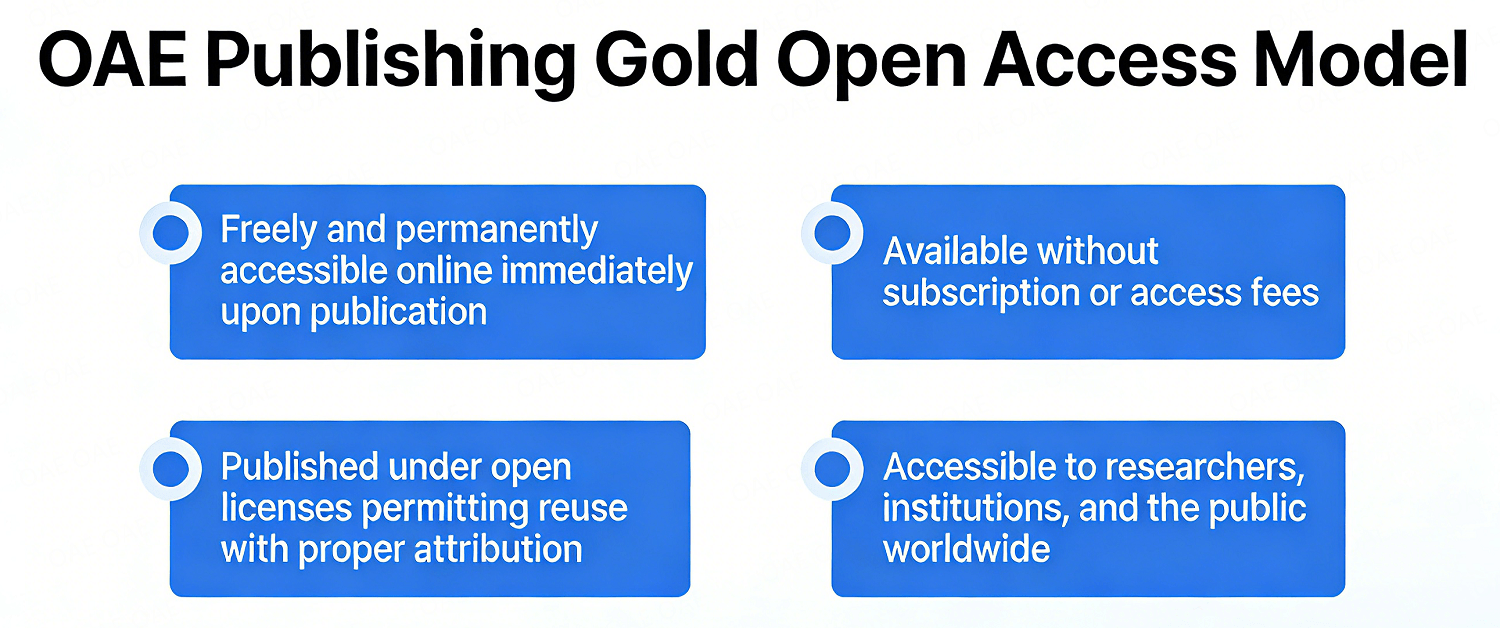
All articles published in OAE journals are:
- Freely and permanently accessible online immediately upon publication
- Available to all users without subscription or access fees
- Not subject to embargo periods or delayed access
- Accessible globally to researchers, institutions, policymakers, and the public
This ensures that research outputs can be accessed and used without restriction, regardless of geographic location or institutional affiliation.
Reuse and Redistribution Rights
In accordance with Open Access principles, OAE ensures that published content may be reused and redistributed under clearly defined licensing terms.
Users are permitted to:
- Read, download, copy, and share articles without restriction
- Distribute content in any medium or format
- Reuse content for research, educational, and scholarly purposes
- Build upon the work, provided appropriate attribution is given
Articles are typically published under a Creative Commons Attribution License (CC BY 4.0) or an equivalent open license, which allows for maximum dissemination and reuse.
All reuse must comply with the applicable license terms and include proper citation of the original source.
No Hybrid or Subscription Content
OAE is a fully open access publisher.
- All journals operate under a consistent Gold Open Access model
- No subscription-based or hybrid publishing options are offered
- No content is restricted behind paywalls or partial access systems
This ensures a transparent and uniform publishing model across the entire journal portfolio.
Benefits of Open Access
Publishing under an Open Access model provides significant advantages for authors while supporting the broader advancement of open science.
- Increased visibility and discoverability
- Higher potential for citation and academic impact
- Immediate global accessibility upon publication
- Compliance with funder and institutional Open Access mandates
- Broader dissemination beyond the academic community
By removing barriers to knowledge access, Open Access also facilitates faster dissemination of research, supports collaboration and innovation across disciplines, and promotes equitable access to scientific information worldwide.
OAE exists to support researchers by providing a publishing environment that is:
- Open and accessible
- Fair and rigorous
- Ethical and transparent
- Globally connected
We aim to serve the scientific community by enabling the rapid and responsible dissemination of knowledge, contributing to the advancement of research across disciplines.
4. Article Processing Charges
OAE is committed to full transparency across all stages of the publication process.
Our Open Access publishing model is supported by clearly defined policies covering Article Processing Charges (APCs), peer review, editorial and ethical standards, copyright and licensing, and long-term preservation.
These policies are designed to ensure clarity, consistency, and accountability for authors, reviewers, and readers.
Further details on APCs are available on the dedicated Fee Policy page.
5. Data Policies
5.1 Data Availability and Transparency
OAE is committed to advancing transparency, reproducibility, and integrity in scholarly communication. Authors are expected to ensure that all data underlying their research results are accurately described, appropriately documented, and made accessible where feasible.
OAE supports internationally recognized best practices in data sharing, including the FAIR principles (Findable, Accessible, Interoperable, and Reusable), to enhance the discoverability, transparency, and long-term value of research data.
In line with global publishing standards, data availability policies are designed to support verification of results while respecting ethical, legal, and privacy considerations.
5.2 Data Sharing
OAE encourages the responsible sharing of research data to facilitate verification, reproducibility, and reuse of published results.
Authors are expected to make the data underlying their studies available where appropriate and feasible. Specifically:
- A Data Availability Statement (DAS) must be included in all research articles
- Data should be deposited in recognized public or domain-specific repositories where suitable (e.g., Zenodo, Figshare, Dryad)
- Persistent identifiers (e.g., Digital Object Identifiers [DOIs]) should be provided for datasets where available
- Data should be sufficiently described and documented to enable interpretation and reuse
Where data sharing is not possible, authors must clearly state the reasons, such as ethical restrictions, privacy concerns, legal limitations, or third-party ownership.
OAE recognizes that data sharing requirements may vary by discipline and allows for flexibility where justified.
5.3 Data Availability Statement
All research articles must include a Data Availability Statement (DAS) describing the accessibility of the data supporting the reported results.
The statement should clearly specify:
- Where the data are available (e.g., repository name and link)
- What data are available
- How the data can be accessed
- Any conditions or restrictions on access
Authors may indicate one of the following conditions:
- Data are publicly available in a recognized repository
- Data are available from the corresponding author upon reasonable request
- Data are included within the article or supplementary materials
- Data are not publicly available due to ethical, legal, or confidentiality restrictions
5.4 Data Sharing for Clinical Research
For clinical research and clinical trials, OAE follows the recommendations of the International Committee of Medical Journal Editors (ICMJE) regarding data sharing.
Authors reporting clinical trials must:
- Include a data sharing statement in the manuscript
- Ensure that trial registration includes a data sharing plan (for applicable studies)
- Specify whether de-identified individual participant data will be shared
- Describe what data and supporting documents (e.g., protocol, statistical analysis plan) will be available
- Indicate when the data will be available and the duration of access
- Define access criteria (who can access the data, for what purpose, and by what mechanism)
These requirements reflect established international standards for clinical data transparency and are critical for compliance with biomedical indexing systems.
5.5 Ethical, Legal, and Privacy Considerations
All data must be handled in accordance with applicable ethical standards and legal regulations.
Authors must ensure that:
- Research involving human subjects has received appropriate ethical approval
- Informed consent has been obtained where required
- Personal and sensitive data are anonymized or de-identified prior to sharing
- Data sharing complies with relevant data protection regulations (e.g., General Data Protection Regulation [GDPR or equivalent frameworks)
Sensitive or identifiable information must not be disclosed unless explicit consent has been obtained.
5.6 Data Citation and Linking
OAE recognizes datasets as legitimate and citable research outputs.
Authors are expected to:
- Cite datasets in the reference list using standard citation formats
- Include persistent identifiers (e.g., DOI, accession number)
- Ensure that dataset citations are consistent with the Data Availability Statement
Proper data citation supports traceability, reproducibility, and integration with indexing systems.
5.7 Data Preservation and Archiving
OAE is committed to ensuring the long-term preservation, integrity, and accessibility of published scholarly content. To support this, OAE participates in Portico, a trusted non-profit digital preservation service operated by ITHAKA, which provides secure archiving and ensures continued access to content in the event of disruption.
Authors are strongly encouraged to deposit underlying research data in recognized, trusted repositories that:
- Support long-term preservation and sustainability
- Provide persistent identifiers (e.g., DOIs or accession numbers)
- Maintain standardized, high-quality metadata
- Enable reliable access and retrieval over time
Where appropriate, authors should select discipline-specific repositories that are widely recognized within their research community.
5.8 Editorial Oversight and Compliance
Editors and reviewers may assess the availability and adequacy of supporting data as part of the peer review and editorial process.
OAE reserves the right to:
- Request access to underlying data during editorial evaluation
- Require revision of Data Availability Statements where necessary
- Decline publication where data transparency requirements are not adequately met
5.9 Scope of the Policy
This policy applies to all research data associated with OAE-published articles, including but not limited to:
- Experimental data
- Clinical and medical datasets
- Survey and social science data
- Code and computational scripts
- Images, figures, and multimedia materials