


Volume 5, Issue 12 (2025) – 12 articles
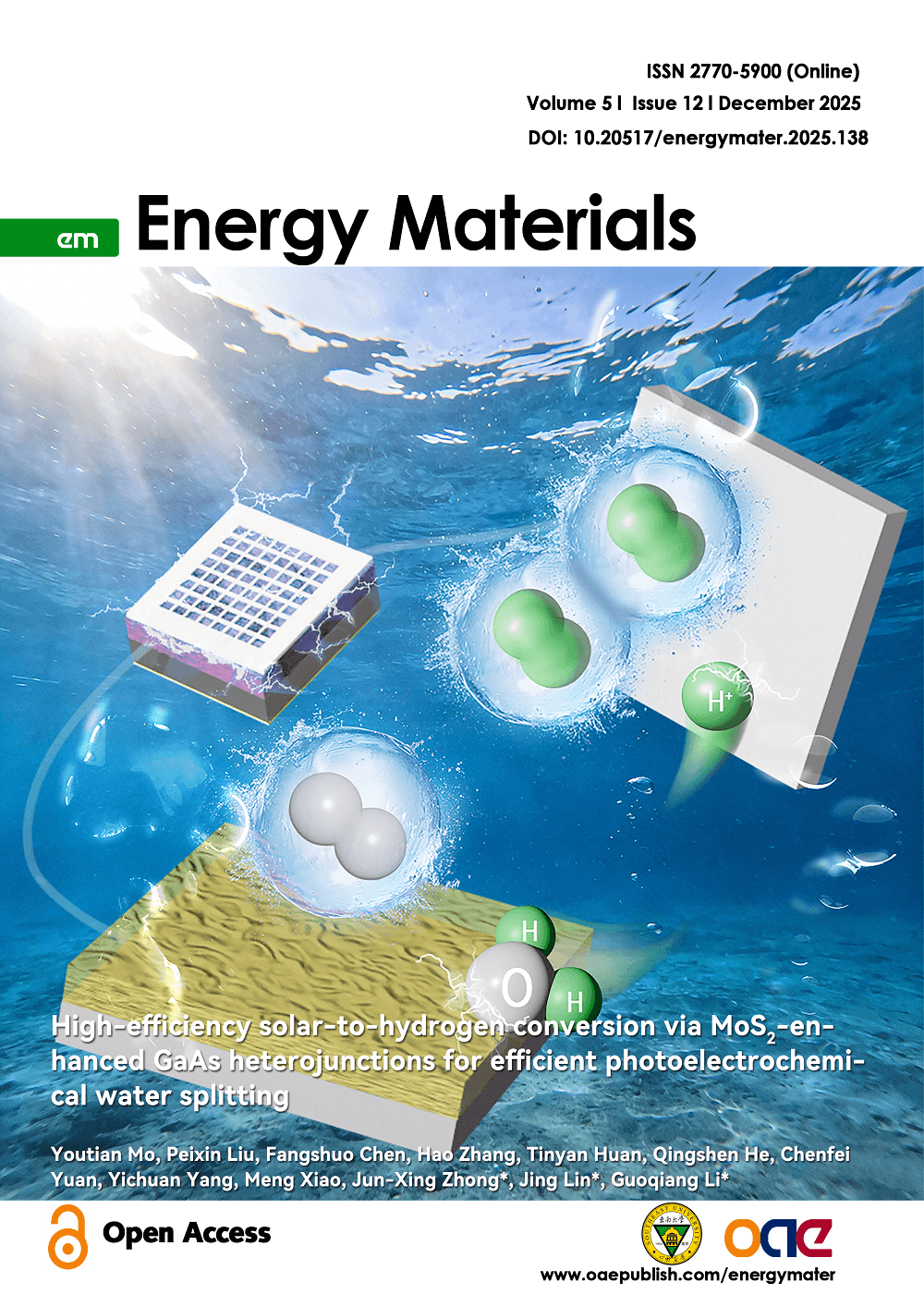
Gallium arsenide (GaAs) heterojunctions have been widely explored for their promising applications in solar cells (SCs) and photoelectrochemical (PEC) water splitting, owing to their cost-effective design and great potential for enhancing power conversion efficiency (PCE). In this study, an innovative MoS2 hole-transport layer was introduced into the GaAs heterojunction for applications in SCs and PEC water splitting. By optimizing the thickness of the MoS2 film, the sulfide oxidation reaction at the heterointerface was effectively suppressed. Significantly, a synergistic system integrating a GaAs heterojunction SC with a photoelectrode was proposed. The incorporation of carbon nanotubes into the GaAs/MoS2 heterojunction significantly improved charge carrier transport, enhancing the PCE from 0.24% to 12.41%. In the PEC water splitting system, the GaAs/MoS2 heterostructure also demonstrated excellent oxygen evolution reaction performance. This optimization led to a maximum applied bias photon-to-current efficiency of 35% under bias, reaching 20% at 0 V vs. reversible hydrogen electrode (RHE), along with a photocurrent density of 40 mA cm-2 and a solar-to-hydrogen conversion efficiency of 17.22%. When integrated into a photovoltaic-PEC system, the GaAs/MoS2 photoelectrode achieved a current density of 20 mA cm-2 at 0 V vs. RHE, with a 400 mV negative shift in the water oxidation onset potential, enabling highly efficient solar-driven hydrogen production.