
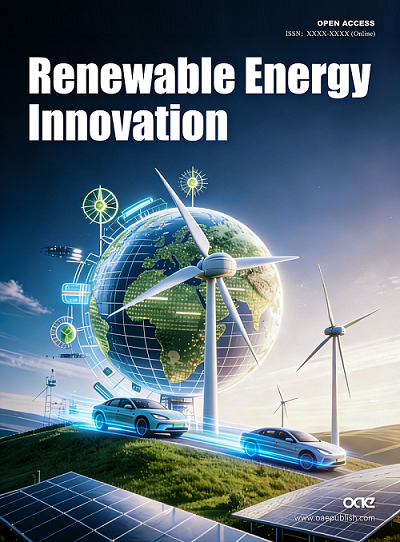
Aim & Scope
Renewable Energy Innovation (REI) aims to publish transformative, cross-disciplinary, and globally relevant research that accelerates the development and deployment of sustainable, carbon-neutral, net-zero, and next-generation energy technologies. The journal provides a platform for pioneering scientific advances, emerging innovations, and integrated solutions that contribute to global energy security, climate resilience, just energy transitions, and long-term environmental sustainability.
The scope of the journal spans fundamental science, applied research, engineering innovations, system integration, policy frameworks, and industrial translation, including but not limited to:
• Advanced Renewable Energy Technologies: Solar energy systems including photovoltaics (crystalline silicon, thin-film, perovskite, tandem, bifacial), PV/T systems, solar thermal systems, and building-integrated PV; wind energy conversion (both onshore and offshore, including floating concepts and next-generation turbine designs); hydropower; geothermal systems (power generation as well as heating and cooling); bioenergy (biofuels, biogas, biorefineries, and waste-to-energy systems within a circular economy framework); ocean/marine energy (tidal, wave, OTEC); hybrid and integrated multi-source renewable systems and distributed energy resources (DERs).
• Next-Generation Materials and Catalysts: Novel semiconductors, nanomaterials, energy-harvesting materials, electrocatalysts, photocatalysts, and biocatalysts for improved efficiency, durability, and stability in renewable energy conversion and storage systems.
• Hydrogen and Clean Fuels: Green hydrogen production, power-to-X pathways, solar fuels, electrosynthesis, biomass-to-fuels routes, CO₂ conversion, ammonia energy systems, e-fuels and synthetic fuels for carbon-neutral transport and industry.
• Energy Storage and Conversion: Battery energy storage systems (BESS), advanced batteries, supercapacitors, fuel cells, thermal energy storage (sensible, latent, and thermochemical), mechanical storage, redox flow systems, and integrated storage solutions for grid-scale, off-grid, and sector-coupled applications.
• Smart Grids, Microgrids, Energy Systems and Sector Coupling: Grid integration of high shares of renewables, energy management, demand-response systems, smart grids and microgrids, distributed energy resources (DERs), vehicle-to-grid (V2G), peer-to-peer energy trading, and digital energy technologies. Sector coupling between electricity, heating/cooling, transport, water, and industry (for example, renewable-driven desalination or process heat) and planning of net-zero energy systems and decarbonization pathways.
• Data, Intelligence, and Optimization: Artificial intelligence, machine learning, and deep learning for forecasting, control, diagnostics, and optimization of renewable energy systems. Digital twins, multi-objective optimization, uncertainty analysis, and robust design methods. Big-data analytics, IoT-enabled monitoring and control, and cyber-physical energy systems. Open datasets, models, and software tools that support transparent and reproducible research.
• Sustainable Energy Infrastructure: Decarbonized transport, renewable-powered industries, building-integrated energy systems, smart and nearly zero-energy buildings, and circular energy technologies that support net-zero and climate-resilient development.
• Modeling, Simulation, and Data-Driven Approaches: Computational materials design, techno-economic analysis, life-cycle assessment, multi-scale and multi-physics modeling, and system modeling for energy research, planning, and optimization of low-carbon and net-zero pathways.
• Environmental, Economic, Social and Policy Dimensions: Carbon neutrality and decarbonization pathways, environmental impact assessment, energy and climate policy, regulatory frameworks, market design, and financing mechanisms that support large-scale deployment of renewables and the societal implications of clean-energy transitions. Energy access, energy justice, energy poverty, off-grid and community-based energy solutions, particularly in the Global South. Energy security, climate resilience, and integration of renewables into national and regional energy strategies.
• Industry Innovations and Technology Deployment: Pilot-scale demonstrations, commercialization pathways, industrial best practices, and real-world energy solutions, including case studies from utilities, industry and cities that showcase successful deployment of innovative renewable energy technologies.
The journal welcomes original research articles, reviews, perspectives, short communications, and technical reports that advance scientific understanding, enable technology breakthroughs, and offer impactful solutions for a sustainable, low-carbon, and net-zero energy future.