
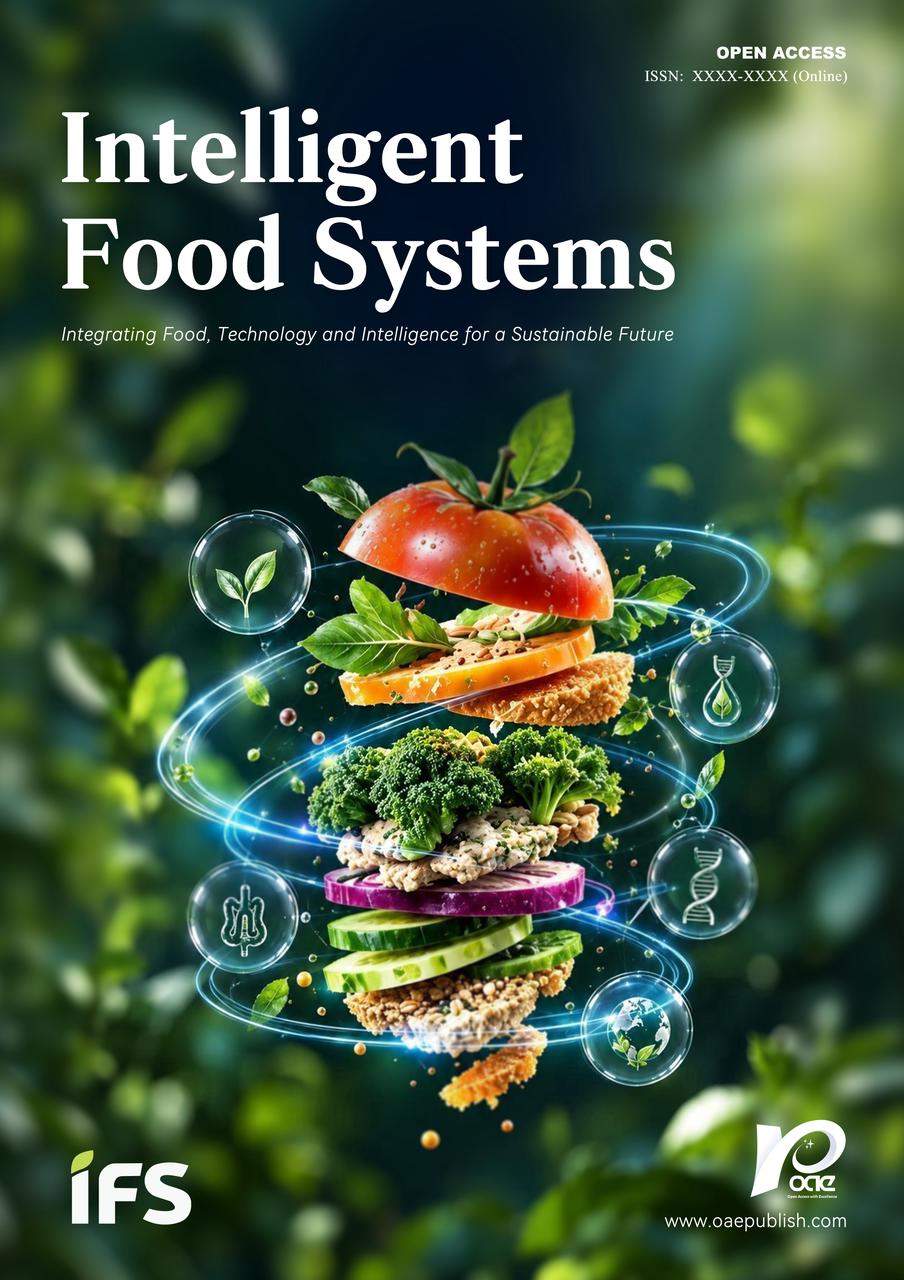
Intelligent Food Systems is an international, peer-reviewed, open-access journal dedicated to advancing the science and technology of iontronics, an emerging field at the intersection of materials science, electrochemistry, soft electronics, and bioinspired systems. By focusing on the unique role of ions as charge and mass carriers, the journal provides a high-impact platform for pioneering research that drives innovations in information processing, energy conversion, signal transduction, and intelligent control.
Aims and Scope
Aims
Intelligent Food Systems is an international, peer-reviewed journal dedicated to advancing the integration of artificial intelligence, data science, and intelligent technologies across the entire food system. The journal addresses a critical gap: while AI has transformed fields such as drug discovery and autonomous systems, its application to food science remains fragmented, often confined to narrow tasks like sensory prediction or adulteration detection, without addressing the fundamental challenges of data scarcity, multimodal complexity, and cross-disciplinary translation that characterize food systems research.
The journal's central premise is that the challenges confronting modern food systems - sustainability, food security, nutritional equity, and supply chain resilience - are fundamentally problems of complexity and uncertainty. These are precisely the domains where intelligent systems can offer transformative solutions. Intelligent Food Systems provides a dedicated forum for research that bridges food science, engineering, and computational intelligence, moving beyond isolated AI applications toward integrated, adaptive, and intelligence-driven food systems.
The revised positioning further emphasizes system-level intelligence and emerging directions such as multimodal intelligence, foundation models, generative and agentic AI, digital twins, intelligent robotics, and autonomous food systems, with the aim of advancing from data analysis and prediction toward intelligent decision-making, adaptation, and autonomous optimization.
Scope
The journal welcomes original research, reviews, and perspectives that advance the science, technologies, and applications of intelligent food systems. Contributions may span the entire food system and should demonstrate how intelligent and computational approaches can deepen scientific understanding, enable intelligent decision-making, or support the development of integrated, adaptive, and autonomous food systems.
Topics include, but are not limited to, the following areas:
- Intelligent food discovery and design: AI- and data-driven discovery and design of food ingredients, formulations, structures, and functional components; predictive modeling of food matrices; and high-throughput screening of bioactive compounds and peptides.
- Intelligent sensing, data, quality, and safety: Intelligent sensing, computer vision, spectroscopy, electronic nose and tongue systems, multimodal data integration, knowledge systems, and AI-enabled approaches for food quality, safety, authenticity, composition, and process monitoring.
- Smart manufacturing and autonomous food systems: Digital twins, intelligent process modeling, real-time optimization, adaptive control, robotics, foundation models, generative AI, agentic AI, human-in-the-loop systems, and autonomous operation of food production and processing systems.
- Supply chain and system intelligence: AI, IoT, blockchain, predictive analytics, and intelligent decision-making for traceability, logistics, demand forecasting, waste reduction, resource optimization, and supply chain resilience.
- Personalized nutrition and consumer intelligence: AI-driven dietary recommendations, personalized nutrition, digital phenotyping, consumer behavior modeling, and data-driven understanding of food preferences and health-related outcomes.
- Responsible and human-centered intelligence: Explainability, robustness, safety, data privacy, algorithmic bias, governance, regulation, and human–AI collaboration in food systems.
Article Types
The journal publishes Research Article, Reviews, Perspectives, etc. Reviews should provide in-depth interpretive coverage of narrowly defined topics with critical evaluation of existing literature. Perspectives should offer forward-looking analyses of emerging areas or controversial issues.
Audience
Intelligent Food Systems serves researchers, engineers, and practitioners at the intersection of food science, artificial intelligence, data science, and food engineering. The journal is committed to international and interdisciplinary representation, encouraging contributions that bridge methodological innovation with real-world food system challenges.
Ownership
The journal is owned by OAE Publishing Inc.
Publishing Model
Gold Open Access. All articles published by Intelligent Food Systems are made freely and permanently accessible online immediately from the date of publication. For further information, please refer to Open Access.
Copyright and License to Publish
Articles in Intelligent Food Systems are published under a Creative Commons Attribution 4.0 International (CC BY 4.0). The CC BY 4.0 allows for maximum dissemination and re-use of open access materials and is preferred by many research funding bodies. Under this license users are free to share (copy, distribute and transmit) and remix (adapt) the contribution for any purposes, even commercially, provided that the users appropriately acknowledge the original authors and the source.
Copyright is retained by authors. Authors are required to sign a License to Publish (which can be downloaded from the journal's Author Instructions), granting Iontronics, which identifies itself as the original publisher, exclusive rights to publish their articles, and granting any third party the right to use the articles freely as long as the integrity is maintained and the original authors, citation details and publisher are identified.
Editors and Editorial Board
For more information about the editorial team, please refer to Editorial Board.
Editorial Policies
All manuscripts submitted to Intelligent Food Systems should adhere to journal's Editorial Policies.
Peer Review
The journal adheres to rigorous peer review and undergoes double-blind peer review. For more details, please refer to Editorial Process.
Publication Ethics Statement
Intelligent Food Systems fully adheres to the Code of Conduct and the Best Practice Guidelines of Committee on Publication Ethics (COPE).
The Editors of this journal enforce a rigorous peer-review process together with strict ethical policies and standards to guarantee to add high quality scientific works to the field of scholarly publication. Unfortunately, cases of plagiarism, data falsification, image manipulation, inappropriate authorship credit, and the like, do arise. The Editors of Intelligent Food Systems take such publishing ethics issues very seriously and are trained to proceed in such cases with a zero tolerance policy. To verify the originality of content submitted to our journals, we use CrossCheck (powered by iThenticate) to check submissions against previous publications.
Journal Information and Statistics
- Publication model: Gold Open Access
- Frequency: Quarterly published
- Digital archive: Portico
Indexing & Archiving
All articles published in Intelligent Food Systems are included in:
Lens
Contact
Please visit Contact Us for details about different queries.