




Development and future directions of eutectic high-entropy alloys
 0
0 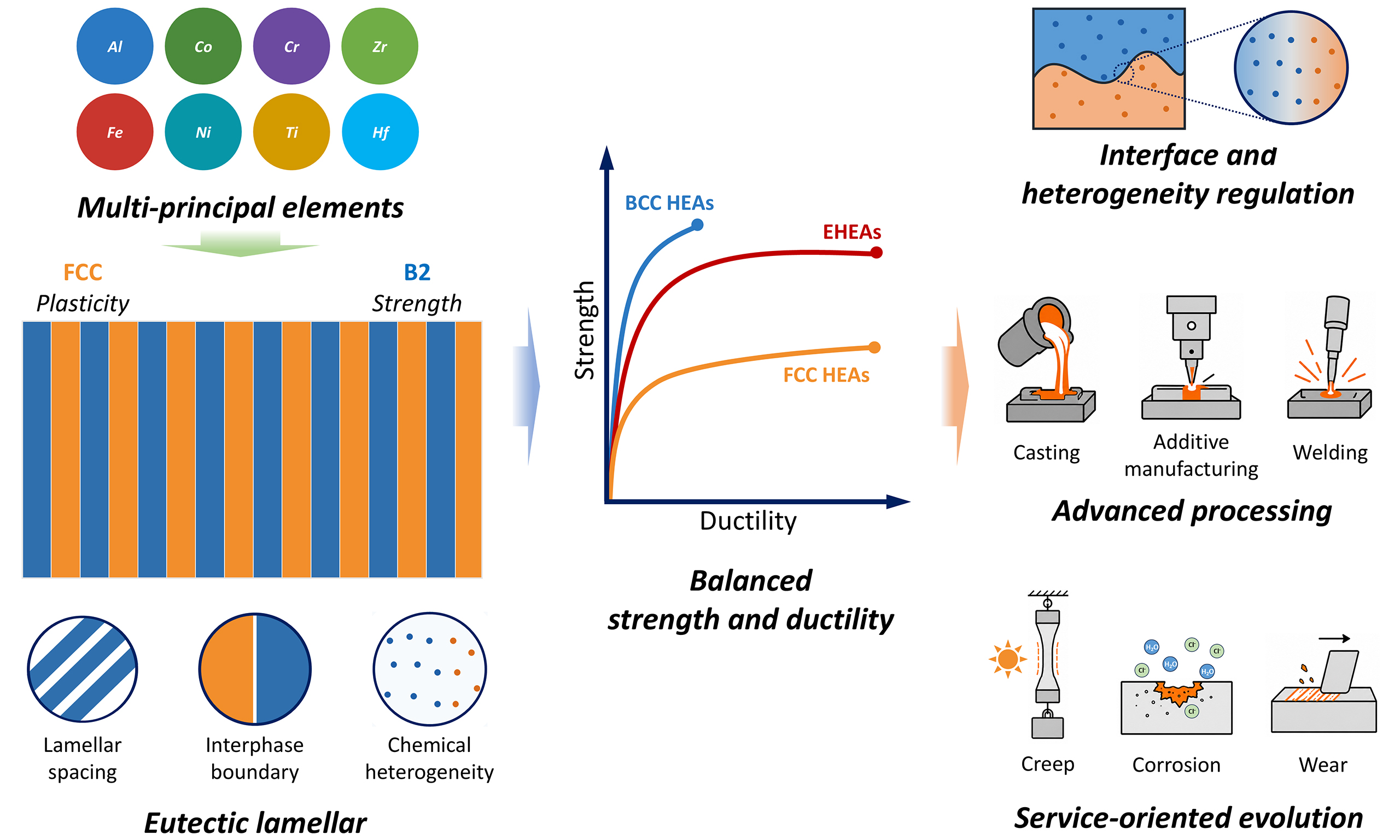
ORIGINS AND DEFINING FEATURES OF EHEAS
Eutectic high-entropy alloys (EHEAs) were proposed in 2014 as an alloy design approach that combines multi-principal-element chemistry with eutectic solidification [Figure 1A][1]. Their development was driven by the need for high-entropy alloys with improved casting behavior and more balanced mechanical properties. By introducing eutectic solidification into multi-principal-element systems, this approach enables directly cast dual-phase alloys with refined microstructures, reduced segregation tendency, and complementary phase functions. This is relevant because, in typical face-centered cubic (FCC)/B2 EHEAs, the FCC phase accommodates plastic deformation, whereas the ordered B2 phase contributes to strengthening and load bearing; their coupled eutectic microstructure further promotes strain partitioning and interphase constraint. The representative AlCoCrFeNi2.1 alloy demonstrated that a multi-principal alloy can solidify into a fine FCC/B2 lamellar microstructure and retain a balanced combination of strength and ductility, with a tensile strength of 944 MPa and an elongation of 25.6% at room temperature, as well as stable mechanical performance up to 700 °C[2-5]. The results showed that eutectic solidification can provide a useful route for developing heterogeneous microstructures and improving casting characteristics in high-entropy alloys.
Subsequent work clarified why this alloy class attracted sustained attention. Detailed microstructural analysis of AlCoCrFeNi2.1 showed that its performance originates from the cooperative action of a dual-phase lamellar architecture, phase contrast, and interphase boundaries, rather than from compositional complexity alone[2]. In parallel, directly cast eutectic and near-eutectic alloys were shown to retain balanced strength and ductility over a comparatively broad compositional and temperature window, indicating that the useful design space is wider than a single nominal eutectic point[6]. These findings shifted the field from proof of concept to metallurgical understanding. They showed that EHEAs are not merely “HEAs with a eutectic morphology”, but a class of alloys in which the solidification pathway, phase constitution, and deformation partitioning can be co-designed.
MICROSTRUCTURAL REGULATION AND PROPERTY OPTIMIZATION
Over the past decade, the field has advanced from feasibility to tunability. Several studies have demonstrated that the performance of EHEAs can be further improved by tuning heterogeneity across multiple scales [Figure 1B]. Directionally solidified herringbone architectures have shown that hierarchical crack buffering can markedly improve elongation without sacrificing high strength[7]. Phase-selective recrystallization has provided a route to fully exploit the strain-hardening capacity of the constituent phases, leading to unusually high uniform elongation at very high true stress[8]. Thermomechanical refinement of the inherited eutectic architecture has been used to produce ultrafine heterostructures with enhanced strength-ductility synergy[9,10]. More recently, the optimization of chemical and microstructural heterogeneities has been shown to alleviate the classical strength-ductility trade-off[11]. These advances indicate that EHEAs should now be understood as tunable heterostructural materials, not simply as-cast eutectic alloys.
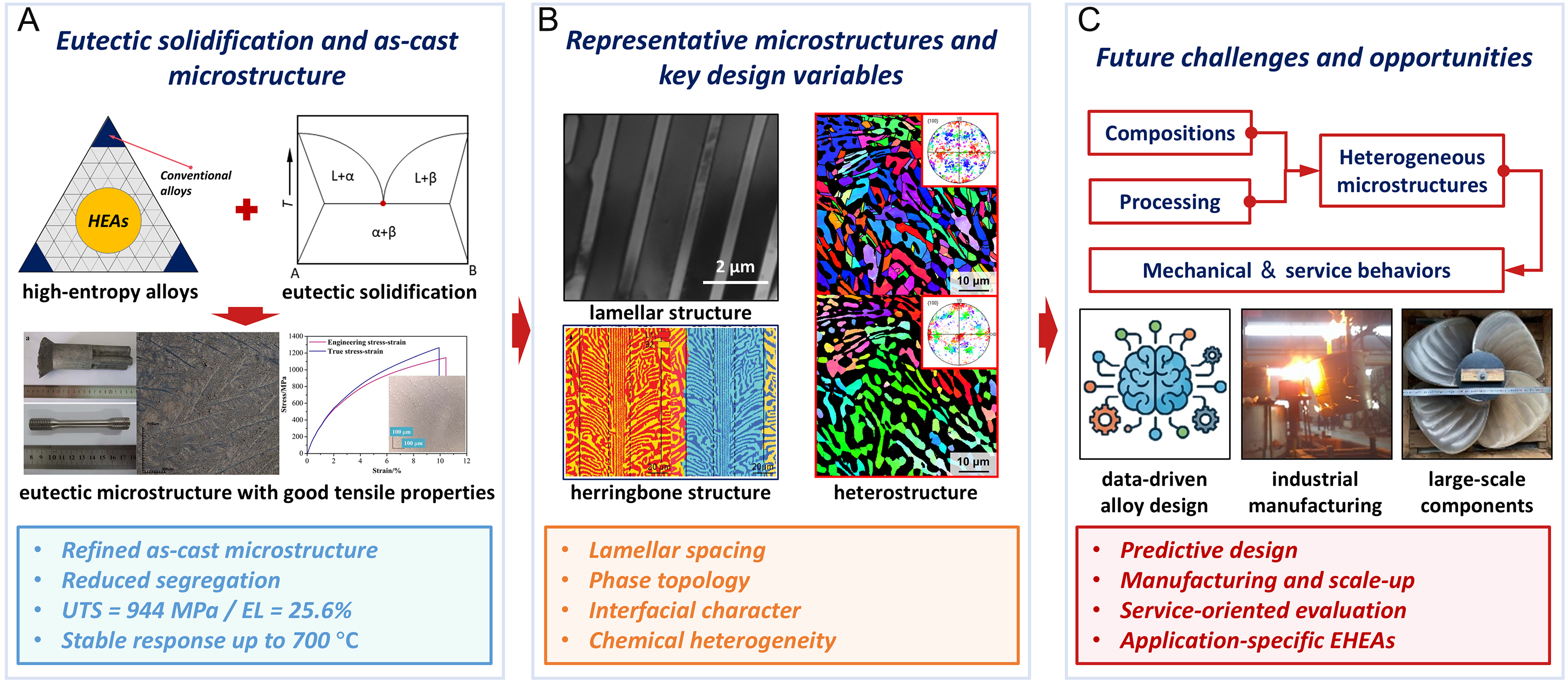
Figure 1. Conceptual development of eutectic high-entropy alloys (EHEAs). (A) Eutectic solidification and representative characteristics of the as-cast microstructure. (B) Representative lamellar, directionally solidified herringbone, and processed heterogeneous microstructures, together with the principal microstructural variables for property regulation. (C) Future directions involving predictive design, manufacturing and scale-up, service evaluation, and application-specific EHEAs. The as-cast lamellar micrograph in (A) was obtained by the authors. The directionally solidified herringbone micrograph in (B) is adapted from Ref.[7] with permission from AAAS. The phase-selectively recrystallized micrograph in (B) is adapted from Ref.[8] under CC BY 4.0; the original image was cropped, resized, and incorporated into the present composite figure. The two photographs in (C) showing industrial manufacturing and a large-scale component were taken by the authors.
This transition shifts EHEA development from composition-centered screening to microstructure-oriented design. In addition to nominal composition, lamellar spacing, phase topology, interface cohesion, local ordering, recrystallization path, and strain partitioning become key design variables. Lamellar spacing affects phase-boundary density, dislocation storage, and load transfer; phase topology influences strain partitioning and crack deflection; interface characteristics affect dislocation transmission, damage initiation, and thermal stability. The significance of EHEAs lies not only in a few representative compositions, but also in showing that compositional complexity can be combined with controlled heterogeneous microstructures. The rapid expansion of the EHEA literature also reflects sustained interest in this field. Recent reviews have also extended EHEA research from bulk mechanical properties to processing-related topics, including welding, surface engineering, and additive manufacturing[12,13]. This broader scope indicates that the development of EHEAs is increasingly linked to processing compatibility and service conditions, in addition to mechanical performance. At the same time, broader engineering application still requires further evaluation of large-scale processing reproducibility, corrosion and oxidation resistance, joining reliability, and long-term service performance.
FUTURE CHALLENGES AND OPPORTUNITIES
Despite substantial progress, the design of EHEAs remains largely empirical. Current understanding is concentrated in a limited number of alloy families, and reliable criteria for predicting eutectic composition ranges, phase topology, and interface stability are still lacking. The transferability of design principles across different chemistries and processing conditions therefore remains to be established. The next stage of EHEA research should therefore be guided by three priorities [Figure 1C]. One is interface-centered design. Since phase boundaries are the key microstructural features in EHEAs, their chemistry, cohesion, and local deformation compatibility should become primary design targets. A second is process-integrated alloy development, in which solidification control, thermomechanical treatment, and non-equilibrium manufacturing routes should be considered together. This direction also requires attention to melt homogeneity, phase-fraction control, cooling-rate sensitivity, casting defects, joining reliability, and microstructural reproducibility in large components. A third is service-oriented evaluation. Application-specific subclasses of EHEAs, designed for cryogenic strength, elevated-temperature stability, wear resistance, or corrosion tolerance, are likely to be more useful than attempts to identify one universally optimal alloy. Cost-performance balance should also be considered together with density, raw-material availability, and the use of high-cost elements such as Co, Mo, W, Hf, or Ta. In this sense, the next decade should focus less on extending the list of available compositions and more on establishing robust composition-process-microstructure-property relationships. For additive manufacturing, laser powder bed fusion may be useful for fine eutectic or near-eutectic microstructures in small complex components, whereas directed energy deposition and wire-arc additive manufacturing may be more relevant to large components, repair, and coating applications. For cryogenic service, tensile behavior, fracture resistance, and fatigue response should be prioritized; for elevated-temperature service, phase stability, oxidation resistance, creep, and creep-fatigue interaction deserve greater attention.
The first decade of EHEA research has shown that eutectic design provides a useful route for developing structurally relevant high-entropy alloys. A key question for the next stage is whether EHEAs can be developed into predictive and application-relevant alloy systems. Progress toward this goal will depend on how effectively physical metallurgy is linked with eutectic growth, heterostructure control, interface stability, processing compatibility, and service reliability. If these aspects are integrated, EHEAs may provide a framework in which compositional complexity and engineering manufacturability are considered together.
DECLARATIONS
Authors’ contributions
Manuscript drafting: Jia, Y.
Conceptualization and manuscript drafting: Lu, Y.
Availability of data and materials
Not applicable.
AI and AI-assisted tools statement
During the preparation of this manuscript, Grammarly (version 1.2.271.1909, released 2026-06-22) was used solely for language editing. The tool did not influence the study design, data collection, analysis, interpretation, or the scientific content of the work. All authors take full responsibility for the accuracy, integrity, and final content of the manuscript.
Financial support and sponsorship
This work was supported by the National Natural Science Foundation of China (Nos. U2341261 and 52501003).
Conflicts of interest
Both authors declared that there are no conflicts of interest.
Ethical approval and consent to participate
Not applicable.
Consent for publication
Not applicable.
Copyright
© The Author(s) 2026.
REFERENCES
1. Lu, Y.; Dong, Y.; Guo, S.; et al. A promising new class of high-temperature alloys: eutectic high-entropy alloys. Sci. Rep. 2014, 4, 6200.
2. Gao, X.; Lu, Y.; Zhang, B.; et al. Microstructural origins of high strength and high ductility in an AlCoCrFeNi2.1 eutectic high-entropy alloy. Acta. Mater. 2017, 141, 59-66.
3. Oliveira, P. H. F.; Mancilha, P. H. S.; Reyes, R. A. V.; et al. Influence of the cooling rate on the solidification path and microstructure of a AlCoCrFeNi2.1 alloy. Mater. Charact. 2023, 203, 113121.
4. Guo, Y.; Su, H.; Zhou, H.; et al. Unique strength-ductility balance of AlCoCrFeNi2.1 eutectic high entropy alloy with ultra-fine duplex microstructure prepared by selective laser melting. J. Mater. Sci. Technol. 2022, 111, 298-306.
5. Liu, S.; Kaban, V.; Witusiewicz, V. T.; Kaban, I. In situ synchrotron X-ray diffraction revealing competition between A1 and B2 phases in AlCoCrFeNi high-entropy alloys. Acta. Mater. 2026, 309, 122097.
6. Lu, Y.; Gao, X.; Jiang, L.; et al. Directly cast bulk eutectic and near-eutectic high entropy alloys with balanced strength and ductility in a wide temperature range. Acta. Mater. 2017, 124, 143-50.
7. Shi, P.; Li, R.; Li, Y.; et al. Hierarchical crack buffering triples ductility in eutectic herringbone high-entropy alloys. Science 2021, 373, 912-8.
8. Wu, Q.; He, F.; Li, J.; Kim, H. S.; Wang, Z.; Wang, J. Phase-selective recrystallization makes eutectic high-entropy alloys ultra-ductile. Nat. Commun. 2022, 13, 4697.
9. Wani, I. S.; Bhattacharjee, T.; Sheikh, S.; et al. Ultrafine-grained AlCoCrFeNi2.1 eutectic high-entropy alloy. Mater. Res. Lett. 2016, 4, 174-9.
10. Shi, P.; Zhong, Y.; Li, Y.; et al. Multistage work hardening assisted by multi-type twinning in ultrafine-grained heterostructural eutectic high-entropy alloys. Mater. Today. 2020, 41, 62-71.
11. Sun, Y.; Wang, C.; Ren, C.; et al. Multiscale chemical ordering heterogeneity facilitates exceptional strength and ductility in additively manufactured Ti-added AlCoCrFeNi2.1 high-entropy alloys at intermediate temperatures. Int. J. Plast. 2025, 190, 104373.
12. Chang, I.; Cai, Q. From simple binary to complex multicomponent eutectic alloys. Prog. Mater. Sci. 2022, 123, 100779.
Cite This Article
 Open Access
How to Cite
Download Citation
Export Citation File:
Type of Import
Tips on Downloading Citation
Citation Manager File Format
Type of Import
Direct Import: When the Direct Import option is selected (the default state), a dialogue box will give you the option to Save or Open the downloaded citation data. Choosing Open will either launch your citation manager or give you a choice of applications with which to use the metadata. The Save option saves the file locally for later use.
Indirect Import: When the Indirect Import option is selected, the metadata is displayed and may be copied and pasted as needed.
About This Article
Copyright

Data & Comments
Data
0







Comments
Comments must be written in English. Spam, offensive content, impersonation, and private information will not be permitted. If any comment is reported and identified as inappropriate content by OAE staff, the comment will be removed without notice. If you have any queries or need any help, please contact us at support@oaepublish.com.