




Rational design of biochar for carbon dioxide capture and catalytic conversion
 0
0 Abstract
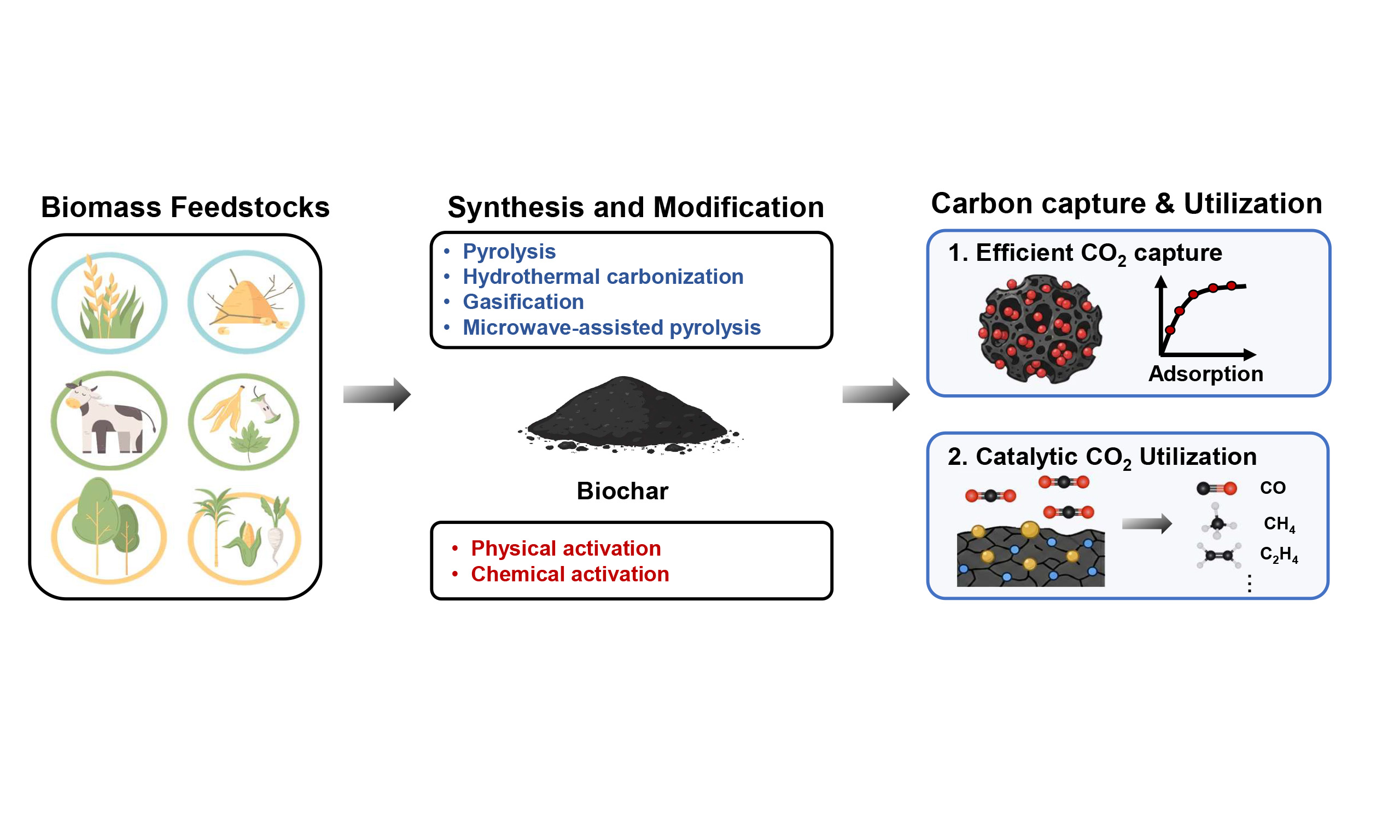
The continuous increase in carbon dioxide (CO2) emissions has intensified the need for efficient carbon capture and utilization (CCU) technologies. Biochar has emerged as a promising, cost-effective, and sustainable platform for CCU. This review provides a comprehensive overview of the rational design of biochar for CO2 capture and subsequent catalytic conversion. We first discuss various synthesis methods and activation strategies for tailoring the physicochemical properties of biochar. We then elucidate the mechanisms of CO2 capture, highlighting the roles of pore modification and heteroatom functionalities in enhancing both physisorption and chemisorption. Furthermore, the roles of biochar in thermocatalytic, electrocatalytic, and photocatalytic CO2 conversion are critically examined, with particular emphasis on its function as a multifunctional support for metal nanoparticles, molecular catalysts, single atoms, and nanoclusters. Finally, we outline key challenges and future directions for the rational development of next-generation biochar toward practical carbon-neutral technologies. Accordingly, this review establishes a rational design framework based on application demand, key performance parameters, and targeted synthesis strategies, thereby linking practical CCU requirements with the controlled engineering of biochar porosity, surface chemistry, conductivity, and catalytic functionality.
Keywords
INTRODUCTION
The intensifying environmental pollution caused by excessive fossil fuel consumption, together with the growing global energy demand, poses a critical challenge to modern society[1]. Addressing these issues requires the urgent development of efficient and sustainable technologies to reduce carbon emissions and meet future energy demands. In this context, carbon capture and utilization (CCU) has gained significant attention as an integrated strategy that not only captures carbon dioxide (CO2) from emission sources but also converts it into value-added chemicals and fuels, thereby contributing to climate change mitigation and resource circularity[2-5].
However, the high cost associated with the CO2 capture stage remains one of the major barriers to the practical implementation of CCU technologies[6,7]. Therefore, the development of efficient and economically viable CO2 sorbent materials is of critical importance. Over the past several decades, a variety of materials, including zeolites[8,9], mesoporous carbons[10], and activated carbons[11], have been extensively explored as CO2 adsorbents. Although these materials often exhibit promising adsorption capacities, many suffer from inherent drawbacks, such as high production costs, reliance on non-renewable precursors, and diminished performance under humid conditions or in the presence of competing gases[12]. These limitations significantly restrict their large-scale application. Consequently, there is growing demand for alternative adsorbent materials that are cost-effective, sustainable, and compatible with circular resource utilization principles.
Biomass has emerged as an abundant and renewable carbon source originating from agricultural residues, forestry by-products, livestock waste, and municipal solid waste streams[13-15]. Compared with conventional carbon precursors, biomass offers inherent sustainability, broad accessibility, economic feasibility, and a reduced environmental footprint[16-19]. These characteristics make it an attractive feedstock for the preparation of next-generation sustainable carbon materials. Among various biomass-derived products, biochar is a carbon-rich solid material derived from abundant biomass resources and has recently attracted considerable attention as a viable alternative for CO2 capture[20,21]. Owing to its controllable pore structure, large surface area, and modifiable surface functionalities, biochar demonstrates considerable potential for CO2 adsorption[22,23]. Moreover, biochar can be synthesized from diverse biomass feedstocks and waste resources, making it a sustainable material from the perspectives of resource recovery and carbon emission mitigation[24]. Its comparatively low manufacturing cost relative to conventional CO2 adsorbents further strengthens its economic competitiveness and practical appeal.
Building on these advantages, recent studies have increasingly focused on tailoring the structural and chemical characteristics of biochar to extend its functionality beyond CO2 adsorption toward catalytic conversion and electrochemical energy storage and conversion applications. A variety of high-value biochar-based carbon materials derived from diverse biomass sources have been reported, demonstrating their potential as multifunctional platforms capable of integrating CO2 capture and conversion within CCU systems[25-27]. Therefore, a comprehensive understanding of how precursor selection, preparation strategies, and structural characteristics govern the performance of biomass-derived biochar is essential for advancing its practical implementation in CCU technologies.
In this review, we first introduce the major synthesis approaches for biomass-derived biochar and examine how different processing conditions influence its structural and physicochemical properties. We then discuss recent advances in biochar-based CO2 capture, with particular emphasis on physisorption and chemisorption mechanisms and the key parameters governing capture performance. Subsequently, biochar-enabled carbon-utilization pathways, including thermocatalytic conversion, electrochemical CO2 reduction, and photocatalytic processes, are critically reviewed. Finally, the current state of the art, remaining challenges, and future research directions are discussed, with particular emphasis on AI-assisted materials discovery and Integrated Carbon Capture and Utilization (ICCU) systems.
To establish a comprehensive design approach, this review connects practical application needs with critical material performance targets and corresponding synthesis strategies. For CO2 capture, practical demands such as high adsorption capacity, selectivity, rapid adsorption kinetics, moisture tolerance, and low regeneration energy are translated into key structural and chemical parameters, including microporosity, pore connectivity, surface basicity, hydrophobicity, and functional-group density. For catalytic CO2 conversion, the principal design criteria include electrical conductivity, active-site accessibility, interfacial coupling, mass transport, and long-term stability. These performance requirements subsequently guide the selection of biomass precursors, pyrolysis conditions, activation methods, pore-engineering approaches, heteroatom-doping strategies, and catalyst-immobilization techniques. Through this systematic design strategy, biochar synthesis is regarded not merely as a material preparation process, but as a targeted engineering approach tailored to the requirements of specific CCU applications.
BIOCHAR SYNTHESIS METHODS
Biochar is a porous carbon-rich material obtained through the thermochemical conversion of biomass under oxygen-deficient environments. Biochar can be synthesized through various routes, including pyrolysis[28-30], hydrothermal carbonization (HTC)[31,32], gasification[33], and microwave-assisted processes (MAP)[34,35], frequently followed by activation steps to further tailor its structure and surface properties[36-39]. The structural and physicochemical properties of biochar are highly dependent on the selected synthesis strategy, and the intrinsic composition of the biomass precursor. These factors collectively determine key properties such as specific surface area, pore architecture, surface functional groups, and electronic characteristics, which ultimately govern its performance in CCU applications. As summarized in Table 1, each preparation route exhibits distinct characteristics in terms of operating conditions, product yield, structural features, advantages, and limitations. Therefore, the selection of an appropriate synthesis route should be guided by the desired structural properties and performance requirements of the resulting biochar. In the following section, the principal synthesis approaches for biochar are outlined.
Comparison of representative biochar preparation methods
| Method | Operating conditions | Product yield | Biochar characteristics | Advantages | Disadvantages | Ref. |
| Pyrolysis | 300-1,200 °C under inert atmospheres | Relatively high, particularly under slow-pyrolysis conditions | High surface areas, aromatic carbon-rich | Simple preparation process, Tunable through temperature, heating rate, and residence time, low-cost | High energy consumption (fast pyrolysis) | [28] |
| Hydrothermal carbonization | 180-250 °C | Moderate | Abundant oxygen-containing functional groups | Low energy consumption | High liquid byproducts | [31] |
| Gasification | 500-1,400 °C | Low | Various porosity,High ash content | High gas yield, High efficiency | Low biochar yield, high ash content | [33] |
| Microwave-assisted Pyrolysis | Microwave powers of 300-3,000 W, under inert atmospheres | Moderate | Uniform structure, High porosity, High specific surface area | Fast preparation speed Uniform internal heating High energy efficiency | High equipment requirements | [34] |
Pyrolysis
Pyrolysis is the most employed route for biochar production, involving the thermal decomposition of biomass in an oxygen-limited atmosphere at elevated temperatures, typically between 300 and 900 °C, and in some cases up to 1,200 °C [Figure 1A][40]. Depending on operational parameters such as heating rate and vapor residence time, pyrolysis can be categorized into slow, fast, and flash modes. Among these, slow pyrolysis is particularly favorable for biochar generation, as it enables efficient volatilization of organic compounds while maximizing solid carbon yield[41]. For this reason, most biochar synthesis processes are conducted via slow pyrolysis under inert gas environments such as nitrogen (N2) or argon[42,43]. The resulting biochar yield and properties are highly sensitive to processing conditions. At relatively lower temperatures (300-500 °C), the produced biochar tends to retain abundant oxygen-containing functional groups, including hydroxyl and carboxyl functionalities. In contrast, increasing the temperature above 700 °C and prolonging the residence time promote aromatic condensation and partial graphitization, thereby enhancing electrical conductivity and pore development while reducing the heteroatom content[44,45]. Moreover, heating rate and reaction duration significantly affect carbon microstructure and porosity evolution. Slow pyrolysis generally leads to higher carbon yields and more structurally ordered frameworks, whereas fast pyrolysis typically produces defect-rich and less ordered carbon structures[46].
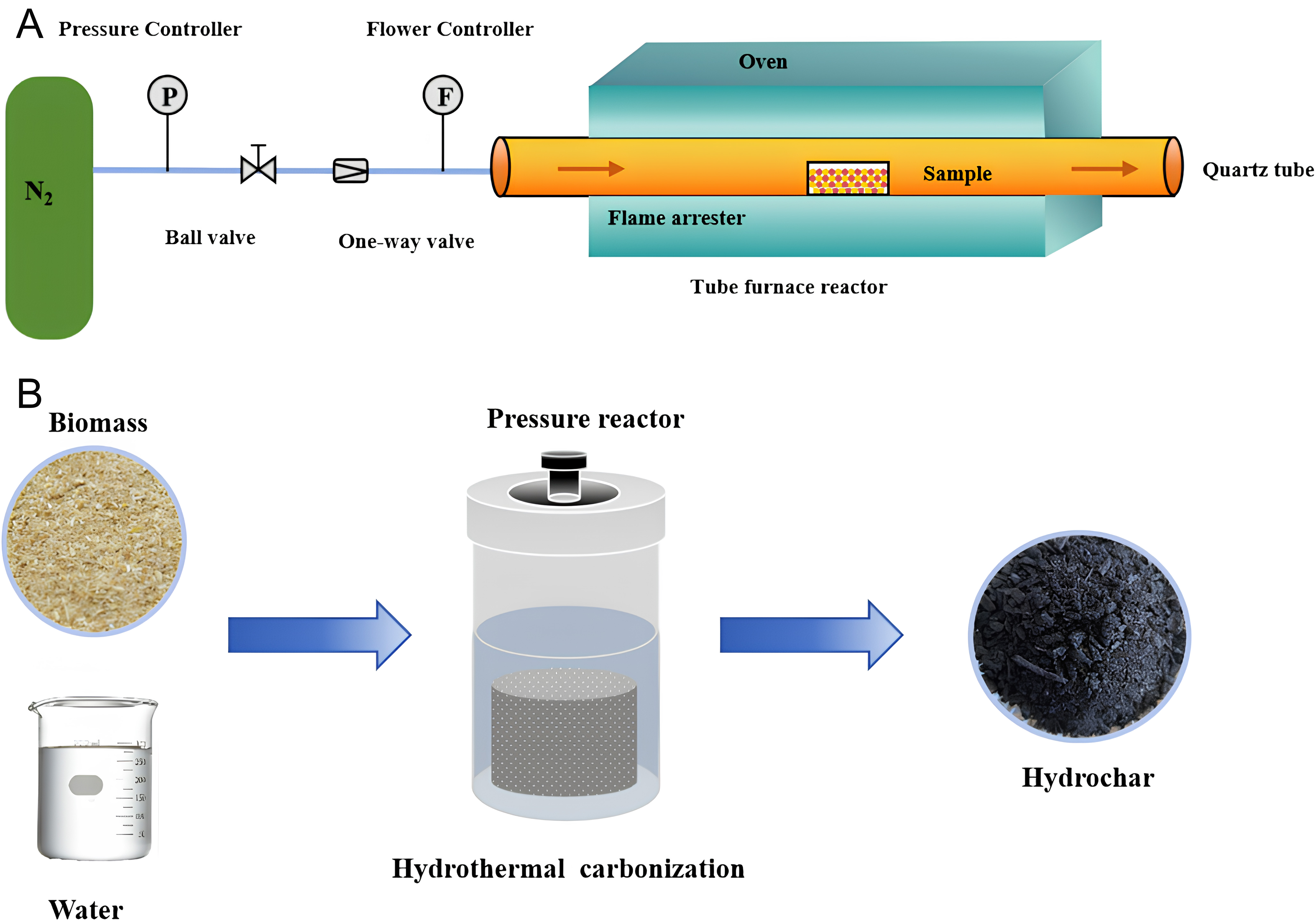
Figure 1. (A) Graphical illustration of the pyrolysis procedure. (B) Schematic representation of the hydrothermal carbonization process. This figure quoted with permission[40]. Copyright 2026, Elsevier.
Hydrothermal carbonization
HTC has been widely explored as a complementary approach to conventional pyrolysis for converting biomass into biochar[40]. This process is carried out in a closed reaction system where water functions simultaneously as solvent and reaction medium under self-generated pressure, typically at moderate temperatures between 180 and 250 °C [Figure 1B]. The solid product formed through HTC, commonly termed hydrochar, exhibits enhanced carbonization compared with the original biomass precursor[47].
A key advantage of HTC lies in its ability to process wet biomass directly, eliminating the need for pre-drying. This feature makes the technique particularly attractive for treating moisture-rich feedstocks such as food waste, agricultural by-products, and sewage sludge[48-50]. Throughout the hydrothermal process, biomass undergoes a cascade of chemical transformations, including hydrolysis, dehydration, and decarboxylation, which collectively modify its molecular structure and carbon framework. Compared with high-temperature pyrolysis-derived biochar, hydrochar generally retains a higher proportion of oxygen-containing functionalities and exhibits a distinct surface chemistry[51]. The final material characteristics can be systematically tuned by adjusting reaction temperature and duration. Lower temperatures tend to preserve surface functional groups, which are advantageous for chemical modification and adsorption-related applications[52]. Conversely, increasing reaction severity promotes aromatic condensation and structural ordering, thereby enhancing electrical conductivity. Owing to this controllability, HTC-derived carbons are considered promising candidates for applications requiring abundant surface functionalities, such as CO2 capture[53,54] and catalyst-support engineering[55].
Gasification
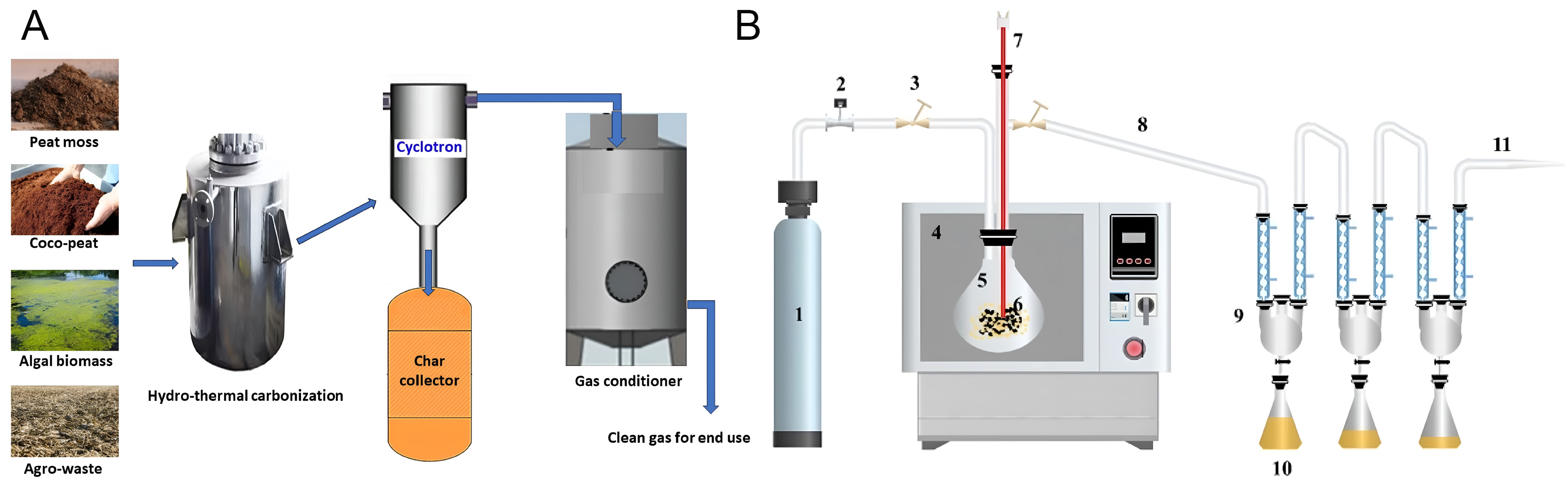
Gasification is a high-temperature thermochemical process that converts carbonaceous feedstocks into a mixture of gaseous products under limited oxygen conditions, typically at temperatures between approximately 700 and 1,400 °C [Figure 2A][56]. During this process, biomass undergoes a sequence of transformations including drying, thermal decomposition, partial oxidation, and reduction reactions. The main products are combustible gases such as hydrogen (H2), carbon monoxide (CO), CO2, and methane (CH4), along with minor amounts of N2 depending on the gasifying agent. In addition, condensable hydrocarbons and solid carbonaceous residue are formed[57]. Unlike pyrolysis, which is primarily designed to maximize solid carbon yield, gasification aims to enhance syngas production for energy applications. This objective is achieved by introducing controlled amounts of oxidizing agents such as oxygen, air, or steam at elevated temperatures[56,58]. As a result, only a limited fraction of carbon remains in the solid phase, leading to significantly lower biochar yields compared with pyrolysis[59]. Furthermore, the residual char obtained from gasification generally exhibits less developed porosity, reduced specific surface area, and diminished surface functional group density relative to biochar produced via conventional pyrolysis[60,61]. The combination of low solid yield, limited control over surface functionality, and difficulty in tailoring active-site distribution makes gasification less suitable as a dedicated route for high-performance biochar production.
Microwave-assisted pyrolysis
MAP represents a microwave-driven thermochemical approach for biomass conversion [Figure 2B][62]. Unlike conventional furnace heating, microwave irradiation delivers electromagnetic energy directly into the material, enabling volumetric heating throughout the biomass matrix. This mechanism allows for rapid temperature rise and more uniform internal heating, often resulting in improved energy utilization efficiency compared with traditional externally heated pyrolysis systems[63]. The distinct heating characteristics of MAP can significantly influence the structure of the resulting biochar. Accelerated heating rates and efficient energy transfer may promote enhanced pore development and increased specific surface area. Moreover, localized high-temperature zones generated by microwave irradiation can intensify biomass decomposition and facilitate structural reorganization of carbon frameworks, potentially improving adsorption-related properties. Owing to these advantages, microwave-assisted pyrolysis is generally considered more energy-efficient than conventional electrically heated pyrolysis and has been widely explored for applications such as catalysis and soil remediation[64,65]. However, the performance of MAP-derived biochar is highly dependent on operational parameters such as microwave power, irradiation time, and frequency. Excessive localized heating may lead to thermal runaway or superheating effects, which can cause pore collapse and structural degradation. Therefore, precise control of microwave input and careful optimization of process conditions are essential to ensure uniform heating and preserve the structural integrity of the produced biochar.
Activation strategies
Biochar produced solely through thermochemical conversion typically exhibits lower specific surface area and less-developed porosity compared with commercial activated carbons[66]. To overcome these inherent limitations, additional activation treatments are commonly applied to tailor its structural and surface properties. Activation strategies are broadly categorized into two main types: physical activation and chemical activation[67]. While physical activation relies on controlled gas-solid reactions at high temperatures to develop porosity, chemical activation involves the use of activating agents that promote simultaneous carbonization and pore formation[68-70]. Through these activation processes, pore architecture can be significantly enhanced, surface functional groups can be introduced, and defect density can be precisely tuned[71,72]. Such structural and chemical modifications are crucial for optimizing biochar performance in carbon capture and broader CCU applications.
Physical activations
Physical activation typically involves a two-step process[67]. First, biomass is carbonized to form a primary biochar framework. The resulting material is then treated at elevated temperatures, usually above 700 °C, under a flow of activating gases such as CO2 or steam[73]. During this stage, controlled gas-solid reactions selectively remove reactive carbon atoms from the matrix, effectively etching the structure. This process opens blocked pores, enhances pore connectivity, and promotes the formation of predominantly microporous structures with increased specific surface area. The properties of physically activated biochar are governed by several parameters, including precursor type, activation temperature, activating atmosphere, and treatment duration[74,75]. Higher temperatures and longer activation times generally enhance pore development. However, excessive burn-off may broaden pore size distribution, reduce structural integrity, and compromise adsorption selectivity[76]. Therefore, careful optimization is required to achieve a balance between pore generation and structural stability.
Chemical activations
Chemical activation is widely employed to produce biochar with highly developed microporous structures, making it particularly attractive for gas adsorption and electrochemical applications[77,78]. In this method, the carbon precursor is first impregnated with activating agents, typically acids, alkalis, or metal salts, followed by thermal treatment under an inert atmosphere, generally within 400-900 °C[79]. Unlike physical activation, carbonization and pore development occur simultaneously during this process. During heat treatment, the activating reagents promote dehydration, bond cleavage, and redox reactions, generating gaseous products such as H2O, CO, and CO2[78,80]. The release of these species etches the carbon framework and facilitates the formation of new pore networks. The resulting textural properties and surface functionalities are governed by several parameters, including activation temperature, the type and concentration of activating agent, and the intrinsic composition of the biomass precursor[81].
Common chemical activators include alkali compounds (e.g., KOH, K2CO3, NaOH, Na2CO3)[81,82], acids (e.g., H3PO4, H2SO4)[83], and metal salts (e.g., ZnCl2, AlCl2)[84]. Among these, KOH is one of the most extensively utilized agents due to its strong ability to generate abundant microporosity and enhance structural ordering in carbon materials. Generally, KOH primarily induces micropore formation, ZnCl2 tends to create widened micropores with limited mesoporosity, whereas H3PO4 favors the development of mesoporous and even macroporous structures[85]. Compared with physical activation, chemical activation can achieve higher specific surface areas and more pronounced pore development at relatively lower temperatures and shorter processing times, often with improved carbon yields[86]. However, this method typically requires extensive post-treatment washing to remove residual chemicals and may introduce practical concerns such as reagent recovery, equipment corrosion, and potential environmental impacts.
BIOCHAR FOR CO2 CAPTURE
Pre-combustion & post-combustion CO2 capture technologies
Pre-combustion CO2 capture is primarily implemented in Integrated Gasification Combined Cycle (IGCC) systems. As shown in Figure 3, the process begins with the conversion of fossil fuel feedstocks such as coal, natural gas, or biomass into syngas, which mainly consists of CO and H2[87]. This conversion step is referred to as gasification when solid fuels are employed, whereas partial oxidation is used for gaseous or liquid feedstocks. Under high-temperature and high-pressure conditions, the feedstock reacts with controlled amounts of oxidants and steam to produce syngas. The resulting syngas subsequently undergoes catalytic conversion through the water-gas shift reaction, which converts CO into CO2 while maximizing H2 production. A key advantage of this pathway is its operation under elevated pressure, which significantly increases the partial pressure of CO2 and thereby facilitates its separation and removal from the gas stream[88]. After separation, CO2 is compressed and dehydrated for transport and storage, while the purified H2 can be utilized as a carbon-free fuel in gas turbines or fuel cells.
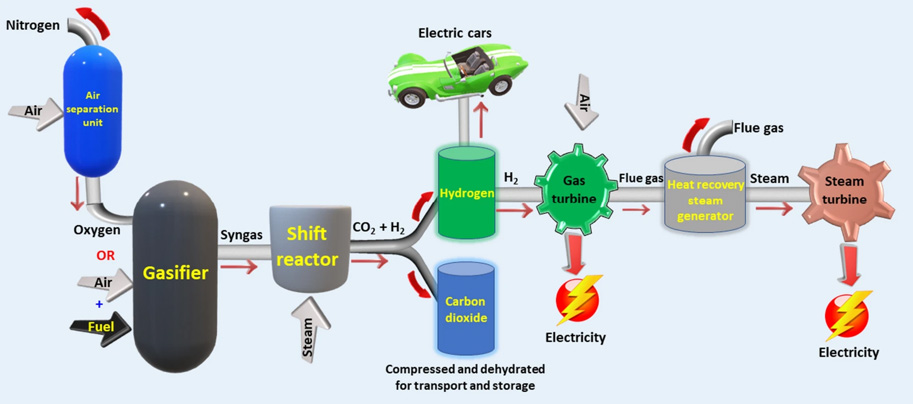
Figure 3. Schematic depiction of pre-combustion carbon capture process. Reprinted with permission[87], licensed under CC BY 4.0.
From a techno-economic perspective, pre-combustion carbon capture offers distinct advantages, including lower H2O consumption compared to other capture methods and the co-production of valuable H2 fuel[89]. Despite the favorable thermodynamic conditions for CO2 separation, the overall capital cost of IGCC plants remains high. Moreover, the complexity associated with integrating pre-combustion carbon capture into existing power plants limits its applicability to new installations, often companied by challenges related to reduced overall plant performance.
Post-combustion CO2 capture involves the separation of CO2 from flue gas generated after the complete combustion of carbon-based fuels[90]. This approach represents the most mature and widely implemented capture strategy, largely due to its downstream configuration, which allows retrofitting into existing power plants without significant modification of the combustion process[91]. However, prior to CO2 separation, the flue gas typically requires pretreatment processes, such as desulphurization and denitrification, to eliminate impurities that can adversely affect capture performance[92]. A variety of post-combustion capture technologies have been developed, including chemical absorption, physical adsorption, membrane separation, and cryogenic distillation[93]. Among these, chemical absorption using amine-based solvents is the most commercially established technology[94,95]. Despite its high capture efficiency, this approach suffers from several drawbacks, including substantial energy penalties associated with solvent regeneration, corrosion-related operational issues, and the formation of potentially harmful degradation products. Alternative approaches also face inherent limitations. Cryogenic distillation can produce high-purity liquid CO2 suitable for direct transport, but its application is often restricted by the large energy demand required for refrigeration[96]. Although membrane separation is attractive due to its chemical-free operation and simplicity, its efficacy is limited by the low CO2 partial pressure in post-combustion flue streams as well as the susceptibility of membrane degradation from H2O vapor.
Consequently, solid-based adsorption has emerged as a promising research direction due to its potential for improved energy efficiency and reversible operation via temperature or pressure swing cycles[12,97]. A wide range of adsorbent materials such as zeolites, biochar, and metal-organic frameworks are actively being investigated. Nevertheless, the industrial scalability of adsorption-based capture remains constrained by trade-offs between adsorption capacity, selectivity, regeneration energy, and long-term stability under realistic flue gas conditions. Exposure to impurities like SOx and NOx can lead to adsorbent deactivation, posing significant challenges for sustained operation[98,99]. Therefore, bridging the gap between laboratory-scale performance and industrial application remains a critical hurdle for adsorption technologies, especially with respect to durability and efficient gas-solid contact under practical operating conditions.
CO2 capture strategies using biochar-based adsorbents
Biochar, a carbon-rich solid produced through the thermal decomposition of biomass under inert conditions, has emerged as a promising and sustainable precursor for carbon capture applications. One of the primary advantages of biochar is its economic viability. In contrast to commercial activated carbon, biochar production generally requires less energy-intensive activation processes, making it a cost-effective option for large-scale deployment[100]. Despite these advantages, the direct utilization of pristine biochar is often constrained by its inherent material limitations. In its untreated form, biochar frequently exhibits a relatively low specific surface area and insufficient surface alkalinity, which hinders it from achieving the high adsorption capacities required for industrial implementation. As a result, improving the performance of biochar necessitates a fundamental understanding of the two primary adsorption mechanisms involved in carbon capture, namely physisorption and chemisorption.
Physisorption is predominantly governed by the textural properties of the material, including micropore volume and overall surface area, which facilitate the physical confinement of CO2 molecules[101]. In contrast, chemisorption relies on surface chemical interactions between acidic CO2 molecules and basic active sites[102]. These sites are primarily associated with functional groups, such as nitrogen-containing species, or with intrinsic inorganic components like alkaline earth metals.
To bridge the performance gap between pristine biochar and commercial adsorbents, recent studies have focused on various modification strategies that regulate both pore architecture and surface chemistry. Although physisorption and chemisorption are discussed separately for mechanistic clarity, they generally coexist in engineered biochars because activation and functionalization can simultaneously alter pore structure, defect density, surface polarity, and active-site accessibility. Their relative contributions therefore cannot be determined from adsorption capacity alone.
Complementary characterization methods are required for reliable mechanism assignment. Low-temperature CO2 desorption, moderate adsorption heat, and reversible uptake generally support weak pore filling, whereas desorption extending to higher temperatures and the in situ Fourier transform infrared spectroscopy (FTIR) identification of carbonate, bicarbonate, carbamate, or other surface-bound species provide stronger evidence of chemical binding[103]. Humidity-dependent measurements can reveal competitive H2O adsorption within micropores and polar sites or, when supported by spectroscopic evidence, moisture-assisted chemical binding. Kinetic models are useful for describing adsorption rates but should not be regarded as independent proof of chemisorption. Accordingly, Sections “Enhancing CO2 physisorption on biochar through structural optimization” and “Promoting CO2 chemisorption on biochar via chemical modification” describe the dominant contributions of pore filling and surface interactions, respectively, while Section “Synergistic pore construction and heteroatom functionalization” discusses their synergistic integration for high-performance CO2 capture.
Enhancing CO2 physisorption on biochar through structural optimization
The effectiveness of CO2 physisorption on biochar is primarily governed by the micropore filling mechanism[104]. Because physical adsorption occurs through the confinement of gas molecules within the porous framework, the development of accessible microporous structures is the key determinant of adsorption capacity. Although increasing the specific surface area generally provides more adsorption sites, it is widely accepted that the availability of well-developed micropores is more critical for efficient CO2 capture than the total surface area alone[105].
Pore size distribution also plays a decisive role in determining CO2 adsorption performance. Micropores in the range of approximately 0.3 to 0.8 nm are considered optimal, with ultra-micropores smaller than 0.5 nm exhibiting the strongest adsorption affinity. Previous studies have further demonstrated that equilibrium CO2 uptake correlates more strongly with micropore volume than with the total Brunauer-Emmett-Teller surface area, indicating that accessible micropores are more critical than the overall surface area for effective CO2 capture[104]. Pores with dimensions comparable to the kinetic diameter of CO2 (~0.33nm) provide the most favorable adsorption environment, where overlapping adsorption potentials from opposing pore walls significantly enhance van der Waals interactions and CO2 affinity[106,107]. In contrast, mesopores and macropores contribute less directly to the equilibrium adsorption capacity but play indispensable roles in facilitating gas diffusion and improving adsorption kinetics by providing efficient transport pathways to the adsorption sites. Therefore, the rational design of biochar should maximize accessible ultramicropore volume while maintaining hierarchical pore connectivity to simultaneously achieve high equilibrium CO2 uptake and efficient mass transport. Consequently, an effective biochar adsorbent integrates macropores for gas transport, mesopores for efficient diffusion, and micropores as the primary CO2 adsorption domains[108].
To validate these structural design principles experimentally, recent studies have adopted synergistic activation strategies to simultaneously optimize micropore development and pore accessibility. Table 2 summarizes previous studies on biochar-based adsorbents for CO2 capture. Wang et al.[109] showed the integration of H2O2 pre-oxidation with KOH activation enables the fabrication of ultra-microporous biochar from pine sawdust. In this process, mild pre-oxidation introduced oxygen-containing functional groups into the precursor, which significantly enhanced the reactivity of the carbon matrix towards the subsequent chemical etching. As a result, an exceptionally well-developed microporous network was obtained, yielding a remarkable specific surface area of 3,380.4 m2·g-1 and a microporosity ratio as high as 91.6%. Consistent with the micropore filling mechanism discussed above, this textural optimization led to high CO2 adsorption capacity of 6.60 mmol·g-1 at 30 °C, even in the absence of heteroatom doping. These findings confirmed that maximizing narrow microporosity while preserving pore accessibility remains a powerful strategy for CO2 capture performance dominated by physisorption.
Summary of biochar-based adsorbents for CO2 capture
| Primary modification strategies | Adsorbents | Specific surface area (m2 g-1) | CO2 adsorption capacity (mmol·g−1) | CO2 adsorption measurement conditions | CO2/N2 selectivity (15 vol % CO2 in N2) | Ref. |
| Porous modification | ABC-ahp-6 | 3,380.4 | 6.60 | Pure CO2/30 °C/1 bar | - | [109] |
| RHC-PC-2 | 1,343.8 | 1.55 | Pure CO2/30 °C/1 bar | 37.80 | [110] | |
| Non-metallic heteroatom functionalization | AF-700 | 1,371 | 3.34 | Pure CO2/0 °C/1 bar | 72 | [126] |
| ABC800 | 836.5 | 4.06 | Pure CO2/0 °C/1 bar | - | [127] | |
| OPPC31 | 1,445.71 | 4.31 | Pure CO2/25 °C/1 bar | 17 | [128] | |
| ASBC-800-0.5 | 2,890 | 2.95 | Pure CO2/30 °C/1 bar | 44.03 | [129] | |
| Introduction of alkali earth metals | 5 wt% Mg-loaded biochar | 292 | 1.86 | Pure CO2/25 °C/1 bar | - | [134] |
| MgO/biochar-1 | 1,453 | 6.65 3.72 | Pure CO2/0 °C/1 bar Pure CO2/25 °C/1 bar | 96.7 | [135] | |
| BC(Ca) | 445 | 2.42 | Pure CO2/25 °C/1 bar | 36 | [136] | |
| Synergistic pore and surface modification | PAC 2 | 755 | 3.13 1.55 | Pure CO2/0 °C/1 bar Pure CO2/50 °C/1 bar | 37 | [138] |
Beyond maximizing micropore volume through conventional chemical activation, recent studies have increasingly explored sustainable synthesis strategies that exploit the intrinsic mineral components of biomass to engineer hierarchical porosity. For example, Gan et al.[110] developed a green synthesis strategy based on silicon-rich rice husk and potassium citrate. In this approach, naturally embedded silica nanoparticles within the biomass functioned as in-situ hard templates, while potassium citrate served as a low-corrosive activating agent. This dual role prevented structural collapse during carbonization, resulting in the formation of unique nanocapsule-like architectures featuring interconnected transport channels. Subsequent removal of the silica template, together with etching by in-situ generated activating species, created a refined pore network dominated by narrowly distributed ultra-micropores centered at 0.36 and 0.59 nm. As depicted in Figure 4A and B, this optimized biochar (RHC-PC-2) achieved a high CO2 uptake of 1.55 mmol·g-1 and a high CO2/N2 selectivity of 37.8, markedly outperforming samples prepared by conventional KOH activation. These results emphasized that leveraging natural structural templates offers a viable pathway to fabricate selective adsorbents with interconnected transport pathways, enabling a favorable balance between adsorption performance and environmental sustainability.
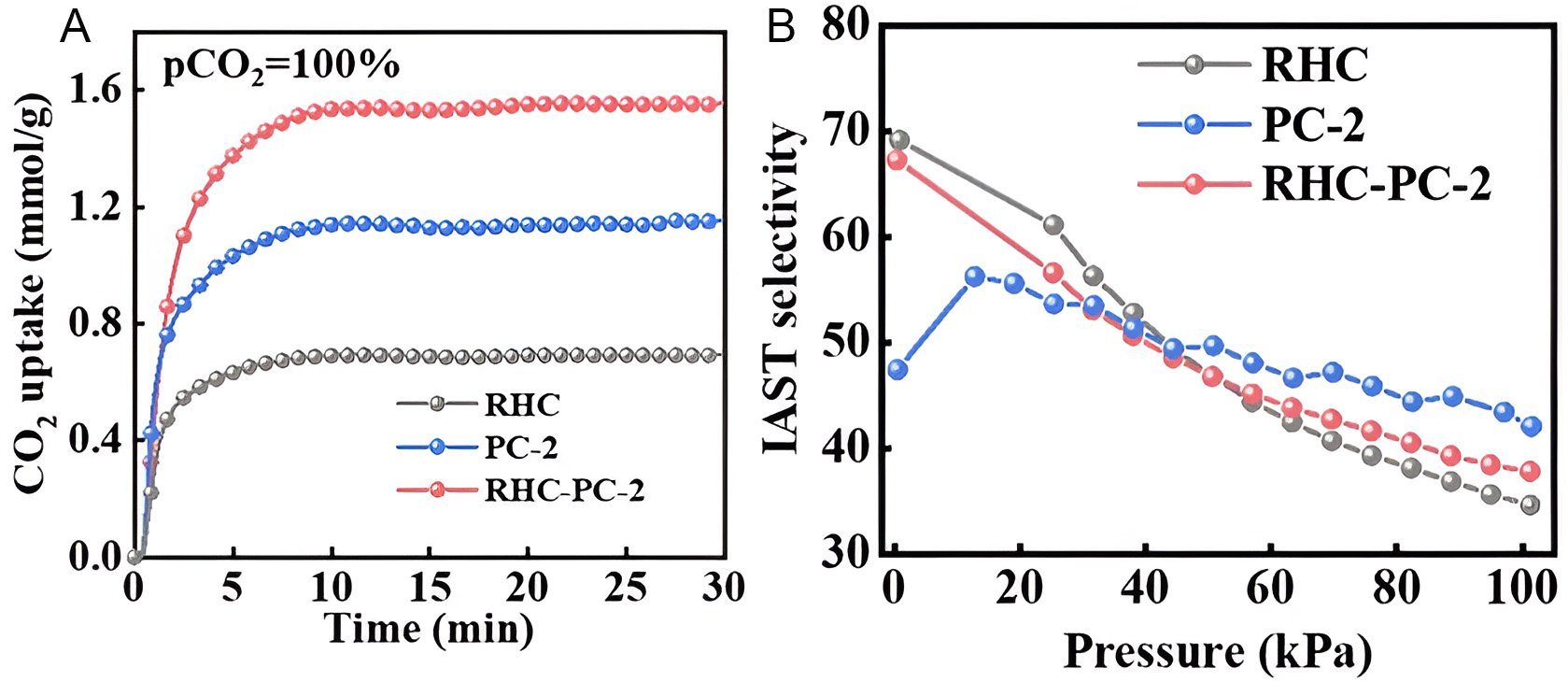
Figure 4. (A) Thermogravimetric analysis curves of the synthesized materials. (B) Comparison of CO2/N2 selectivity across the as-prepared samples. This figure quoted with permission[110]. Copyright 2022, Elsevier.
Promoting CO2 chemisorption on biochar via chemical modification
Beyond pore confinement, surface chemical properties provide complementary contributions to CO2 adsorption by introducing basic and polar interaction sites. This mechanism is largely driven by Lewis acid-base interactions, in which acidic CO2 molecules interact with basic active sites on the biochar surface[111]. Consequently, enhancing surface basicity through the introduction of nitrogen or oxygen containing functional groups, or through the incorporation of alkaline earth metals, is considered an effective strategy for increasing CO2 capture capacity. In addition to surface basicity, surface polarity also plays a crucial role in adsorption selectivity[112]. Beyond heteroatom- and metal-derived sites, topological and edge defects within the carbon skeleton can also contribute to CO2 capture. Non-hexagonal motifs, particularly five-membered rings, together with vacancies and exposed edge sites, disrupt the electronic symmetry of the sp2 carbon lattice and induce localized charge redistribution. The resulting electron-rich carbon centers may act as weak Lewis-basic sites toward the electrophilic carbon atom of CO2, thereby strengthening adsorption and promoting molecular polarization. Depending on the defect configuration and binding strength, this contribution may range from enhanced physisorption to weak chemisorption. Therefore, defect-derived adsorption should be distinguished from micropore confinement and heteroatom effects through complementary Raman, X-ray photoelectron spectroscopy (XPS), CO2-temperature-programmed desorption (CO2-TPD), and theoretical analyses rather than inferred from defect density alone[113]. Moreover, a reduction in hydrophilicity increases surface hydrophobicity, which suppresses the competitive adsorption of H2O molecules and thereby promotes preferential CO2 uptake under humid conditions. Most adsorption capacities, however, are reported under dry conditions and may therefore overestimate performance in practical flue-gas streams. Under humid conditions, H2O competes with CO2 for polar surface sites and narrow micropores, reducing the accessible adsorption capacity. Although increasing surface hydrophobicity can mitigate this effect, excessive removal of polar functional groups may simultaneously weaken CO2 affinity. Furthermore, co-adsorbed water increases the energy required for adsorbent regeneration[114]. Therefore, humid working capacity and long-term cyclic stability under simulated flue-gas conditions should be considered together with dry equilibrium adsorption capacity.
To introduce chemically defined heteroatom- and metal-derived adsorption sites, pristine biochar typically requires chemical modification. Such treatments generally follow two main approaches. In pre-modification strategies, raw biomass is impregnated with chemical agents prior to pyrolysis[115]. In contrast, post-modification strategies involve chemical treatment and subsequent thermal activation of the biochar after carbonization[116]. Both approaches aim to enrich the carbon framework with chemically active sites capable of forming strong intermolecular interactions with CO2, including hydrogen bonding and dipole-related interactions.
Common chemical modifications include oxidation using basic solutions to introduce oxygen-containing functional groups such as carboxyl, phenolic and hydroxyl as well as high temperature amination to incorporate nitrogen-containing functionalities such as amine groups[117-119]. Additionally, impregnation with metal oxide precursors is frequently utilized to anchor basic metal species onto the biochar matrix. Based on these considerations, the following subsections will systematically categorize and critically analyze chemisorption enhancement strategies focusing on non-metallic functional group modification and metal incorporation.
Non-metallic heteroatoms functionalities
Beyond porous structure engineering, the intrinsic surface chemistry of biochar fundamentally dictates its chemisorption behavior. While the incorporation of metal species creates localized basic sites, the introduction of non-metallic heteroatoms, particularly nitrogen, oxygen and sulfur, serves as a primary strategy for modulating the electronic structure and surface polarity of the carbon matrix[120-122]. Among these heteroatoms, nitrogen doping has been extensively explored due to its ability to generate electron-rich Lewis basic sites, such as pyridinic, pyrrolic, and amine functionalities, directly within the carbon lattice[123]. Among these nitrogen species, pyridinic N is generally regarded as the primary active site for CO2 chemisorption because its lone-pair electrons readily interact with the electrophilic carbon atom of CO2 through Lewis acid-base interactions. In contrast, pyrrolic N and amine functionalities mainly contribute by enhancing the local electron density and surface basicity of the carbon framework, thereby promoting CO2 adsorption[124,125]. Similarly, oxygen-containing ketone and carbonyl groups enhance the surface polarity and strengthen dipole-quadrupole interactions with CO2, whereas sulfur containing functionalities primarily improve CO2 affinity by redistributing the electron density and polarizability of adjacent carbon atoms. Collectively, the targeted incorporation of these non-metallic heteroatoms transforms the relatively inert carbon matrix into a chemically active CO2 adsorption surface, indicating that the capture performance is governed not only by the overall heteroatom content but also by the chemical state and distribution of these surface functional groups.
Building upon these principles, nitrogen doping has been widely adopted as an effective strategy to introduce basic active sites into the carbon lattice, thereby markedly enhancing CO2 affinity. For instance, Sun et al.[126] reported the synthesis of nitrogen self-doped hierarchical porous biochar derived from carp fish scales via a KOH-mediated activation process. XPS analysis of the N 1s spectrum of the optimized sample (AF-700) revealed the successful substitution of carbon atoms with nitrogen, predominantly in the form of pyrrolic N (N-5) and pyridinic N (N-6) functionalities. These nitrogen configurations functioned as alkaline active sites that not only strengthened hydrogen bonding but also facilitated electron transfer with weakly acidic CO2 molecules, creating a highly favorable environment for chemisorption. Benefiting from the synergistic combination of nitrogen-induced chemical interactions and a substantial specific surface area of 1,371 m2·g-1, the AF-700 biochar achieved a CO2 uptake capacity of
Active amination processes such as ammonialization represent a highly effective strategy to chemically graft strongly basic functional groups onto the carbon skeleton. For example, Hsu et al. demonstrated a single-step pyrolytic synthesis combining carbonization and ammonialization using Leucaena leucocephala biomass[127]. During the high-temperature treatment, ammonia gas decomposed into reactive nitrogen radicals (NH* and NH2*), which covalently bonded with the biochar matrix to form abundant amino (C-NH2) and imine/pyrrolic (C-NH) functional groups [Figure 5A]. These introduced nitrogen species served as potent Lewis basic sites that chemically anchored the weakly acidic CO2 molecules. The additional behavior was well described by the pseudo-second-order kinetic and Langmiur-Freundlich models, suggesting heterogeneous uptake involving both pore filling and interactions with nitrogen-containing sites. However, kinetic and isotherm fitting alone cannot conclusively establish chemisorption. The optimized ammonialized biochar (ABC800) exhibited a superior CO2 capacity of 4.06 mmol·g-1 at 0 °C, indicating that nitrogen functionalization enhanced CO2 affinity in combination with its ultramicroporous structure.
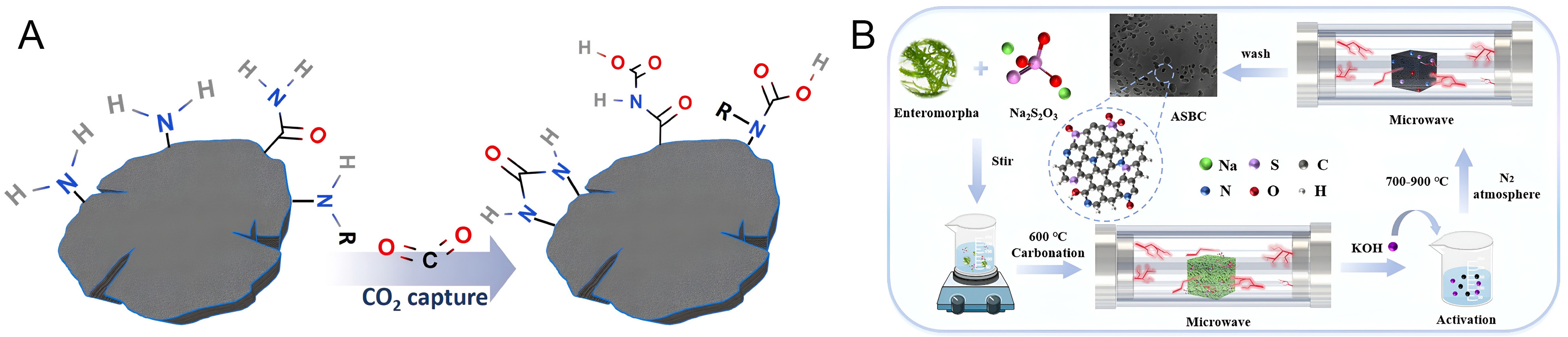
In addition to nitrogen functionalities, the introduction of oxygen-containing functional groups offers another effective avenue to manipulate the surface polarity of biochar, thereby promoting CO2 adsorption through strong electrostatic interactions. In a recent study, Wang et al.[128] developed a green synthesis route based on a dual organic salt activation process to produce highly oxygenated porous biochar from orange peels. This approach enabled simultaneous control over porous architecture and surface chemistry, leading to a substantial enrichment of oxygen functionalities on the carbon surface. By integrating experimental characterizations with density functional theory (DFT) calculations, they elucidated the specific roles of distinct oxygen-containing groups in CO2 adsorption. Notably, ketone functionalities, identified as the dominant oxygen species in the optimized sample, exhibited particularly strong electrostatic interactions with CO2 molecules. DFT calculations demonstrated that the incorporation of ketone groups dramatically increased the CO2 adsorption energy by 109.9% compared to a pristine carbon substrate, highlighting their critical contribution to adsorption affinity. Driven by the synergistic effects of a well-developed microporous framework and enhanced surface polarity, the resulting biochar delivered an outstanding CO2 capture capacity of 4.31 mmol·g-1 at 25 °C. This work suggested that rational oxygen functionalization can significantly amplify electrostatic interactions, offering an effective chemisorption pathway that complements physical confinement within micropores.
To further push the boundaries of chemisorption, recent advancements have focused on synergistic effects of multi-heteroatom co-doping, particularly combining nitrogen and sulfur. As depicted in Figure 5B,
Incorporation of alkaline earth metals
Biomass exhibits an intrinsically heterogeneous elemental composition that depends on its feedstock origin. In addition to carbon, oxygen and nitrogen, biomass typically contains trace amounts of inorganic mineral species, including alkaline earth metals. The inherent presence or intentional enrichment of these metals, particularly calcium (Ca) and magnesium (Mg), plays a critical role in tuning the surface chemistry of biochar[130-133]. By increasing surface alkalinity, these metal species enhance the affinity of the adsorbent toward acidic CO2 molecules. This interaction promotes chemisorption mechanisms, enabling CO2 fixation through the formation of stable carbonate and bicarbonate species. As a result, exploiting these unique chemical properties to improve adsorption capacity has become a major focus in recent biochar-based CO2 capture research.
To enhance chemisorption performance, the incorporation of alkaline earth metals into biochar has been extensively investigated. Lahijani et al.[134] studied metal-impregnated biochar derived from walnut shells, highlighting the pivotal role of metal selection in CO2 adsorption behavior. As illustrated in Figure 6A, among various samples loaded with 5 wt% metals, Mg-modified biochar exhibited the highest CO2 uptake compared to other counterparts. This superior performance was attributed to the formation of basic magnesium oxide (MgO) species on the carbon surface, which strongly interact with acidic CO2 molecules. Metal loading was also found to critically influence adsorption capacity. As shown in Figure 6B, increasing Mg content initially enhanced CO2 uptake due to the increased density of basic active sites. However, excessive metal loading resulted in a decline in performance, likely caused by metal agglomeration and partial blockage of micropores that restrict gas diffusion. These results highlighted the importance of optimizing metal content to balance chemical activity and pore accessibility. In addition to capacity, Mg-loaded biochar revealed high selectivity for CO2 over N2 and CH4 [Figure 6C]. This selectivity arose from preferential acid-base interactions, confirming the potential of Mg impregnated biochar for post-combustion CO2 capture.
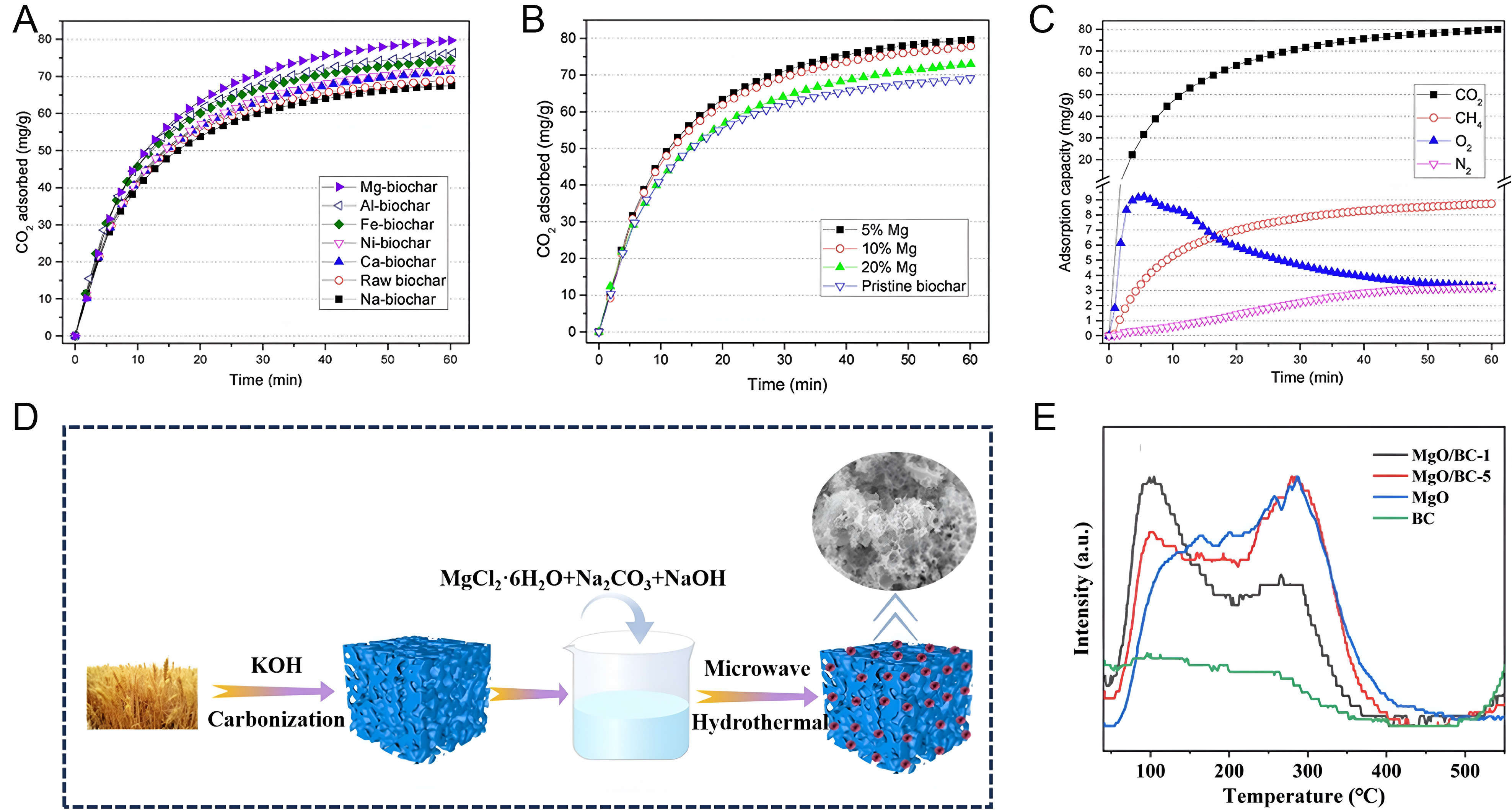
Figure 6. (A) CO2 adsorption curves for biochars modified with 5 wt% of different metals. (B) CO2 uptake profiles of biochars for varying Mg loadings. (C) Gas adsorption selectivity of Mg-loaded biochar for CO2 over competing gases. (A-C) Reprinted with permission[134]. Copyright 2018, Elsevier. (D) Illustration of the fabrication route for the hierarchically porous MgO/biochar composites. (E) CO2-TPD profiles of the fabricated samples. (D and E) Reprinted with permission[135]. Copyright 2024, Elsevier.
To overcome the limitations of conventional metal impregnation and maximize the synergy between physisorption and chemisorption, Li et al.[135] employed an in situ structural engineering approach, fabricating hierarchically porous MgO/biochar composites via a microwave-assisted hydrothermal method [Figure 6D]. Unlike conventional pyrolysis, this approach facilitated rapid and uniform nucleation of MgO nanocrystals within the carbon matrix. The resulting composite achieved a remarkable specific surface area of 1,453 m2·g-1 with abundant narrow micropores, providing a favorable architecture for CO2 adsorption. CO2-TPD analysis revealed broad desorption features extending toward higher temperatures, consistent with a distribution of MgO-derived basic sites and stronger CO2 binding than that of pristine biochar [Figure 6E]. These results support a contribution from surface chemical interactions in addition to micropore filling. However, CO2-TPD alone cannot identify magnesium carbonate or other specific adsorbed species, which requires direct spectroscopic evidence such as in situ FTIR. Consequently, the composite demonstrates how hierarchical porosity and MgO-derived basic sites can jointly contribute to CO2 capture through improved transport and enhanced adsorption affinity.
Expanding the range of alkaline earth metals, Ca has emerged as a cost-effective alternative for enhancing surface basicity in biochar-based adsorbents. Arjona-Jaime et al.[136] displayed that Ca-modified biochar prepared through a rapid microwave-assisted irradiation method enabled uniform dispersion of Ca-based active sites within the carbon matrix while avoiding the prolonged processing times associated with conventional thermal treatments. The resulting adsorbent exhibited enhanced CO2 uptake capacity along with high selectivity toward CO2 over N2, which is a key requirement for post-combustion capture applications. Crucially, the Ca-functionalized biochar effectively addressed a major limitation of many physical adsorbents, namely performance degradation under humid conditions. When evaluated under simulated flue gas environments containing H2O vapor, the adsorbent maintained stable CO2 uptake. This moisture tolerance suggests that Ca-derived basic sites preserved CO2 affinity in the presence of H2O and may have promoted the formation of carbonate and bicarbonate species. Nevertheless, humidity resistance alone cannot conclusively distinguish chemisorption from suppressed competitive H2O adsorption, and direct spectroscopic identification of the adsorbed species is required. Taken together, these findings suggest that Ca incorporation can increase CO2 adsorption through acid-base interactions while improving the potential applicability of biochar under humid industrial conditions.
Synergistic pore construction and heteroatom functionalization
High-performance biochar adsorbents generally rely on the coupled contributions of pore confinement and surface chemical interactions rather than on either factor alone. In particular, activation strategies such as KOH treatment can simultaneously develop accessible micropores and topological defects while altering retention, exposure, and accessibility of heteroatom-containing sites[137]. The resulting non-hexagonal carbon rings and exposed edge sites can redistribute local electron density and provide additional weak Lewis-basic sites for CO2 adsorption. Therefore, activation conditions affect not only pore architecture but also the electronic and chemical environment surrounding the adsorption sites.
Nandi et al.[138] demonstrated this synergistic behavior using rice husk-derived biochar. By adjusting the KOH-to-biomass ratio, they synthesized PAC 2 with a moderate specific surface area of 755 m2·g-1 and a well-developed micropore volume of 0.243 cm3·g-1. Importantly, the optimized adsorbent retained approximately 2.27% of intrinsic nitrogen present in the biomass precursor, which effectively enhanced the isosteric heat of adsorption without additional heteroatom doping. The combination of micropore-driven CO2 confinement and nitrogen-derived adsorption affinity enabled high CO2 uptake and CO2/N2 selectivity at flue-gas-relevant temperatures.
This example illustrates that the simultaneous engineering of pore architecture and heteroatom functionalities is a central design principle for high-performance CO2 capture. Accessible ultramicropores increase local CO2 concentration, whereas N-, O-, S-containing sites enhance adsorption affinity and selectivity through basic or polar interactions. Nevertheless, these properties should be balanced because excessive activation may widen micropores or remove surface functionalities, whereas excessive heteroatom incorporation may block pores and restrict CO2 transport. Rational biochar design should therefore optimize accessible microporosity and CO2-philic surface sites simultaneously rather than treating them as independent targets.
Overall, the available studies support several common design principles. Accessible micropores in the range of approximately 0.3-0.8 nm, particularly ultramicropores below 0.5 nm, are generally most strongly associated with low-pressure CO2 uptake, whereas larger pores primarily facilitate mass transport. Appropriately distributed heteroatom sites enhance adsorption affinity and selectivity; however, no universal optimum doping ratio has been established because their effects depend more strongly on chemical state, spatial distribution, and accessibility than on total heteroatom content. Alkaline-earth-metal loading generally exhibits a non-monotonic relationship with adsorption performance, as moderate loading increases the density of basic sites, whereas excessive loading promotes particle agglomeration and pore blockage. Nevertheless, transferable quantitative relationships among these descriptors remain unresolved because pore structure, heteroatom speciation, and metal loading are commonly altered simultaneously. Their effects are further complicated by differences in adsorption temperature, pressure, gas composition, and measurement protocol. Future studies should therefore independently control these parameters and employ standardized equilibrium, breakthrough, humidity-dependent and cyclic adsorption measurements to establish reliable structure-performance correlations.
BIOCHAR FOR CO2 CHEMICAL UTILIZATION
In addition to its role in CO2 capture, biochar has increasingly been recognized as a multifunctional platform for carbon utilization, wherein captured CO2 is converted into value-added chemicals and fuels. Benefiting from its tunable pore architecture, modifiable surface chemistry, and defect-rich carbon framework, biochar can function not only as a passive adsorbent but also as a catalyst support or, in some cases, an active catalytic medium. In most biochar-based CO2 utilization systems, however, the primary catalytic centers are supported metals, metal oxides, molecular complexes, or atomically dispersed metal sites, while biochar primarily serves as a versatile support. Its key roles include enhancing CO2 adsorption, stabilizing and dispersing active species, facilitating charge and mass transport, and modulating the local electronic environment through surface functionalities and metal-support interactions.
Compared with conventional carbon materials such as activated carbon, carbon nanotubes, and graphene, biochar offers notable advantages in terms of low cost, renewable feedstocks, and structural tunability[106,139]. Activation and functionalization can further tailor its pore architecture, surface chemistry, and defect density, thereby improving active-site accessibility and promoting the uniform dispersion and stabilization of catalytic species. Nevertheless, biochar-based systems still face several challenges, including feedstock-dependent variability, structural heterogeneity, and the need for additional post-treatment. Moreover, their catalytic performance is generally governed by the supported active species rather than the carbon framework itself. Therefore, the key competitive advantage of biochar-based systems lies not simply in providing higher intrinsic catalytic activity, but in combining competitive catalytic performance with sustainability, low material cost, and tunable physicochemical properties.
Depending on the energy input and reaction environment, CO2 utilization pathways can be broadly classified into thermocatalytic, electrochemical, and photocatalytic processes. Although these approaches operate under distinct driving forces and reaction conditions, they share fundamental requirements, including efficient CO2 adsorption, activation of the C=O bond, stabilization of reaction intermediates, and effective charge or heat transfer. The following sections provide a comprehensive overview of recent progress in biochar-based CO2 conversion, covering thermocatalytic hydrogenation, electrochemical CO2 reduction, and photocatalytic transformation processes.
Thermocatalytic CO2 conversion
Thermocatalytic CO2 conversion refers to the transformation of carbon dioxide into value-added chemicals and fuels through heat-driven catalytic reactions[140]. Representative thermocatalytic pathways mainly involve CO2 hydrogenation reactions, including the reverse water gas shift (RWGS) reaction for CO production, methanation to CH4, and methanol (CH3OH) synthesis[141].
For instance, Pan et al.[142] developed a Cu-Mo2C cluster catalyst supported on nitrogen-doped biochar (NBC) derived from Enteromorpha prolifera (Cu-Mo2C/EPBC) for the RWGS reaction. The algae-derived precursor enabled the formation of N-doped mesoporous carbon enriched with nitrogen functionalities, strengthening interactions with β-Mo2C and promoting the generation of well-defined Cu-Mo2C interfacial active sites. Compared with the activated carbon-supported counterpart (Cu-Mo2C/AC), the EPBC-supported catalyst exhibited higher graphitization, larger surface area, and abundant pyridinic-N species capable of stabilizing Cu-Mo2C clusters. Catalytic performance was evaluated using a fixed-bed reactor. The catalyst containing 20 wt% Mo2C and 0.8 wt% Cu achieved optimal CO2 conversion and CO selectivity. At 500 °C, Cu-Mo2C/EPBC delivered a CO selectivity of 99.95% and nearly threefold higher CO2 conversion than Cu-Mo2C/AC. Control experiments confirmed that the enhanced performance originated from the synergistic effect between pyridinic-N anchoring and Cu-Mo2C cluster interactions. The catalyst also maintained over 99% of its initial activity after 50 h, demonstrating excellent stability. In the case of CH3OH synthesis, Xu et al.[143] reported CuZn catalysts supported on coconut shell-derived mesoporous biochar (CuZn/MC). Reference catalysts were prepared via sequential impregnation, including Cu-Zn/MC, Zn-Cu/MC, and CuZn/SiO2. The mesoporous carbon framework facilitated uniform dispersion of Cu-ZnO species and promoted the formation of low-valence Cu (Cu0/Cu+) sites essential for CH3OH production. One-step incorporation of Cu and Zn strengthened metal-support interactions and increased the abundance of Cu+ species. As a result, CuZn/MC exhibited significantly higher CO2 conversion and space-time yield (STY) than CuZn/SiO2, while maintaining comparable CH3OH selectivity [Figure 7A]. Notably, CuZn/MC reached a CH3OH STY of 121.25 gMeOH·kgcat-1·h-1 at 260 °C, nearly three times that of CuZn/SiO2, with stable performance over 50 h [Figure 7B and C]. Similarly, Vali et al.[144] demonstrated that biochar derived from renewable waste can function as an effective support for Cu/ZnO nanoparticles in CO2 hydrogenation to CH3OH. The resulting catalyst delivered a CH3OH STY of 496.5 mgMeOH·gCu-1·h-1 with 71% selectivity and maintained stable operation for more than 45 h. Under identical reaction conditions, its performance markedly surpassed that of conventional Cu/ZnO/Al2O3, which exhibited lower productivity and more rapid deactivation. Structural characterization revealed that the enhanced activity and durability originated from enriched Cu-Zn interfacial sites, enabled by the uniform dispersion of ultrasmall nanoparticles and improved H2 and CO2 adsorption on the biochar support.
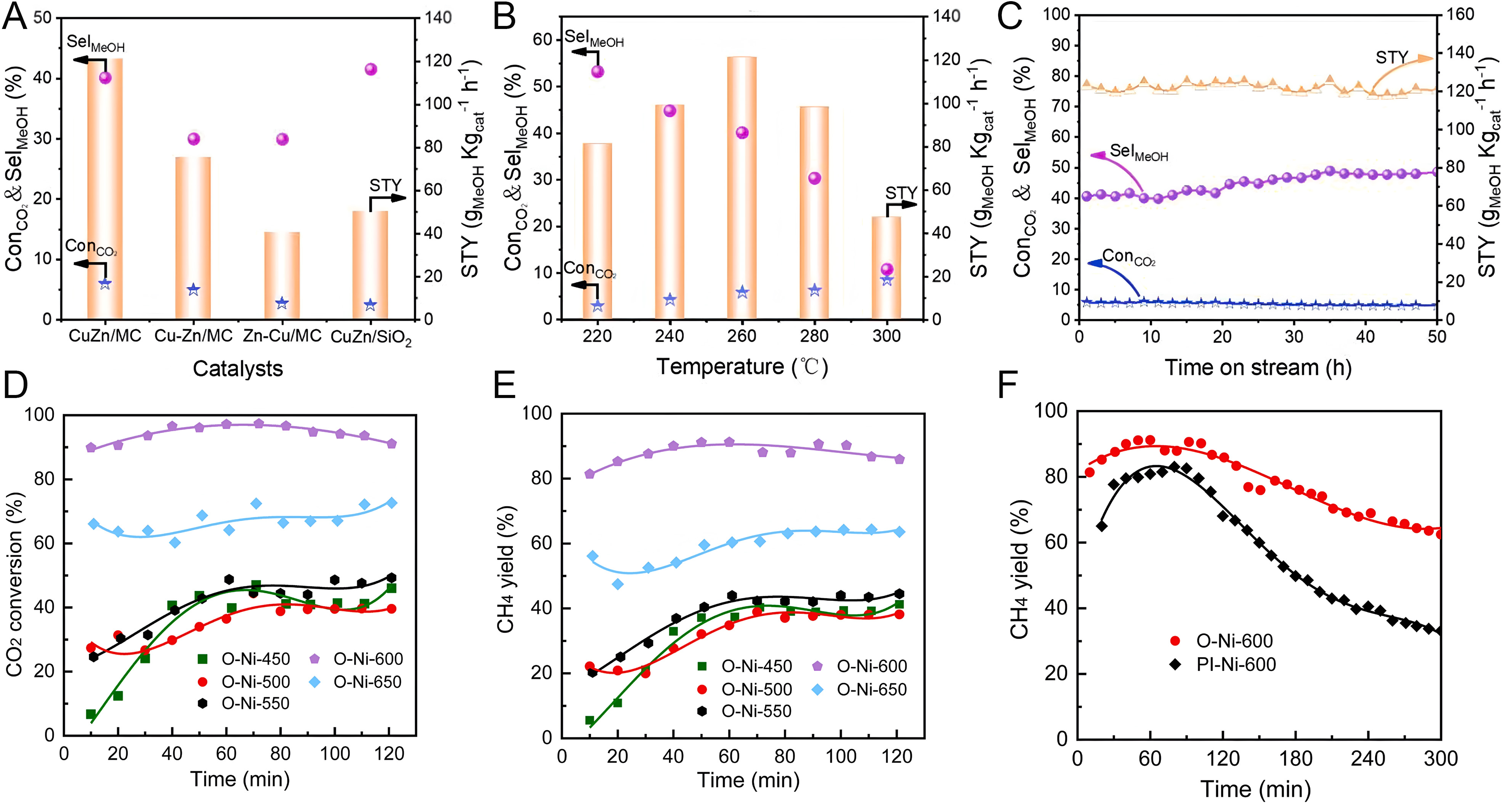
Figure 7. Performance of CO2 hydrogenation to methanol over (A) series of Cu-Zn catalysts and (B) varying reaction temperatures. (C) Durability evaluation of the CuZn/MC catalyst. (A-C) Reprinted with permission[143]. Copyright 2025, Elsevier. Influence of pyrolysis temperature on catalytic performance in CO2 methanation at 400 °C: (D) CO2 conversion, (E) CH4 yield. (F) CH4 yield in CO2 methanation at 400 °C as a function of preparation method. (D-F) Reprinted with permission[147]. Copyright 2026, Elsevier.
Beyond CH3OH synthesis, CO2 methanation to CH4 has received considerable attention as an attractive pathway for synthetic natural gas production. Villardon et al.[145] investigated olive stone-derived biochar as a sustainable support for Ni-based methanation catalysts. To tailor the structural and surface characteristics of the support, chemical activation was performed using KOH, ZnCl2, or H3PO4. Among the resulting materials, the KOH-activated biochar exhibited the highest surface area, superior Ni dispersion, and a greater density of moderately strong basic sites favorable for CO2 activation. Consequently, this catalyst achieved 72% CO2 conversion with 95.5% CH4 selectivity, outperforming the other activated counterparts. In contrast, H3PO4 activation led to partial encapsulation of Ni species, while ZnCl treatment promoted Ni-Zn alloy formation, both of which negatively affected methanation performance.
Furthermore, Wang et al.[146] developed NBC from Pinus sylvestris through an in-situ pyrolysis process employing urea as a nitrogen precursor and NaHCO3 as an activating agent. By adjusting the pyrolysis temperature, the distribution of nitrogen functionalities and surface basicity were systematically tuned. The catalytic performance showed a strong dependence on the proportion of pyridinic-N species. Notably, the Ru/N-ABC-600 catalyst, containing the highest pyridinic-N content (37.7%), delivered 93.8% CO2 conversion and 99.7% CH4 selectivity at 380 °C. The superior activity was attributed to enhanced electron density and surface basicity introduced by nitrogen incorporation, which facilitated Ru0 formation for H2 dissociation and strengthened CO2 adsorption, thereby promoting CH4 formation. Recently,
Electrocatalytic CO2 conversion
Electrochemical conversion of CO2 has emerged as a promising strategy for decarbonizing chemical industries, particularly when driven by renewable electricity. The electrochemical CO2 reduction reaction (CO2RR) enables the generation of a wide range of value-added products, including CO, formate, CH4, ethylene (C2H4), and ethanol (C2H5OH)[148-151]. By tailoring synthesis and activation processes, biochar with tunable porosity, surface functionalities, and defect density can be engineered, making it a versatile platform for electrocatalytic CO2 reduction.
One effective strategy involves integrating biochar into gas diffusion electrode (GDE) architectures to improve mass transport and interfacial charge transfer. Tan et al.[152] reported biochar-modified GDEs based on coconut husk (CH)-derived biochar. In their configuration, a polytetrafluoroethylene membrane served as the gas diffusion layer, while Ag nanoparticles constituted the catalyst layer. An additional conductive biochar layer, obtained by pyrolyzing CH at 700-900 °C, was introduced to enhance electrical conductivity and facilitate interfacial charge transport [Figure 8A]. Among the prepared electrodes, Ag/CH-900 exhibited the highest conductivity and superior electrochemical performance. Although all electrodes reached current densities of 300 mA cm-2, Ag/CH-900 required the least negative cathodic potential to achieve this value, indicating improved energy efficiency. Furthermore, it delivered CO faradaic efficiency (FECO) values of 94.4% at
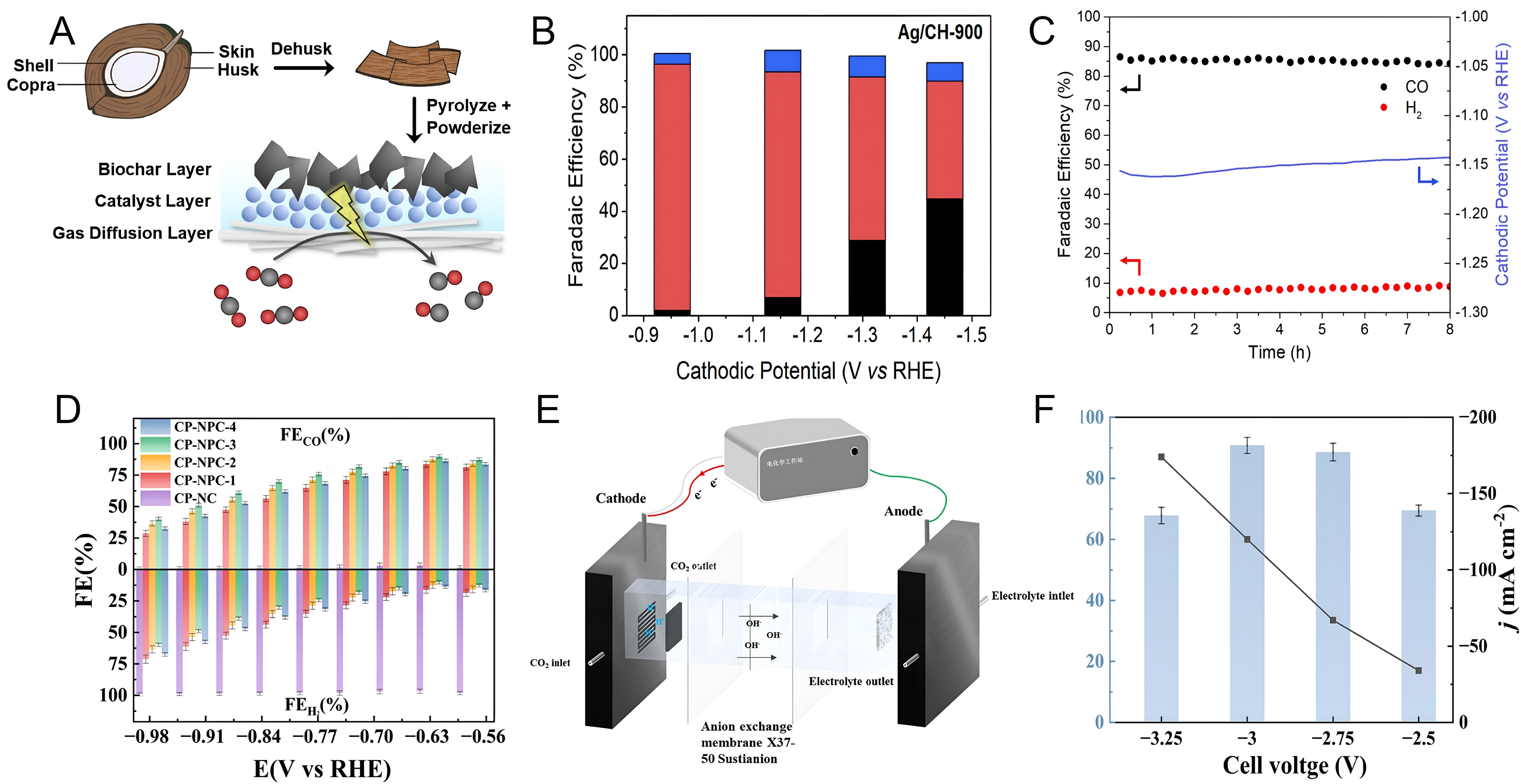
Figure 8. (A) Conceptual schematic of GDE using coconut husks-derived biochar. (B) FECO as a function of cathodic potential for Ag/CH-900. (C) Long-term stability test of Ag/CH-900. (A-C) Reprinted with permission[152]. Copyright 2023, Elsevier. (D) FECO and FEH2 for all prepared samples. (E) Schematic illustration of MEA cell. (F) FECO and corresponding current density of CP-NPC-3. (D-F) Reprinted with permission[154]. Copyright 2025, Elsevier.
Additionally, porosity engineering has been demonstrated to play a crucial role in modulating catalytic performance. Zhang et al.[155] reported the fabrication of biochar-derived Ni single-atom catalysts with precisely controlled pore architectures for efficient CO2 electroreduction. By tailoring the activation process through different combinations of KHCO3, KCl, and LiCl, microporous, mesoporous, and hierarchically porous carbon frameworks were constructed to anchor atomically dispersed Ni sites [Figure 9A]. In a typical synthesis, glossy privet biomass was first subjected to HTC, followed by high-temperature activation at
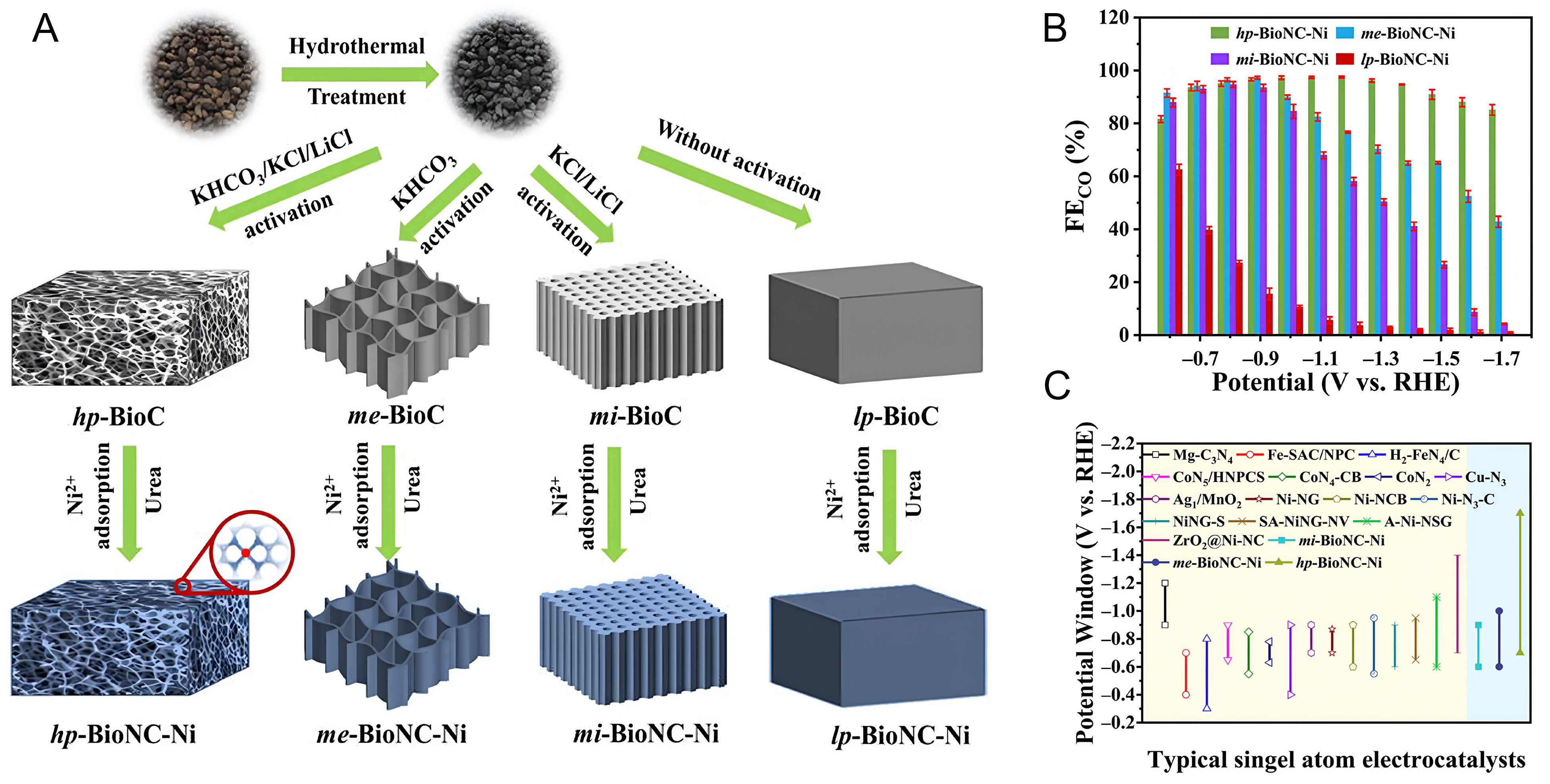
Figure 9. (A) Schematic representation of the preparation of biochar-derived single-atom Ni catalysts with tunable porosity. (B) FECO comparison of hp-BioNC-Ni, me-BioNC-Ni, mi-BioNC-Ni, and lp-BioNC-Ni. (C) Potential ranges of state-of-the-art carbon-based SACs. This figure quoted with permission[155]. Copyright 2023, John Wiley and Sons.
Moreover, Wang et al.[156] synthesized biochar-supported Au nanoparticle (Au NP) composites using swine manure as a biomass precursor. Due to its intrinsic abundance of heteroatoms such as nitrogen and oxygen, swine manure provides a favorable source for producing functional carbon materials. Manure-derived biochar was first obtained via hydrothermal treatment, followed by KOH activation to construct a porous carbon framework. Pre-synthesized Au nanoparticles were then uniformly deposited onto the activated biochar through ultrasonic-assisted dispersion, yielding a series of composites with different Au loadings, designated as Au/BC-0.1, Au/BC-0.6, and Au/BC-1.2. The electrocatalytic performance was evaluated in 1 M KOH electrolyte. Among the prepared catalysts, Au/BC-1.2 exhibited the highest CO selectivity, achieving a FECO of 87.72% at -0.4 V vs. RHE, along with a jCO of 41.3 mA·cm-2. Notably, Au/BC-0.1 delivered a remarkable mass activity of 9,451 A·g·Au-1, highlighting the possibility of reducing noble metal loading while maintaining high catalytic performance.
Beyond selective CO production, biochar-based catalysts have been investigated for the generation of multicarbon (C2+) products such as C2H4 and C2H5OH[157-161]. The tunable pore architecture and abundant surface functionalities of biochar can modulate intermediate adsorption and facilitate C-C coupling, a critical step in C2+ formation. For example, Yu et al.[159] designed a Cu/CuO catalyst supported on phosphorus-enriched carbon obtained from Ceratophyllum demersum L. (denoted as Cu-CuO/P-CCDL) for the selective electrochemical reduction of CO2 to C2H5OH. The biomass precursor inherently contains substantial amounts of carbon, oxygen, and phosphorus within its biological framework, enabling direct phosphorus incorporation into the carbon matrix during carbonization without the need for external dopants. Electrocatalytic measurements were conducted in an H-type cell using CO2-saturated 0.5 M NH4Cl as the electrolyte. Under these conditions, the Cu-CuO/P-CCDL-600 catalyst achieved a C2H5OH selectivity of 38.9% at -1.5 V vs. RHE. Additionally, it exhibited a favorable faradaic efficiency distribution, with a higher proportion of C2+ products relative to competing C1 species and hydrogen evolution. The enhanced CC coupling capability was attributed to the synergistic interaction between Cu/CuO active sites and the phosphorus-modified carbon framework.
Chen et al.[160] employed locust leaves as a biomass precursor to fabricate high-performance Cu-based electrocatalysts for CO2 reduction. The biomass-derived carbon was first activated with K2CO3 and pyrolyzed under an N2 atmosphere to produce porous biochar. Subsequently, a series of CuxO@C composites were prepared via a solvothermal method, in which the carbon content was systematically adjusted by varying the amount of introduced biochar. The electrocatalytic performance was evaluated in an H-type cell using 0.5 M KHCO3 as the electrolyte. Among the series, CuxO@C-2, exhibited the highest FEC2+ of 41.3% at -1.08 V vs. RHE, approximately 1.7 times higher than that of the pristine CuxO catalyst. To further elucidate the interaction between the catalyst surface and reaction intermediates, single oxidative scans were conducted to probe OH- adsorption behavior. CuxO@C-2 displayed the most negative OH- adsorption potential (-0.71 V vs. RHE), followed by CuxO@C-3 (-0.66 V), CuxO@C-1 (-0.60 V), and pristine CuxO (-0.55 V). The more negative adsorption potential indicates stronger binding affinity toward OH- species, suggesting more favorable intermediate stabilization in CuxO@C-2. Hu et al.[161] developed Cu-based electrocatalysts for selective C2+ production using pig manure-derived biochar as a carbon support prepared via a hydrothermal strategy. The optimized catalyst, denoted as Cu-NB-2000, achieved an FEC2+ of 47.35% with a jC2+ of
Photocatalytic CO2 conversion
Solar-driven CO2 reduction into value-added fuels has attracted significant attention as a sustainable strategy to address energy shortages and climate change. Nevertheless, the practical efficiency and product selectivity of photocatalytic CO2 conversion are often limited by the high thermodynamic barrier for C=O bond activation and the rapid recombination of photogenerated charge carriers. Therefore, the rational design of photocatalysts with optimized electronic structures and efficient charge-separation pathways is essential to improve CO2 reduction performance. In this context, biochar has emerged as a promising component in photocatalytic systems. Owing to its intrinsic electrical conductivity and tunable surface chemistry, biochar can serve as an electron mediator or conductive scaffold in semiconductor-based composites, effectively suppressing charge recombination. This conductive network facilitates rapid electron transport, reduces interfacial charge-transfer resistance, and enhances overall photocatalytic activity.
For example, Lv et al.[162] reported the hydrothermal synthesis of a CuS-loaded NBC composite derived from corncob powder. Electrostatic attraction between negatively charged NBC and positively charged CuS in aqueous solution enabled uniform immobilization of CuS nanoparticles on the biochar surface, forming well-defined heterointerfaces. Zeta potential measurements [Figure 10A] confirmed the opposite surface charges of the two components, supporting their spontaneous assembly. The resulting interfacial junctions generated localized electric fields that promoted directional charge transfer and improved the utilization of active sites. Consequently, the CuS/NBC composite achieved a CO production rate of 2.85 μmol·g-1·h-1 under 4 h of continuous illumination, significantly surpassing that of pristine CuS
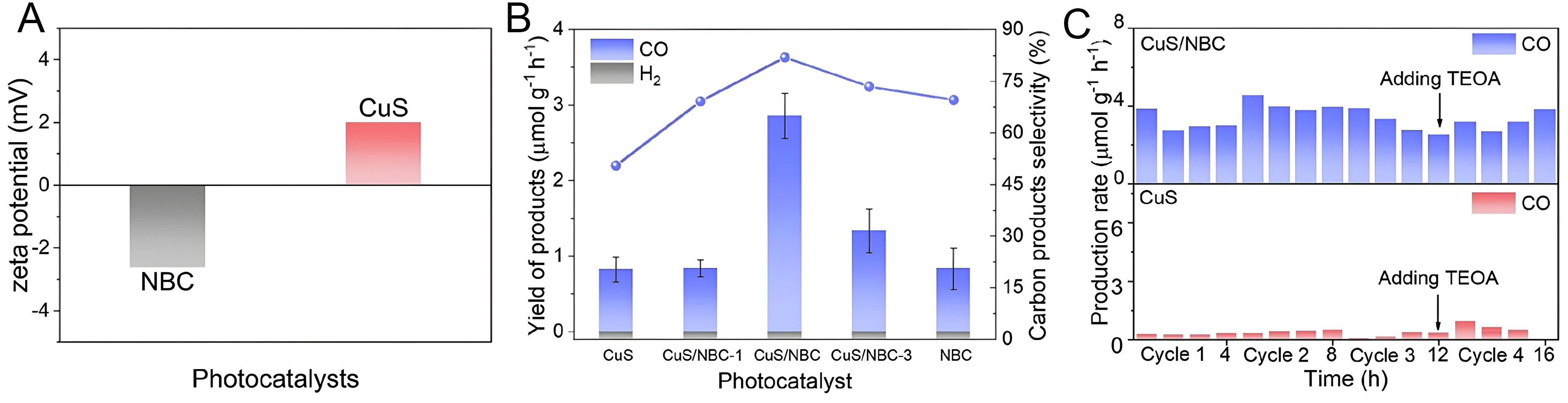
Figure 10. (A) Comparison of zeta potential between NBC and CuS. (B) Photocatalytic CO and H2 production yields of the as-synthesized samples. (C) Catalyst recyclability of CuS/NBC compared with CuS. This figure quoted with permission[162]. Copyright 2026, Elsevier.
Yang et al.[165] prepared a cherry blossom-derived biochar-modified Co-Al layered double hydroxide photocatalyst (Co-Al LDH-C) via an ultrasonic-assisted solvent treatment. Compared with pristine Co-Al LDH, the biochar-integrated composite demonstrated markedly enhanced CO2 reduction performance. Under optimized conditions, Co-Al LDH-C achieved a CO production rate of 29.2 µmol·g-1 approximately 15 times higher than that of the unmodified Co-Al LDH (2.1 µmol·g-1). The enhanced activity was attributed to improved light absorption, accelerated charge separation, and reduced carrier transport resistance induced by biochar incorporation, which collectively increased the density of accessible active sites. Furthermore, only a slight decrease in CO evolution was observed after 30 h of continuous operation, confirming satisfactory long-term stability. Structural and spectroscopic analyses indicated that the synergistic interaction between biochar and Co-Al LDH was critical for promoting photocatalytic CO2 conversion. Zhang et al.[166] synthesized NiO nanoparticle-decorated activated pinecone-derived biochar (NiO/APC) composites via a two-step strategy. Pinecones were first carbonized and chemically activated with KOH to construct a tubular porous carbon framework, where gaseous species generated during activation created abundant pore structures. The surface functional groups formed during this process promoted the adsorption of Ni2+ ions, which were subsequently converted into NiO nanoparticles through heat treatment at 300 °C under oxygen-deficient conditions. Photoluminescence (PL) spectra revealed that the NiO/APC composites exhibited markedly lower emission intensities than pristine NiO, with NiO/APC-3 showing the weakest signal. The suppressed PL intensity indicates reduced charge recombination and improved separation of photogenerated carriers, attributed to efficient electron transfer across the conductive APC support. Consequently, NiO/APC-3 demonstrated markedly enhanced photocatalytic activity, achieving CH4 and CO production yields of 81.06 and 15.00 μmol·g-1, respectively, which are 66.4 and 1.9 times higher than those of pristine NiO, and 2.0 and 1.2 times higher than those of NiO/PC.
Table 3 highlights that product selectivity differs markedly among thermocatalytic, electrocatalytic, and photocatalytic CO2 conversion pathways. While pore architecture influences local CO2 enrichment, reactant transport, and active-site accessibility, product selectivity is ultimately governed by the interplay between the supported active centers and their interactions with key reaction intermediates. Therefore, rational engineering of biochar porosity and surface chemistry should be tailored to the specific reaction pathway rather than relying on a single structural parameter.
Summary of biochar-based catalysts for CO2 chemical utilization
| Catalysts | Main product | Selectivity | Ref. | |
| Thermocatalytic | Cu-Mo2C/EPBC | CO | 99.95% | [142] |
| CuZn/MC | CH3OH | STY of 121.25 gMeOH·Kgcat-1·h-1 | [143] | |
| Cu/ZnO@BC | STY of 496.5 mgMeOH·gCu-1·h-1, | [144] | ||
| 10Ni-KOH | CH4 | 95.4% | [145] | |
| Ru/N-ABC-600 | 99.7% | [146] | ||
| O-Ni-600 | 90%-95% | [147] | ||
| Electrocatalytic | Ag/CH-900 | CO | 94.4% @ 50 mA cm-2 and 86.5% @100 mA cm-2 (Flow cell) | [152] |
| NiPc/N-BMBC | 86% @ -0.80 VRHE (H-cell) | [153] | ||
| CP-NPC-3 | 89.8%@-0.62 VRHE (H-cell)/90.79% (MEA) | [154] | ||
| hp-BioNC-Ni | 97.4%@-1.2 VRHE (H-cell) | [155] | ||
| Au/BC-1.2 | 87.72%@-0.4 VRHE (Flow cell) | [156] | ||
| Cu-CuO/P-CCDL | C2H5OH | 38.9%@-1.5 VRHE (H-cell) | [159] | |
| CuxO@C-2 | C2+ | 41.3%@-1.08 VRHE (H-cell) | [160] | |
| Cu-NB-2000 | 47.35%@-1.51 VRHE (Flow cell) | [161] | ||
| Photocatalytic | CuS/NBC | CO | 12 μmol·g-1 | [162] |
| CDB-3 | 48.3 μmol·h-1 | [163] | ||
| CN-BIO/CeO2 | 69.1 μmol·g-1 | [164] | ||
| Co-Al LDH | 29.2 µmol·g-1 | [165] | ||
| NiO/APC | CH4 | 81.06 μmol·g-1 | [166] | |
CONCLUSION AND FUTURE PROSPECTS
In summary, this review has systematically highlighted the immense potential of rationally designed biochar as a sustainable, cost-effective, and highly efficient platform for both CO2 capture and subsequent catalytic conversion. Driven by the urgent need to mitigate anthropogenic greenhouse gas emissions, biochar has transcended its traditional role as a passive carbon storage medium. Through the judicious selection of biomass precursors and advanced synthesis strategies such as tailored pyrolysis, hydrothermal method, and targeted activation, the physicochemical properties of biochar can be precisely engineered. We have discussed how hierarchical pore architectures govern physical adsorption, while the introduction of non-metallic heteroatoms via chemical modification substantially enhances surface basicity, thereby boosting chemisorption. Furthermore, this review comprehensively covered the catalytic utilization of biochar-based materials. By serving as an intrinsic catalyst or as a robust support for metal nanoparticles and single atoms, biochar significantly improves the efficiency, selectivity, and stability of CO2 conversion across thermocatalytic, electrocatalytic, and photocatalytic pathways.
Despite these promising advancements, several critical challenges must be addressed to overcome the disparity between laboratory-scale research and industrial-scale deployment. First, the inherent heterogeneity of biomass sources often leads to batch-to-batch variations, complicating the reproducibility of biochar properties. Second, the fundamental understanding of the structure-property-performance relationships remains insufficiently explored, especially concerning the dynamic interactions between CO2 molecules, reaction intermediates, and the active sites on the biochar surface during complex reaction conditions. Finally, the long-term stability and resistance to poisoning by impurities typically present in real-world flue gases such as moisture, SOx and NOx demand more rigorous evaluation.
To overcome these hurdles and advance the field, several future research directions are highly recommended. Foremost, the integration of advanced in-situ and operando characterization techniques combined with theoretical calculations is imperative. These tools will elucidate the dynamic evolution of active sites, clarify the exact mechanisms of CO2 activation, and identify intermediate species in real time, thereby guiding the molecular-level design of both superior biochar adsorbents and catalysts. Concurrently, to resolve the critical issues of competitive adsorption and the poisoning of both biochar-based adsorbents and catalysts, future studies should prioritize the advanced surface engineering of biochar. Strategies such as tuning surface hydrophobicity or introducing highly CO2-selective functional groups are essential to repel moisture and resist SOx and NOx degradation. Additionally, rigorous long-term cyclic testing under simulated or actual industrial flue gas conditions rather than pure CO2 streams should be established as a standard protocol to validate the commercial viability of these materials.
Moreover, the traditional trial-and-error approach to biochar synthesis is highly resource-intensive and time-consuming. Therefore, the implementation of machine learning (ML) and artificial intelligence algorithms is emerging as a critical necessity for future breakthroughs. ML models can efficiently manage and analyze vast datasets derived from diverse experimental studies, establishing complex correlations among biomass precursors, pyrolysis parameters, activation methods, and the resulting catalytic or adsorptive performance. By predicting the optimal synthesis conditions required to achieve specific pore structures or target heteroatom configurations, ML-guided materials design will drastically accelerate the discovery and optimization of high-performance biochar architecture.
Ultimately, the future of CO2 mitigation technologies lies in the development of ICCU systems. Conventional CCU processes operate in tandem, requiring highly energy-intensive desorption, compression, and transportation steps between the capture and conversion stages. In this context, biochar can act as a uniquely promising platform for ICCU as a dual functional material. Thanks to its highly tunable nature, biochar can be engineered to possess both robust CO2 adsorption sites and highly active catalytic centers. In an ICCU framework, the rationally designed biochar can directly capture CO2 from dilute emission sources and immediately convert the trapped CO2 into value-added chemicals upon switching to the requisite catalytic reaction conditions. This integrated approach can decrease the thermodynamic penalty of intermediate CO2 desorption, significantly reducing the overall energy footprint and operational costs.
In conclusion, leveraging rationally designed biochar for CO2 capture and conversion represents a highly promising, circular economy approach to global carbon management. By embracing predictive modeling through ML and advancing toward integrated ICCU technologies, the transition of biochar-based systems from laboratory-scale research to practical climate solutions can be successfully realized.
DECLARATIONS
Authors’ contributions
Proposed the topic of this review: Kim, S. Y.
Prepared the manuscript: Ma, J.; Kim, J. H.
Data curation: Abdi-Jalebi, M.
Availability of data and materials
Not applicable.
AI and AI-assisted tools statement
During the preparation of this manuscript, the AI tool ChatGPT (OpenAI) (version GPT-5.6, released 2026 07-09) was used solely for language editing. The tool did not influence the study design, data collection, analysis, interpretation, or the scientific content of the work. The AI tool Nano Banana 2 (version Gemini 3.1 Flash Image, released 2026 02-26) was used only for the partial creation of the Graphical Abstract. Specifically, it was used to generate three graphical elements: (i) the porous biochar structure illustrating CO2 adsorption, (ii) the biochar-supported catalytic structure, and (iii) the biochar powder illustration. The AI tools did not influence the study design, data collection, analysis, interpretation, or scientific content of the work. All authors take full responsibility for the accuracy, integrity, and final content of the manuscript and Graphical Abstract.
Financial support and sponsorship
This research was supported by the Basic Science Research Program through the National Research Foundation of Korea (NRF) funded by the Ministry of Education (RS-2024-00414848, RS-2025-25421582, RS-2025-00558945).
Conflicts of interest
All authors declared that there are no conflicts of interest.
Ethical approval and consent to participate
Not applicable.
Consent for publication
Not applicable.
Copyright
© The Author(s) 2026.
REFERENCES
1. Do, H. H. Recent progress and perspectives of Co3O4-based electrocatalysts for oxygen evolution reaction. Trans. Electr. Electron. Mater. 2025, 26, 667-78.
2. Wang, N.; Zhou, J.; Ren, J. Recent advances in CO2 capture and utilization: from the perspective of process integration and optimization. Renew. Sustain. Energy. Rev. 2025, 216, 115688.
3. Kumar, H.; Sharma, R.; Malik, A. K.; Sharma, A. K.; Kumar, P.; Singh, D. Advancements in carbon capture and utilization technologies: transforming CO2 into valuable resources for a sustainable carbon economy. Next. Energy. 2026, 10, 100476.
4. Li, X.; Wang, H.; Huang, J.; Meng, L.; Li, J.; Huang, M. Advances in the application of metal-organic frameworks(MOFs) for carbon capture and catalytic conversion. J. Environ. Chem. Eng. 2025, 13, 120065.
5. Bharatee, R. K.; Quaff, A. R.; Jaiswal, S. K. Advances in perovskite membranes for carbon capture & utilization: a sustainable approach to CO2 emissions reduction - A review. J. Environ. Manag. 2025, 380, 124924.
6. Devadiga, M. M.; Bhat, A. S.; Sarangi, S.; et al. Describing critical barriers in commercial deployment of CO2 capture and utilization technologies. Energy. Environ. Sci. 2026, 19, 743-90.
7. Zhang, Z.; Li, Y.; Zhong, Y.; et al. sp2/sp3-hybridized nitrogen-mediated electrochemical CO2 capture and utilization. Sci. Adv. 2025, 11, eadw6592.
8. Ganiyu, S. A. Review of zeolitic-based sorbents for CO2 capture: insights into functional modifications, economic feasibility and machine learning-enhanced strategies. Chem. Eng. J. Adv. 2025, 23, 100818.
9. Whaieb, A. H.; Jasim, F. T.; Abdulrahman, A. A.; et al. Tailoring zeolites for enhanced post-combustion CO2 capture: a critical review. Curr. Res. Green. Sustain. Chem. 2025, 10, 100451.
10. Darunte, L. A.; Walton, K. S.; Sholl, D. S.; Jones, C. W. CO2 capture via adsorption in amine-functionalized sorbents. Curr. Opin. Chem. Eng. 2016, 12, 82-90.
11. Khan, S. A.; Ahmed, S.; Ali, S.; Altaf, F. Advances in CO2 capture materials: from strategies to CO2-based fertilizers for a sustainable future. Carbon. Neutral. 2025, 4, e70063.
12. Zentou, H.; Hoque, B.; Abdalla, M. A.; et al. Recent advances and challenges in solid sorbents for CO2 capture. Carbon. Capture. Sci. Technol. 2025, 15, 100386.
13. Ibitoye, S. E.; Mahamood, R. M.; Jen, T.; Loha, C.; Akinlabi, E. T. An overview of biomass solid fuels: biomass sources, processing methods, and morphological and microstructural properties. J. Bioresour. Bioprod. 2023, 8, 333-60.
14. Chandran, C.; Mohan, M.; Dawi, E.; et al. Biochar-derived carbon nanomaterials in electrocatalytic water splitting for hydrogen production. Chem. Rec. 2025, 26, 2500093.
15. Lam, E.; Luong, J. H. Carbon materials as catalyst supports and catalysts in the transformation of biomass to fuels and chemicals. ACS. Catal. 2014, 4, 3393-410.
16. Peters, J. F.; Iribarren, D.; Dufour, J. Biomass pyrolysis for biochar or energy applications? A life cycle assessment. Environ. Sci. Technol. 2015, 49, 5195-202.
17. Shaheen, J.; Fseha, Y. H.; Sizirici, B. Performance, life cycle assessment, and economic comparison between date palm waste biochar and activated carbon derived from woody biomass. Heliyon 2022, 8, e12388.
18. El Refaay, D.; Khalafallah, D.; Wang, Z.; Henaish, A.; Lin, W.; Zhang, Q. Waste-to-wealth: biomass-derived sustainable materials for energy storage applications. J. Ind. Eng. Chem. 2026, 156, 254-90.
19. Afridi, A. M.; Aktary, M.; Shaheen Shah, S.; et al. Advancing electrical engineering with biomass-derived carbon materials: applications, innovations, and future directions. Chem. Rec. 2024, 24, e202400144.
20. Yu, S.; Zhang, W.; Dong, X.; et al. A review on recent advances of biochar from agricultural and forestry wastes: Preparation, modification and applications in wastewater treatment. J. Environ. Chem. Eng. 2024, 12, 111638.
21. Xu, J.; Xie, Y.; Yao, Q.; Lv, L.; Chu, H. Advances in sustainable nano-biochar: precursors, synthesis methods and applications. Nanoscale 2024, 16, 15009-32.
22. Meng, X.; Gao, S.; Kozinski, J. A.; Ruan, R.; Fang, Z. Biochar-based oxygen electrocatalysts for advanced Zn-air batteries: mechanisms, applications, and prospects. Chem. Eng. J. 2026, 529, 172878.
23. Afshar, M.; Mofatteh, S. Biochar for a sustainable future: Environmentally friendly production and diverse applications. Results. Eng. 2024, 23, 102433.
24. Manikandan, S.; Vickram, S.; Subbaiya, R.; et al. Comprehensive review on recent production trends and applications of biochar for greener environment. Bioresour. Technol. 2023, 388, 129725.
25. Guo, S.; Li, Y.; Wang, Y.; Wang, L.; Sun, Y.; Liu, L. Recent advances in biochar-based adsorbents for CO2 capture. Carbon. Capture. Sci. Technol. 2022, 4, 100059.
26. Zhang, Y.; Wang, S.; Feng, D.; et al. Functional biochar synergistic solid/liquid-phase CO2 capture: a review. Energy. Fuels. 2022, 36, 2945-70.
27. Dissanayake, P. D.; You, S.; Igalavithana, A. D.; et al. Biochar-based adsorbents for carbon dioxide capture: a critical review. Renew. Sustain. Energy. Rev. 2020, 119, 109582.
28. Cetin, E.; Moghtaderi, B.; Gupta, R.; Wall, T. Influence of pyrolysis conditions on the structure and gasification reactivity of biomass chars. Fuel 2004, 83, 2139-50.
29. Leng, L.; Huang, H. An overview of the effect of pyrolysis process parameters on biochar stability. Bioresour. Technol. 2018, 270, 627-42.
30. Fakayode, O. A.; Aboagarib, E. A. A.; Zhou, C.; Ma, H. Co-pyrolysis of lignocellulosic and macroalgae biomasses for the production of biochar - A review. Bioresour. Technol. 2020, 297, 122408.
31. He, Q.; Cheng, C.; Raheem, A.; Ding, L.; Shiung, Lam. S.; Yu, G. Effect of hydrothermal carbonization on woody biomass: from structure to reactivity. Fuel 2022, 330, 125586.
32. Böttger, J.; Eckhard, T.; Pflieger, C.; Senneca, O.; Muhler, M.; Cerciello, F. Green coal substitutes for boilers through hydrothermal carbonization of biomass: pyrolysis and combustion behavior. Fuel 2023, 344, 128025.
33. You, S.; Ok, Y. S.; Chen, S. S.; et al. A critical review on sustainable biochar system through gasification: Energy and environmental applications. Bioresour. Technol. 2017, 246, 242-53.
34. Li, J.; Dai, J.; Liu, G.; et al. Biochar from microwave pyrolysis of biomass: a review. Biomass. Bioenergy. 2016, 94, 228-44.
35. Hadiya, V.; Popat, K.; Vyas, S.; et al. Biochar production with amelioration of microwave-assisted pyrolysis: current scenario, drawbacks and perspectives. Bioresour. Technol. 2022, 355, 127303.
36. Pallarés, J.; González-Cencerrado, A.; Arauzo, I. Production and characterization of activated carbon from barley straw by physical activation with carbon dioxide and steam. Biomass. Bioenergy. 2018, 115, 64-73.
37. Thue, P. S.; Lima, D. R.; Lima, E. C.; et al. Comparative studies of physicochemical and adsorptive properties of biochar materials from biomass using different zinc salts as activating agents. J. Environ. Chem. Eng. 2022, 10, 107632.
38. Chen, W.; Gong, M.; Li, K.; et al. Insight into KOH activation mechanism during biomass pyrolysis: chemical reactions between O-containing groups and KOH. Appl. Energy. 2020, 278, 115730.
39. Yang, H.; Chen, P.; Chen, W.; et al. Insight into the formation mechanism of N, P co-doped mesoporous biochar from H3PO4 activation and NH3 modification of biomass. Fuel. Process. Technol. 2022, 230, 107215.
40. Lin, Y.; Dai, W.; Cao, J.; Zou, Y.; Feng, C.; Liu, H. Biomass-derived carbon electrocatalysts for oxygen evolution reaction: Progress and perspective. J. Electroanal. Chem. 2026, 1007, 119837.
41. Clemente-Castro, S.; Palma, A.; Ruiz-Montoya, M.; Giráldez, I.; Díaz, M. J. Optimizing pyrolysis parameters and product analysis of a fluidized bed pilot plant for Leucaena leucocephala biomass. Environ. Sci. Eur. 2023, 35, 88.
42. Li, J.; Xu, K.; Yao, X.; Liu, J.; Su, D.; Wang, B. Study on the effect of biochar catalyst on the formation of biomass slow pyrolysis products. Fuel 2025, 392, 134862.
43. Dananjaya, V.; Hansika, N.; Chevali, V.; et al. Advancing energy storage technologies beyond lithium with cellulose-derived sustainable carbon materials. Small. Struct. 2025, 7, e202500551.
44. Song, Y.; Tan, J.; Jin, M.; et al. Effect of pyrolysis temperature and heating rate on the physicochemical properties of alkali lignin-derived biochar: a comparative study of fast and slow pyrolysis. J. Anal. Appl. Pyrolysis. 2025, 191, 107236.
45. Conti, R.; Fabbri, D.; Vassura, I.; Ferroni, L. Comparison of chemical and physical indices of thermal stability of biochars from different biomass by analytical pyrolysis and thermogravimetry. J. Anal. Appl. Pyrolysis. 2016, 122, 160-8.
46. Tripathi, M.; Sahu, J.; Ganesan, P. Effect of process parameters on production of biochar from biomass waste through pyrolysis: a review. Renew. Sustain. Energy. Rev. 2016, 55, 467-81.
47. Fang, J.; Zhan, L.; Ok, Y. S.; Gao, B. Minireview of potential applications of hydrochar derived from hydrothermal carbonization of biomass. J. Ind. Eng. Chem. 2018, 57, 15-21.
48. Adeniyi, A. G.; Iwuozor, K. O.; Emenike, E. C.; et al. Leaf-based biochar: a review of thermochemical conversion techniques and properties. J. Anal. Appl. Pyrolysis. 2024, 177, 106352.
49. Wang, Q.; Wu, S.; Cui, D.; et al. Co-hydrothermal carbonization of organic solid wastes to hydrochar as potential fuel: a review. Sci. Total. Environ. 2022, 850, 158034.
50. Ma, R.; Fakudze, S.; Shang, Q.; et al. Catalytic hydrothermal carbonization of pomelo peel for enhanced combustibility of coal/hydrochar blends and reduced CO2 emission. Fuel 2021, 304, 121422.
51. Heidari, M.; Dutta, A.; Acharya, B.; Mahmud, S. A review of the current knowledge and challenges of hydrothermal carbonization for biomass conversion. J. Energy. Inst. 2019, 92, 1779-99.
52. Guo, S.; Gao, Y.; Wang, Y.; et al. Urea/ZnCl2 in situ hydrothermal carbonization of Camellia sinensis waste to prepare N-doped biochar for heavy metal removal. Environ. Sci. Pollut. Res. 2019, 26, 30365-73.
53. Querejeta, N.; Gil, M. V.; Rubiera, F.; Pevida, C. Sustainable coffee-based CO2 adsorbents: toward a greener production via hydrothermal carbonization. Greenhouse. Gases. 2017, 8, 309-23.
54. Zhang, Z.; Cano, Z. P.; Luo, D.; Dou, H.; Yu, A.; Chen, Z. Rational design of tailored porous carbon-based materials for CO2 capture. J. Mater. Chem. A. 2019, 7, 20985-1003.
55. Schonvogel, D.; Nowotny, M.; Woriescheck, T.; et al. Hydrothermal carbonization-derived carbon from waste biomass as renewable Pt support for fuel cell applications: role of carbon activation. Energy. Technol. 2019, 7, 1900344.
56. Rajput, V.; Saini, I.; Parmar, S.; et al. Biochar production methods and their transformative potential for environmental remediation. Discov. Appl. Sci. 2024, 6, 408.
57. Hansen, V.; Müller-Stöver, D.; Ahrenfeldt, J.; Holm, J. K.; Henriksen, U. B.; Hauggaard-Nielsen, H. Gasification biochar as a valuable by-product for carbon sequestration and soil amendment. Biomass. Bioenergy. 2015, 72, 300-8.
58. Zhang, Y.; Wan, L.; Guan, J.; Xiong, Q.; Zhang, S.; Jin, X. A review on biomass gasification: effect of main parameters on char generation and reaction. Energy. Fuels. 2020, 34, 13438-55.
59. Fryda, L.; Visser, R. Biochar for soil improvement: evaluation of biochar from gasification and slow pyrolysis. Agriculture 2015, 5, 1076-115.
60. Peterson, S. C.; Jackson, M. A. Simplifying pyrolysis: using gasification to produce corn stover and wheat straw biochar for sorptive and horticultural media. Ind. Crops. Prod. 2014, 53, 228-35.
61. Brewer, C. E.; Schmidt-Rohr, K.; Satrio, J. A.; Brown, R. C. Characterization of biochar from fast pyrolysis and gasification systems. Environ. Prog. Sustain. Energy. 2009, 28, 386-96.
62. Zhang, Y.; Fan, S.; Liu, T.; Fu, W.; Li, B. A review of biochar prepared by microwave-assisted pyrolysis of organic wastes. Sustain. Energy. Technol. Assess. 2022, 50, 101873.
63. Shen, Y. Microwave-assisted pyrolysis of biomass and plastic wastes for hydrogen production. Green. Chem. 2025, 27, 10402-22.
64. Suresh, A.; Alagusundaram, A.; Kumar, P. S.; et al. Microwave pyrolysis of coal, biomass and plastic waste: a review. Environ. Chem. Lett. 2021, 19, 3609-29.
65. Foong, S. Y.; Chan, Y. H.; Yek, P. N. Y.; et al. Microwave-assisted pyrolysis in biomass and waste valorisation: insights into the life-cycle assessment (LCA) and techno-economic analysis (TEA). Chem. Eng. J. 2024, 491, 151942.
66. Skubiszewska-Zięba, J.; Charmas, B.; Kołtowski, M.; Oleszczuk, P. Active carbons from waste biochars: structural and thermal properties. J. Therm. Anal. Calorim. 2017, 130, 15-24.
67. Anto, S.; Sudhakar, M.; Shan, Ahamed. T.; et al. Activation strategies for biochar to use as an efficient catalyst in various applications. Fuel 2021, 285, 119205.
68. Panwar, N. L.; Pawar, A. Influence of activation conditions on the physicochemical properties of activated biochar: a review. Biomass. Conv. Bioref. 2020, 12, 925-47.
69. Akhil, D.; Lakshmi, D.; Kartik, A.; Vo, D. N.; Arun, J.; Gopinath, K. P. Production, characterization, activation and environmental applications of engineered biochar: a review. Environ. Chem. Lett. 2021, 19, 2261-97.
70. Venkatachalam, C. D.; Sekar, S.; Sengottian, M.; Ravichandran, S. R.; Bhuvaneshwaran, P. A critical review of the production, activation, and morphological characteristic study on functionalized biochar. J. Energy. Storage. 2023, 67, 107525.
71. Pandey, D.; Daverey, A.; Arunachalam, K. Biochar: production, properties and emerging role as a support for enzyme immobilization. J. Clean. Prod. 2020, 255, 120267.
72. Cheng, B.; Zeng, R. J.; Jiang, H. Recent developments of post-modification of biochar for electrochemical energy storage. Bioresour. Technol. 2017, 246, 224-33.
73. Chai, W. S.; Aslam, A. A.; Li, X.; Wu, T.; Pang, C. H. Surface-engineered biochar: recent advances in modification strategies for environmental remediation and energy applications. J. Environ. Chem. Eng. 2025, 13, 117951.
74. Sun, L. M.; Mcintyre, S. R.; Iacomi, P.; et al. Biochar production, activation, and applications: a comprehensive technical review. Carbon. Capture. Sci. Technol. 2025, 16, 100421.
75. Xu, Z.; He, M.; Xu, X.; Cao, X.; Tsang, D. C. Impacts of different activation processes on the carbon stability of biochar for oxidation resistance. Bioresour. Technol. 2021, 338, 125555.
76. Sajjadi, B.; Chen, W.; Egiebor, N. O. A comprehensive review on physical activation of biochar for energy and environmental applications. Rev. Chem. Eng. 2019, 35, 735-76.
77. Tsarpali, M.; Kuhn, J. N.; Philippidis, G. P. Activated carbon production from algal biochar: chemical activation and feasibility analysis. Fuel. Commun. 2024, 19, 100115.
78. Sajjadi, B.; Zubatiuk, T.; Leszczynska, D.; Leszczynski, J.; Chen, W. Y. Chemical activation of biochar for energy and environmental applications: a comprehensive review. Rev. Chem. Eng. 2019, 35, 777-815.
79. Sakhiya, A. K.; Baghel, P.; Anand, A.; Vijay, V. K.; Kaushal, P. A comparative study of physical and chemical activation of rice straw derived biochar to enhance Zn2+ adsorption. Bioresour. Technol. Rep. 2021, 15, 100774.
80. Longo, L.; Baldassin, D.; Di, Michele. A.; Bittencourt, C.; Menegazzo, F.; Signoretto, M. Activation strategies for rice husk biochar: enhancing porosity and performance as a support for Pd catalysts in hydrogenation reactions. Catal. Sci. Technol. 2025, 15, 5101-15.
81. Hayashi, J.; Horikawa, T.; Takeda, I.; Muroyama, K.; Nasir, Ani. F. Preparing activated carbon from various nutshells by chemical activation with K2CO3. Carbon 2002, 40, 2381-6.
82. Wang, J.; Kaskel, S. KOH activation of carbon-based materials for energy storage. J. Mater. Chem. 2012, 22, 23710.
83. Jagtoyen, M.; Derbyshire, F. Activated carbons from yellow poplar and white oak by H3PO4 activation. Carbon 1998, 36, 1085-97.
84. Angın, D.; Altintig, E.; Köse, T. E. Influence of process parameters on the surface and chemical properties of activated carbon obtained from biochar by chemical activation. Bioresour. Technol. 2013, 148, 542-9.
85. Yagmur, E.; Gokce, Y.; Tekin, S.; Semerci, N. I.; Aktas, Z. Characteristics and comparison of activated carbons prepared from oleaster (Elaeagnus angustifolia L.) fruit using KOH and ZnCl2. Fuel 2020, 267, 117232.
86. Lamata-Bermejo, I.; Alba, M. D.; Ramírez-Rico, J. Influence of the chemical activation with KOH/KNO3 on the CO2 adsorption capacity of activated carbons from pyrolysis of cellulose. J. Environ. Chem. Eng. 2024, 12, 114288.
87. Osman, A. I.; Hefny, M.; Abdel, Maksoud. M. I. A.; Elgarahy, A. M.; Rooney, D. W. Recent advances in carbon capture storage and utilisation technologies: a review. Environ. Chem. Lett. 2020, 19, 797-849.
88. Theo, W. L.; Lim, J. S.; Hashim, H.; Mustaffa, A. A.; Ho, W. S. Review of pre-combustion capture and ionic liquid in carbon capture and storage. Appl. Energy. 2016, 183, 1633-63.
89. Obi, D.; Onyekuru, S.; Orga, A. Minimizing carbon capture costs in power plants: a novel dimensional analysis framework for techno-economic evaluation of oxyfuel combustion, pre-combustion, and post-combustion capture systems. Energy. Sci. Eng. 2025, 13, 1749-70.
90. Kárászová, M.; Zach, B.; Petrusová, Z.; et al. Post-combustion carbon capture by membrane separation, Review. Sep. Purif. Technol. 2020, 238, 116448.
91. Plaza, M.; García, S.; Rubiera, F.; Pis, J.; Pevida, C. Post-combustion CO2 capture with a commercial activated carbon: comparison of different regeneration strategies. Chem. Eng. J. 2010, 163, 41-7.
92. Wang, R.; Wang, X.; Zhu, T. Research progress and application of carbon sequestration in industrial flue gas by microalge: a review. J. Environ. Sci. 2025, 152, 14-25.
93. Raganati, F.; Ammendola, P. CO2 Post-combustion capture: a critical review of current technologies and future directions. Energy. Fuels. 2024, 38, 13858-905.
94. Yusuf, M.; Ibrahim, H. A comprehensive review on recent trends in carbon capture, utilization, and storage techniques. J. Environ. Chem. Eng. 2023, 11, 111393.
95. Du, J.; Yang, W.; Xu, L.; et al. Review on post-combustion CO2 capture by amine blended solvents and aqueous ammonia. Chem. Eng. J. 2024, 488, 150954.
96. Knapik, E.; Kosowski, P.; Stopa, J. Cryogenic liquefaction and separation of CO2 using nitrogen removal unit cold energy. Chem. Eng. Res. Des. 2018, 131, 66-79.
97. Yang, J.; Cao, N.; Liu, Y.; Lu, Y. CO2 capture with adsorption strategies: achievements, challenges, and prospects. J. Clean. Prod. 2025, 515, 145798.
98. Rezaei, F.; Rownaghi, A. A.; Monjezi, S.; Lively, R. P.; Jones, C. W. SOx/NOx removal from flue gas streams by solid adsorbents: a review of current challenges and future directions. Energy. Fuels. 2015, 29, 5467-86.
99. Khan, H.; Arshad, M.; Jalal, A.; et al. Mechanistic and data-guided design of biochar adsorbents for gas phase pollution control: a state-of-the-art review. Environ. Sci. Pollut. Res. 2026, 33, 7424-51.
100. Ghazoui, M.; Boudouch, O.; Zahnoune, R.; et al. Next-generation biochar adsorbents from waste biomass: functionalization strategies and real-world water treatment applications. ENG. Environ. 2026, 20, 12.
101. Lund, A.; Manohara, G. V.; Song, A.; et al. Characterization of chemisorbed species and active adsorption sites in Mg-Al mixed metal oxides for high-temperature CO2 capture. Chem. Mater. 2022, 34, 3893-901.
102. Shen, X.; Lin, H.; Wang, H.; et al. Chemisorption contribution of support materials in CO2 capture by amine-impregnated adsorbents. J. Mater. Chem. A. 2025, 13, 36166-76.
103. Bekhti, H.; Boucheffa, Y.; Blal, A. A.; Travert, A. In situ FTIR investigation of CO2 adsorption over MgO-Impregnated NaY zeolites. Vib. Spectrosc. 2021, 117, 103313.
104. Kim, C.; Lee, S.; Park, S. Efficient micropore sizes for carbon dioxide physisorption of pine cone-based carbonaceous materials at different temperatures. J. CO2. Util. 2021, 54, 101770.
105. Liu, R. S.; Shi, X. D.; Wang, C. T.; et al. Advances in post-combustion CO2 capture by physical adsorption: from materials innovation to separation practice. ChemSusChem 2021, 14, 1428-71.
106. Singh, J.; Gupta, A.; Zhu, Z.; Tiwari, S. K.; Dhaliwal, A. S. Tailoring carbon nanomaterial architectures for CO2 capture: structure-property relationships, surface engineering, and future perspectives. Mater. Adv. 2026, 7, 3031-71.
107. Zhao, T.; He, X.; Islam, M. A.; Palash, M.; Saha, B. B. Metal-assisted pore architecture regulating CO2 adsorption and supercapacitor performance in biomass-derived carbons. Environ. Res. 2026, 305, 124986.
108. Ahn, H.; Kim, S.; Xu, R.; Lee, J. W.; Kang, Y. T. Structural modified metal-organic frameworks by hierarchical layer-by-layer method for efficient CO2 capture enhancement. J. CO2. Util. 2023, 77, 102603.
109. Wang, T.; Quan, X.; Sun, Z.; Sun, Z. Sustainable biochar synthesis via synergistic H2O2-KOH modification for enhanced CO2 physisorption. Carbon. Capture. Sci. Technol. 2025, 15, 100438.
110. Gan, F.; Wang, B.; Guo, J.; et al. Green synthesis of porous biochar with interconnected pore architectures from typical silicon-rich rice husk for efficient CO2 capture. Sep. Purif. Technol. 2022, 302, 122089.
111. Wang, C.; Luo, X.; Zhu, X.; et al. The strategies for improving carbon dioxide chemisorption by functionalized ionic liquids. RSC. Adv. 2013, 3, 15518.
112. Chen, J.; Li, H.; Zhong, M.; Yang, Q. Tuning the surface polarity of microporous organic polymers for CO2 capture. Chem. Asian. J. 2017, 12, 2291-8.
113. He, M.; Zhao, H.; Jia, J.; et al. Multiscale analysis of CO2 adsorption mechanisms on porous carbon: an investigation into the impact of intrinsic defects and pore size. Environ. Res. 2025, 267, 120701.
114. Zhong, Y.; Zheng, Z.; Hao, D.; et al. Electrochemically integrated carbon capture and utilization. ACS. Mater. Lett. 2025, 7, 3952-73.
115. Mahzari, M. Y.; Ullah, S.; Assiri, M. A. Pre and post synthetic modifications of MOF-5 by graphene oxide and deep eutectic solvents for chemisorption and physisorption of CO2. Ceram. Int. 2025, 51, 10262-72.
116. Kurisingal, J. F.; Choe, J. H.; Kim, H.; Youn, J.; Cheon, G.; Hong, C. S. Post-synthetic modifications of MOF-74 type frameworks for enhancing 2 capture and moisture stability. Bull. Korean. Chem. Soc. 2024, 45, 675-88.
117. Zhou, F.; Zhou, J.; Gao, X.; Kong, C.; Chen, L. Facile synthesis of MOFs with uncoordinated carboxyl groups for selective CO2 capture via postsynthetic covalent modification. RSC. Adv. 2017, 7, 3713-9.
118. Plaza, M. G.; Thurecht, K. J.; Pevida, C.; et al. Influence of oxidation upon the CO2 capture performance of a phenolic-resin-derived carbon. Fuel. Process. Technol. 2013, 110, 53-60.
119. Liao, Q.; Yuan, Y.; Cao, J. One-step synthesis of hydroxyl-functionalized ionic hyper-cross-linked polymers with high surface areas for efficient CO2 capture and fixation. J. Colloid. Interface. Sci. 2024, 665, 958-68.
120. Al-Hajri, W.; De Luna, Y.; Bensalah, N. Review on recent applications of nitrogen-doped carbon materials in CO2 capture and energy conversion and storage. Energy. Technol. 2022, 10, 2200498.
121. Ma, X.; Li, L.; Zeng, Z.; et al. Experimental and theoretical demonstration of the relative effects of O-doping and N-doping in porous carbons for CO2 capture. Appl. Surf. Sci. 2019, 481, 1139-47.
122. Sevilla, M.; Parra, J. B.; Fuertes, A. B. Assessment of the role of micropore size and N-doping in CO2 capture by porous carbons. ACS. Appl. Mater. Interfaces. 2013, 5, 6360-8.
123. Ren, X.; Li, H.; Chen, J.; et al. N-doped porous carbons with exceptionally high CO2 selectivity for CO2 capture. Carbon 2017, 114, 473-81.
124. Petrovic, B.; Gorbounov, M.; Masoudi Soltani, S. Impact of surface functional groups and their introduction methods on the mechanisms of CO2 adsorption on porous carbonaceous adsorbents. Carbon. Capture. Sci. Technol. 2022, 3, 100045.
125. Sun, F.; Liu, X.; Gao, J.; et al. Highlighting the role of nitrogen doping in enhancing CO2 uptake onto carbon surfaces: a combined experimental and computational analysis. J. Mater. Chem. A. 2016, 4, 18248-52.
126. Sun, W.; Zheng, X.; Ji, B.; et al. Nitrogen self-doping hierarchical pore biochar for enhanced CO2 capture: modulation of pore structure and surface properties. Langmuir 2025, 41, 8876-88.
127. Hsu, C.; Kuo, I.; Hsi, H.; Lam, S. S.; Huang, Y.; Ting, Y. Single-step pyrolytic synthesis of ultra-microporous ammonialized biochar for carbon dioxide capture. J. Environ. Manag. 2025, 381, 125197.
128. Wang, M.; Yin, Q.; Wang, R.; et al. Mechanism of CO2 adsorption on the green oxygen-doped hierarchical biochar activated by dual organic salts. Langmuir 2026, 42, 3050-62.
129. Chen, J.; Lin, J.; Luo, J.; et al. Enhanced CO2 capture performance of N, S co-doped biochar prepared by microwave pyrolysis: synergistic modulation of microporous structure and functional groups. Fuel 2025, 379, 132987.
130. Kim, K.; Han, J. W.; Lee, K. S.; Lee, W. B. Promoting alkali and alkaline-earth metals on MgO for enhancing CO2 capture by first-principles calculations. Phys. Chem. Chem. Phys. 2014, 16, 24818-23.
131. Hu, J.; Liu, Y.; Liu, J.; Gu, C. Computational screening of alkali, alkaline earth, and transition metals alkoxide-functionalized metal-organic frameworks for CO2 capture. J. Phys. Chem. C. 2018, 122, 19015-24.
132. Cui, H.; Cheng, Z.; Zhou, Z. Unravelling the role of alkaline earth metal carbonates in intermediate temperature CO2 capture using alkali metal salt-promoted MgO-based sorbents. J. Mater. Chem. A. 2020, 8, 18280-91.
133. Han, Z.; Qiao, T.; Pan, H.; et al. Alkali/alkaline earth metal-doped 2D carbonaceous materials for ultra-high CO2 capture and separation. J. Mater. Sci. 2025, 60, 9163-75.
134. Lahijani, P.; Mohammadi, M.; Mohamed, A. R. Metal incorporated biochar as a potential adsorbent for high capacity CO2 capture at ambient condition. J. CO2. Util. 2018, 26, 281-93.
135. Li, D.; Sun, L.; He, R.; et al. Hierarchically porous MgO/biochar composites for efficient CO2 capture: structure, performance and mechanism. Chem. Eng. J. 2024, 498, 155607.
136. Arjona-Jaime, P.; Morales-Ospino, R.; Izquierdo, M. T.; et al. Ca-modified biochar by microwave irradiation for robust CO2 capture under realistic flue gas conditions. Chem. Eng. J. 2025, 525, 170349.
137. Chettiannan, B.; Muniappan, E.; Maninathan, I.; et al. Advances in carbon architectures for high-performance supercapacitors: challenges and future perspectives. J. Energy. Storage. 2026, 176, 123393.
138. Nandi, R.; Jha, M. K.; Guchhait, S. K.; Sutradhar, D.; Yadav, S. Impact of KOH activation on rice husk derived porous activated carbon for carbon capture at flue gas alike temperatures with high CO2/N2 selectivity. ACS. Omega. 2023, 8, 4802-12.
139. Razzak, S. A.; Uddin, S.; Hasan, A.; et al. Biomass-derived carbon materials as sustainable platforms for advanced biomedical applications. Environ. Surf. Interfaces. 2026, 4, 45-70.
140. Lee, Y.; Srinivaas, M.; Li, I.; et al. Palladium-catalyzed thermo, photo, and electrocatalytic CO2 conversion to methanol and formaldehyde: a review of mechanistic pathways using synthetic, biogas, and fossil-derived CO2. J. Environ. Chem. Eng. 2025, 13, 119187.
141. Yadav, V. S. K.; Al-Marri, M. J.; Saad, M. A. H. S.; Kumar, A. Understanding the progress and challenges in the fields of thermo-catalysis and electro-catalysis for the CO2 conversion to fuels. Emergent. Mater. 2023, 7, 1-16.
142. Pan, X.; Wang, C.; Li, B.; et al. Coupling enteromorpha prolifera-derived N-doped biochar with Cu-Mo2C clusters for selective CO2 hydrogenation to CO. Adv. Powder. Mater. 2025, 4, 100259.
143. Xu, J.; Sun, H.; Pan, X.; et al. One-step preparation of coconut shell derived mesoporous biochar supported CuZn catalysts for CO2 hydrogenation to methanol. Biomass. Bioenergy. 2025, 195, 107710.
144. Vali, S. A.; Moral-Vico, J.; Sánchez, A. Biochar-supported highly dispersed ultrasmall Cu/ZnO nanoparticles as a highly efficient novel catalyst for CO2 hydrogenation to methanol. Biofuel. Res. J. 2025, 12, 2398-411.
145. Villardon, A.; Alcazar-Ruiz, A.; Cencerrero, J.; Romero, A.; Sanchez-Silva, L.; Dorado, F. Olive stone-derived biochar as a sustainable catalyst support for CO2 methanation. J. CO2. Util. 2025, 96, 103102.
146. Wang, X.; Liu, Y.; Zhu, L.; et al. Biomass derived N-doped biochar as efficient catalyst supports for CO2 methanation. J. CO2. Util. 2019, 34, 733-41.
147. Yang, X.; Zhang, J.; Liu, L.; et al. One-pot synthesis of Ni/biochar catalysts for efficient CO2 methanation. Int. J. Hydrogen. Energy. 2026, 203, 153186.
148. Ma, J.; Lee, W.; Kim, J. H.; et al. Leveraging the intermetal distance in dual-atom catalysts: revealing optimized synergistic interactions for CO2 electroreduction. ACS. Nano. 2025, 19, 18698-707.
149. Lim, J. W.; Cho, W. S.; Lee, J. Kinetic Investigation of CuSx formation on Cu substrates for enhanced electrochemical CO2 reduction to HCOOH. Electron. Mater. Lett. 2025, 21, 245-51.
150. Kim, J. H.; Kim, J.; Ma, J.; et al. Spontaneous metal-chelation strategy for highly dense Ni single-atom catalysts with asymmetric coordination in CO2 electroreduction. Small 2024, 21, 2409481.
151. Kim, I.; Lee, G.; Kim, S.; et al. Unveiling the reconstruction of copper bimetallic catalysts during CO2 electroreduction. Nat. Catal. 2025, 8, 697-713.
152. Tan, Y.; Jia, S.; Tan, J.; et al. Coconut husk-derived biochar for enhancing electrochemical conversion of CO2. Mater. Today. Chem. 2023, 30, 101595.
153. Hu, K.; Jia, S.; Shen, B.; Wang, Z.; Dong, Z.; Lyu, H. Nickel phthalocyanine anchored onto N-doped biochar for efficient electrocatalytic carbon dioxide reduction. Chem. Eng. J. 2024, 497, 154686.
154. Zhang, X.; Qian, J.; Liu, Z.; Yu, T.; Han, F.; Liu, J. N-doped biochar for efficient electrocatalytic CO2 reduction to CO and insight into active sites. J. Electroanal. Chem. 2025, 999, 119598.
155. Zhang, B.; Song, D.; Liu, Y.; et al. Porosity engineering of biochar-based single-atom Ni catalysts to promote 2 electroreduction over a broad potential window. AIChE. J. 2023, 69, e18175.
156. Wang, X.; Hu, Y.; Zhou, Y.; et al. High-performance electrocatalytic reduction of carbon dioxide to carbon monoxide using biochar-supported gold nanoparticles. Energy. Fuels. 2025, acs.energyfuels.5c01058.
157. Dong, L.; Feng, D.; Zhang, Y.; et al. Mechanism of biochar-Cu-based catalysts construction and its electrochemical CO2 reduction performance. Carbon. Capture. Sci. Technol. 2024, 13, 100250.
158. Chen, W. Q.; Foo, J. L. C.; Veksha, A.; Chan, W.; Ge, L. Y.; Lisak, G. Tailoring Cu-loaded activated biochar-based catalysts via N-doping and surfactant modification for tunable C2/CH4 selectivity in CO2 electroreduction. Carbon 2025, 245, 120782.
159. Yu, Z.; Gu, M.; Wang, H.; et al. Dual sites on graphitic biochar for electrocatalytic CO2 reduction to ethanol conversion. J. Phys. Chem. C. 2024, 128, 4171-9.
160. Chen, C.; Zhang, J.; Qi, Y.; Zhang, J.; Guo, T.; Wang, H. Locust leaves-derived biochar coupled CuxO composites for efficient electrocatalytic CO2 reduction. Fuel 2024, 372, 132245.
161. Hu, Y.; Wang, X.; Liu, J.; et al. Constructing fecal-derived electrocatalysts for CO2 upcycling: simultaneously tackling waste and carbon emissions. Nanoscale 2025, 17, 5056-63.
162. Lv, X.; Liu, Z.; Liu, Z.; et al. Heterointerfaces trigger strong electron transport coupling in CuS/nitrogen-doped biochar with enhanced CO2 photoreduction. Chem. Eng. Sci. 2026, 322, 123098.
163. Lin, F.; Gao, M.; Wang, Y.; Yu, J.; Gao, C.; Zang, S. Enhanced mass transfer with amphiphilic CoOx/biochar for photocatalytic CO2 conversion. Appl. Surf. Sci. 2022, 605, 154612.
164. Yu, X.; Tang, X.; Luo, H.; Mao, Y. Construction of biochar assisted S-scheme of CeO2/g-C3N4 with enhanced photoreduction CO2 to CO activity and selectivity. Mater. Res. Bull. 2025, 181, 113085.
165. Yang, J.; Gao, G.; Zhu, Z.; Yu, X. Biochar modified Co-Al LDH for enhancing photocatalytic reduction CO2 performance and mechanism insight. Res. Chem. Intermed. 2022, 48, 2313-23.
Cite This Article
 Open Access
How to Cite
Ma, J.; Kim, J. H.; Abdi-Jalebi, M.; Kim, S. Y. Rational design of biochar for carbon dioxide capture and catalytic conversion. Microstructures 2026, 6, 20260128. https://dx.doi.org/10.20517/microstructures.2026.172
Download Citation
Export Citation File:
Type of Import
Tips on Downloading Citation
Citation Manager File Format
Type of Import
Direct Import: When the Direct Import option is selected (the default state), a dialogue box will give you the option to Save or Open the downloaded citation data. Choosing Open will either launch your citation manager or give you a choice of applications with which to use the metadata. The Save option saves the file locally for later use.
Indirect Import: When the Indirect Import option is selected, the metadata is displayed and may be copied and pasted as needed.
About This Article
Copyright

Data & Comments
Data
0







Comments
Comments must be written in English. Spam, offensive content, impersonation, and private information will not be permitted. If any comment is reported and identified as inappropriate content by OAE staff, the comment will be removed without notice. If you have any queries or need any help, please contact us at support@oaepublish.com.