


Multiscale microstructure design for high-performance dielectric energy storage materials
 0
0 
Abstract
Dielectric materials are increasingly recognized as promising candidates for advanced energy storage and power amplification, particularly in dielectric capacitors that combine high power density with rapid charge-discharge capability and exceptional cycling stability. Special attention is given to the development of multilayer ceramic capacitors (MLCCs) for high-power pulsed systems, where the challenge lies in simultaneously achieving miniaturization and high energy density. This review highlights recent advances in dielectric materials, with particular emphasis on polarization engineering strategies that enhance energy and power densities through multiscale microstructural design, spanning devices, interfaces, grains, domains or nanoregions, and the lattice itself. Progress in material design is examined, including targeted doping, component solid solutions, high-entropy configurations, polarization mismatch, delayed polarization saturation, composite architectures, and texturing techniques, each evaluated for its role in improving dielectric performance. Special attention is devoted to solid-state dielectrics, which offer a unique combination of environmental compatibility and robust functional properties. The role of multiscale structural tailoring and processing innovations in optimizing dielectric responses is also explored. By integrating recent advances in polarization control and material design, this review outlines pathways toward next-generation dielectric energy storage systems, highlighting the importance of not only performance, but also scalability, reliability, and device integration.
Keywords
INTRODUCTION
A broad spectrum of energy storage (ES) technologies has been developed, encompassing mechanical, chemical, electrochemical, and electrostatic approaches[1,2]. Among these, electrostatic energy storage, particularly in dielectric capacitors, has attracted increasing attention due to its inherently high power density (PD) and ultrafast charge-discharge capability[3-6]. These attributes position it as a compelling choice for integration into pulsed-power systems and advanced electronic circuits, where both ES and power amplification are critical.
The ES behavior of dielectric capacitors is fundamentally determined by the properties of their constituent dielectric materials, which include polymers, inorganic solids, and polymer-ceramic composites. The field has seen a surge of comprehensive reviews that contextualize historical developments, summarize current advancements, and outline future directions in dielectric materials research. For example, Wang et al. provided an in-depth analysis of electronic ceramics tailored for high-performance ES capacitors[7]; Yang et al. reviewed the progress, design principles, and persistent challenges of lead-free bulk ceramics[8]; Yang et al. synthesized recent developments in perovskite-structured lead-free dielectrics for capacitive applications[9]. Zhang et al. offered strategic insights into the rational design of perovskite dielectric materials, guiding the development of next-generation multilayer ceramic capacitors (MLCCs)[10]. In parallel, Qi et al. highlighted the critical role of local structure engineering in achieving high-performance lead-free ferroic dielectrics[11], while Dai et al. advocated combinatorial strategies for optimizing perovskite-based ferroelectric (FE) ceramics for ES applications[12]. In the polymer domain, Wei and Zhu critically examined intrinsic polymer dielectrics with high energy densities and low dielectric loss, identifying dipole glass polymers with engineered side- and main-chain architectures as promising candidates[13]. Complementarily, Yang et al. provided a systematic overview of polymer nanocomposites, detailing nanoscale strategies that have substantially enhanced the discharged energy density[14]. Collectively, these reviews serve as intellectual beacons, offering researchers a synthesized view of the evolution, challenges, and opportunities in the design and application of dielectric materials.
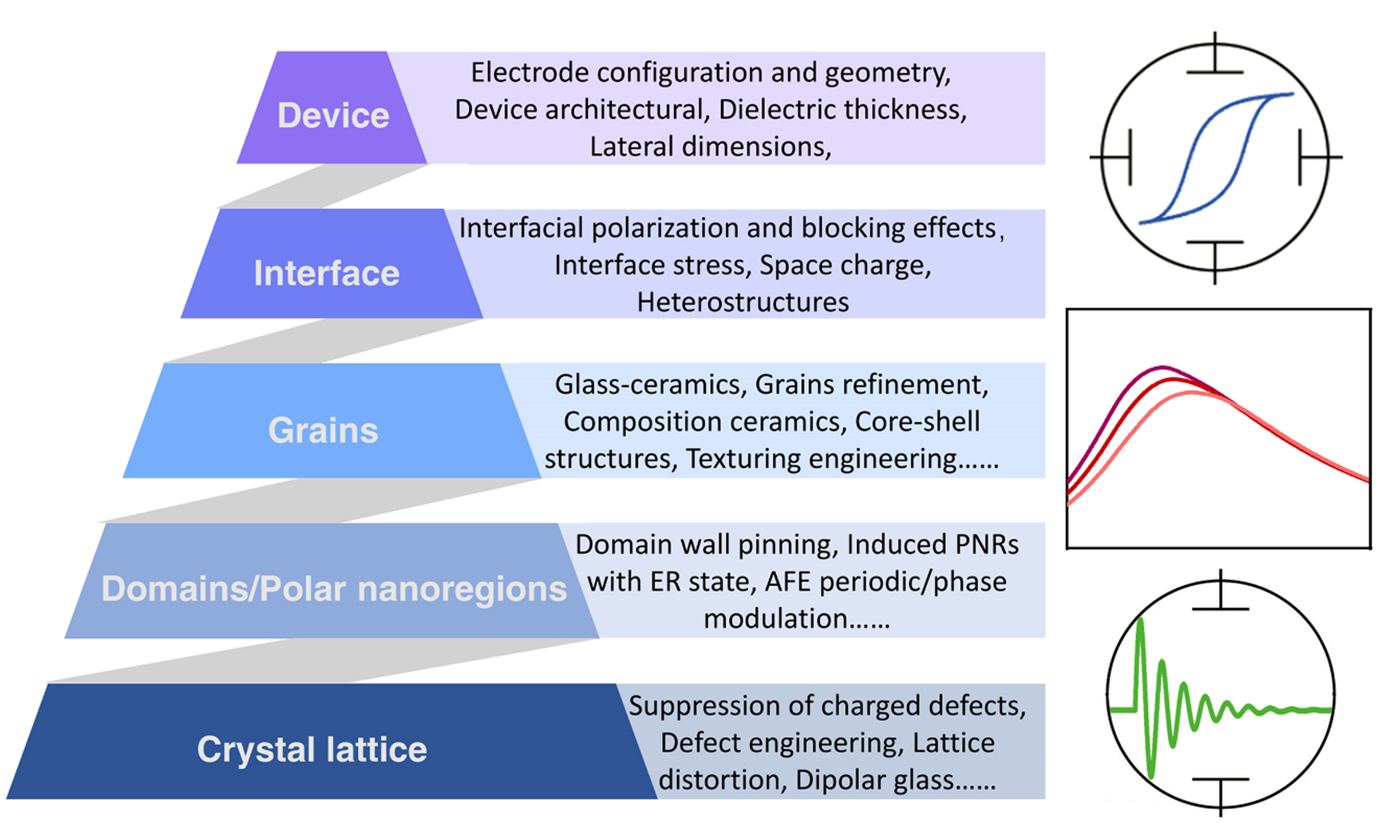
Recently, increasingly sophisticated microstructural and compositional design strategies have emerged, including grain-grain boundary engineering, nanocomposite ceramics, polar nanocluster modulation, and high-entropy approaches[4]. Given the pivotal role of multiscale microstructures in dictating material properties, it is crucial to recognize that dielectric capacitors store energy in the form of electric polarization, which is inherently dictated by hierarchical structural features across multiple length scales[11,15]. These span from electronic-scale orbital hybridization, lattice-level ion displacement, and g (PNRs) to meso- and macro-domain structures, extending up to grain-scale interfaces and even device-level architectural design.
Accordingly, this review proposes a phenomenological framework in which “microstructure-driven design” serves as a guiding principle for optimizing dielectric energy storage performance (ESP). We synthesize recent advances in the structural engineering of inorganic solid-state dielectrics, with a particular focus on bulk ceramics, and identify promising avenues for future innovation. Chemical modification, in combination with process optimization, remains the principal route for tailoring microstructure. Importantly, similar dopants can induce modifications across multiple length scales, and regulation at a given scale often produces distinct effects on polarization behavior. These observations underscore both the multifaceted roles of dopants and the intrinsic correlations between microstructures across different scales.
Microstructural strategies offer several transformative advantages. First, they enable precise tuning of critical material parameters through targeted modifications at specific length scales. Second, multiscale synergistic effects, arising from the integrated manipulation of macro-, meso-, and microstructures, can surpass the intrinsic performance limits of conventional materials. Third, these approaches facilitate the integration of multiple functionalities, advancing the frontier of intelligent dielectric materials. Finally, the microstructure-centric paradigm supports a closed-loop strategy that links the development of new materials, optimization of fabrication processes, and application-specific innovation. This framework is further empowered by advanced computational tools, including materials informatics, machine learning, AI-assisted discovery, and high-throughput simulations. Collectively, this review aims to illuminate a roadmap toward next-generation high-performance dielectric capacitors, grounded in the strategic manipulation of microstructure across all relevant scales.
Modes of electrical energy storage
ES systems serve as indispensable intermediaries, enabling temporal compression, spatial redistribution, and efficient regulation of electrical energy[1]. Currently, widely adopted ES technologies span a spectrum of mechanisms: chemical ES, exemplified by lithium-ion and flow batteries or hydrogen production via water electrolysis[16,17]; mechanical ES, including pumped hydro, flywheels, and compressed air[18]; and electromagnetic ES, where electricity is stored directly as electric fields (in dielectric capacitors), electrochemical double layers (supercapacitors), or persistent currents (superconducting magnetic ES)[19-21]. Each paradigm exhibits distinct performance profiles, differing in energy density, power density, charge-discharge rates, conversion efficiency, scalability, and compatibility with operational environments. These characteristics inherently tailor each technology to specific applications, highlighting the importance of context-driven selection in advanced ES systems.
Among these technologies, dielectric capacitors are uniquely distinguished by their purely physical storage mechanism[3]: energy is stored as electrostatic charge without involving intermediate chemical or mechanical conversions. This enables ultrahigh power density, sub-microsecond charge-discharge rates, and exceptional cycling endurance, positioning dielectric capacitors as prime candidates for high-repetition-rate pulsed power systems[7-9]. Dielectric capacitors also offer high voltage tolerance, low internal inductance, and robust power output, although they are limited by relatively low recoverable energy storage density (Wrec), which constrains their miniaturization potential.
Compared with power transistors and magnetic devices, ES MLCCs provide superior efficiency, lower losses, and higher volumetric specific power[9]. To meet the demands of pulsed power applications, where rapid delivery of large currents is critical, dielectric capacitors must combine high Wrec with high PD. ES MLCCs have emerged as a leading solution, offering compact form factors, fast discharge capabilities, scalable modular designs, and cost-efficient manufacturing. Their ability to operate reliably at high voltages while supporting rapid energy release renders them indispensable in defense technologies, electric propulsion systems, and advanced power electronics. It is noteworthy that, although ES MLCCs and conventional MLCCs (such as X7R and C0G devices) share similar fabrication processes, their applications differ fundamentally: ES MLCCs are designed for ultrahigh discharge currents and power densities under high operating fields, whereas conventional MLCCs primarily serve charge storage, filtering, and decoupling functions under lower electric fields[22].
As pulsed power systems continue to evolve toward higher output, faster cycling rates, and greater integration, the demand for capacitors with enhanced energy storage capacity, longer operational lifetimes, and superior reliability becomes increasingly pressing. The primary bottleneck lies in the development of dielectric materials capable of simultaneously delivering high Wrec and high PD. Achieving this balance is crucial for reducing the size and weight of MLCCs while accommodating increasingly complex and demanding functionalities. Overcoming this materials challenge is therefore essential to enabling the next generation of compact, high-performance pulsed energy technologies[4].
Principle of dielectric energy storage
Dielectric ES is fundamentally governed by the electric polarization of insulating materials under an external electric field. When a voltage is applied, bound charges within the dielectric are displaced or reoriented, giving rise to induced dipoles. This polarization process enables the accumulation of electrostatic energy within the material without involving chemical reactions or ion migration[7]. Consequently, dielectric capacitors exhibit ultrafast response times and superior cycling stability, making them particularly suitable for applications that demand rapid charge-discharge performance and long-term reliability.
As schematically illustrated in Figure 1A, the most basic implementation of dielectric energy storage is the parallel-plate capacitor, in which two conductive electrodes enclose a dielectric layer. The intrinsic properties of the dielectric, including permittivity, polarization response, and dielectric breakdown strength (BDS), critically determine the capacitor’s charge-storage capability.
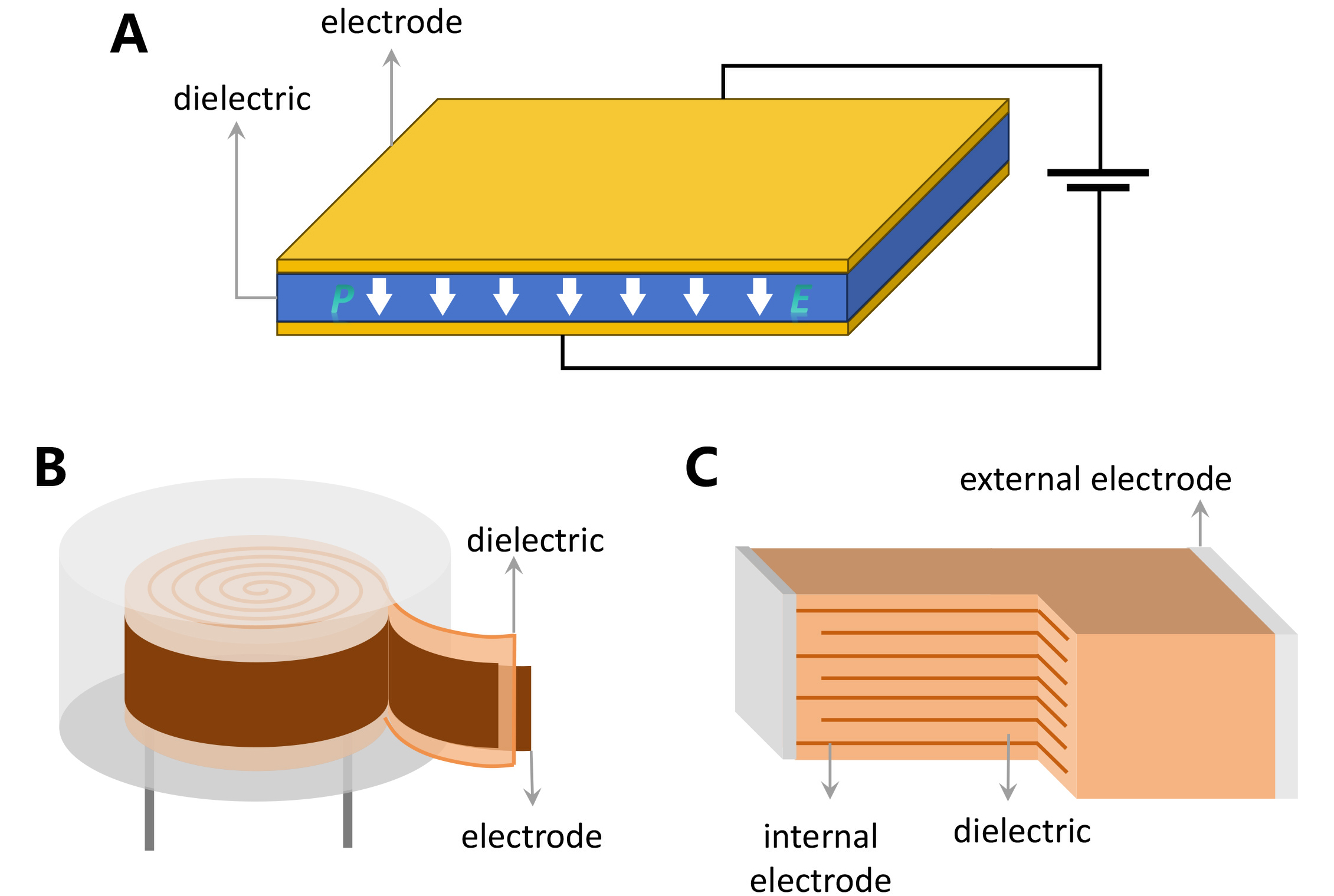
Figure 1. Illustration of three common dielectric capacitor configurations: (A) Parallel-plate capacitor, the conceptual model for ES via dielectric polarization; (B) Rolled-film capacitor, widely used in power electronics, offering flexibility and scalability through thin-film windings; (C) MLCC, composed of alternating layers of ceramic dielectric and internal electrodes, enabling high volumetric efficiency, large capacitance values, and excellent frequency response. ES: Energy storage; MLCC: multilayer ceramic capacitor.
Among these architectures, MLCCs have become the workhorse of modern high-power and high-frequency applications. Advances in material engineering and microstructural control enable the precise tuning of dielectric properties, optimizing both ESP and operational reliability. Key dielectric properties-including high relative permittivity (εr), low dielectric loss, and elevated breakdown field-govern not only the stored energy density and charge-discharge efficiency but also the long-term stability of these devices under demanding operational conditions[23].
Categories of dielectric materials
In principle, any good electrical insulator can function as a dielectric medium for ES, including both inorganic non-metallic materials and organic polymers. However, to achieve high Wrec, different strategies are adopted depending on the material system. As shown in Figure 1B, polymer-based dielectrics leverage their intrinsic flexibility and ease of processing. These materials are typically fabricated into ultrathin films and rolled into compact structures to minimize thickness and maximize capacitance per unit volume[14]. In contrast, inorganic dielectric materials, particularly ceramics with intrinsically high εr, are often processed into MLCCs to enhance volumetric Wrec by minimizing device size while maintaining high capacitance (see Figure 1C).
The εr of a material originates from three primary polarization mechanisms: electronic polarization, ionic displacement polarization, and dipolar orientation polarization[24]. Dipolar orientation, driven by the reconfiguration of permanent dipoles in response to an external electric field, significantly contributes to dielectric permittivity, with values often ranging from 103 to 104. As a result, most high-permittivity dielectrics studied and applied in modern capacitor technologies are FE-based materials[25].
FE-related materials can be broadly categorized based on their microscopic dipole configurations and macroscopic polarization behaviors, as illustrated in Figure 2[26,27]. These include FE, antiferroelectric (AFE), relaxor ferroelectric (RFE), relaxor antiferroelectric (RAFE), and dipole glass or quantum paraelectric (QPE) materials. In FE materials, adjacent dipoles within the crystal lattice align to produce uniform spontaneous polarization, forming long-range ordered domains. These domains are energetically stable and separated by domain walls, which act as energy barriers to dipole reorientation. Consequently, FEs exhibit pronounced hysteresis in their polarization-electric field (P-E) hysteresis loops, marked by remanent polarization (Pr) and coercive fields, reflecting their strong nonlinear response and memory effects[26].
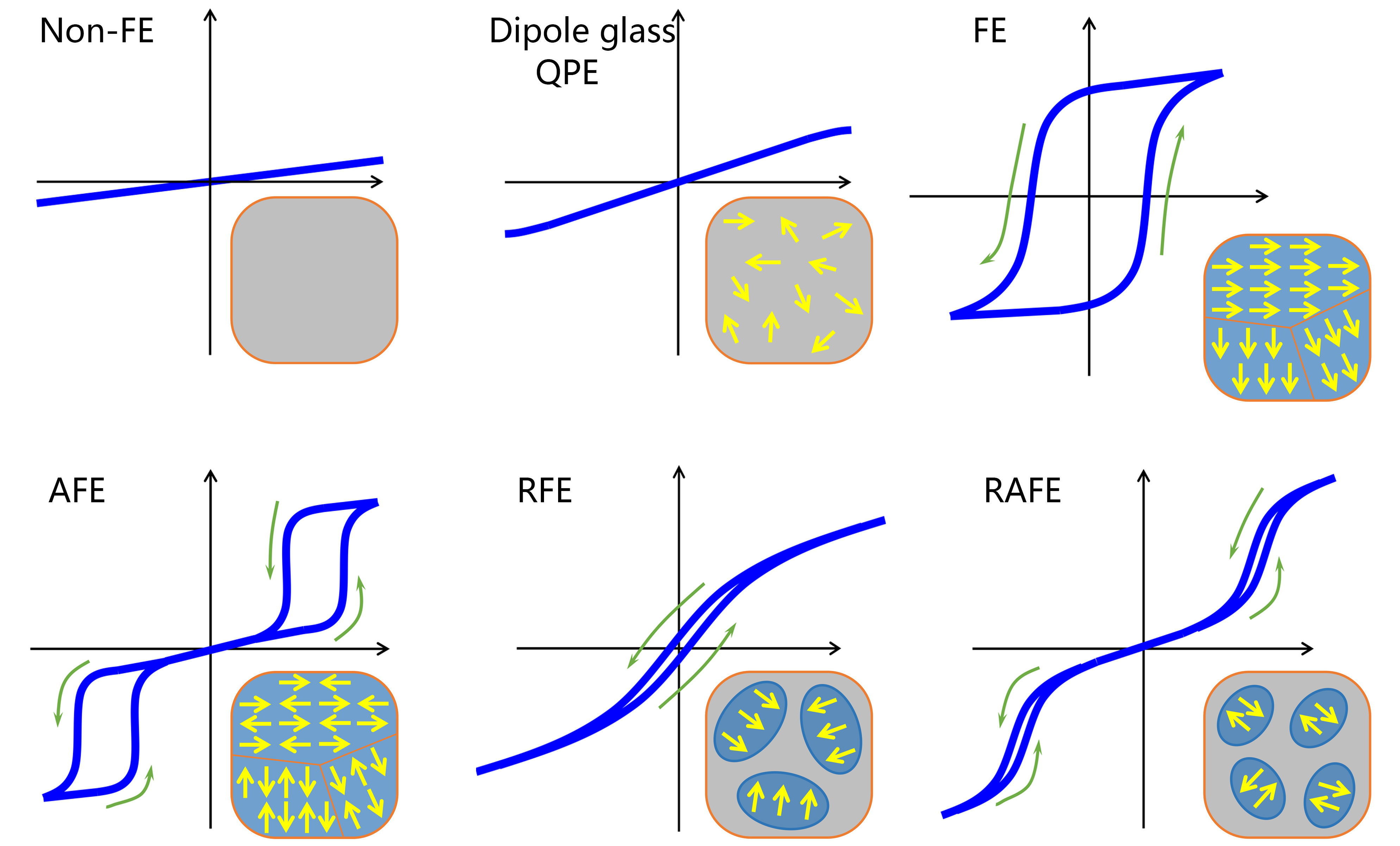
Figure 2. Schematic representation of characteristic dipolar structures and corresponding P-E hysteresis loops across different material classes. AEF: Antiferroelectric; RFE: relaxor ferroelectric; RAFE: relaxor antiferroelectric; FE: ferroelectric; QPE: quantum paraelectric.
AFEs, on the other hand, feature antiparallel alignment of dipoles within adjacent unit cells, resulting in zero net polarization under zero field[28]. When subjected to a sufficiently high electric field, AFEs can undergo a field-induced AFE-to-FE phase transition, during which the antiparallel dipoles reorient into a parallel configuration[29]. This unique behavior gives rise to a double P-E hysteresis loop, making them promising candidates for high-Wrec capacitor applications.
RFEs possess short-range correlated dipoles, often forming PNRs[30,31]. These PNRs fluctuate dynamically, contributing to strong dielectric dispersion and pronounced nonlinearity[32]. Unlike conventional FEs, RFEs exhibit slim P-E loops with high maximum polarization and minimal hysteresis, enabling excellent ES efficiency (η) under high electric fields.
Lastly, QPEs are systems with weak dipole-dipole interactions, where quantum fluctuations suppress the formation of long-range FE order, even at low temperatures[33]. These materials display minimal dielectric nonlinearity, negligible hysteresis, and relatively low permittivity, making them less favorable for energy storage but highly valuable for investigations of fundamental quantum phenomena[34,35].
In summary, selecting an appropriate dielectric material system requires careful consideration of the complex interplay between microscopic dipole behavior and the emergent macroscopic dielectric properties. Advancing the understanding and precise engineering of these polarization mechanisms is essential for realizing high-performance capacitors with superior ES capabilities.
DIELECTRIC ENERGY STORAGE PERFORMANCE
Characterization methodologies
Dielectric capacitors, particularly those intended for pulsed power and advanced power electronics, demand rigorous evaluation of several key metrics: Wrec, η, and PD. These parameters collectively determine the practical utility of a dielectric material in high-PD applications. Two primary approaches are employed to quantify ESP: the indirect (quasi-static) method and the direct (dynamic) method[9]. The indirect approach relies on P-E hysteresis loops acquired via a FE workstation. By integrating the area enclosed within the P-E loop, one can derive the Wrec and η. This method offers a convenient and rapid means of evaluating dielectric behavior, particularly useful in high-throughput material screening and comparative studies. In contrast, the direct method captures the dynamic response of a dielectric capacitor under real working conditions, employing a series resistor-inductor-capacitor (RLC) discharge circuit. This setup enables time-resolved acquisition of voltage and current (I) signals via an oscilloscope during capacitor discharge. The Wrec, discharge duration, current density, and PD are derived through time integration of the electrical output, thereby reflecting the actual performance of the dielectric material under pulse operation. Compared to the indirect method, the direct discharge technique provides a more faithful representation of operational characteristics, especially under high-speed, high-voltage conditions. As such, it serves as an indispensable tool in the design and validation of advanced dielectric ES systems.
Key determinants
As derived from the integral-based formalism of Wrec, the dielectric ES capability of a material is fundamentally governed by two pivotal factors: its polarization response and its BDS. Conceptually, enhancements in maximal polarization (Pmax) and in the ability of a material to sustain high electric fields without dielectric failure are directly correlated with improvements in Wrec and η. These two aspects, while inherently interconnected, originate from distinct scientific and engineering domains.
From a materials engineering perspective, strategies to elevate BDS primarily focus on processing optimization and microstructural refinement. Techniques such as densification, grain-size control, and defect management are frequently employed, often combined with modest compositional tuning to fine-tune intrinsic properties[7,8]. In contrast, the modulation of polarization behavior is predominantly dictated by compositional design and chemical tailoring, encompassing approaches such as isovalent or aliovalent doping, controlled structural heterogeneity, and precise manipulation of phase boundaries[26]. These methods, firmly rooted in materials science principles, provide effective levers for tuning dielectric performance. Consequently, the realization of synergistic improvements in dielectric ESP requires a dual strategy: simultaneously enhancing BDS and optimizing the polarization response.
Crucially, both polarization and breakdown behavior are intricately coupled to the multiscale microstructure of the dielectric. The spatial distribution, morphology, and nature of grains, grain boundaries, porosity, and defect chemistry act as critical mediators that govern field-dependent polarization dynamics and influence the statistical likelihood of dielectric breakdown events. This underscores a central insight: multiscale microstructural design and engineering represent the most powerful route for advancing the ESP of dielectric ceramics.
a. Breakdown strength
Among all parameters influencing dielectric capacitor performance, BDS stands out as the most critical for high-power pulse applications. In particular, for MLCCs operating under high-voltage and high-charge conditions, BDS defines the safe operational field and thereby dictates device reliability and lifetime. Breakdown phenomena in dielectrics can be broadly categorized as intrinsic, thermal, partial discharge-induced, or hybrid in nature[36]. For bulk ceramics, the measured BDS reflects not only intrinsic physical parameters (such as bandgap, electronic conductivity, dielectric loss, and thermal conductivity) but also extrinsic factors, including sample geometry (thickness and electrode area), microstructural features (density, grain size, and defect topology), and external testing conditions (frequency, waveform, thermal management, and atmosphere).
Advances in processing and chemical modification provide the principal routes to enhancing BDS. In practice, ultra-dense ceramics fabricated by hot pressing or spark plasma sintering generally outperform those produced by conventional sintering[37-40]. Statistical effects further favor thinner ceramic layers, which typically exhibit higher BDS than thicker counterparts, partly owing to the reduced probability of failure from defects or thermal accumulation[9]. Chemical modification offers an additional lever: appropriate dopants can broaden the bandgap, reduce the density of mobile charge carriers, and raise the activation energy for defect migration. Additives may also serve as sintering aids or grain-growth inhibitors, promoting denser and more uniform microstructures. These improvements, however, must be balanced, since excessive doping can trigger secondary phase formation or elevate dielectric loss[41].
Although BDS is a critical parameter, its increase alone does not necessarily translate into proportional gains in ESP. While a higher BDS permits stronger applied fields and potentially higher polarization, it is the field dependence of the polarization response that ultimately governs recoverable energy. Once polarization approaches saturation, additional increases in field yield diminishing returns in Pmax while simultaneously heightening the risk of breakdown. Thus, the notion that maximizing BDS alone guarantees optimal ESP is an oversimplification. Instead, coupling high BDS with a field-responsive yet controllably saturating polarization behavior represents a more effective paradigm for the design of next-generation dielectric capacitors.
b. Polarization response
The polarization response of dielectric materials is central to their ESP. As a fundamental electrostatic phenomenon, it governs key metrics including Wrec, η, and PD by bridging intrinsic dielectric behavior with extrinsic factors such as BDS. This response arises from the synergistic interplay of multiscale structural features under an applied electric field, ranging from atomic dipole arrangements to mesoscale domain configurations. The practical viability of a dielectric for ES is therefore dictated by the nature of its polarization behavior.
Three descriptors are commonly employed to characterize polarization dynamics: hysteresis, Pmax, and the polarization pathway. Comparative evaluation of these parameters provides critical insight into material-specific storage capabilities. For instance, pronounced hysteresis is typically associated with substantial energy dissipation during field cycling, rendering conventional FEs and AFEs less efficient for ES. In contrast, materials with high Pmax, particularly RFEs, can deliver elevated Wrec and are thus positioned as strong candidates for advanced dielectric capacitors. Beyond these parameters, the polarization pathway itself plays a decisive role. Field-induced phase transitions, particularly those producing abrupt polarization jumps, can markedly enhance Wrec even when BDS and Pmax remain constant. Such behavior is exemplified by RAFE systems, which surpass conventional RFEs due to their distinctive transition kinetics.
These polarization characteristics are intimately linked to the material’s polar microstructure, encompassing dipolar configurations with varying degrees of order, correlation lengths, and responsiveness. While spontaneous polarization is an intrinsic lattice property, the macroscopic response is strongly modulated by hierarchical structural features, including nanodomains, defect complexes, and grain boundaries. Consequently, microstructural design has become a central strategy for tailoring polarization behavior to enhance ESP. This strategy must be system-specific. For linear dielectrics (LDs), characterized by low permittivity and negligible hysteresis, efforts primarily focus on maximizing Pmax. For FEs, which offer high intrinsic spontaneous polarization but suffer from large hysteresis losses, the key challenge lies in suppressing hysteresis while retaining high polarization.
Importantly, hysteresis, Pmax, and polarization trajectory are inherently interdependent; optimization of one parameter often perturbs the others, leading to unavoidable trade-offs. Furthermore, polarization dynamics are closely coupled with dielectric breakdown behavior, and the two often compete. Thus, optimizing dielectric ESP requires a multiscale co-engineering strategy that balances these competing factors. The overarching objective is to sustain a high Pmax, suppress hysteresis, delay polarization saturation, and simultaneously enhance BDS, all of which are indispensable for achieving next-generation high-Wrec dielectric capacitors.
MULTISCALE MICROSTRUCTURE AND ITS DETERMINISTIC ROLE IN DIELECTRIC ES
Despite the intrinsic properties of dielectrics being decisive for their fundamental BDS and polarization capability, the observable macroscopic ESP is, in practice, governed by the complex interplay of structural features across multiple length scales. A quintessential example is the significant discrepancy, often spanning one to two orders of magnitude, between the theoretical breakdown field and the experimentally measured values in bulk dielectric ceramics. This divergence arises because intrinsic BDS defines the ideal dielectric failure limit in a defect-free, perfectly homogeneous material, whereas real materials undergo premature breakdown driven by localized discharges, thermal runaway, and aging-related structural degradation, all of which are fundamentally controlled by the microstructure. From a materials design perspective, it is therefore both rational and imperative to prioritize microstructural optimization to enhance dielectric ESP. Through targeted structural engineering across scales, extrinsic failure mechanisms can be suppressed and polarization dynamics finely tuned to achieve superior functionality.
Structural hierarchy: from macro to atomic scale
As illustrated schematically in Figure 3, the microstructure of bulk dielectric ceramics exhibits a hierarchical architecture spanning six interrelated spatial scales:
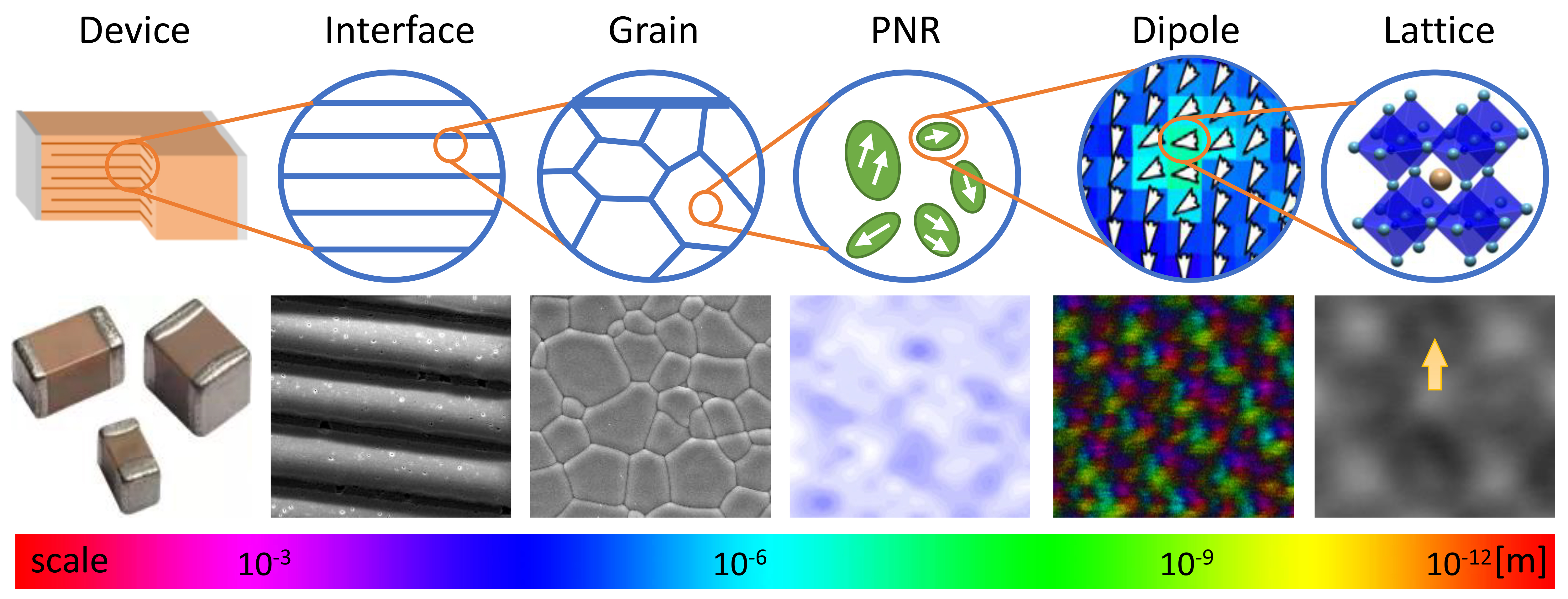
Figure 3. The microstructures at different scales that determine or influence the ESP of MLCC. ESP: Energy storage performance; MLCC: multilayer ceramic capacitor.
• Device scale: Includes macroscopic parameters such as sample dimensions, thickness, electrode configuration, and boundary constraints.
• Interface scale: Encompasses junctions between ceramic dielectrics and metallic electrodes, as well as internal interfaces in compositional or gradient multilayer structures.
• Grain scale: Covers the distribution, orientation, and boundary character of ceramic grains, together with associated porosity and intergranular defects of comparable dimensions.
• Domain/microdomain/PNR scale: Describes the spatial organization and dynamic behavior of polar structures, ranging from micrometer-scale FE domains to nanoscale regions of correlated dipoles.
• Dipolar scale: Refers to the collective interactions and spatial correlations among local dipole moments that give rise to complex polarization patterns and responses.
• Lattice scale: Encompasses atomic-level features such as spontaneous ionic displacements, local distortions, and point defects within the unit cell.
Within this multiscale framework, the material’s polarization response and dielectric breakdown characteristics arise not from a single dominant length scale, but from the cooperative influence of structural heterogeneities across all scales. Spontaneous polarization, for instance, is rooted in orbital hybridization, particularly involving Bi3+ and Pb2+ in RFEs[9]. Its magnitude Pmax, field dependence, and hysteretic behavior are jointly shaped by orientation potential barriers at the lattice scale, by spatial correlations and dynamic fluctuations of dipoles at the mesoscopic scale, and by the role of grain boundaries and defects at the grain scale. At the device scale, interfacial conditions and internal stress distributions further regulate the observable polarization, completing the cascade of scale-dependent interactions that define macroscopic behavior.
This multiscale coupling is particularly prominent in RFEs, where the presence of chemical disorder and nanoscale compositional fluctuations gives rise to a distribution of PNRs embedded within a heterogeneous matrix. The macroscopic dielectric response and ESP in such systems represent a statistical average of a broad ensemble of local polarization states and dynamic reconfiguration pathways. Consequently, tuning the microstructure across various scales, from atomic substitutions and defect engineering to mesoscale texturing and interfacial tailoring, provides a practical and scientifically well-founded strategy to modulate dielectric performance.
Therefore, a rational design strategy must aim to suppress high-loss mechanisms (e.g., excessive orientational polarization), optimize the response time of relevant polarization types to match the application bandwidths, and homogenize the microstructure to minimize local field concentrations. This coordinated approach enables a balance between high permittivity, low loss, and enhanced BDS, thereby achieving a comprehensive enhancement of ESP. Fundamentally, this optimization paradigm represents a targeted, multiscale polarization engineering strategy that integrates spatial structuring and dynamic response design.
Characterization techniques across microstructural scales
To enable precise microstructural engineering, an arsenal of complementary characterization techniques is required, each tailored to the relevant length scale and structural features of interest. Below is a concise taxonomy of key tools employed in multiscale microstructural analysis:
(a) Device/Macro scale: Visual inspection and optical microscopy suffice for observing overall surface morphology and cracking behavior. Advanced X-ray computed tomography (X-CT) and ultrasound imaging provide non-destructive, three-dimensional evaluation of internal structural defects[42].
(b) Interface scale: High-resolution scanning electron microscopy (SEM) and confocal laser scanning microscopy (CLSM) are used to assess interfacial roughness, topology, and defect distribution[43,44]. Ultrasound-based imaging can also reveal subsurface inhomogeneities[45].
(c) Grain scale: SEM combined with electron backscatter diffraction (EBSD) and energy-dispersive X-ray spectroscopy (EDS) delivers multimodal data on grain size, boundary character, orientation, and elemental distribution[46]. Optical microscopy (OM), including polarized light microscopy, is effective for analyzing large-grain ceramics and detecting residual stress. X-ray diffraction (XRD) enables phase identification, lattice strain analysis, and estimation of average grain size. Micro-CT permits three-dimensional defect mapping at the microscale[47].
(d) Domain/PNR scale: Field-emission SEM and transmission electron microscopy (TEM) resolve fine-scale domain configurations[48]. Piezoelectric force microscopy (PFM) is particularly powerful for mapping local polarization amplitude and phase, and for revealing domain wall dynamics and reversible switching behavior under external bias fields. PFM also provides insights into temperature- and stress-dependent domain evolution[49].
(e) Atomic/Dipolar scale: Advanced scanning transmission electron microscopy (STEM), high-resolution TEM (HR-TEM), and electron energy loss spectroscopy (EELS) offer atomic-resolution imaging of lattice distortions, point defects, and bonding environments[50,51]. For quantitative analysis of ionic displacement vectors, local polarization, and electrostatic field gradients, aberration-corrected STEM equipped with high-angle annular dark field (HAADF), differential phase contrast (DPC), and integrated bright field (IBF) is essential[52-54].Atom probe tomography (APT) enables three-dimensional compositional mapping at near-atomic resolution, particularly for analyzing segregation at grain boundaries or interfacial phases[55]. To capture real-time microstructural evolution under functional stimuli such as electric fields, temperature, or mechanical stress, in-situ TEM platforms are increasingly employed, enabling direct observation of field-driven domain wall motion, lattice distortion, and defect dynamics at unprecedented resolution[56,57].
MICROSTRUCTURAL DESIGN STRATEGIES
Achieving breakthroughs in dielectric ESP, whether by enhancing the breakdown electric field or optimizing polarization responses, ultimately relies on the rational design of material microstructure across multiple length scales[58]. These include not only compositional engineering and additive modulation, but also innovative processing, fabrication, and sintering methodologies. This section presents a comprehensive discussion of microstructural design strategies at various scales, highlighting their underlying mechanisms, comparative advantages, and the remaining challenges, along with avenues for future optimization.
Macroscale design considerations
At the macroscopic level, microstructural design encompasses the geometric parameters of dielectric devices and bulk ceramics, such as sample thickness, lateral dimensions, and electrode configuration, which exert a significant impact on dielectric breakdown and ES behavior. One of the most widely used and effective strategies for enhancing Wrec is the intentional reduction of sample thickness and electrode area. This approach is grounded in statistical and thermal principles: in systems where defects are randomly distributed, smaller electrode areas lower the likelihood of activating critical flaws under high fields. Thinner samples also improve heat dissipation, thereby mitigating localized thermal accumulation. Accordingly, bulk ceramics prepared via conventional solid-state sintering often exhibit markedly lower BDS than those fabricated through tape casting or the viscous polymer process. Even mechanical thinning via surface grinding and polishing has been adopted to boost the breakdown field and Wrec.
It is important to note that while macroscale strategies can effectively enhance measured performance metrics, they do not yield intrinsic improvements in the material itself. Although such extrinsic enhancements can be valuable for performance demonstrations, they offer limited contribution to advancing the fundamental understanding of materials. This distinction underscores the urgent need for standardized testing protocols in dielectric ES research.
Moreover, the use of ultrathin dielectric layers and reduced electrode dimensions may introduce significant edge effects and parasitic capacitance, which can artificially inflate Wrec values[59]. Ding et al. carried out comprehensive experimental and theoretical investigations, revealing that the presence of material non-idealities, particularly in low-permittivity dielectrics such as A2O3 and SrTiO3 (ST), leads to significant discrepancies in the measured electrical properties, as shown in Figure 4. These deviations become especially pronounced when asymmetric or small-area electrodes are employed, underscoring the critical influence of electrode geometry and dielectric quality on the accuracy of property characterization[59]. Their work proposed a calibration method for eliminating parasitic capacitance artifacts and recommended standardized configurations to enhance data reliability, offering a pivotal step toward methodological rigor in the field.
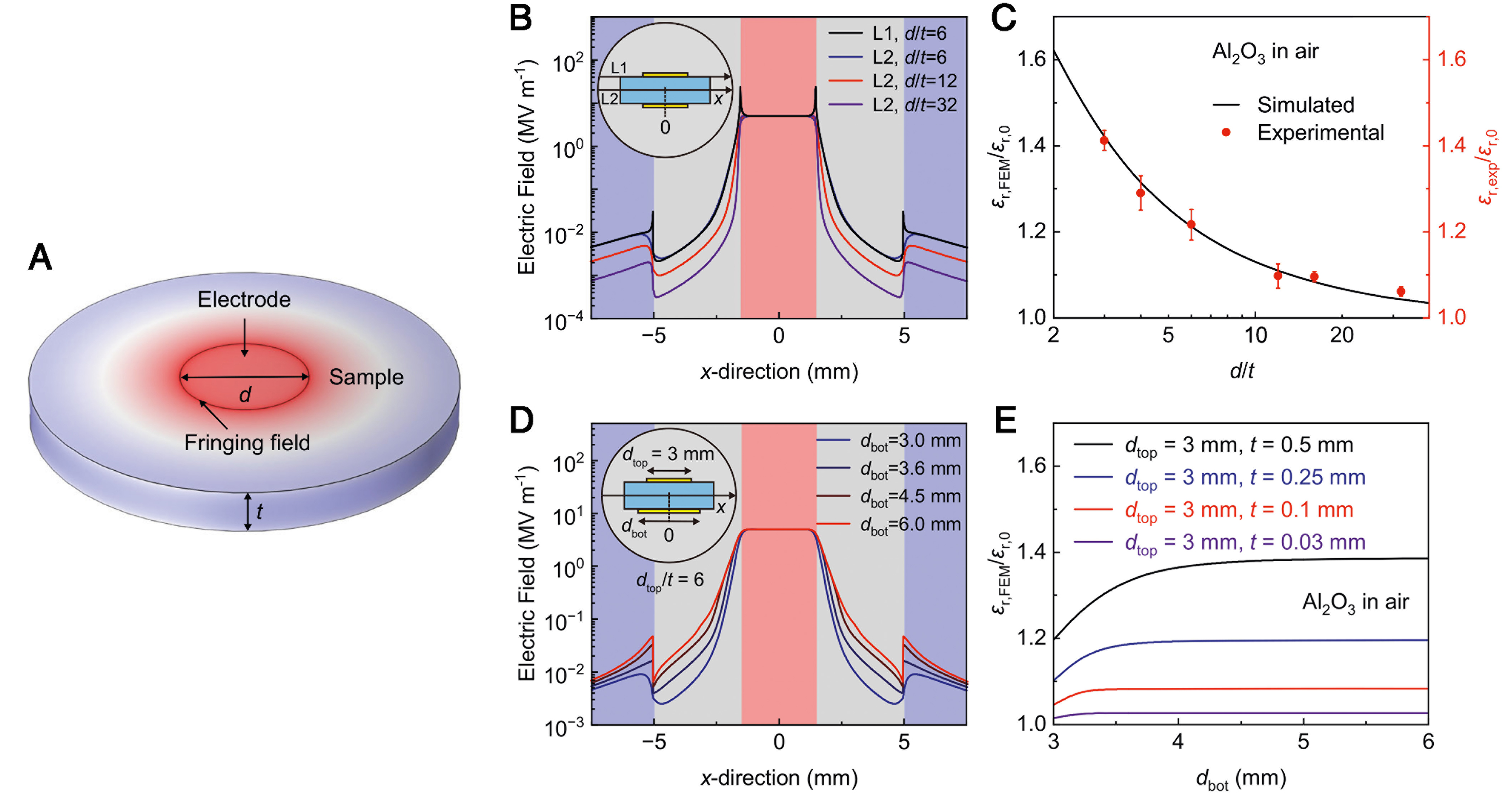
Figure 4. Finite element method simulations of parallel-plate capacitors with varying geometric configurations. (A) Schematic of the parallel-plate capacitor model; (B) Simulated electric field distributions along L1 (surface) and L2 (center) in the x-direction across the cross-section of Al2O3 in air. Light red, gray, and blue regions indicate the sample area under electrode coverage, the area outside electrode coverage, and the surrounding air, respectively; (C) Comparison of relative permittivity ratios (εr,FEM/εr,0: lines; εr,exp/εr,0: dots) for Al2O3 capacitors with different d/t ratios. Error bars denote standard deviations; (D) Electric field distributions along the x-direction at the center of the Al2O3 cross-section in air for different bottom electrode widths (dbot), with dbot = 3 mm and dielectric thickness t = 0.5 mm; (E) Dependence of εr,FEM/εr,0 on dbot. Here, εr,0 is the intrinsic dielectric constant, εr,FEM is the FEM-calculated dielectric constant, and εr,exp is the experimentally measured value. This figure is quoted with permission from Ding et al.[59]. FEM: Finite element method.
Beyond size effects, electrode geometry and architecture also play a critical role in governing dielectric breakdown behavior and Wrec in MLCCs[60]. Cai et al.[60] developed a phase-field electromechanical model and demonstrated that MLCCs with extended electrode margin lengths exhibit significantly enhanced BDS. Specifically, employing a margin length of 400 μm enabled a Wrec of 7.8 J/cm3 under an applied electric field of 790 kV/cm. This finding highlights a promising and resource-efficient strategy for optimizing ES performance at the device scale.
In parallel, novel architectural strategies such as interlaminar strain engineering have emerged as transformative tools to regulate domain structure and decouple the traditional trade-off between high polarization and low hysteresis. Yang et al. engineered a multilayer dielectric stack comprising compositionally distinct AFE ceramics, as shown in Figure 5, thereby creating a heterogeneous strain distribution capable of manipulating polarization dynamics[61]. This configuration achieved a record-high Wrec of 22.0 J/cm3 together with an ultrahigh η of 96.1%. These results establish a new benchmark, emphasizing the pivotal role of macroscale heterostructure engineering in pushing the performance limits of next-generation ES devices.
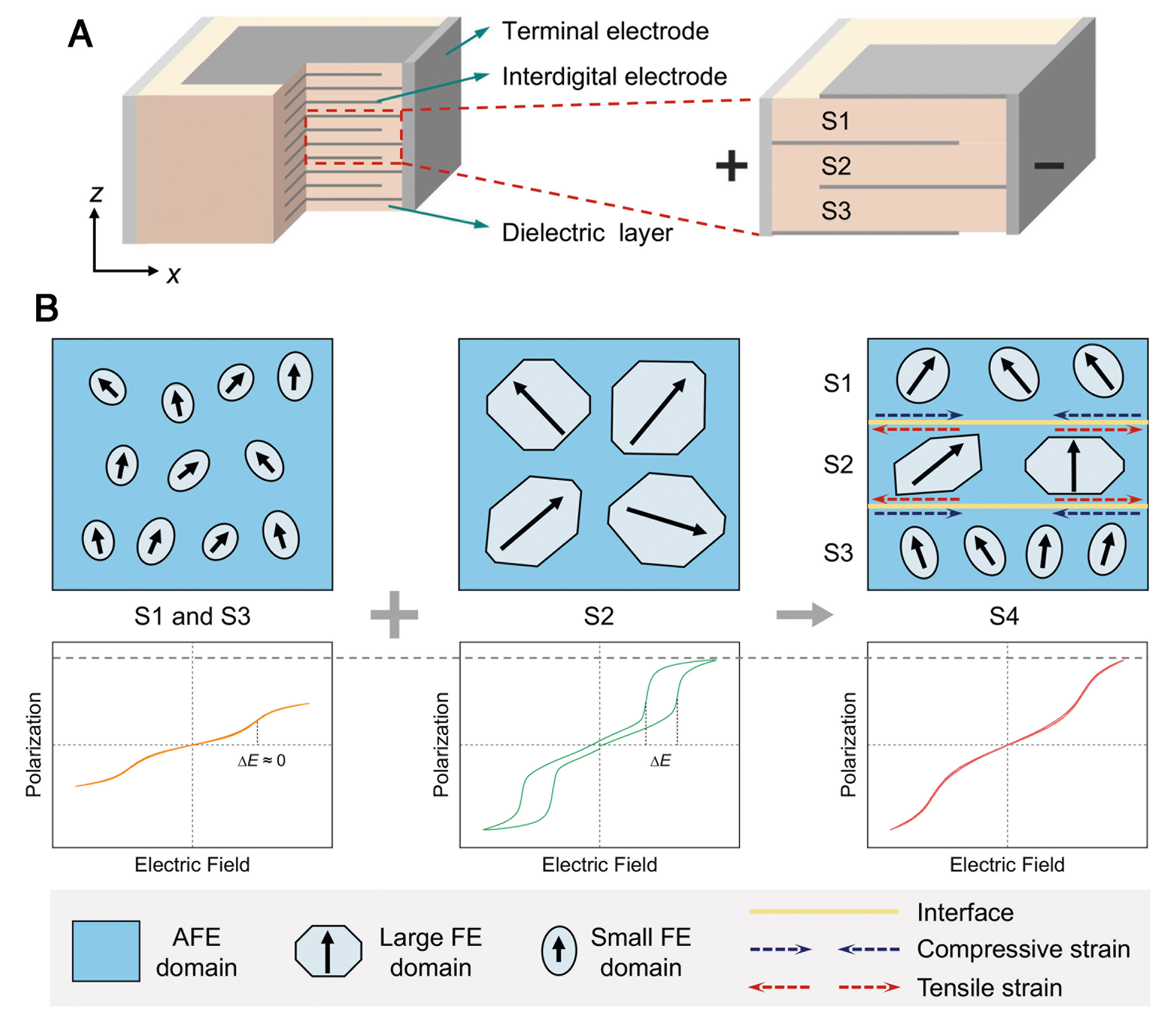
Figure 5. Interlaminar strain engineering strategy for enhanced ESP in MLCCs. (A) Schematic illustration of the engineered MLCC (S4) featuring a periodic heterogeneous layer structure; (B) Comparison of domain structures and P-E loops for S1, S2, and S3 under high electric fields. Samples S1 and S3, characterized by small domains, exhibit slim P-E loops with minimal hysteresis and negligible Pr, albeit with low maximum polarization. This figure is quoted with permission from Yang et al.[61]. ESP: Energy storage performance; MLCC: multilayer ceramic capacitor; AEF: antiferroelectric; FE: ferroelectric.
Interface scale engineering
In ideal bulk dielectric ceramics, the microstructure is typically treated as homogeneous and isotropic, rendering interfacial effects relatively minor compared with those in composite materials[62] and heteroepitaxial thin films[63-65]. However, this assumption does not universally hold, particularly for multiphase composite ceramics and compositionally graded bulk systems, where interface phenomena play a significant role in modulating dielectric behavior. In layered composite dielectrics, for example, the intrinsic disparity in electrical conductivity and dielectric permittivity between constituent phases can give rise to pronounced interfacial polarization and blocking effects. These effects may either enhance or compromise overall material performance: while interfacial polarization can strengthen the macroscopic polarization response, the accumulation of space charges at interfaces often elevates the risk of dielectric breakdown. Accordingly, interface engineering must be carefully tailored to the specific composition and performance objectives of the dielectric system.
Recent studies underscore the effectiveness of interfacial modulation. Hu et al. introduced a rational design strategy in AFE composites by pairing high-breakdown-field Pb0.94La0.04(Zr0.99-xSnxTi0.01)O3 (PLZST) with high-η Pb0.8925Ba0.04La0.045(Zr0.65Sn0.3Ti0.05)O3 (PBLZST), leveraging Sn content modulation to minimize interfacial dielectric mismatch and thereby suppress detrimental interfacial polarization[66]. Similarly, Yang et al. implemented a multilayer AFE ceramic structure based on the synergistic coupling of interfacial polarization and blocking effects in (Pb0.9Ba0.04La0.04)(Zr0.65Sn0.3Ti0.05)O3/(Pb0.95Ca0.02La0.02)(Zr0.93Sn0.05Ti0.02)O3 ceramics[67]. The engineered interface enabled simultaneous optimization of Pmax and BDS, resulting in a Wrec of 9.4 J/cm3. Notably, even without explicit interface optimization, processing methods that introduce compositional and structural heterogeneity, such as tape casting, roll compaction, lamination, and co-sintering, can inherently induce interface-scale modifications that significantly influence material performance. These mesoscale heterostructures are often designed to synergize the advantageous features of each constituent phase, mitigate their individual limitations, or balance mutually exclusive properties[68].
For example, Yang et al. employed a multilayer configuration combining RFE (Bi0.5Na0.5)TiO3 (BNT)-based and RAFE PLZST-based ceramics, as shown in Figure 6A, thereby optimizing dielectric properties through deliberate mesoscale assembly[69]. In another example [Figure 6B], Liu et al. addressed the intrinsic trade-off between polarization and BDS via a laminated composite strategy, constructing a bilayer structure with a high-polarization AFE and a high-breakdown AFE, achieving a record-high Wrec of 13.9 J/cm3 and η of 89.9%[70].
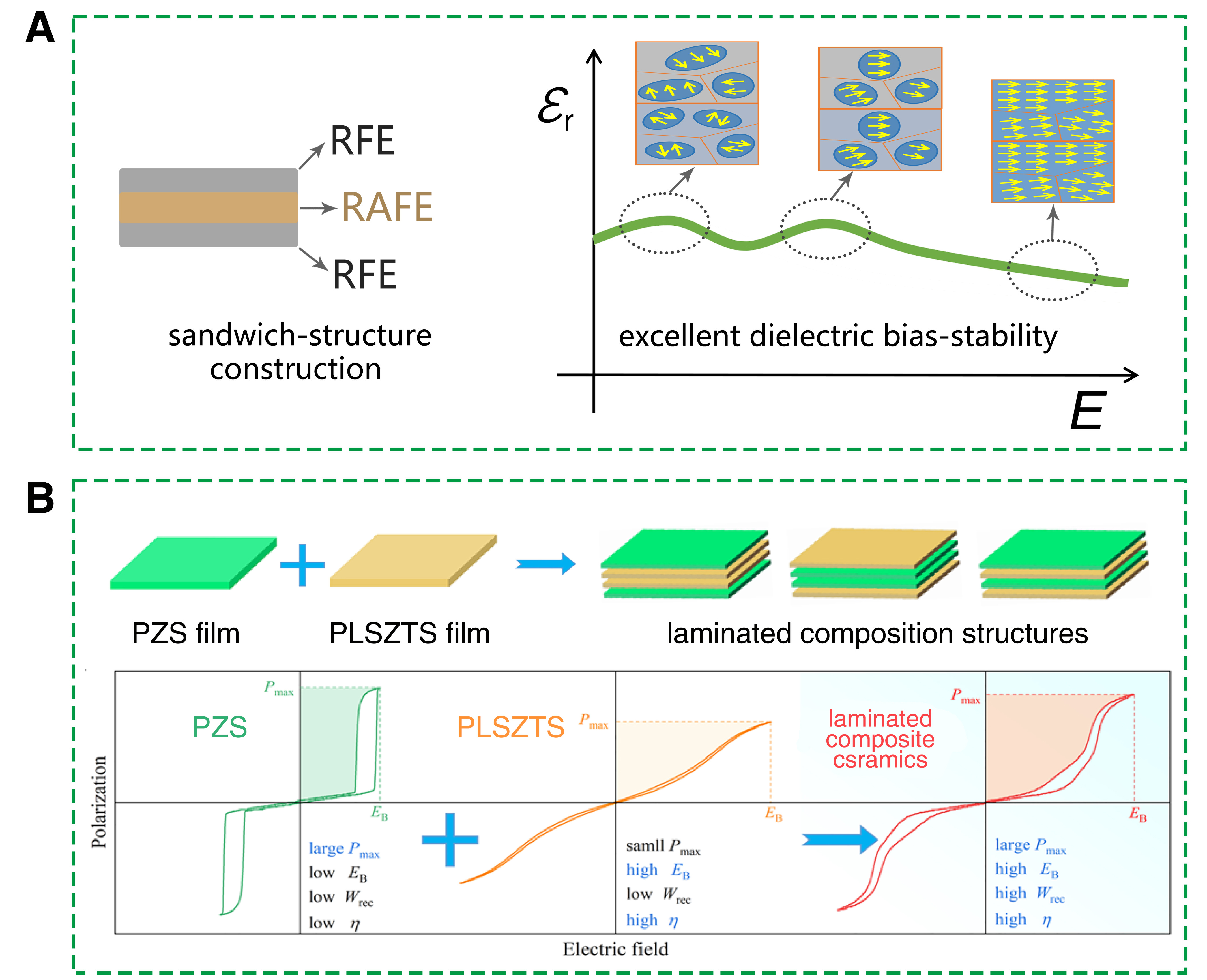
Figure 6. Interface-scale engineering of heterogeneous composite ceramics for enhanced dielectric and ESP. (A) Schematic of a multilayer sandwich structure combining RFE and RAFE components. The accompanying plot shows the εr as a function of applied DC electric field, with microstructural insets illustrating the evolution of domain structures under different field strengths. This figure is quoted with permission from Yang et al.[69]; (B) Schematic of the fabrication process for laminated composite ceramics using a tape casting method. This figure is quoted with permission from Liu et al.[70]. PLSZTS:(Pb0.875La0.05Sr0.05)(Zr0.695Ti0.005Sn0.3)O3; ESP: energy storage performance; PZ: PbZrO3; DC: direct current; PZS: Pb(Zr0.88Sn0.12)O3; RFE: relaxor ferroelectric; RAFE: relaxor antiferroelectric; AEF: antiferroelectric.
Furthermore, interface-level design has emerged as a critical strategy in developing lead-free dielectric ES materials[71-75]. Huan et al. successfully designed layered-structured lead-free (K0.5Na0.5)NbO3 (KNN)-based ceramics that exhibit both high BDS and large polarization[71]. More recently, a multilayer sandwich-structured composite attained an ultrahigh Wrec of 9.05 J/cm3 and a near-ideal η of 97% under
Beyond composite systems, interfaces are inherently ubiquitous in single-phase polycrystalline ceramics due to intrinsic microstructural heterogeneities such as grain boundaries and pores. When the thickness of the grain boundary is negligible, it can be regarded simply as the interface between adjacent crystalline grains. In this context, grain boundary engineering has emerged as a critical strategy for enhancing ESP, a topic further elaborated in the section on grain-scale structural design. Conversely, when the grain boundary phase is sufficiently thick, it often behaves as an amorphous or non-crystalline region, introducing new dielectric interfaces that profoundly influence the material’s electrical response, a prime example demonstrated by Li et al.[76]. This improvement was attributed to the effective suppression of space charge accumulation at the amorphous-crystalline interface, a mechanism pivotal for realizing high recoverable ESP. Similarly, Cao et al. emphasized the central role of interfacial polarization in governing ESP parameters, including grain size, bandgap, and relaxor behavior[77]. Their work established interfacial polarization as a key factor in optimizing dielectric performance.
Further engineering by Cao et al. involved tuning the activation energy differential between grains and grain boundaries, as shown in Figure 7, effectively restricting interfacial polarization and achieving a remarkable breakdown strength (Eb) of 640 kV/cm and Wrec of 15.1 J/cm3 in 0.62(0.94BNT-0.06BaTiO3)-0.38(Ca0.7La0.2)TiO3 (BNT-BT-CLT) ceramics[78].
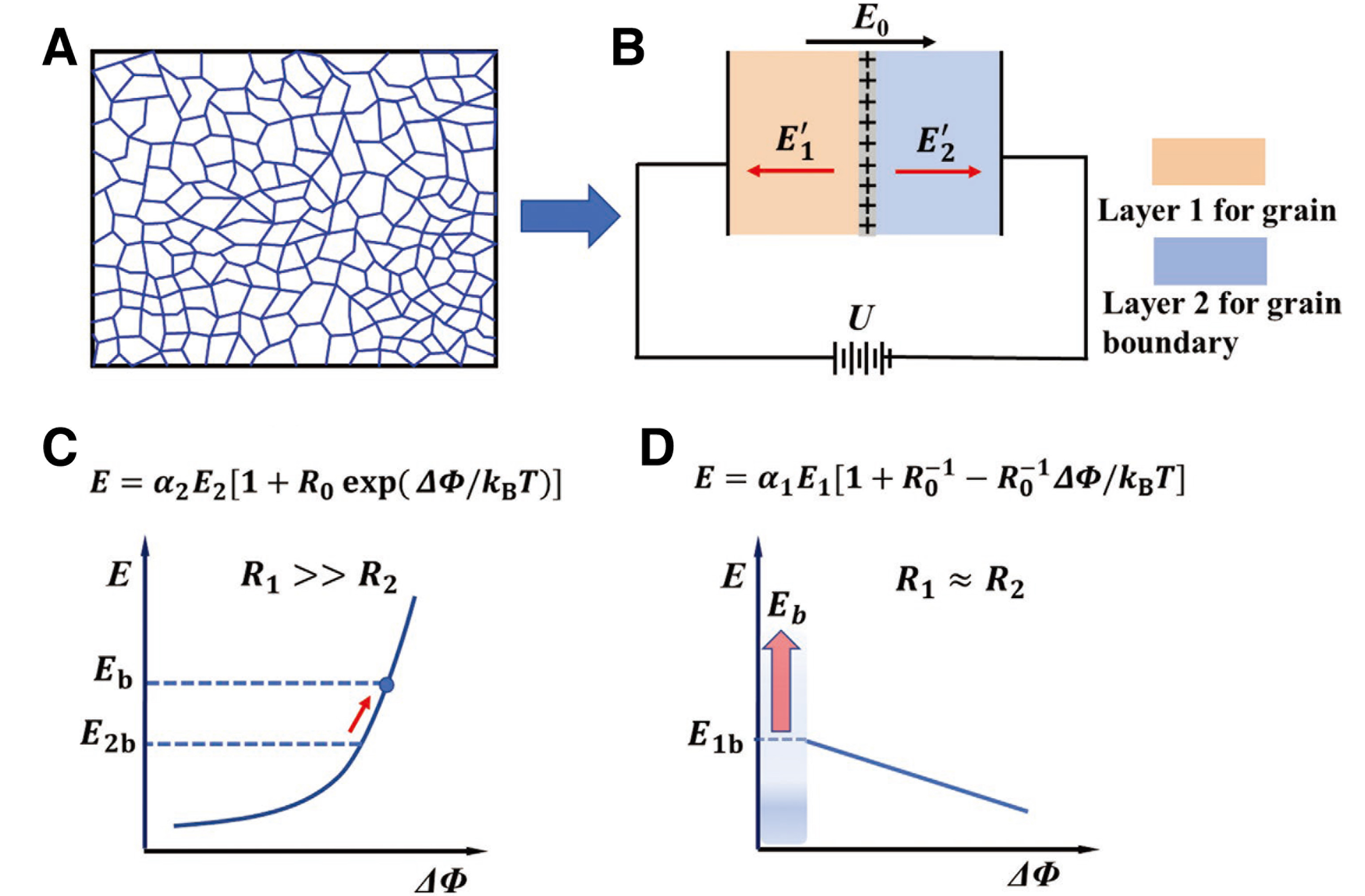
Figure 7. Interface polarization and local electric field modulation in brick-and-mortar ceramic structures. (A) Schematic of a brick-and-mortar ceramic architecture, illustrating structural heterogeneity; (B) Maxwell-Wagner two-layer condenser model describing interface polarization and its influence on local electric fields. (C and D) Simulated electric field distributions across the sample as a function of potential difference (Δ) under two scenarios: (C) when the resistance of layer 1 greatly exceeds that of layer 2 (R1 ≫ R2), and (D) when the resistances are comparable (R1 ≈ R2). This figure is quoted with permission from Cao et al.[78].
Compared with bulk ceramics, interfacial design at the nanometer scale is more commonly implemented in thin-film dielectrics via multilayer heterostructures[79]. A variety of fabrication techniques, including chemical deposition[80], epitaxy[81], sol-gel synthesis[82], and radio frequency magnetron sputtering[83], have been employed to construct nanostructured dielectric films with finely tailored interfaces and exceptional electrical properties. For example, Nguyen et al. engineered multilayer films integrating paraelectric-like (Ba0.6Sr0.4)TiO3 (BST) with RFE Ba(Zr0.4Ti0.6)O3 (BZT) on Si substrates buffered with ST, achieving a record Wrec of 165.6 J/cm3 at an unprecedented breakdown field of 7.5 MV/cm[84].
In another approach, Zhai et al. addressed the common limitation of low BDS in Ag(Nb,Ta)O3-based films via interface engineering[85]. By introducing a BaTiO3 (BT) layer and using an n-type LaNiO3 buffer, a vertical n-p-n heterojunction was formed, elevating the energy barrier for carrier injection, reducing leakage currents, and significantly enhancing Wrec to 62.3 J/cm3. A similar concept was extended to double-heterojunction capacitors combining FE, dead-layer (DL), and superparaelectric (SPE) constituents. In the Bi0.9Sm0.1Fe0.9Co0.05Zn0.05O3/Al0.9Ga0.1O3/Ba0.985Na0.015Ti0.95Ni0.05O3 (BSFCZ/AGO/BNTN) system, interface and composition design preserved a high polarization of 55 μC/cm2 while suppressing remnant polarization, resulting in a giant Wrec of 132 J/cm3 and an η of 84% at an Eb of 5,500 kV/cm[80].
An emerging area of research focuses on engineering the interface between dielectric materials and electrodes, typically involving metal/inorganic non-metal junctions. This interface can give rise to unique physical phenomena not present within the internal dielectric heterostructures. For example, Silva et al. achieved efficient ES by inserting a thin HfO2:Al2O3 (HAO) interlayer between 0.5Ba(Zr0.2Ti0.8)O3-0.5(Ba0.7Ca0.3)TiO3 (BCZT) ceramics and gold electrodes[65]. The induced depolarization field improved linearity and reduced energy loss. Similarly, Chen et al. demonstrated that inserting an ultrathin Ca0.2Zr0.8O1.8 (CSZ) artificial “dead-layer” between Ba0.3Sr0.7Zr0.18Ti0.82O3 (BSZT) films and Au electrodes significantly suppressed Schottky emission through the formation of a 3.92 eV injection barrier[86]. This strategy effectively enhanced thermal stability and dielectric strength under high fields.
Additionally, Sun et al. investigated the influence of electrode-film interfaces by controlling the stacking sequence in BT/SiO2-BaZr0.2Ti0.8O3 multilayers[87,88]. Structures starting with the SiO2-BaZr0.2Ti0.8O3 layer consistently exhibited higher Eb and Wrec, attributed to the formation of Schottky barriers via 2Ti3+-
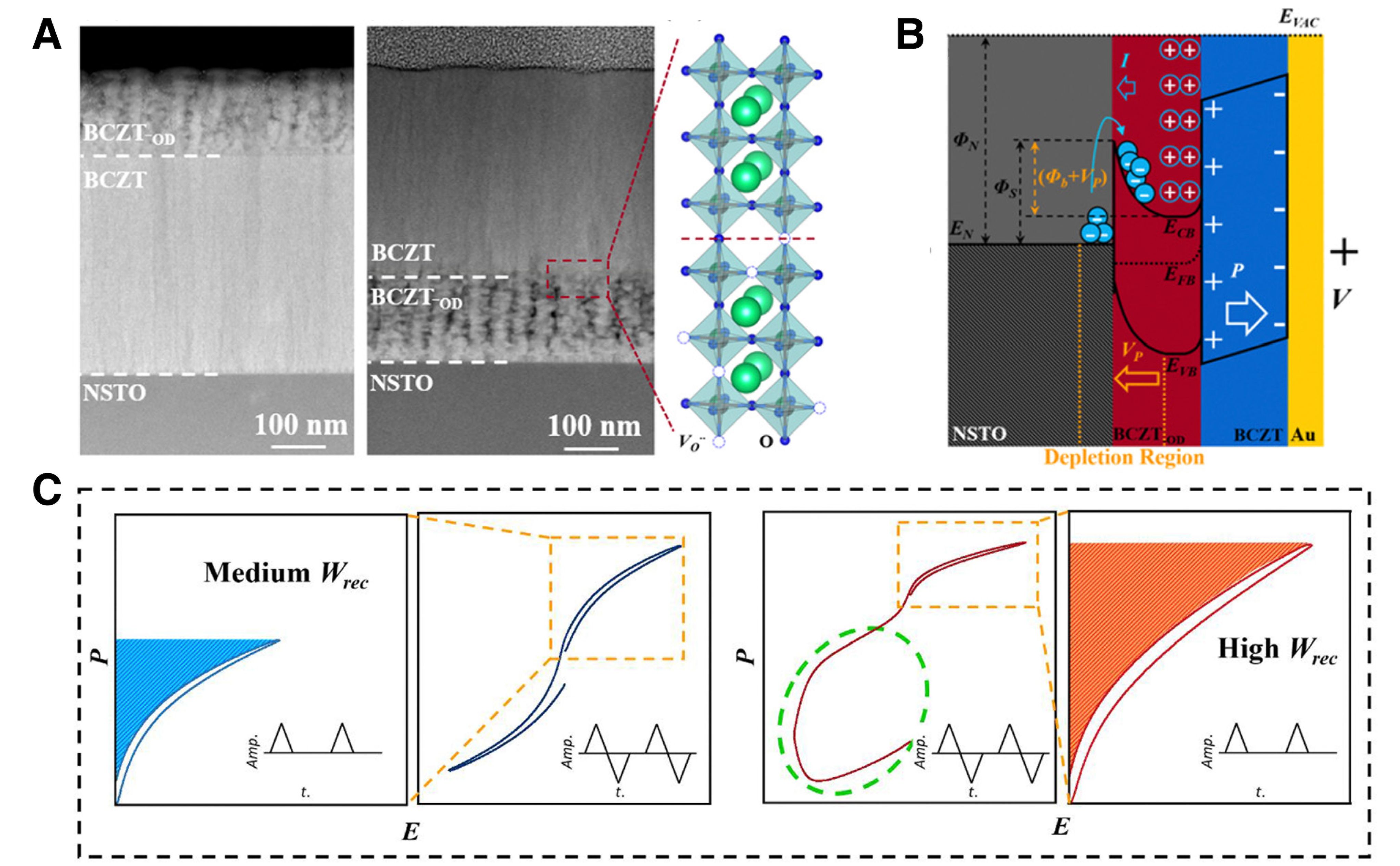
Figure 8. Schottky barrier formation at the dielectric-substrate interface enables electric field redistribution and enhanced BDS. (A) Cross-sectional STEM images of BCZTOD/BCZT//(1P) and BCZT/BCZTOD//(1P) heterostructures, accompanied by corresponding lattice ball-and-stick models; (B) Energy band diagram of the BCZT/BCZTOD//(1P) structure under forward bias, depicting the metal-semiconductor-dielectric configuration and the formation of a Schottky barrier at the interface. (C) Schematic illustration of Wrec in different types of P-E loops. High Wrec is achieved by suppressing the negative-side FE contribution, enabling improved ESP. BCZT: Ba0.7Ca0.3Zr0.2Ti0.8O3; BCZTOD: oxygen-deficient BCZT. This figure is quoted with permission from Sun et al.[88]. BDS: Dielectric breakdown strength; STEM: scanning transmission electron microscopy; ESP: energy storage performance; FE: ferroelectric; BCZT: 0.5Ba(Zr0.2Ti0.8)O3-0.5(Ba0.7Ca0.3)TiO3; NSTO: Nb-doped SrTiO3.
Grain-scale microstructural engineering
The grain-scale microstructure is among the most critical determinants of dielectric behavior and ESP in FE ceramics. Engineering strategies at this length scale are essential for enhancing polarization dynamics and improving dielectric BDS, both of which play a critical role in determining Wrec and η. As shown, Wrec is proportional to Eb2 and is also influenced by the effective polarization difference (Pmax-Pr), with Eb representing the dielectric BDS. The microstructural features at the grain scale, including grain size, boundary integrity, local electric field distribution, and space charge accumulation, decisively influence both Eb and polarization behavior.
One of the most straightforward yet effective approaches to boosting Eb in dielectric ceramics is grain refinement in tandem with densification, which reduces internal voids and defect concentrations. However, the properties of the grain-boundary phase, including its insulating behavior, thermal conductivity, and ability to accumulate or dissipate space charges, also exert significant secondary effects on polarization stability and dielectric losses. Furthermore, compositional tuning at the grain level offers an additional degree of freedom, enabling modulation of relaxation behavior and the associated polarization mechanisms. Therefore, the grain-scale microstructure design strategies summarized in this subsection include grains, grain boundaries, and corresponding compositional changes, as shown in Figure 9.
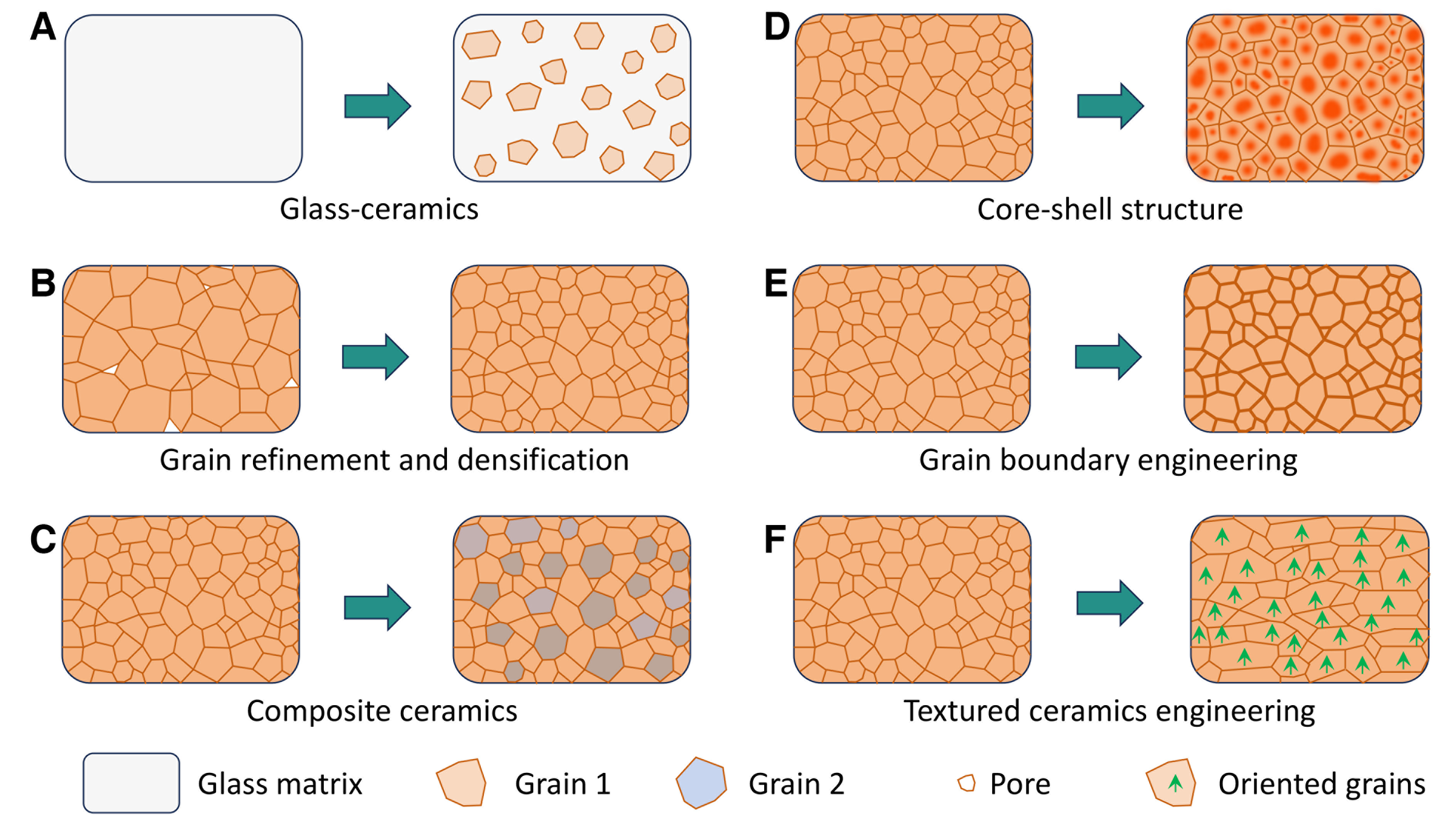
Figure 9. Grain-scale microstructural engineering strategies for optimizing dielectric ESP. (A) Promotion of microcrystal precipitation to form glass-ceramic structures; (B) Grain refinement and densification to enhance dielectric uniformity; (C) Formation of composite ceramics comprising grains with distinct compositions or crystal structures; (D) Construction of core-shell architectures via controlled elemental diffusion or compositional segregation; (E) Grain boundary modification through low-melting-point dopants or chemical coating of pre-synthesized powders; (F) Development of oriented grains using textured ceramic processing. ESP: Energy storage performance.
Glass ceramics
Glass ceramics and dipole glasses are typically regarded as linear dielectric materials, characterized by their non-switchable polarization behavior and linear dielectric response under applied electric fields[8]. Nevertheless, a fundamental drawback of these materials lies in their relatively low εr, which, despite their high Eb, limits the Pmax and ultimately constrains their Wrec. To overcome these intrinsic limitations, microstructural engineering strategies have been increasingly explored.
Among these, compositional tailoring and process optimization remain the most effective and widely adopted approaches[7], both aimed at introducing or forming a strong polar phase. Controlled heat treatment and crystallization protocols play a crucial role in modulating the microstructure. Compared with amorphous phases, crystalline domains typically exhibit higher dielectric permittivity and polarization capacity. Facilitating the controlled formation of such crystalline phases within a glassy matrix can effectively enhance the overall dielectric performance while retaining the thermal and chemical stability advantages of the glass-ceramic system.
The glass materials intended for dielectric ES are often referred to as dielectric glass ceramics or microcrystalline glasses, emphasizing the coexistence of crystalline and glassy phases[22]. Liu et al. comprehensively summarized recent advances in high-Wrec FE glass-ceramics, analyzing the critical factors influencing their dielectric performance and outlining prospective directions[89]. A direct microstructural design strategy for improving both the dielectric permittivity and inducible polarization in such materials lies in promoting controlled crystallization. One of the most effective routes to enhance crystallization and, consequently, the dielectric constant is to increase the crystallization temperature[90-93]. For example, in the BaO-Na2O-Nb2O5-SiO2-TiO2-ZrO2 glass-ceramic system, the dielectric constant increased markedly from 36.8 at a crystallization temperature of 750 °C to 103.5 at 1,050 °C, primarily due to the formation of NN and Ba2NaNb5O15 crystalline phases[92]. In addition to thermal treatments, compositional engineering via the introduction of suitable dopants has proven highly effective in promoting crystallization and enhancing the dielectric response.
Rare-earth oxides or other functional additives are commonly employed for this purpose[94-97]. In Gd2O3-doped BaO-K2O-Nb2O5-SiO2 glass ceramics, the increasing Gd2O3 content leads to the gradual emergence of crystalline phases such as Ba2KNb5O15, BaNb2O6, and K3NbO4, which contribute to both higher dielectric permittivity and enhanced Pmax under the same electric field[98]. While tungsten bronze and other structures are effective, perovskite-type FE crystals typically offer even higher dielectric constants due to their intrinsic lattice polarizability. Thus, compositional control strategies aimed at promoting perovskite-phase crystallization represent a promising avenue for further dielectric enhancement[99].
However, it is undeniable that microstructural strategies designed to promote crystallization, while improving the dielectric constant of glass ceramics, inevitably sacrifice other critical advantages inherent to linear dielectrics, such as dielectric stability, polarization linearity, low dielectric loss, and high Wrec[100]. For linear dielectric materials, a clear trade-off exists between polarization capability and BDS. When employing this structural tuning strategy, careful consideration must be given to the trade-offs between various performance parameters based on the specific application requirements. Overall, linear dielectric ceramics, with their superior thermal/frequency stability, remain highly promising for applications in ultra-high-voltage pulsed circuits. For example, Shang et al. designed the “amorphous-disordered-ordered” microstructure in BT-based glass ceramics by the ingenious strategy of defect formation modulation, as shown in Figure 10, resulting in a high Wrec of 12.04 J/cm3 and a superb PD of 973 MW/cm3[101]. This representative work demonstrates a feasible route to obtain glass ceramics with an outstanding ESP and proves the enormous potential of glass ceramics in high and pulsed power applications.
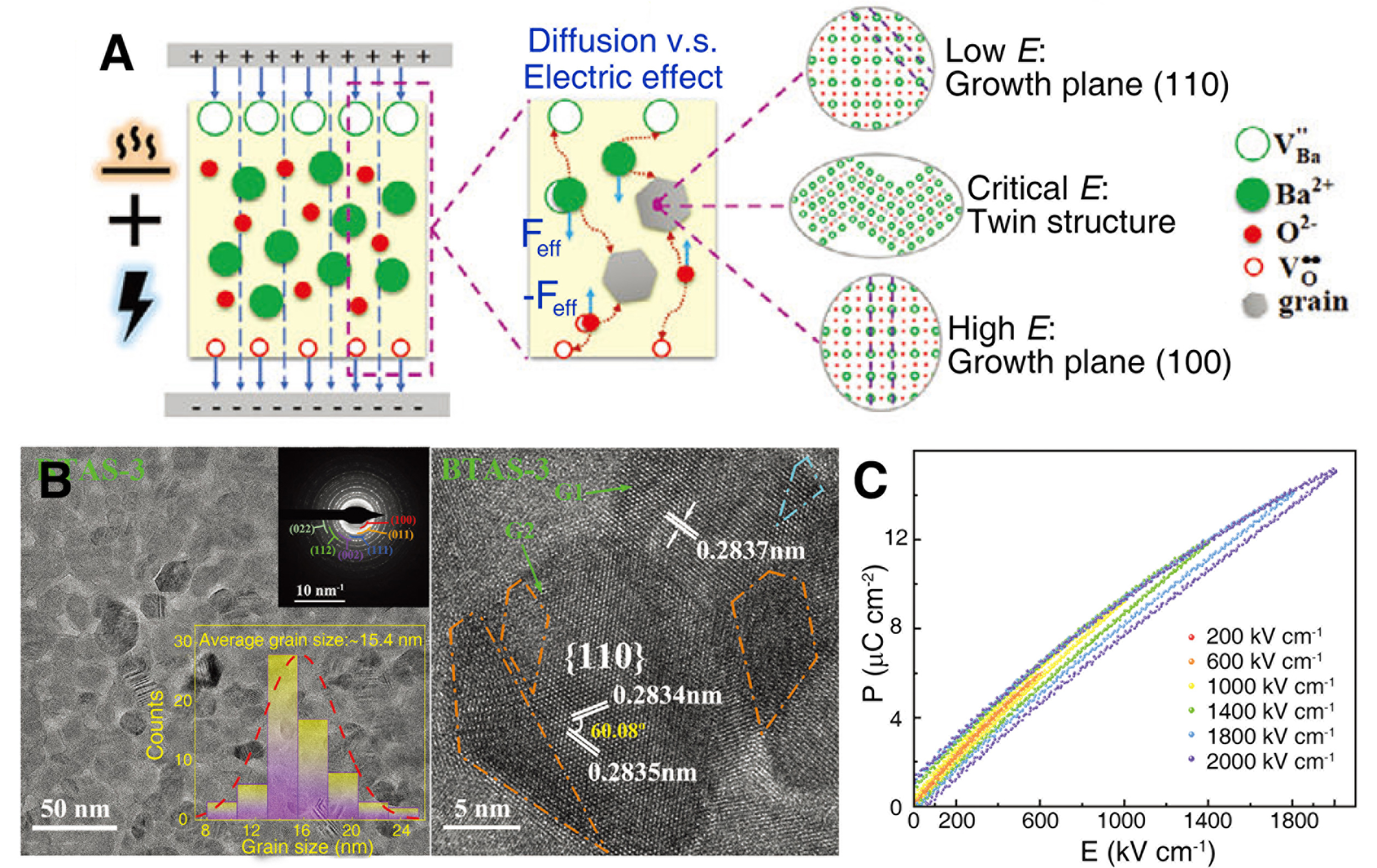
Figure 10. Enhanced ESP in BT-based glass ceramics via defect formation modulation leading to an “amorphous-disordered-ordered” microstructure. (A) Schematic illustrating defect formation during crystallization without and with electric field assistance; (B) High-resolution TEM image of BTAS glass ceramic showing morphology and lattice fringes; insets display the selected area electron diffraction pattern and grain size distribution histogram; (C) P-E loops of BTAS glass ceramics measured at 10 Hz. The BTAS composition corresponds to glass ceramics crystallized under a 3 kV/cm electric field. This figure is quoted with permission from Shang et al.[101]. ESP: Energy storage performance; TEM: transmission electron microscopy; BT: BaTiO3; BTAS: BaO-TiO2-Al2O3-SiO2.
Grain refinement and density enhancement
The grain size, porosity, and phase uniformity of dielectric ceramic materials are key factors influencing their dielectric breakdown field; then, the dielectric and polarization responses are also affected based on size effects and clamping effects. A large porosity is highly detrimental to the breakdown field. Under the requirement of high Wrec, refining the grain size has been widely proven to improve BDS and is one of the most common strategies for grain structure design, which has been extensively validated across various systems[102-106] as shown in Figure 11.
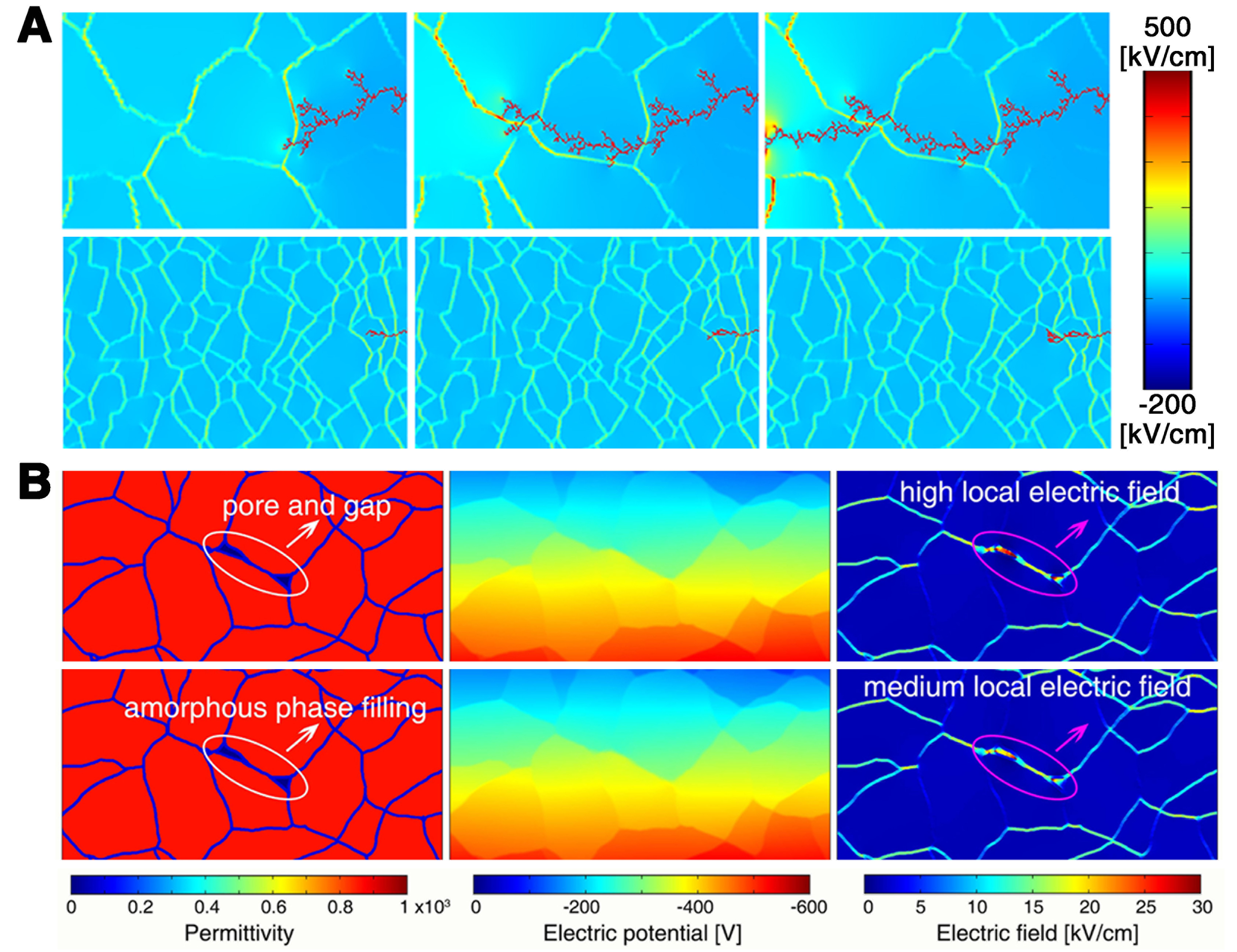
Figure 11. Grain refinement and densification enhance dielectric BDS. (A) Evolution of electric field and development of breakdown paths under a constant field of 320 kV/cm for 0.1-CS and 0.25-HPS ceramics. The 0.1-CS sample is a 0.9Bi0.5Na0.5TiO3-0.1K0.5Na0.5NbO3 ceramic prepared by conventional sintering, while the 0.25-HPS sample is a 0.75Bi0.5Na0.5TiO3-0.25K0.5Na0.5NbO3 ceramic prepared by hot-press sintering. This figure is quoted with permission from Deng et al.[103]; (B) Simulated distributions of dielectric constant, electric potential, and local electric field in ceramic macrostructures before and after amorphous phase filling. This figure is quoted with permission from Zhang et al.[106]. BDS: Dielectric breakdown strength.
Refining the grain structure can reduce defects and pores, thereby mitigating localized electric potential concentration. The increased grain boundary density and number act as insulating barriers, hindering the development of electrical treeing and reducing the probability of dielectric breakdown[106]. Additionally, the fine-grained structure, through high-density grain boundaries, suppresses the migration of thermally activated charge carriers, reducing leakage current and Joule heat accumulation. This not only enhances the material’s thermal stability under high electric fields but also prevents thermal breakdown. The grain size directly influences the size and distribution of FE domains, with smaller grains significantly reducing domain size. Due to size effects, the FE macrodomains transition into nanosized domains or polar microregions. As a result, the ferroelectricity weakens or may even disappear, significantly lowering the coercive field, remnant polarization, hysteresis, and energy loss.
Moreover, grain refinement may affect polarization behavior. For example, in RFEs, small grains can enhance the local random field, suppressing remnant polarization, and improving η. Wang et al. investigated the impact of grain size and grain boundaries on the ESP of polycrystalline FEs using a phase-field model[105]. As shown in Figure 12, their findings indicate that the depolarization field at the grain boundary induces vortex domains when the grain size is reduced or when the grain boundary thickness increases to a certain extent, leading to narrow P-E loops. The influence of these grain microstructural features on breakdown characteristics and polarization behavior can be utilized to improve dielectric ESP.
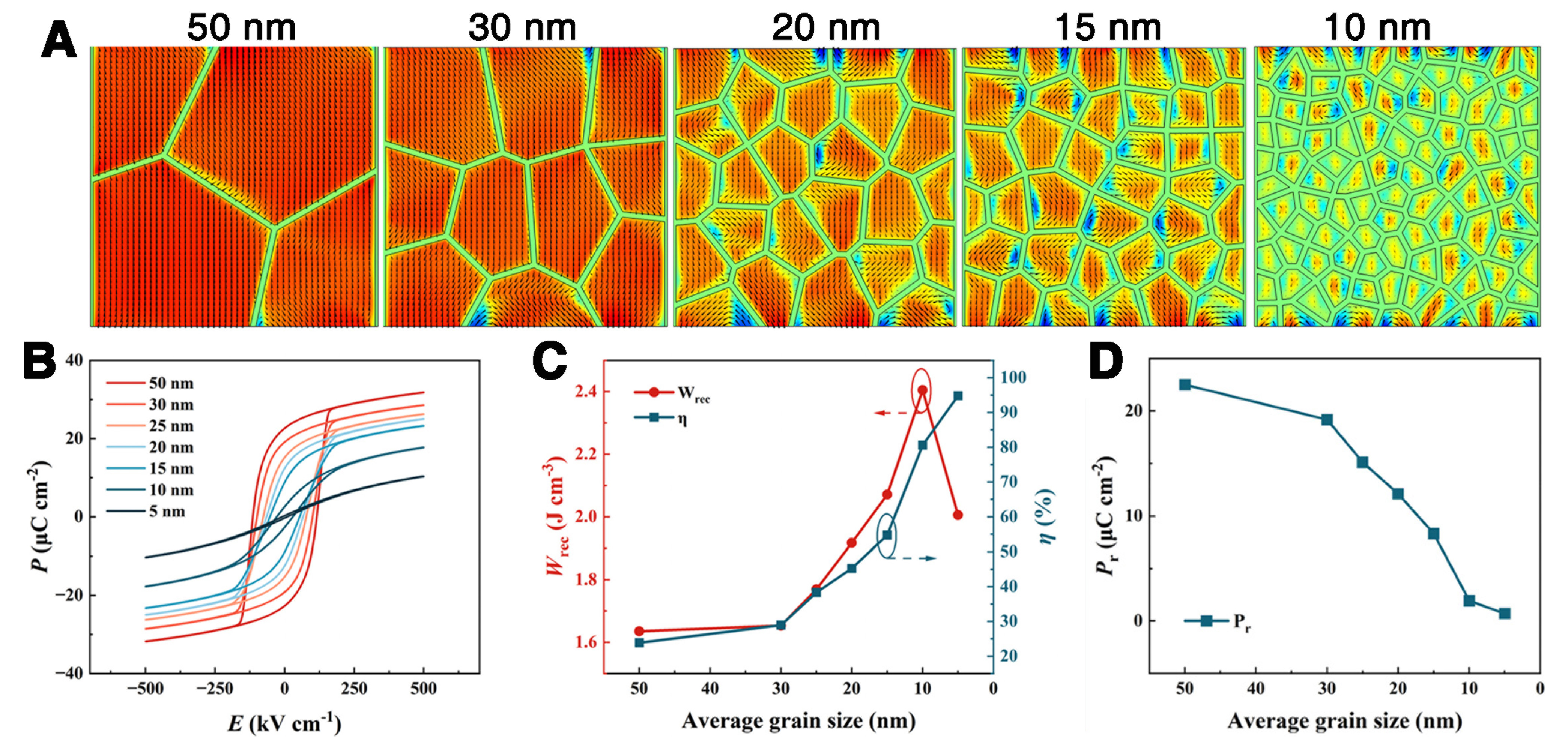
Figure 12. Influence of grain size on polarization behavior and ESP in polycrystalline FEs. (A) Domain structures of polycrystalline models at remnant polarization state with varying grain sizes; (B) P-E loops, (C) ESP, and (D) Pr as a function of average grain size. This figure is quoted with permission from Wang et al.[105]. ESP: Energy storage performance; FE: ferroelectric.
However, it is important to note that smaller grain sizes are not always better; there may be an optimal size range. Excessively small grains may lead to an excessive number of grain boundaries, which can reduce the dielectric constant or maximum induced polarization, or cause difficulties in preparation and densification. According to Wang’s research, further decreasing the grain size or increasing the grain boundary thickness results in a decrease in Wrec due to a concurrent reduction in both remnant and saturation polarization[105]. Therefore, it is crucial to select the optimal size range based on the material system[107].
Grain refinement and densification are fundamental to improving the dielectric ESP of ceramic materials. The underlying mechanism involves enhancing BDS and optimizing polarization characteristics by fine-tuning the microstructure. This approach has proven to be a generally applicable strategy for boosting dielectric ES capacity. Several material preparation methods and chemical processing techniques can effectively achieve this goal. These processes typically encompass ceramic powder fabrication, sintering techniques, and the use of chemical additives.
Reducing the initial powder size, enhancing sintering activity, and inhibiting grain boundary migration during sintering are all effective strategies for controlling grain growth. Applying physical pressure during sintering facilitates particle rearrangement, mass transfer, and plastic flow, thereby promoting densification and lowering sintering barriers. A common approach is hot pressing, in which uniaxial pressure (typically 10-50 MPa) is applied during high-temperature sintering, accelerating densification and limiting grain growth. Rapid sintering techniques also contribute to both densification and grain refinement. One such method is spark plasma sintering (SPS), which generates high temperatures almost instantaneously through pulsed direct current while applying pressure, achieving rapid sintering and densification and suppressing excessive grain growth. Similar techniques include microwave sintering and flash sintering. In addition, chemical methods such as sol-gel processing, hydrothermal or solvothermal synthesis, and co-precipitation enable the preparation of homogeneous, nanometer-sized precursor powders, which, after sintering, yield fine-grained ceramics.
Sintering can also be optimized through two-step processes[108] or the addition of grain growth inhibitors to enhance density and reduce grain size. For instance, introducing second-phase materials like MgO, SiO2, or Y2O3, or doping with elements such as La3+ and Nb5+, can pin grain boundaries or reduce their migration, effectively suppressing grain growth. By combining physical and chemical methods and optimizing sintering parameters, it is possible to achieve coordinated control over both grain refinement (< 1 μm) and high density (> 98%), significantly improving the dielectric ESP.
When designing high-performance dielectric ceramics for ES, grain refinement is often coupled with other modification techniques. For example, chemical composition adjustments, doping, and multiscale structural designs (such as multilayer structures, core-shell configurations, or composite ceramics) are employed to further enhance performance. Liu et al. demonstrated exceptionally high BDS and ESP in lead-free BT-based RFE using a combined strategy of composition modification, viscous polymer processing, and liquid-phase sintering[109]. Composition modification disrupted long-range FE order, while liquid-phase sintering enabled low-temperature densification and grain refinement, as shown in Figure 13A. Viscous polymer processing (VPP) allowed for thinner single-layer ceramic samples, illustrating an effective collaborative optimization strategy that could serve as a paradigm for the development of new dielectric ES ceramics.
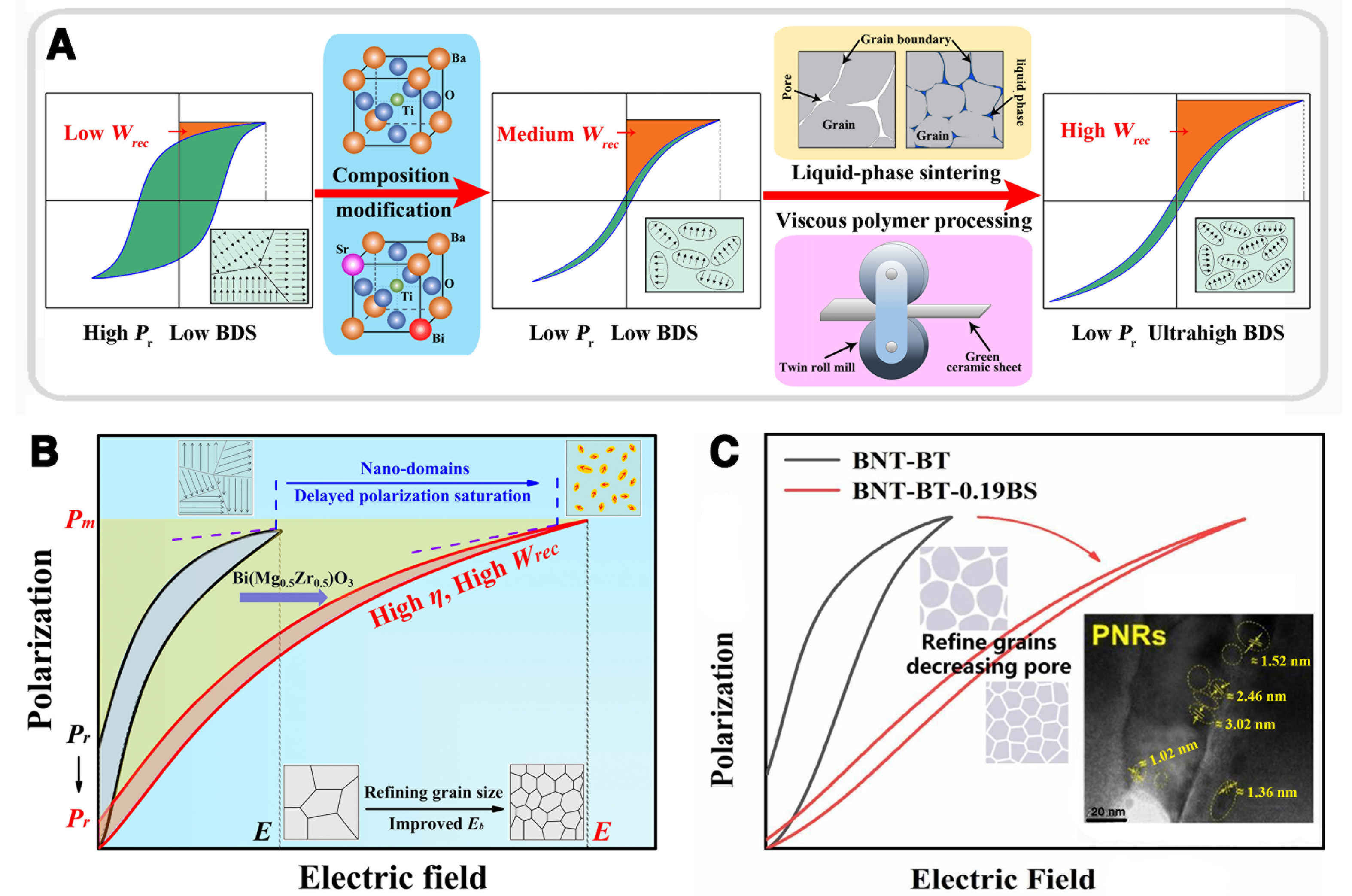
Figure 13. Grain refinement and densification significantly enhance ESP in dielectric ceramics. (A) Ultrahigh dielectric BDS and superior ESP achieved in BT-based RFE ceramics through combined composition modification, viscous polymer processing, and liquid-phase sintering. This figure is quoted with permission from Liu et al.[109]; (B) Schematic illustrating strategies to realize outstanding ESP in Bi0.5Na0.5TiO3-based RFE ceramics. This figure is quoted with permission from Zhu et al.[110]; (C) Grain refinement and pore reduction via two-step firing in 0.6BNT-0.21BT-0.19BiScO3 ceramics, resulting in doubled BDS and enhanced ESP. This figure is quoted with permission from Xu et al.[112]. ESP: Energy storage performance; RFE: relaxor ferroelectric; BDS: dielectric breakdown strength; BNT: (Bi0.5Na0.5)TiO3; BT: BaTiO3
For RFE materials, particularly those with rapidly saturating polarization, simply refining the grain structure to improve the breakdown field provides limited enhancement in ES. It is more effective to combine this with strategies designed to delay saturation polarization for significant performance improvements[110-112], as illustrated in Figure 13B and C. Li et al. developed a composite dielectric with an intragranular segregation structure, achieving excellent ESP by delaying saturation polarization[113]. This approach demonstrates how strategic modifications to polarization dynamics can significantly boost the ES capabilities of FE materials.
The FE properties of FE materials are highly dependent on grain size, with various dielectric properties exhibiting a pronounced size effect. Numerous studies have explored these effects and have established that the dielectric response, as well as other electrical characteristics, can be significantly influenced by grain size[114-118]. Tan et al. have found that the grain size effect is universal and nearly independent of the sintering method and the starting powder[117]. Zhang et al. studied the grain size dependence of domain wall activity in a lead-free (Ba,Ca)(Zr,Ti)O3 system and demonstrated that the dielectric properties of polycrystalline FEs are influenced by the grain size, particularly through the dynamics of domain walls[119]. Their research found that the highest dielectric permittivity occurs at intermediate grain sizes, which facilitate easier and faster domain wall dynamics, coupled with moderate lattice distortion.
Interestingly, the size effect can also be exploited as a strategy for suppressing ferroelectricity. By reducing polarization hysteresis, this approach can enhance dielectric ESP[120]. It is widely applied in the production of MLCCs. Typically, BT is a FE material, exhibiting high polarization hysteresis and energy loss. However, low-voltage, high-dielectric MLCCs commonly employ nanoscale BT grains. These ceramics exhibit relaxation-like behavior rather than the typical FE response. Additionally, the incorporation of rare-earth ions into grain boundaries further improves performance by promoting the formation of multiphase ceramics and core-shell structures. This strategy extends the temperature range and stability of the dielectric constant, enabling the production of MLCC materials with standardized temperature stability parameters such as X7R, X8R, and X9R[22,121-124].
Grain size and defect engineering have a significant impact on the dielectric properties of BT-based ceramics and the temperature coefficient of capacitance in MLCCs[125-127]. For BT ceramics, grain refinement helps suppress tetragonal lattice distortion and ferroelectricity, thereby reducing polarization hysteresis and broadening the dielectric peak. Although the grain size effect is widely applied in low-field applications of BT-based MLCC devices, where a high dielectric constant is leveraged for functions, such as charge storage and filtering, the primary demand for dielectric ES materials focuses on exploiting high polarization responses for power amplification and pulsed discharge. In these materials, the most crucial structural requirement for industrialization remains densification and grain refinement. For dielectric ES ceramics, ensuring finely tuned grains is essential to achieve optimal performance, particularly in applications that rely on high polarization for ES and rapid energy release.
Composite ceramics
The design of composite FE ceramics at the grain scale aims not merely to alter the intrinsic physical or chemical properties of the matrix phase through dopant modification, but rather to harness the distinct advantages of multiple end-member phases through engineered composite microstructures. Broadly defined, a variety of structural configurations fall under the category of composite ceramics. These include multilayer architectures, ceramics with heterogeneous, additive-induced secondary phase precipitations, co-sintered systems comprising mixed compositional constituents, and materials exhibiting core-shell architectures formed via the diffusion of additives into grain lattices during processing. This section specifically focuses on 0-0 type composite ceramics, wherein compositional heterogeneity is introduced at the grain level.
The 0-0 composite paradigm refers to systems in which discrete grains of two different compositions are distributed throughout the ceramic matrix[66]. These grains may share the same crystal structure but differ in chemical composition, or they may possess fundamentally distinct crystallographic symmetries. For instance, Hu et al. developed a 0-0 type composite by co-sintering two Pb-based RFE compounds with complementary functional characteristics. The high-breakdown-field Pb0.94La0.04(Zr0.99-xSnxTi0.01)O3 was combined with the high-efficiency Pb0.8925Ba0.04La0.045(Zr0.65Sn0.3Ti0.05)O3 to construct a composite with markedly improved ESP. The resulting ceramic exhibited a high Wrec of approximately 7.15 J/cm3 and an η of about 90.5% under an electric field of 345 kV/cm[66].
More commonly, high-performance composite systems are achieved by integrating materials with inherently distinct crystal structures and polarization mechanisms. These include combinations of perovskite phases with bismuth-layered, tungsten-bronze, or pyrochlore-type phases. For example, Wu et al. developed a ST-based diphase composite by introducing the bismuth-layered BaBi2Nb2O9 into the perovskite relaxor matrix of Sr0.6(Na0.5Bi0.5)0.4TiO3[128], as shown in Figure 14A. This strategy yielded a ceramic capable of delivering a Wrec of approximately 3.6 J/cm3 and an outstanding η of 94.3% under moderate electric fields. Similarly, Wang et al. proposed a heterogeneous combination strategy involving embedding a high Eb plate-like pyrochlore phase in a high-polarization perovskite phase[129], as shown in Figure 14B. The embedded plate-like pyrochlore enhances the breakdown field strength and facilitates the dynamic polarization response. Meanwhile, the strong spin-orbit coupling effect of the 5d electrons helps maintain the high polarization value of the perovskite. Other notable examples include pseudo-cubic BT matrix ceramics with Ba4MgTi11O27 as the secondary phase[130] (as shown in Figure 14C), as well as composites of BNT (a classic perovskite FE) with the pyrochlore-structured Sm2Ti2O7[131]. These systems collectively demonstrate that the deliberate design of grain-scale phase coexistence, especially between end-members exhibiting contrasting dielectric and polarization characteristics, provides an effective strategy for enhancing both Wrec and operational η in lead-based and lead-free dielectric ceramics.
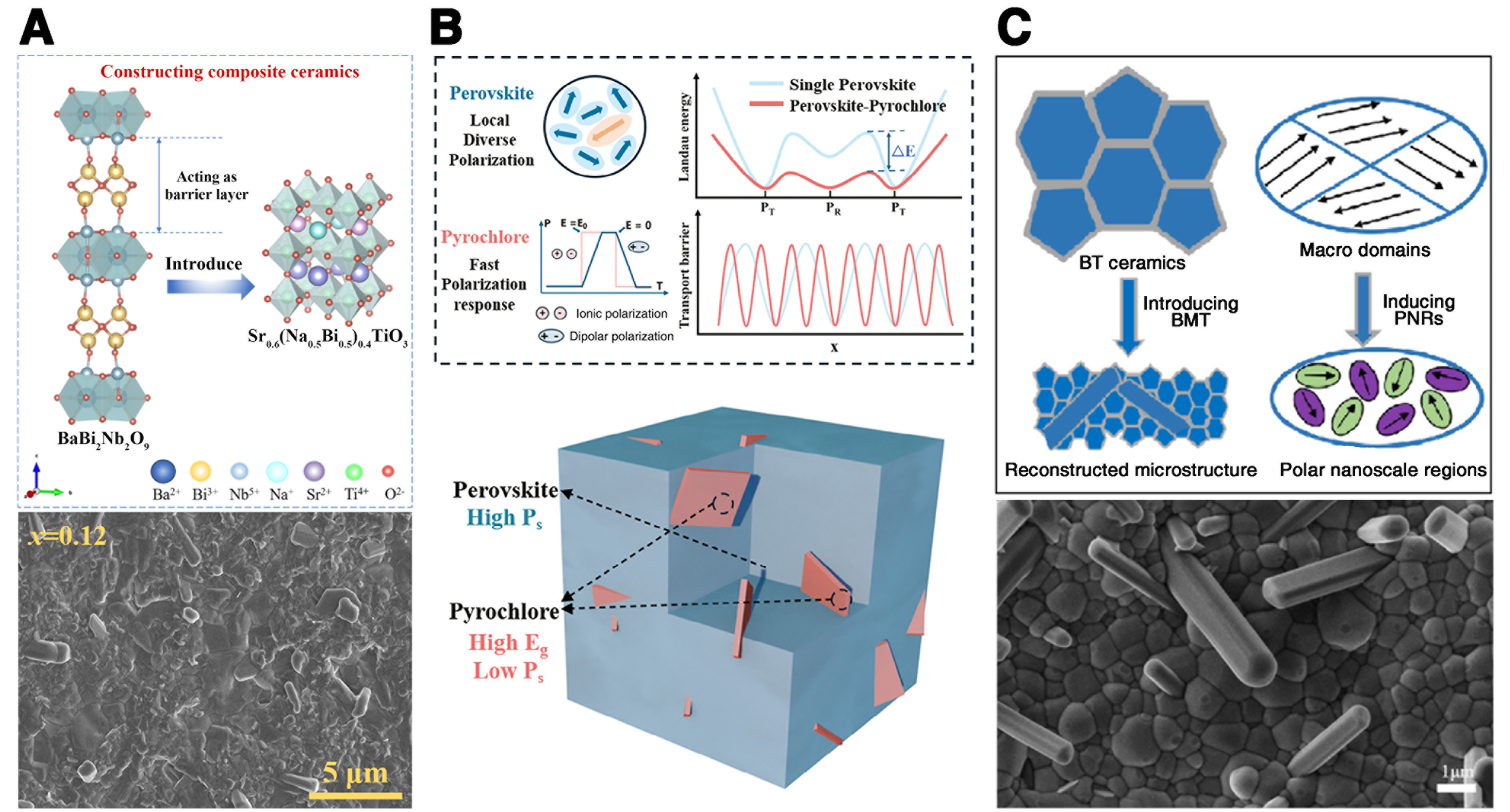
Figure 14. Enhanced ESP through grain-scale composite ceramic design. (A) Incorporation of bismuth layer-structured BaBi2Nb2O2 into perovskite Sr0.6(Na0.5Bi0.5)0.4TiO3 ceramic via traditional solid-state synthesis to improve overall ESP. This figure is quoted with permission from Wu et al.[128]; (B) Embedding high-breakdown-strength plate-like pyrochlore phase within high-polarization perovskite matrix to boost ES in BNT-based ceramics. This figure is quoted with permission from Wang et al.[129]; (C) Superior ESP in BT-based RFE ceramics with reconstructed microstructure featuring elongated rod-shaped and polygonal perovskite grains. This figure is quoted with permission from Yin et al.[130]. ESP: Energy storage performance; BNT: (Bi0.5Na0.5)TiO3; ES: energy storage; RFE: relaxor ferroelectric; BT: BaTiO3; BMT: Bi(Mg1/2Ti1/2)O3.
In addition to conventional FE or relaxor components, high-melting-point oxides capable of forming distinct secondary phases, such as HfO2[132,133] and ZrO2[134,135], have emerged as promising candidates for engineering advanced composite FE ceramics. These oxides can be selectively introduced to create heterostructures with tailored local electric fields and optimized dielectric behaviors. For instance, Lu et al. developed a self-assembled metadielectric nanostructure by embedding HfO2 nanophases within a BaHf0.17Ti0.83O3 RFE matrix, as shown in Figure 15A. The inclusion of HfO2 contributed to a significant enhancement in dielectric BDS, improved RFE characteristics, and a reduction in conduction losses. As a result, the fabricated thin-film capacitors achieved an exceptional Wrec of up to 85 J/cm3, with an η surpassing 81%[132]. In a similar approach, Shen et al. incorporated HfO2 into 0.75BNT-0.24NN-0.01ST RFE ceramics to construct heterogeneous composites. Here, HfO2 particles were predominantly located along grain boundaries, acting as physical barriers that effectively suppressed the formation of localized electric branches while preserving high saturation polarization. This structural design strategy ensured a marked improvement in ESP and reliability under high fields[133]. As shown in Figure 15B, isolated ZrO2 secondary phases embedded in the perovskite matrix not only enhance the fracture toughness of the ceramics but also improve electrical insulation and broaden the bandgap, resulting in excellent stability, reliability, and superior charge-discharge performance.
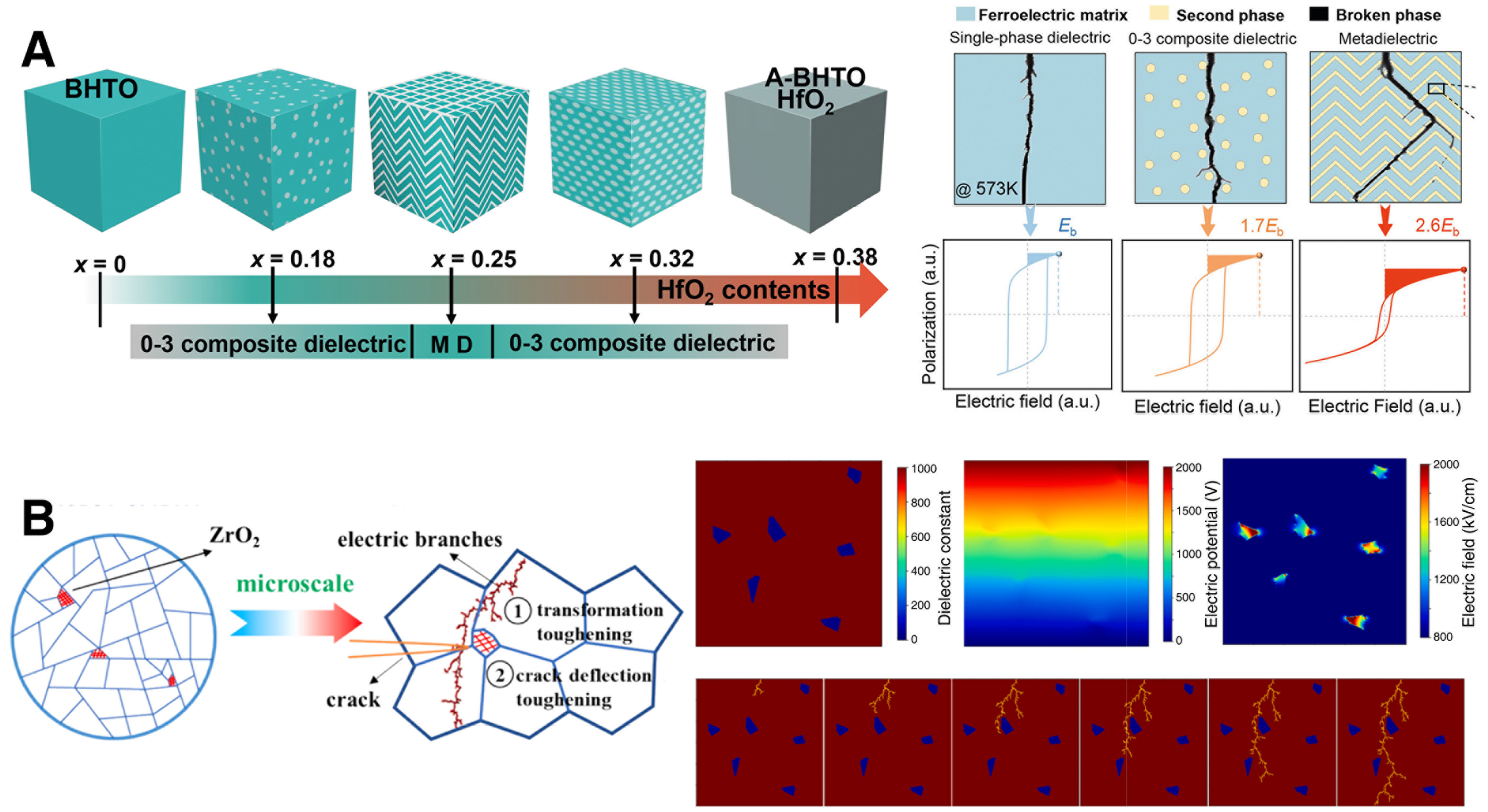
Figure 15. Enhanced ESP via self-assembled metadielectric nanostructures and phase toughening in RFE ceramics. (A) Self-assembled BaHf0.17Ti0.83O3-xHfO2 metadielectric nanostructure: schematic of structural evolution, breakdown phase transitions, and corresponding P-E hysteresis loops under breakdown conditions. This figure is quoted with permission from Lu et al.[132]; (B) Schematic illustrating improved ESP in ZrO2-toughened Ba0.55Sr0.45TiO3-Bi0.5Na0.5TiO3-SrZrO3 RFE ceramics due to enhanced BDS following ZrO2 phase incorporation. The studied composition is 0.4 Ba0.55Sr0.45TiO3-0.4 Bi0.5Na0.5TiO3-0.2SrZrO3. This figure is quoted with permission from Yang et al.[134]. ESP: Energy storage performance; RFE: relaxor ferroelectric; BDS: dielectric breakdown strength.
The impact of composite architectures on polarization response is inherently multifaceted. A key advantage of such composites lies in their ability to leverage and synergize the functional merits of each constituent phase. Accordingly, the selection of end-member phases is typically guided by their complementary properties. One common strategy involves pairing a component possessing intrinsically high polarization capability with another phase, either crystalline or amorphous, that provides superior dielectric BDS. Alternatively, a high-polarization material may be coupled with a secondary phase known for its superior η, thereby balancing Wrec and η within a single composite system. Nonetheless, it is crucial to emphasize that the realization of these synergistic effects critically depends on the reproducibility and precision of the composite fabrication process. Achieving optimal performance requires the formation of dense microstructures with well-defined and stable interfaces. Care must be taken to prevent undesirable interdiffusion between phases, which can otherwise compromise the intrinsic functionalities of the individual components. Controlled phase distribution, grain boundary engineering, and sintering protocols, therefore, play an essential role in translating microstructural advantages into macroscopic dielectric performance.
Core-shell structures
In ceramic materials, the term “core-shell structure” commonly refers to grains exhibiting radial compositional gradients or inhomogeneities. It is important to clarify that the core-shell strategy discussed in this section pertains exclusively to microstructural design at the grain level within sintered ceramics, rather than to particle-level core-shell configurations formed during powder synthesis. For example, BT particles coated with SiO2 through chemical modification are frequently referred to as core-shell powders. However, upon sintering, the SiO2 coating typically transforms into an amorphous intergranular network. As such, this structural motif should be more appropriately classified under the domain of grain boundary engineering, rather than as a genuine core-shell structure within the ceramic grains. The distinction between these two strategies is fundamental and warrants careful attention by the reader.
Analogous to the 0-0 type composite ceramics described earlier, core-shell structured grains can be regarded as a particular form of compositional or structural heterogeneity, and thus constitute a subclass of composite ceramics. In practice, this design approach is often coupled with grain refinement and has found widespread application in contemporary BT-based MLCC[136], where both dielectric performance and reliability critically depend on the intricate interplay between grain size and microstructure. The core-shell model has been extensively employed to rationalize the influence of grain size on the FE and dielectric properties of ceramics[137,138].
In addition to their well-established role in tailoring dielectric and FE properties, core-shell structural strategies have emerged as a highly effective approach for enhancing ESP in dielectric ceramics. Fundamentally, the rational design of core-shell architectures enables the concurrent optimization of dielectric permittivity and BDS, two parameters that often exhibit an inverse relationship in homogeneous materials. By integrating a high-permittivity core material with a shell that exhibits superior dielectric strength, these heterogeneous structures overcome the performance limitations inherent to conventional single-phase systems. The core supports robust polarization, while the shell acts as a protective barrier that sustains high electric fields without premature failure. Moreover, such structural motifs can be exploited to modulate interfacial polarization and suppress dielectric losses. The introduction of dielectric gradient layers or space charge regions within the shell offers a mechanism to fine-tune the interfacial polarization response, thereby mitigating energy dissipation caused by mobile charge carriers. In addition, the high-resistivity shell layer blocks direct charge injection from the electrodes, significantly reducing conduction-related losses and further enhancing the overall η.
The presence of a shell also plays a crucial role in passivating surface defects at the grain boundaries of the core. By smoothing local potential fluctuations and reducing electric field concentration, the shell effectively delays the onset of dielectric breakdown. Through precise control over the relative dimensions of the core and shell, as well as the compositional gradient across the interface, it becomes possible to engineer a favorable balance between dielectric properties and insulation characteristics. This structural tunability offers a promising route toward simultaneous improvements in BDS, Wrec, and cycling stability. Typically, the core region retains a FE domain structure, contributing substantially to the net polarization, while the shell exhibits either relaxor-like behavior or linear dielectric characteristics with minimal hysteresis and enhanced electrical robustness.
For instance, Xue et al. developed BNT-based RFE ceramics featuring core-shell grains induced by the controlled diffusion of Ta5+ ions in the BNT-KTaO3 system[139]. As shown in Figure 16A and B, this diffusion-limited mechanism yields a chemical heterogeneity in which the Ta5+-depleted cores contain nanodomains approximately 10 nm in size, while the Ta5+-rich shells harbor PNRs on the order of 1-2 nm. Such a configuration enhances dielectric relaxation behavior, suppresses grain growth, and collectively contributes to improved temperature stability, elevated BDS, and favorable ESP, as shown in Figure 16C.
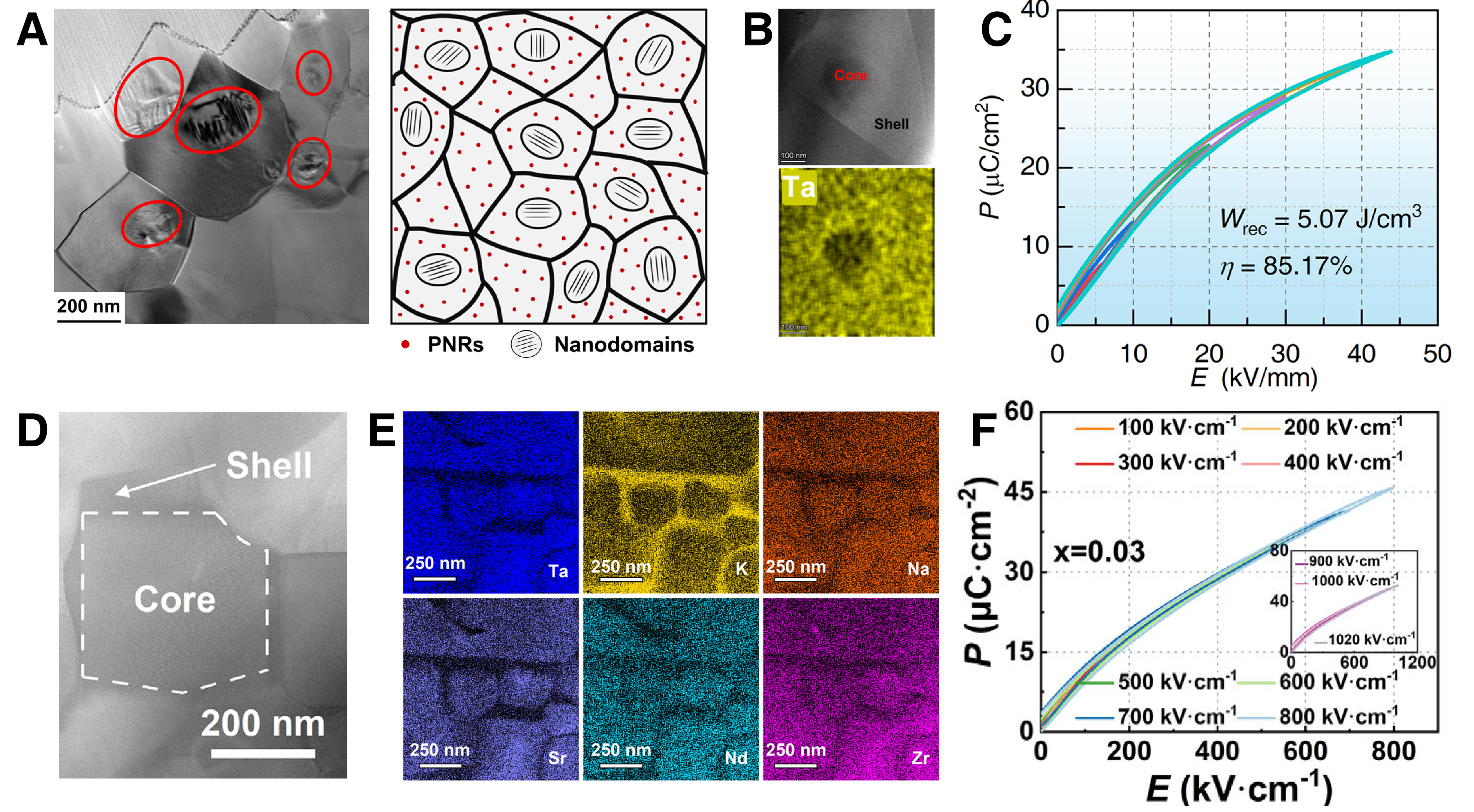
Figure 16. Core-shell grain structures enhance dielectric and ESP in lead-free RFE ceramics. (A-C) Core-shell microstructure and properties of BNT-KTaO3-0.02wt% Li2CO3 ceramics: (A) grain morphology and schematic illustration, (B) high-angle annular dark-field (HAADF) image with corresponding EDS elemental mapping, and (C) P-E loops alongside ESP. This figure is quoted with permission from Xue et al.[139]; (D-F) Ultrahigh ESP in KNN-based RFE ceramics with core-shell grains: (D) grain morphology, (E) EDS mapping, and (F) P-E loops of 0.85KNN-0.15Sr0.7Nd0.2ZrO3-0.03Ag(Nb0.45Ta0.55)O3 ceramics. This figure is quoted with permission from Chai et al.[141]. ESP: Energy storage performance; RFE: relaxor ferroelectric; BDS: dielectric breakdown strength; BNT: (Bi0.5Na0.5)TiO3; KNN: (K0.5Na0.5)NbO3.
In a related study, Dong et al. engineered core-shell structured bulk ceramics in a (1-x)[0.90NN-0.10Bi(Mg2/3Nb1/3)O3]-x(Bi0.5Na0.5)0.7Sr0.3TiO3 system[140]. Their work demonstrated that the presence of a polar core effectively suppressed local electric field concentrations in the surrounding weakly polar shell, significantly elevating the BDS and enabling a remarkable balance between high polarization and dielectric robustness.
Recently, Chai et al. reported KNN-based bulk ceramics featuring a grain-level core-shell structure combined with polymorphic nanodomains[141], as shown in Figure 16D and E. Guided by compositional engineering, this microstructural design produced a synergistic enhancement of both polarization and BDS. As a result, the ceramics achieved an outstanding Wrec of approximately 20.4 J/cm3 and an η near 90% under an applied field of around 1,020 kV/cm, as shown in Figure 16F.
Beyond the widely explored FE-RFE and FE-LD composite frameworks, the combination of RAFE and RFE components has also demonstrated significant promise in the construction of core-shell grain structures tailored for dielectric ES applications. A representative example is provided by Xie et al., who developed a core-shell microstructure in a BT-modified NN-BiFeO3 system[142]. Their design capitalized on spontaneous compositional segregation, which induced a unique structural evolution from a RAFE to a RFE state. This transition manifested as a progressive transformation of hierarchical AFE nanodomains into nanoscale FE polar regions, enabling the core and shell to respectively inherit the high Wrec potential of the RAFE phase and the high η typical of RFE behavior. The resulting core-shell architecture exhibited an outstanding combination of Wrec and η, highlighting the potential of this strategy for advanced capacitor applications.
The core-shell concept has also been successfully extended to AFE-based bulk dielectrics, where grain-scale structural modulation plays a crucial role in modulating polarization dynamics and mitigating energy loss. Based on phase-field simulations, Wu et al. proposed a model wherein the core adopts AFE characteristics while the shell behaves as a LD[143]. This heterostructure configuration effectively delayed the onset of saturation polarization and reduced hysteresis-related losses, thereby offering an improved balance between ES capability and η.
Although substantial evidence supports the effectiveness of core-shell grain architectures in enhancing dielectric ESP, several key challenges remain unresolved. In particular, ensuring interfacial chemical compatibility between core and shell phases is critical to maintaining structural coherence and polarization continuity. Moreover, the scalable fabrication of such microstructures remains technically demanding, especially under constraints of industrial viability. Structural stability under high electric fields and elevated temperatures also poses significant limitations for long-term operational reliability. Additionally, the development of precision coating techniques, such as atomic layer deposition, may enable unprecedented control over shell thickness and compositional gradients at the atomic scale. These emerging strategies could unlock the full potential of core-shell microstructures, positioning them as a cornerstone in the next generation of high-performance dielectric ES materials.
Grain boundary engineering
Grain boundary engineering (GBE) has emerged as a powerful microstructural design strategy at the grain scale for enhancing dielectric ESP. By systematically tailoring the structural, chemical, and electrical properties of grain boundaries, which are defined as the interfacial or amorphous regions between adjacent grains, GBE provides a versatile approach to simultaneously enhance critical functional metrics, including dielectric BDS, polarization behavior, and energy loss characteristics. The primary mechanisms underlying these improvements include increased material densification, reduced defect concentrations, enhanced grain boundary resistance, and the suppression of space charge accumulation. These effects collectively contribute to improved insulation and elevated η.
GBE strategies are typically implemented through the introduction of wide-bandgap dopants, intergranular phase modifications, or chemical coating techniques. One of the most representative approaches involves constructing a pseudo 0-3 type composite structure, wherein an amorphous phase forms a percolating three-dimensional network that hosts high-dielectric crystalline grains. This architecture is commonly realized using a two-phase system in which an amorphous matrix, generated from pre-synthesized glass additives or low-melting-point oxides, encapsulates discrete crystalline components during high-temperature sintering. The crystalline grains provide strong polarization capability, while the surrounding amorphous network contributes to high electrical insulation, thereby enabling a synergy between high dielectric permittivity and breakdown endurance[71,144-147].
A typical example of such a design involves the incorporation of oxides with high bandgap energies and excellent dielectric strength into the composite system. Silica is a common choice for this strategy. As shown in Figure 17A, a core-shell structure of Sr0.985Ce0.01TiO3 (SCT)@ SiO2 combines a high dielectric permittivity core with an insulating shell material. After sintering, the SiO2 enriches grain boundaries, enhancing dielectric breakdown[144]. Silica-coated pre-synthesized powders are suitable for many material systems[71,148]. For instance, Huan et al. employed a chemical coating technique to deposit a thin SiO2 shell around KNN-BZT powders[71]. As shown in Figure 17B, the resulting core-shell composites exhibited significantly improved dielectric BDS and fatigue endurance, attributed to the suppression of electrical conduction pathways and the stabilization of interfacial regions.
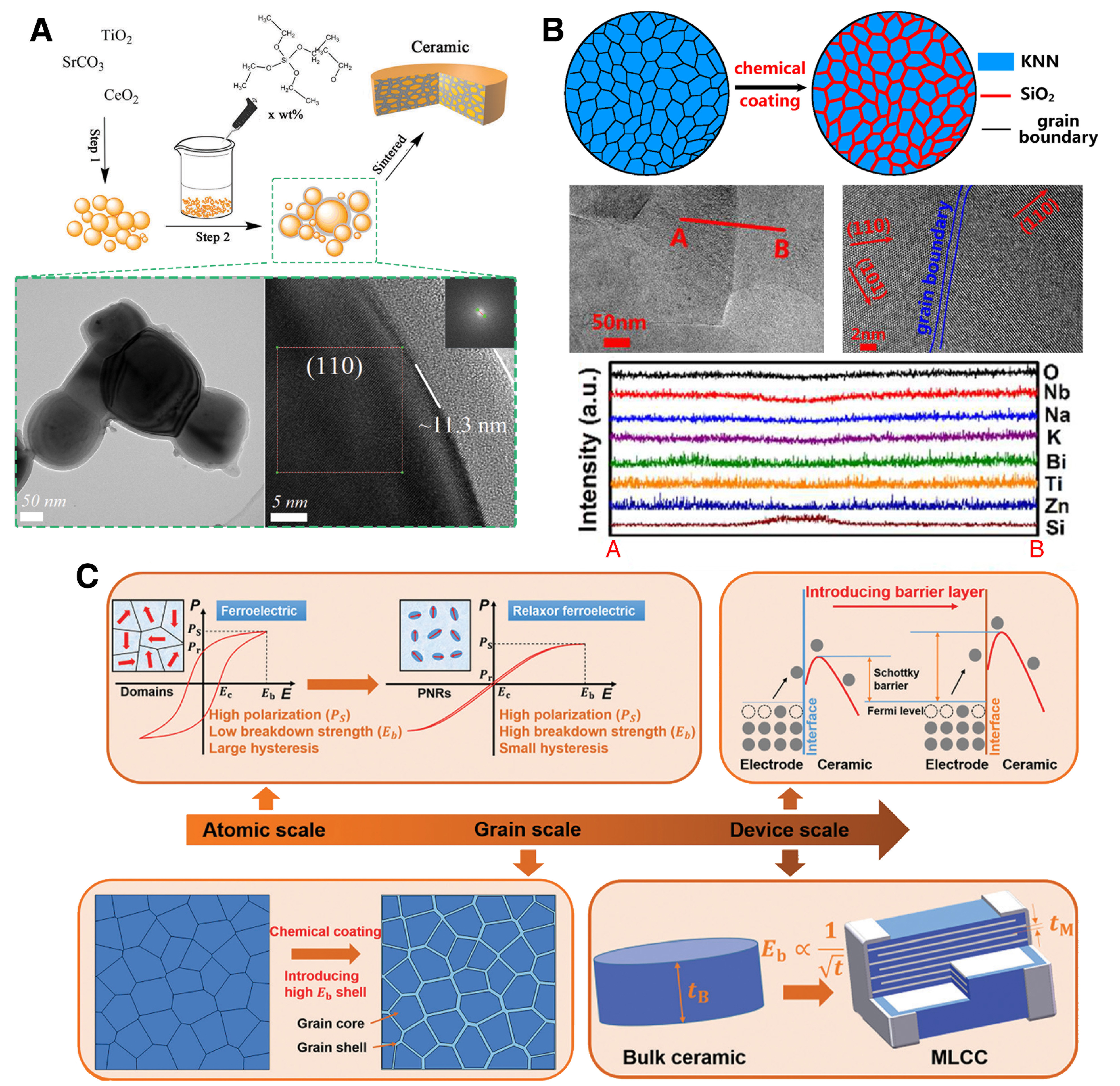
Figure 17. Grain boundary engineering enhances BDS to optimize ESP. (A) Experimental processing route and field-emission TEM images of
In practical device architectures, GBE is often implemented in conjunction with other multiscale microstructural optimization strategies to realize superior overall performance. A particularly noteworthy example is the work of Zhao et al., who integrated GBE with the design of PNRs and multilayer device configurations, as shown in Figure 17C. At the atomic scale, compositional modulation was employed to induce relaxor-type nanodomains; at the grain scale, SiO2 coatings formed dense intergranular barriers that reduced leakage current and mitigated local electric field concentrations; at the device level, MLCC structures were fabricated to leverage these microscale enhancements[149]. This holistic design paradigm yielded remarkable results, with the MLCC devices achieving a Wrec of 18.24 J/cm3, an η exceeding 94.5%, and excellent thermal and cycling stability.
Recent advances in GBE have highlighted the transformative potential of multilayer chemical coating techniques applied to pre-synthesized ceramic powders. This strategy enables the construction of hierarchically tailored grain boundary architectures that can simultaneously modulate multiple interfacial properties, such as electric field distribution, defect density, and intergranular polarization dynamics. Among the pioneers in this area, Zhang et al. have conducted a series of influential studies that establish multilayer chemical coating as a highly effective approach for achieving complex microstructural control in dielectric ceramics[146,147]. In a representative study, a ternary Bi2O3-B2O3-SiO2 (BBS) glass was introduced to facilitate the densification of sintered ceramics. Simultaneously, La2O3, a wide-bandgap oxide with excellent insulating properties, was employed as a buffer layer at the interface between the glass phase and the ceramic particles, as shown in Figure 18A. This La2O3 interfacial coating enhanced uniformity and compactness and mitigated local electric field distortion, which is often a limiting factor for dielectric breakdown. As a result, the coated system demonstrated superior wide-temperature capacitive ES characteristics, with improved stability and η across operating conditions[146]. Building upon this strategy, a more intricate multilayer configuration was developed by sequentially coating SrZrO3-BiMg0.5Sn0.5O3 (SZ-BMS) and a SiO2-based glass onto Na0.4K0.1Bi0.5TiO3 (NKBT) particles, as shown in Figure 18B. This synergistic design enabled the realization of a ceramic system with outstanding electrical performance[147].
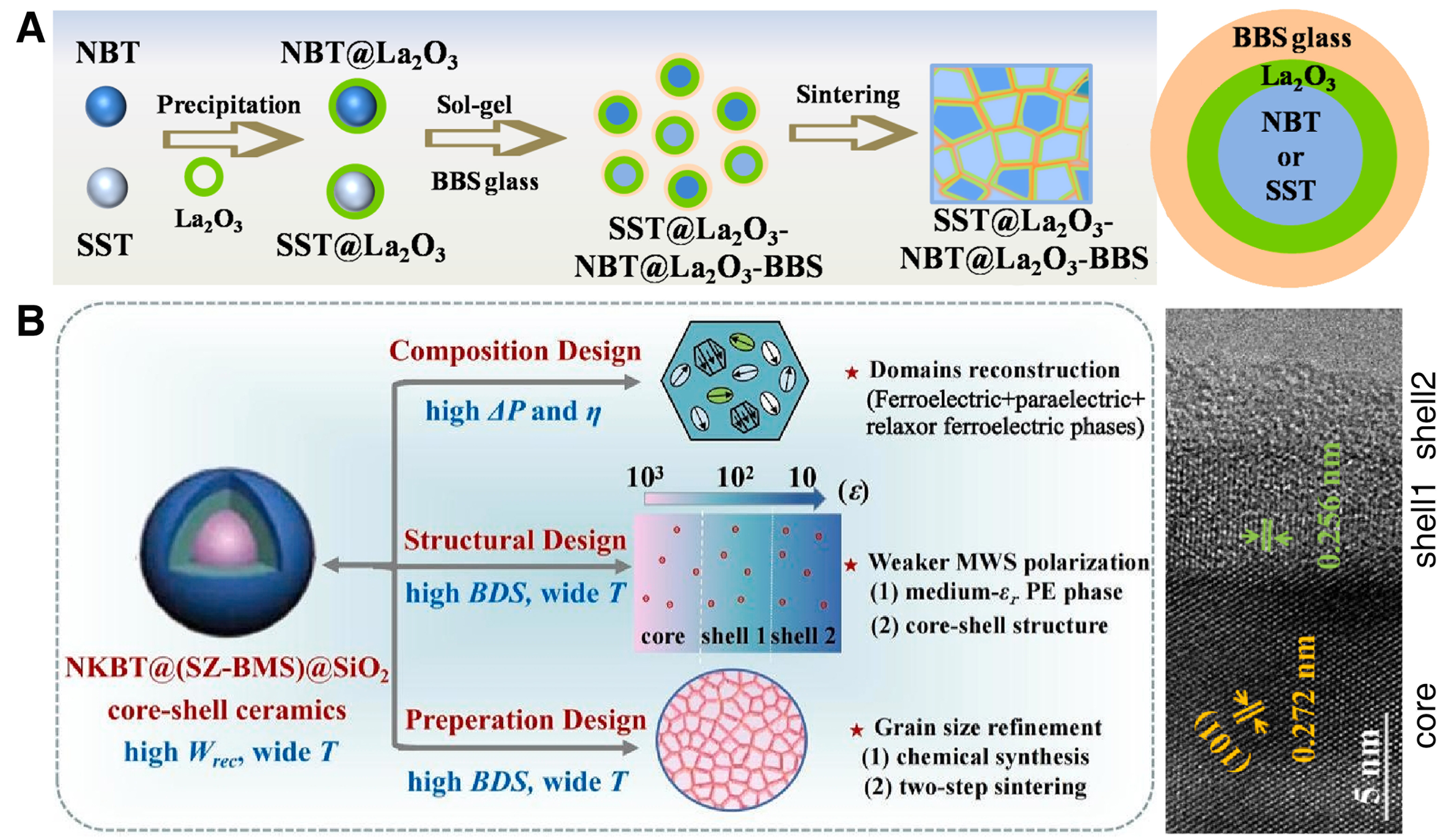
Figure 18. Core-shell powder design and multiscale optimization in lead-free RFE ceramics. (A) Schematic of core-shell powder architecture for (Na0.5Bi0.5TiO3@La2O3)-(SrSn0.2Ti0.8O3@La2O3)-Bi2O3-B2O3-SiO2 system and the corresponding sintered composite ceramics. This figure is quoted with permission from Zhang et al.[146]; (B) Multiscale synergistic optimization in Na0.4K0.1Bi0.5TiO3@(SrZrO3-BiMg0.5Sn0.5O3)@SiO2 composite ceramics, featuring pre-synthesized core-shell powders and bright-field TEM imaging. This figure is quoted with permission from Zhang et al.[147]. TEM: Transmission electron microscopy; NBT: Na0.5Bi0.5TiO3; SST: SrSn0.2Ti0.8O3; NKBT: Na0.4K0.1Bi0.5TiO3; SZ-BMS: SrZrO3-BiMg0.5Sn0.5O3; BDS: breakdown strength; NWS: Maxwell-Wagner-Sillars; SST: SrSn0.2Ti0.8O3.
Texturing engineering
An advanced strategy in microstructural engineering at the grain scale involves the deliberate alignment of crystallographic orientations, a technique commonly referred to as texturing. In conventional processing routes, ceramics are typically polycrystalline with randomly oriented grains, resulting in macroscopically isotropic properties. However, through techniques such as templated grain growth or electric-field-assisted sintering, it is possible to fabricate ceramics with controlled anisotropic grain orientations, known as textured ceramics. The principal advantage of texturing lies in its ability to exploit the intrinsic anisotropy of crystal structures to enhance targeted physical properties or mitigate adverse behaviors. This approach has been extensively adopted in piezoelectric and electrostrictive materials to boost their electromechanical response[150,151].
In the context of dielectric ES ceramics, crystallographic orientation control provides a powerful tool to modulate dielectric response and polarization saturation trends, leveraging the anisotropic dielectric permittivity inherent to perovskite structures. For example, in tetragonal FEs, the dielectric constant reaches a maximum along the [001] direction. By preferentially aligning grains along this axis, as in [001]-textured BT-based systems, one can achieve rapid polarization response at relatively low electric fields, thereby realizing high ESP under moderate operating conditions. Alternatively, the fabrication of [111]-textured ceramics can delay polarization saturation, allowing for higher Wrec under elevated electric fields. These examples underscore the transformative role of crystallographic orientation engineering in tailoring polarization dynamics and dielectric behavior of ES ceramics, providing a versatile platform for optimizing performance across diverse application scenarios.
Recent advances have demonstrated that tailoring crystallographic orientation through texturing can serve as a powerful method to modulate electrostrictive effects in RFE ceramics, as shown in Figure 19A, thereby enhancing ES capability and operational reliability of dielectric devices. For instance, Li et al. successfully employed grain orientation engineering to exploit the intrinsic anisotropy of crystal structures in RFE ceramics, as shown in Figure 19B-D. They reported that <111>-oriented, high-quality textured BNT-based MLCCs exhibit significant suppression of electric-field-induced strain[152], as shown in Figure 19E. This substantial reduction in electrostrain mitigates mechanical failure risks in MLCCs and contributes to a pronounced improvement in BDS, as shown in Figure 19F. The Wrec of such textured NBT-SBT MLCCs reached up to 21.5 J/cm3, surpassing the performance benchmarks of many state-of-the-art dielectric systems [Figure 19G].
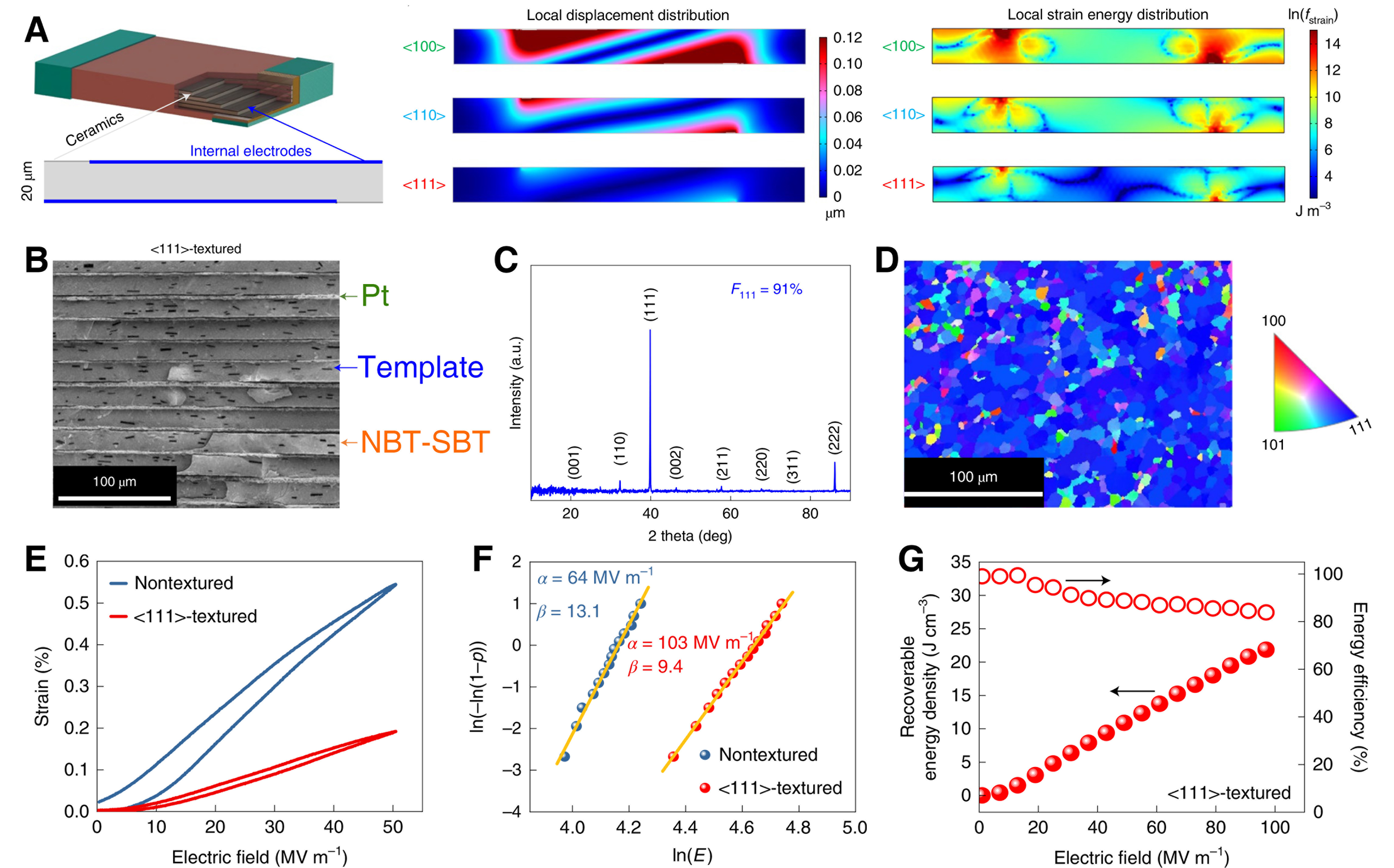
Figure 19. Enhancement of BDS and ESP in polycrystalline ceramics through grain orientation control in textured MLCCs. (A) Finite-element simulations of electric field-induced local displacements and elastic energy densities for <100>-, <110>-, and <111>-oriented perovskite layers in a single MLCC ceramic layer; (B) Cross-sectional SEM image of the textured MLCC; (C) XRD patterns of textured ceramics; (D) Grain orientation mapping of <111>-textured NBT-SBT MLCC obtained by SEM-EBSD analysis; (E) E-induced strain, (F) Weibull distribution of BDS, and (G) ESP as a function of electric field for <111>-textured versus nontextured 0.65BNT-0.35Sr0.7Bi0.2TiO3 MLCC. This figure is quoted with permission from Li et al.[152]. BDS: Dielectric breakdown strength; ESP: energy storage performance; MLCCs: multilayer ceramic capacitors; XRD: X-ray diffraction; SEM: scanning electron microscopy; EBSD: electron backscatter diffraction; BNT-SBT: (Bi0.5Na0.5)TiO3-(Sr0.7Bi0.2)TiO3.
To elucidate the fundamental mechanisms underpinning this behavior, Wang et al. developed an electromechanical breakdown model that incorporates the electrostrictive contributions to breakdown dynamics in textured ceramics, as shown in Figure 20A. Their investigations revealed that BDS is strongly influenced by local electric field and strain energy distributions in the polycrystalline matrix. Through high-throughput computational simulations coupled with machine learning, they established rational guidelines for texture design to alleviate electromechanical breakdown, as shown in Figure 20B[153]. Subsequently, Li et al. employed the templated grain growth technique to fabricate <111>-oriented MLCCs. Compared to their nontextured counterparts, these ceramics demonstrated a 37% reduction in electrostrain and a 42% enhancement in BDS[154]. As a result, the MLCCs achieved an ultrahigh Wrec of 15.7 J/cm3 with an outstanding η exceeding 95% under a high field of 850 kV/cm.
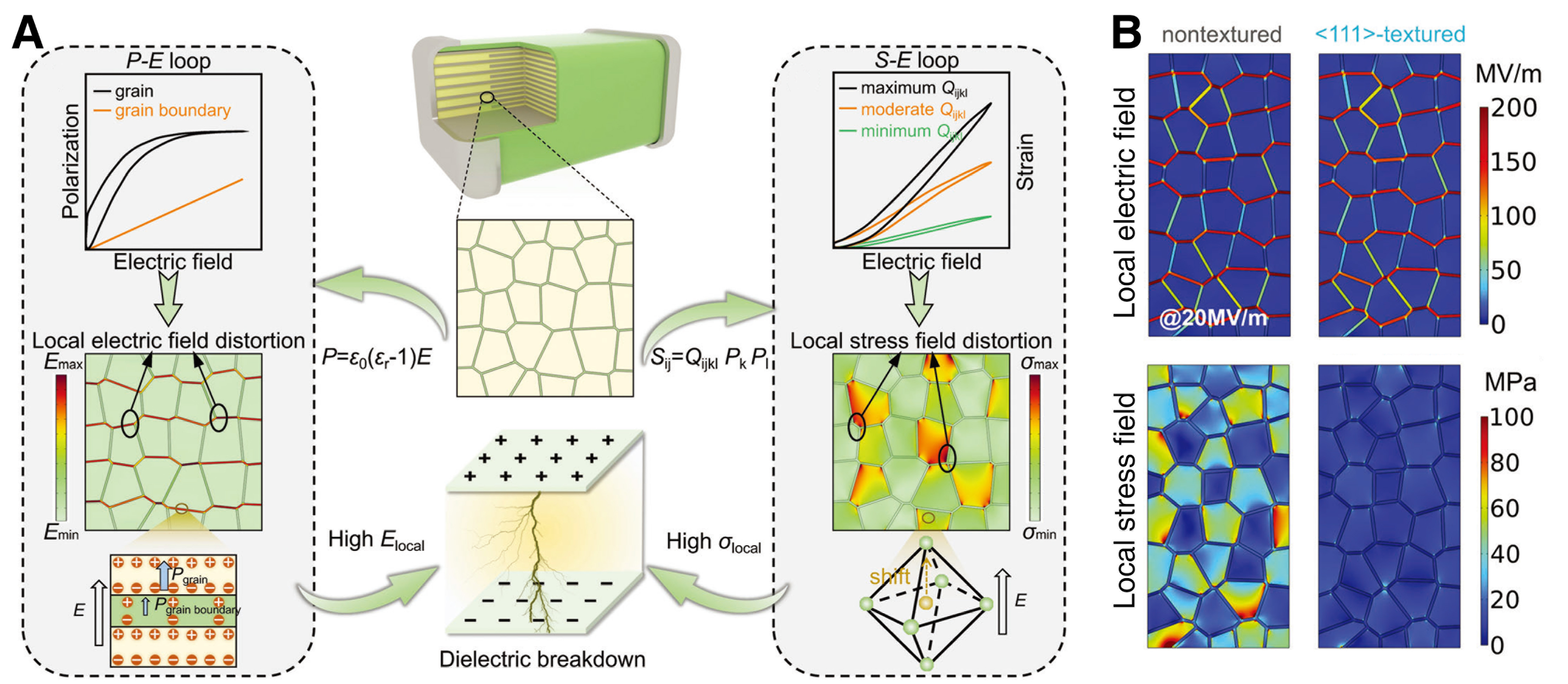
Figure 20. Texture engineering modulates electromechanical breakdown in MLCCs. (A) Schematic illustrating electromechanical breakdown mechanisms in dielectric ceramics based on coupled electrical and mechanical responses; (B) Distributions of local electric field and local stress under 20 MV/m in the dielectric layers of <111>-textured and nontextured MLCCs. This figure is quoted with permission from Wang et al.[153]. MLCCs: multilayer ceramic capacitors.
Taken together, these studies highlight the pivotal role of texturing as an advanced microstructural design strategy. By exploiting the anisotropic nature of FE crystals, texturing not only mitigates detrimental electrostrictive effects but also enables superior ESP in both bulk ceramics and MLCCs. Nevertheless, despite its demonstrated efficacy, the practical implementation of texturing techniques remains relatively complex and costly. Consequently, the pursuit of simpler, more cost-effective compositional modification strategies continues to attract considerable research interest[71,155,156].
Domain-nanoregion scale
Among the diverse microstructural features inherent to FE materials, domain structures emerge as the most critical and defining characteristic[26]. These domains not only dictate the fundamental behavior of FEs but also constitute the central focus of the most versatile and extensively employed strategies for optimizing dielectric ESP. The configuration and dynamics of domain structures control key aspects of polarization behavior, including the maximum inducible polarization, the nature of hysteresis, and the available polarization switching pathways[157]. Consequently, precise manipulation of domain architecture provides a direct route to tailoring functional properties. Given the strong dependence of domain configurations on chemical composition, compositional engineering remains the most prevalent and effective method for structural modulation and performance enhancement[158]. While extrinsic factors such as temperature, mechanical stress, and boundary conditions can also influence domain morphology and its dynamic response, their effects are typically indirect. These external stimuli may contribute to improved dielectric and polarization characteristics, yet they are generally considered supplementary to compositional design in the pursuit of high-performance ES materials.
Domain wall pinning
Large polarization hysteresis and energy loss render conventional FEs suboptimal for dielectric ES applications. Consequently, minimizing polarization hysteresis has become a primary objective in microstructural engineering targeting improved ESP. The hysteretic behavior of FEs is intimately linked to the energy barriers that separate different macroscopic domain orientations[26]. At the microscopic level, point defects can interact strongly with the polar structure, thereby altering the macroscopic dielectric and polarization response. A particularly well-studied mechanism involves the pinning of FE domain walls by defect dipoles. For instance, acceptor-oxygen vacancy defect dipoles can act as localized pinning centers that restrict domain wall mobility and reshape the polarization switching pathway[26].
This domain wall pinning effect provides a promising approach for suppressing FE hysteresis and enhancing recoverable polarization, thereby contributing to improved Wrec and η. A representative example is provided by Zhang et al., who demonstrated that defect dipole engineering through B-site substitution in BT-based ceramics can significantly influence the polarization behavior. Specifically, the formation of [LiTi-VO]-dipoles[159], where Li+ ions correlate with neighboring oxygen vacancies, effectively modulates domain dynamics. As schematically illustrated in Figure 21, Li-doped BT exhibits a reduced Pr and an enhanced polarization difference (∆P), collectively leading to increased ESP.
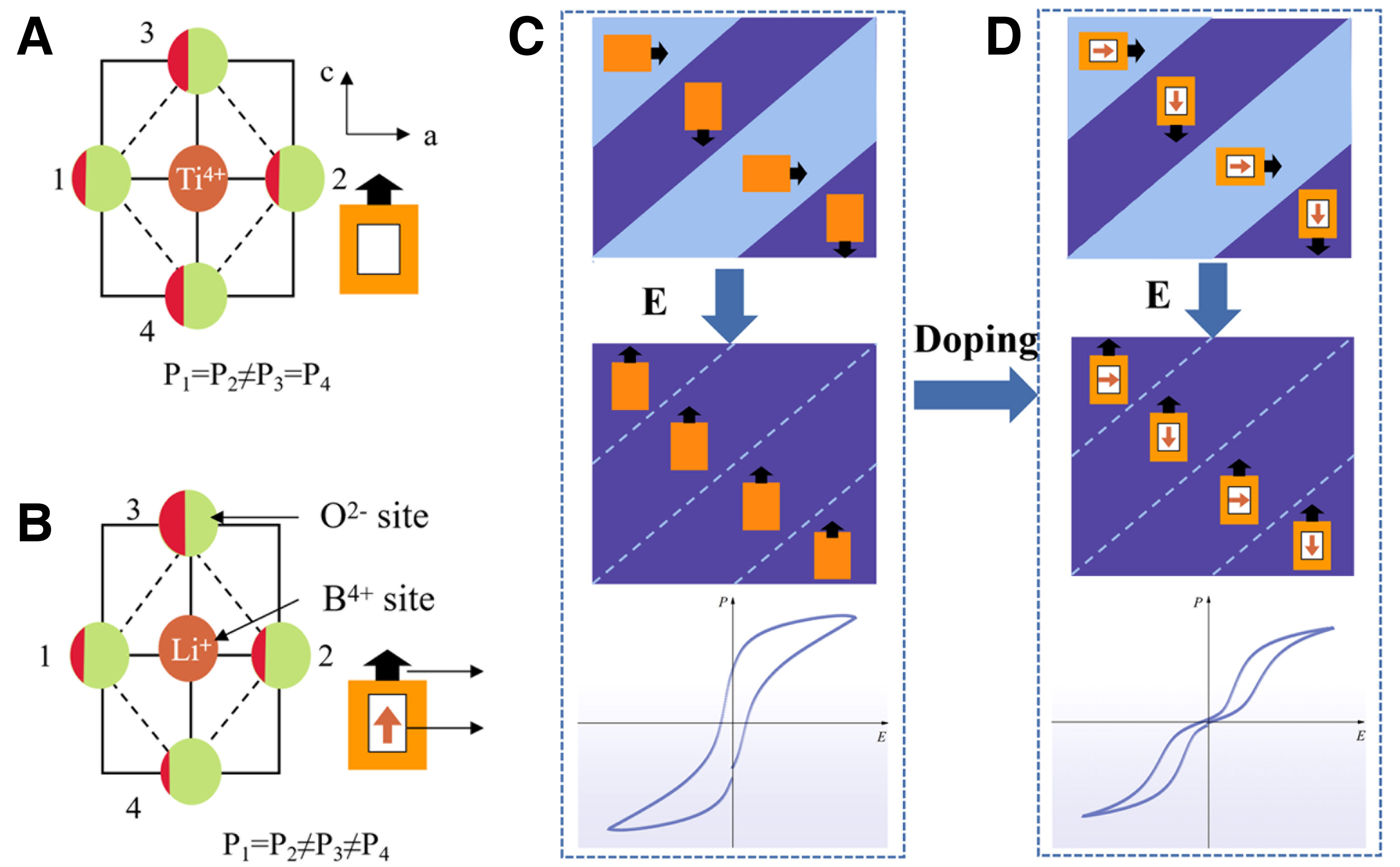
Figure 21. Impact of Li doping on domain behavior and polarization in BaTi1-xLixO3 ceramics. (A and B) Schematic illustrating the doping mechanism: transition between nonpolar/centrosymmetric tetragonal FE state and polar tetragonal FE state, domain switching process, and corresponding P-E loops before and after doping; (C and D) Domain wall pinning by defect dipoles leads to reduced remnant polarization. This figure is quoted with permission from Zhang et al.[159]. FE: Ferroelectric.
However, under high electric fields, elevated temperatures, or prolonged cycling, the defect dipoles may become depinned, causing a reversion to the classical square-shaped FE P-E loop. Additionally, activation of these defects can generate substantial leakage currents, thereby compromising electrical insulation reliability. Taken together, while domain wall pinning via defect dipole engineering presents a viable pathway for modulating FE response, its applicability in high-field pulsed ES devices remains limited due to stability and leakage constraints.
Inducing PNRs
One of the most widely employed and effective strategies for developing advanced dielectric materials involves disrupting long-range FE order through compositional modification. Introducing nanoscale chemical heterogeneities, including compositional fluctuations and gradients, fragments spontaneous macroscopic ferroelectric domains into PNRs. This transformation typically induces a RFE state near room temperature, characterized by dynamic, short-range polar order rather than static, long-range ferroelectricity.
RFEs have emerged as highly promising candidates for dielectric ES due to their unique combination of structural and functional properties. The nanoscale polar regions retain the ability to support significant dipolar reorientation under an electric field, thereby contributing to a large dielectric permittivity and high induced polarization[160,161]. Simultaneously, the energy barriers for polarization switching in these systems are substantially lower compared to conventional FEs. As a result, RFEs exhibit exceptionally slim P-E hysteresis loops, indicative of minimal energy dissipation and negligible hysteresis. This behavior closely mirrors that of ideal paraelectric or linear dielectric materials[162].
The RFE state is commonly achieved through compositional tuning in traditional FE systems, employing techniques such as isovalent or aliovalent substitution and solid-solution engineering. At the macroscopic level, this leads to a thermally activated relaxor or SPE phase near ambient conditions. Microscopically, the hallmark of this transformation is the breakdown of long-range FE domains into a disordered ensemble of PNRs, as shown in Figure 22A. The transition is typically accompanied by a reduction in the Curie temperature, broadening of the dielectric anomaly, and pronounced frequency dispersion in the dielectric response. Collectively, these features indicate a diffuse phase transition, which enhances thermal stability and expands the operational temperature window for dielectric applications.
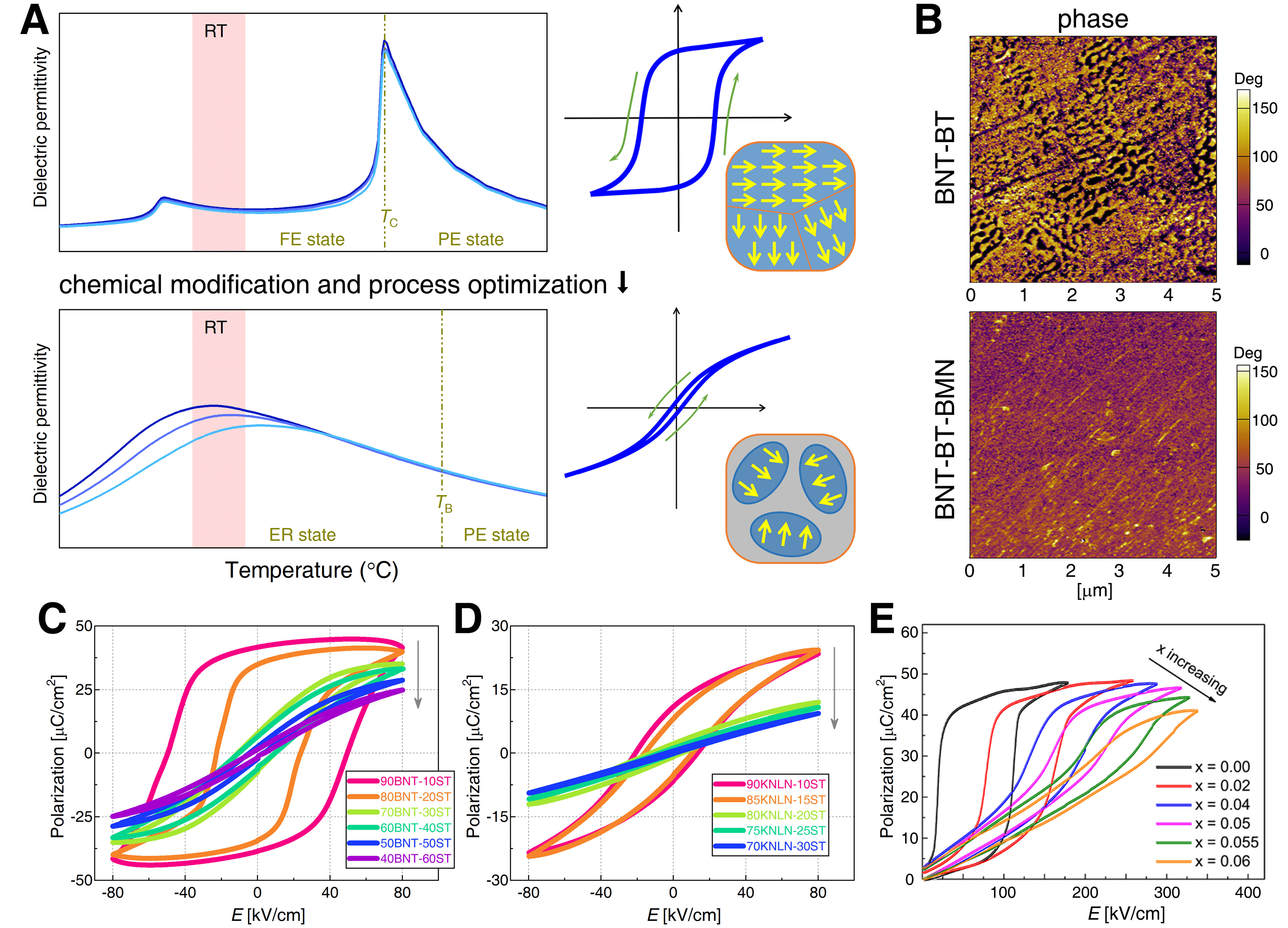
Figure 22. Evolution from macroscopic domains to PNRs during composition-driven FE to RFE transition, enhancing ESP. (A) Schematic of evolution of dielectric response, P-E hysteresis loop, and polar microstructure during the composition-driven FE to RFE transition; (B) The characterization of the polar microstructure by piezoelectric force microscopy (PFM) for BNT-BT and BNT-BT-BMN. This figure is quoted with permission from Guo et al.[166]; (C-E) Composition-dependent evolution of P-E loops for (1-x)BNT-xSrTiO3, (1-x)(K0.45Na0.49Li0.06)NbO3-xSrTiO3, and (1-x)AgNbO3-x(Sr0.7Bi0.2)HfO3 systems, respectively. This figure is quoted with permission from Xu et al.[169]. PNRs: Polar nanoregions; FE: ferroelectric; ESP: energy storage performance; RFE: relaxor ferroelectric; BNT-BT-BMN: (Bi0.5Na0.5)TiO3-BaTiO3-Bi(Mg2/3Nb1/3)O3.
Central to the behavior of RFEs is the emergence of random local electric fields. In a long-range ordered FE, internal fields are typically coherently aligned. However, the introduction of chemical disorder transforms these fields, rendering them spatially inhomogeneous and temporally dynamic. This disruption inhibits the development of coherent FE domains and instead promotes the formation of locally correlated, reorientable dipoles, which manifest as PNRs, as shown in Figure 22B. These local fields may arise from static sources, such as quenched compositional disorder, lattice vacancies, and impurities, or from dynamic phenomena, including non-ferroactive ion displacements away from their ideal lattice positions. Such field-induced frustration plays a crucial role in suppressing FE long-range order while enabling high dielectric tunability and low-loss polarization response[161].
Inducing PNRs has emerged as the most widely adopted and effective microstructural strategy for designing high-performance dielectric ES materials, as shown in Figure 22. Among the various implementation methods, compositional engineering remains the most fundamental and versatile approach to achieve this transformation. In perovskite-structured inorganic dielectrics, a broad array of chemical modification strategies has been successfully applied to disrupt long-range FE order and promote the formation of RFE states under ambient conditions. These approaches include single-ion substitution, incorporation of complex ionic groups, isostructural solid-solution blending, and co-doping with multiple elements, each contributing to the local compositional heterogeneity necessary for RFE behavior. Representative systems such as BT[163,164], BNT[165,166], BiFeO3 (BFO)[167], KNN[168], and even AFE[169] matrices have all been extensively modified using these techniques to enhance their ES capabilities through relaxor behavior. The evolution of P-E loops typically shows a decrease in residual polarization and a reduction in hysteresis, as shown in Figure 22C-E[169].
The resulting diversity in composition and structure is one of the primary reasons behind the remarkable complexity and variety of current dielectric ES materials. Despite this diversity, the design principle for constructing effective relaxor states remains consistent: the introduction of compositional disorder must avoid incorporating components that promote stronger FE ordering. Furthermore, achieving the desired relaxor characteristics requires the elemental distribution within the lattice to remain disordered at the nanoscale. Long-range chemical ordering, mesoscale segregation, and macroscopic phase coexistence are detrimental to the formation of a genuine relaxor state and typically lead to the reappearance of FE domains, thereby diminishing the slim-loop polarization behavior and associated ES benefits.
Through careful regulation of ionic size mismatch, charge compensation mechanisms, and local lattice strain, the incorporation of disorder can effectively destabilize FE long-range order while maintaining strong local dipolar interactions. This delicate balance enables high polarizability with minimal hysteresis loss, which is essential for achieving large Wrec and high η in capacitive ES applications.
In the design of RFEs for ES applications, a key strategy involves doping with ions that are not ferroelectrically active. Elements such as Bi3+[170] or Pb2+, as well as Ti4+ or Nb5+, which typically enhance FE long-range order, are either excluded entirely or introduced only in trace amounts. The rationale behind this approach is to disrupt rather than reinforce the preexisting long-range polar order. This principle has been widely implemented in perovskite systems, where ionic substitution serves as a critical pathway for tuning polar microstructures. A representative example includes the Na0.7Bi0.1NbO3 system, in which compositional modifications effectively suppress FE ordering and induce a relaxor state[171]. Similar effects have been observed in non-perovskite structures as well[172-174].
Among the various doping strategies, heterovalent ion substitution at ferroelectrically active lattice sites is one of the most effective methods for breaking long-range FE order. However, this approach comes with a trade-off: while it enhances relaxor behavior, it may simultaneously dilute the spontaneous dipole density, leading to a reduction in the maximum attainable polarization. As a result, simple doping strategies are typically insufficient to induce robust PNR formation on their own and are best employed in combination with other compositional or structural modifications to finely tune both relaxor characteristics and ESP. A further consideration is that heterovalent doping commonly introduces charged point defects such as oxygen or A-site cation vacancies. These defects can significantly compromise electrical insulation and η, especially under conditions of high temperature or strong electric fields[175]. Therefore, while heterovalent ion doping is an indispensable tool in engineering dielectric properties, its application must be carefully balanced to avoid undesirable leakage conduction and thermal instability in practical device environments.
To avoid the formation of charge-compensating vacancies typically associated with heterovalent ion doping, an increasingly effective strategy involves the use of complex ion groups composed of two heterovalent ions. These co-doped configurations enhance local electric field fluctuations and disrupt long-range FE order more efficiently, thereby promoting the formation of PNRs, not only in perovskite-structured FE matrix[176-178], but also in the tungsten bronze FE matrix[179,180].
An even more sophisticated approach involves simultaneous A-site and B-site doping with carefully selected ion pairs. This co-substitution can promote relaxor behavior at relatively low dopant concentrations by inducing strong local field disorder across the crystal lattice[181-183]. Additional examples include Ce-Mn co-doped Sr0.4Ba0.6Nb2O6 FEs[184], as well as systems where Ba2+, Sr2+, and Sm3+ occupy the A-site, accompanied by partial Nb5+ substitution with Zr4+ in the B-site[185]. These multi-ion doping strategies result in a compositionally disordered lattice, closely resembling that of solid solutions, in which randomly distributed cations serve as the origin of strong local electric fields. This disorder is essential in generating PNRs and promoting an RFE state. The resulting microstructure exhibits both high dielectric tunability and enhanced ES characteristics, making it a promising design route for high-performance dielectric materials.
Beyond simple ion substitution, the incorporation of nonpolar, weakly polar, or quantum paraelectric components into FE matrices has proven highly effective in disrupting long-range FE ordering. This disruption facilitates the formation of PNRs, enabling the emergence of ergodic relaxor (ER) states at room temperature, suppressing polarization hysteresis, and enhancing ESP. Quantum paraelectrics have been widely adopted as solid solution components to this end[186-192]. Similarly, non-ferroelectric perovskite-structured compounds are frequently utilized to induce relaxor behavior by diluting long-range dipole alignment[193-203].
An even more promising compositional design strategy involves the introduction of complex perovskite components based on heterovalent cation groups. Representative examples include A(B1,B2)O3 and (A1,A2)BO3[158,167,204]. These systems incorporate compositional complexity that enhances local electric field randomness and strongly suppresses long-range FE correlations. In particular, multicomponent systems such as (1-x)Bi0.5(Na0.9Li0.1)0.5TiO3-xSr(Al0.5Nb0.25Ta0.25)O3 demonstrate an advanced level of compositional design[205]. These systems simultaneously contain ferroelectrically active ions to preserve dipole density and support high polarizability, alongside heterovalent ions that generate pronounced local field fluctuations. Such a combination not only enhances relaxor behavior but also effectively reduces hysteresis, leading to improved dielectric ES characteristics.
Microstructural engineering strategies aimed at inducing nanoscale domains or PNRs are equally applicable to AFE materials and can substantially reduce polarization hysteresis while enhancing η[206,207]. In contrast to FEs, AFEs also exhibit long-range polar ordering, although the configuration differs in its antiparallel dipolar nature[208]. For example, classical AFEs such as PbZrO3 (PZ) accommodate antiferrodistortive instabilities, in which Pb2+ ions undergo A-O coupling to generate local spontaneous polarization arranged in an antiparallel fashion across neighboring unit cells.
While electric field-induced AFE-to-FE phase transitions contribute to an abrupt polarization increase and ES capability, they also introduce substantial hysteresis losses due to the large-scale structural transformation. This not only reduces η during charge-discharge cycles but also increases the risk of stress concentration and crack propagation, which are detrimental to material reliability. To mitigate these issues, substitution or doping at both A- and B-sites of the perovskite lattice can be employed to tune the relative stability between FE and AFE phases in PZ-based systems. Such modifications effectively reduce the scale of polarization ordering, enabling the formation of partial nanoscale domains or embedded PNRs. The choice of dopants or solid solution components follows similar empirical guidelines as those established for RFEs, focusing on enhancing local electric field fluctuations and disrupting long-range order.
However, it is crucial to note that the functional requirements for inducing the relaxor state in AFEs differ fundamentally from those in FEs. In FE systems, a complete transition to an ER state is typically desired to minimize hysteresis. In contrast, for AFEs, optimal ESP requires the retention of AFE structural features and polarization characteristics, while introducing moderate relaxor behavior to reduce hysteresis without eliminating the field-induced phase transition mechanism. As a result, the design strategies for inducing relaxor features in AFEs must be carefully balanced to preserve the beneficial aspects of the AFE-FE transition while improving cycling efficiency.
The most representative system of RAFEs is the Pb(Zr,Sn,Ti)O3 family, in which equimolar or non-equimolar substitution of B-site ions such as Sn4+ and Ti4+ in the PZ matrix forms a continuous solid solution. This strategy preserves antiparallel spontaneous polarization at the A-site while introducing polar nanodomains or PNRs, thereby maximizing η[209-211]. The incorporation of isovalent ions primarily serves to disrupt long-range A-O coupling without completely destroying the AFE ordering. Building upon the Pb(Zr,Ti,Sn)O3 ternary solid solution, further improvements in relaxor characteristics and ESP can be achieved by introducing trace amounts of aliovalent dopants at the A-site. These dopants modulate the relaxor and AFE features in the P-E hysteresis loop. A notable example is (Pb0.94La0.04)(Zr0.49Sn0.5Ti0.01)O3[212], which exhibits a distinctive double P-E loop with both AFE and relaxor characteristics. Numerous PZ-based RAFE systems reported with superior ESP follow similar compositional strategies[213-217]. Moreover, due to the structural and polar behavior similarities between PbZrO3 and PbHfO3[218], the microstructural design strategies established for PZ-based RAFEs are also applicable to PbHfO3-based systems. These approaches include simple ionic doping and the incorporation of secondary components through solid solution to induce polar nanodomains and PNRs, enabling further enhancement of ES capability in PbHfO3-based relaxor AFEs[107,217,219-221].
In lead-free AFE systems, similar compositional modification and structural design strategies can be applied to enhance ESP[222-226]. Beyond inducing relaxor characteristics, several specialized nanoscale microstructural design approaches have also been explored. Notably, inspired by core-shell architectures in glass ceramics, Tang et al. engineered ceramic-like AFE regions within a self-generated glass-ceramics-like structure. Benefiting from simultaneous improvements in Pmax and BDS, the (EuxAg1-3x)NbO3 compounds achieved ultrahigh Wrec and η[227]. This work provides a compelling paradigm for advancing the ESP of AFE-based ES MLCCs to meet the stringent demands of next-generation applications.
In the composition-driven induction of PNRs and nanoscale domains, a variety of ionic dopants and solid-solution modifications have been employed to construct new RFE systems with enhanced dielectric ESP. This approach has led to a proliferation of reported dielectric materials with increasingly complex yet compositionally similar formulations. Although many of these systems share the common goal of disrupting long-range FE ordering to induce PNRs, there are still distinct compositional design principles that can be followed to achieve targeted performance enhancements.
During this component-driven process, many specialized strategies have been proposed and validated, including polarization mismatch and reconstruction[160,163,228,229], high-entropy engineering[230-242], and PNR characteristic regulation[243-245]. These strategies provide guiding mechanisms from multiple dimensions for inducing PNRs. They not only include enriching PNR types[165,243,246-257], reducing PNR size and improving dynamics[244,246,252-254,258-260], but also regulating PNR shape[261-265], weakening coupling between PNRs[266-268], and even combining multiple PNR characteristic regulations[269,270]. In general, component design follows the empirical principles outlined above and remains within the broader category of “component-driven PNR induction”[142,181,197,243,248,249,269,271-273]. Specific cases are therefore not detailed here.
AFE periodic/phase modulation
AFE materials offer a unique strategy for controlling polarization response pathways through the design of ordered AFE periodic structures. Analogous to FE domains, these periodic structures exist at comparable length scales, making periodic modulation a representative approach for domain and microregion manipulation.
The modulation of AFE polarization ordering in these periodic structures can be interpreted as a phase transition, where the microstructural design strategy primarily governs the sequence of field-induced phase transitions and determines the critical electric field required for such transitions[274,275]. Typically, once the polarization in an AFE material undergoes a sharp increase upon reaching a certain field, further increases in the electric field contribute little to enhancing the polarization response. Consequently, the most effective working electric field for AFE-based dielectric materials is slightly above the phase transition-driving field. This periodic modulation strategy is particularly effective in optimizing ESP under specific electric fields; the key lies in matching the phase transition-driving electric field with the operating field. For example, to achieve high ESP under elevated electric fields, the driving field should be tuned toward higher values[275,276]. Conversely, for cost-effective ESP under lower or moderate fields, the driving field should be shifted to lower values[219,277,278]. In recent work, Ge et al. demonstrated the effectiveness of this approach by stabilizing the AFE phase through La3+ and Cd2+ doping, thereby modulating the incommensurate phase of the material[216].
Furthermore, AFE materials exhibit complex behaviors, including the coexistence and competition of multiple phases, field-induced multistage phase transitions, and a degree of diffuse phase transition[214,275]. Li et al. have described the field-induced multistage phase transition in Pb-containing AFE materials, driven by competing FE and AFE interactions, as the “electric devil’s staircase.” This unique transition, characterized by numerous degenerate dipole configurations, facilitates superior ESP. For instance, in (Pb0.97La0.02)(Zr0.50Sn0.50)O3 AFE ceramics, the modulated structure can be readily adjusted through chemical substitution. Moreover, the temperature-driven electric devil’s staircase behavior enhances Wrec and thermal stability across a broad temperature range, making it highly suitable for high-power AFE capacitor applications[279]. Similarly, Li et al. proposed a phase modulation strategy to optimize ESP. In Pb-containing AFE ceramics, multistage phase transition behaviors were effectively controlled via chemical modification, enhancing both BDS and the phase-switching field, resulting in excellent ESP for (Pb0.92Gd0.02Sr0.05)(Zr0.87Sn0.12Ti0.01)O3 ceramics[280].
Hu et al. have made significant contributions to the understanding of phase transitions and periodic modulation in AFE materials. Using in-situ biasing TEM, they investigated two representative AFE compositions exhibiting multiple and double hysteresis loops. Their findings revealed that as modulation periods increase, AFE materials undergo additional transitions between various AFE phases prior to the final AFE-FE phase transition, as illustrated in Figure 23A. This progression leads to the formation of a favorable multiple-loop configuration, thereby enhancing ESP[281,282].
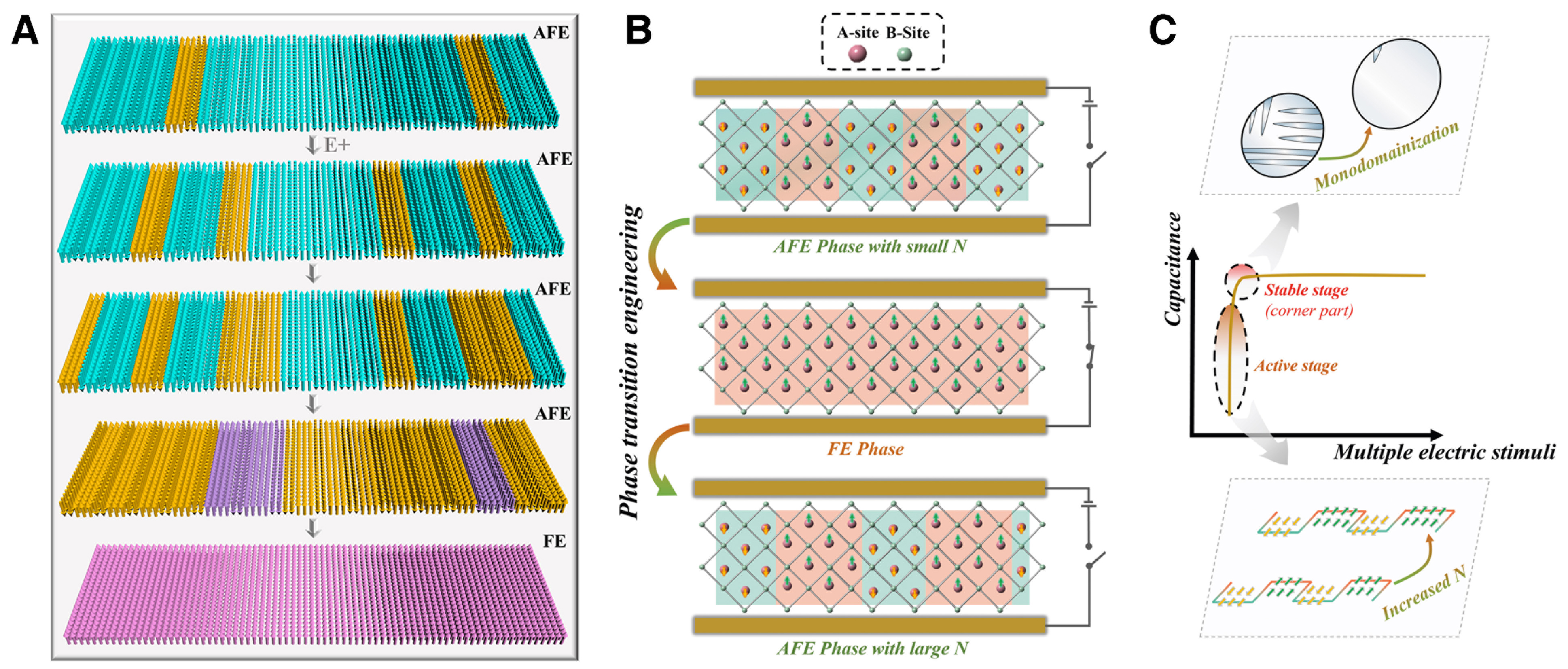
Figure 23. Periodic modulation of AFE materials at the domain scale. (A) Schematic of defect-driven phase transitions in the (Pb,La)(Zr,Sn,Ti)O3 AFE system. Colors indicate modulation periods of 4, 5, and 6 in the AFE phase (blue, yellow, purple) and FE phase (pink). This figure is quoted with permission from Hu et al.[281]; (B) Model of phase transition engineering with electric-field-induced polarization switching in Pb0.97La0.02(Zr0.35Sn0.55Ti0.10)O3 AFE ceramics, where N denotes the modulation period; (C) Structure-property correlation diagram illustrating the evolution of multilevel structures under varying electric field stimuli. This figure is quoted with permission from Hu et al.[283]. AFE: Antiferroelectric; FE: ferroelectric.
In 2024, Hu et al. proposed a phase transition engineering strategy by applying pulsed electric stimuli near the critical electric field. This approach resulted in a ~54.3% enhancement and rapid stabilization of capacitance density in Pb0.97La0.02(Zr0.35Sn0.55Ti0.10)O3 AFE ceramics[283]. The electric stimuli induced irreversible recovery of the modulated structures, driving successive structural evolution, including domain transformation from multidomain to monodomain states and a shift in the modulation period, as illustrated in Figure 23B. As shown in Figure 23C, Hu et al. effectively employed component- and field-induced periodic modulation/phase transition control to enhance ESP in AFE materials[283]. Collectively, this series of studies serves as a valuable reference for similar research endeavors.
In conclusion, periodic and phase-transition modulation not only allows for precise tuning of polarization response pathways to optimize ESP but also mitigates polarization hysteresis arising from field-induced phase transitions[284,285], thereby enhancing η[217]. This microstructural design strategy provides an effective approach for enhancing the ESP of AFE materials at the domain and microregion scales.
Lattice scale
In solid-state dielectric ES materials, chemical modifications are typically implemented by doping ions into the lattice sites of the matrix. However, because polarization responses in FE materials are predominantly governed by domain- and microregion-scale polar structures, lattice-scale microstructural design strategies are comparatively rare in dielectric ES materials. Such strategies are considered relevant only when lattice-scale features significantly influence or even dictate the electrical properties of the dielectric. The lattice-scale microstructural design approaches discussed in this chapter primarily include: (1) suppression of charge-defect migration within the lattice; (2) modulation of spontaneous polarization or dipolar responses via lattice defects; (3) control of independent dipoles in dipolar glass structures; and (4) exploitation of lattice distortions to achieve targeted performance enhancements.
Suppression of charged defects and conductivity
An ideal dielectric material should behave as a perfect insulator. However, due to doping defects or element volatilization, point defects-primarily A-site and oxygen vacancies-are inevitably introduced into the crystal lattice[286]. Additionally, changes in element valence can generate conductive pathways within the lattice. For instance, in BT-based dielectric materials, the reduction of Ti4+ to Ti3+ facilitates electron hopping between Ti4+ and Ti3+ sites, contributing to long-range conductivity and compromising the material’s insulating properties.
Effective strategies for mitigating leakage conduction, reducing polarization hysteresis, and improving stability involve lowering defect concentration, reducing defect mobility, and increasing activation energy barriers[287-290]. The most common approach is optimization of the sintering process. Techniques such as buried sintering or the addition of volatile elements can alleviate defects caused by element loss[291]. Advanced sintering methods, including reaction-sintering, have been shown to reduce energy losses relative to conventional solid-state sintering[292]. Lowering the sintering temperature can further mitigate volatilization, which can be achieved by employing chemical additives, highly reactive raw materials, or high-energy ball milling to reduce particle size[293]. Hydrothermal synthesis can also produce uniform spherical nanoparticles that reduce defect formation. Additionally, charge compensation by substituting higher-valence ions for lower-valence ions can suppress defects-for example, Ta5+ replacing Ti4+ reduces oxygen vacancies in BNT-based RFE ceramics, enhancing dielectric ESP[294]. Controlled atmospheres during sintering, such as oxidizing environments or post-sintering oxygen annealing, also minimize element reduction and defect formation.
These defect suppression strategies are directly relevant to enhancing dielectric ESP. For example, Lou et al. introduced an excess of K to suppress volatile Schottky defects, preventing conduction losses and enhancing ESP in tetragonal tungsten bronze-structured dielectric bulk ceramics[286]. Similarly, Che et al. synthesized (1-x)BNT-xAgNb0.5Ta0.5O3 RFE ceramics in a flowing oxygen atmosphere, eliminating defects such as metallic silver and oxygen vacancies, which significantly improved BDS and reduced hysteresis[295]. Nb doping has also been used to increase resistivity by eliminating hole conduction and promoting microstructural homogeneity[296].
For industrial MLCC production, a synergistic approach integrating chemical additives, tailored sintering protocols, and atmospheric control is essential to ensure dielectric reliability and performance[287,297,298]. A central strategy involves aliovalent ion doping for charge compensation, mitigating the formation of charge carriers and suppressing electronic conduction[290,299,300]. Stabilizing defect associations has also been shown to inhibit the proliferation of detrimental point defects during high-temperature processing[288]. Complementary compositional modifications can enhance redox resistance, providing further protection against oxygen vacancy formation under reductive conditions[301,302].
Beyond chemical methods, sintering techniques play a critical role. Multistage sintering, applying distinct atmospheric conditions across temperature regimes, has proven effective in reducing defect density while preserving phase integrity[297]. Importantly, defect suppression often functions synergistically with other microstructural design strategies, such as grain size refinement and composition-driven transitions from long-range FE domains to PNRs, thereby further enhancing the dielectric and ESP of the ceramic[303].
Defect dipoles and defect engineering
Defect engineering has emerged as a powerful lattice-level strategy for tailoring polarization behavior in dielectric materials. In bulk dielectric ceramics, this approach is primarily associated with extrinsic point defects introduced via the incorporation of dopant atoms or ions into the host lattice, a process commonly referred to as doping. It is important to note, however, that from the standpoint of defect chemistry, even isovalent substitutions such as those in Ba(Ti1-xSnx)O3 or (Ba1-xSrx)TiO3 formally generate point defects. Yet, within the field of electronic ceramics, these substitutions are generally excluded from conventional defect engineering frameworks. Instead, the term “defect engineering” is typically reserved for aliovalent doping and the intentional creation of charged vacancies, most notably oxygen or A-site vacancies. Accordingly, this section focuses on the narrower definition of defect engineering widely adopted in dielectric research.
To harness defect engineering effectively while preserving insulation reliability, it is essential to limit the defect concentration and ensure that defect activation occurs well above room temperature. This strategy enables the modulation of polarization dynamics, particularly in RFEs, while suppressing unwanted leakage. For example, Li et al. reported an A-site defect engineering approach that enhanced the dielectric ESP of Ba0.105Na0.325Sr0.245-1.5x□0.5xBi0.325+xTiO3 RFE ceramics (x = 0.06). Here, the controlled introduction of A-site vacancies and cation disorder disrupted A-site ion alignment and stabilized the polarization response under low fields, ultimately yielding a higher Wrec[304].
The influence of extrinsic point defects on polarization and ES behavior is primarily mediated through their interaction with microscopic polar structures. A comprehensive understanding of these mechanisms is therefore critical for advancing dielectric ceramics. A representative example is found in (Pb,La)(Zr,Sn,Ti)O3 (PLZST)-based RAFEs[214,219,305]. In this system, partial substitution of Pb2+ with La3+ at the A-site introduces a charge imbalance, which is compensated by the formation of A-site vacancies. These defect dipoles subtly disturb the long-range polar order of Pb2+, while B-site compositional fluctuations generate strong local fields. Together, these effects promote dielectric relaxation and suppress macroscopic ferroelectricity, resulting in a distinctive RAFE state characterized by both double hysteresis loops and RFE properties.
Defect engineering has also been widely employed in RFEs to modulate polarization response and thereby optimize dielectric ESP. A notable case is the BNT-based RFE system, which exhibits field-induced RFE-FE transitions within a critical temperature window and yields constricted P-E loops. In 2018, Li et al. proposed a compositional design involving the incorporation of (Sr0.7Bi0.2)TiO3 (SBT), a perovskite component with intrinsic A-site vacancies, into the BNT matrix. This strategy introduced nanoscale chemical and structural heterogeneity, producing AFE-like double hysteresis loops. As a result, the engineered material achieved a Wrec of 9.5 J/cm3 with an η of 92% under moderate fields[306]. Subsequent studies further confirmed the beneficial role of A-site vacancies in BNT-based RFEs. For instance, Liu et al. demonstrated that deliberate A-site deficiencies could effectively suppress remnant polarization and enhance η[307]. The local fields and structural frustration induced by defect engineering facilitated the field-driven assimilation of PNRs with diverse local symmetries, enabling a recoverable polarization response with minimal hysteretic loss[248].
The modulation of polarization dynamics through defect engineering relies critically on the interactions between charged point defects and dipolar entities within the lattice. In functional electronic materials, such defect-dipole interactions are widely exploited to tune local energy barriers, thereby governing dipole responses to external electric fields[189,308-310]. Numerous studies have employed aliovalent ion substitution to introduce localized defects into dielectric matrices as a route to optimize ESP. In RFEs, particularly those based on BNT, the inherently low energy barriers associated with polarization reversal of PNRs, as well as transitions between PNRs of different symmetries, often lead to rapid polarization saturation and relatively low critical electric fields. These features constrain their effectiveness in applications requiring both high energy density and robust dielectric performance. Defect engineering offers a promising pathway to overcome these limitations by raising the energy barriers between distinct PNR orientations. By increasing the activation field required for polarization switching, AFE-like features in the P-E loops of BNT-based RFEs can be significantly enhanced[311].
A representative example is provided by Zhang et al., who developed a defect-engineering strategy based on aliovalent substitution with rare-earth La3+ ions[311]. The introduction of 3 at.% La3+ into BNT ceramics markedly modified local energy barriers, elevating both the critical and saturation fields during polarization switching [Figure 24A]. These effects are attributed to the reinforcement of energy barriers associated with lattice torsion and dipole alignment [Figure 24B]. As a result, La3+-modified BNT ceramics exhibited enhanced AFE-like relaxor behavior, achieving a Wrec of 8.58 J/cm3 and an η of 94.5%. Despite this progress, such defect-mediated approaches primarily deliver quantitative improvements rather than qualitative breakthroughs. The double hysteresis loops observed in La-doped BNT-based RFEs remain distinct from those of true AFEs, both in loop shape and switching dynamics. This distinction underscores the need for innovative defect-dipole design strategies to bridge the performance gap between relaxor systems and ideal AFEs.
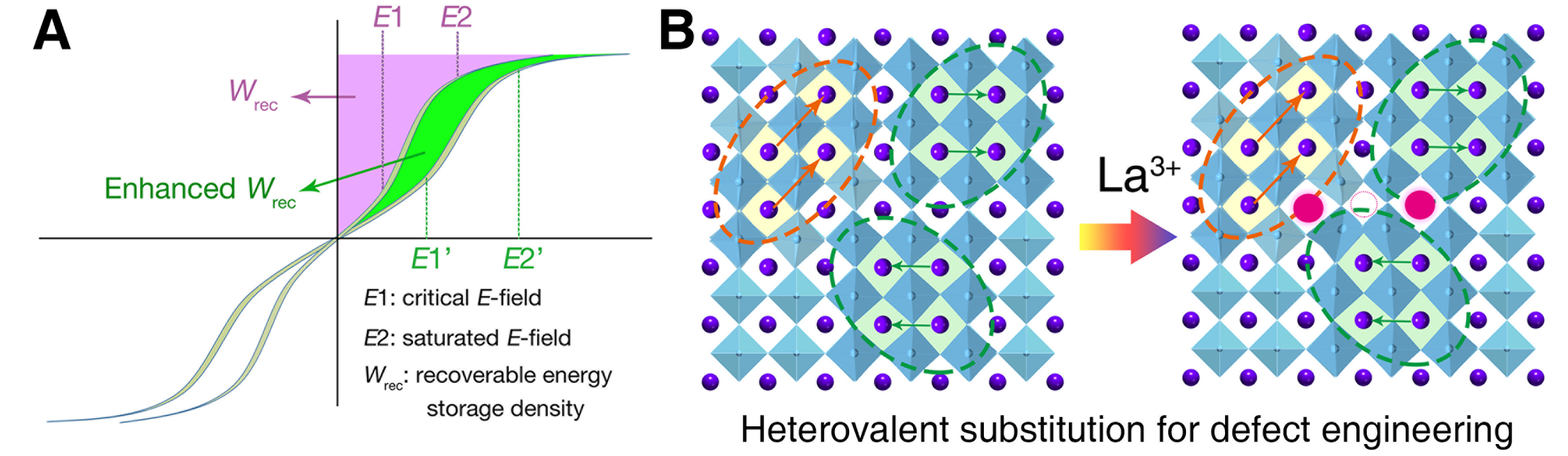
Figure 24. Defect engineering-enabled polarization regulation in AFE-like RFEs for enhanced ESP. (A) Schematic illustrating polarization modulation via defect engineering; (B) Effects of La3+ doping on the local crystal lattice structure. This figure is quoted with permission from Zhang et al.[311]. AFE: Antiferroelectric; RFE: relaxor ferroelectric; ESP: energy storage performance.
At the lattice scale, defect structures also play a critical role in advancing the ESP of thin-film capacitors[312]. One key insight is that the formation of defect complexes can alleviate the intrinsic trade-off between Pmax and BDS, a major limitation in high-performance dielectric thin films. A notable example is provided by Luo et al., who used Mn doping to tailor the defect chemistry of Sr0.7Bi0.2TiO3-based RFE thin films. In this system, Mn2+ ions formed stable dipoles with oxygen vacancies, thereby mitigating oxygen and titanium vacancy concentrations[313]. This defect configuration stabilized a slush-like “single-domain” state characterized by fluctuating B-site cation displacements, ultimately leading to a substantial improvement in ESP.
A similar influence of defect engineering has also been demonstrated in bulk dielectric materials[314], extending beyond RFE-based dielectrics to AFE systems[315,316]. The central effect is the reduction of hysteresis losses and the simultaneous enhancement of dielectric response. For instance, to address A-site volatility and Ti4+ reduction in BNT-based RFEs, Li et al. introduced Mn2+ dopants, which effectively suppressed Ti4+ reduction while promoting off-centering displacements of cations[154]. This strategy not only minimized energy dissipation under high fields but also boosted net polarization, delivering a remarkable enhancement in ESP. Such lattice-level defect engineering has proven highly effective in reducing energy loss and improving η in BNT-SBT-based MLCCs operated under strong electric fields[154,306,317].
Dipolar glass and quasi-linearization
In certain dielectric systems, when dipoles fail to establish long-range or even mesoscopic correlations and polar order remains confined to the scale of individual unit cells, the material is typically classified as a dipolar glass. Prototypical examples include doped quantum paraelectrics such as (K1-xLix)TaO3,
From a physical standpoint, dipolar glasses can be regarded as an extreme limit of RFEs, in which the dipole concentration is heavily diluted. Consequently, their dielectric permittivity exceeds that of conventional nonpolar dielectrics but remains far below that of classical FEs. A key distinction between dipolar glasses and relaxors lies in the degree of correlation among polar entities. Whereas RFEs may undergo field-induced or spontaneous FE transitions below the freezing temperature, dipolar glasses lack sufficient interaction strength to sustain such transformations. In these materials, the spatial extent of dipolar coupling remains shorter than the average dipole-dipole separation, even at cryogenic temperatures[318,320].
This absence of collective polarization implies that even under strong external fields, dipolar glasses cannot develop FE long-range order. Their dielectric response therefore closely resembles that of linear dielectrics, characterized by modest permittivity and limited field-induced polarization. Nonetheless, the highly stable and rigid local structure endows dipolar glasses with exceptionally high BDS. These attributes make them attractive candidates for ultrahigh-voltage ES capacitors, where minimal polarization loss and superior dielectric reliability under extreme fields are critical.
A promising design route for next-generation dielectric ES materials is to exploit the intrinsic features of quantum paraelectrics by deliberately introducing randomly distributed, uncorrelated dipoles at the lattice scale. Such dipolar glasses are defined by high η, nearly linear polarization, and excellent thermal and field stability[102,321,322]. This approach circumvents nanoscale polar correlations and instead harnesses lattice-level disorder for functional performance. For example, Zhang et al. reported that co-doping Mg2+ and Nb5+ into Ca0.5Sr0.5TiO3, substituting for Ti4+ at the B-site, produced a dielectric with nearly ideal linear polarization. The material achieved Wrec = 7.62 J/cm3 and η = 92% at 640 kV/cm, ranking among the most promising bulk LDs to date[323].
Building on this concept, Fu et al. proposed a dipolar-glass framework based on high-entropy design [Figure 25A]. By substituting multiple heterovalent, ferroelectrically active cations onto equivalent lattice sites in (Bi1/3Ba1/3Na1/3)(Fe2/9Ti5/9Nb2/9)O3, they generated a dense network of uncorrelated dipoles with dissimilar polarization vectors across neighboring unit cells [Figure 25B][324]. This structure permitted highly diffused dipole reorientation under applied fields while suppressing long-range growth of polarization, thus preventing domain formation. The resulting ceramic exhibited outstanding performance, with Wrec =
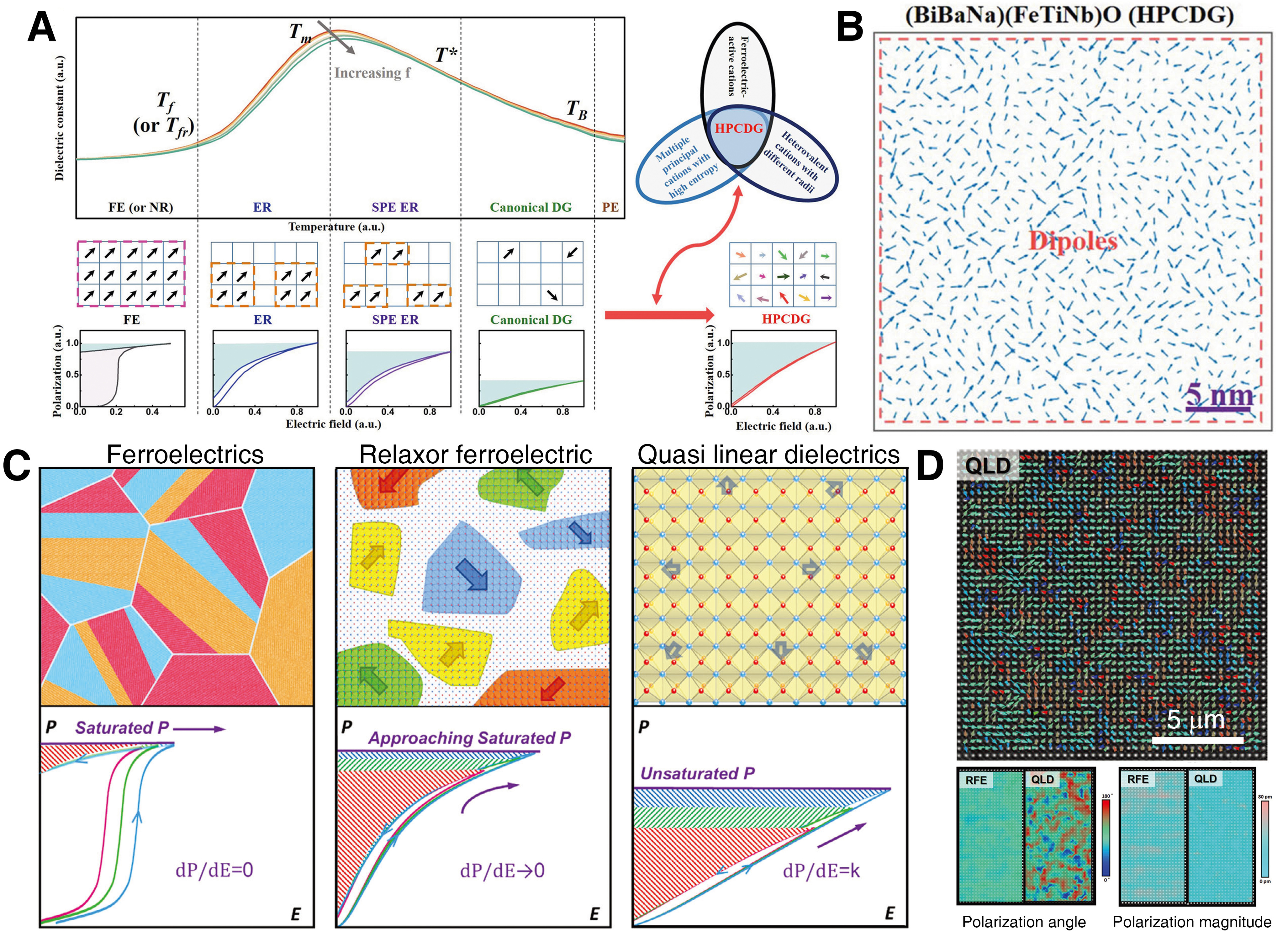
Figure 25. Design strategies for high-performance dielectric capacitors based on highly polarizable concentrated dipole glass (HPCDG) and QLD behavior. (A and B) HPCDG design: (A) Temperature-dependent dielectric response sketches of typical RFEs at various frequencies, with corresponding polar structures and polarization responses for nonergodic relaxor (NR, or FE), ergodic relaxor (ER), superparaelectric ergodic relaxor (SPE ER), canonical dipole glass (DG), paraelectric (PE) states, and HPCDG. The inset shows the schematic design strategy of HPCDG; (B) Composition strategy and structural mechanism of (BiBaNa)(FeTiNb)O HPCDG, illustrated by phase-field-simulated two-dimensional domain structures of BF-BT-2/9BNT-2/9NN. This figure is quoted with permission from Fu et al.[324]; (C and D) Novel RFEs with enhanced ESP through high-permittivity QLD behavior: (C) Schematic microstructures and unipolar P-E loops (with identical internal electric fields represented by red, green, and blue loops) comparing different dielectrics including FEs with macroscopic domains and QLD materials featuring lattice distortions; the shaded areas represent electrostatic ES capacity; (D) Advanced transmission electron microscopy of QLD-type composition 0.88NaNb0.9Ta0.1O3-0.10ST-0.02La(Mg1/2Ti1/2)O3: [001]-oriented atomic-resolution HAADF-STEM images, polar states shown by individual arrows representing B-site cation displacement vectors in each unit cell, projected polarization angle, and polarization magnitude mappings. This figure is quoted with permission from Wang et al.[325]. RFE: Relaxor ferroelectric; ESP: energy storage performance; HAADF-STEM: high-angle annular dark field- scanning transmission electron microscopy; ES: energy storage; QLD: quasi-linear dielectrics.
Similarly, Wang et al. developed a quasi-linear dielectrics (QLD) paradigm inspired by dipolar-glass dynamics but realized through compositional and structural modulation. In a ceramic system of 0.88NaNb0.9Ta0.1O3-0.10ST-0.02La(Mg1/2Ti1/2)O3, they achieved an ultrahigh Wrec approaching 43.5 J/cm3[325]. This exceptional result was enabled by a controlled polar-evolution process: the system transformed from a FE state with long-range order to a RFE state via targeted compositional design, and subsequently into a QLD state through dopant-induced suppression of polar coupling down to only a few unit cells [Figure 25C]. Structural evidence confirmed this progressive transformation [Figure 25D], highlighting its close alignment with the defining features of dipolar glass systems.
It is noteworthy that although dipolar glasses exhibit remarkable ESP and superior stability, their intrinsically low dielectric permittivity and restricted field-induced polarization fundamentally limit their achievable energy density. Overcoming these constraints requires the realization of ultrahigh BDS. Consequently, the development of advanced ceramic processing routes and precise defect management strategies is imperative to fully unlock the potential of dipolar glass dielectrics for practical high-energy-density capacitor applications.
Lattice distortion engineering
An alternative lattice-scale strategy for enhancing the electrical properties of dielectric ceramics involves the intentional induction of lattice distortions through ionic doping. As noted in the context of domain- and nano-region-level design, doping-induced fluctuations in local electric and strain fields can disrupt long-range FE order. This effect is particularly significant in displacive FEs, where polar fluctuations are strongly coupled to structural distortions. Here, we focus on the broader and potentially beneficial impacts of doping-induced lattice distortion on dielectric ESP, extending beyond their role in modulating polar order.
Lattice distortion refers to deviations from the periodic atomic arrangement in a crystal, arising from intrinsic or extrinsic perturbations. These include ionic substitutions that induce lattice expansion or contraction, thermal or mechanical stresses that cause structural deformations, and spontaneous lattice reconstructions associated with FE phase transitions. The influence of such distortions on functional properties is multifaceted. First, lattice distortion enhances phonon scattering and reduces carrier mobility, thereby improving insulation, minimizing leakage losses, and boosting η. In addition, structural distortions can amplify ionic displacement polarization, reshape potential barriers for dipole reorientation, and create spatial inhomogeneities in local electric fields, each contributing complex effects to dielectric response and polarization behavior. Consequently, the overall impact of lattice distortion on FE polarization remains nontrivial, often requiring a delicate balance between competing mechanisms to optimize performance.
Lattice distortion offers an effective route to tune dielectric response and polarization. A striking example is provided by Zhang et al., who imposed substantial epitaxial strain on PbTiO3 via fabrication of a PbTiO3/PbO composite. Owing to the large lattice mismatch between the two phases, interfacial strain generated strong lattice distortion in PbTiO3, yielding an enhanced tetragonality (c/a ≈ 1.238) and an extraordinarily high Pr of ~236.3 μC/cm2, underscoring the promise of interphase strain engineering for amplifying polarization strength[326]. A similar concept has been applied in dielectric ceramics. Li et al. engineered core-shell ST-BT nanoparticles through epitaxial growth, confining lattice distortion within interfacial regions. Compared with conventional Ba0.6Sr0.4TiO3 solid solutions, these core-shell ceramics exhibit a broadened dielectric anomaly, enhanced polarization, and reduced nonlinearity, thereby demonstrating superior ESP[327].
In high-entropy dielectric systems, pronounced lattice distortion is often intrinsic due to the coexistence of multiple cation species with different ionic radii and valence states. In KNN-based high-entropy RFEs, strong lattice distortion has been proposed to temporarily absorb part of the applied electric energy, resulting in delayed polarization saturation and improved ESP[328].
Zhu et al. further demonstrated that local polarization configurations can be effectively tailored by controlling local lattice distortion in BNT-based high-entropy RFEs, as shown in Figure 26. Their approach yielded a remarkable ESP, attributed to the combined effects of suppressed domain growth and stabilized polar disorder[329]. More recently, Xi et al. proposed a high-entropy quasi-linear dielectric system characterized by locally diverse lattice distortions, including the coexistence of multiphase PNRs within a pseudo-cubic matrix and multiple modes of BO6 octahedral tilting[330]. These heterogeneously distorted regions reduce polarization anisotropy, suppress hysteresis, delay saturation, and reinforce BDS through a synergy of intrinsic lattice hardening and extrinsic grain refinement.
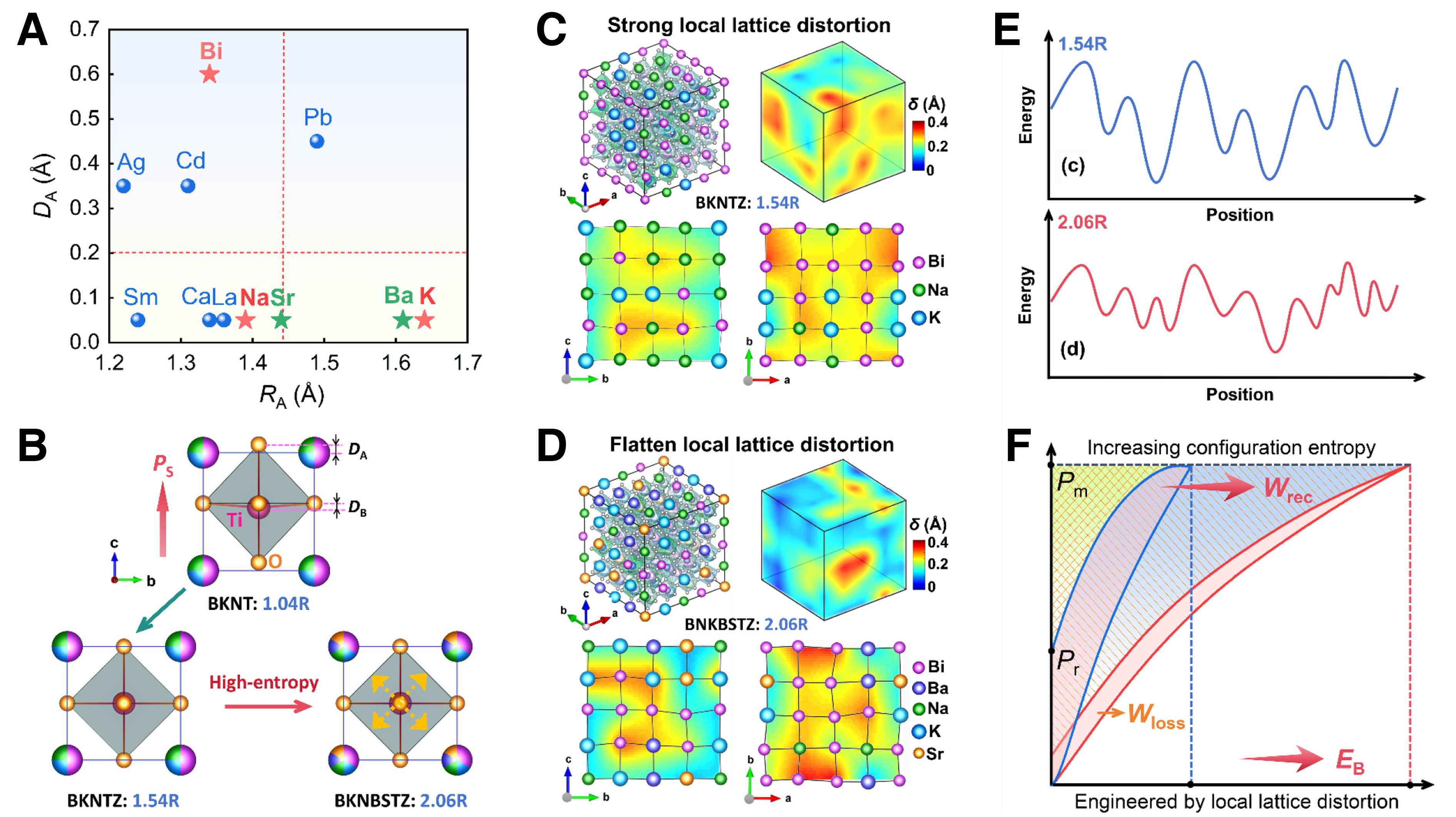
Figure 26. Engineering local lattice distortion via a high-entropy strategy to enhance ESP. (A) Ionic radii and theoretical polar displacements of various A-site cations; (B) Chemical composition design of high-entropy Bi0.5K0.5TiO3 (BKT)-based RFEs; (C and D) Atomic configurations showing A-site cation distributions and corresponding local lattice distortion fields from density functional theory (DFT) calculations; (E and F) Schematics of energy profiles and evolution of P-E loops illustrating improved ES behavior. This figure is quoted with permission from Zhu et al.[329]. ESP: Energy storage performance; RFE: relaxor ferroelectric.
Beyond its direct influence on dielectric response and polarization behavior, lattice distortion also plays a critical indirect role in enhancing ESP and device reliability by mitigating electromechanical breakdown. In FE materials, a strong intrinsic coupling exists between polarization and strain under external electric fields, with multiple mechanisms contributing simultaneously to both responses[26,331]. In practical dielectric devices, particularly MLCCs, such electromechanical coupling is often detrimental to performance[332,333]. For instance, in the AFE material AgNbO3 (AN), field-induced AFE-FE phase transitions produce large electrostrain. Zhu et al. proposed a heterovalent doping strategy to generate low-displacement regions within the AFE matrix, which alleviate spontaneous lattice distortion and reduce macroscopic strain during field-driven transitions, thereby enhancing both BDS and ESP[156].
In RFEs, electrostrain is primarily governed by the electrostrictive effect. Li et al. observed that materials with higher dielectric permittivity and lower strain under electric fields generally exhibit smaller electrostrictive coefficients, indicating that weak polarization-strain coupling is advantageous for ES applications[331]. Building on this principle, Zhang et al. introduced a “weak polarization-strain coupling” strategy[155], which suppresses electrostrain in RFE-based dielectrics without compromising polarization. In (Bi0.5Na0.5)TiO3-Pb(Mg1/3Nb2/3)O3 (BNT-PMN) systems, the coexistence of A- and B-site cations with multiple valences and radii introduces both strong local electric fields and non-synergistic lattice distortions. This duality promotes large ionic-displacement polarization while simultaneously suppressing macroscopic lattice stretching. As a result, the material achieves exceptional polarization response and outstanding ESP with minimal strain output[155]. This work demonstrates that lattice distortion engineering provides a cost-effective and broadly applicable route to suppress electrostrain in MLCCs, thereby improving performance, stability, and operational lifetime.
In summary, lattice distortion in FE ceramics acts as a double-edged regulator of electrical properties. While moderate distortion can optimize polarization dynamics and dielectric behavior, excessive distortion may trigger performance degradation or structural instability. Achieving precise control over lattice distortion remains a grand challenge, requiring advances in in situ characterization and multiscale theoretical modeling.
PERSPECTIVE ON ADVANCEMENTS IN DIELECTRIC ENERGY STORAGE
Dielectric materials, particularly in capacitor architectures, hold great promise for high-power and fast-response energy storage by exploiting electric-field-driven polarization. Future progress must move beyond incremental material discovery toward integrated advances in processing, structural design, and performance evaluation. This perspective highlights three critical directions: (i) advanced fabrication strategies for precise structural and compositional control, (ii) phase-field simulations coupled with state-of-the-art TEM for multiscale insight into polarization dynamics, and (iii) standardized protocols for ESP characterization to ensure rigorous and meaningful comparison across studies.
Advanced fabrication techniques for high-performance dielectrics
Conventional methods such as sol-gel processing, solid-state sintering, and hydrothermal synthesis have long been employed to fabricate dielectric materials for energy storage. While effective at the laboratory scale, these techniques face inherent challenges in scalability, cost efficiency, and microstructural precision. To meet the demands of next-generation miniaturized and high-performance capacitor systems, there is a pressing need for emerging fabrication routes that enable deterministic control over composition, defect chemistry, and hierarchical microstructure while ensuring compatibility with device integration.
Thin-film deposition and nanostructuring
Thin-film deposition techniques, including atomic layer deposition and chemical vapor deposition, have enabled angstrom-level control over thickness, stoichiometry, and interfacial quality in dielectric materials. Such precision is essential for optimizing dielectric performance and ensuring seamless device-level integration. These methods also facilitate rational nanostructuring, allowing porosity, grain orientation, and crystallinity to be tailored at the nanoscale to enhance dielectric constants. Furthermore, the incorporation of nano-engineered architectures, including nanowires, nanotubes, and nanoparticle-assembled composites, has shown great potential to enhance both energy density and discharge efficiency in dielectric systems.
Additive manufacturing
Additive manufacturing offers a transformative route for fabricating complex dielectric structures with programmable control over geometry and hierarchical internal architecture. This technique enables the design of capacitors with engineered spatial distributions of dielectric phases, thereby enhancing ESP through improved polarization pathways and breakdown resistance. It also provides a versatile platform for producing multicomponent composites that integrate disparate dielectric chemistries across multiple length scales, creating new opportunities to overcome the long-standing trade-off between high polarization strength and high BDS.
Hybrid processing techniques
Hybrid processing approaches that integrate conventional and advanced synthesis routes are emerging as an effective strategy for tailoring dielectric performance. For instance, combining sol-gel synthesis with rapid sintering techniques such as spark plasma sintering can achieve near-theoretical ceramic densities and microstructural homogeneity, thereby yielding superior dielectric properties. Embedding such hybrid strategies into scalable manufacturing workflows offers a viable pathway to produce high-performance dielectric materials with enhanced precision, reproducibility, and cost efficiency, accelerating their transition toward advanced energy storage applications.
Phase-field simulations and advanced TEM for material system design
Experimental advances in dielectric fabrication are increasingly complemented by computational frameworks that provide deep insights into structure-property relationships and guide materials optimization. Among these, phase-field simulations stand out as a versatile tool for capturing the temporal and spatial evolution of complex microstructures, including multiphase interfaces and hierarchical architectures[334-336]. Such simulations enable predictive design of dielectrics with tailored functionalities, reducing dependence on empirical trial-and-error synthesis. Yet, predictive design ultimately demands rigorous validation, for which advanced TEM remains unparalleled. By integrating multiple imaging modalities with state-of-the-art data analytics, TEM can now provide not only atomic-scale structural and compositional maps but also direct visualization of lattice distortions, polar states, and nanoscale field distributions. The synergy between phase-field simulations and advanced TEM is becoming indispensable for deciphering emergent polarization phenomena and accelerating the discovery of next-generation high-performance dielectric systems.
Microstructure-property relationships
Phase-field simulations have proven highly effective in capturing the physics of FE and RFE systems, where domain evolution and polarization dynamics dictate energy storage characteristics. By modeling domain nucleation, wall motion, and switching under applied electric fields, these simulations can predict dielectric permittivity, hysteresis behavior, and the impact of defects and grain boundaries on energy-storage efficiency. When combined with advanced TEM-based characterization and macroscopic electrical testing, such approaches enable a closed feedback loop in which microstructural features are quantitatively correlated with performance, thereby refining simulation accuracy and predictive capability. This integration provides a unified view of how composition, defect chemistry, and microstructure converge to govern dielectric behavior, laying the foundation for rational design of materials with targeted ESP.
Design of multiscale materials
A unique strength of phase-field simulations lies in their ability to bridge length scales, spanning from atomic distortions to device-level behavior. This capability enables the rational design of materials with optimized grain sizes, engineered interfaces, and tunable domain architectures, ensuring both performance and reliability under realistic operating conditions. For instance, in MLCCs, simulations can capture the electromechanical interplay of individual dielectric layers and predict how interfacial strain or charge accumulation affects device breakdown. Similarly, in RFEs, they can guide the tuning of PNR size, density, and spatial distribution to maximize recoverable energy storage. Such multiscale insights not only clarify the origins of observed phenomena but also provide quantitative guidelines for the fabrication of next-generation capacitors with unprecedented energy-storage capabilities.
Future prospects for simulations and characterizations
With rapidly expanding computational power, phase-field models are becoming increasingly predictive and capable of resolving intricate electromechanical interactions across multiple scales. Advanced TEM techniques provide the essential foundation for supplying realistic model parameters, while experimental validation remains indispensable for ensuring reliability. The interdependence between simulations and characterizations is thus intensifying, and the two are poised to evolve into inseparable counterparts, much like complementary perspectives on the same physical reality. Looking ahead, the integration of phase-field simulations with machine learning algorithms and high-throughput computational screening offers a transformative pathway for the rapid identification of dielectric materials with superior ESP. Such integration promises to accelerate materials discovery, optimization, and device-level translation, thereby driving the emergence of next-generation high-performance capacitors.
Standardization of energy storage characterization
Despite significant advances in dielectric materials for ES, the field still lacks universally accepted standards for evaluating ESP. Disparities in experimental methodologies, testing conditions, and reporting practices lead to wide variations in reported values, making cross-study comparisons unreliable. These inconsistencies obscure intrinsic material potential, complicate benchmarking, and hinder the translation of laboratory discoveries into commercially viable technologies. Establishing standardized characterization protocols that combine unified testing environments, consistent performance metrics, and rigorous reporting guidelines is therefore essential for enabling fair evaluation, ensuring reproducibility, and accelerating the development of next-generation dielectric materials.
The need for consistent testing protocols
Variations in testing procedures frequently lead to substantial discrepancies in reported ESP parameters. For instance, dielectric BDS can vary dramatically with changes in voltage ramp rate, sample geometry, or testing temperature. Likewise, measured energy density is strongly influenced by factors such as electrode composition, sample thickness, and the frequency of the applied field. Studies have further demonstrated that geometric scaling of samples and electrodes can markedly affect polarization behavior and attainable ESP[337]. Establishing standardized protocols with clearly defined conditions and metrics is therefore essential. Such harmonization would enable the development of comprehensive, reliable performance databases, facilitating cross-study comparisons and guiding the rational selection of optimal dielectric materials for energy-storage applications.
Developing comprehensive databases
The creation of comprehensive, publicly accessible databases is central to advancing standardized evaluation of dielectric materials. Such repositories should couple quantitative performance metrics with detailed metadata on fabrication routes, microstructural characteristics, and processing conditions. Integrated datasets of this nature would allow researchers to discern systematic performance trends, identify composition-structure-property correlations, and accelerate knowledge exchange. Beyond cataloguing performance, these databases would serve as critical platforms for machine-learning-driven predictions and data-informed materials discovery. Sustained progress in dielectric ES will therefore depend not only on innovations in fabrication and computational design but also on the widespread adoption of standardized protocols and open-access data infrastructures. Addressing these needs will enable the rapid discovery, optimization, and translation of next-generation dielectric materials capable of meeting the stringent demands of modern ES systems.
CONCLUSIONS
This review systematically explores how polarization regulation engineering can enhance the energy storage performance of dielectric materials, thereby advancing the development of dielectric capacitors with high-power-density. The core research progress demonstrates that multiscale microstructural design - from the device, interface, grain, domain/nanoregion levels down to the lattice itself - can effectively regulate dielectric/polarization behavior, thereby simultaneously improving energy density, efficiency, and power density. Specific material design strategies, such as targeted doping, component solid solutions, high-entropy configurations, polarization mismatch, and texturing techniques, have been proven to significantly optimize dielectric/polarization responses, showing great potential particularly in solid dielectric materials and MLCCs. Looking ahead, the successful development of next-generation dielectric energy storage systems will depend not only on breakthroughs in material performance limits but also on the deep integration of advanced polarization control science with scalable fabrication processes, device reliability, and system integration technologies, ultimately leading to the comprehensive realization of high-performance, practical energy storage devices.
DECLARATIONS
Acknowledgements
The authors gratefully acknowledge Dr. Yang Li, Dr. Mingyang Tang, Dr. Biao Guo, Dr. Liqiang He, Dr. Yangfei Gao, Dr. Guoliang Xue, and Linpeng Tang for their valuable comments and assistance during the preparation of this manuscript.
Authors’ contributions
Conceptualization, data curation, investigation, validation, writing - original draft: Zhang, L.
Investigation: Jing, R.
Conceptualization, supervision, writing - review and editing: Zhang, S.
Conceptualization, supervision, project administration, funding acquisition, writing - review and editing:
Availability of data and materials
Not applicable.
Financial support and sponsorship
This work was supported by the National Natural Science Foundation of China (Grant Nos. 52261135548 and 52402155) and the China Postdoctoral Science Foundation (Grant Nos. GZC20232075 and 2023M742767).
Conflicts of interest
Zhang, S. is Editor-in-Chief of the journal Microstructures. Zhang, S. was not involved in any steps of editorial processing, notably including reviewers’ selection, manuscript handling and decision making. The other authors declare that there are no conflicts of interest.
Ethical approval and consent to participate
Not applicable.
Consent for publication
Not applicable.
Copyright
© The Author(s) 2026.
REFERENCES
1. Gür, T. M. Review of electrical energy storage technologies, materials and systems: challenges and prospects for large-scale grid storage. Energy. Environ. Sci. 2018, 11, 2696-767.
2. Chen, H.; Ling, M.; Hencz, L.; et al. Exploring chemical, mechanical, and electrical functionalities of binders for advanced energy-storage devices. Chem. Rev. 2018, 118, 8936-82.
4. Yao, Z.; Song, Z.; Hao, H.; et al. Homogeneous/Inhomogeneous-structured dielectrics and their energy-storage performances. Adv. Mater. 2017, 29, 1601727.
5. Palneedi, H.; Peddigari, M.; Hwang, G.; Jeong, D.; Ryu, J. High-performance dielectric ceramic films for energy storage capacitors: progress and outlook. Adv. Funct. Mater. 2018, 28, 1803665.
6. Feng, Q. K.; Zhong, S. L.; Pei, J. Y.; et al. Recent progress and future prospects on all-organic polymer dielectrics for energy storage capacitors. Chem. Rev. 2022, 122, 3820-78.
7. Wang, G.; Lu, Z.; Li, Y.; et al. Electroceramics for high-energy density capacitors: current status and future perspectives. Chem. Rev. 2021, 121, 6124-72.
8. Yang, Z.; Du, H.; Jin, L.; Poelman, D. High-performance lead-free bulk ceramics for electrical energy storage applications: design strategies and challenges. J. Mater. Chem. A. 2021, 9, 18026-85.
9. Yang, L.; Kong, X.; Li, F.; et al. Perovskite lead-free dielectrics for energy storage applications. Porg. Mater. Sci. 2019, 102, 72-108.
10. Zhang, L.; Pu, Y.; Chen, M.; Peng, X.; Wang, B.; Shang, J. Design strategies of perovskite energy-storage dielectrics for next-generation capacitors. J. Eur. Ceram. Soc. 2023, 43, 5713-47.
11. Qi, H.; Xie, A.; Zuo, R. Local structure engineered lead-free ferroic dielectrics for superior energy-storage capacitors: a review. Energy. Storage. Mater. 2022, 45, 541-67.
12. Dai, S.; Li, M.; Wu, X.; et al. Combinatorial optimization of perovskite-based ferroelectric ceramics for energy storage applications. J. Adv. Ceram. 2024, 13, 877-910.
13. Wei, J.; Zhu, L. Intrinsic polymer dielectrics for high energy density and low loss electric energy storage. Prog. Polymer. Sci. 2020, 106, 101254.
14. Yang, M.; Guo, M.; Xu, E.; et al. Polymer nanocomposite dielectrics for capacitive energy storage. Nat. Nanotechnol. 2024, 19, 588-603.
15. Wang, J.; Shen, Z. Modeling-guided understanding microstructure effects in energy storage dielectrics. Microstructures 2021, 1, 2021006.
16. Goodenough, J. B. Energy storage materials: a perspective. Energy. Storage. Mater. 2015, 1, 158-61.
17. Chen, K.; Xue, D. Materials chemistry toward electrochemical energy storage. J. Mater. Chem. A. 2016, 4, 7522-37.
18. Mahmoud, M.; Ramadan, M.; Olabi, A.; Pullen, K.; Naher, S. A review of mechanical energy storage systems combined with wind and solar applications. Energy. Conv. Manag. 2020, 210, 112670.
19. Wang, D.; Liu, N.; Chen, F.; Wang, Y.; Mao, J. Progress and prospects of energy storage technology research: Based on multidimensional comparison. J. Energy. Storage. 2024, 75, 109710.
20. Liu, C.; Li, F.; Ma, L. P.; Cheng, H. M. Advanced materials for energy storage. Adv. Mater. 2010, 22, E28-62.
21. Ould Amrouche, S.; Rekioua, D.; Rekioua, T.; Bacha, S. Overview of energy storage in renewable energy systems. Int. J. Hydrog. Energy. 2016, 41, 20914-27.
22. Hong, K.; Lee, T. H.; Suh, J. M.; Yoon, S. H.; Jang, H. W. Perspectives and challenges in multilayer ceramic capacitors for next generation electronics. J. Mater. Chem. C. 2019, 7, 9782-802.
23. Zhang, G.; Zhang, S.; Wang, Q. Dielectric materials for electrical energy storage. J. Materiomics. 2022, 8, 1287-9.
24. Damjanovic, D. Ferroelectric, dielectric and piezoelectric properties of ferroelectric thin films and ceramics. Rep. Prog. Phys. 1998, 61, 1267-324.
25. Hennings, D.; Schreinemacher, B.; Schreinemacher, H. High-permittivity dielectric ceramics with high endurance. J. Eur. Ceram. Soc. 1994, 13, 81-8.
26. Jin, L.; Li, F.; Zhang, S.; Green, D. J. Decoding the fingerprint of ferroelectric loops: comprehension of the material properties and structures. J. Am. Ceram. Soc. 2014, 97, 1-27.
27. Yan, H.; Inam, F.; Viola, G.; et al. The contribution of electrical conductivity, dielectric permittivity and domain switching in ferroelectric hysteresis loops. J. Adv. Dielect. 2011, 01, 107-18.
28. Moriwake, H.; Fisher, C. A. J.; Kuwabara, A.; Fu, D. First-principles study of point defect formation in AgNbO3. Jpn. J. Appl. Phys. 2013, 52, 09KF08.
29. Hao, X.; Zhai, J.; Kong, L. B.; Xu, Z. A comprehensive review on the progress of lead zirconate-based antiferroelectric materials. Prog. Mater. Sci. 2014, 63, 1-57.
30. Xu, G.; Wen, J.; Stock, C.; Gehring, P. M. Phase instability induced by polar nanoregions in a relaxor ferroelectric system. Nat. Mater. 2008, 7, 562-6.
31. Eremenko, M.; Krayzman, V.; Bosak, A.; et al. Local atomic order and hierarchical polar nanoregions in a classical relaxor ferroelectric. Nat. Commun. 2019, 10, 2728.
33. Müller, K. A.; Burkard, H. SrTiO3: an intrinsic quantum paraelectric below 4 K. Phys. Rev. B. 1979, 19, 3593-602.
34. Fan, Y.; Qu, W.; Qiu, H.; et al. High entropy modulated quantum paraelectric perovskite for capacitive energy storage. Nat. Commun. 2025, 16, 3818.
35. Aramberri, H.; Fedorova, N. S.; Íñiguez, J. Ferroelectric/paraelectric superlattices for energy storage. Sci. Adv. 2022, 8, eabn4880.
36. Zhang, H.; Wei, T.; Zhang, Q.; et al. A review on the development of lead-free ferroelectric energy-storage ceramics and multilayer capacitors. J. Mater. Chem. C. 2020, 8, 16648-67.
37. Zhang, G.; Zhu, D.; Zhang, X.; et al. High-energy storage performance of (Pb0.87Ba0.1La0.02)(Zr0.68Sn0.24Ti0.08)O3 antiferroelectric ceramics fabricated by the hot-press sintering method. J. Am. Ceram. Soc. 2015, 98, 1175-81.
38. Gao, X.; Li, Y.; Chen, J.; et al. High energy storage performances of Bi1-xSmxFe0.95Sc0.05O3 lead-free ceramics synthesized by rapid hot press sintering. J. Eur. Ceram. Soc. 2019, 39, 2331-8.
39. Huang, Y. H.; Wu, Y. J.; Li, J.; Liu, B.; Chen, X. M. Enhanced energy storage properties of barium strontium titanate ceramics prepared by sol-gel method and spark plasma sintering. J. Alloy. Compd. 2017, 701, 439-46.
40. Liu, B.; Wu, Y.; Huang, Y. H.; Song, K. X.; Wu, Y. J. Enhanced dielectric strength and energy storage density in BaTi0.7Zr0.3O3 ceramics via spark plasma sintering. J. Mater. Sci. 2019, 54, 4511-7.
41. Yan, Y.; Hui, J.; Wang, X.; et al. Improvement of energy storage properties of BNT-based ceramics via compositional modification. Ceram. Int. 2024, 50, 48918-30.
42. Withers, P. J.; Bouman, C.; Carmignato, S.; et al. X-ray computed tomography. Nat. Rev. Methods. Primers. 2021, 1, 15.
43. Joy, D. C.; Pawley, J. B. High-resolution scanning electron microscopy. Ultramicroscopy 1992, 47, 80-100.
44. Sun, D.; Shang, H.; Jiang, H. Effective metrology and standard of the surface roughness of micro/nanoscale waveguides with confocal laser scanning microscopy. Opt. Lett. 2019, 44, 747-50.
45. Amireddy, K. K.; Balasubramaniam, K.; Rajagopal, P. Holey-structured metamaterial lens for subwavelength resolution in ultrasonic characterization of metallic components. Appl. Phys. Lett. 2016, 108, 224101.
46. Bilsland, C.; Barrow, A.; Britton, T. B. Correlative statistical microstructural assessment of precipitates and their distribution, with simultaneous electron backscatter diffraction and energy dispersive X-ray spectroscopy. Mater. Charact. 2021, 176, 111071.
47. Okuma, G.; Watanabe, S.; Shinobe, K.; et al. 3D multiscale-imaging of processing-induced defects formed during sintering of hierarchical powder packings. Sci. Rep. 2019, 9, 11595.
48. Wang, Z.; Poncharal, P.; de Heer, W. Nanomeasurements in Transmission Electron Microscopy. Microsc. Microanal. 2000, 6, 224-30.
49. Gomez, A.; Gich, M.; Carretero-Genevrier, A.; Puig, T.; Obradors, X. Piezo-generated charge mapping revealed through direct piezoelectric force microscopy. Nat. Commun. 2017, 8, 1113.
50. Pennycook, S. J.; Ishikawa, R.; Wu, H.; et al. Physics through the microscope. Chinese. Phys. B. 2024, 33, 116801.
51. Kumar, A.; Baker, J. N.; Bowes, P. C.; et al. Atomic-resolution electron microscopy of nanoscale local structure in lead-based relaxor ferroelectrics. Nat. Mater. 2021, 20, 62-7.
52. Wu, H.; Zhang, Y.; Wu, J.; Wang, J.; Pennycook, S. J. Microstructural Origins of High Piezoelectric Performance: A Pathway to Practical Lead-Free Materials. Adv. Funct. Mater. 2019, 29, 1902911.
53. Kohno, Y.; Nakamura, A.; Morishita, S.; Shibata, N. Development of tilt-scan system for differential phase contrast scanning transmission electron microscopy. Microscopy 2022, 71, 111-6.
54. Wu, H.; Zhao, X.; Guan, C.; et al. The atomic circus: small electron beams spotlight advanced materials down to the atomic scale. Adv. Mater. 2018, 30, e1802402.
55. Gault, B.; Chiaramonti, A.; Cojocaru-Mirédin, O.; et al. Atom probe tomography. Nat. Rev. Methods. Primers. 2021, 1, 51.
56. Huang, Q.; Chen, Z.; Cabral, M. J.; et al. Direct observation of nanoscale dynamics of ferroelectric degradation. Nat. Commun. 2021, 12, 2095.
57. Fan, Z.; Tan, X. Dual-stimuli in-situ TEM study on the nonergodic/ergodic crossover in the 0.75(Bi1/2Na1/2)TiO3-0.25SrTiO3 relaxor. Appl. Phys. Lett. 2019, 114, 212901.
58. Zhang, L.; Chen, F.; Huang, Y.; Jing, R.; Jin, L. Perspective on polarization regulation for advanced energy storage. Appl. Phys. Lett. 2025, 127, 130502.
59. Ding, S.; Jia, J.; Xu, B.; et al. Overrated energy storage performances of dielectrics seriously affected by fringing effect and parasitic capacitance. Nat. Commun. 2025, 16, 608.
60. Cai, Z.; Wang, H.; Zhao, P.; et al. Significantly enhanced dielectric breakdown strength and energy density of multilayer ceramic capacitors with high efficiency by electrodes structure design. Appl. Phys. Lett. 2019, 115, 023901.
61. Yang, Y.; Xu, K.; Yang, B.; et al. Giant energy storage density with ultrahigh efficiency in multilayer ceramic capacitors via interlaminar strain engineering. Nat. Commun. 2025, 16, 1300.
62. Pan, Z.; Yao, L.; Zhai, J.; Yao, X.; Chen, H. Interfacial coupling effect in organic/inorganic nanocomposites with high energy density. Adv. Mater. 2018, 30, e1705662.
63. Yu, Y.; Zhang, Q.; Xu, Z.; et al. Structure-evolution-designed amorphous oxides for dielectric energy storage. Nat. Commun. 2023, 14, 3031.
64. Liu, Y.; Liu, J.; Pan, H.; et al. Phase-Field simulations of tunable polar topologies in lead-free ferroelectric/paraelectric multilayers with ultrahigh energy-storage performance. Adv. Mater. 2022, 34, e2108772.
65. Silva, J. P. B.; Silva, J. M. B.; Oliveira, M. J. S.; et al. High-performance ferroelectric-dielectric multilayered thin films for energy storage capacitors. Adv. Funct. Mater. 2019, 29, 1807196.
66. Hu, J.; Wang, W.; Yang, Y.; et al. Achieving ultrahigh energy storage performance of PBLZST-based antiferroelectric composite ceramics via interfacial polarization engineering. J. Eur. Ceram. Soc. 2024, 44, 7642-50.
67. Yang, Y.; Dou, Z.; Zou, K.; et al. Superior energy storage performance in antiferroelectric multilayer ceramics via heterogeneous interface structure engineering. Chem. Eng. J. 2023, 451, 138636.
68. Liu, T.; Jia, B.; Wang, J.; et al. High capacitive performances obtained in sandwich structured Bi0.5Na0.5TiO3 -based dielectric ceramics. Inorg. Chem. Front. 2025, 12, 4901-10.
69. Yang, Y.; Zhang, L.; Jing, R.; et al. RFE/RAFE multilayer composite ceramics with excellent dielectric bias-field stability. J. Eur. Ceram. Soc. 2025, 45, 117239.
70. Liu, X.; Yang, T.; Shen, B.; Chen, L. Enhancing the energy storage performance in lead-based antiferroelectric ceramics via Pb(Zr0.88Sn0.12)O3/(Pb0.875La0.05Sr0.05)(Zr0.695Ti0.005Sn0.3)O3-derived laminated composite structures. ACS. Appl. Energy. Mater. 2023, 6, 1218-27.
71. Huan, Y.; Wang, X.; Zheng, Y.; et al. Achieving excellent energy storage reliability and endurance via mechanical performance optimization strategy in engineered ceramics with core-shell grain structure. J. Materiomics. 2022, 8, 601-10.
72. Yan, F.; Ge, G.; Qian, J.; et al. Gradient-structured ceramics with high energy storage performance and excellent stability. Small 2023, 19, e2206125.
73. Yan, F.; Qian, J.; Lin, J.; Ge, G.; Shi, C.; Zhai, J. Ultrahigh energy storage density and efficiency of lead-free dielectrics with sandwich structure. Small 2024, 20, e2306803.
74. Liu, X.; Yang, T.; Li, Y.; Wang, R.; Sun, N. Regulating the switching electric field and energy-storage performance in antiferroelectric ceramics via heterogeneous laminated engineering. Ceram. Int. 2024, 50, 35810-9.
75. Cai, K.; Yan, X.; Deng, P.; et al. Phase coexistence and evolution in sol-gel derived BY-PT-PZ ceramics with significantly enhanced piezoelectricity and high temperature stability. J. Materiomics. 2019, 5, 394-403.
76. Li, Y.; Chang, Z.; Zhang, M.; et al. Realizing outstanding energy storage performance in KBT-based lead-free ceramics via suppressing space charge accumulation. Small 2024, 20, e2401229.
77. Cao, W.; Li, L.; Chen, K.; et al. Interfacial-polarization engineering in BNT-based bulk ceramics for ultrahigh energy-storage density. Adv. Sci. 2024, 11, e2409113.
78. Cao, W.; Lin, R.; Hou, X.; et al. Interfacial polarization restriction for ultrahigh energy-storage density in lead-free ceramics. Adv. Funct. Mater. 2023, 33, 2301027.
79. Pan, H.; Jiang, Y.; Macmanus-driscoll, J. L. Interplay of polarization, strength, and loss in dielectric films for capacitive energy storage: current status and future directions. J. Materiomics. 2023, 9, 516-9.
80. Ren, L.; Guo, K.; Cui, R.; Wang, X.; Zhang, M.; Deng, C. Excellent energy storage performance in BSFCZ/AGO/BNTN double-heterojunction capacitors via the synergistic effect of interface and dead-layer engineering. Nano. Energy. 2024, 129, 110065.
81. Choi, J. O.; Kim, T. Y.; Park, S. M.; et al. Co:BaTiO3/Sn:BaTiO3 heterostructure thin-film capacitors with ultrahigh energy density and breakdown strength. Adv. Elect. Mater. 2023, 9, 2201141.
82. Chi, Q.; Dong, B.; Yin, C.; et al. Improved energy storage performance of NBTM/STM multilayer films via designing the stacking order. J. Mater. Chem. C. 2024, 12, 13927-35.
83. Wang, Y.; Zhu, H.; Luo, H.; et al. Tunable antiferroelectric-like polarization behavior and enhanced energy storage characteristics in symmetric BaTiO3/BiFeO3/BaTiO3 heterostructure. J. Materiomics. 2024, 10, 1290-8.
84. Nguyen, M. D.; Houwman, E. P.; Birkhölzer, Y. A.; Vu, H. N.; Koster, G.; Rijnders, G. Toward design rules for multilayer ferroelectric energy storage capacitors - a study based on lead-free and relaxor-ferroelectric/paraelectric multilayer devices. Adv. Mater. 2024, 36, e2402070.
85. Zhai, X.; Ouyang, J.; Kuai, W.; et al. Enhanced energy storage performance in Ag(Nb,Ta)O3 films via interface engineering. J. Materiomics. 2025, 11, 100895.
86. Chen, X.; Peng, B.; Ding, M.; et al. Giant energy storage density in lead-free dielectric thin films deposited on Si wafers with an artificial dead-layer. Nano. Energy. 2020, 78, 105390.
87. Sun, Z.; Houwman, E. P.; Wang, S.; Nguyen, M. D.; Koster, G.; Rijnders, G. Revealing the effect of the Schottky barrier on the energy storage performance of ferroelectric multilayers. J. Alloys. Compd. 2024, 981, 173758.
88. Sun, Z.; Xin, H.; Diwu, L.; et al. Boosting the energy storage performance of BCZT-based capacitors by constructing a Schottky contact. Mater. Horiz. 2025, 12, 2328-40.
89. Liu, S.; Xin, Z.; Du, W.; Hao, H.; Wang, Q. Improvement in dielectric properties and energy storage performance of barium strontium niobate glass ceramics by Sm2O3 addition. J. Alloys. Compd. 2023, 966, 171579.
90. Liu, S.; Shen, B.; Hao, H.; Zhai, J. Glass-ceramic dielectric materials with high energy density and ultra-fast discharge speed for high power energy storage applications. J. Mater. Chem. C. 2019, 7, 15118-35.
91. Geng, X.; Wang, Y.; Shang, F.; Chen, G. Crystallization temperature dependence of phase evolution and energy storage feature of KSr2Nb5O15 based glass ceramics. J. Mater. Sci. Mater. Electron. 2023, 34, 1264.
92. Chen, K.; Jiang, T.; Shen, B.; Zhai, J. Effects of crystalline temperature on microstructures and dielectric properties in BaO-Na2O-Bi2O3-Nb2O5-Al2O3-SiO2 glass-ceramics. Mater. Sci. Eng. B. 2021, 263, 114885.
93. Wang, J.; Xin, Z.; Hao, H.; Wang, Q.; Sun, X.; Liu, S. Reinforced dielectric properties and energy storage performance of BaO-Na2O-Nb2O5-SiO2-TiO2-ZrO2 dielectric glass ceramics. Ceram. Int. 2024, 50, 17283-90.
94. Wang, H.; Liu, J.; Zhai, J.; et al. Effect of crystallization temperature on dielectric and energy-storage properties in SrO-Na2O-Nb2O5-SiO2 glass-ceramics. Ceram. Int. 2017, 43, 8898-904.
95. Luo, F.; Xing, J.; Qin, Y.; Zhong, Y.; Shang, F.; Chen, G. Up-conversion luminescence, temperature sensitive and energy storage performance of lead-free transparent Yb3+/Er3+ co-doped Ba2NaNb5O15 glass-ceramics. J. Alloys. Compd. 2022, 910, 164859.
96. Liu, J.; Wang, H.; Shen, B.; et al. Crystallization kinetics, breakdown strength, and energy-storage properties in niobate-based glass-ceramics. J. Alloys. Compd. 2017, 722, 212-8.
97. Chen, C.; Wang, T.; Zhang, S.; Li, B. Engineering phase separation in niobate glass through ab initio molecular dynamics for enhanced energy storage performance and unprecedented thermal stability in niobate-based glass ceramics. ACS. Appl. Mater. Interfaces. 2024, 16, 13961-71.
98. Yang, K.; Liu, J.; Shen, B.; Zhai, J.; Wang, H. Large improvement on energy storage and charge-discharge properties of Gd2O3-doped BaO-K2O-Nb2O5-SiO2 glass-ceramic dielectrics. Mater. Sci. Eng. B. 2017, 223, 178-84.
99. Wei, J.; Jiang, D.; Yu, W.; Shang, F.; Chen, G. The effect of Hf doping on the dielectric and energy storage performance of barium titanate based glass ceramics. Ceram. Int. 2021, 47, 11581-6.
100. Won, S. S.; Kim, H.; Lee, J.; Jeong, C. K.; Kim, S.; Kingon, A. I. Lead-free bismuth pyrochlore-based dielectric films for ultrahigh energy storage capacitors. Mater. Today. Phys. 2023, 33, 101054.
101. Shang, F.; Wei, J.; Xu, J.; et al. Boosting energy storage performance of glass ceramics via modulating defect formation during crystallization. Adv. Sci. 2024, 11, e2307011.
102. Pu, Y.; Wang, W.; Guo, X.; Shi, R.; Yang, M.; Li, J. Enhancing the energy storage properties of Ca0.5Sr0.5TiO3 -based lead-free linear dielectric ceramics with excellent stability through regulating grain boundary defects. J. Mater. Chem. C. 2019, 7, 14384-93.
103. Deng, T.; Hu, T.; Liu, Z.; et al. Ultrahigh energy storage performance in BNT-based binary ceramic via relaxor design and grain engineering. Energy. Storage. Mater. 2024, 71, 103659.
104. Lee, S. Y.; Kim, H.; Baek, C.; et al. Yielding optimal dielectric energy storage and breakdown properties of lead-free pyrochlore ceramics by grain refinement strategies. J. Alloys. Compd. 2024, 1008, 176569.
105. Wang, Z.; Bin, C.; Zheng, S.; Wang, J. Effect of grain size and grain boundary on the energy storage performance of polycrystalline ferroelectrics. Appl. Phys. Lett. 2024, 125, 152903.
106. Zhang, L.; Cao, S.; Li, Y.; et al. Achieving ultrahigh energy storage performance over a broad temperature range in (Bi0.5Na0.5)TiO3-based eco-friendly relaxor ferroelectric ceramics via multiple engineering processes. J. Alloys. Compd. 2022, 896, 163139.
107. Chao, W.; Tian, L.; Yang, T.; Li, Y.; Liu, Z. Excellent energy storage performance achieved in novel PbHfO3-based antiferroelectric ceramics via grain size engineering. Chem. Eng. J. 2022, 433, 133814.
108. Li, Y.; Wu, J.; Zhang, Z.; et al. Improving the electric energy storage performance of multilayer ceramic capacitors by refining grains through a two-step sintering process. Chem. Eng. J. 2024, 479, 147844.
109. Liu, G.; Li, Y.; Guo, B.; et al. Ultrahigh dielectric breakdown strength and excellent energy storage performance in lead-free barium titanate-based relaxor ferroelectric ceramics via a combined strategy of composition modification, viscous polymer processing, and liquid-phase sintering. Chem. Eng. J. 2020, 398, 125625.
110. Zhu, X.; Gao, Y.; Shi, P.; et al. Ultrahigh energy storage density in (Bi0.5Na0.5)0.65Sr0.35TiO3-based lead-free relaxor ceramics with excellent temperature stability. Nano. Energy. 2022, 98, 107276.
111. Li, G.; Shi, C.; Zhu, K.; et al. Achieving synergistic electromechanical and electrocaloric responses by local structural evolution in lead-free BNT-based relaxor ferroelectrics. Chem. Eng. J. 2022, 431, 133386.
112. Xu, Y.; Pang, D.; Li, T. Achieving excellent energy storage properties and temperature stability in BNT-BT-BS ceramics under low electric field. Appl. Surf. Sci. 2025, 697, 163011.
113. Li, Y.; Hou, Y.; Xi, K.; Zheng, M.; Zhu, M. An intragranular segregation structure enables an excellent energy storage performance in composite dielectrics through delayed saturation polarization. ACS. Appl. Mater. Interfaces. 2024, 16, 57386-94.
114. Stojanovic, B.; Foschini, C.; Zaghete, M.; et al. Size effect on structure and dielectric properties of Nb-doped barium titanate. J. Mater. Process. Technol. 2003, 143-144, 802-6.
115. Hoshina, T. Size effect of barium titanate: fine particles and ceramics. J. Ceram. Soc. Japan. 2013, 121, 156-61.
116. Huan, Y.; Wang, X.; Fang, J.; Li, L. Grain size effect on piezoelectric and ferroelectric properties of BaTiO3 ceramics. J. Eur. Ceram. Soc. 2014, 34, 1445-8.
117. Tan, Y.; Zhang, J.; Wu, Y.; et al. Unfolding grain size effects in barium titanate ferroelectric ceramics. Sci. Rep. 2015, 5, 9953.
118. Jin, Q.; Song, E.; Cai, K. Simple synthesis of barium titanate ceramics with controllable grain size. J. Mater. Sci. Mater. Electron. 2022, 33, 26801-12.
119. Zhang, M.; Zhao, C.; Yan, X.; et al. Understanding the grain size dependence of functionalities in lead-free (Ba,Ca)(Zr,Ti)O3. Acta. Materialia. 2024, 276, 120112.
120. Ghayour, H.; Abdellahi, M. A brief review of the effect of grain size variation on the electrical properties of BaTiO3-based ceramics. Powder. Technol. 2016, 292, 84-93.
121. Yao, G.; Wang, X.; Yang, Y.; Li, L. Effects of Bi2O3 and Yb2O3 on the curie temperature in BaTiO3 -based ceramics. J. Am. Ceram. Soc. 2010, 93, 1697-701.
122. Kinoshita, K.; Yamaji, A. Grain-size effects on dielectric properties in barium titanate ceramics. J. Appl. Phys. 1976, 47, 371-3.
123. Arlt, G.; Hennings, D.; de With, G. Dielectric properties of fine-grained barium titanate ceramics. J. Appl. Phys. 1985, 58, 1619-25.
124. Acosta, M.; Novak, N.; Rojas, V.; et al. BaTiO3-based piezoelectrics: fundamentals, current status, and perspectives. Appl. Phys. Rev. 2017, 4, 041305.
125. Wa Gachigi, K.; Kumar, U.; Dougherty, J. P. Grain size effects in barium titanate. Ferroelectrics 1993, 143, 229-38.
126. Sun, T.; Wang, X.; Wang, H.; Cheng, Z.; Zhang, X.; Li, L. A theoretical model on size effect of dielectric response in DC bias field in barium titanate ceramic system. J. Am. Ceram. Soc. 2010, 93, 3808-13.
127. Huang, X.; Wang, P.; Zhao, J.; et al. Significantly enhanced dielectric properties of BaTiO3-based ceramics via synergetic grain size and defect engineering. Ceram. Int. 2024, 50, 15202-8.
128. Wu, C.; Pu, Y.; Lu, X.; et al. Constructing novel SrTiO3-based composite ceramics with high energy storage performance under moderate electric field. J. Power. Sources. 2024, 604, 234475.
129. Wang, S.; Qian, J.; Ge, G.; et al. Embedding plate-like pyrochlore in perovskite phase to enhance energy storage performance of BNT-based ceramic capacitors. Adv. Energy. Mater. 2025, 15, 2403926.
130. Yin, M.; Zhang, Y.; Bai, H.; et al. Preeminent energy storage properties and superior stability of (Ba(1-x)Bix)(Ti(1-x)Mg2x/3Tax/3)O3 relaxor ferroelectric ceramics via elongated rod-shaped grains and domain structural regulation. J. Mater. Sci. Technol. 2024, 184, 207-20.
131. Deng, T.; Liu, Z.; Hu, T.; Dai, K.; Hu, Z.; Wang, G. Excellent energy-storage performance in Bi0.5Na0.5TiO3-based lead-free composite ceramics via introducing pyrochlore phase Sm2Ti2O7. Chem. Eng. J. 2023, 465, 142992.
132. Lu, R.; Wang, J.; Duan, T.; et al. Metadielectrics for high-temperature energy storage capacitors. Nat. Commun. 2024, 15, 6596.
133. Shen, M.; Zhang, G.; Wang, H.; et al. Excellent energy storage density and superior discharge properties of NBT-NN-ST/xHfO2 ceramics via 0-3 type heterogeneous structure designing. J. Mater. Chem. A. 2023, 11, 18972-83.
134. Yang, F.; Bao, Y.; Zeng, B.; et al. Excellent energy storage properties in ZrO2 toughened Ba0.55Sr0.45TiO3-based relaxor ferroelectric ceramics via multi-scale synergic regulation. Chem. Eng. J. 2024, 493, 152624.
135. Yang, B.; Gao, Y.; Li, J.; et al. Tailoring Zr-doped tungsten bronze (Sr,Ba,Gd)Nb2O6 relaxor ferroelectric with high electrical insulation interface for dielectric capacitor. Compos. Pt. B. Eng. 2024, 271, 111189.
136. Huang, X.; Cao, W.; Liu, L.; Niu, X.; Liang, C.; Wang, C. Enhanced energy storage performance of temperature-stable X8R ceramics with core-shell microstructure. Ceram. Int. 2025, 51, 2259-67.
137. Gonçalves, L. G.; Rino, J. P. Finite size effects on a core-shell model of barium titanate. Comput. Mater. Sci. 2017, 130, 98-102.
138. Fang, C.; Zhou, D.; Gong, S.; Luo, W. Multishell structure and size effect of barium titanate nanoceramics induced by grain surface effects. Phys. Status. Solidi. B. 2010, 247, 219-24.
139. Xue, G.; Zhou, X.; Su, Y.; Tang, L.; Zou, J.; Zhang, D. Core-shell structure and domain engineering in Bi0.5Na0.5TiO3-based ceramics with enhanced dielectric and energy storage performance. J. Materiomics. 2023, 9, 855-66.
140. Dong, X.; Li, X.; Chen, X.; et al. (1-x)[0.90NN-0.10Bi(Mg2/3Nb1/3)O3]-x(Bi0.5Na0.5)0.7Sr0.3TiO3 ceramics with core-shell structures: a pathway for simultaneously achieving high polarization and breakdown strength. Nano. Energy. 2022, 101, 107577.
141. Chai, Q.; Tan, P.; Zhang, L.; et al. Ultrahigh energy storage in relaxor ferroelectric ceramics with core-shell grains. Adv. Funct. Mater. 2025, 35, 2503798.
142. Xie, S.; Chen, Y.; He, Q.; et al. Relaxor antiferroelectric-relaxor ferroelectric crossover in NaNbO3-based lead-free ceramics for high-efficiency large-capacitive energy storage. Chinese. Chem. Lett. 2024, 35, 108871.
143. Wu, L.; Lan, G.; Cai, Z.; Zhao, L.; Lu, J.; Wang, X. Concurrent achievement of giant energy density and ultrahigh efficiency in antiferroelectric ceramics via core-shell structure design. Appl. Phys. Lett. 2022, 120, 172902.
144. Qi, J.; Cao, M.; Heath, J. P.; et al. Improved breakdown strength and energy storage density of a Ce doped strontium titanate core by silica shell coating. J. Mater. Chem. C. 2018, 6, 9130-9.
145. Ma, R.; Cui, B.; Shangguan, M.; et al. A novel double-coating approach to prepare fine-grained BaTiO3@La2O3@SiO2 dielectric ceramics for energy storage application. J. Alloys. Compd. 2017, 690, 438-45.
146. Zhang, X.; Zhao, L.; Liu, L.; Zhang, Z.; Cui, B. Interface and defect modulation via a core-shell design in (Na0.5Bi0.5TiO3@La2O3)-(SrSn0.2Ti0.8O3@La2O3)-Bi2O3-B2O3-SiO2 composite ceramics for wide-temperature energy storage capacitors. Chem. Eng. J. 2022, 435, 135061.
147. Zhang, X.; Zhao, L.; Qiu, Y.; et al. Achieving comprehensive temperature-stable energy storage properties in core-shell Na0.4K0.1Bi0.5TiO3@(SrZrO3-BiMg0.5Sn0.5O3)@SiO2 ceramics via a multi-scale synergistic optimization. Chem. Eng. J. 2023, 462, 142251.
148. Zhu, C.; Li, A.; Li, X.; et al. Ultra-stable dielectric properties and enhanced energy storage density of BNT-NN-based ceramics via precise core-shell structure controlling. J. Alloys. Compd. 2025, 1010, 177556.
149. Zhao, P.; Cai, Z.; Chen, L.; et al. Ultra-high energy storage performance in lead-free multilayer ceramic capacitors via a multiscale optimization strategy. Energy. Environ. Sci. 2020, 13, 4882-90.
150. Li, J.; Qu, W.; Daniels, J.; et al. Lead zirconate titanate ceramics with aligned crystallite grains. Science 2023, 380, 87-93.
151. Zhang, L.; Jing, R.; Du, H.; et al. Ultrahigh Electrostrictive effect in lead-free ferroelectric ceramics via texture engineering. ACS. Appl. Mater. Interfaces. 2023, 15, 50265-74.
152. Li, J.; Shen, Z.; Chen, X.; et al. Grain-orientation-engineered multilayer ceramic capacitors for energy storage applications. Nat. Mater. 2020, 19, 999-1005.
153. Wang, J.; Shen, Z. H.; Liu, R. L.; et al. Texture engineering modulating electromechanical breakdown in multilayer ceramic capacitors. Adv. Sci. 2023, 10, e2300320.
154. Li, Y.; Fan, N.; Wu, J.; et al. Enhanced energy storage performance in NBT-based MLCCs via cooperative optimization of polarization and grain alignment. Nat. Commun. 2024, 15, 8958.
155. Zhang, L.; Jing, R.; Huang, Y.; et al. Ultra-weak polarization-strain coupling effect boosts capacitive energy storage. Adv. Mater. 2024, 36, e2406219.
156. Zhu, L. F.; Deng, S.; Zhao, L.; et al. Heterovalent-doping-enabled atom-displacement fluctuation leads to ultrahigh energy-storage density in AgNbO3-based multilayer capacitors. Nat. Commun. 2023, 14, 1166.
157. Diwu, L.; Wang, P.; Wang, T.; et al. Engineering ordered-disordered domains for high-performance energy storage in BCZT-based relaxor ferroelectrics. Small 2025, 21, e2503713.
158. Liu, W.; Fu, B.; Zhang, J.; et al. Exceptional capacitive energy storage in CaTiO3-based ceramics featuring laminate nanodomains. Chem. Eng. J. 2025, 512, 162477.
159. Zhang, Y.; Li, A.; Zhang, G.; et al. Optimization of energy storage properties in lead-free barium titanate-based ceramics via B-site defect dipole engineering. ACS. Sustainable. Chem. Eng. 2022, 10, 2930-7.
160. Hu, Q.; Wei, X. Abnormal phase transition and polarization mismatch phenomena in BaTiO3 -based relaxor ferroelectrics. J. Adv. Dielect. 2019, 09, 1930002.
161. Bokov, A. A.; Ye, Z. Recent progress in relaxor ferroelectrics with perovskite structure. J. Mater. Sci. 2006, 41, 31-52.
162. Li, Y.; Lin, W.; Yang, B.; Zhang, S.; Zhao, S. Domain dynamics engineering in ergodic relaxor ferroelectrics for dielectric energy storage. Acta. Materialia. 2023, 255, 119071.
163. Wang, W.; Zhang, L.; Jing, R.; et al. Enhancement of energy storage performance in lead-free barium titanate-based relaxor ferroelectrics through a synergistic two-step strategy design. Chem. Eng. J. 2022, 434, 134678.
164. Wang, W.; Zhang, L.; Li, C.; et al. Effective strategy to improve energy storage properties in lead-free (Ba0.8Sr0.2)TiO3-Bi(Mg0.5Zr0.5)O3 relaxor ferroelectric ceramics. Chem. Eng. J. 2022, 446, 137389.
165. Wang, W.; Zhang, L.; Yang, Y.; et al. Enhancing energy storage performance in Na 0.5 Bi 0.5 TiO 3 -based lead-free relaxor ferroelectric ceramics along a stepwise optimization route. J. Mater. Chem. A. 2023, 11, 2641-51.
166. Guo, B.; Yan, Y.; Tang, M.; et al. Energy storage performance of Na0.5Bi0.5TiO3 based lead-free ferroelectric ceramics prepared via non-uniform phase structure modification and rolling process. Chem. Eng. J. 2021, 420, 130475.
167. Liu, G.; Tang, M.; Hou, X.; et al. Energy storage properties of bismuth ferrite based ternary relaxor ferroelectric ceramics through a viscous polymer process. Chem. Eng. J. 2021, 412, 127555.
168. Zhang, L.; Jing, R.; Huang, Y.; et al. Ultrahigh electrostrictive effect in potassium sodium niobate-based lead-free ceramics. J. Eur. Ceram. Soc. 2022, 42, 944-53.
169. Xu, Y.; Yang, Z.; Xu, K.; et al. Enhanced energy-storage performance in silver niobate-based dielectric ceramics sintered at low temperature. J. Alloys. Compd. 2022, 913, 165313.
170. Wei, F.; Zhang, L.; Jing, R.; et al. Structure, dielectric, electrostrictive and electrocaloric properties of environmentally friendly Bi-substituted BCZT ferroelectric ceramics. Ceram. Int. 2021, 47, 34676-86.
171. Zhou, M.; Liang, R.; Zhou, Z.; Dong, X. Achieving ultrahigh energy storage density and energy efficiency simultaneously in sodium niobate-based lead-free dielectric capacitors via microstructure modulation. Inorg. Chem. Front. 2019, 6, 2148-57.
172. Wang, H.; Bu, X.; Zhang, X.; et al. Pb/Bi-free tungsten bronze-based relaxor ferroelectric ceramics with remarkable energy storage performance. ACS. Appl. Energy. Mater. 2021, 4, 9066-76.
173. Wan, R.; Zhang, H.; Sheng, L.; et al. Outstanding energy density and charge-discharge performances in Sr2KNb5O15-based tungsten bronze ceramics for dielectric capacitor applications. Ceram. Int. 2024, 50, 37126-35.
174. Yang, B.; Zhang, J.; Lou, X.; et al. Enhancing comprehensive energy storage properties in tungsten bronze Sr0.53Ba0.47Nb2O6-based lead-free ceramics by B-site doping and relaxor tuning. ACS. Appl. Mater. Interfaces. 2022, 14, 34855-66.
175. Koch, L.; Steiner, S.; Hoang, A.; Klomp, A. J.; Albe, K.; Frömling, T. Revealing the impact of acceptor dopant type on the electrical conductivity of sodium bismuth titanate. Acta. Materialia. 2022, 229, 117808.
176. Wang, L.; Qi, H.; Deng, S.; et al. Design of superior electrostriction in BaTiO3-based lead-free relaxors via the formation of polarization nanoclusters. InfoMat 2023, 5, e12362.
177. Yang, Y.; Jing, R.; Wang, J.; Lu, X.; Du, H.; Jin, L. Large electrostrain and high energy-storage properties of (Sr1/3Nb2/3)4+-substituted (Bi0.51Na0.5)TiO3-0.07BaTiO3 lead-free ceramics. Ceram. Int. 2022, 48, 23975-82.
178. Zhou, M.; Liang, R.; Zhou, Z.; et al. High energy storage properties of (Ni1/3Nb2/3)4+ complex-ion modified (Ba0.85Ca0.15)(Zr0.10Ti0.90)O3 ceramics. Mater. Res. Bull. 2018, 98, 166-72.
179. Wu, J.; Mahajan, A.; Riekehr, L.; et al. Perovskite Srx(Bi1-xNa0.97-xLi0.030.5TiO3 ceramics with polar nano regions for high power energy storage. Nano. Energy. 2018, 50, 723-32.
180. Yang, B.; Gao, Y.; Lou, X.; et al. Remarkable energy storage performances of tungsten bronze Sr0.53Ba0.47Nb2O6-based lead-free relaxor ferroelectric for high-temperature capacitors application. Energy. Storage. Mater. 2023, 55, 763-72.
181. Luo, C.; Feng, Q.; Luo, N.; et al. Effect of Ca2+/Hf4+ modification at A/B sites on energy-storage density of Bi0.47Na0.47Ba0.06TiO3 ceramics. Chem. Eng. J. 2021, 420, 129861.
182. Pu, Y.; Zhang, L.; Cui, Y.; Chen, M. High energy storage density and optical transparency of microwave sintered homogeneous (Na0.5Bi0.5)(1-x)BaxTi(1-y)SnyO3 ceramics. ACS. Sustainable. Chem. Eng. 2018, 6, 6102-9.
183. Alkathy, M. S.; Gatasheh, M. K.; Zabotto, F. L.; Kassim, H. A.; Raju, K. C. J.; Eiras, J. A. Enhancing energy storage performance in BaTiO3 ceramics via Mg and La co-doping strategy. J. Mater. Sci. Mater. Electron. 2024, 35, 12816.
184. Zhao, Y.; Li, Z.; Du, H.; et al. Enhanced energy storage properties promoted by the synergistic effects of aging effects and relaxor behavior in Ce-Mn co-doped Sr0.4Ba0.6Nb2O6 ferroelectric ceramics. Ceram. Int. 2024, 50, 38462-70.
185. Dan, Y.; Tang, L.; Ning, W.; et al. Achieving enhanced energy storage performance and ultra-fast discharge time in tungsten-bronze ceramic. J. Adv. Ceram. 2024, 13, 1349-58.
186. Li, D.; Lin, Y.; Zhang, M.; Yang, H. Achieved ultrahigh energy storage properties and outstanding charge-discharge performances in (Na0.5Bi0.5)0.7Sr0.3TiO3-based ceramics by introducing a linear additive. Chem. Eng. J. 2020, 392, 123729.
187. Cui, C.; Pu, Y.; Gao, Z.; et al. Structure, dielectric and relaxor properties in lead-free ST-NBT ceramics for high energy storage applications. J. Alloys. Compd. 2017, 711, 319-26.
188. Yang, Z.; Du, H.; Qu, S.; et al. Significantly enhanced recoverable energy storage density in potassium-sodium niobate-based lead free ceramics. J. Mater. Chem. A. 2016, 4, 13778-85.
189. Yan, F.; Huang, K.; Jiang, T.; et al. Significantly enhanced energy storage density and efficiency of BNT-based perovskite ceramics via A-site defect engineering. Energy. Storage. Mater. 2020, 30, 392-400.
190. Zhou, X.; Qi, H.; Yan, Z.; Xue, G.; Luo, H.; Zhang, D. Superior thermal stability of high energy density and power density in domain-engineered Bi0.5Na0.5TiO3-NaTaO3 relaxor ferroelectrics. ACS. Appl. Mater. Interfaces. 2019, 11, 43107-15.
191. Xu, Q.; Liu, H.; Zhang, L.; et al. Structure and electrical properties of lead-free Bi0.5Na0.5TiO3 -based ceramics for energy-storage applications. RSC. Adv. 2016, 6, 59280-91.
192. Kamba, S.; Goian, V.; Bovtun, V.; et al. Incipient ferroelectric properties of NaTaO3. Ferroelectrics 2012, 426, 206-14.
193. Liu, G.; Li, Y.; Gao, J.; et al. Structure evolution, ferroelectric properties, and energy storage performance of CaSnO3 modified BaTiO3-based Pb-free ceramics. J. Alloys. Compd. 2020, 826, 154160.
194. Zhang, L.; Pu, X.; Chen, M.; Bai, S.; Pu, Y. Influence of BaSnO3 additive on the energy storage properties of Na0.5Bi0.5TiO3-based relaxor ferroelectrics. J. Eur. Ceram. Soc. 2018, 38, 2304-11.
195. Yu, Y.; Zhang, Y.; Zhang, Y.; et al. High-temperature energy storage performances in (1-x)(Na0.50Bi0.50TiO3)-xBaZrO3 lead-free relaxor ceramics. Ceram. Int. 2020, 46, 28652-8.
196. Zou, X.; Liu, S.; Qiu, G.; et al. Improved energy storage performance at the phase boundary in BaTiO3-based film capacitors. J. Power. Sources. 2024, 619, 235201.
197. Guo, X.; Shi, P.; Lou, X.; Liu, Q.; Zuo, H. Superior energy storage properties in (1-x)(0.65Bi0.5Na0.5TiO3-0.35Bi0.2Sr0.7TiO3)-xCaZrO3 ceramics with excellent temperature stability. J. Alloys. Compd. 2021, 876, 160101.
198. Zuo, R.; Fu, J.; Qi, H. Stable antiferroelectricity with incompletely reversible phase transition and low volume-strain contribution in BaZrO3 and CaZrO3 substituted NaNbO3 ceramics. Acta. Materialia. 2018, 161, 352-9.
199. Liu, G.; Chen, L.; Qi, H. Energy storage properties of NaNbO3-based lead-free superparaelectrics with large antiferrodistortion. Microstructures 2023, 3, 2023009.
200. Xue, G.; Zhou, X.; Yan, Z.; Liu, G.; Luo, H.; Zhang, D. Temperature-stable Na0.5Bi0.5TiO3-based relaxor ceramics with high permittivity and large energy density under low electric fields. J. Alloys. Compd. 2021, 882, 160755.
201. Ren, P.; Liu, Z.; Wang, X.; et al. Dielectric and energy storage properties of SrTiO3 and SrZrO3 modified Bi0.5Na0.5TiO3-Sr0.8Bi0.1□0.1TiO3 based ceramics. J. Alloys. Compd. 2018, 742, 683-9.
202. Jiang, Y.; Liu, J.; Zhang, W.; et al. Comprehensively improved energy storage and DC-bias properties in Bi0.5Na0.5TiO3NaNbO3 based relaxor antiferroelectric. J. Materiomics. 2025, 11, 100917.
203. Zhang, M. H.; Ding, H.; Egert, S.; et al. Tailoring high-energy storage NaNbO3-based materials from antiferroelectric to relaxor states. Nat. Commun. 2023, 14, 1525.
204. Zhang, Y.; Zhang, X.; Zhang, J.; Zhao, J.; Ren, W.; Yue, Z. Multi-scale domain enhanced energy storage performance in lead-free Bi0.5Na0.5TiO3-based complex perovskites with low sintering temperature. J. Power. Sources. 2025, 641, 236845.
205. Wang, Z.; Kang, R.; Liu, W.; et al. (Bi0.5Na0.5)TiO3-based relaxor ferroelectrics with medium permittivity featuring enhanced energy-storage density and excellent thermal stability. Chem. Eng. J. 2022, 427, 131989.
206. Han, K.; Luo, N.; Mao, S.; et al. Realizing high low-electric-field energy storage performance in AgNbO3 ceramics by introducing relaxor behaviour. J. Materiomics. 2019, 5, 597-605.
207. Li, J.; Jin, L.; Tian, Y.; et al. Enhanced energy storage performance under low electric field in Sm3+ doped AgNbO3 ceramics. J. Materiomics. 2022, 8, 266-73.
208. Liu, Y.; Niu, R.; Uriach, R.; et al. Coexistence of ferroelectric and ferrielectric phases in ultrathin antiferroelectric PbZrO3 thin films. Microstructures 2024, 4, 2024045.
209. Xu, R.; Tian, J.; Zhu, Q.; et al. Effects of La-induced phase transition on energy storage and discharge properties of PLZST ferroelectric/antiferroelectric ceramics. Ceram. Int. 2017, 43, 13918-23.
210. Zhang, Y.; Liu, P.; Kandula, K. R.; et al. Achieving excellent energy storage density of Pb0.97La0.02(ZrxSn0.05Ti0.95-x)O3 ceramics by the B-site modification. J. Eur. Ceram. Soc. 2021, 41, 360-7.
211. Xu, R.; Li, B.; Tian, J.; et al. Pb0.94La0.04[(Zr0.70Sn0.30)0.90Ti0.10]O3 antiferroelectric bulk ceramics for pulsed capacitors with high energy and power density. Appl. Phys. Lett. 2017, 110, 142904.
212. Meng, X.; Zhao, Y.; Li, Y.; Hao, X. Systematical investigation on energy-storage behavior of PLZST antiferroelectric ceramics by composition optimizing. J. Am. Ceram. Soc. 2021, 104, 2170-80.
213. Liu, X.; Li, Y.; Sun, N.; Hao, X. High energy-storage performance of PLZS antiferroelectric multilayer ceramic capacitors. Inorg. Chem. Front. 2020, 7, 756-64.
214. Wang, H.; Liu, Y.; Yang, T.; Zhang, S. Ultrahigh energy-storage density in antiferroelectric ceramics with field-induced multiphase transitions. Adv. Funct. Mater. 2019, 29, 1807321.
215. Liu, X.; Zhao, Y.; Sun, N.; Li, Y.; Hao, X. Ultra-high energy density induced by diversified enhancement effects in (Pb0.98-xLa0.02Cax)(Zr0.7Sn0.3)0.995O3 antiferroelectric multilayer ceramic capacitors. Chem. Eng. J. 2021, 417, 128032.
216. Ge, G.; Shi, C.; Chen, C.; et al. Tunable domain switching features of incommensurate antiferroelectric ceramics realizing excellent energy storage properties. Adv. Mater. 2022, 34, e2201333.
217. Jiang, S.; Zhang, J.; Wang, J.; Wang, S.; Wang, J.; Wang, Y. Delayed phase switching field and improved capacitive energy storage in Ca2+-modified (Pb,La)(Zr,Sn)O3 antiferroelectric ceramics. Scripta. Mater. 2023, 235, 115602.
218. Fan, Z.; Ma, T.; Wei, J.; Yang, T.; Zhou, L.; Tan, X. TEM investigation of the domain structure in PbHfO3 and PbZrO3 antiferroelectric perovskites. J. Mater. Sci. 2020, 55, 4953-61.
219. Li, Y.; Yang, T.; Liu, X. Improving energy storage properties of PbHfO3 -based antiferroelectric ceramics with lower phase transition fields. Inorg. Chem. Front. 2023, 11, 196-206.
220. Guo, J.; Yang, T. Giant energy storage density in Ba, La co-doped PbHfO3-based antiferroelectric ceramics by a rolling process. J. Alloy. Compd. 2021, 888, 161539.
221. Wan, H.; Liu, Z.; Zhuo, F.; et al. Synergistic design of a new PbHfO3 -based antiferroelectric solid solution with high energy storage and large strain performances under low electric fields. J. Mater. Chem. A. 2023, 11, 25484-96.
222. Tian, Y.; Song, P.; Viola, G.; et al. Silver niobate perovskites: structure, properties and multifunctional applications. J. Mater. Chem. A. 2022, 10, 14747-87.
223. Tian, Y.; Jin, L.; Hu, Q.; et al. Phase transitions in tantalum-modified silver niobate ceramics for high power energy storage. J. Mater. Chem. A. 2019, 7, 834-42.
224. Tian, Y.; Jin, L.; Zhang, H.; et al. Phase transitions in bismuth-modified silver niobate ceramics for high power energy storage. J. Mater. Chem. A. 2017, 5, 17525-31.
225. Tang, T.; Liu, D.; Wang, Q.; et al. AgNbO3-based multilayer capacitors: heterovalent-ion-substitution engineering achieves high energy storage performances. ACS. Appl. Mater. Interfaces. 2023, 15, 45128-36.
226. Tang, T.; Liu, D.; Wang, L.; et al. Ultrahigh energy storage density and efficiency of antiferroelectric AgNbO3-based MLCCs via reducing the off-center cations displacement. Chem. Eng. J. 2025, 503, 158557.
227. Tang, T.; Liu, J.; Liu, D.; et al. Self-generated glass-ceramics-like structure boosts energy storage performance of AgNbO3-based MLCC. Adv. Funct. Mater. 2025, 35, 2425711.
228. Hu, Q.; Tian, Y.; Zhu, Q.; et al. Achieve ultrahigh energy storage performance in BaTiO3-Bi(Mg1/2Ti1/2)O3 relaxor ferroelectric ceramics via nano-scale polarization mismatch and reconstruction. Nano. Energy. 2020, 67, 104264.
229. Xie, A.; Zuo, R.; Qiao, Z.; Fu, Z.; Hu, T.; Fei, L. NaNbO3-(Bi0.5Li0.5)TiO3 lead-free relaxor ferroelectric capacitors with superior energy-storage performances via multiple synergistic design. Adv. Energy. Mater. 2021, 11, 2101378.
230. Chen, L.; Yu, H.; Wu, J.; et al. Large energy capacitive high-entropy lead-free ferroelectrics. Nano. Micro. Lett. 2023, 15, 65.
231. Zhang, M.; Lan, S.; Yang, B. B.; et al. Ultrahigh energy storage in high-entropy ceramic capacitors with polymorphic relaxor phase. Science 2024, 384, 185-9.
232. Chen, L.; Wang, N.; Zhang, Z.; et al. Local diverse polarization optimized comprehensive energy-storage performance in lead-free superparaelectrics. Adv. Mater. 2022, 34, e2205787.
233. Gao, Y.; Song, Z.; Hu, H.; et al. Optimizing high-temperature energy storage in tungsten bronze-structured ceramics via high-entropy strategy and bandgap engineering. Nat. Commun. 2024, 15, 5869.
234. Peng, H.; Wu, T.; Liu, Z.; et al. High-entropy relaxor ferroelectric ceramics for ultrahigh energy storage. Nat. Commun. 2024, 15, 5232.
235. Yang, B.; Zhang, Y.; Pan, H.; et al. High-entropy enhanced capacitive energy storage. Nat. Mater. 2022, 21, 1074-80.
236. Yang, B.; Zhang, Q.; Huang, H.; et al. Engineering relaxors by entropy for high energy storage performance. Nat. Energy. 2023, 8, 956-64.
237. Duan, J.; Wei, K.; Du, Q.; et al. High-entropy superparaelectrics with locally diverse ferroic distortion for high-capacitive energy storage. Nat. Commun. 2024, 15, 6754.
238. Wang, H.; Zhang, J.; Jiang, S.; Wang, J.; Wang, J.; Wang, Y. (Bi1/6Na1/6Ba1/6Sr1/6Ca1/6Pb1/6)TiO3 -based high-entropy dielectric ceramics with ultrahigh recoverable energy density and high energy storage efficiency. J. Mater. Chem. A. 2023, 11, 4937-45.
239. Liu, J.; Ren, K.; Ma, C.; Du, H.; Wang, Y. Dielectric and energy storage properties of flash-sintered high-entropy (Bi0.2Na0.2K0.2Ba0.2Ca0.2)TiO3 ceramic. Ceram. Int. 2020, 46, 20576-81.
240. Li, W.; Shen, Z. H.; Liu, R. L.; et al. Generative learning facilitated discovery of high-entropy ceramic dielectrics for capacitive energy storage. Nat. Commun. 2024, 15, 4940.
241. Zhang, S. High entropy design: a new pathway to promote the piezoelectricity and dielectric energy storage in perovskite oxides. Microstructures 2022, 3, 2023003.
242. Chen, L.; Deng, S.; Liu, H.; Wu, J.; Qi, H.; Chen, J. Giant energy-storage density with ultrahigh efficiency in lead-free relaxors via high-entropy design. Nat. Commun. 2022, 13, 3089.
243. Zhang, L.; Zhao, M.; Yang, Y.; et al. Achieving ultrahigh energy density and ultrahigh efficiency simultaneously via characteristic regulation of polar nanoregions. Chem. Eng. J. 2023, 465, 142862.
244. Liu, L.; Chen, K.; Wang, D.; et al. Size and orientation of polar nanoregions characterized by PDF analysis and using a statistical model in a Bi(Mg1/2Ti1/2)O3-PbTiO3 ferroelectric re-entrant relaxor. J. Mater. Chem. A. 2024, 12, 11580-90.
245. Xu, Y.; Hou, Y.; Song, B.; Cheng, H.; Zheng, M.; Zhu, M. Superior ultra-high temperature multilayer ceramic capacitors based on polar nanoregion engineered lead-free relaxor. J. Eur. Ceram. Soc. 2020, 40, 4487-94.
246. Zhang, Y.; Yan, M.; Zhang, Z.; et al. Enhanced energy storage properties and good stability of novel (1-x)Na0.5Bi0.5TiO3-xCa(Mg1/3Nb2/3)O3 relaxor ferroelectric ceramics prepared by chemical modification. J. Materiomics. 2024, 10, 770-82.
247. Zhou, Z.; Bai, W.; Liu, N.; et al. Ultrahigh capacitive energy storage of BiFeO3-based ceramics through multi-oriented nanodomain construction. Nat. Commun. 2025, 16, 2075.
248. Shi, W.; Zhang, L.; Jing, R.; et al. Relaxor antiferroelectric-like characteristic boosting enhanced energy storage performance in eco-friendly (Bi0.5Na0.5)TiO3-based ceramics. J. Eur. Ceram. Soc. 2022, 42, 4528-38.
249. Shi, W.; Zhang, L.; Jing, R.; et al. Moderate fields, maximum potential: achieving high records with temperature-stable energy storage in lead-free BNT-based ceramics. Nano. Micro. Lett. 2024, 16, 91.
250. Pan, H.; Li, F.; Liu, Y.; et al. Ultrahigh-energy density lead-free dielectric films via polymorphic nanodomain design. Science 2019, 365, 578-82.
251. Liu, J.; Xi, K.; Song, B.; et al. Boosting ultra-wide temperature dielectric stability of multilayer ceramic capacitor through tailoring the combination types of polar nanoregions. J. Materiomics. 2024, 10, 751-61.
252. Pan, H.; Ma, J.; Ma, J.; et al. Giant energy density and high efficiency achieved in bismuth ferrite-based film capacitors via domain engineering. Nat. Commun. 2018, 9, 1813.
253. Zha, J.; Yang, Y.; Liu, J.; et al. High energy storage performance of KNN-based relaxor ferroelectrics in multiphase-coexisted superparaelectric state. J. Appl. Phys. 2024, 136, 074101.
254. Zeng, X.; Lin, J.; Chen, Y.; et al. Superior energy storage capability and fluorescence negative thermal expansion of NaNbO3-based transparent ceramics by synergistic optimization. Small 2024, 20, e2309992.
255. Xi, J.; Liu, J.; Bai, W.; et al. Polymorphic heterogeneous polar structure enabled superior capacitive energy storage in lead-free relaxor ferroelectrics at low electric field. Small 2024, 20, e2400686.
256. Xu, S.; Han, M.; Zhu, Z.; et al. Excellent energy-storage performance realized in SANNS-based tungsten bronze ceramics via synergistic optimization strategy. J. Materiomics. 2025, 11, 100930.
257. Chai, Q.; Liu, Z.; Deng, Z.; et al. Excellent energy storage properties in lead-free ferroelectric ceramics via heterogeneous structure design. Nat. Commun. 2025, 16, 1633.
258. Ma, Q.; Chen, L.; Yu, H.; et al. Excellent energy-storage performance in lead-free capacitors with highly dynamic polarization heterogeneous nanoregions. Small 2023, 19, e2303768.
259. Pan, H.; Lan, S.; Xu, S.; et al. Ultrahigh energy storage in superparaelectric relaxor ferroelectrics. Science 2021, 374, 100-4.
260. Shi, X.; Wang, J.; Xu, J.; Cheng, X.; Huang, H. Quantitative investigation of polar nanoregion size effects in relaxor ferroelectrics. Acta. Materialia. 2022, 237, 118147.
261. Chen, X.; Shen, Z. H.; Liu, R. L.; et al. Programming polarity heterogeneity of energy storage dielectrics by bidirectional intelligent design. Adv. Mater. 2024, 36, e2311721.
262. Shu, L.; Shi, X.; Zhang, X.; et al. Partitioning polar-slush strategy in relaxors leads to large energy-storage capability. Science 2024, 385, 204-9.
263. Qian, J.; Yu, Z.; Ge, G.; et al. Topological vortex domain engineering for high dielectric energy storage performance. Adv. Energy. Mater. 2024, 14, 2303409.
264. Liu, Y.; Zhang, Y.; Wang, J.; et al. Ultrahigh capacitive energy storage through dendritic nanopolar design. Science 2025, 388, 211-6.
265. Han, H.; Li, W.; Zhang, Q.; et al. Electric field-manipulated optical chirality in ferroelectric vortex domains. Adv. Mater. 2024, 36, e2408400.
266. Pan, Y.; Dong, Q.; Huang, J.; Chen, X.; Li, X.; Zhou, H. Realizing enhanced energy storage performance of Na0.47Bi0.47Ba0.06TiO3-based relaxors with weak coupling behavior by manipulating phase fraction. Chem. Eng. J. 2024, 497, 154695.
267. Pan, Y.; Dong, Q.; Zeng, D.; et al. Enhanced energy storage performance of NaNbO3-based ceramics by constructing weakly coupled relaxor behavior. J. Energy. Storage. 2024, 82, 110597.
268. Gao, Y.; Qiao, W.; Lou, X.; et al. Ultrahigh energy storage in tungsten bronze dielectric ceramics through a weakly coupled relaxor design. Adv. Mater. 2024, 36, e2310559.
269. Wang, H.; Wu, S.; Fu, B.; et al. Hierarchically polar structures induced superb energy storage properties for relaxor Bi0.5Na0.5TiO3-based ceramics. Chem. Eng. J. 2023, 471, 144446.
270. Xie, A.; Fu, J.; Zuo, R.; et al. Supercritical relaxor nanograined ferroelectrics for ultrahigh-energy-storage capacitors. Adv. Mater. 2022, 34, e2204356.
271. Li, Y.; Liu, Y.; Tang, M.; et al. Energy storage performance of BaTiO3-based relaxor ferroelectric ceramics prepared through a two-step process. Chem. Eng. J. 2021, 419, 129673.
272. Wang, G.; Li, J.; Zhang, X.; et al. Ultrahigh energy storage density lead-free multilayers by controlled electrical homogeneity. Energy. Environ. Sci. 2019, 12, 582-8.
273. Zhao, W.; Xu, D.; Li, D.; et al. Broad-high operating temperature range and enhanced energy storage performances in lead-free ferroelectrics. Nat. Commun. 2023, 14, 5725.
274. Gao, J.; Li, Q.; Zhang, S.; Li, J. Lead-free antiferroelectric AgNbO3: Phase transitions and structure engineering for dielectric energy storage applications. J. Appl. Phys. 2020, 128, 070903.
275. Hu, J.; Pan, Z.; Lv, L.; et al. Enhanced energy storage capabilities in PbHfO3-based antiferroelectric ceramics through delayed phase switching and induced multiphase transitions. Inorg. Chem. Front. 2024, 11, 4187-96.
276. Zhao, L.; Liu, Q.; Gao, J.; Zhang, S.; Li, J. F. Lead-Free antiferroelectric silver niobate tantalate with high energy storage performance. Adv. Mater. 2017, 29.
277. Li, D.; Meng, X.; Zhou, E.; et al. Ultrahigh energy density of antiferroelectric PbZrO3-based films at low electric field. Adv. Funct. Mater. 2023, 33, 2302995.
278. Chao, W.; Hao, J.; Du, J.; Li, P.; Li, W.; Yang, T. Improving energy storage performance enabled by composition-induced dielectric behavior in PbHfO3-based ceramics under low electric fields. J. Mater. Chem. C. 2024, 12, 14590-6.
279. Li, Z.; Fu, Z.; Cai, H.; et al. Discovery of electric devil’s staircase in perovskite antiferroelectric. Sci. Adv. 2022, 8, eabl9088.
280. Li, C.; Yao, M.; Yang, T.; Yao, X. Optimizing energy storage performance of lead zirconate-based antiferroelectric ceramics by a phase modulation strategy. Chem. Eng. J. 2024, 497, 154913.
281. Hu, T.; Fu, Z.; Li, Z.; et al. Decoding the double/multiple hysteresis loops in antiferroelectric materials. ACS. Appl. Mater. Interfaces. 2021, 13, 60241-9.
282. Hu, T.; Fu, Z.; Liu, X.; et al. Giant enhancement and quick stabilization of capacitance in antiferroelectrics by phase transition engineering. Nat. Commun. 2024, 15, 9293.
283. Hu, T.; Fu, Z.; Li, Z.; et al. Electric-induced devil’s staircase in perovskite antiferroelectric. J. Appl. Phys. 2022, 131, 214105.
284. Quan, K.; Zhao, Y.; Meng, X.; et al. High-performance antiferroelectric ceramics via multistage phase transition. J. Am. Ceram. Soc. 2023, 106, 420-9.
285. Chen, C.; Qian, J.; Lin, J.; et al. PYN-based antiferroelectric ceramics with superior energy storage performance within an ultra-wide temperature range. Acta. Materialia. 2024, 278, 120225.
286. Lou, K.; Bao, Y.; Chai, J.; et al. Achieving high energy density/efficiency in light-metal-element-rich relaxor ferroelectric ceramics by annihilating volatile Schottky defects. J. Mater. Chem. A. 2024, 12, 12198-207.
287. Hennings, D. F. Dielectric materials for sintering in reducing atmospheres. J. Eur. Ceram. Soc. 2001, 21, 1637-42.
288. Wang, X.; Sun, H.; Wang, M.; et al. Low-temperature sintering of PLSZT-based antiferroelectric ceramics in reducing atmosphere for energy storage. J. Eur. Ceram. Soc. 2024, 44, 898-906.
289. Zhen, Y.; Xiao, M.; Cheng, X.; Zhu, C.; Yu, Y.; Wang, X. Defect control of Yb-doped dielectric ceramics on improving the reliability for MLCC application. Ceram. Int. 2023, 49, 12097-104.
290. Wang, M.; Xue, K.; Zhang, K.; Li, L. Dielectric properties of BaTiO3-based ceramics are tuned by defect dipoles and oxygen vacancies under a reducing atmosphere. Ceram. Int. 2022, 48, 22212-20.
291. Zhang, Y.; Jia, Y.; Yang, J.; et al. Enhancing energy storage performance of 0.85Bi0.5Na0.5TiO3-0.15LaFeO3 lead-free ferroelectric ceramics via buried sintering. Materials 2024, 17, 4019.
292. Moradi, P.; Taheri-Nassaj, E.; Yourdkhani, A.; Mykhailovych, V.; Diaconu, A.; Rotaru, A. Enhanced energy storage performance in reaction-sintered AgNbO3 antiferroelectric ceramics. Dalton. Trans. 2023, 52, 4462-74.
293. Chen, B.; Peng, Z.; Qiao, X.; et al. Influence of milling speed of high energy mechanochemical technique on microstructure and electrical properties of K0.5Na0.5NbO3 ceramics. J. Mater. Sci. Mater. Electron. 2024, 35, 50.
294. Zhang, Y.; Shen, Y.; Tang, L.; Chen, J.; Pan, Z. Modulation of oxygen vacancies optimized energy storage density in BNT-based ceramics via a defect engineering strategy. J. Mater. Chem. C. 2024, 12, 13343-52.
295. Che, Z.; Ma, L.; Luo, G.; et al. Phase structure and defect engineering in (Bi0.5Na0.5)TiO3-based relaxor antiferroelectrics toward excellent energy storage performance. Nano. Energy. 2022, 100, 107484.
296. Lu, Z.; Wang, G.; Bao, W.; et al. Superior energy density through tailored dopant strategies in multilayer ceramic capacitors. Energy. Environ. Sci. 2020, 13, 2938-48.
297. Jeon, S.; Kim, S.; Moon, K. Interface structure dependent step free energy and grain growth behavior of core/shell grains in (Y, Mg)-doped BaTiO3 containing a liquid phase. J. Eur. Ceram. Soc. 2022, 42, 2804-12.
298. Liu, S.; Zhang, F.; Gu, Y.; Luo, J.; Liu, Z. Effect of BaO addition on core-shell structure and electric properties of BaTiO3-based dielectrics for high-end MLCCs. Ceram. Int. 2024, 50, 43144-52.
299. Zhang, K.; Li, L.; Wang, M.; Luo, W. Charge compensation in rare earth doped BaTiO3-based ceramics sintered in reducing atmosphere. Ceram. Int. 2020, 46, 25881-7.
300. Peng, W.; Li, L.; Yu, S.; Yang, P.; Xu, K. Dielectric properties, microstructure and charge compensation of MnO2-doped BaTiO3-based ceramics in a reducing atmosphere. Ceram. Int. 2021, 47, 29191-6.
301. Zhang, J.; Hao, H.; Guo, Q.; Yao, Z.; Cao, M.; Liu, H. Dielectric and anti-reduction properties of BaTiO3-based ceramics for MLCC application. Ceram. Int. 2023, 49, 24941-7.
302. Luo, Z.; Hao, H.; Chen, C.; et al. Dielectric and anti-reduction properties of (1-x)BaTiO3-xBi(Zn0.5Y0.5)O2.75 ceramics for BME-MLCC application. J. Alloys. Compd. 2019, 794, 358-64.
303. Xi, J.; Lin, L.; Bai, W.; et al. Compromise boosted high capacitive energy storage in lead-free (Bi0.5Na0.5)TiO3 -based relaxor ferroelectrics by phase structure modulation and defect engineering. Chem. Eng. J. 2024, 502, 157986.
304. Li, Z.; Li, D.; Shen, Z.; et al. Remarkably enhanced dielectric stability and energy storage properties in BNT-BST relaxor ceramics by A-site defect engineering for pulsed power applications. J. Adv. Ceram. 2022, 11, 283-94.
305. Hu, P.; Yao, M.; Yang, T.; Yao, X. Ultrahigh energy storage density and efficiency achieved in PbZrO3-based antiferroelectric ceramics via phase modulation engineering. ACS. Appl. Mater. Interfaces. 2025, 17, 26881-91.
306. Li, J.; Li, F.; Xu, Z.; Zhang, S. Multilayer lead-free ceramic capacitors with ultrahigh energy density and efficiency. Adv. Mater. 2018, 30, e1802155.
307. Liu, X.; Shi, J.; Zhu, F.; et al. Ultrahigh energy density and improved discharged efficiency in bismuth sodium titanate based relaxor ferroelectrics with A-site vacancy. J. Materiomics. 2018, 4, 202-7.
308. Ren, X. Large electric-field-induced strain in ferroelectric crystals by point-defect-mediated reversible domain switching. Nat. Mater. 2004, 3, 91-4.
309. Huangfu, G.; Zeng, K.; Wang, B.; et al. Giant electric field-induced strain in lead-free piezoceramics. Science 2022, 378, 1125-30.
310. Hou, D.; Liu, X.; Li, Y.; et al. Effects of thickness and defect on ultrahigh electro strain of piezoelectric ceramics. Ceram. Int. 2024, 50, 39918-26.
311. Zhang, L.; Jing, R.; Huang, Y.; et al. Enhanced antiferroelectric-like relaxor ferroelectric characteristic boosting energy storage performance of (Bi0.5Na0.5)TiO3-based ceramics via defect engineering. J. Materiomics. 2022, 8, 527-36.
312. Abbas, W.; Ibrahim, M. S.; Waseem, M.; et al. Defect and texture engineering of relaxor thin films for high-power energy storage applications. Chem. Eng. J. 2024, 482, 148943.
313. Luo, Y.; Zheng, T.; Liu, S.; Liu, Y.; Lyu, Y.; Luo, J. Ultrahigh energy storage performance via defect engineering in Sr0.7Bi0.2TiO3 lead-free relaxor ferroelectrics. J. Materiomics. 2025, 11, 101065.
314. Long, C.; zhou, W.; Liu, L.; et al. Achieving excellent energy storage performances and eminent charging-discharging capability in donor (1-x)BT-x(BZN-Nb) relaxor ferroelectric ceramics. Chem. Eng. J. 2023, 459, 141490.
315. Li, P.; Wang, S.; Qian, J.; et al. Local defect structure design enhanced energy storage performance in lead-free antiferroelectric ceramics. Chem. Eng. J. 2024, 497, 154926.
316. Zeng, X.; Lin, J.; Dong, G.; et al. Polymorphic relaxor phase and defect dipole polarization co-reinforced capacitor energy storage in temperature-monitorable high-entropy ferroelectrics. Nat. Commun. 2025, 16, 1870.
317. Zhao, X.; Bai, W.; Ding, Y.; et al. Tailoring high energy density with superior stability under low electric field in novel (Bi0.5Na0.5)TiO3-based relaxor ferroelectric ceramics. J. Eur. Ceram. Soc. 2020, 40, 4475-86.
318. Samara, G. A. The relaxational properties of compositionally disordered ABO3 perovskites. J. Phys. Condens. Matter. 2003, 15, R367-411.
319. Bonardd, S.; Moreno-Serna, V.; Kortaberria, G.; Díaz, Díaz. D.; Leiva, A.; Saldías, C. Dipolar glass polymers containing polarizable groups as dielectric materials for energy storage applications. a minireview. Polymers 2019, 11, 317.
320. Blinc, R.; Laguta, V. V.; Zalar, B.; Banys, J. Polar nanoclusters in relaxors. J. Mater. Sci. 2006, 41, 27-30.
321. Zhang, X.; Pu, Y.; Ning, Y.; et al. Realizing ultrahigh energy-storage density in Ca0.5Sr0.5TiO3-based linear ceramics over broad temperature range. Chem. Eng. J. 2023, 471, 144619.
322. Wang, W.; Pu, Y.; Guo, X.; Shi, R.; Yang, M.; Li, J. Combining high energy efficiency and fast charge-discharge capability in calcium strontium titanate-based linear dielectric ceramic for energy-storage. Ceram. Int. 2020, 46, 11484-91.
323. Zhang, X.; Pu, Y.; Gao, P.; et al. Linear dielectric ceramics for near-zero loss high-capacitance energy storage. Mater. Today. Phys. 2024, 49, 101579.
324. Fu, J.; Xie, A.; Zuo, R.; et al. A highly polarizable concentrated dipole glass for ultrahigh energy storage. Nat. Commun. 2024, 15, 7338.
325. Wang, X.; Song, X.; Fan, Y.; et al. Lead-free high permittivity quasi-linear dielectrics for giant energy storage multilayer ceramic capacitors with broad temperature stability. Adv. Energy. Mater. 2024, 14, 2400821.
326. Zhang, L.; Chen, J.; Fan, L.; et al. Giant polarization in super-tetragonal thin films through interphase strain. Science 2018, 361, 494-7.
327. Li, H.; Fu, Y.; Alhashmialameer, D.; et al. Lattice distortion embedded core-shell nanoparticle through epitaxial growth barium titanate shell on the strontium titanate core with enhanced dielectric response. Adv. Compos. Hybrid. Mater. 2022, 5, 2631-41.
328. Huan, Y.; Wu, L.; Xu, L.; Li, P.; Wei, T. Superior energy-storage density and ultrahigh efficiency in KNN-based ferroelectric ceramics via high-entropy design. J. Materiomics. 2025, 11, 100862.
329. Zhu, B.; Zhang, J.; Long, F.; et al. Boosting energy-storage in high-entropy pb-free relaxors engineered by local lattice distortion. J. Am. Chem. Soc. 2024, 146, 29694-702.
330. Xi, J.; Liu, J.; Bai, W.; et al. Design of lead-free high-entropy quasi-linear dielectrics with giant comprehensive electrostatic energy storage. Acta. Materialia. 2025, 289, 120931.
331. Li, F.; Jin, L.; Xu, Z.; Zhang, S. Electrostrictive effect in ferroelectrics: an alternative approach to improve piezoelectricity. Appl. Phys. Rev. 2014, 1, 011103.
332. Covaci, C.; Gontean, A. “Singing” multilayer ceramic capacitors and mitigation methods-a review. Sensors 2022, 22, 3869.
333. Laadjal, K.; Cardoso, A. J. M. Multilayer ceramic capacitors: an overview of failure mechanisms, perspectives, and challenges. Electronics 2023, 12, 1297.
334. Xu, K.; Tang, S.; Guo, C.; Song, Y.; Huang, H. Antiferroelectric domain modulation enhancing energy storage performance by phase-field simulations. J. Materiomics. 2025, 11, 100901.
335. Shi, X.; Liu, J.; Huang, H. Designing ferroelectric material microstructure for energy storage performance: insight from phase-field simulation. Sci. Bull. 2025, 70, 1550-3.
336. Xu, K.; Shi, X.; Liu, Z.; et al. Multi-scale design of high energy storage performance ferroelectrics by phase-field simulations. Sci. Bull. 2025, 70, 474-7.
Cite This Article
 Open Access
How to Cite
Download Citation
Export Citation File:
Type of Import
Tips on Downloading Citation
Citation Manager File Format
Type of Import
Direct Import: When the Direct Import option is selected (the default state), a dialogue box will give you the option to Save or Open the downloaded citation data. Choosing Open will either launch your citation manager or give you a choice of applications with which to use the metadata. The Save option saves the file locally for later use.
Indirect Import: When the Indirect Import option is selected, the metadata is displayed and may be copied and pasted as needed.
About This Article
Copyright

Data & Comments
Data
0







Comments
Comments must be written in English. Spam, offensive content, impersonation, and private information will not be permitted. If any comment is reported and identified as inappropriate content by OAE staff, the comment will be removed without notice. If you have any queries or need any help, please contact us at support@oaepublish.com.