



TFEB in cardiac stress adaptation: more than just lysosomes
 0
0 
UNCOVERING THE ROLE OF LYSOSOMES IN THE HEART
The remarkable ability of the heart to maintain cellular homeostasis throughout life relies on efficient quality control mechanisms, in which lysosomes play a central role by ensuring the degradation and recycling of cellular components[1]. These processes become critical during pathological stress, when a sustained increase in workload triggers cardiomyocyte hypertrophy and imposes major demands on cellular quality control and metabolic systems[2]. Beyond their traditional degradative function, lysosomes have emerged as dynamic signaling and metabolic hubs that coordinate multiple cellular stress responses[3]. Understanding how lysosome-centered networks contribute to cardiac adaptation may therefore provide new insights into the transition from hypertrophy to heart failure (HF).
TRANSCRIPTION FACTOR EB AS KEY PLAYER
A major regulator of lysosomal function is the basic helix-loop-helix leucine zipper transcription factor EB (TFEB) that belongs to the family of the microphthalmia/transcription factor E[4]. TFEB activity is regulated by its abundance, its shuttling to the nucleus, and its capacity to bind to the promoters of target genes. Being highly sensitive to nutritional status and organelle damage, TFEB regulates important functions such as lysosomal biogenesis, autophagy, and exocytosis.
ROLE OF TFEB IN CARDIAC DISEASES
Early studies investigating TFEB’s role in the heart employed overexpression strategies to restore its function, as TFEB protein expression and/or nuclear translocation were impaired in various stress models. Through gene-targeted therapy, increasing TFEB expression in the heart protected against cardiac injury by improving lysosomal function and autophagic flux in amyloid light-chain (AL) amyloidosis, oxidative stress, and doxorubicin cardiotoxicity[5-7]. While these studies demonstrated a beneficial role of cardiac TFEB overexpression, conflicting results were later obtained in the context of pressure overload. Whereas moderate TFEB overexpression (≈ 2-fold) was protective, high overexpression (≈ 8-fold) was deleterious during the transition from hypertrophy to HF[8,9]. Excessive and uncontrolled autophagy activation or non-canonical TFEB function might underlie the detrimental cardiac effects observed with high TFEB overexpression[8]. These findings highlight the importance of finely tuned TFEB activity. However, all studies relied on gain-of-function approaches, leaving the endogenous role of TFEB in the stressed heart unexplored.
BEYOND LYSOSOMES: TFEB AS A CARDIOPROTECTIVE ACTOR THROUGH THE REGULATION OF MITOCHONDRIAL METABOLISM
The new study published in Circulation Research by Daou et al. employed, for the first time, a cardiomyocyte-specific TFEB knockout mouse model (CTKO) to study pressure overload-induced HF[10]. Contrary to previous studies, the authors found that TFEB expression was transiently upregulated in the early stages of cardiac hypertrophy. In CTKO mice, transverse aortic constriction (TAC) surgery led to exaggerated hypertrophic growth, rapid transition to HF, and increased mortality compared to wild-type (WT) mice. As expected, CTKO mice failed to increase the expression of lysosomal markers in response to TAC, leading to an accumulation of LC3-II and ubiquitinated proteins, which confirms the importance of TFEB in coordinating the autophagy-lysosome pathway and proteotoxic stress. Having observed blunted phosphorylation of AMP-activated protein kinase alpha (AMPKα) in CTKO mice, Daou et al. showed that metformin, an activator of AMPKα, prevented excessive hypertrophy in TAC mice but failed to rescue lysosomal deficiency or ventricular dysfunction[10]. To investigate the mechanisms linking TFEB deletion to ventricular dysfunction, the authors performed proteomic and transcriptomic analyses in CTKO TAC hearts. Peroxisome proliferator-activated receptor gamma coactivator 1-alpha (PGC-1α), the master regulator of mitochondrial biogenesis and energy metabolism, was markedly downregulated, together with broad alterations in mitochondrial gene programs and function.
DISCUSSION AND PERSPECTIVES
This study by Daou et al. provides important insights into how TFEB coordinates the cardiac response to hypertrophic stress[10]. Their findings support a model in which TFEB engages distinct but interconnected adaptive programs: lysosomal capacity and AMP-activated protein kinase (AMPK) signaling restrain hypertrophic growth, whereas mitochondrial metabolism sustains cardiac function [Figure 1].
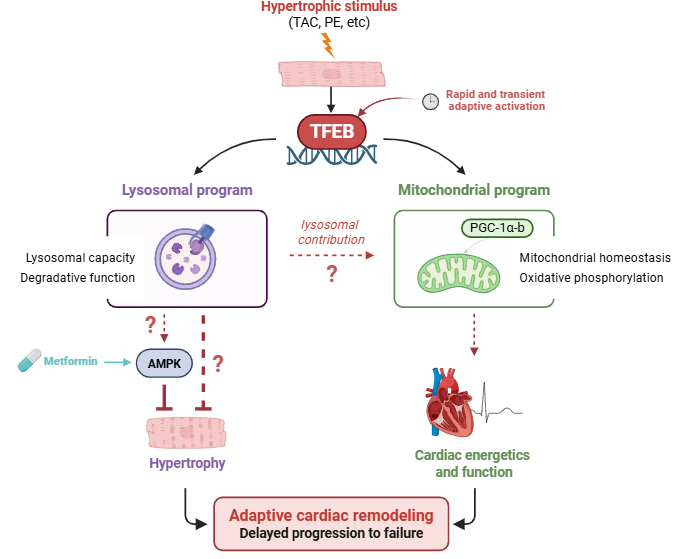
Figure 1. TFEB-mediated adaptation to hypertrophic stress. In response to hypertrophic stimuli, cardiomyocyte TFEB coordinates lysosomal and mitochondrial programs that contribute to limiting hypertrophic growth and preserving cardiac energetics and function. Dashed lines and question marks indicate potential mechanistic links between lysosomal function, AMPK signaling, mitochondrial homeostasis, and cardiac adaptation that remain unresolved and warrant further investigation. Created in BioRender. Santin Y (2026) https://BioRender.com/t8m2g29. TFEB: Transcription factor EB; TAC: transverse aortic constriction; PE: phenylephrine; AMPK: AMP-activated protein kinase; PGC-1α-b: peroxisome proliferator-activated receptor gamma coactivator 1-alpha-b.
The authors identified a previously unrecognized TFEB-AMPK axis, opening an interesting mechanistic avenue. While AMPK is known as a regulator of TFEB activity through a phosphorylation-dependent mechanism[4], the present study suggests a reciprocal relationship, as TFEB deletion markedly reduced AMPKα phosphorylation in TAC hearts. However, whether lysosomal dysfunction contributes to blunted AMPK activation in CTKO hearts remains to be determined, as does the potential involvement of additional AMPK-independent mechanisms in restraining hypertrophic growth. Indeed, the rescue achieved with metformin supports a role for AMPK in limiting hypertrophy, while its pleiotropic actions leave room for additional pathways linking TFEB/lysosome to metabolic adaptation and cardiac stress response[11]. For example, whether metformin modulates mitochondrial biogenesis and function in CTKO TFEB hearts after TAC has not been evaluated in the present study.
Another important discovery is that TFEB regulates mitochondrial function. Previous studies demonstrated direct transcriptional control of PGC-1α by TFEB[12], and Daou et al. identified selective regulation of the PGC-1α-b isoform, supporting a direct TFEB-driven mitochondrial program[10]. Alternatively, enhanced lysosomal function may preserve mitochondrial homeostasis by promoting autophagy/mitophagy and mitochondrial quality control[13]. These mechanisms, however, are not mutually exclusive and may act in concert to preserve mitochondrial function. One way to disentangle their respective contributions would be to improve lysosomal function independently of TFEB. Lysosome-acidifying nanoparticles, which directly restore lysosomal function and improve mitochondrial homeostasis[14], provide one example of such an approach. Comparing TFEB-independent lysosomal rescue with direct TFEB activation could therefore help define the relative contributions of lysosome-mediated and direct transcriptional mechanisms to mitochondrial protection.
Overall, these findings position TFEB as a compelling therapeutic target at the crossroads of several major adaptive pathways in the heart. By coordinating lysosomal, metabolic, and mitochondrial adaptation, TFEB offers the possibility of simultaneously enhancing multiple aspects of cardiac stress resilience. The growing repertoire of pharmacological strategies capable of enhancing TFEB activity, including natural compounds[15,16], cardiac glycosides[17], and synthetic small molecules[18], further strengthens its translational potential. However, TFEB activation must be finely tuned, as excessive overexpression can be detrimental. The magnitude, duration, and cellular context of TFEB may ultimately shape the adaptive programs engaged, emphasizing the need to tailor TFEB-targeting strategies to distinct pathological settings.
DECLARATIONS
Authors’ contributions
Made substantial contributions to conceptualization, supervision, writing - review and editing: Santin Y, Mialet-Perez J
Availability of data and materials
Not applicable.
AI and AI-assisted tools statement
Not applicable.
Financial support and sponsorship
This work was supported by the MITOCARD grant (Région Pays de la Loire, Angers-Loire Metropole and University of Angers).
Conflicts of interest
All authors declared that there are no conflicts of interest.
Ethical approval and consent to participate
Not applicable.
Consent for publication
Not applicable.
Copyright
© The Author(s) 2026
REFERENCES
1. Henning RH, Brundel BJJM. Proteostasis in cardiac health and disease. Nat Rev Cardiol. 2017;14:637-53.
2. Nakamura M, Sadoshima J. Mechanisms of physiological and pathological cardiac hypertrophy. Nat Rev Cardiol. 2018;15:387-407.
3. Settembre C, Perera RM. Lysosomes as coordinators of cellular catabolism, metabolic signalling and organ physiology. Nat Rev Mol Cell Biol. 2024;25:223-45.
4. Takla M, Keshri S, Rubinsztein DC. The post-translational regulation of transcription factor EB (TFEB) in health and disease. EMBO Rep. 2023;24:e57574.
5. Guan J, Mishra S, Qiu Y, et al. Lysosomal dysfunction and impaired autophagy underlie the pathogenesis of amyloidogenic light chain-mediated cardiotoxicity. EMBO Mol Med. 2014;6:1493-507.
6. Santin Y, Sicard P, Vigneron F, et al. Oxidative stress by monoamine oxidase-a impairs transcription factor EB activation and autophagosome clearance, leading to cardiomyocyte necrosis and heart failure. Antioxid Redox Signal. 2016;25:10-27.
7. Bartlett JJ, Trivedi PC, Yeung P, Kienesberger PC, Pulinilkunnil T. Doxorubicin impairs cardiomyocyte viability by suppressing transcription factor EB expression and disrupting autophagy. Biochem J. 2016;473:3769-89.
8. Song R, Lei H, Feng L, et al. TFEB insufficiency promotes cardiac hypertrophy by blocking autophagic degradation of GATA4. J Biol Chem. 2021;297:101189.
9. Wundersitz S, Pablo Tortola C, Schmidt S, et al. The transcription factor EB (TFEB) sensitizes the heart to chronic pressure overload. Int J Mol Sci. 2022;23:5943.
10. Daou D, Das Gupta S, Anand A, et al. TFEB antagonizes cardiac hypertrophy and failure by enhancing lysosomal capacity and mitochondrial function. Circ Res. 2026;139:e328083.
11. Foretz M, Guigas B, Viollet B. Metformin: update on mechanisms of action and repurposing potential. Nat Rev Endocrinol. 2023;19:460-76.
12. Settembre C, De Cegli R, Mansueto G, et al. TFEB controls cellular lipid metabolism through a starvation-induced autoregulatory loop. Nat Cell Biol. 2013;15:647-58.
13. Ravindran R, Gustafsson ÅB. Mitochondrial quality control in cardiomyocytes: safeguarding the heart against disease and ageing. Nat Rev Cardiol. 2025;22:798-813.
14. Santin Y, Formoso K, Haidar F, et al. Inhalation of acidic nanoparticles prevents doxorubicin cardiotoxicity through improvement of lysosomal function. Theranostics. 2023;13:5435-51.
15. Miceli C, Santin Y, Manzella N, et al. Oleuropein aglycone protects against MAO-A-induced autophagy impairment and cardiomyocyte death through activation of TFEB. Oxid Med Cell Longev. 2018;2018:8067592.
16. Jeong SJ, Stitham J, Evans TD, et al. Trehalose causes low-grade lysosomal stress to activate TFEB and the autophagy-lysosome biogenesis response. Autophagy. 2021;17:3740-52.
17. Wang C, Niederstrasser H, Douglas PM, et al. Small-molecule TFEB pathway agonists that ameliorate metabolic syndrome in mice and extend C. elegans lifespan. Nat Commun. 2017;8:2270.
Cite This Article
 Open Access
How to Cite
Santin Y, Mialet-Perez J. TFEB in cardiac stress adaptation: more than just lysosomes. J Cardiovasc Aging. 2026;6:48. https://dx.doi.org/10.20517/jca.2026.107
Download Citation
Export Citation File:
Type of Import
Tips on Downloading Citation
Citation Manager File Format
Type of Import
Direct Import: When the Direct Import option is selected (the default state), a dialogue box will give you the option to Save or Open the downloaded citation data. Choosing Open will either launch your citation manager or give you a choice of applications with which to use the metadata. The Save option saves the file locally for later use.
Indirect Import: When the Indirect Import option is selected, the metadata is displayed and may be copied and pasted as needed.
About This Article
Special Topic
Copyright

Data & Comments
Data
0







Comments
Comments must be written in English. Spam, offensive content, impersonation, and private information will not be permitted. If any comment is reported and identified as inappropriate content by OAE staff, the comment will be removed without notice. If you have any queries or need any help, please contact us at support@oaepublish.com.