

fig2
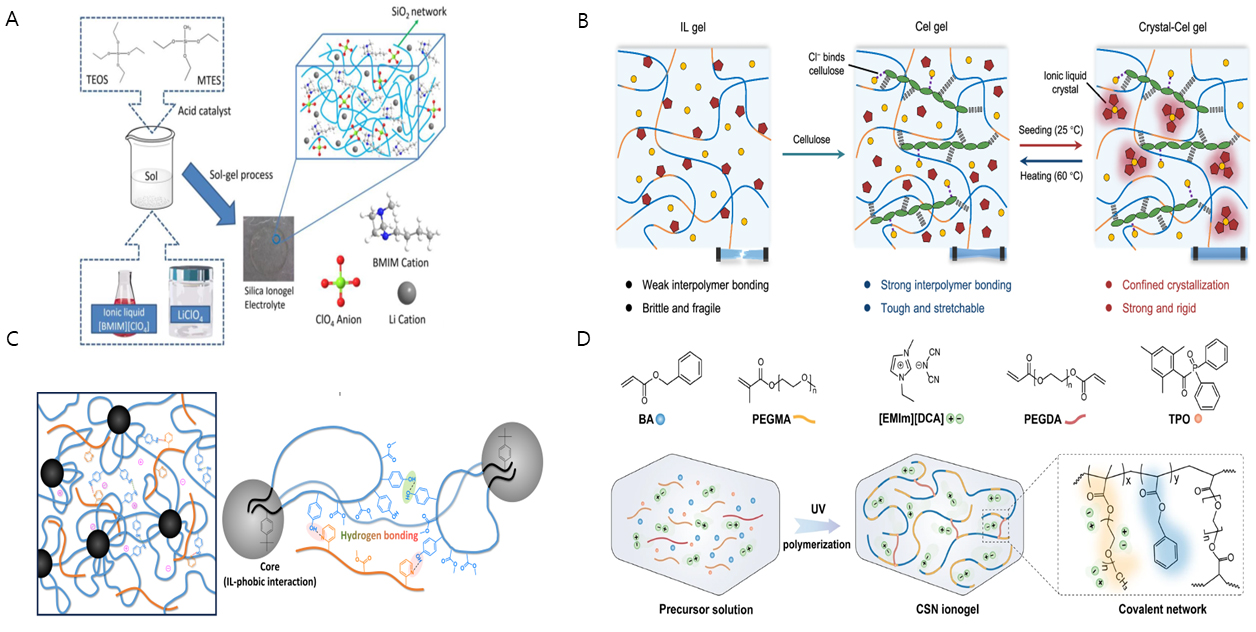
Figure 2. Illustrations of representative ionogel synthesis and formation strategies. (A) Sol-gel fabrication of a silica-based ionogel electrolyte, in which TEOS and MTES precursors form a SiO2 network that immobilizes the ionic liquid, LiClO4, and mobile ions within the gel matrix. (A) is reproduced from ref.[46], under the CC BY 4.0 license, without any modifications. (B) Cellulose-mediated reinforcement and reversible crystallization of an ionic-liquid-containing gel, where cellulose strengthens interpolymer interactions and controlled ionic-liquid crystallization enables reversible switching between soft and rigid gel states. (B) is reproduced as a cropped excerpt from ref.[74], under the CC BY-NC-ND 4.0 license; the depicted content was not altered; (C) Supramolecular ionogel formation through dual association involving IL-phobic micellar interactions, polymer bridging, and reversible hydrogen bonding between the constituent copolymers. (C) is reproduced as a cropped excerpt from ref.[80], under the CC BY-NC 3.0 Unported license; the depicted content was not altered; (D) UV-induced photopolymerization of an ionogel precursor containing BA, PEGMA, PEGDA, and [EMIM][DCA], resulting in a covalently cross-linked conductive and stretchable nanostructured (CSN) ionogel network. (D) is reproduced as a cropped excerpt from ref.[86], under the CC BY-NC-ND 4.0 license; the depicted content was not altered. IL: Ionic liquid; UV: ultraviolet; BA: benzyl acrylate; PEGMA: poly(ethylene glycol) methyl ether methacrylate; PEGDA: poly(ethylene glycol) diacrylate; [EMIM][DCA]: 1-ethyl-3-methylimidazolium dicyanamide; TEOS: tetraethyl orthosilicate; MTES: methyltriethoxysilane.