
fig5
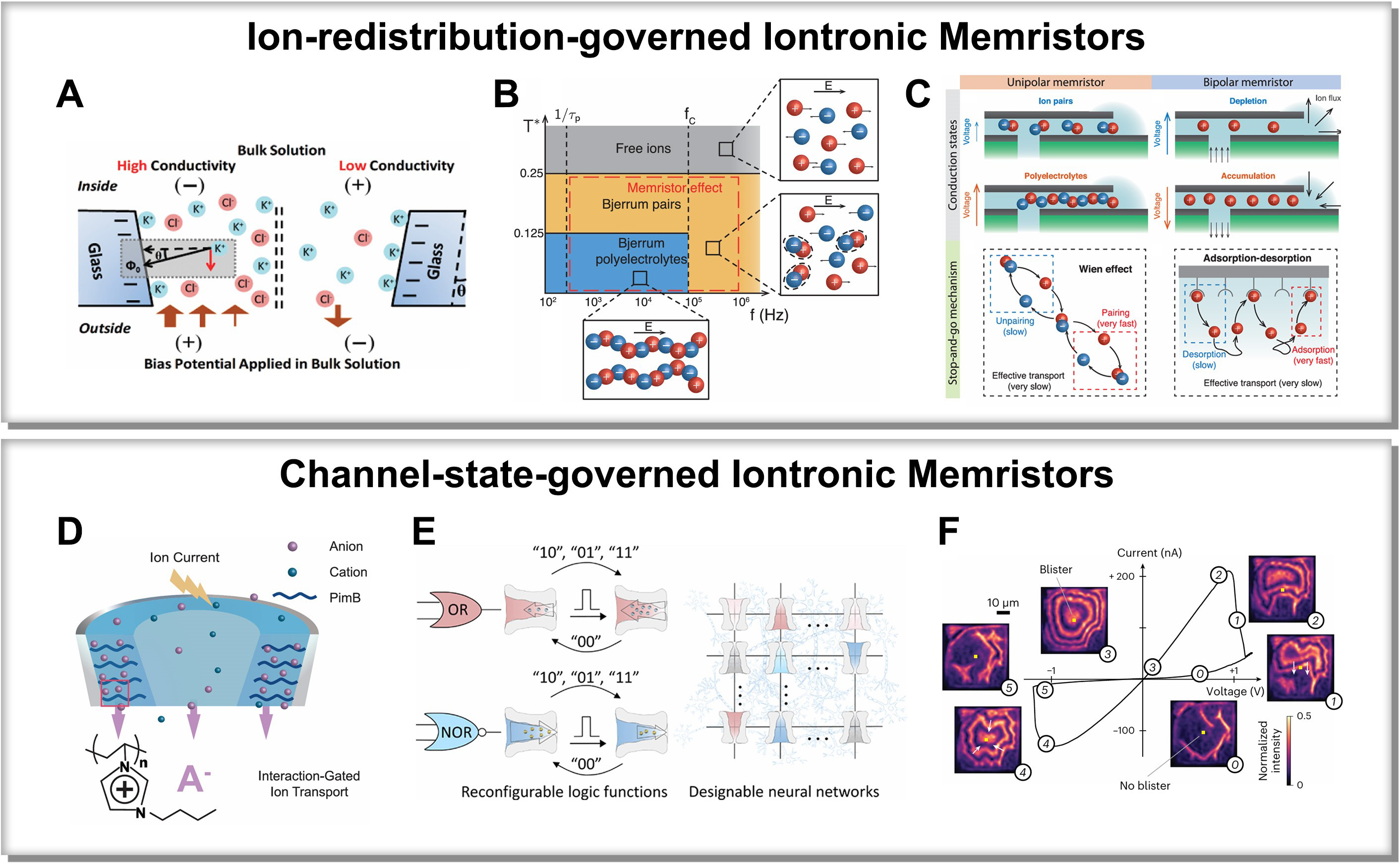
Figure 5. Iontronic memristors based on nanoconfined materials. (A) Memristive ion transport in a single conical SiO2 nanopore originates from bias-dependent ion redistribution. This figure is quoted with permission from the American Chemical Society[82]; (B) Angstrom-scale quasi-two-dimensional slits exhibit memristive behavior through confinement-enhanced ionic correlations. This figure is quoted with permission from the American Association for the Advancement of Science[23]; (C) Two-dimensional nanofluidic channels enable unipolar and bipolar iontronic memristors. This figure is quoted with permission from the American Association for the Advancement of Science[22]; (D) A polyelectrolyte-confined fluidic memristor shows hysteretic conductance and chemical-electric signal transduction. This figure is quoted with permission from the American Association for the Advancement of Science[76]; (E) A single-pore logic memristor achieves reconfigurable synaptic and logic functions through protonation/deprotonation-regulated ion transport. This figure is quoted with permission from the American Chemical Society[83]; (F) Mechano-ionic memristive switches in highly asymmetric channels enable fast switching and nanofluidic logic circuits. This figure is quoted with permission from Springer Nature[78].