
fig1
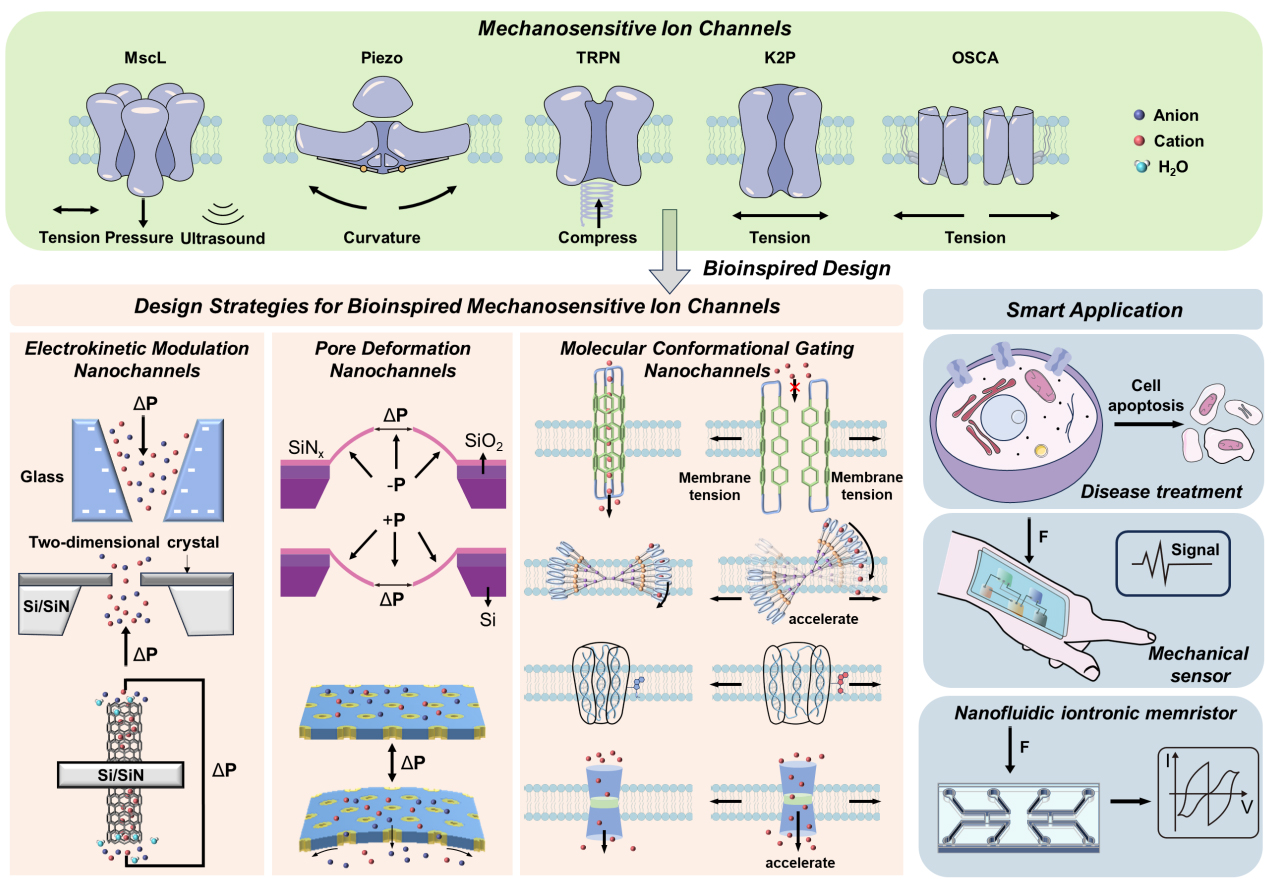
Figure 1. The design strategy of bioinspired mechanosensitive ion channels (BMSCs) and their applications. The green part contains the structures and response capabilities of the five family channels. The orange part contains the current strategies for constructing BMSCs. The electrokinetic modulators are mostly composed of glass, graphene, and carbon nanotubes. Reproduced with permission[11]. Copyright 2011 American Chemical Society. Pore/Channel deformation is typically constructed by exploiting SiN film or block-copolymer self-assembly to form well-defined nanochannels, and it responds to mechanical stimuli by changing the effective pore size. Reproduced with permission[15]. Copyright 2020, American Chemical Society. The molecular conformational gating nanochannels are mainly composed of amphiphilic molecules, butterfly-shaped molecules, six-helix-bundle DNA and pillar-shaped molecules, and mainly respond to membrane tension. Reproduced with permission[19]. Copyright 2025 Wiley-VCH. The blue part contains some applications of BMSC, including disease treatment, mechanical force sensors and nanofluidic iontronic memristors. MscL: Mechanosensitive channel of large conductance; TRPN: transient receptor potential channel, subfamily N; K2P: two-pore domain potassium; OSCA: osmosensitive calcium-permeable.