

fig4
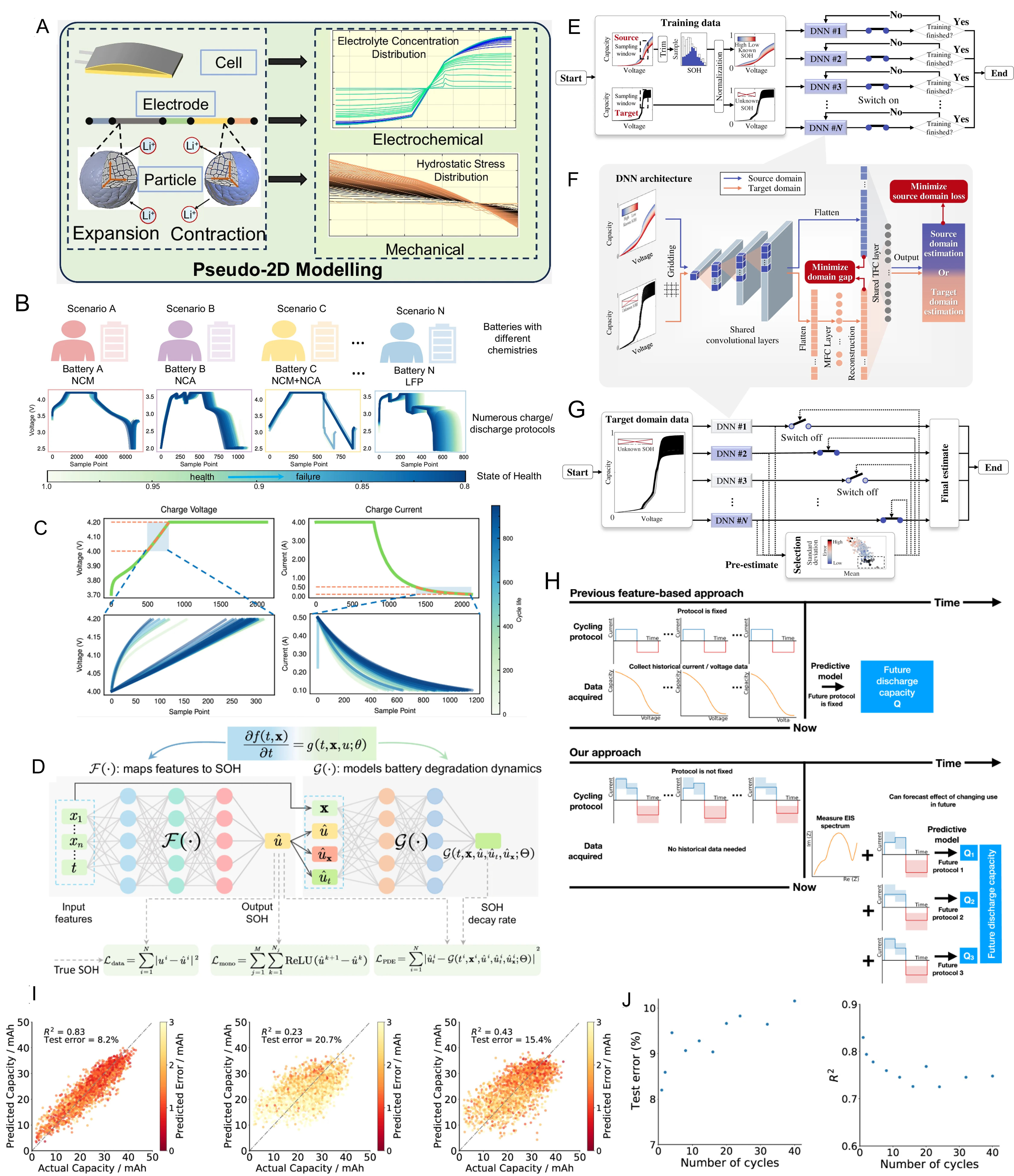
Figure 4. Physics-based models, hybrid learning, and uncertainty-aware inference. (A) Cross-scale electrochemical-mechanical modeling framework linking particle-scale strain, electrode-scale displacement, and cell-level voltage-strain response for high-fidelity battery twins. Figure 4A is reprinted with permission from Ref.[37]. Copyright © 2025 Springer Nature; (B) Chemistry and user-dependent degradation heterogeneity motivating physics-informed learning; (C) Short charging-window feature extraction for SOH estimation; (D) Physics-informed neural-network architecture for stable degradation modeling and SOH prognosis. Figure 4B-D is reprinted from Ref.[17], under the CC BY 4.0 license; (E) Training procedure for domain-adaptive SOH estimation; (F) DNN-swarm architecture for source-target transfer; (G) Estimation procedure without additional degradation experiments. Figure 4E-G is reprinted from Ref.[76], under the CC BY 4.0 license; (H) Impedance-based forecasting framework under variable future protocols; (I) State-action forecasting evidence showing the joint need for electrochemical impedance spectroscopy (EIS)-derived state and protocol action; (J) Multi-step forecasting performance under uneven usage. Figure 4H-J is reprinted from Ref.[55], under the CC BY 4.0 license. NCM: Lithium nickel-cobalt-manganate; NCA: lithium nickel-cobalt-aluminate; LFP: lithium iron phosphate; SOH: state of health; DNN: deep neural network; MFC: middle fully connected; TFC: terminal fully connected; EIS: electrochemical impedance spectroscopy.