

fig1
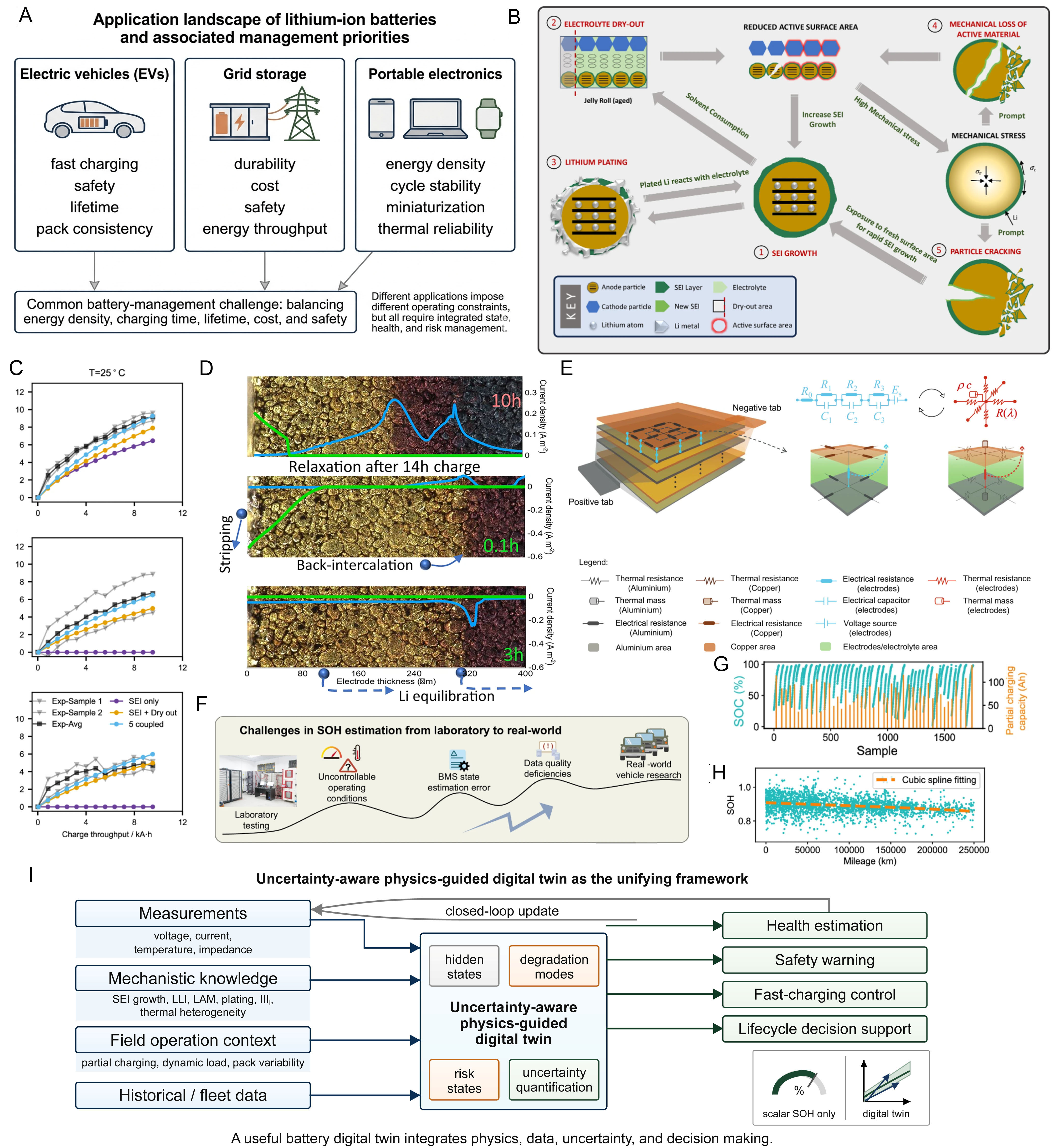
Figure 1. Shared physicochemical origins of health, safety, and fast charging. (A) Application landscape and management priorities for lithium-ion batteries; (B) Coupled degradation submodels, including SEI growth, electrolyte dry-out, lithium plating, active-material loss, and particle cracking; (C) Degradation-mode trajectories involving LLI, LAMNE, and LAMPE. Figure 1B and C are reprinted from Ref.[13], under the CC BY 4.0 license; (D) Phase-field prediction of lithiation/delithiation and plating/stripping current distributions during charge and relaxation. Figure 1D is reprinted from Ref.[14], under the CC BY 4.0 license; (E) Electrothermal network representation of a pouch cell under spatially resolved thermal gradients. Figure 1E is reprinted from Ref.[22], under the CC BY 4.0 license; (F) Real-world EV SOH estimation challenges; (G) Fragmented EV charging behavior; (H) Fleet-level SOH variability. Figure 1F-H is reprinted with permission from Ref.[12]. Copyright © 2025 Springer Nature; (I) Uncertainty-aware physics-guided digital twin as the unifying framework. SEI: Solid electrolyte interphase; LLI: lithium inventory loss; LAM: loss of active material; SOC: state of change; SOH: state of health; LAMNE: negative-electrode loss of active material; LAMPE: positive-electrode loss of active material; EV: electric vehicle.