

fig2
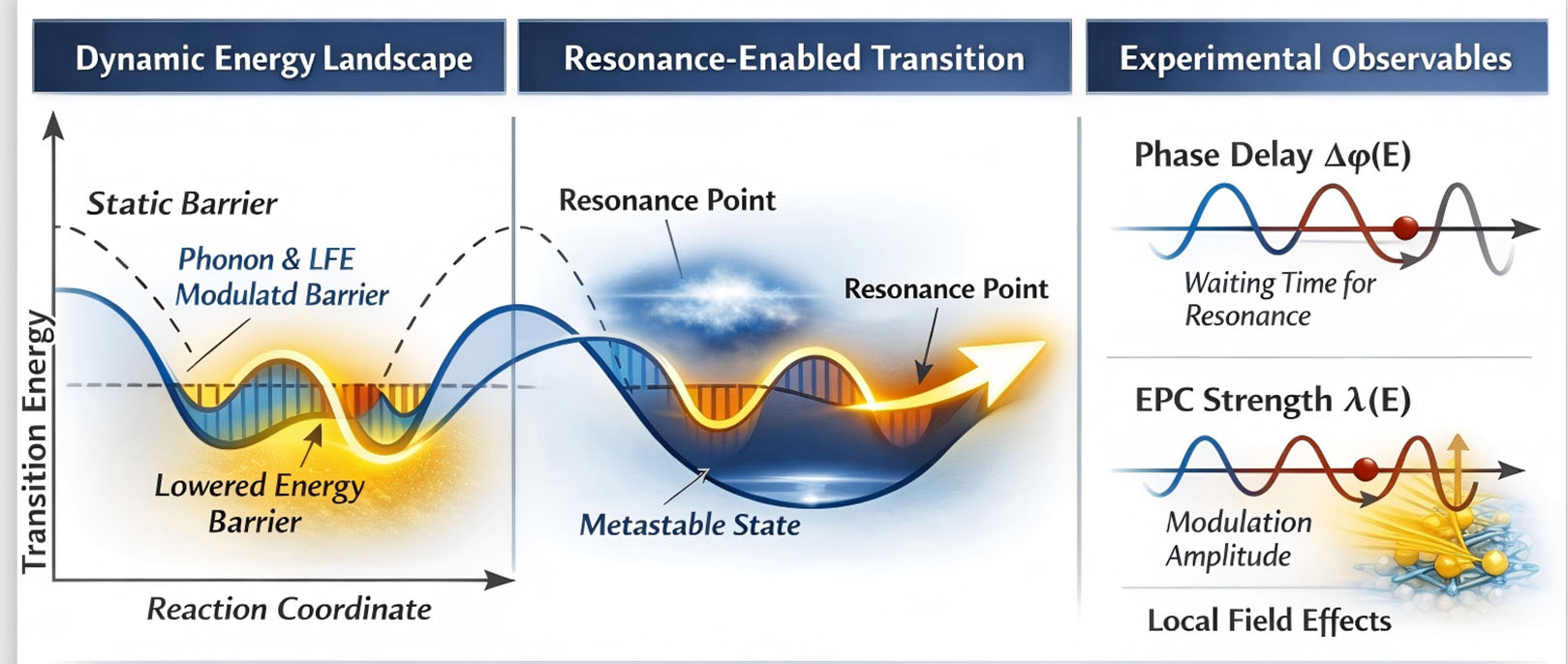
Figure 2. Minimal-energy resonance governs ultrafast carrier-lattice dynamics. Schematic illustration of the minimal-energy resonance transition principle underlying nonadiabatic carrier transport. Left: Coherent lattice motion and local field effects (LFEs) dynamically modulate the effective energy landscape, periodically lowering transition barriers relative to the static configuration. Center: Carriers remain trapped in metastable states and undergo transition only when lattice displacement and LFEs jointly satisfy a minimal-energy resonance condition, leading to a discrete, resonance-enabled transition rather than continuous adiabatic following. Right: Experimental observables associated with this process: the energy-dependent phase delay Δφ(E) reflects the waiting time for resonance alignment; the electron-phonon coupling strength λ(E) controls the amplitude of energy-landscape modulation; and LFEs provide spatial confinement and orbital selectivity that sharpen the resonance condition. Together, these elements establish minimal-energy resonance as the governing principle of ultrafast carrier-lattice dynamics beyond relaxation-limited or adiabatic descriptions.