

fig2
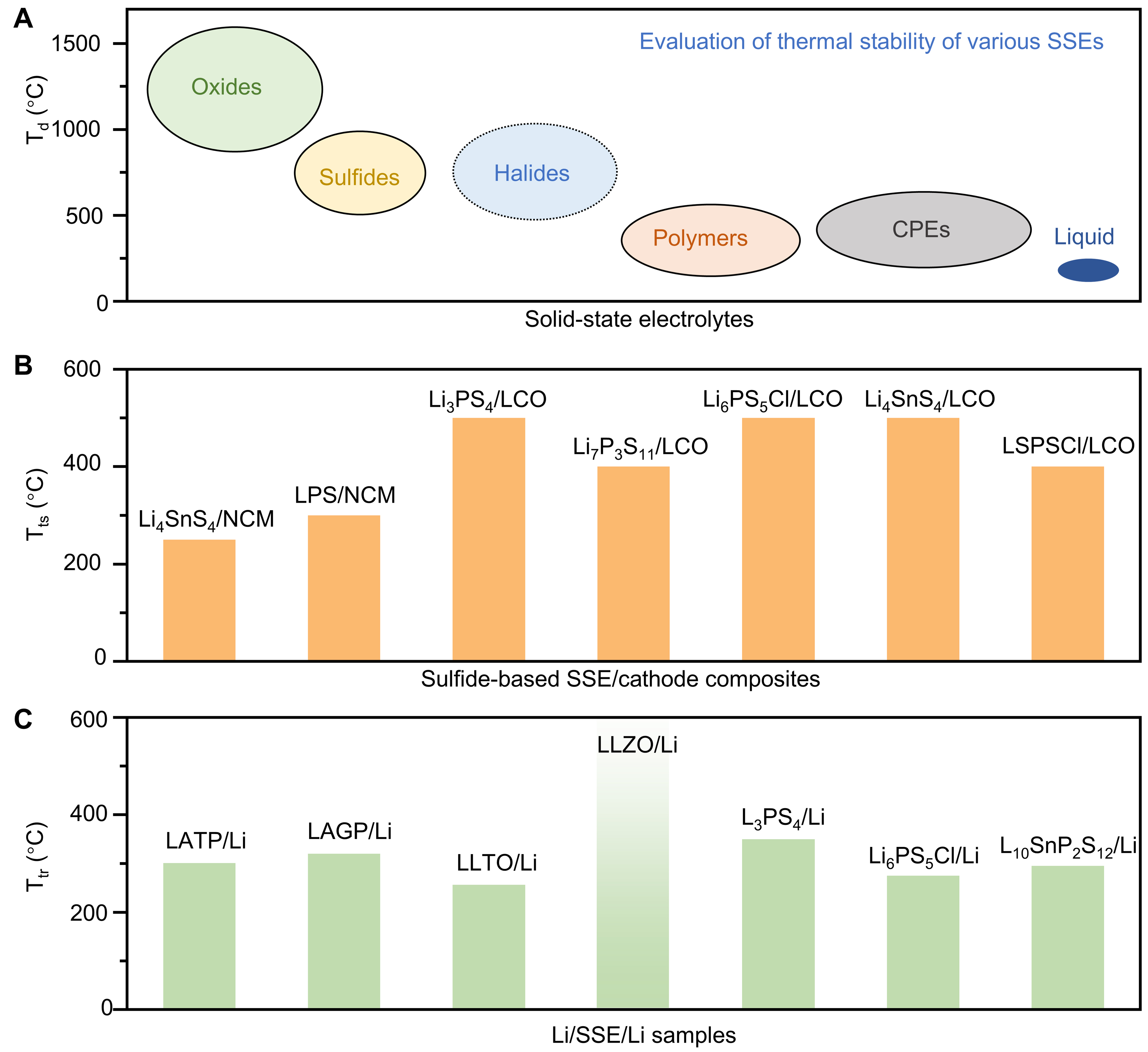
Figure 2. (A) Comparison of thermal stability among mainstream SSEs and LEs, in which Td refers to the decomposition temperature of the material based on experimental or calculated values. The Td values of halide-based SSEs are estimated from studies on their high-temperature performance and are therefore indicated by dashed circles. Adapted from Ref.[38] under a CC BY 4.0 license; (B) Summary of the thermal stability of representative sulfide-based SSE/CAM composites, indicated by the thermally stable temperature (Tts). Reproduced with permission based on data from Ref.[32,42,43]; (C) Summary of the thermal stability of representative Li/SSE/Li composites, indicated by the critical temperature of thermal runaway (Ttr; identified as T2 in ARC tests). Reproduced with permission based on data from Ref.[45,46]. SSEs: Solid-state electrolytes; LEs: liquid electrolytes; CAM: cathode active material; ARC: accelerating rate calorimeter; CPEs: composite polymer electrolytes; NCM: LiNixCoyMn1-x-yO2; LPS: 75Li2S·25P2S5; LCO: LiCoO2; LSPSCl: Li9.54Si1.74P1.44S11.7Cl0.3; LATP: Li1.4Al0.4Ti1.6(PO4)3; LAGP: Li1.5Al0.5Ge1.5(PO4)3; LLTO: Li3xLa2/3-xTiO3; LLZO: Li6.4La3Zr1.4Ta0.6O12.