

fig2
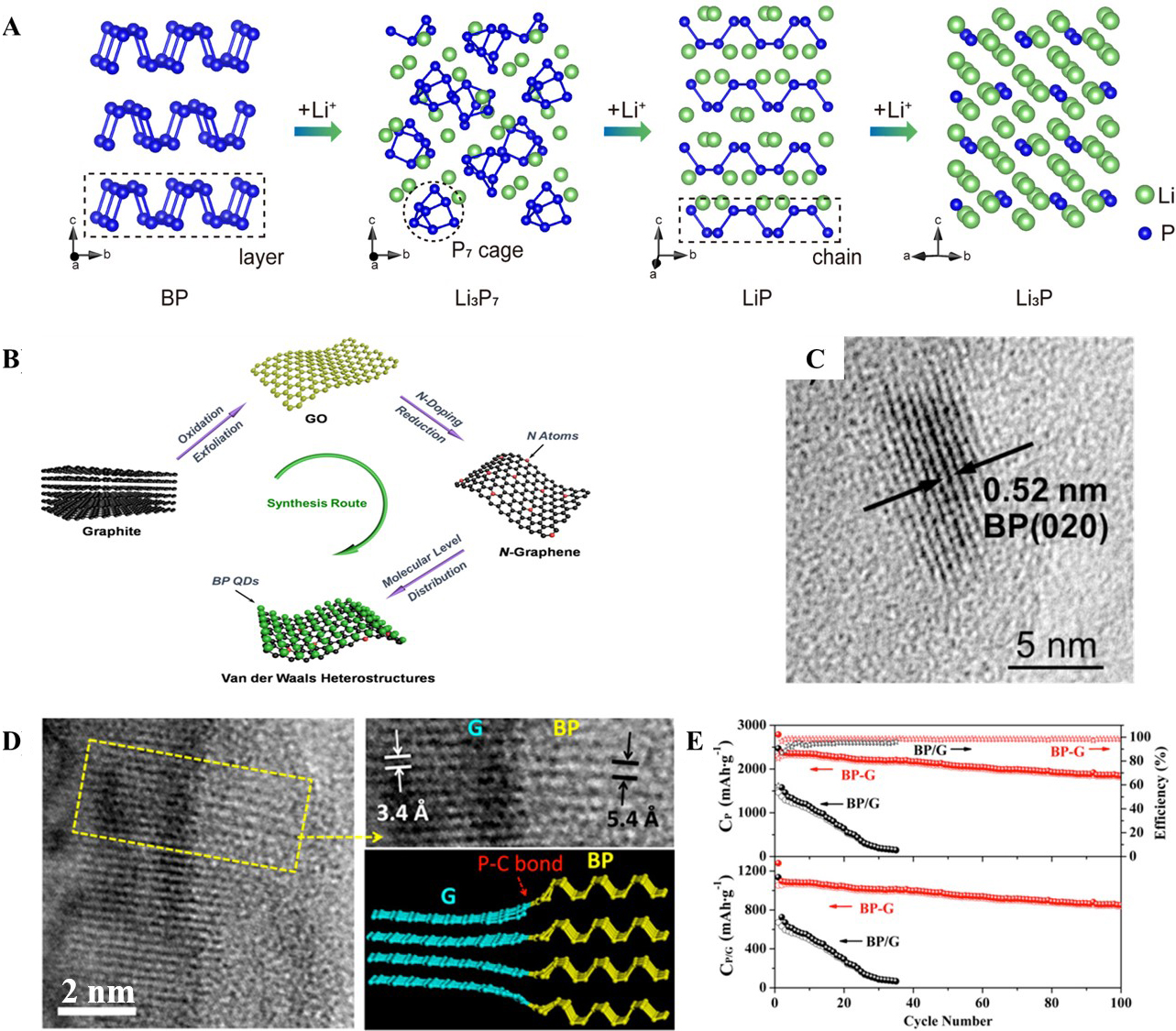
Figure 2. (A) Illustrations of layered BP, Li3P7 with P7 cages, LiP with helical chains, and Li3P with isolated P ions. Li and P atoms are shown by green and blue spheres, respectively, and the blue lines represent P-P bonds, adapted with permission from Ref.[56], copyright 2024, American Chemical Society; (B) Schematic illustration of the synthesis route for van der Waals heterostructures of BP QDs distributed on N-graphene nanosheets at the molecular level. (C) HRTEM image of BP QDs. (D) High-resolution TEM image alongside a schematic illustration of the BP-G composite. (E) The cycling behavior and Coulombic efficiency of BP/G and BP-G electrodes at 0.2 C. (B and C) are adapted with permission from Ref.[58], copyright 2016, Elsevier; (D and E) are adapted with permission from Ref.[27], copyright 2014, American Chemical Society.