


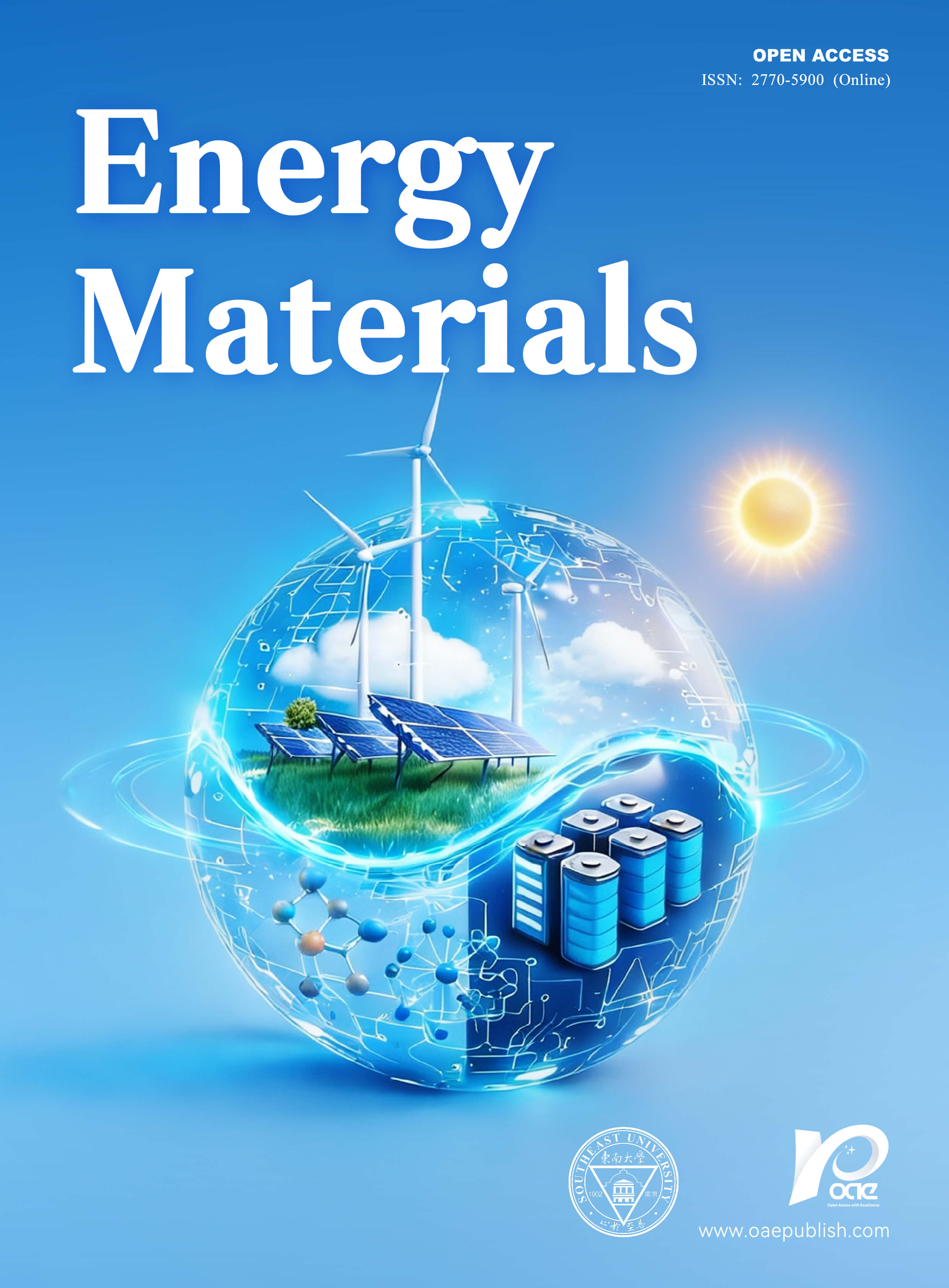
Hydrophobic modification regulates the water microenvironment at the interface of Cu-based materials to promote E-CO2RR
 0

Abstract
Electrocatalytic CO2 reduction (E-CO2RR) powered by renewable energy is vital for carbon cycling and carbon neutrality. Cu-based catalysts uniquely produce multi-carbon (C2+) products, yet the interfacial water microenvironment and reaction kinetics remain poorly understood. This work fabricates hydrophobic HY-Cu2O (100) catalysts by self-assembling octadecanethiol on cubic (100)-faced Cu2O nanoparticles to tune interfacial water. Integrated characterizations, electrochemistry, and in situ Attenuated Total Reflection Surface-Enhanced Infrared Absorption Spectroscopy (ATR-SEIRAS) reveal how hydrophobicity regulates E-CO2RR performance. Hydrophilic/hydrophobic contact-angle measurements reveal that the surface wetting angle changes from 46.1° (hydrophilic) to 133.5° (hydrophobic). X-ray diffraction (XRD) confirms that the crystal structure remains unchanged. X-ray photoelectron spectroscopy (XPS) results demonstrate that the Cu-S coordination environment of the material is modified. Further inference suggests that the formation of Cu-S bonds verifies the successful functional grafting of octadecyl chains onto the Cu2O (100) surface, which alters the surface hydrophilicity/hydrophobicity without inducing any variation in the crystal structure. In
Keywords
INTRODUCTION
The global energy system is accelerating its transition toward low-carbon, sustainable practices, driven primarily by the threat of climate change[1]. With continued growth in energy demand, the reduction and conversion of CO2 generated by the manufacturing sector have become critical issues requiring urgent attention[2]. Among existing carbon-neutral technology pathways, Electrocatalytic carbon dioxide reduction (E-CO2RR) has attracted the interest of researchers because of its ability to convert carbon dioxide into useful chemicals[3,4].
Early research primarily focused on the production of one-carbon products (C1, e.g., CO, HCOOH)[5-8]; however, their low energy density and high product-separation costs have limited their practical application. In contrast, multi-carbon products (C2+) such as C2H4 and CH3CH2OH are receiving increasing attention due to their higher energy density and economic value[9,10]. Among these, C2H4, as one of the world’s primary petrochemical feedstocks, holds an irreplaceable strategic position in the chemical industry. Among the numerous catalytic materials, Cu-based catalysts have attracted significant research attention.
To enhance the E-CO2RR performance of Cu-based catalysts, researchers have developed various surface modification strategies, such as alloying[11], forming protective layers[12], and ligand modification[13]. These methods influence the adsorption behavior and reaction pathways of key intermediates by regulating the electronic structure and exposure of active sites. Among them, ligand modification, as an effective surface engineering approach, not only enhances catalyst stability but also optimizes reaction selectivity by altering the surface microenvironment[14].
In recent years, regulation of the interfacial microenvironment has been a key strategy for improving E-CO2RR performance[15]. Researchers have found that constructing a nanoporous ion transport layer on the surface of Cu-based catalysts can create a localized alkaline microenvironment enriched with alkali metal cations. By leveraging the nanoconfinement effect, this approach significantly enhances the production efficiency of C2H4, further confirming the importance of microenvironment regulation in catalyst design. Building on this, in addition to the interfacial ionic microenvironment, the interfacial aqueous microenvironment may also significantly influence the E-CO2RR process.
E-CO2RR is a complex reaction that undergoes sequential proton-electron transfer events, with its reaction pathway predominantly determined by the combined action of interfacial water molecules and CO2 reactants. Reaction intermediates must acquire protons from water molecules to undergo further transformation; therefore, the structure and kinetic behavior of H2O at the catalytic interface have a decisive influence on the reaction[16]. Previous studies have shown that water molecules can form hydrogen-bond networks on the electrode surface, and alterations in hydrogen-bonding patterns can characterize changes in their local structure. The research team led by Jianfeng Li at Xiamen University has revealed an intrinsic correlation between interfacial water structure and Hydrogen Evolution Reaction (HER) activity, indicating that “free water” coordinated with metal cations can be directed to the catalyst surface under biased potentials and undergoes a reorganization from disordered to ordered states during the HER process[17,18].
Although there is consensus that the local microenvironment influences the performance of the E-CO2RR, existing studies have primarily focused on the structure of the catalyst matrix and the design of active sites. However, systematic research on the structure of water molecules at the electrode interface, the intrinsic relationship between their hydrogen-bond networks and the hydrophobic interface, and their dynamic interactions with key intermediates (such as *CO) remains lacking[19]. Based on this, this study constructed a HY-Cu2O (100) catalyst with a controllable interfacial water microenvironment by modifying the surface of Cu2O (100) nanoparticles with a hydrophobic long-chain alkane (octadecanethiol). We systematically investigated its impact on the electrochemical CO2 reduction performance and elucidated, at the mechanistic level, how the hydrophobic interface promotes the formation of C2+ products.
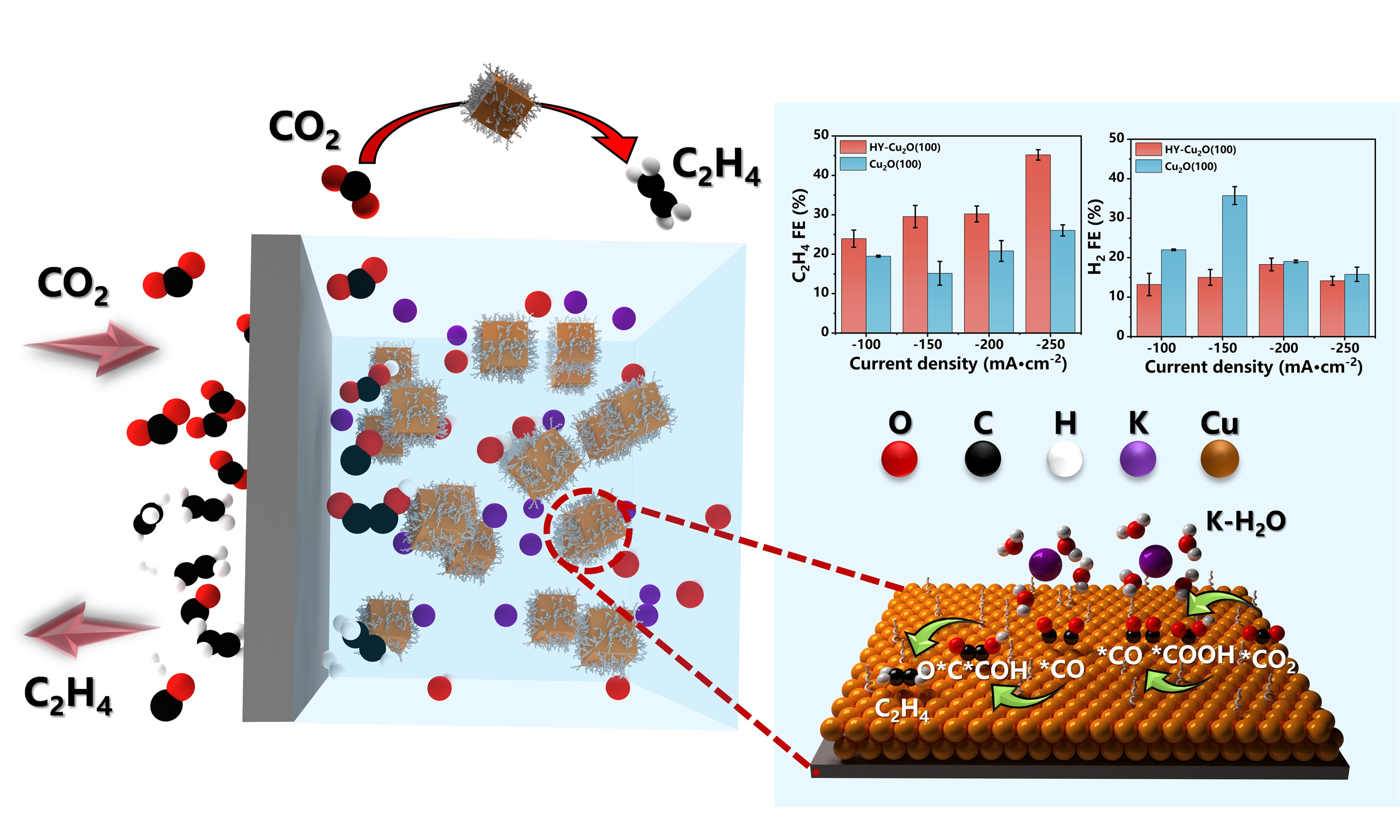
In this study, a hydrophobic alkyl layer was assembled on the Cu2O surface via thiol self-assembly, thereby realizing the transition from a hydrophilic interface to a hydrophobic interface. Various characterization techniques confirmed the uniform coverage of alkyl chains and the formation of Cu-S bonds. This modification not only enhances CO2 interfacial mass transfer but also effectively suppresses the HER, creating favorable conditions for the highly selective production of C2H4. Electrochemical performance tests indicate that the modified HY-Cu2O (100) achieves a C2H4 Faradaic efficiency of 45.2% at a current density of -250 mA cm-2, which was superior to the 26.0% observed for the unmodified sample. The C2H4 partial current density is markedly enhanced, while the H2 partial current is effectively suppressed, demonstrating the synergistic effect of the hydrophobic modification in improving both reaction rate and selectivity. In situ Attenuated Total Reflection Surface-Enhanced Infrared Absorption Spectroscopy (ATR-SEIRAS) analysis revealed the microscopic mechanism behind this performance enhancement: hydrophobic interface-enriched “free water” (K∙H2O) coordinated with K+, rather than “ice-like water” bound by strong hydrogen bonds. This change in the interfacial water structure weakens the hydrogen bonding between water molecules, thereby accelerating the interaction between free water and *CO. This effectively promotes the *CO hydrogenation process, which, in turn, drives its coupling with *CHO, ultimately yielding a key intermediate for C2H4 synthesis. Concurrently, the modified surface exhibits higher *CO coverage and stronger adsorption capacity, which, from a kinetic perspective, confirms its promotional effect on C-C coupling. This study developed an effective surface hydrophobic modification strategy and, through in situ spectroscopic analysis, clarified the key role of interfacial water microenvironment regulation in C2+ product selectivity, providing new insights for the design of high-performance CO2 reduction catalysts.
EXPERIMENTAL
Synthesis of Cu2O (100) nanoparticles
Taking the synthesis of Cu2O (100) nanoparticles (NPs) as an example[20]. Add 90 mL of ultrapure water to a round-bottom flask, then add 10 mL of 0.1 mol/L CuCl2 solution dropwise. After stirring thoroughly (at
Synthesis of HY-Cu2O (100) NPs
Using synthesized Cu2O (100) nanoparticles, long-chain hydrophobic alkane groups were introduced onto their surfaces, yielding HY-Cu2O (100) NPs. The specific synthesis procedure is as follows: The catalyst was immersed in a solution of 10 mM octadecanethiol in argon-saturated CH3CH2OH for 15 min in a 60 °C water bath to perform thiol treatment via self-assembly. Continuous argon flushing was maintained throughout the immersion process to ensure the desired results. The electrode was then repeatedly rinsed with anhydrous ethanol to remove excess octadecanethiol and air-dried.
RESULTS AND DISCUSSION
Synthesis and characterization
To investigate the effect of the water microenvironment at the electrode interface on the performance of CO2 electroreduction, we selected widely studied cubic Cu2O nanoparticles [Figure 1] as a model catalyst[21-23], designated as Cu2O (100), which exhibits hydrophilic surface properties. The synthesis procedure for this catalyst is shown in Figure 1. To enhance the hydrophobicity of the catalyst, we surface-modified Cu2O (100) with octadecanethiol mercaptan, and the resulting sample was named HY-Cu2O (100). The modification process was carried out under heated conditions: the pristine Cu2O nanoparticles were immersed in a CH3CH2OH solution containing octadecanethiol mercaptan (structural formula shown in Figure 1) and stirred continuously. During heating, sulfur atoms formed stable coordination bonds with copper atoms; furthermore, due to the low steric hindrance of the linear alkane chain, the self-assembly process was more efficient. This confirms the existence of chemical interactions between the S atom at the terminal end of the octadecanethiol molecule and the Cu atoms on the catalyst surface.
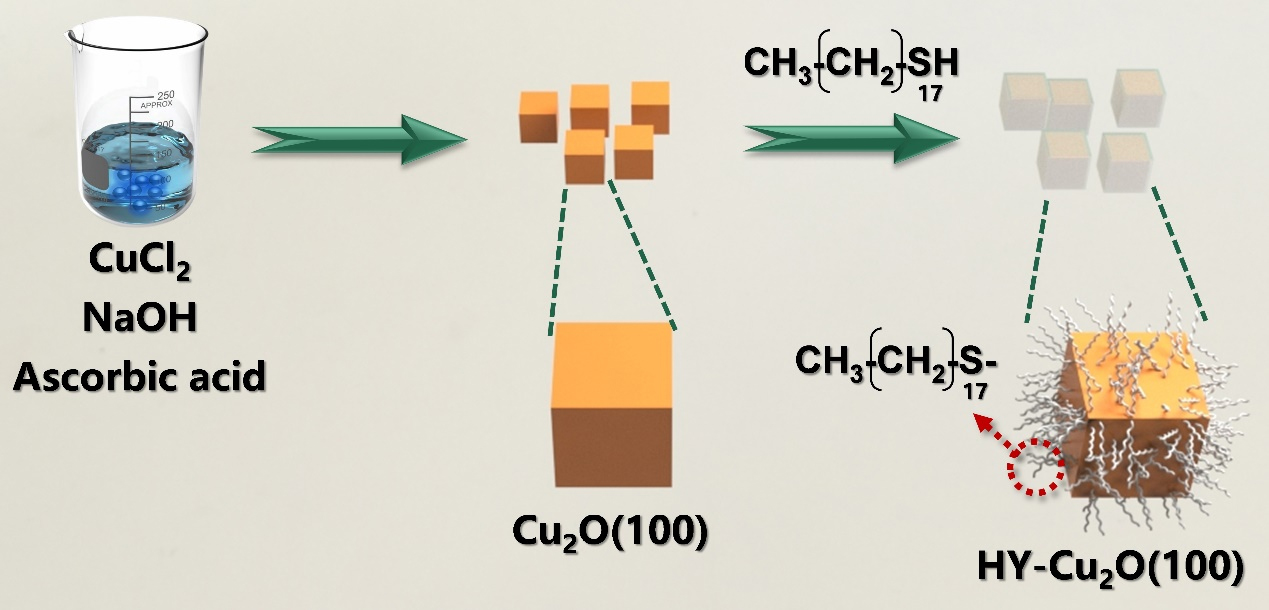
Figure 1. Schematic diagram of the synthesis of Cu2O (100) and HY-Cu2O (100).
As shown in Figure 2, the cubic Cu2O nanoparticles fully expose their (100) crystal faces. The Cu2O (100) surface is relatively smooth. In contrast, the surface of HY-Cu2O (100) shows a degree of roughness and a visible coating, indicating that the material has been successfully modified with long-chain alkanes. At the same magnification, the image clarity of Cu2O (100) [Figure 2A-C] is higher than that of HY-Cu2O (100) [Figure 2D-F], indicating that thiol modification lowers the electrical conductivity of the catalyst material.
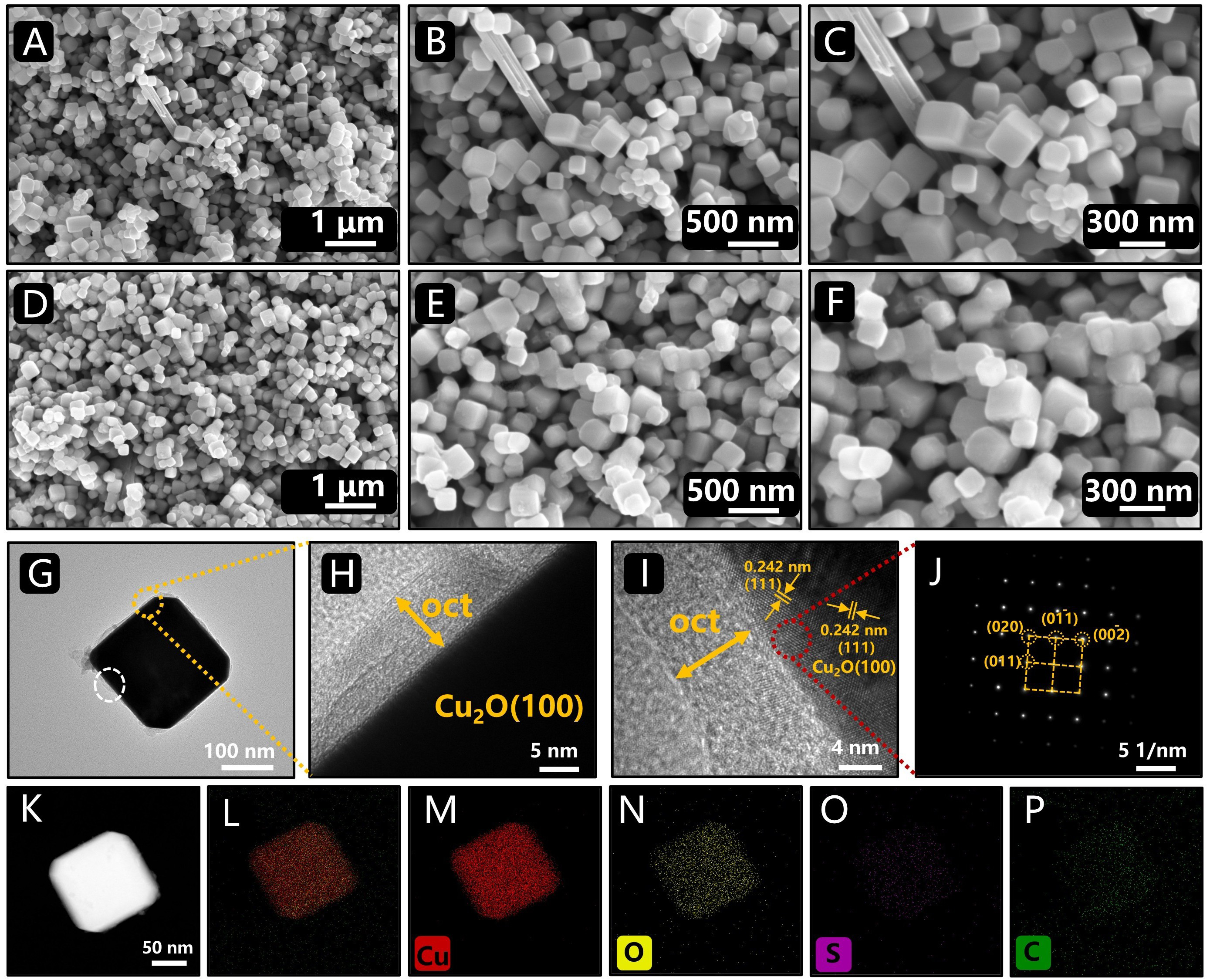
Figure 2. Morphological characterization of the samples. SEM images of Cu2O (100) at different magnifications (A-C): scale bars are 1 μm (A), 500 nm (B), and 300 nm (C); SEM images of HY-Cu2O (100) at different magnifications (D-F): scale bars are 1 μm (D), 500 nm (E), and 300 nm (F); TEM image of HY-Cu2O (100) (G); HRTEM images (H and I) show enlarged views of the yellow and white boxed regions in (G), respectively; SAED pattern of HY-Cu2O (100) (J); HAADF-STEM image (K); EDS spectrum map (L); elemental EDS maps for Cu, O, S, and C (M-P), all with a 50 nm scale bar. TEM: Transmission electron microscopy; EDS: energy-dispersive X-ray spectroscopy; HAADF: high-angle annular dark-field; SEM: scanning electron microscopy; HRTEM: high-resolution transmission electron microscopy; SAED: selected-area electron diffraction; STEM: scanning transmission electron microscopy.
Selective Energy-Dispersive X-ray Spectroscopy (EDS) analysis of Cu2O (100) and HY-Cu2O (100) revealed [Supplementary Figure 1] that sulfur was detected in HY-Cu2O (100) but not in Cu2O (100); Additionally, the carbon content on the surface of HY-Cu2O (100) was higher than that of Cu2O (100), further confirming the successful modification with hydrophobic long-chain alkanes. Since both samples were sputtered with Au before testing, Au signals were present in the EDS spectra of both samples. Under the same conditions, the Cu content in HY-Cu2O (100) was lower than that in Cu2O (100), which is attributed to the surface of HY-Cu2O (100) being covered by saturated long-chain alkanes.
Transmission Electron Microscopy (TEM) results [Figure 2G] show that the prepared HY-Cu2O (100) nanostructures are intact, with a particle size of approximately 300 nm, and retain a cubic morphology without significant changes. Figure 2H and I shows that the hydrophobic long-chain alkanes uniformly coat the Cu2O (100) surface, forming an amorphous structure, which also accounts for the increased surface roughness.
Selective-area electron diffraction [Figure 2J] of HY-Cu2O (100) was performed from the direction shown in Figure 2I. The diffraction spots formed a regular two-dimensional lattice pattern, with no polycrystalline rings or diffuse spots observed, indicating that these Cu2O nanoparticles have a single-crystal structure. The square arrangement of the spots further confirms their cubic crystal system. The High-Resolution Transmission Electron Microscopy (HRTEM) image [Figure 2I] reveals an interplanar spacing of 0.242 nm, corresponding to the (111) plane of Cu2O. HAADF-STEM and EDS analysis [Figure 2K-P] show that S and C elements are uniformly distributed on the Cu2O outer layer.
Infrared spectroscopy further confirmed the successful modification of the saturated long-chain alkane layer [Figure 3A-C]. The spectrum of HY-Cu2O (100) exhibits characteristic peaks at 2,917 cm-1 and 2,849 cm-1, whereas Cu2O (100) shows no such peaks at these wavelengths; the literature indicates that these peaks correspond to the antisymmetric and symmetric stretching vibrations of the -CH2 group, and a peak corresponding to C-C stretching vibrations (1,468 cm-1) is also observed. This confirms the presence of long-chain alkanes on the HY-Cu2O (100) surface (as shown in Figure 3A)[24].
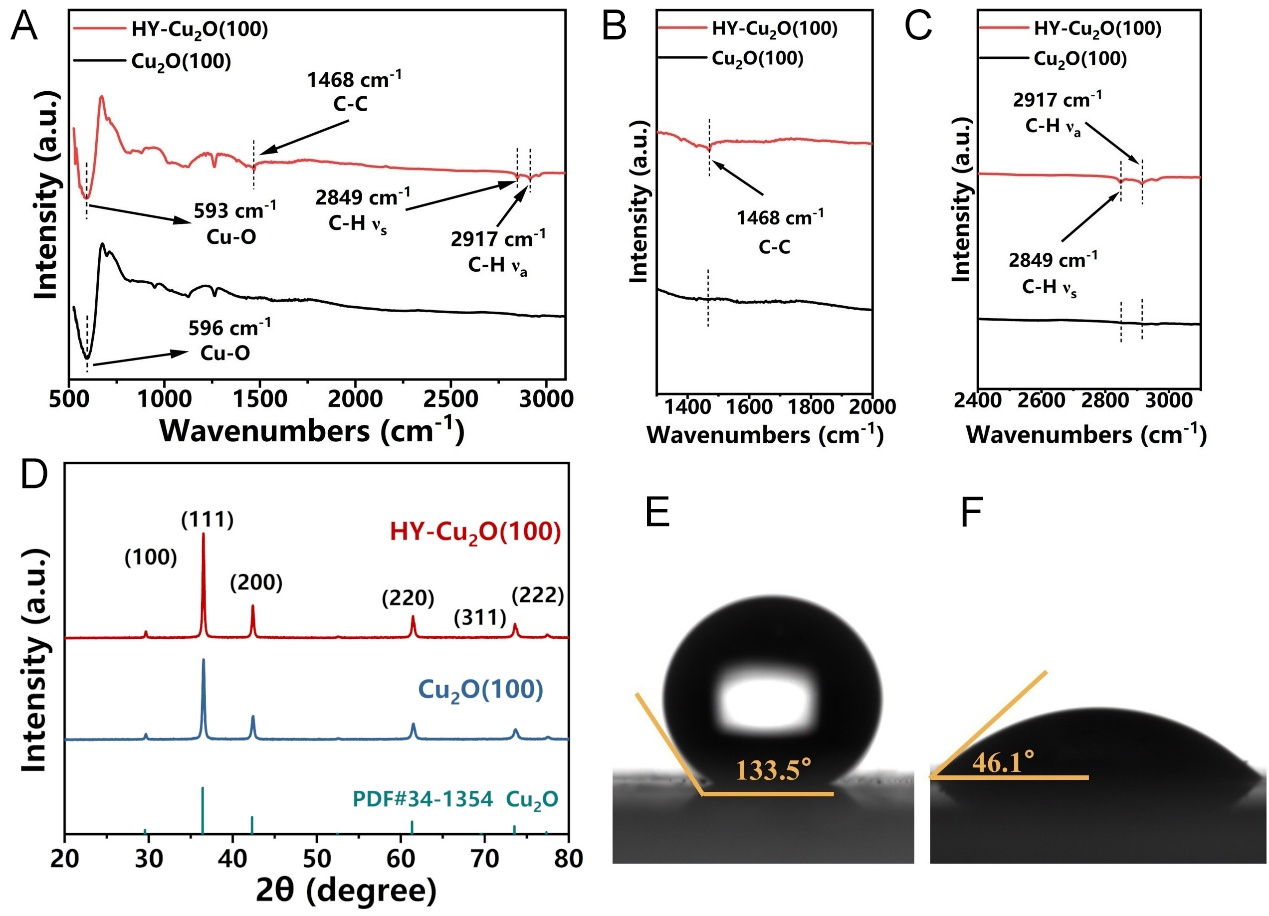
Figure 3. (A) ATR-FTIR spectra of Cu2O (100) and HY-Cu2O (100); Local ATR-FTIR spectra of (B and C) Cu2O (100) and HY-Cu2O (100); (D) XRD patterns of Cu2O (100) and HY-Cu2O (100); (E and F) Experimental optical images of the hydrophilic and hydrophobic properties of Cu2O (100) and HY-Cu2O (100). XRD: X-ray diffraction; ATR-FTIR: attenuated total reflectance Fourier-transform infrared spectroscopy.
The X-ray Diffraction (XRD) pattern [Figure 3D] shows that both samples exhibit the strongest diffraction peak at 36.5°, corresponding to the Cu2O (111) crystal plane, consistent with the HRTEM analysis [Figure 2I]. The subtle differences in the XRD patterns indicate that the crystal structure of HY-Cu2O (100) remains consistent with that of Cu2O (100), suggesting that the long-chain alkane modification primarily affects the surface properties of the material rather than its crystalline phase composition. Hydrophobicity test results [Figure 3E and F] show that Cu2O (100) exhibits hydrophilic properties (contact angle of 46.1°), whereas HY-Cu2O (100) exhibits enhanced hydrophobicity (contact angle of 133.5°). The increased hydrophobicity of the catalyst surface plays a crucial role in promoting the effective diffusion of reactant gases during the electrochemical reduction of CO2.
X-ray Photoelectron Spectroscopy (XPS) characterization was used to verify the surface elemental chemistry of the prepared catalyst [Figure 4]. As shown in Supplementary Figure 2, Cu, O, and C were detected in the full XPS spectra of both HY-Cu2O (100) and Cu2O (100), whereas S was detected only in HY-Cu2O (100), suggesting that Cu-S bonds may have formed on its surface. The full-scan range was 0-1,250 eV.
Figure 4. XPS spectra of Cu2O (100) and HY-Cu2O (100). (A) Cu 2p spectrum of HY-Cu2O (100); (B) Cu 2p spectrum of Cu2O (100); (C) O 1s spectrum of HY-Cu2O (100); (D) O 1s spectrum of Cu2O (100); (E) S 2p spectrum of HY-Cu2O (100); (F) S 2p spectrum of Cu2O (100); AES of different samples: (G) Cu LMM spectrum of Cu2O (100); (H) Cu LMM spectrum of HY-Cu2O (100); (I) C 1s spectrum of HY-Cu2O (100). XPS: X-ray photoelectron spectroscopy; AES: Auger electron spectroscopy; LMM: L-shell M-shell M-shell auger transition.
The S 2p fine-line spectrum [Figure 4E and F] shows that HY-Cu2O (100) exhibits distinct characteristic peaks at 162.3 eV and 163.4 eV, attributed to S 2p3/2 and S 2p1/2, respectively, corresponding to the formation of Cu-S bonds. In contrast, no S signals were detected in Cu2O (100)[25,26]. Combining Infrared Spectroscopy (IR) spectroscopy and XPS data, it can be clearly confirmed that the Cu2O (100) surface has been successfully functionalized with octadecanethiol chains.
In the O 1s spectrum [Figure 4C and D], the characteristic peaks at 530.6 eV and 530.3 eV are attributed to lattice oxygen, while the peaks at 532.2 eV and 531.6 eV correspond to adsorbed oxygen[27,28]. The ratio of lattice oxygen to adsorbed oxygen in HY-Cu2O (100) is significantly higher than that in Cu2O (100). This is not due to a decrease in the absolute amount of adsorbed oxygen, but rather stems from the formation of a Cu-S coordination protective layer by thiol molecules with surface Cu atoms, which effectively passivates surface defect sites prone to oxygen loss, thereby suppressing the loss of lattice oxygen and increasing the relative signal intensity of lattice oxygen. This phenomenon reflects microstructural changes in the
Electrochemical testing and CO2 reduction performance
To reveal how hydrophobic long alkane chain modification regulates the electrochemistry of Cu-based catalysts, cyclic voltammetry measurements in an H-type cell and CO2 electroreduction evaluations in a flow cell were carried out for bare Cu2O (100) and hydrophobically modified HY-Cu2O (100) [Figure 5].
Figure 5. Electrochemical performance of Cu2O (100) and HY-Cu2O (100) in 1 M KOH. CV curves of (A and C) Cu2O (100) and (B and D) HY-Cu2O (100) in Ar and CO2 atmospheres; Electrocatalytic CO2 reduction performance of Cu2O (100) and HY-Cu2O (100) in 1 M KOH; (E) Faradaic efficiency (FE) of C2H4 for Cu2O (100) and HY-Cu2O (100); (F) FE of H2 for Cu2O (100) and HY-Cu2O (100); (G and H) FE distributions for all gaseous products of Cu2O (100) and HY-Cu2O (100); (I) C2H4 current density for Cu2O (100) and HY-Cu2O (100); (J) H2 current density for Cu2O (100) and HY-Cu2O (100); (K) C2H4 yield for Cu2O (100) and HY-Cu2O (100); (L) H2 yield for Cu2O (100) and HY-Cu2O (100). [For all electrochemical performance curves, the error bars represent the standard deviation from at least three independent tests (n = 3)]. RHE: Reversible hydrogen electrode; CV: cyclic voltammetry.
By comparing the Cyclic Voltammetry (CV) curves of the two catalysts in Ar and CO2 atmospheres [Figure 5A and B], we found that in the potential range from 0 to -0.5 V [vs. Reversible Hydrogen Electrode (RHE)], the response curve under CO2 atmosphere was closer to that under Ar atmosphere. The multiple redox peaks observed in the figure are attributed to the interconversion of copper ions in different oxidation states. At the same time, the presence of CO2 inhibits the reversible redox process observed in argon. As shown in Figure 5C and D, in the low-potential range, the absolute value of the cathodic current density of HY-Cu2O (100) in the CO2 atmosphere exceeds
Figure 5E further confirms that hydrophobic modification increases the C2H4 yield. In constant-current testing, the C2H4 yield [Faradaic Efficiency (FE) (C2H4)] of HY-Cu2O (100) increased gradually with current density, peaking at 45.2% at -250 mA cm-2, outperforming the yield of Cu2O (100) (26.0%). Compared with relevant studies on hydrophobicity, this study demonstrates superior performance in current control, catalyst selection, and selectivity for the multi-carbon product ethylene [Supplementary Table 1]. The difference between the two was particularly pronounced in the -150 to -250 mA cm-2. Significant C2H4 production was detected at all four current densities, indicating that this potential range satisfies the kinetic requirements for the C-C coupling reaction.
At the same time, the hydrophobic modification effectively suppressed HER [Figure 5F]. At all tested current densities, the FE(H2) of HY-Cu2O (100) was lower than that of Cu2O (100), with the greatest difference observed at -150 mA cm-2. This phenomenon indicates that thiol modification effectively suppressed the competitive hydrogen-evolution pathway while enhancing selectivity for C2H4. Furthermore, the distribution of other CO2 reduction products on the modified catalyst also changed [Figure 5G and H]: the CO production efficiency of HY-Cu2O (100) increased markedly. Still, it then gradually decreased with increasing current density, contrary to the trend observed for C2H4. This phenomenon suggests that more surface-adsorbed *CO intermediates participate in the C-C coupling pathway, thereby reducing the proportion that desorbs to form CO.
In terms of partial current densities [Figure 5I and J], the C2H4 partial current of HY-Cu2O (100) is higher than that of Cu2O (100), while the H2 partial current is effectively suppressed. At the same catalyst loading, the C2H4 yield of HY-Cu2O (100) was increased [Figure 5K], while the H2 yield correspondingly decreased [Figure 5L], further confirming the synergistic effect of hydrophobic modification in enhancing the selectivity and activity of CO2 electroreduction. Meanwhile, stability tests [Supplementary Figures 3 and 4] demonstrated that hydrophobic modification also improves the stability of CO2 electroreduction.
Electrochemical impedance spectroscopy (EIS) was further employed to investigate how the surface modification with thiol molecules alters the charge transfer resistance (Rct) of the Cu2O (100) electrode [Figure 6A-F]. The amplitude of the arc in the high-frequency region of the measured data reflects the magnitude of the interfacial transfer resistance. It is generally accepted that a smaller arc indicates a lower Rct and, consequently, a lower reaction resistance at the electrochemical interface[24,29-32]. The increased charge transfer resistance of HY-Cu2O compared to pure Cu2O at high potentials (less negative potentials) is primarily due to the hydrophobic nature of the octadecanethiol mercaptan modification. This long-chain alkane layer acts as an insulating barrier on the electrode surface, which hinders the transport of electrolyte ions to the active sites and impedes electron transfer. We performed circuit fitting on the impedance data obtained at the open-circuit potential (OCP) and at 0.55 V vs. RHE, with the results shown in Figure 6A, B, D and E. The fitted circuit resembles the classic electrochemical interfacial transfer circuit, including solution resistance (Rs), constant phase element (CPE), Rct, and warburg element (W).
Figure 6. Nyquist plots of Cu2O (100) and HY-Cu2O (100) collected at different potentials (A-F): EIS spectra recorded at open-circuit potential (OCP; Z ranges of 0-50 kΩ and 0-10 kΩ, respectively) (A and D); EIS spectra at 0.55 V vs. reversible hydrogen electrode (RHE); Z ranges of 0-50 kΩ and 0-10 kΩ, respectively (B and E); EIS spectrum at 0.35 V vs. RHE (Z range of 0-0.1 kΩ) (C); EIS spectrum at 0.15 V vs. RHE (Z range of 0-0.1 kΩ) (F). Electrochemical performance of Cu2O (100) and HY-Cu2O (100) measured in 0.1 mol L-1 Na2SO4 electrolyte: Cyclic voltammetry curves of Cu2O (100) under Ar atmosphere (G); Cyclic voltammetry curves of HY-Cu2O (100) under Ar atmosphere (H); Double-layer capacitance values of Cu2O (100) and HY-Cu2O (100) (I). EIS: Electrochemical impedance spectroscopy; CV: cyclic voltammetry; CPE: constant phase element; W: Warburg element; Rs: solution resistance; Rct: charge transfer resistance.
At the OCP point [Figure 6A and D], HY-Cu2O (100) exhibited a slightly larger arc radius than Cu2O (100) in the high-frequency region, which implies that the Rct value of HY-Cu2O (100) was higher than that of Cu2O (100); however, when the potential was reduced to 0.55 V (relative to RHE) [Figure 6B and E], the Rct value of HY-Cu2O (100) was comparable to that of Cu2O (100); When the potential was further reduced to 0.35 V and 0.15 V (vs. RHE) [Figure 6C and F], HY-Cu2O (100) exhibited a slightly smaller arc radius than Cu2O (100) in the high-frequency region; it can be concluded that at these two potentials, the interfacial resistance of HY-Cu2O (100) is lower than that of Cu2O (100). Comparing the gradual decrease in potential reveals that the arc radius of HY-Cu2O (100) gradually decreases, indicating that during the E-CO2RR reaction, the reaction kinetics of HY-Cu2O (100) gradually accelerate as the potential decreases, suggesting that the catalytic activity of HY-Cu2O (100) is more readily enhanced.
To evaluate the electrochemically active surface area (ECASA) of these catalysts, we measured the double-layer capacitance in the non-Faradaic region of the catalysts [Figure 6G-I][29]. The results show that the cyclic voltammogram of Cu2O (100) exhibits a rugby-ball shape [Figure 6G], indicating certain capacitive properties; in contrast, the curve for HY-Cu2O (100) is relatively flat [Figure 6H]. In Figure 6I, the double-layer capacitance (Cdl) value of HY-Cu2O (100) is 28.0 μF cm-2, which is lower than the 71.5 μF cm-2 value for Cu2O (100). The long alkyl chain modification of the Cu-based catalyst increased the hydrophobicity of HY-Cu2O (100), reducing the extent of contact between the catalyst surface and the liquid-phase electrolyte; this also explains the lower Cdl value. Since ECASA shows a positive correlation with Cdl, the ECASA of HY-Cu2O (100) is also lower than that of Cu2O (100)[30]. This is a direct consequence of the hydrophobic octadecanethiol mercaptan layer. This long-chain alkane modification renders the surface hydrophobic, reducing its wettability and thus decreasing the effective contact area with the aqueous electrolyte.
In situ characterization and mechanism analysis
In situ infrared spectroscopy was used to investigate the mechanism by which hydrophobic long-chain alkanes act as intermediates in the electrocatalytic reduction of carbon dioxide. The adsorption behavior and evolution of intermediates on the surfaces of HY-Cu2O (100) and Cu2O (100) during the electrocatalytic reduction of carbon dioxide were monitored[31,32].
According to existing research, the O-H stretching vibrations of water molecules in the 3,600-3,000 cm-1 range can be broadly classified into three categories: “ice-like water” (4HB-H2O) at 3,250 cm-1 with four hydrogen bonds; “asymmetric hydrogen-bonded water” (asymmetric HB-H2O) at approximately 3,450 cm-1 with one to three hydrogen bonds; and “cationic water” (K∙H2O) at 3,610 cm-1 that does not form hydrogen bonds, which in this system specifically refers to water molecules coordinated with K+. It is also called “isolated water”[33]. This spectral region is highly sensitive to hydrogen-bonding structures; a negative shift in potential typically enhances hydrogen-bonding interactions, leading to a red shift of the spectral peak.
In situ IR spectra recorded in a CO2 atmosphere [Figure 7A and B] show that as the potential becomes more negative, the K∙H2O content at the HY-Cu2O (100) interface increases, whereas no obvious changes are observed at the Cu2O (100) interface. At the same time, the increase in 4HB-H2O and asymmetric HB-H2O at the Cu2O (100) interface was much higher than that at the HY-Cu2O (100) interface. This indicates that hydrophobic modification effectively regulates the water structure at the electrode-electrolyte interface, promoting the enrichment of K∙H2O. Furthermore, we observed a red shift in the interface water spectral peaks as the potential became more negative, which is attributed to the Vibrational Stark Effect (VSE), a shift in molecular vibrational energy levels under the influence of an external electric field. The more negative the potential, the higher the electron density on the electrode surface; this increases the transfer of lone pair electrons from oxygen in water molecules to the electrode surface, leading to a reduction in the O-H bond order and a decrease in the vibrational frequency, thereby causing the red shift[34]. Test results under an Ar atmosphere [Figure 7C and D] further demonstrate that even in the absence of CO2, the K∙H2O content at the HY-Cu2O (100) interface remains higher than that at the Cu2O (100) interface, and its trend is consistent with that observed under a CO2 atmosphere. This indicates that the regulatory effect of the hydrophobic chains on the interfacial water structure is independent of the atmosphere, further validating their modification effect.
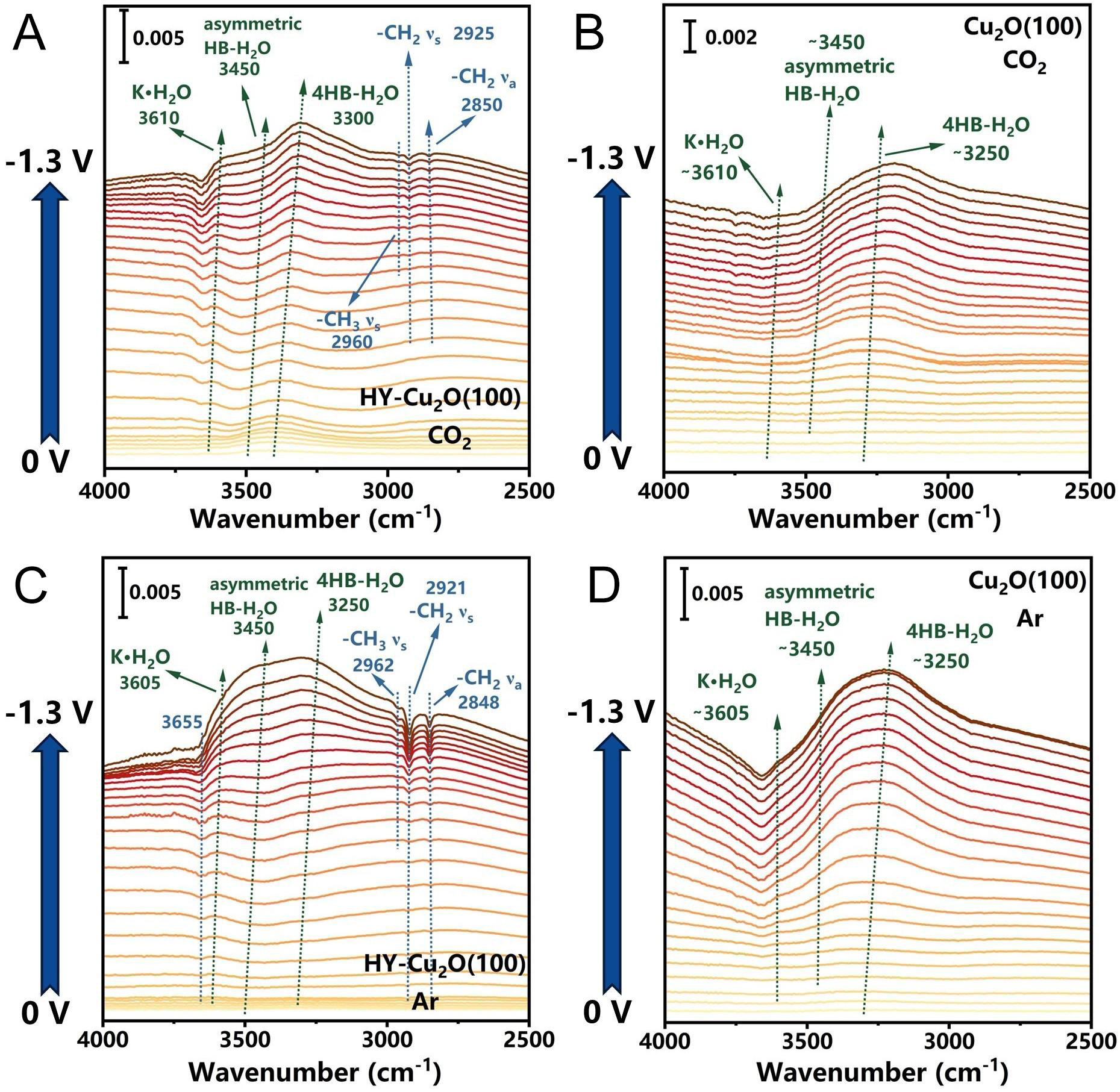
Figure 7. (A and C) HY-Cu2O (100) and (B and D) Cu2O (100) under different applied potentials: (A and B) CO2 atmosphere; (C and D) Ar atmosphere. All spectra were recorded over 4,000 cm-1 to 2,500 cm-1 using in situ ATR-SEIRAS. ATR-SEIRAS: Attenuated total reflection surface-enhanced infrared absorption spectroscopy.
It is worth noting that during the in situ ATR-SEIRAS measurements [Figure 7A and C], we also detected characteristic peaks of the -CH2 antisymmetric/symmetric stretching vibrations and the -CH3 antisymmetric stretching vibration at 2,925 cm-1, 2,850 cm-1, and 2,960 cm-1, respectively, further confirming the presence of long-chain alkanes on the HY-Cu2O (100) surface (The shift in the position corresponding to the ATR-FTIR spectrum in Figure 3 is due to differences in testing conditions, specifically the absence of electrolyte and the application of an external bias). These peaks were more pronounced in an Ar atmosphere than in a CO2 atmosphere, possibly because CO2-reduction intermediates occupy active surface sites, disrupting the ordered arrangement and orientation of the alkyl chains and partially masking their infrared signals.
Figure 8A-F shows the in situ ATR-SEIRAS spectra of HY-Cu2O (100) and Cu2O (100) under different applied potentials. The peak near 1,608 cm-1 in Figure 8B is assigned to the O-H bending vibration mode (δH2O) of water molecules at the electrode interface, and this characteristic feature is observable in all four sets of spectra[34,35]. Under the inert Ar atmosphere [Figure 8A], the bending vibration peak of interfacial water on hydrophobic HY-Cu2O appears at 1,661 cm-1, which is significantly higher than that at 1,613 cm-1 on hydrophilic Cu2O, indicating the formation of a more ordered hydrogen-bond network on the hydrophobic surface[35]. The characteristic signals of the key intermediates *CO, *COO-, *CHO, and O*C*CHO were detected in Figure 8B and E, whereas no corresponding signals appeared in Figure 8A and D, confirming the presence of these intermediates during the CO2 reduction process. The positive peak at approximately
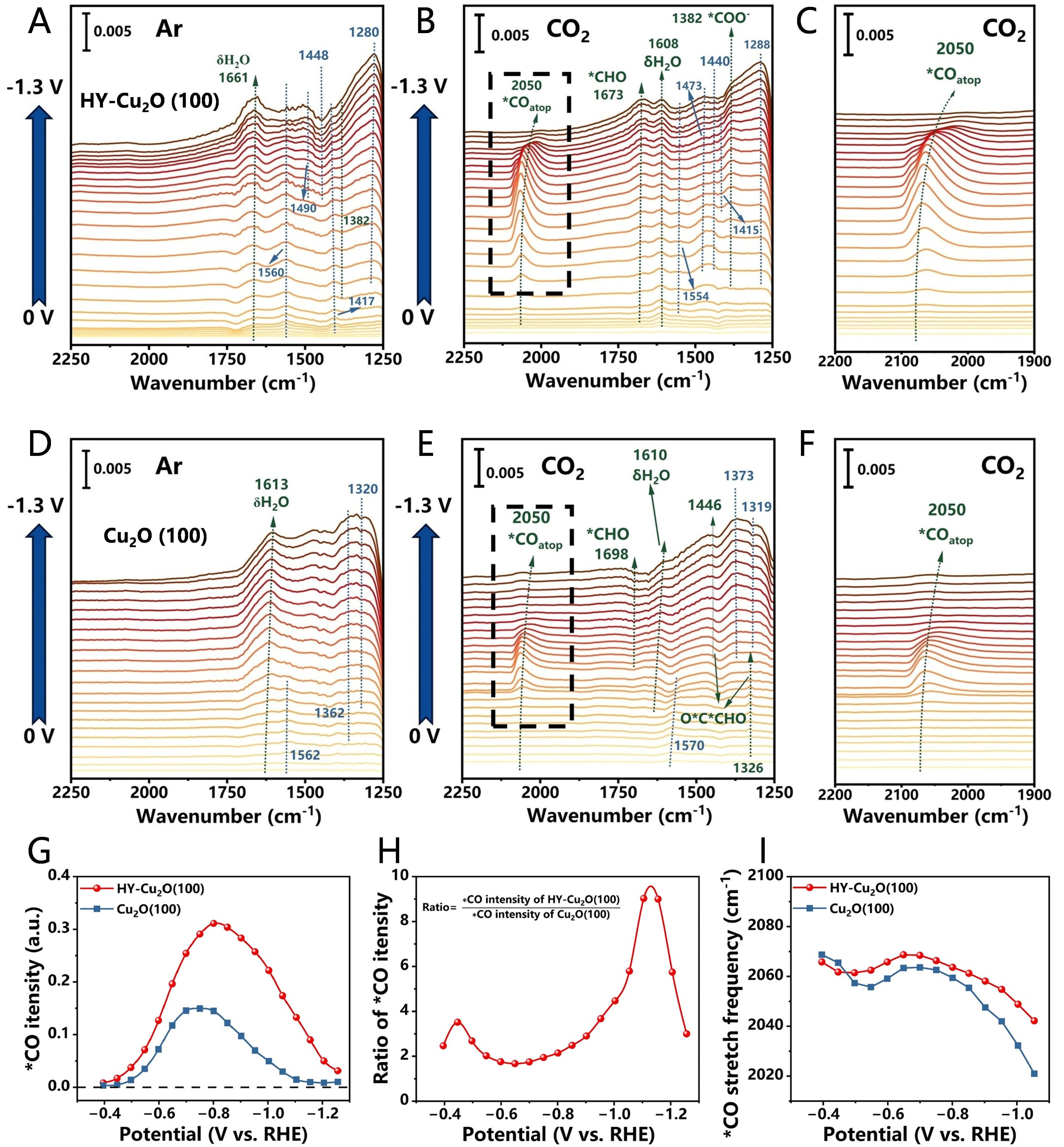
Figure 8. In situ ATR-SEIRAS spectra of HY-Cu2O (100) (A-C) and Cu2O (100) (D-F) collected at different applied potentials: under Ar atmosphere (A and D) and CO2 atmosphere (B and E), all spectra were recorded over the range of 2,250-1,250 cm-1. Electrochemical in situ infrared spectra of *CO adsorption intermediates on (C) HY-Cu2O (100) and (F) Cu2O (100) electrodes at different applied potentials; Peak area of surface *CO on the electrode at different applied potentials (G), peak area intensity ratio of *CO (H), and stretching vibrational frequency of *CO (cm-1) (I). ATR-SEIRAS: Attenuated total reflection surface-enhanced infrared absorption spectroscopy; RHE: reversible hydrogen electrode.
The positive peak observed in the 2,100-2,000 cm-1 range [Figure 8C and F] was identified as the top-site adsorption species of CO (*COatop), which is formed by the further reduction of *COOH. The position of this spectral band shifts toward the red or blue as the potential becomes more negative, a phenomenon attributable to the VSE[37]. *COatop can be hydrogenated to form *CHO (1,673 cm-1), which is considered a key intermediate in the CH4 formation pathway. However, based on the E-CO2RR test results discussed earlier, the FE (CH4) values for both Cu2O (100) and HY-Cu2O (100) are extremely low. Therefore, *CHO does not primarily convert to methane; instead, it participates in other reaction pathways. Given the high energy barrier for *CO dimerization on the surface, it is generally accepted in the literature that *CO couples with *CHO to form O*C*CHO (1,446 cm-1 and 1,326 cm-1) [Figure 8E][38,39], which serves as an important precursor for the formation of C2H4 and other C2+ products.
Combining this with electrocatalytic performance data, the trends in K∙H2O content and C2H4 production efficiency as a function of potential are similar, suggesting a possible correlation between the two. Based on the preceding discussion, we propose the following hypothesis: if the content of 4HB-H2O and asymmetric HB-H2O at the interface is high, *CO will be less likely to interact with isolated water molecules, which will hinder its protonation; conversely, if the concentration of K∙H2O at the interface is high, the hydrogen bonding between water molecules is weakened, which is more conducive to the hydrogenation of *CO, thereby promoting subsequent C-C coupling. That is, K∙H2O plays a key role in facilitating the conversion of CO2 to C2H4.
The catalysts used in the electrochemical tests were all modified with Nafion (via ultrasonic mixing) to leverage its binding and mass-transfer properties. Because Nafion contains organic functional groups such as sulfonic acid (-SO3H), C-F, and C-C bonds, it exhibits distinct absorption peaks in the infrared spectrum[40]. By comparing the test results under the two atmospheres, we can effectively distinguish the characteristic peaks of the adsorbed intermediates (marked in green in Figure 8) from other background signals (marked in blue).
The formation of C2+ products is closely related to the local *COatop coverage. Under the same test conditions, the *COatop signal intensity of HY-Cu2O (100) was higher than that of Cu2O (100) [Figure 8C and F], indicating that it can more effectively stabilize the *COatop intermediate and promote the C-C coupling reaction[41-43]. As shown in Figure 8G, the peak area of the *COatop signal for both catalysts first increases and then decreases with potential, but the peak for HY-Cu2O (100) appears at a more negative potential. Taking HY-Cu2O (100) as an example, its *COatop peak area continued to increase up to -0.81 V (relative to RHE); as shown in Figure 8G, at the same potential, the integrated *COatop peak area on the HY-Cu2O (100) surface was greater than that on the Cu2O (100) surface. This indicates that the surface CO coverage increases in tandem and reaches a maximum at this potential, demonstrating that hydrophobic modification enhances the adsorption capacity of the *CO intermediate. This high local coverage of *CO is a prerequisite for the subsequent C-C coupling step. At more negative potentials, the peak area gradually decreases as *COatop is consumed by hydrogenation and C-C coupling reactions.
In the range of -0.4 V to -1.26 V (vs. RHE), the peak area of *COatop on HY-Cu2O (100) consistently exceeds that on Cu2O (100) [Figure 8G and H], and the intensity ratio remains greater than 1 throughout this range [Figure 8H], particularly in the range of -1.0 V to -1.26 V. Combined with electrochemical performance data, this potential range corresponds precisely to the critical region where C-C coupling occurs. Higher *COatop coverage, together with optimized K∙H2O supply, jointly promotes *COatop conversion, thereby enhancing its hydrogenation and coupling reactions with *CHO.
In the range of -0.45 V to -1.05 V (vs. RHE), the vibrational wavenumbers of CO adsorbed atop the HY-Cu2O(100) surface (*COatop) are generally higher than those on Cu2O(100). As shown in Figure 8C and F, no characteristic signals of bridge-site adsorbed CO were observed when species other than the top-site adsorbed *COatop were excluded, ruling out peak position differences caused by changes in adsorption configuration. Two distinct Stark-shifted regions were observed in Figure 8I, with a critical point at -0.7 V
Theoretical calculation and analysis
To elucidate the underlying mechanism by which hydrophobic modification enhances the ethylene production efficiency on Cu2O (100) electrodes, clarify the regulatory role of the K∙H2O species in a hydrophobic environment, and reveal its reaction pathway, this study employed density functional theory (DFT) to conduct theoretical calculations[44], comparing and analyzing the 4HB-H2O, asymmetric HB-H2O, and K∙H2O - on the Cu2O (100) surface. These calculations not only systematically reveal the formation mechanisms of ethylene and C2+ products on the Cu2O (100) surface but also clarify the key role of K∙H2O in the electroreduction of CO2 to ethylene.
Based on the research approach outlined above, this paper constructs an electrode model based on the Cu2O (100) crystal plane and introduces three types of hydration structures - K∙H2O, asymmetric hydrogen-bonded water, and 4HB-H2O - above the electrode interface, corresponding to the interfacial water environment before and after hydrophobic modification, respectively. The free energy calculation models for the three structures are shown in Figure 9A-C. The formation process of the key intermediate O*C*CHO in the K∙H2O environment is illustrated in Figure 9D, while the corresponding reaction processes for the other two comparison models are shown in Supplementary Figures 5 and 6 in the Supplementary Materials.
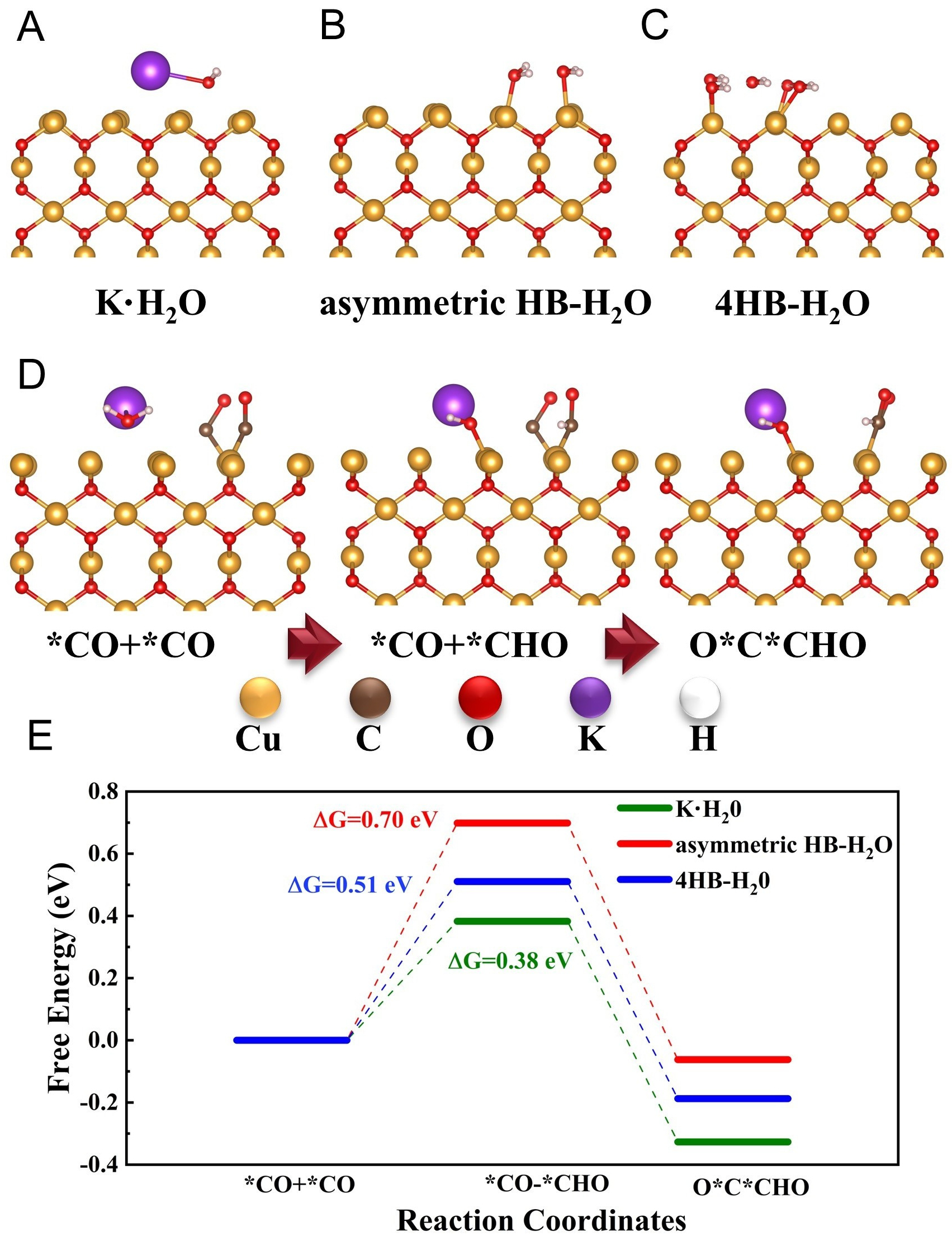
Figure 9. (A-C) Structural models of K∙H2O, asymmetric HB-H2O, and 4HB-H2O on a Cu2O (100) electrode; (D) Structures of the reaction intermediates of K∙H2O on a Cu2O (100) electrode; (E) Free energy diagrams for the transformation of *CO to O*C*CHO for 4HB-H2O, asymmetric HB-H2O, and K∙H2O on a Cu2O (100) electrode.
As shown in Figure 9E, the calculation results indicate that on a hydrophobic Cu2O (100) surface enriched with K∙H2O, the reaction energy barrier (ΔG = 0.38 eV) for the hydrogenation of *CO to *CHO is lower than that of the two unmodified control systems (ΔG = 0.51 eV/0.70 eV). This indicates that K∙H2O enriched at the interface effectively promotes the hydrogenation of *CO, lowering the reaction energy barrier for Rate-Determining Step (RDS) and thereby facilitating the subsequent C-C coupling reaction. Based on this, it can be inferred that the presence of K∙H2O promotes the conversion of *CO adsorbed on the surface (*COatop)[24,45,46]. At the same time, the formation of O*C*CHO is an exothermic process, indicating that C-C coupling does not determine the rate of multi-carbon product formation. It can be confirmed that the hydrogenation of *CO to form *CHO is the rate-determining step for the formation of ethylene and C2+ products. Furthermore, on hydrophobic interfaces enriched with K∙H2O, the reaction energy barrier for the coupling of *CO and *CHO to form O*C*CHO is lower than in the two unmodified systems, indicating that K∙H2O not only accelerates the *CO-*CHO coupling process but also promotes the formation of the key intermediate O*C*CHO. These theoretical calculation results are consistent with experimental observations.
In summary, hydrophobic interfaces can enrich “free water” species (K∙H2O) that coordinate with K+, thereby inhibiting the formation of “ice-like water” structures characterized by strong hydrogen bonding. The K∙H2O species enriched at the interface can effectively accelerate the protonation and hydrogenation of *CO, lower the RDS energy barrier, thereby promoting subsequent C-C coupling reactions and driving the dimerization of *CO with *CHO, ultimately facilitating the formation of key intermediates for ethylene production.
CONCLUSIONS
In this study, the HY-Cu2O (100) catalyst was successfully synthesized by hydrophobic modification of the surface of Cu2O (100) nanoparticles using octadecanethiol mercaptan. This modification exerts significant control over CO2 electroreduction behavior, and the core mechanism responsible for the improved C2H4 yield is thoroughly elucidated. A thiol self-assembly method was employed to transition the catalyst from a hydrophilic to a hydrophobic surface. Characterization techniques, including EDS, XPS, Attenuated Total Reflectance Fourier-Transform Infrared Spectroscopy (ATR-FTIR), and theoretical calculations, confirmed the uniform coverage of alkyl chains and the formation of Cu-S bonds. Electrochemical testing showed that the hydrophobic modification enhanced C2H4 selectivity: at a current density of -250 mA cm-2, the Faradaic efficiency reached 45.2%, surpassing that of the unmodified sample. Meanwhile, HER was effectively suppressed, demonstrating the synergistic effect of the modification strategy in enhancing both reaction rate and selectivity. In situ ATR-SEIRAS and theoretical computations (DFT) revealed that the hydrophobic interface is enriched with “free water” (K∙H2O) coordinated to K+. This feature modulates the hydrogen-bond network of interfacial water molecules, suppressing the formation of strong hydrogen bonds and instead promoting the interaction between *CO and K∙H2O. This effectively accelerates the protonation of *CO, thereby promoting its dimerization with *CHO and ultimately forming a key intermediate for C2H4 synthesis. Furthermore, the modified catalyst exhibits higher *COatop coverage and stronger adsorption capacity, which kinetically confirms its promotional effect on C-C coupling. This study not only developed an effective strategy for enhancing CO2 electroreduction performance via surface hydrophobic modification but, more importantly, clarified the key role of interfacial water microenvironment regulation in C2H4 product selectivity through in situ spectroscopic analysis, providing a new perspective for the design of high-performance catalysts.
DECLARATIONS
Authors’ contributions
Writing-original draft, methodology, data curation, conceptualization: Li, K. X.; Shi, H. Y.
Writing-review & editing, funding acquisition, methodology, conceptualization, supervision: Chen, Y. X.
Data curation: Wang, H. L.; Wu, Y. H.; Wu, X. W.; Wang, S. L.; Ding, Y.
Writing-review & editing, data curation: Jia, A. Z.; Fornasiero, P.
Writing-review & editing, funding acquisition, methodology, conceptualization, supervision: Lu, C. Z.
Availability of data and materials
The original contributions presented in this study are included in the article/Supplementary Materials. Further inquiries can be directed to the corresponding authors.
AI and AI-assisted tools statement
Not applicable.
Financial support and sponsorship
This work was supported by the Natural Science Foundation of Fujian Province (2023H0046), the XMIREM autonomous deployment project (2023CX10, 2023GG01), the Science and Technology Service Network Initiative from Chinese Academy of Sciences (STS2024T3071), the National Natural Science Foundation of China (22275185), the Major Research Project of Xiamen (3502Z20191015), the Fujian Science & Technology Innovation Laboratory for Optoelectronic Information of China (2021ZR132, 2021ZZ115).
Conflicts of interest
All authors declared that there are no conflicts of interest.
Ethical approval and consent to participate
Not applicable.
Consent for publication
Not applicable.
Copyright
© The Author(s) 2026.
Supplementary Materials
REFERENCES
1. Chu, S.; Majumdar, A. Opportunities and challenges for a sustainable energy future. Nature 2012, 488, 294-303.
2. Chang, B.; Pang, H.; Raziq, F.; et al. Electrochemical reduction of carbon dioxide to multicarbon (C2+) products: challenges and perspectives. Energy Environ Sci 2023, 16, 4714-58.
3. Fan, L.; Xia, C.; Yang, F.; Wang, J.; Wang, H.; Lu, Y. Strategies in catalysts and electrolyzer design for electrochemical CO2 reduction toward C2+ products. Sci Adv 2020, 6, eaay3111.
4. Burkart, M. D.; Hazari, N.; Tway, C. L.; Zeitler, E. L. Opportunities and challenges for catalysis in carbon dioxide utilization. ACS Catal 2019, 9, 7937-56.
5. Ajmal, S.; Yasin, G.; Kumar, A.; et al. A disquisition on CO2 electroreduction to C2H4: an engineering and design perspective looking beyond novel choosy catalyst materials. Coord Chem Rev 2023, 485, 215099.
6. Soodi, S.; Zhang, J.; Zhang, J.; et al. Selective electroreduction of CO2 to C2+ products on cobalt decorated copper catalysts. Chem Synth 2024, 4, 44.
7. Okatenko, V.; Loiudice, A.; Newton, M. A.; et al. Alloying as a strategy to boost the stability of copper nanocatalysts during the electrochemical CO2 reduction reaction. J Am Chem Soc 2023, 145, 5370-83.
8. Xie, W.; Chen, J.; Yang, Z.; He, L. Cobalt macrocyclic complex-catalyzed selective electroreduction of CO2 to CO. Green Chem 2023, 25, 10366-71.
9. Ni, W.; Yixiang, Z.; Yao, Y.; et al. Surface reconstruction with a sandwich-like C/Cu/C catalyst for selective and stable CO2 electroreduction. ACS Appl Mater Interfaces 2022, 14, 13261-70.
10. Liu, M.; Liu, G.; Xu, Q.; Zeng, G. Decorating pore environment via cationic units of covalent organic frameworks for enhancing CO2 reduction reaction. Chem Synth 2025, 5, 17.
11. Guo, S.; Wang, J.; Zhang, H.; Iloeje, C. O.; Liu, D. Direct electrochemical reduction of CO2 to C2+ chemicals: catalysts, microenvironments, and mechanistic understanding. ACS Energy Lett 2025, 10, 600-19.
12. Ge, W.; Chen, Y.; Fan, Y.; et al. Dynamically formed surfactant assembly at the electrified electrode-electrolyte interface boosting CO2 electroreduction. J Am Chem Soc 2022, 144, 6613-22.
13. Jiang, X.; Chen, R.; Chen, Y.; Lu, C. Research progress of photoelectrochemical conversion of CO2 to C2+ products. Chem Synth 2024, 4, 46.
14. Ma, W.; Xie, S.; Liu, T.; et al. Electrocatalytic reduction of CO2 to ethylene and ethanol through hydrogen-assisted C-C coupling over fluorine-modified copper. Nat Catal 2020, 3, 478-87.
15. Li, X.; Zhang, B.; Xiong, W.; et al. Highly selective CO2 electroreduction to ethylene on long alkyl chains-functionalized copper nanowires. Chin J Catal 2025, 73, 196-204.
16. Sun, M.; Cheng, J.; Yamauchi, M. Gas diffusion enhanced electrode with ultrathin superhydrophobic macropore structure for acidic CO2 electroreduction. Nat Commun 2024, 15, 491.
17. Wang, Y. H.; Zheng, S.; Yang, W. M.; et al. In situ Raman spectroscopy reveals the structure and dissociation of interfacial water. Nature 2021, 600, 81-5.
18. Xue, L.; Wu, X.; Liu, Y.; et al. Hydrophobic 1-octadecanethiol functionalized copper catalyst promotes robust high-current CO2 gas-diffusion electrolysis. Nano Res 2022, 15, 1393-8.
19. Wakerley, D.; Lamaison, S.; Ozanam, F.; et al. Bio-inspired hydrophobicity promotes CO2 reduction on a Cu surface. Nat Mater 2019, 18, 1222-7.
20. Wu, Z. Z.; Zhang, X. L.; Niu, Z. Z.; et al. Identification of Cu(100)/Cu(111) interfaces as superior active sites for CO dimerization during CO2 electroreduction. J Am Chem Soc 2022, 144, 259-69.
21. Deng, Y.; Wan, C.; Li, C.; et al. Synergy effect between facet and zero-valent copper for selectivity photocatalytic methane formation from CO2. ACS Catal 2022, 12, 4526-33.
22. Hu, J.; Osella, S.; Albero, J.; García, H. Unraveling the influence of shell thickness in organic functionalized Cu2O nanoparticles on C2+ products distribution in electrocatalytic CO2 reduction. Adv Funct Mater 2024, 34, 2404566.
23. Zhao, Y.; Li, Q. Q.; He, Q. F.; et al. In situ Raman spectroscopy reveals the multifunctional role of interfacial water in CO2-to-C2 electroreduction on Cu(hkl) surfaces. J Am Chem Soc 2025, 147, 30230-8.
24. Zhu, S.; Jiang, B.; Cai, W. B.; Shao, M. Direct observation on reaction intermediates and the role of bicarbonate anions in CO2 electrochemical reduction reaction on Cu surfaces. J Am Chem Soc 2017, 139, 15664-7.
25. Delmo, E. P.; Wang, Y.; Song, Y.; et al. In situ infrared spectroscopic evidence of enhanced electrochemical CO2 reduction and C-C coupling on oxide-derived copper. J Am Chem Soc 2024, 146, 1935-45.
26. Chen, R.; Wu, Q.; Zhu, J.; et al. Hydrophobic ionic liquid engineering for reversing CO intermediate configuration toward ampere-level CO2 electroreduction to C2+ products. J Am Chem Soc 2025, 147, 7921-31.
27. Yang, Y.; He, A.; Li, H.; et al. Operando constructing Cu/Cu2O electrocatalysts for efficient CO2 electroreduction to ethanol: CO2-assisted structural evolution of octahedral Cu2O by operando CV activation. ACS Catal 2022, 12, 12942-53.
28. Zhou, D.; Chen, C.; Zhang, Y.; et al. Cooperation of different active sites to promote CO2 electroreduction to multi-carbon products at ampere-level. Angew Chem Int Ed 2024, 63, e202400439.
29. Zhang, Y.; Chen, Y.; Wang, X.; et al. Low-coordinated copper facilitates the *CH2CO affinity at enhanced rectifying interface of Cu/Cu2O for efficient CO2-to-multicarbon alcohols conversion. Nat Commun 2024, 15, 5172.
30. Liu, Z.; Song, L.; Lv, X.; et al. Switching CO2 electroreduction toward ethanol by delocalization state-tuned bond cleavage. J Am Chem Soc 2024, 146, 14260-6.
31. Li, K. X.; Li, C. H.; Shi, H. Y.; et al. A convenient in situ preparation of Cu2ZnSnS4-anatase hybrid nanocomposite for photocatalysis/photoelectrochemical water-splitting hydrogen production. Molecules 2024, 29, 2514.
32. Shi, H.; Chen, Y.; Pu, Y.; et al. Regulation of electrode surface microenvironment by porous ion transport layer for high-efficiency CO2 electrochemical reduction to ethylene. Chem Eng J 2025, 515, 163490.
33. Lee, S.; Lee, J. Ethylene Selectivity in CO Electroreduction when using Cu oxides: an in situ ATR‐SEIRAS study. ChemElectroChem 2018, 5, 558-64.
34. Cai, H.; Yang, H.; Li, D.; et al. Combining the active site construction and microenvironment regulation via a bio-inspired strategy boosts CO2 electroreduction under ampere-level current densities. Angew Chem Int Ed 2025, 64, e202425325.
35. Li, Z.; Chen, R.; Ge, W.; et al. Molecular scale interfacial water management switching reaction pathway of carbon dioxide electroreduction. Angew Chem Int Ed 2025, 64, e202508801.
36. McKee, M.; Kutter, M.; Wu, Y.; et al. Hydrophobic assembly of molecular catalysts at the gas-liquid-solid interface drives highly selective CO2 electromethanation. Nat Chem 2025, 17, 92-100.
37. Ren, S.; Cao, X.; Fan, Q.; et al. Selective CO2 electroreduction to multi-carbon products on organic-functionalized CuO nanoparticles by local micro-environment modulation. Nano Micro Lett 2024, 16, 262.
38. Dong, Z.; Jia, Y.; Wang, Z.; Rajendran, A.; Li, W. Regulating the hydrophobic microenvironment of SnS2 to facilitate the interfacial CO2/H2O ratio towards pH-universal electrocatalytic CO2 reduction. Green Chem 2025, 27, 5498-506.
39. Fan, J.; Pan, B.; Wu, J.; et al. Immobilized tetraalkylammonium cations enable metal-free CO2 electroreduction in acid and pure water. Angew Chem Int Ed 2024, 63, e202317828.
40. Li, J.; He, F.; Cheng, Z.; Chen, J.; Zhang, X.; Qi, Z. Recent advances in surface modification for enhanced electrocatalytic CO2 reduction. J Mater Chem A 2025, 13, 12039-56.
41. Ma, T.; Qiu, L.; Tao, Y.; Cai, Y.; Liang, F. Ligand dominating the catalytic performance of cucurbit[6]uril modified gold nanoparticles for electrocatalytic CO2 reduction. J Alloys Compd 2024, 979, 173477.
42. Ruan, S.; Tang, G.; Zhang, Z.; Zhang, Q.; Wang, Y.; Xie, S. Ionomers modulate the microenvironment in electrocatalytic CO2 reduction. Chem Sci 2026, 17, 96-117.
43. Wang, D.; Mao, X.; Peng, Y.; et al. Investigation of a hydrophobic sputtered Cu electrode to electrocatalyze CO2 towards a C2+ product: the effect of substrate and catalyst thickness. Processes 2024, 12, 2374.
44. Li, S.; Sha, X.; Gao, X.; Peng, J. Al-doped octahedral Cu2O nanocrystal for electrocatalytic CO2 reduction to produce ethylene. Int J Mol Sci 2023, 24, 12680.
45. Wang, Y.; Chen, L.; Li, G.; et al. Molecular modification strategies for enhancing CO2 electroreduction. Molecules 2025, 30, 3038.
Cite This Article
 Open Access
How to Cite
Li, K.X.; Chen, Y.X.; Shi, H.Y.; Wang, H.L.; Wu, Y.H.; Wu, X.W.; Wang, S.L.; Ding, Y.; Jia, A.Z.; Fornasiero, P.; Lu, C.Z. Hydrophobic modification regulates the water microenvironment at the interface of Cu-based materials to promote E-CO2RR. Energy Mater. 2026, 6, 600150. https://dx.doi.org/10.20517/energymater.2026.202
Download Citation
Export Citation File:
Type of Import
Tips on Downloading Citation
Citation Manager File Format
Type of Import
Direct Import: When the Direct Import option is selected (the default state), a dialogue box will give you the option to Save or Open the downloaded citation data. Choosing Open will either launch your citation manager or give you a choice of applications with which to use the metadata. The Save option saves the file locally for later use.
Indirect Import: When the Indirect Import option is selected, the metadata is displayed and may be copied and pasted as needed.
About This Article
Special Topic
Copyright

Data & Comments
Data
0







Comments
Comments must be written in English. Spam, offensive content, impersonation, and private information will not be permitted. If any comment is reported and identified as inappropriate content by OAE staff, the comment will be removed without notice. If you have any queries or need any help, please contact us at support@oaepublish.com.