
fig7
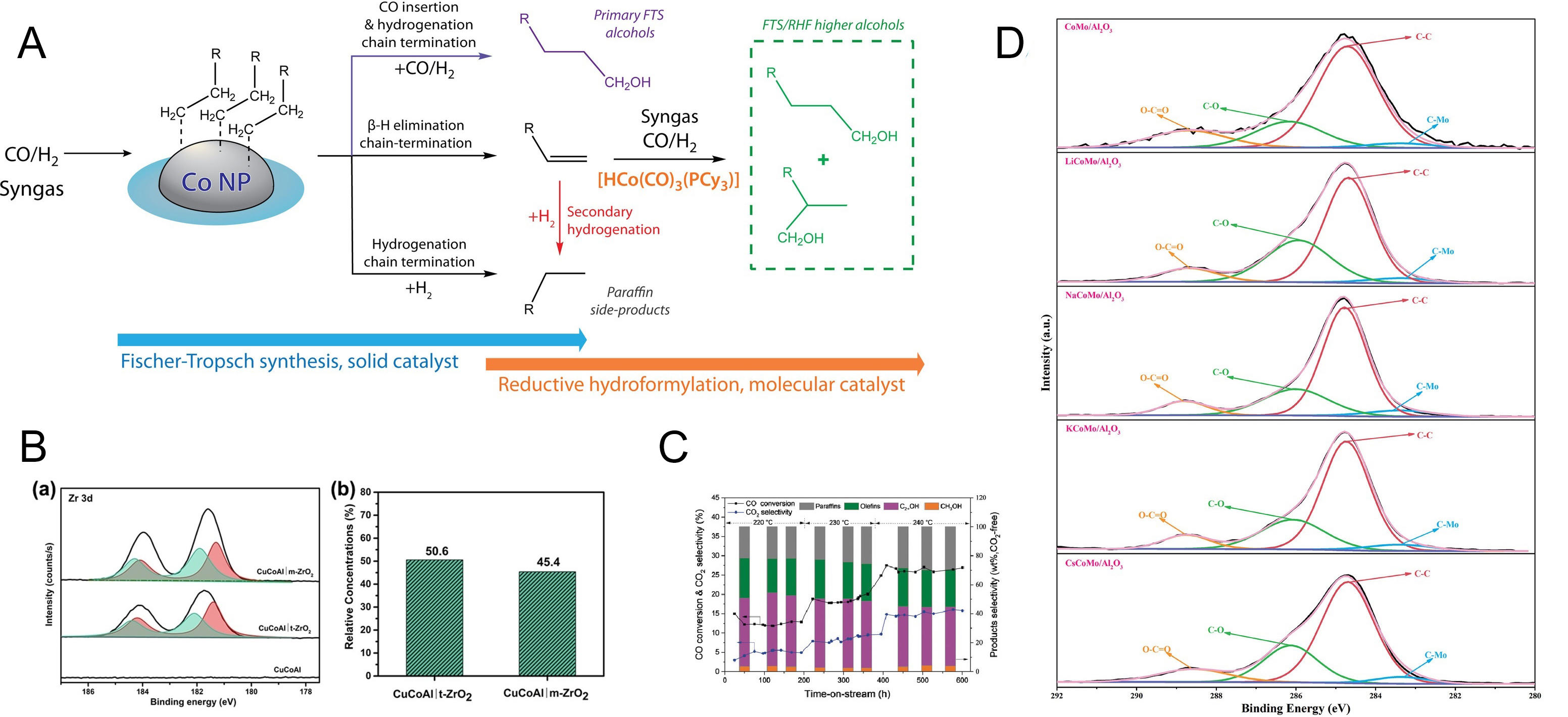
Figure 7. (A) Production of higher alcohols from syngas via the integration of Fischer-Tropsch synthesis (FTS) and reductive hydroformylation (RHF) in a tandem process. The active sites of the solid catalyst are responsible for chain growth (number of Cn in R). The ratio between β-H elimination and hydrogenation as chain termination steps determines the primary hydrocarbon selectivity, i.e., olefin-to-paraffin ratio. The activity of the molecular catalyst in olefin reductive hydroformylation relative to secondary olefin hydrogenation pathways determines the final alcohol selectivity. For completeness, the CO insertion chain-termination pathway on the FTS catalyst is also indicated as a source for primary, strictly linear higher alcohols. (A) is reprinted with permission from Ref.[142], Copyright © 2022 WILEY; (B) XPS spectra of CuCoAl, CuCoAljm-ZrO2 and CuCoAljt-ZrO2 catalysts after reduction. (a) Zr 3d, (b) The relative concentrations of ZrI species. (B) is reprinted with permission from Ref.[147], Copyright © 2021 John Wiley & Sons.; (C) Stability test of CoMn|CuZnAlZr multifunctional catalyst with mortar mixing. Reaction conditions: 6 MPa, H2/CO = 2 and 2,000 mL/(g·h). (C) is reprinted with permission from Ref.[149], Copyright © 2019 WILEY; (D) C 1s spectrum of catalyst MCoMo/Al2O3. (D) is reprinted with permission from Ref.[150], Copyright © 2025 WILEY. XPS: X-ray photoelectron spectroscopy.