


fig6
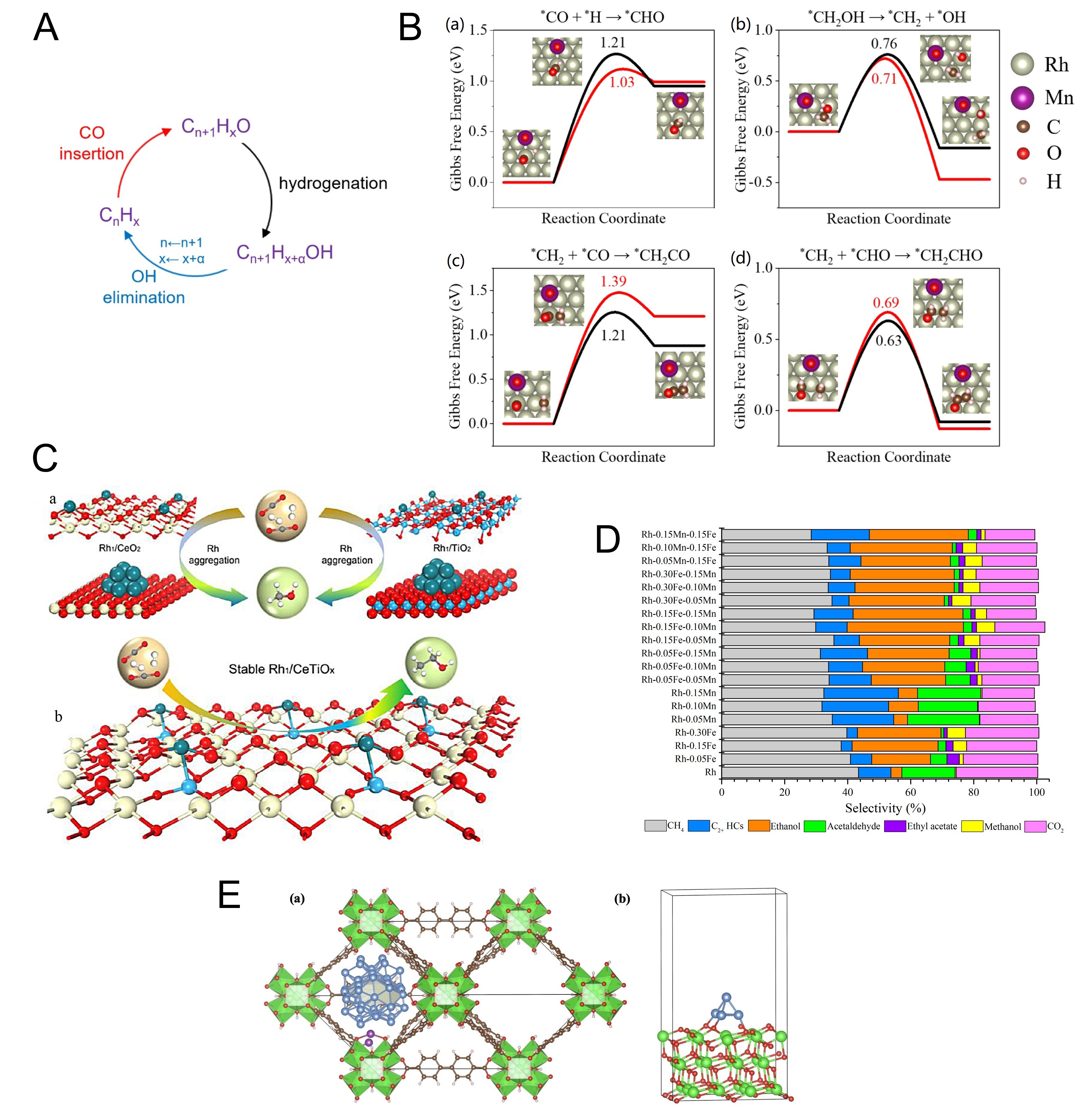
Figure 6. (A) The overall reaction cycle for HAS consisting of CO insertion (red), hydrogenation (black), and OH elimination (blue). (A) is reprinted with permission from Ref.[125], Copyright © 2024 Springer US; (B) (a-d) Gibbs free energy diagrams and configurations for four intermediate steps on Mn1O1 supported on the Rh (111) facet (black line) and (221) facet (red line) at 595 K. The insets in (a–d) show the configurations of the initial state (IS), transition state (TS) and final state (FS) on Rh (111). (B) is reprinted with permission from Ref.[126], Copyright © 2025 The Royal Society of Chemistry; (C) Schematic reaction process for long-term stability testing in CO2 hydrogenation to ethanol over single-atom Rh supported on CeO2, TiO2 (a), and CeTiOx (b). (C) is reprinted with permission from Ref.[128], Copyright © 2022 WILEY; (D) Summary of selectivities for syngas conversion over Rh/SiO2 and Rh-based multimetallic catalysts. (D) is reprinted with permission from Ref.[132], Copyright © 2017 American Chemical Society; (E) Optimized structures of Rh+-Rh0 /UiO-67 (a) and Rh0/t-ZrO2(101) (b). C, brown; O, red; H, white; Zr, green; Rh+, purple; Rh0, blue; this color code is used throughout the paper. Details of model construction and charge analyses can be found in the Supporting Information. (E) is reprinted with permission from Ref.[135], Copyright © 2024 WILEY. HAS: higher-alcohol synthesis.