


Figure6
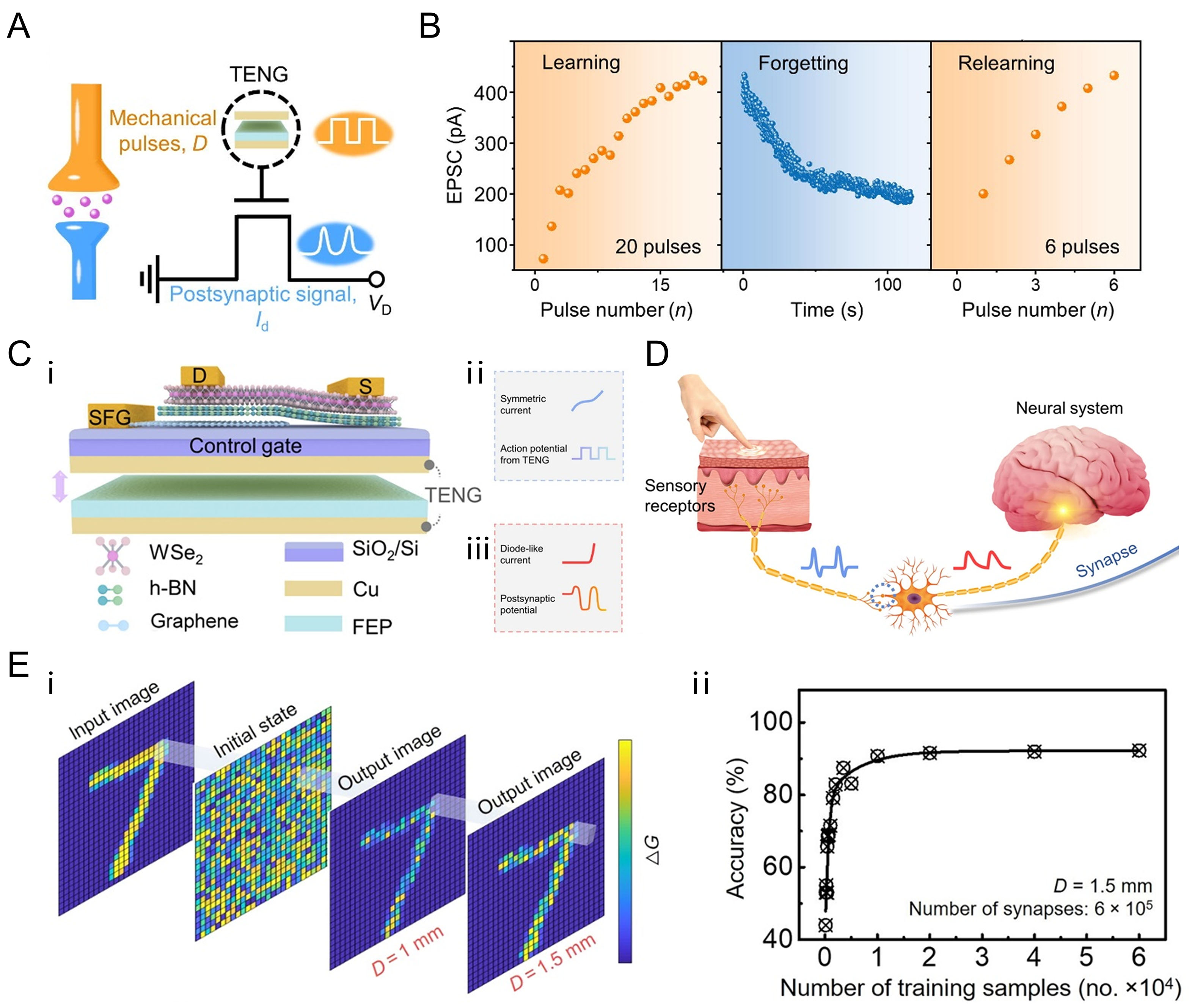
Figure 6. (A) Schematic of an energy-coupled memristor driven by TENG pulses: mechanical stimulation produces a high-voltage, low-current signal that modulates the formation/rupture of conductive filaments. (B) Memristive learning behavior under periodic mechanical excitation, illustrating learning, forgetting, and relearning processes. (C) TENG-gated WSe2/h-BN/graphene vdW synaptic device: (ⅰ) device structure; (ⅱ) mechanically induced current response; (ⅲ) device-level potentiation. (D) Biological analogy of continuous tactile receptors and synaptic transmission, mapping triboelectric action-potential-like pulses to synaptic responses, adapted from[63]. (E) Pattern recognition using a TENG-driven synaptic array: (ⅰ) evolution from a random/initial state to a stable image for D=1 mm and 1.5 mm; (ⅱ) recognition accuracy as a function of training-set size for ≈ 6×10⁵ synapses at D=1.5 mm, adapted from[100]. Reproduced with permission from Elsevier (A-D) and American Association for the Advancement of Science (E).