



Figure4
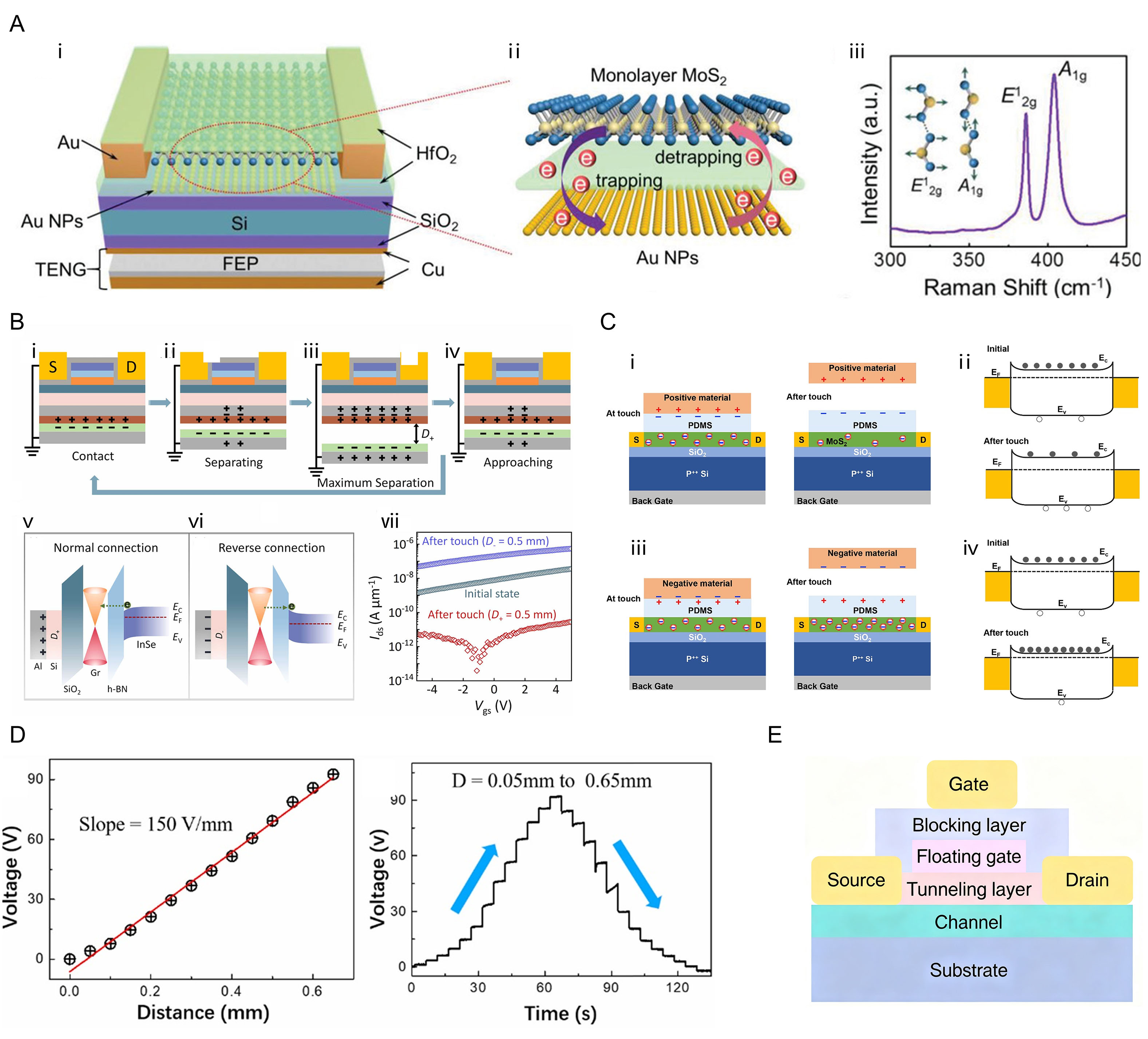
Figure 4. TENG-driven floating-gate synapse: structure, operation, and waveforms. (A) Device architecture and materials: (ⅰ) overall schematic; (ⅱ) MoS2 channel with an Au nanoparticle (Au NP) hybrid stack illustrating charge trapping/detrapping pathways; (ⅲ) Raman spectroscopy verification of the MoS2 layer number, adapted from[66]. (B) Operating principle under TENG pulsing: bias-dependent charge accumulation and release in the floating gate, adapted from[67]. (C) Polarity-tunable band diagrams in a tribotronic tactile memory: (ⅰ and ⅱ) positive tribopotential lowers the injection barrier and promotes charge trapping; (ⅲ and ⅳ) negative tribopotential raises the barrier and accelerates charge detrapping, adapted from[99]. (D) TENG output as a function of mechanical displacement: left—open-circuit voltage varies linearly with distance (150 V mm-1); right—pulse envelope as a function of excitation frequency, adapted from[98]. (E) Canonical three-terminal floating-gate stack (gate/blocking dielectric/FG/tunneling dielectric/channel) as a scalable core for triboelectric-memristive hybrid systems, adapted from[96]. Reproduced with permission from Wiley (A), Elsevier (B-D), Nature (E).