


fig1
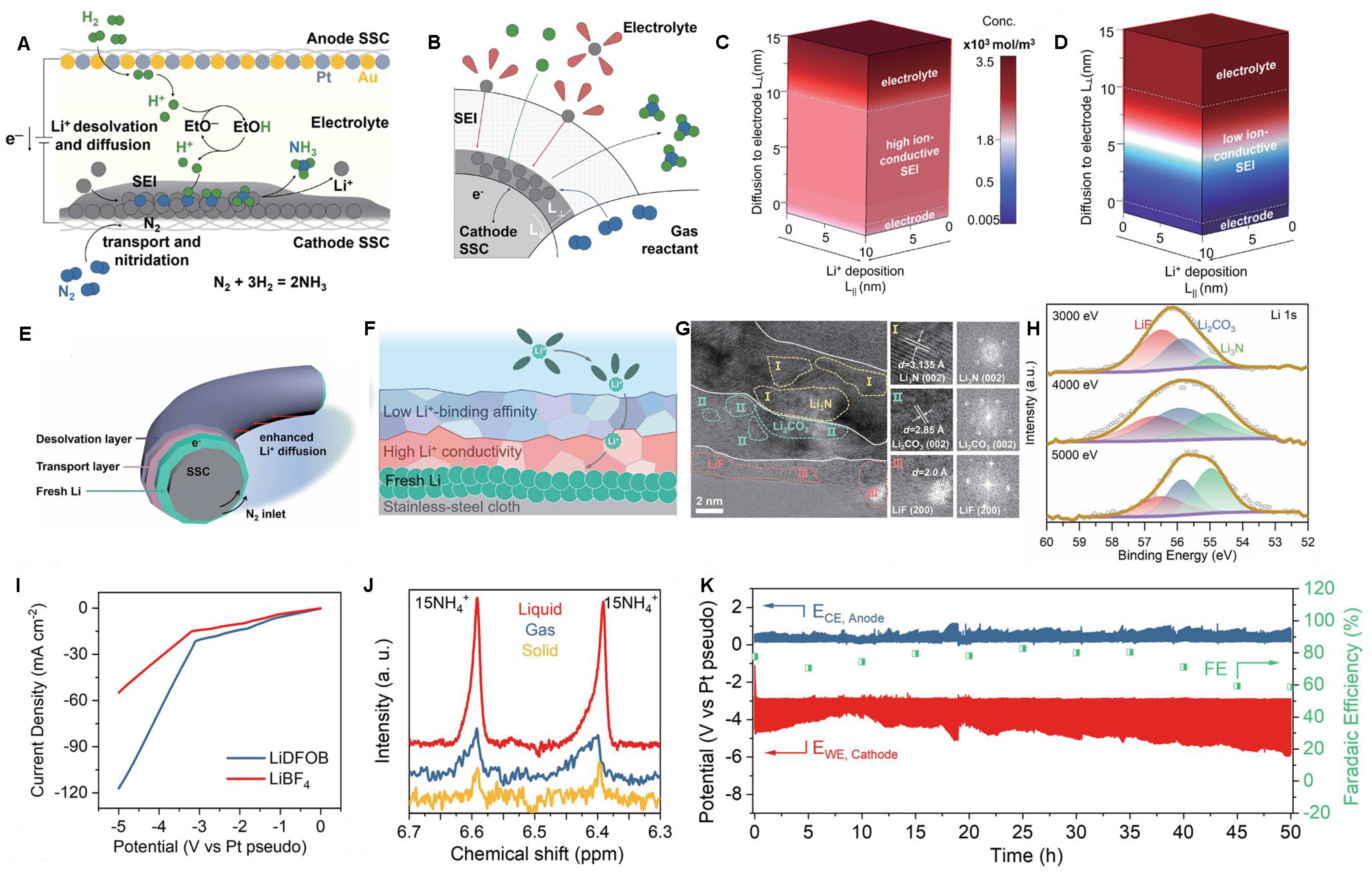
Figure 1. (A) Schematic of N2 electrolysis in a continuous-flow electrolyzer; (B) Schematic illustrations of N2 electrolysis at the SEI with high ionic conductivity; Modeled Li+ concentration along the cathode surface for high (C) and low (D) ion-conductive SEI films, assuming different Li+ diffusivities of DSEI/D0 valued at 10-3 and 10-5, respectively. (E) Schematic of an ion-conductive SEI coated onto SSC support; (F) The LiDFOB-derived SEI exhibits differentiated low ion-binding affinity and high ion-conductivity characteristics endowed by LiF and Li2CO3 species, respectively; (G) Cryo-TEM images at different magnifications of the LiDFOB-derived SEI, revealing a multilayer stacked structure; (H) XPS depth profiles of Li 1 s for the LiDFOB-derived SEI film at different incident X-ray energies; (I) Linear sweep voltammetry profiles of N2 electrolysis with a scan rate of 10 mV·s-1; (J) Nuclear magnetic resonance data from 15N2 isotope labeling experiments; (K) Extended ammonia electrosynthesis with controlled potential cycling at -100 mA·cm-2 using LiDFOB. This figure is adapted with permission from Ref.[7]. SEI: Solid electrolyte interphase; SSC: stainless steel cloth; LiDFOB: lithium difluoro(oxalato)borate; cryo-TEM: cryogenic transmission electron microscopy; XPS: X-ray photoelectron spectroscopy.