

Redefining interphase chemistry for efficient N2-to-NH3 conversion
 0
0 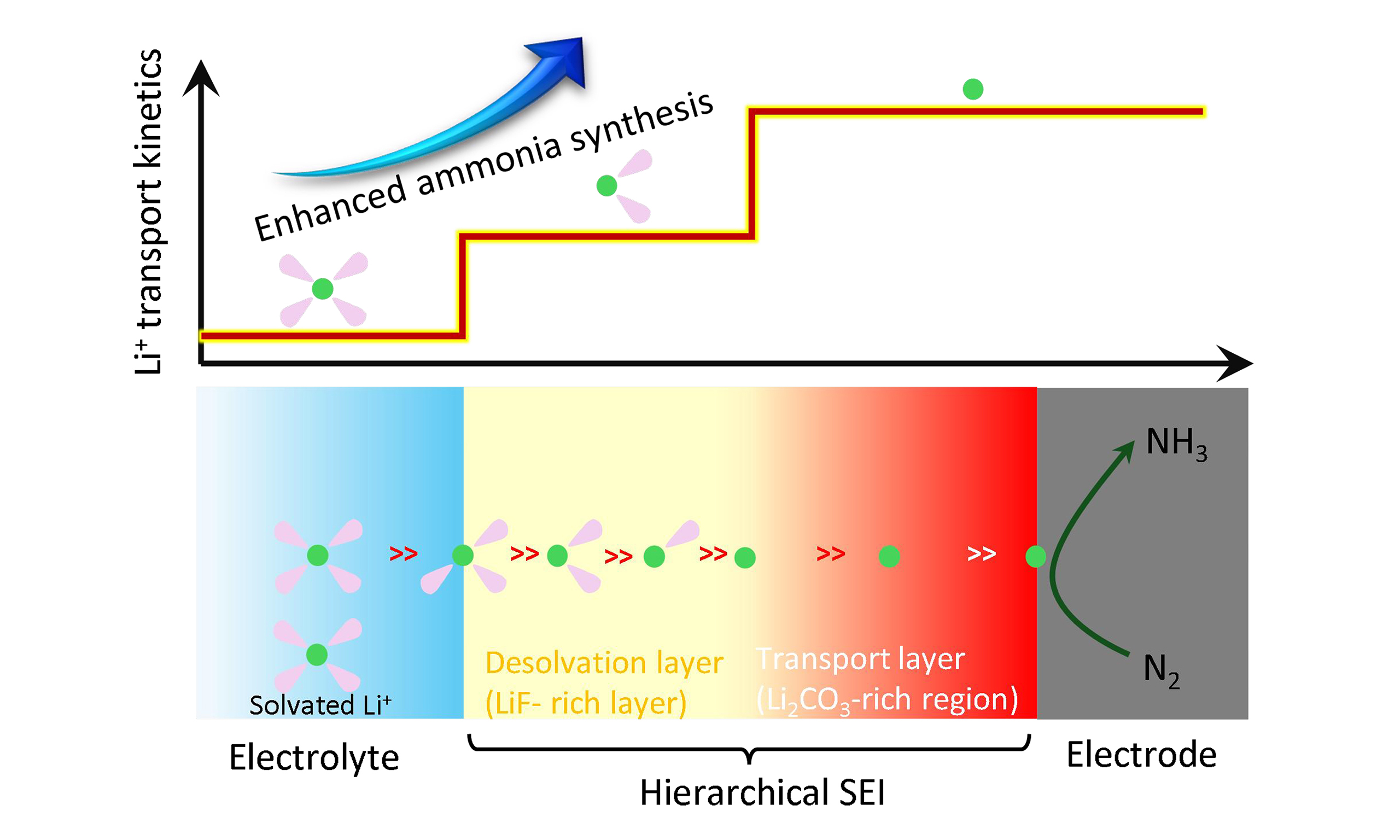
The century-old ammonia industry has profoundly reshaped human society and the Earth system. Since 1950, the global population has nearly tripled, partly due to the development of industrial ammonia (NH3) synthesis[1]. As a cornerstone of modern agriculture and a promising carbon-free energy carrier, NH3 is predominantly produced via the energy-intensive Haber–Bosch process (350-450 oC; 150-200 bar) at present[2]. This has motivated sustained efforts to develop milder and more sustainable routes. Lithium-mediated nitrogen reduction reaction (Li-NRR), capable of operating at ambient temperature and pressure, has emerged as a promising pathway[3,4]. However, its practical implementation remains fundamentally constrained by sluggish Li+ transport within the solid electrolyte interphase (SEI), which hinders lithium deposition and leads to substantial ohmic losses[5]. In addition, Li-NRR is often plagued by parasitic interfacial reactions, such as electrolyte decomposition and hydrogen evolution; meanwhile, electrode degradation together with challenges in scaling to industrially relevant current densities continue to hinder practical implementation[6].
Rational interfacial engineering to regulate ion transport and decouple key interfacial processes would overcome these limitations and enable high-efficiency Li-NRR. Although tremendous efforts have been devoted to engineering the SEI through electrolyte composition tuning, additive incorporation, and artificial SEI construction, these strategies largely focus on improving SEI composition and stability, without decoupling the elementary steps of Li+ desolvation and diffusion, thereby leaving the fundamental transport limitation insufficiently addressed[3,5].
Writing in Science, Zhang et al. report an innovative interfacial engineering strategy that tackles the long-standing kinetic bottleneck of Li-NRR by rethinking the intrinsic structure and the function of the SEI [Figure 1A][7]. Using a lithium difluoro(oxalato)borate (LiDFOB) electrolyte, they construct a spatially differentiated SEI that integrates an outer layer with low ion-binding affinity to facilitate Li+ desolvation and ensure sufficient Li+ supply, and an inner layer with high ionic conductivity to accelerate Li+ diffusion [Figure 1B]. This synergistic architecture markedly enhances the Li+ flux by two orders of magnitude, enabling a Faradaic efficiency of 98% and an energy efficiency of 21% for NH3 production at 100 mA·cm-2.
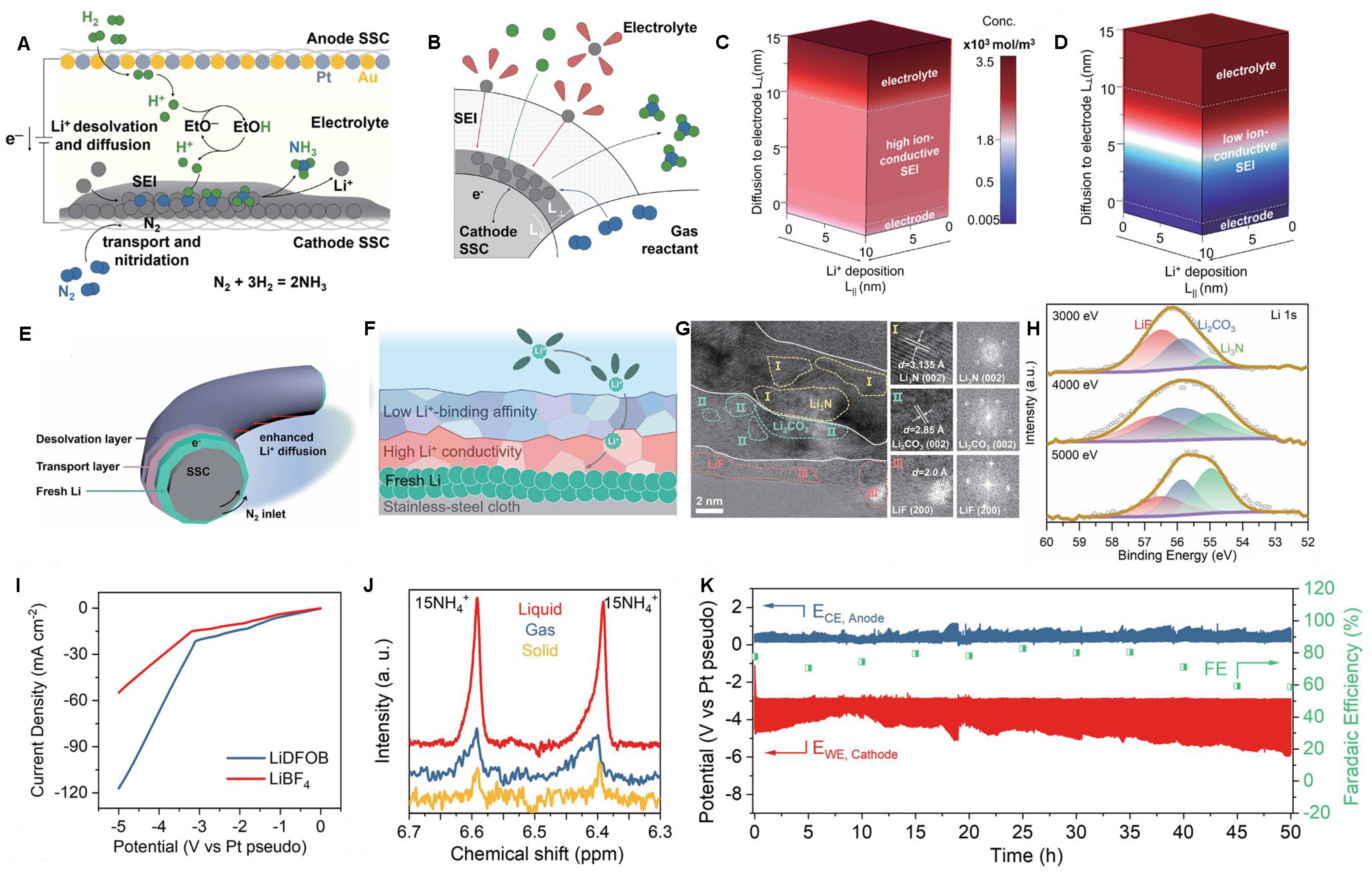
Figure 1. (A) Schematic of N2 electrolysis in a continuous-flow electrolyzer; (B) Schematic illustrations of N2 electrolysis at the SEI with high ionic conductivity; Modeled Li+ concentration along the cathode surface for high (C) and low (D) ion-conductive SEI films, assuming different Li+ diffusivities of DSEI/D0 valued at 10-3 and 10-5, respectively. (E) Schematic of an ion-conductive SEI coated onto SSC support; (F) The LiDFOB-derived SEI exhibits differentiated low ion-binding affinity and high ion-conductivity characteristics endowed by LiF and Li2CO3 species, respectively; (G) Cryo-TEM images at different magnifications of the LiDFOB-derived SEI, revealing a multilayer stacked structure; (H) XPS depth profiles of Li 1 s for the LiDFOB-derived SEI film at different incident X-ray energies; (I) Linear sweep voltammetry profiles of N2 electrolysis with a scan rate of 10 mV·s-1; (J) Nuclear magnetic resonance data from 15N2 isotope labeling experiments; (K) Extended ammonia electrosynthesis with controlled potential cycling at -100 mA·cm-2 using LiDFOB. This figure is adapted with permission from Ref.[7]. SEI: Solid electrolyte interphase; SSC: stainless steel cloth; LiDFOB: lithium difluoro(oxalato)borate; cryo-TEM: cryogenic transmission electron microscopy; XPS: X-ray photoelectron spectroscopy.
Finite-element modeling reveals that the Li+ flux within the SEI is a key factor affecting the reaction rates and current density [Figure 1C and D]. Enhancing the Li+ diffusivity in the SEI can substantially expand the active reaction zone and enable high current densities. Guided by these insights, a desolvation-diffusion decoupled SEI that is composed of a LiF-rich layer (promoting Li+ desolvation) and a Li2CO3-rich region (accelerating Li+ diffusion) is successfully constructed by adopting a LiDFOB electrolyte [Figure 1E and F]. Cryogenic transmission electron microscopy (cryo-TEM) shows a continuous and conformal multilayer SEI with a thickness of ~10-20 nm, consisting of an outer LiF layer, an intermediate Li2CO3 layer, and an inner Li3N layer [Figure 1G]. Synchrotron-based X-ray photoelectron spectroscopy (XPS) depth profiling further suggests that the LiF component preferentially faces the electrolyte, while Li2CO3 is sandwiched between LiF and Li3N [Figure 1H]. Cyclic voltammetry experiments confirm that the Li+ diffusion coefficient in the LiDFOB-derived SEI reaches 5.75 × 10⁻¹³ m2·s-1, which is two orders of magnitude higher than the LiBF4-derived SEI (1.63 × 10⁻¹⁵ m2·s-1). Also, density functional theory calculations reveal that the engineered SEI lowers the Li+ desolvation energy (-0.67 eV) and the migration barriers (~0.60 eV) simultaneously compared with LiBF4-derived SEI.
This improved ion transport kinetics enabled by LiDFOB-derived differentiated SEI contributes to outstanding Li-NRR performances. As shown in Figure 1I, the LiDFOB system delivers substantially higher current densities compared with the LiBF4 counterpart, indicating accelerated reaction kinetics. At an industrially relevant current density of 100 mA·cm-2, it achieves a Faradaic efficiency of 98% and an energy efficiency of 21%, far exceeding the LiBF4 system (~16%). 15N2 isotope-labeling experiments confirm that the produced ammonia is indeed derived from N2 [Figure 1J]. Besides, the Faradaic efficiencies determined by nuclear magnetic resonance and ion chromatography are close to each other. This improvement originates from sufficient Li+ availability at the interface, which suppresses parasitic reactions and promotes selective nitrogen reduction. Notably, the optimized system can even sustain ~71% Faradaic efficiency at an elevated current density of 150 mA·cm-2, highlighting its high-rate capability. At lower current densities, the system approaches near-unity Faradaic efficiency. Moreover, long-term testing shows stable operation with ~80% Faradaic efficiency maintained over 40 h [Figure 1K], although gradual decay is observed due to SEI thickening and dead lithium accumulation.
This work by Zhang et al. pioneers a strategy to enable concerted Li+ desolvation and diffusion within SEI, effectively overcoming the long-standing Li+ transport limitation in the Li-NRR field[7]. By assigning distinct and complementary roles to the structure of SEI, the study advances beyond conventional trial-and-error electrolyte optimization toward a rational paradigm of interfacial engineering. Further progress can be envisioned along several key directions. At the interface level, precise regulation of SEI chemistry and architecture will be essential to simultaneously optimize Li+ transport, suppress parasitic reactions, and maintain structural stability under high current densities. In particular, designing compositionally graded or dynamically adaptive SEI layers, as well as tailoring ion transport pathways and solvation environments, may offer effective routes to achieve both high activity and selectivity. At the material level, exploring new metal mediators with lower reduction potentials would overcome the limitation of theoretical energy efficiency (~28%) of Li-NRR[8-10]. At the system level, developing scalable reactor architectures with optimized gas-liquid-solid mass transport, uniform current distribution, and efficient electrolyte management will be critical to bridge the gap between laboratory studies and practical applications. In parallel, further improvement in long-term stability at practical current densities (e.g., > 300 mA·cm-2) will also be essential, for instance, mitigating SEI thickening, suppressing dead lithium accumulation, etc.[8]. In all, this work highlights the fine regulation of ion transport and interfacial chemistry in confined environments, which can be extended to other electrochemical reactions, such as Li+/Na+ batteries, metal–air batteries. Integrating such interface-engineered chemistries with scalable reactor architectures and system-level optimization may open a viable pathway toward sustainable, high-efficiency electrochemical manufacturing and a low-carbon chemical industry.
DECLARATIONS
Authors’ contributions
Drafted the manuscript: Ren, Y.
Revised the manuscript: Qu, H.
Revised and rewrote sections of the manuscript: Li, Y.
Availability of data and materials
Not applicable.
AI and AI-assisted tools statement
Not applicable.
Financial support and sponsorship
This work was supported by the Wallonia Government in the frame of “Plan de Relance” (2310153-BatFactory) and National Natural Science Foundation of China (22408383).
Conflict of interest
All authors declared that there are no conflicts of interest.
Ethical approval and consent to participate
Not applicable.
Consent for publication
Not applicable.
Copyright
© The Author(s) 2026.
REFERENCES
1. Qing, G.; Ghazfar, R.; Jackowski, S. T.; et al. Recent advances and challenges of electrocatalytic N2 reduction to ammonia. Chem. Rev. 2020, 120, 5437-516.
2. Chen, J. G.; Crooks, R. M.; Seefeldt, L. C.; et al. Beyond fossil fuel–driven nitrogen transformations. Science 2018, 360, eaar6611.
3. Fu, X.; Pedersen, J. B.; Zhou, Y.; et al. Continuous-flow electrosynthesis of ammonia by nitrogen reduction and hydrogen oxidation. Science 2023, 379, 707-12.
4. Wang, Z.; Guan, Z. L.; Su, B. L. Proton shuttle: a key for efficient ammonia electrosynthesis. Chem. Synth. 2025, 5, 20.
5. Li, S.; Fu, X.; Nørskov, J. K.; Chorkendorff, I. Towards sustainable metal-mediated ammonia electrosynthesis. Nat. Energy. 2024, 9, 1344-9.
6. Du, H. L.; Chatti, M.; Hodgetts, R. Y.; et al. Electroreduction of nitrogen with almost 100% current-to-ammonia efficiency. Nature 2022, 609, 722-7.
7. Zhang, Q.; Li, H.; Yu, P.; et al. Enhanced Li-ion diffusion improves N2-to-NH3 current efficiency at 100 mA cm-2. Science 2026, 391, 724-9.
8. Li, S.; Zhou, Y.; Fu, X.; et al. Long-term continuous ammonia electrosynthesis. Nature 2024, 629, 92-7.
9. Wang, Z.; Zhang, X.; Xiao, Z.; et al. Intercoupled electrocatalytic ammonia synthesis via a looped Li–N2/H2 battery. Natl. Sci. Rev. 2026, 13, nwaf586.
Cite This Article
 Open Access
How to Cite
Download Citation
Export Citation File:
Type of Import
Tips on Downloading Citation
Citation Manager File Format
Type of Import
Direct Import: When the Direct Import option is selected (the default state), a dialogue box will give you the option to Save or Open the downloaded citation data. Choosing Open will either launch your citation manager or give you a choice of applications with which to use the metadata. The Save option saves the file locally for later use.
Indirect Import: When the Indirect Import option is selected, the metadata is displayed and may be copied and pasted as needed.
About This Article
Copyright

Data & Comments
Data
0








Comments
Comments must be written in English. Spam, offensive content, impersonation, and private information will not be permitted. If any comment is reported and identified as inappropriate content by OAE staff, the comment will be removed without notice. If you have any queries or need any help, please contact us at support@oaepublish.com.