


fig20
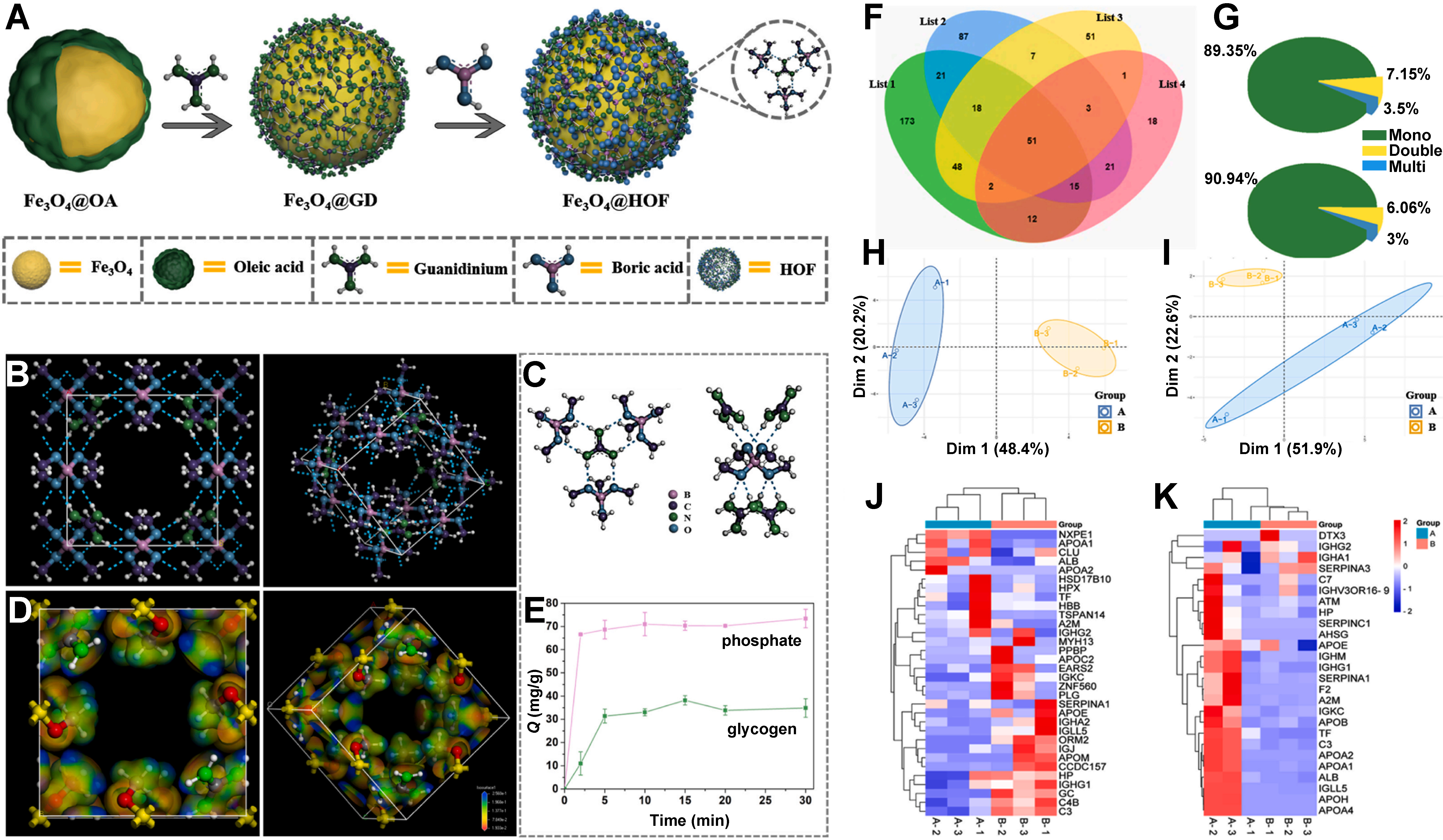
Figure 20. (A) Fabrication process of Fe3O4@HOF; (B) Schematic illustration of HOF comprising borate ester anion and guanidinium cation via H-bonding (highlighted by dashed blue line with disordered Cl- omitted for clarity); (C) Calculated electron density map of HOF (red, negative part; blue, positive part); (D) H-bonding (denoted as dashed blue line) between GD and BA; (E) Saturated adsorption isotherms for phosphate and glycogen adsorbed by Fe3O4@HOF; (F) Venn diagram of the overlap of glycosylation and phosphorylation at the protein level; (G) Distribution of mono-, and multi-phosphorylation events observed from human serum samples of lung cancer patients and healthy controls; Quantitative PCA of (Group A) healthy controls and (Group B) lung cancer patients of (H) phosphoproteins and (I) glycoproteins; Heat maps of the significantly regulated proteins between (Group A) healthy controls and (Group B) lung cancer patients of (J) phosphoproteins and (K) glycoproteins. Reprinted with permission from Ref.[163], Copyright © 2024 by Elsevier. HOF: Hydrogen-bonded organic framework; GD: guanidine hydrochloride; BA: boric acid; PCA: principal component analysis.