

fig1
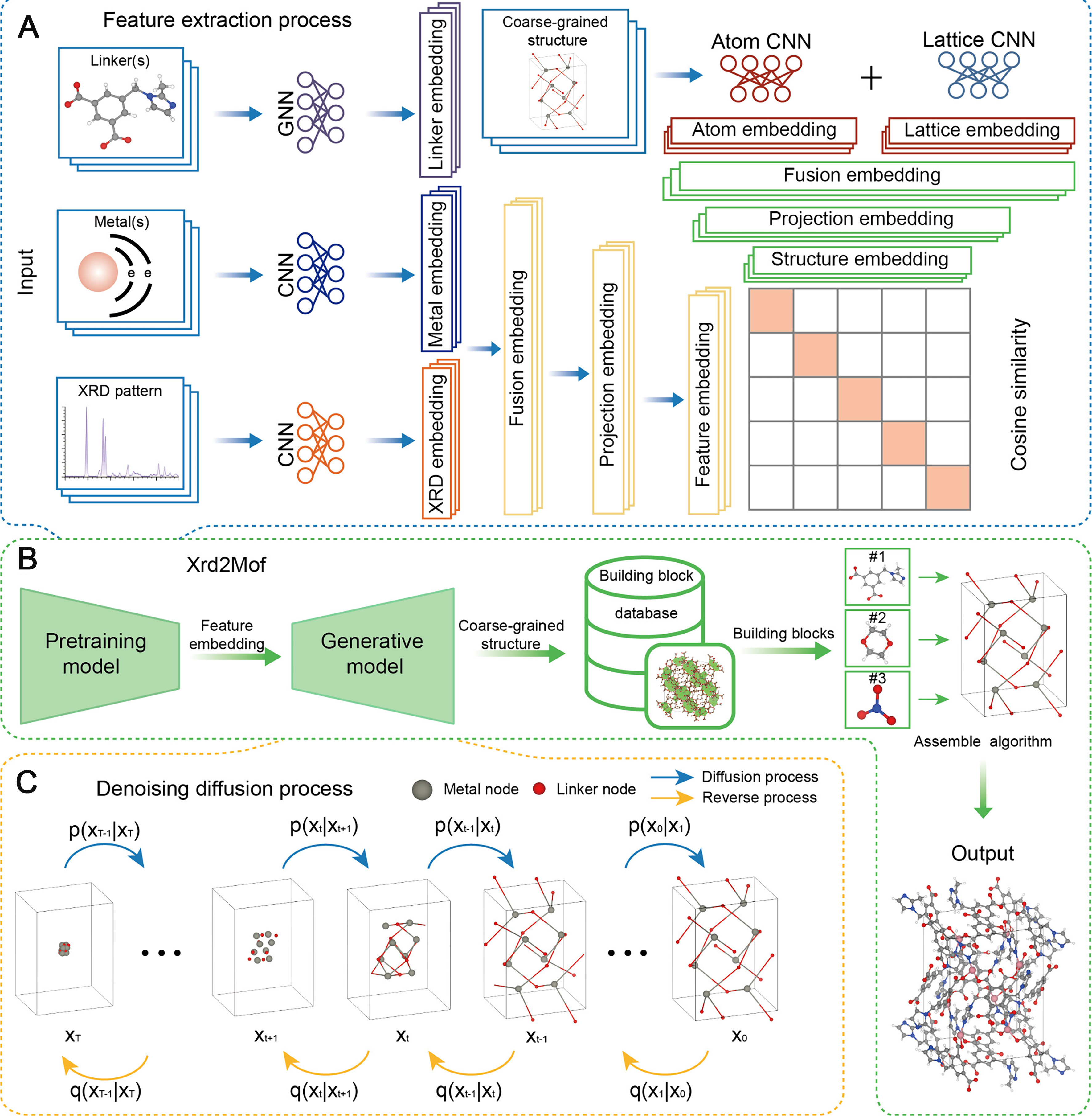
Figure 1. Architecture and workflow of Xrd2Mof for generative interpretation of metal-organic framework structures from powder X-ray diffraction patterns. (A) Pretrained multimodal feature-extraction module. Simulated PXRD patterns, metal-node information, and organic-linker information are processed by dedicated neural networks, fused, and projected into feature vectors for comparison with coarse-grained structural representations. After pretraining, the feature-extraction module is frozen; (B) Overall Xrd2Mof workflow. The extracted feature vectors guide the diffusion-based generation of coarse-grained MOF candidates. Corresponding building blocks are then retrieved from a database, assembled into atomistic structures, and optimized using a force-field method. Multiple candidate structures are generated for subsequent evaluation; (C) Conditional diffusion model for coarse-grained structure generation. During training, node types and valences are initialized using chemical prior knowledge and iteratively refined under the guidance of the extracted feature vectors and diffusion time steps; during inference, the reverse diffusion process generates candidate structures. Reproduced with permission from reference[2]. Copyright 2026 American Chemical Society. PXRD: Powder X-ray diffraction; MOF: metal-organic framework; CNN: convolutional neural network; GNN: graph neural network.