

fig1
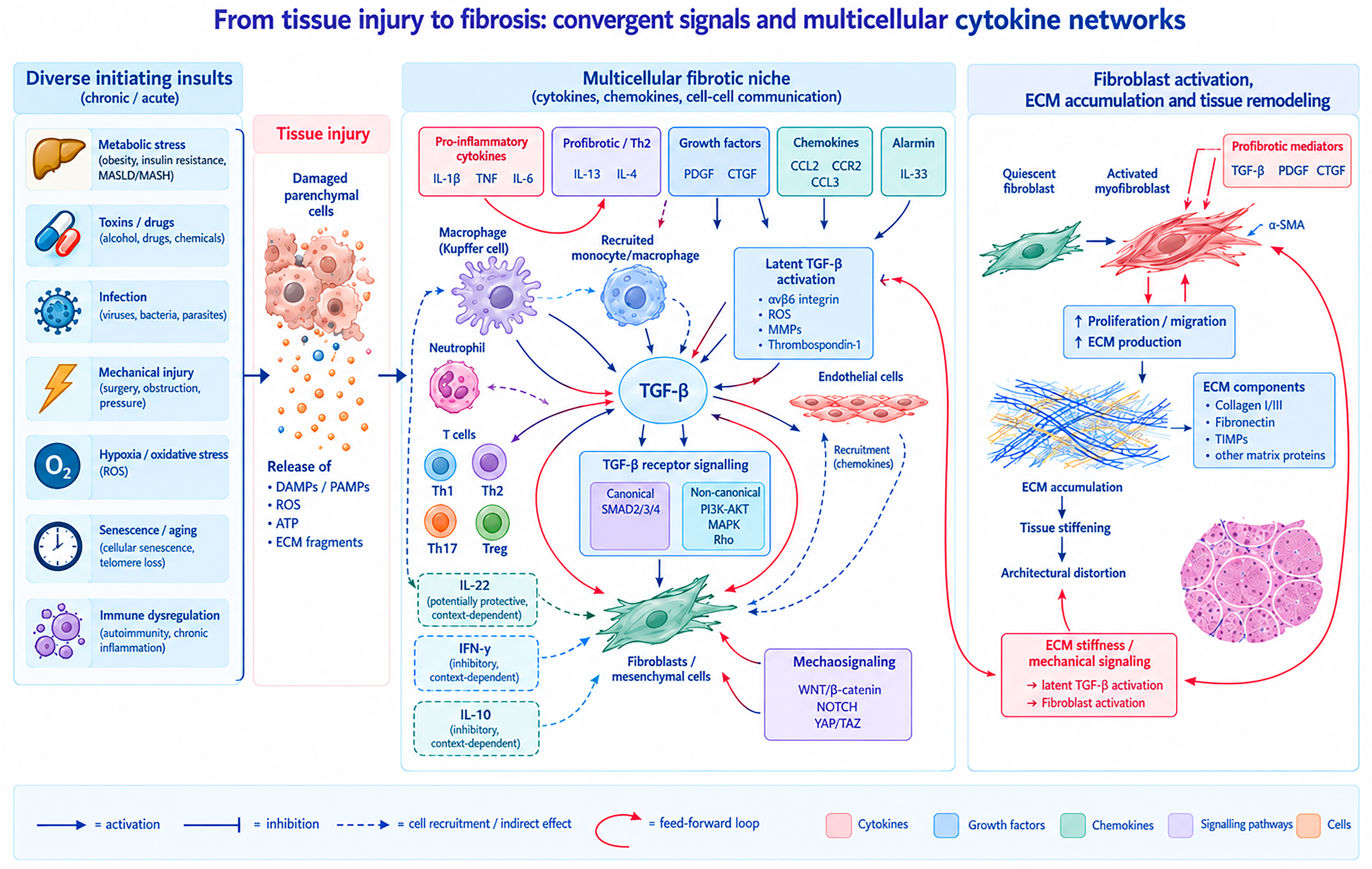
Figure 1. From tissue injury to fibrosis: convergent signals and multicellular cytokine networks. Fibrosis is a dynamic, multicellular process initiated by diverse acute or chronic tissue insults, including metabolic stress, toxins and drugs, infections, mechanical injury, hypoxia, oxidative stress, senescence, and immune dysregulation. Tissue injury induces the release of DAMPs, PAMPs, ROS, ATP, and ECM fragments, triggering inflammatory and fibrogenic responses. The fibrotic niche integrates signals from damaged parenchymal cells, macrophages, recruited monocytes, neutrophils, T-cell subsets, endothelial cells, and fibroblasts. Pro-inflammatory cytokines, including IL-1β, TNF, and IL-6, together with profibrotic Th2 cytokines IL-13 and IL-4, growth factors such as PDGF and CTGF, chemokines, and alarmins, converge on fibroblasts and mesenchymal cells. TGF-β represents a central profibrotic mediator. Its activation from latent complexes involves, among other mechanisms, αvβ6 integrin, ROS, MMPs, and thrombospondin-1. TGF-β receptor signaling proceeds through canonical SMAD2/3/4-dependent and non-canonical PI3K-AKT, MAPK, and Rho pathways. Additional immune mediators, including IL-22, IFN-γ, and IL-10, exert context-dependent effects on fibrogenesis. Fibroblast activation is characterized by increased proliferation, migration, and ECM production, including collagen I/III, fibronectin, TIMPs, and other matrix proteins. Progressive ECM accumulation results in tissue stiffening and architectural distortion. Mechanosensitive pathways, including WNT/β-catenin, NOTCH, and YAP/TAZ, further contribute to fibroblast activation and may promote latent TGF-β activation, thereby establishing self-reinforcing feed-forward loops. The figure illustrates the complex interplay between inflammatory, profibrotic, chemotactic, growth factor, and mechanical signals that drive tissue remodeling and fibrosis. AKT: Protein kinase B; ATP: adenosine triphosphate; α-SMA: α-smooth muscle actin; CCL: CC chemokine ligand; CCR: CC chemokine receptor; CTGF: connective tissue growth factor; DAMPs: damage-associated molecular patterns; ECM: extracellular matrix; IFN-γ: interferon-γ; IL: interleukin; MAPK: mitogen-activated protein kinase; MMPs: matrix metalloproteinases; PAMPs: pathogen-associated molecular patterns; PDGF: platelet-derived growth factor; PI3K: phosphoinositide 3-kinase; ROS: reactive oxygen species; SMAD: small mothers against decapentaplegic; TAZ: transcriptional coactivator with PDZ-binding motif; TGF-β: transforming growth factor-β; Th: T helper; TIMPs: tissue inhibitors of metalloproteinases; TNF: tumor necrosis factor; Treg: regulatory T cell; YAP: Yes-associated protein.