
Volume 1, Issue 2 (2026) – 5 articles
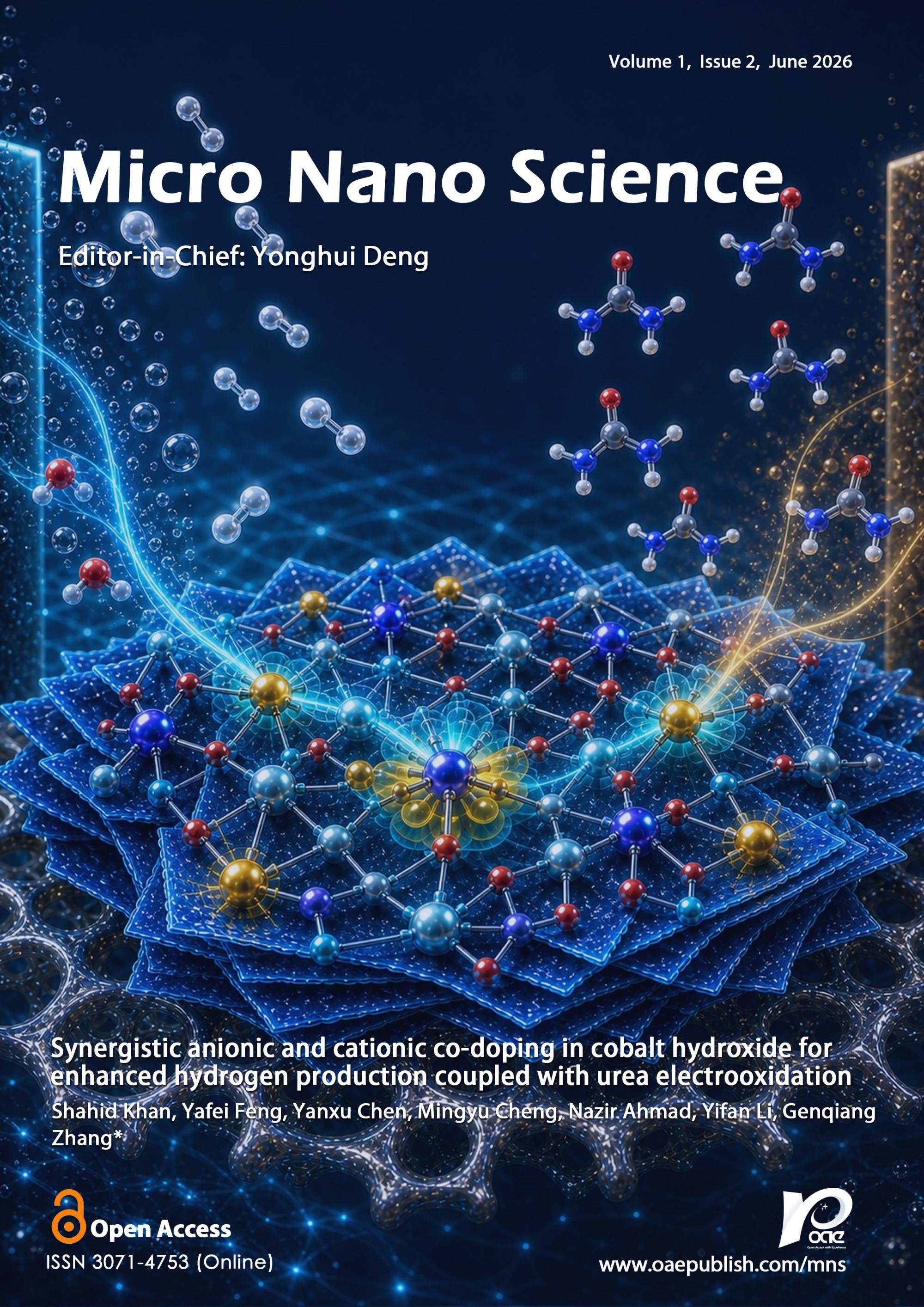
Cover Picture: Urea-assisted electrolysis offers an energy-efficient and sustainable approach to industrial-scale hydrogen generation by reducing cell voltage relative to conventional water electrolysis. However, the design of bifunctional catalysts that deliver high activity and durability for both half-reactions remains a significant challenge. Here, we adjust the electronic structure of cobalt hydroxide via synergistic co-doping with tungsten cations and sulfur anions, optimizing the reaction pathways for hydrogen evolution reaction (HER) and urea oxidation reaction (UOR). Sulfur and tungsten co-doped cobalt hydroxide nanosheet arrays grown directly on Ni foam [S,W-Co(OH)2/NF] were prepared through a scalable one-step electrodeposition method and demonstrate outstanding catalytic performance, delivering HER overpotentials of 70 and 136 mV at current densities of 10 and 100 mA cm-2, respectively, while achieving a UOR current density of 500 mA cm-2 at 1.45 V. In a two-electrode system, the total energy consumption of urea-aided electrolysis is reduced by approximately 23% relative to conventional water electrolysis. Density functional theory (DFT) calculations reveal that dual doping enhances the electronic environment of cobalt active sites and promotes advantageous adsorption of reaction intermediates. This work presents a cost-effective strategy that couples energy-efficient hydrogen production with urea-rich wastewater treatment.
view this paper